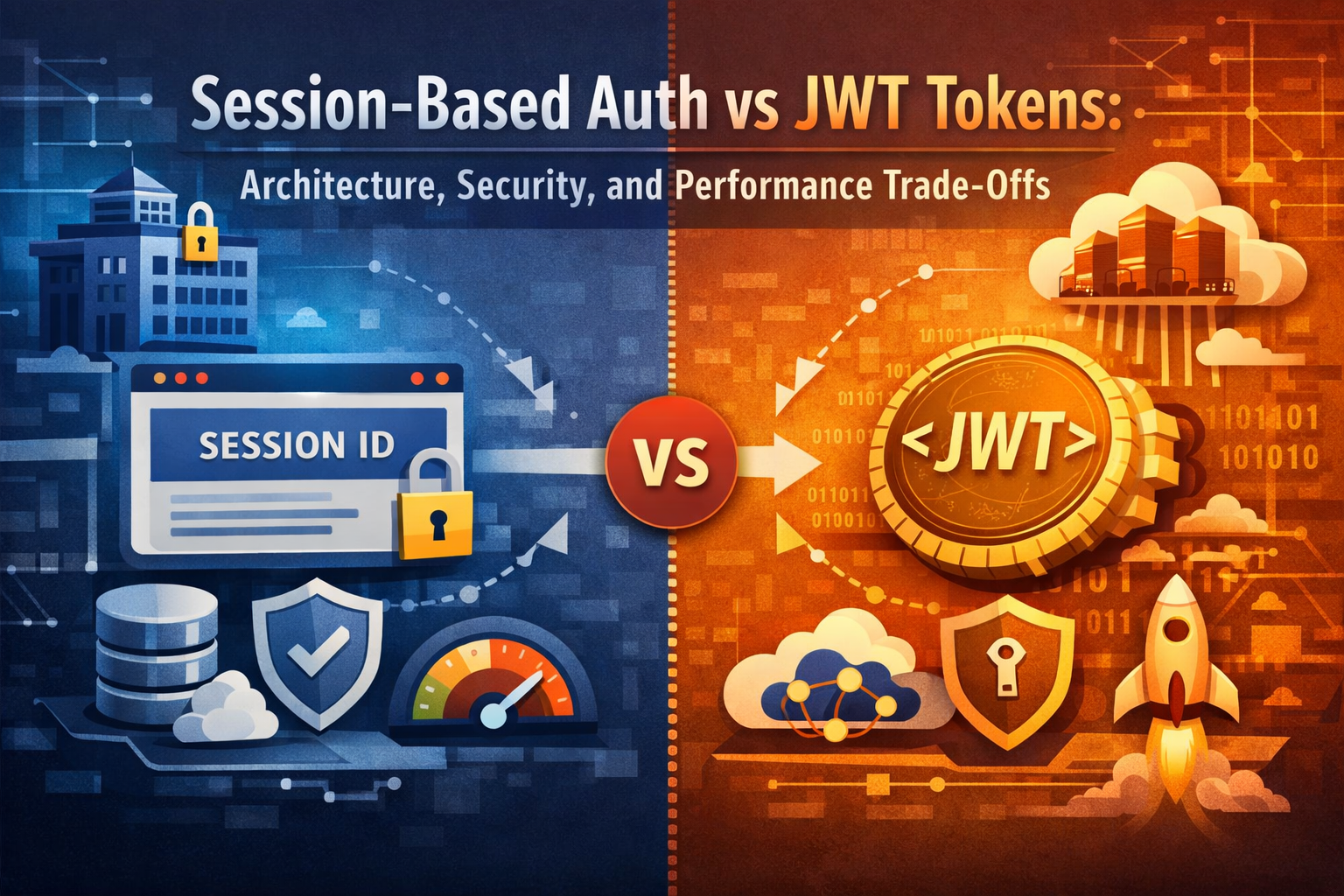
Choosing between session based authentication and JWT tokens is one of the most critical decisions web developers face when building authentication systems. This guide breaks down the key differences in authentication architecture, security considerations, and performance trade-offs to help backend developers, full-stack engineers, and technical leads make informed decisions for their applications.
Who this is for: Developers working on web applications, mobile APIs, or microservices who need to implement robust authentication systems and want to understand when to use session vs JWT approaches.
We’ll compare how session management and token based authentication work under the hood, examine the security implications of each approach including common attack vectors, and analyze performance benchmarks to understand how JWT vs sessions performance differs at scale. You’ll also get a practical decision framework for choosing the right web authentication methods based on your specific use case and scalability requirements.
Understanding Session-Based Authentication Fundamentals

How server-side sessions store user state
Session based authentication relies on the server maintaining a dedicated storage area for each authenticated user. When you log into a web application, the server creates a unique session object that holds your user information, permissions, and any temporary data needed during your browsing session. This session data lives entirely on the server, typically stored in memory, databases like Redis or PostgreSQL, or specialized session stores.
The server assigns each session a unique identifier – usually a long, random string that’s practically impossible to guess. This session ID acts like a claim ticket at a dry cleaner. You present your ticket, and the server looks up which session belongs to you, then retrieves all your associated data. The actual user information never travels back and forth between your browser and the server after the initial authentication.
Popular session storage options include:
- In-memory storage: Fast but lost when server restarts
- Database storage: Persistent but requires database queries
- Redis/Memcached: Fast, persistent, and scalable
- File-based storage: Simple but not suitable for distributed systems
Cookie-based session identifier mechanics
Browsers automatically handle session management through HTTP cookies. After successful authentication, the server sends a “Set-Cookie” header containing the session ID. Your browser stores this cookie and automatically includes it with every subsequent request to the same domain.
The session cookie typically contains just the session identifier – not the actual user data. Here’s what a typical session cookie looks like:
Set-Cookie: sessionid=abc123xyz789; HttpOnly; Secure; SameSite=Strict; Path=/; Max-Age=3600
Key cookie attributes for session management include:
| Attribute | Purpose | Security Benefit |
|---|---|---|
| HttpOnly | Prevents JavaScript access | Protects against XSS attacks |
| Secure | HTTPS-only transmission | Prevents man-in-the-middle attacks |
| SameSite | Controls cross-site requests | Mitigates CSRF vulnerabilities |
| Max-Age | Sets expiration time | Limits session lifespan |
The browser automatically attaches this cookie to every request, making the authentication process seamless for users. The server receives the session ID, looks up the corresponding session data, and processes the request with the appropriate user context.
Session lifecycle management and expiration
Session management involves careful orchestration of creation, maintenance, and destruction phases. When a user logs in successfully, the server generates a new session ID, stores the session data, and sets the session cookie. The session remains active as long as the user continues interacting with the application within the configured timeout period.
Most applications implement sliding expiration, where each user action resets the session timeout. This keeps active users logged in while automatically logging out inactive ones. Fixed expiration provides additional security by forcing re-authentication after a specific time regardless of activity.
Session cleanup happens through multiple mechanisms:
- Automatic expiration: Sessions expire after predetermined timeouts
- Explicit logout: Users can manually end their sessions
- Garbage collection: Server periodically removes expired sessions
- Security events: Sessions terminate after suspicious activity
Web authentication methods using sessions must handle edge cases like concurrent logins, session fixation attacks, and distributed server environments. Proper session storage and cleanup prevent memory leaks and security vulnerabilities while maintaining optimal performance for legitimate users.
JWT Token Architecture and Core Principles

Stateless Token Structure and Payload Composition
JWT tokens follow a three-part structure separated by dots: header.payload.signature. The header contains metadata about the token type and signing algorithm, typically specifying “JWT” as the type and algorithms like RS256 or HS256. The payload section carries the actual claims – pieces of information about the user and their session.
Unlike session based authentication where server-side storage maintains user state, JWT tokens are completely self-contained. The payload includes standard claims like iss (issuer), exp (expiration), iat (issued at), and sub (subject), plus custom claims specific to your application. This stateless authentication approach means servers don’t need to query databases or cache systems to validate user identity.
Each section uses Base64URL encoding, making tokens URL-safe while remaining human-readable when decoded. The compact format typically ranges from 200-1000 characters, depending on payload size. This structure enables distributed systems to validate tokens without centralized session storage, a key advantage over traditional session management.
Digital Signature Verification Process
The signature section provides cryptographic proof that the token hasn’t been tampered with. When using HMAC algorithms, both token creation and verification use the same secret key. The server combines the encoded header and payload, applies the specified hashing algorithm with the secret key, and compares the result against the provided signature.
Public key cryptography (RSA/ECDSA) offers enhanced security by separating signing and verification keys. The authorization server signs tokens with a private key, while resource servers verify using the corresponding public key. This eliminates the need to share sensitive signing keys across multiple services.
The verification process happens on every request without external dependencies. Servers decode the header to determine the algorithm, retrieve the appropriate key (from configuration or a key store), and perform the cryptographic verification. Failed verification immediately rejects the request, making this process crucial for token based authentication security.
Claims-Based Authorization Implementation
Claims represent assertions about the authenticated user embedded directly within the token. Standard claims like sub identify the user, while exp enforces token lifetime. Custom claims carry application-specific data such as user roles, permissions, or organizational membership.
Authorization logic reads these claims to make access decisions without additional database queries. A token might include claims like {"role": "admin", "department": "engineering", "permissions": ["read", "write", "delete"]}, enabling fine-grained access control.
This approach differs significantly from session vs JWT patterns where session-based systems typically store minimal identifiers and fetch authorization data from databases. Claims-based systems trade token size for reduced server-side complexity and improved performance in distributed environments.
Role-based and attribute-based access control both work well with JWT claims. The key consideration involves balancing token size against authorization granularity – more detailed permissions create larger tokens but enable more sophisticated access patterns.
Token Refresh and Rotation Strategies
JWT tokens require careful lifetime management since they can’t be revoked once issued (without additional infrastructure). Short-lived access tokens (15-30 minutes) paired with longer-lived refresh tokens provide a practical solution. When access tokens expire, clients use refresh tokens to obtain new ones without requiring user re-authentication.
Refresh token rotation enhances security by issuing new refresh tokens with each renewal, invalidating the previous ones. This technique limits the impact of token theft and provides audit trails for suspicious activity. Implementation typically involves storing refresh token identifiers server-side, creating a hybrid approach between stateless authentication and session management.
Some organizations implement sliding expiration windows, extending token lifetimes with each successful use. Others prefer fixed expiration times for predictable security boundaries. The choice depends on your application’s security requirements and user experience goals.
Blacklisting provides another strategy for handling compromised tokens, though it requires server-side storage and somewhat contradicts the stateless nature of JWT tokens. Many teams implement lightweight blacklists storing only token identifiers rather than full session data, maintaining some benefits of the JWT architecture while enabling token revocation when necessary.
Security Implications and Attack Vector Analysis

Session Hijacking and CSRF Vulnerabilities in Session Auth
Session-based authentication faces two primary security threats that developers must address. Session hijacking occurs when attackers steal session IDs through various methods like network sniffing, cross-site scripting, or malware. Since session IDs are typically stored in cookies, they’re vulnerable to interception during transmission or extraction from the browser.
Cross-Site Request Forgery (CSRF) attacks exploit the automatic cookie transmission behavior of browsers. When users visit malicious websites while authenticated to your application, attackers can trigger unauthorized actions using the victim’s valid session cookie. This happens because browsers automatically include cookies in requests to the original domain.
Common Attack Scenarios:
- Network-based interception: Unsecured WiFi networks allowing session ID capture
- XSS-enabled session theft: Malicious scripts extracting session cookies
- CSRF exploitation: Unauthorized state-changing operations through forged requests
- Session fixation: Attackers forcing users to use predetermined session IDs
Mitigation strategies include implementing CSRF tokens, using secure cookie flags, rotating session IDs after authentication, and enforcing proper session timeout policies.
JWT Token Exposure and XSS Attack Risks
JWT tokens carry different security challenges compared to session management. Since JWTs contain encoded payload data, token exposure can reveal sensitive user information. The stateless nature of JWT tokens means revocation becomes complex – compromised tokens remain valid until expiration.
Cross-site scripting attacks pose significant risks to JWT token based authentication. When JWTs are stored in browser localStorage or sessionStorage, malicious scripts can easily access and exfiltrate these tokens. Unlike cookies with httpOnly flags, JavaScript storage mechanisms offer no built-in XSS protection.
JWT-Specific Vulnerabilities:
- Token replay attacks: Stolen tokens used for unauthorized access
- Information disclosure: Sensitive data exposed through token payload
- Algorithm manipulation: Attackers modifying token headers to bypass verification
- Weak secret keys: Brute force attacks against poorly chosen signing secrets
The lack of server-side token tracking in stateless JWT implementations makes detecting and preventing token abuse challenging.
Secure Storage Options for Both Approaches
Storage security differs significantly between session based authentication and JWT tokens. Each approach requires specific protective measures to maintain security integrity.
Session Storage Security:
| Storage Method | Security Level | Recommended Settings |
|---|---|---|
| Server-side sessions | High | Encrypted storage, secure session stores |
| Database sessions | High | Proper database security, encrypted connections |
| In-memory sessions | Medium | Process isolation, memory protection |
JWT Storage Security:
| Storage Location | Security Risk | Best Practices |
|---|---|---|
| localStorage | High XSS risk | Avoid for sensitive applications |
| sessionStorage | High XSS risk | Limited session lifetime only |
| httpOnly cookies | Low XSS risk | Secure flag, SameSite attribute |
| Memory (JavaScript) | Medium risk | Automatic cleanup on page refresh |
Secure cookie implementation for both approaches requires setting appropriate flags: Secure for HTTPS-only transmission, HttpOnly to prevent JavaScript access, and SameSite to limit cross-origin requests.
HTTPS Requirements and Transport Security
Both session management and token based authentication demand HTTPS implementation for production environments. Transport Layer Security protects authentication credentials during transmission and prevents man-in-the-middle attacks.
Critical HTTPS Configurations:
- TLS version requirements: Minimum TLS 1.2, preferably TLS 1.3
- Certificate validation: Proper SSL/TLS certificate management
- HSTS headers: HTTP Strict Transport Security enforcement
- Mixed content prevention: All resources served over HTTPS
Session-based authentication relies heavily on HTTPS because session IDs transmitted in plain text become immediately exploitable. JWT tokens face similar risks – stolen tokens provide full authentication capabilities regardless of the authentication method used.
Web security tokens require additional protection through proper Content Security Policy headers, preventing unauthorized script execution that could compromise authentication mechanisms. Regular security audits help identify potential vulnerabilities in both authentication architectures before attackers can exploit them.
Performance Benchmarks and Scalability Factors

Database Load Comparison for Session Storage
Session-based authentication puts significant pressure on your database infrastructure. Every user login creates a new session record, and each subsequent request triggers a database lookup to validate the session. This creates a constant stream of read operations that can quickly overwhelm your database as user traffic scales.
The numbers tell the story clearly. A typical web application with 10,000 active users might generate 50,000-100,000 session validation queries per minute during peak hours. Each query requires:
- Primary key lookup on the sessions table
- Timestamp comparison for expiration checking
- Potential user data joins for authorization
- Write operations for session updates
JWT tokens eliminate this database dependency entirely. Token validation happens in-memory using cryptographic signatures, removing the need for database lookups during authentication checks. This architectural difference becomes critical when scaling beyond a few thousand concurrent users.
Database Operations Comparison:
| Authentication Method | Read Operations/Request | Write Operations | Storage Requirements |
|---|---|---|---|
| Session-based | 1-3 queries | 0.2-0.5 queries | Growing session table |
| JWT tokens | 0 queries | 0 queries | Static configuration |
Session cleanup adds another layer of complexity. Expired sessions accumulate rapidly, requiring scheduled cleanup jobs that can lock tables and impact performance during maintenance windows.
Network Overhead Analysis for Token Transmission
JWT tokens carry their authentication payload with every request, creating measurable network overhead compared to lightweight session cookies. A typical JWT token ranges from 200-800 bytes, while session cookies usually weigh in at 20-50 bytes.
This size difference compounds quickly across high-traffic applications. Consider an API serving 1 million requests daily – the additional bandwidth consumption from JWT tokens can reach several gigabytes monthly. For mobile applications or users on slower connections, this overhead directly impacts user experience.
Token Size Breakdown:
- Header: ~36 bytes (base64 encoded)
- Payload: 100-500 bytes (varies by claims)
- Signature: ~43 bytes (RS256)
- Encoding overhead: ~33% increase
However, JWT’s stateless nature eliminates the need for server-side session synchronization across distributed systems. This trade-off often favors JWT tokens in microservices architectures where inter-service communication would otherwise require complex session sharing mechanisms.
The network overhead becomes less significant when using refresh token patterns or implementing token compression strategies for large payloads.
Horizontal Scaling Capabilities Assessment
Session-based authentication creates sticky session problems that complicate horizontal scaling. When users authenticate against one server, their session data lives on that specific instance. Load balancers must route subsequent requests back to the same server, creating uneven distribution and potential single points of failure.
Traditional solutions include:
- Sticky sessions: Routes users to specific servers
- Session replication: Copies session data across all servers
- Centralized session storage: Redis or database-backed sessions
Each approach introduces complexity and performance penalties. Sticky sessions reduce load balancing effectiveness, session replication multiplies memory usage across instances, and centralized storage creates a bottleneck.
JWT tokens solve this elegantly through their stateless design. Any server can validate any token without external dependencies. This enables true horizontal scaling where:
- Load balancers can route requests to any available server
- New servers can join the cluster instantly without synchronization
- Failed servers don’t lose session state
- Auto-scaling responds faster to traffic spikes
Scaling Comparison:
| Factor | Session-Based | JWT Tokens |
|---|---|---|
| Server independence | Requires coordination | Fully independent |
| Load balancer complexity | High (sticky sessions) | Low (round-robin) |
| Failover recovery | Data loss risk | Seamless |
| Auto-scaling speed | Slow (sync required) | Instant |
Caching Strategies and Memory Consumption
Session storage demands significant memory allocation and sophisticated caching strategies. Active sessions consume server RAM, and session data often includes user preferences, shopping cart contents, and authorization details. A single session might consume 1-10KB of memory, multiplied across thousands of concurrent users.
Popular caching approaches for sessions include:
In-Memory Caching:
- Fastest access times (sub-millisecond)
- Limited by server RAM capacity
- Data loss during server restarts
- Complex synchronization across instances
Redis/Memcached:
- Dedicated caching infrastructure
- Network latency for each lookup
- Additional operational complexity
- Built-in expiration and persistence options
JWT token validation requires minimal memory overhead. The server stores only the signing keys and validation logic in memory. Token processing uses CPU cycles for cryptographic operations rather than memory for data storage.
Memory Usage Patterns:
| Component | Session-Based | JWT Tokens |
|---|---|---|
| Per-user overhead | 1-10KB active storage | 0KB server storage |
| Base infrastructure | Session store + cache | Signing keys only |
| Memory growth pattern | Linear with users | Constant |
| Cache invalidation | Complex expiration rules | Not required |
The memory consumption difference becomes dramatic at scale. An application with 50,000 concurrent users might require 500MB-5GB for session storage, while JWT validation consumes under 10MB regardless of user count.
However, JWT tokens push memory requirements to client devices. Mobile applications must store and manage tokens locally, though this distributed approach often proves more efficient than centralized session management for large-scale applications.
Implementation Complexity and Developer Experience

Server-side session management requirements
Session-based authentication creates a significant server-side footprint that developers must carefully architect and maintain. When implementing session management, you need dedicated infrastructure to store session data, whether that’s in-memory storage, Redis clusters, or database tables. This storage layer becomes a critical dependency that requires monitoring, backup strategies, and careful capacity planning.
Session cleanup presents another layer of complexity. Without proper garbage collection, expired sessions accumulate and consume valuable resources. Most applications need background processes to purge stale sessions, adding operational overhead to your deployment pipeline. Memory-based session stores face additional challenges around persistence and recovery after server restarts.
Load balancing introduces sticky session requirements or session replication across multiple servers. When users can hit different application instances, you need mechanisms to share session state. This typically means implementing session clustering, database-backed storage, or forcing users to specific servers – each approach brings trade-offs in performance and complexity.
Database-backed sessions offer persistence but introduce latency for every request validation. Redis or Memcached provide faster access but require additional infrastructure components. The choice impacts not only performance but also your disaster recovery and scaling strategies.
Client-side token handling and storage decisions
JWT implementation pushes authentication complexity to the client side, where developers face critical security decisions around token storage and handling. Browser storage options each carry distinct security implications that directly impact your application’s vulnerability profile.
LocalStorage provides persistent token storage but exposes JWT tokens to XSS attacks. Any malicious script injection can access and exfiltrate stored tokens. SessionStorage offers slightly better protection by clearing tokens when browser tabs close, but still remains vulnerable to cross-site scripting exploits.
HttpOnly cookies represent the most secure storage mechanism, preventing JavaScript access while maintaining automatic transmission to servers. However, they reintroduce CSRF vulnerability concerns and require additional protection mechanisms like SameSite attributes and CSRF tokens.
Token refresh logic adds another implementation layer. Applications need robust error handling for expired tokens, automatic refresh flows, and fallback mechanisms when refresh tokens themselves expire. This client-side orchestration becomes particularly complex in single-page applications where multiple components might simultaneously discover token expiration.
Mobile applications face additional challenges around secure storage. iOS Keychain and Android Keystore provide hardware-backed security, but implementation requires platform-specific code and careful key management strategies.
Cross-domain and microservices compatibility
JWT tokens excel in distributed architectures where session-based authentication becomes increasingly problematic. Cross-domain requests with sessions require careful CORS configuration and often resort to complex workarounds like JSONP or server-side proxying.
Microservices architectures highlight session authentication’s limitations. Each service would need access to centralized session storage, creating tight coupling and potential bottlenecks. Session replication across multiple services becomes a coordination nightmare, especially when services are owned by different teams or deployed independently.
JWT’s stateless nature allows services to validate tokens independently without external dependencies. Services only need access to public keys or shared secrets to verify token authenticity. This independence simplifies deployment pipelines and reduces inter-service communication overhead.
However, token-based systems face their own microservices challenges. Token revocation becomes complex without centralized state management. When users need immediate access termination, services must implement token blacklisting or short expiration times with frequent refresh cycles.
API gateways often bridge this gap by centralizing authentication decisions while maintaining stateless service communication. The gateway validates sessions or tokens and passes authenticated context to downstream services through headers or modified tokens.
Cross-platform compatibility favors JWT implementation. Mobile apps, web applications, and third-party integrations can all consume the same token format without requiring different authentication flows. Session-based approaches typically need separate authentication endpoints for different client types, increasing maintenance complexity and potential security inconsistencies.
Real-World Use Cases and Decision Framework

Optimal scenarios for session-based authentication
Session-based authentication works best when you’re building traditional web applications where users primarily interact through web browsers. E-commerce platforms benefit significantly from this approach since shopping carts and user preferences need to persist throughout browsing sessions. The server-side session storage makes it easy to track complex user states without exposing sensitive data to the client.
Corporate intranets and internal tools represent another sweet spot for session based authentication. These environments typically have controlled access patterns, predictable user loads, and centralized infrastructure where session storage doesn’t create scaling bottlenecks. Banks and financial institutions often prefer sessions because they can implement immediate session invalidation for security purposes.
Content management systems and admin dashboards work exceptionally well with sessions. These applications require fine-grained permission controls that can be efficiently managed server-side. The ability to instantly revoke access by destroying sessions provides crucial security benefits for administrative interfaces.
| Use Case | Session Advantage | Key Benefit |
|---|---|---|
| E-commerce | Server-side cart storage | Data persistence without client exposure |
| Corporate intranet | Centralized user management | Immediate access control |
| Banking applications | Instant session termination | Enhanced security compliance |
| CMS platforms | Complex permission handling | Fine-grained access control |
JWT token advantages in distributed systems
Distributed architectures shine with JWT tokens because of their stateless nature. Microservices can independently verify tokens without coordinating with a central session store, eliminating single points of failure and reducing network latency. Each service validates tokens using shared cryptographic keys, enabling true horizontal scaling.
Mobile applications gain tremendous flexibility with JWT implementation. Tokens work seamlessly across different platforms and can handle intermittent connectivity gracefully. Unlike sessions that require constant server communication, JWT tokens allow offline functionality where apps can continue operating using cached, valid tokens.
API-first architectures find JWT tokens particularly valuable. Third-party integrations become straightforward when external services can authenticate using self-contained tokens. The stateless authentication enables clean API design without complex session management across different client applications.
Cloud-native applications leverage JWT tokens for cross-region deployments. Load balancers can route requests to any available server without worrying about session affinity. This flexibility reduces infrastructure complexity and improves fault tolerance across distributed environments.
Hybrid approaches and best practices
Smart teams often combine both authentication methods to maximize benefits while minimizing drawbacks. A common pattern uses JWT tokens for API authentication while maintaining sessions for web interface interactions. This approach provides API flexibility without sacrificing web user experience.
Short-lived access tokens paired with longer-lived refresh tokens create an effective hybrid system. The access token enables stateless authentication, while the refresh token (often stored server-side) provides revocation capabilities. This pattern delivers JWT scalability with session-like security controls.
**Hybrid Architecture Pattern:**
- Access Token (JWT): 15-30 minutes lifespan
- Refresh Token: Server-stored, 7-30 days
- Session Storage: Critical user preferences only
- Token Storage: Secure HTTP-only cookies
Geographic distribution often drives hybrid implementations. Regional servers can validate JWT tokens locally while maintaining centralized session stores for critical operations. This setup reduces latency for routine operations while preserving centralized control for sensitive actions.
Progressive web applications benefit from layered authentication where JWT tokens handle background sync operations while sessions manage active user interactions. This dual approach optimizes both online and offline user experiences.
Migration strategies between authentication methods
Moving from session based authentication to JWT tokens requires careful planning to avoid user disruption. The most effective approach involves running both systems in parallel during transition periods. Existing sessions continue working while new logins receive JWT tokens, allowing gradual user migration.
Database schema changes need coordination with application updates. Session tables can be gradually phased out while token validation logic gets introduced. Consider maintaining session fallback capabilities during initial JWT rollout phases to handle edge cases and provide rollback options.
Client-side applications require updates to handle token storage and renewal logic. Browser applications need secure cookie handling or localStorage management, while mobile apps must implement token refresh flows. Staggered client updates prevent overwhelming support teams with simultaneous changes.
Security audits become crucial during authentication transitions. Token signing keys need secure generation and distribution across services. Session invalidation procedures must work alongside token revocation systems. Regular security reviews ensure no gaps emerge between old and new authentication flows.
| Migration Phase | Duration | Key Activities | Risk Level |
|---|---|---|---|
| Preparation | 2-4 weeks | Schema design, key generation | Low |
| Parallel running | 4-8 weeks | Dual authentication support | Medium |
| Gradual migration | 6-12 weeks | User transition, monitoring | High |
| Cleanup | 2-4 weeks | Legacy system removal | Low |
Performance monitoring throughout migration reveals bottlenecks and optimization opportunities. Token validation times, session lookup performance, and overall authentication latency need continuous tracking. User experience metrics help identify issues before they impact broader user bases.

Both session-based authentication and JWT tokens bring unique strengths to the table, but your choice depends on your specific needs and constraints. Session-based auth shines when you need tight security controls and server-side session management, making it perfect for traditional web applications with centralized architectures. JWT tokens, on the other hand, excel in distributed systems, microservices, and mobile applications where stateless authentication and cross-domain capabilities matter most.
The decision comes down to weighing your priorities: security control versus scalability, server resources versus network overhead, and implementation simplicity versus flexibility. Consider your team’s expertise, your application’s architecture, and your long-term scaling plans. Don’t feel locked into one approach either – many modern applications successfully combine both methods, using sessions for sensitive operations and JWTs for API access. Start with what fits your current needs best, then evolve your authentication strategy as your application grows and requirements change.