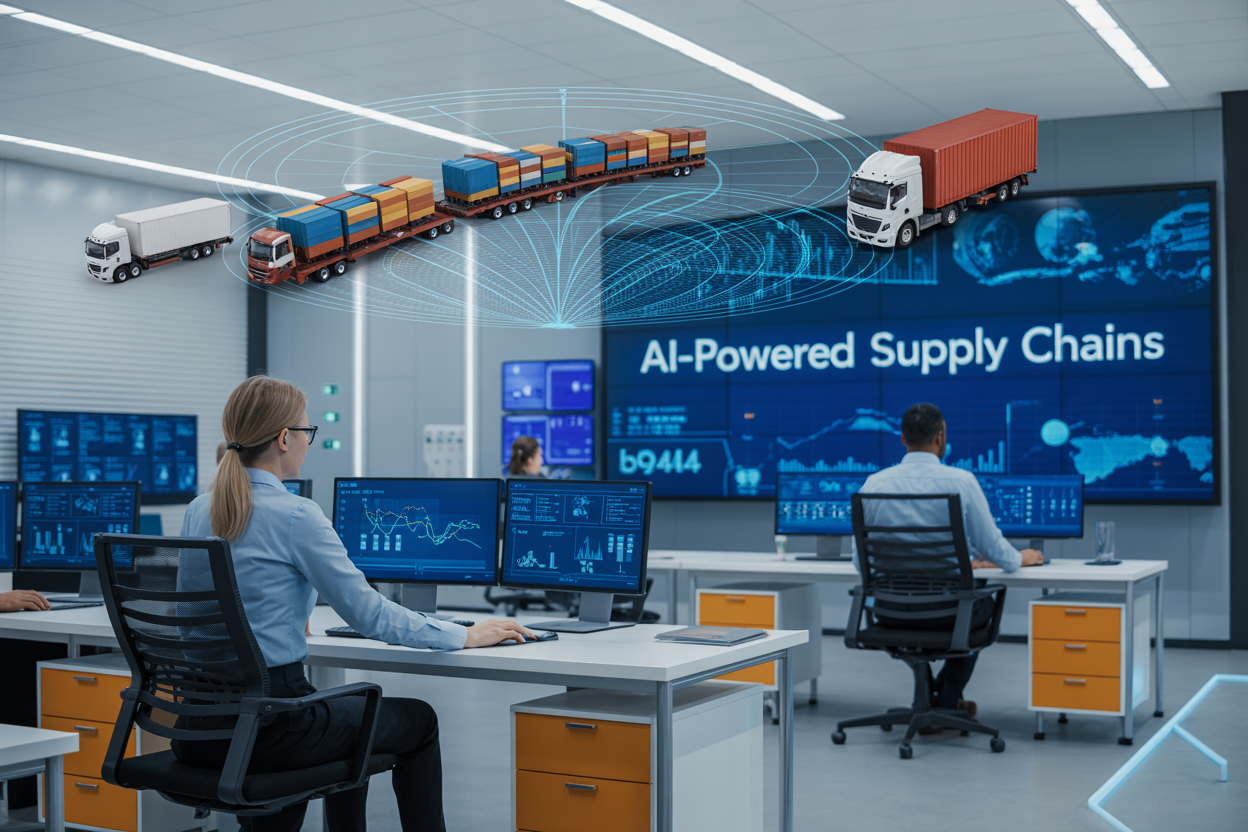
Supply chains are getting a major upgrade thanks to AI and generative AI technologies that are reshaping how businesses predict demand, plan routes, and bounce back from disruptions. This guide is written for supply chain managers, logistics directors, and business leaders who want to understand how AI supply chain transformation can drive real results in their operations.
Modern AI-powered supply chain management goes beyond basic automation. Machine learning algorithms now analyze massive datasets to spot patterns humans miss, while generative AI creates new solutions for complex logistics challenges. Companies using these technologies report significant improvements in accuracy, efficiency, and cost savings across their entire supply chain network.
We’ll explore how intelligent demand forecasting helps businesses predict what customers want before they know it themselves, reducing waste and stockouts. You’ll also discover how AI route optimization cuts delivery times and fuel costs by finding the smartest paths through complex transportation networks. Finally, we’ll cover how predictive analytics supply chain tools help companies build stronger defenses against unexpected disruptions, creating supply chain resilience technology that keeps operations running smoothly even when things go wrong.
Understanding AI and Generative AI in Modern Supply Chain Management

Key differences between traditional AI and generative AI applications
Traditional AI in supply chain operations focuses on analyzing historical data patterns to make predictions and automate routine decisions. Think of it as the smart calculator that looks at your past inventory levels, seasonal trends, and sales data to predict how much product you’ll need next quarter. These systems excel at classification tasks, like identifying which shipments might be delayed based on weather patterns or determining optimal warehouse locations.
Generative AI supply chain transformation takes this several steps further by creating entirely new solutions and scenarios. Instead of just analyzing what happened before, generative AI can simulate thousands of “what-if” scenarios, generate alternative routing strategies on the fly, and even create synthetic data to test supply chain resilience under conditions that have never occurred. For instance, while traditional AI might predict a 15% increase in demand for winter coats, generative AI can model how your entire supply network would respond to that increase across multiple scenarios – from supplier disruptions to transportation bottlenecks.
| Traditional AI | Generative AI |
|---|---|
| Analyzes historical patterns | Creates new scenarios and solutions |
| Reactive decision-making | Proactive strategy generation |
| Fixed model outputs | Dynamic, creative problem-solving |
| Rule-based automation | Contextual adaptation |
The real game-changer lies in generative AI’s ability to understand context and create human-like explanations for its recommendations. When your AI-powered supply chain management system suggests rerouting a shipment, generative AI can explain the reasoning in plain English and even generate alternative options with their respective trade-offs.
Real-world implementation scenarios across industry verticals
Automotive manufacturers are leveraging AI supply chain transformation to manage their complex multi-tier supplier networks. Toyota’s production system now incorporates machine learning logistics optimization to predict component failures before they happen, automatically triggering orders from backup suppliers. The system analyzes vibration patterns, temperature data, and usage statistics from thousands of vehicles to forecast when specific parts across their supply chain will need replacement.
Retail giants like Walmart deploy intelligent demand forecasting across their 10,000+ stores worldwide. Their AI systems process everything from local weather forecasts and social media trends to economic indicators and competitor pricing. During Hurricane Harvey, their predictive analytics supply chain automatically increased orders for emergency supplies like flashlights and bottled water to affected regions 48 hours before traditional demand signals would have triggered restocking.
Pharmaceutical companies face unique challenges with temperature-sensitive products and strict regulatory requirements. Pfizer uses AI route optimization to ensure vaccines and biologics maintain cold chain integrity while minimizing transportation costs. Their system continuously monitors real-time temperature data, traffic conditions, and regulatory checkpoint delays across global distribution networks.
Food and beverage companies deal with highly perishable inventory and unpredictable consumer preferences. Nestlé’s supply chain resilience technology processes social media sentiment, seasonal eating patterns, and local event calendars to predict demand spikes for specific products. Their system even accounts for viral TikTok recipes that might suddenly boost demand for certain ingredients.
Manufacturing sectors with just-in-time production rely heavily on supplier reliability predictions. General Electric’s aviation division uses AI to monitor their global supplier network health, analyzing financial stability indicators, production capacity reports, and geopolitical risk factors to prevent disruptions before they impact aircraft production schedules.
Cost-benefit analysis of AI adoption in supply chain operations
Initial investment costs for comprehensive AI supply chain transformation typically range from $500,000 for mid-sized companies to $10 million for large enterprises. These figures include software licensing, hardware infrastructure, data integration, and staff training. However, the AI supply chain ROI often becomes visible within 12-18 months through multiple value streams.
Inventory optimization alone generates substantial savings. Companies implementing intelligent demand forecasting report 20-30% reductions in excess inventory while maintaining 99%+ service levels. A mid-sized electronics retailer saved $2.3 million annually by reducing safety stock requirements through more accurate demand predictions.
Transportation and logistics costs see immediate impact from AI route optimization. FedEx reports 10-15% fuel savings and 25% improvement in delivery time accuracy after implementing machine learning logistics optimization across their ground network. These improvements translate to roughly $1.2 billion in annual cost savings across their operations.
Key financial benefits include:
- Inventory carrying costs: 15-25% reduction
- Transportation expenses: 10-20% decrease
- Labor productivity: 30-40% improvement
- Customer service levels: 95%+ order accuracy
- Demand forecast accuracy: 85-95% vs. 60-70% traditional methods
Risk mitigation provides harder-to-quantify but equally valuable returns. Companies with AI-powered supply chain management experienced 60% faster recovery times during COVID-19 disruptions compared to those relying on manual processes. The ability to quickly pivot suppliers, reroute shipments, and adjust production schedules prevented millions in potential losses.
Ongoing operational costs include system maintenance (typically 15-20% of initial investment annually), continuous training data, and specialized personnel. However, most organizations find that productivity gains and cost savings far exceed these maintenance expenses, with typical payback periods ranging from 18-36 months depending on implementation scope and industry complexity.
Revolutionizing Demand Forecasting Through Intelligent Predictions

Machine Learning Algorithms for Accurate Demand Pattern Recognition
Machine learning algorithms have completely changed how businesses predict what customers want and when they’ll want it. These sophisticated systems analyze massive amounts of historical sales data, seasonal trends, and customer behavior patterns to spot connections that human analysts might miss completely.
Traditional forecasting methods relied heavily on basic statistical models that often fell short when market conditions shifted unexpectedly. Today’s AI supply chain transformation leverages algorithms like neural networks, random forests, and gradient boosting machines to identify complex patterns across multiple variables simultaneously. These systems excel at recognizing subtle signals – like how weather patterns influence ice cream sales or how social media trends drive fashion demands.
The real power comes from continuous learning capabilities. Every new data point refines the algorithm’s understanding, making predictions more accurate over time. Companies using intelligent demand forecasting report accuracy improvements of 20-50% compared to traditional methods, translating directly into better inventory management and reduced stockouts.
Generative AI Models Creating Multiple Forecasting Scenarios
Generative AI takes demand prediction to another level by creating comprehensive scenario planning capabilities. Instead of producing a single forecast, these models generate multiple potential futures based on different assumptions and market conditions.
Think of it as having thousands of expert analysts working around the clock, each exploring different “what-if” scenarios. Generative AI logistics systems can simulate outcomes for various situations: economic downturns, supply disruptions, competitive launches, or seasonal variations. This scenario-based approach gives supply chain managers a range of possibilities rather than betting everything on one prediction.
These models use techniques like Monte Carlo simulations and variational autoencoders to generate realistic demand scenarios. Each scenario comes with probability weights, helping decision-makers understand not just what might happen, but how likely each outcome is. This probabilistic approach enables more sophisticated inventory strategies and risk management.
Reducing Inventory Costs While Improving Customer Satisfaction
The sweet spot in AI-powered supply chain management lies in balancing inventory costs with service levels. Traditional approaches often forced companies to choose between carrying excess inventory (high costs) or risking stockouts (unhappy customers). AI eliminates this false choice.
Smart algorithms optimize inventory levels by predicting demand with unprecedented precision. They factor in lead times, supplier reliability, and demand variability to determine optimal stock levels for each product and location. This dynamic approach adjusts automatically as conditions change.
Supply chain forecasting AI enables strategies like:
- Dynamic safety stock optimization based on real-time demand signals
- Automated reorder points that adjust for seasonal patterns
- Product substitution recommendations during shortages
- Coordinated inventory positioning across multiple locations
Companies implementing these systems typically see 15-30% reductions in inventory holding costs while maintaining or improving fill rates. The AI continuously monitors performance and adjusts parameters to maintain this balance.
Integration with External Data Sources for Enhanced Accuracy
Modern predictive analytics supply chain systems don’t operate in isolation. They integrate dozens of external data sources to create a comprehensive view of factors influencing demand. Weather data, economic indicators, social media sentiment, competitor pricing, and even satellite imagery all contribute to more accurate predictions.
Real-time data integration allows these systems to respond quickly to changing conditions. If a weather system threatens crop yields, the AI immediately adjusts forecasts for affected products. Social media buzz around a product launch triggers automatic inventory repositioning to capitalize on expected demand spikes.
| Data Source Type | Impact on Forecasting | Update Frequency |
|---|---|---|
| Weather Data | High for seasonal products | Hourly |
| Economic Indicators | Medium for luxury goods | Weekly/Monthly |
| Social Media | High for trending items | Real-time |
| Competitor Pricing | Medium for price-sensitive products | Daily |
| Promotional Calendars | High for all categories | As scheduled |
The key to successful integration lies in data quality and relevance scoring. AI systems learn which external signals provide the most predictive value for specific products and markets, focusing computational resources on the most impactful data sources. This selective approach prevents information overload while maximizing forecast accuracy improvements.
Optimizing Logistics and Route Planning with AI-Powered Solutions

Dynamic Route Optimization Responding to Real-Time Conditions
Modern AI route optimization systems transform logistics operations by processing thousands of data points every second. These systems analyze traffic patterns, weather conditions, vehicle capacity, and driver schedules to create optimal routes that adapt instantly to changing circumstances. When a traffic accident blocks a major highway, AI route optimization algorithms immediately recalculate alternative paths, minimizing delays and maintaining delivery schedules.
Machine learning models continuously learn from historical data and real-time inputs, improving their prediction accuracy over time. Advanced systems integrate GPS tracking, telematics data, and external APIs to monitor road conditions, construction zones, and even local events that might affect delivery routes. This AI-powered supply chain management approach reduces delivery times by up to 25% while cutting operational costs significantly.
The technology goes beyond simple navigation by considering customer preferences, delivery time windows, and vehicle-specific constraints. Smart routing platforms can prioritize urgent shipments, accommodate last-minute changes, and optimize driver breaks to comply with regulations while maximizing efficiency.
Multi-Modal Transportation Planning for Complex Supply Networks
AI supply chain transformation extends to coordinating multiple transportation modes seamlessly. Advanced algorithms evaluate combinations of trucks, trains, ships, and aircraft to determine the most cost-effective and time-efficient shipping methods for each leg of the journey.
These systems analyze factors including:
- Transit times across different modes
- Loading and unloading capacities
- Weather-related delays
- Fuel costs and port fees
- Customs and regulatory requirements
Machine learning logistics optimization platforms create sophisticated models that balance speed, cost, and reliability across complex global networks. They can automatically switch transportation modes when disruptions occur, such as port closures or rail strikes, ensuring cargo keeps moving toward its destination.
The technology also optimizes container loading and scheduling across different carriers, reducing empty miles and improving asset utilization. Smart consolidation algorithms group shipments heading to similar destinations, maximizing vehicle capacity while minimizing handling costs.
Fuel Cost Reduction and Carbon Footprint Minimization
AI-driven logistics solutions deliver substantial environmental and financial benefits through intelligent fuel management. These systems analyze vehicle performance data, route elevation changes, traffic patterns, and driver behavior to minimize fuel consumption without compromising delivery schedules.
Predictive analytics identify the most fuel-efficient routes by considering factors like:
- Real-time traffic density
- Road grade and terrain
- Vehicle load weight
- Weather conditions affecting fuel efficiency
Generative AI logistics platforms can simulate thousands of routing scenarios to identify opportunities for carbon footprint reduction. They optimize delivery schedules to avoid peak traffic hours, reducing idle time and emissions. Some systems even coordinate with electric vehicle charging networks to plan routes around charging station availability and optimal charging times.
Fleet managers gain detailed insights into fuel consumption patterns, enabling them to implement driver training programs and vehicle maintenance schedules that further improve efficiency. The technology also supports sustainable logistics strategies by prioritizing eco-friendly transportation options when multiple viable routes exist.
Automated Scheduling and Load Balancing Capabilities
Smart scheduling systems revolutionize how companies manage complex logistics operations by automatically coordinating thousands of moving parts. These platforms balance driver schedules, vehicle availability, warehouse capacity, and customer delivery windows to create optimal operational plans.
AI algorithms continuously monitor and adjust schedules based on:
- Driver hours of service regulations
- Vehicle maintenance requirements
- Warehouse staffing levels
- Customer priority levels
- Seasonal demand fluctuations
Predictive analytics supply chain systems anticipate potential bottlenecks before they occur, automatically redistributing workloads to prevent delays. They can reschedule deliveries when drivers approach regulatory hour limits or redirect shipments when warehouses reach capacity constraints.
Load balancing technology ensures optimal vehicle utilization by analyzing package dimensions, weight distribution, and delivery destinations. Smart consolidation algorithms group compatible shipments, reducing the total number of vehicles needed while maintaining service quality. These systems also coordinate with warehouse management platforms to optimize loading sequences, reducing handling time and improving delivery efficiency.
The automation extends to exception handling, where AI systems automatically respond to common disruptions like vehicle breakdowns or driver absences by reassigning tasks and updating delivery schedules without human intervention.
Building Unbreakable Supply Chain Resilience Through AI Innovation

Predictive risk assessment and early warning systems
Modern supply chain resilience technology transforms how companies anticipate and prepare for potential disruptions. AI-powered predictive risk assessment systems continuously monitor thousands of variables across global supply networks, from weather patterns and geopolitical tensions to supplier financial health and transportation capacity. These intelligent systems process real-time data streams, identifying subtle patterns that human analysts might miss.
Machine learning algorithms excel at detecting early warning signals by analyzing historical disruption data and current market conditions. When a supplier shows signs of financial distress or a shipping route faces emerging risks, the system triggers automated alerts long before problems escalate. This proactive approach gives supply chain managers weeks or even months to implement mitigation strategies.
The technology monitors supplier performance metrics, quality indicators, and delivery patterns to spot anomalies before they impact operations. Geographic risk mapping incorporates climate data, political stability indices, and infrastructure assessments to predict regional vulnerabilities. Companies using these systems report 40-60% fewer supply disruptions compared to traditional reactive approaches.
Automated contingency planning and alternative sourcing strategies
AI-powered supply chain management revolutionizes backup planning by automatically generating multiple contingency scenarios for every potential disruption. These systems maintain dynamic databases of alternative suppliers, backup transportation routes, and substitute materials, continuously updating sourcing options based on real-time availability and cost factors.
When disruptions occur, AI instantly evaluates pre-approved alternatives and recommends optimal switching strategies. The technology considers factors like quality standards, regulatory compliance, lead times, and cost implications to suggest the best backup options. Smart sourcing algorithms can automatically trigger purchase orders with alternative suppliers when primary sources become unavailable.
Generative AI creates comprehensive contingency playbooks that outline step-by-step response procedures for different disruption scenarios. These AI-generated plans include supplier contact protocols, inventory reallocation strategies, and communication templates for stakeholders. The system learns from each disruption event, refining future contingency plans based on what worked and what didn’t.
Supply chain visibility and transparency enhancement
Intelligent demand forecasting and tracking systems provide unprecedented visibility across multi-tier supply networks. AI-powered platforms integrate data from suppliers, manufacturers, logistics providers, and retailers to create comprehensive supply chain maps. This enhanced transparency reveals hidden dependencies and single points of failure that traditional systems often overlook.
Blockchain integration with AI creates immutable audit trails for every product component, enabling complete traceability from raw materials to final delivery. Smart sensors and IoT devices provide real-time location tracking, temperature monitoring, and condition assessments throughout the supply journey. This data feeds into AI models that predict potential quality issues or delivery delays.
Visual dashboards powered by AI analytics translate complex supply chain data into actionable insights. Supply chain managers can drill down from high-level network overviews to specific shipment details, identifying bottlenecks and optimization opportunities. Automated reporting systems generate executive summaries highlighting key performance indicators and emerging risks.
Rapid recovery mechanisms during disruptions
Machine learning logistics optimization accelerates recovery processes when supply chains face unexpected disruptions. AI-driven recovery systems immediately assess the scope of impact and calculate optimal resource reallocation strategies. These systems can reroute shipments, adjust production schedules, and redistribute inventory within hours rather than days or weeks.
Automated communication protocols ensure all stakeholders receive timely updates about disruption impacts and recovery timelines. AI generates personalized notifications for customers, suppliers, and internal teams, maintaining transparency during crisis situations. Recovery plans include specific actions for each stakeholder group, eliminating confusion and accelerating response times.
Dynamic inventory rebalancing algorithms redirect available stock to minimize customer impact during recovery periods. The system prioritizes critical customers and high-value orders while managing expectations for less urgent deliveries. Post-disruption analysis helps refine recovery protocols, building institutional knowledge that improves future response capabilities.
Recovery metrics tracking measures how quickly normal operations resume after disruptions. AI systems benchmark recovery performance against industry standards and historical data, identifying areas for improvement in future crisis response strategies.
Measuring Success and ROI from AI-Driven Supply Chain Transformations

Key Performance Indicators for Tracking AI Implementation Success
Measuring AI supply chain transformation requires careful tracking of specific metrics that reflect both operational improvements and strategic gains. Primary KPIs include forecast accuracy improvements, typically showing 15-30% better prediction rates compared to traditional methods. Inventory turnover ratios often increase by 20-40% as intelligent demand forecasting reduces excess stock while preventing stockouts.
Order fulfillment speed represents another critical metric, with AI-powered supply chain management frequently delivering 25-50% faster processing times. Customer satisfaction scores improve alongside these operational gains, as better inventory management and faster delivery translate directly to enhanced customer experiences.
Technology adoption metrics also matter – tracking system uptime, data quality scores, and user engagement rates with AI tools provides insight into implementation success. The best-performing companies monitor algorithm performance continuously, measuring prediction confidence levels and model accuracy decay over time.
Quantifying Operational Efficiency Improvements and Cost Savings
AI supply chain ROI becomes tangible through measurable cost reductions across multiple areas. Transportation costs typically decrease by 10-25% through AI route optimization algorithms that consider real-time traffic, weather conditions, and delivery constraints simultaneously. Warehouse operations see similar improvements, with automated picking and intelligent inventory placement reducing labor costs by 15-35%.
Administrative overhead drops significantly as generative AI logistics systems handle routine tasks like vendor communications, order processing, and documentation. Companies report 40-60% reductions in manual data entry and associated errors, freeing staff for higher-value strategic work.
| Cost Category | Typical Reduction | Annual Savings (Large Company) |
|---|---|---|
| Transportation | 15-25% | $2-5 million |
| Inventory Holding | 20-30% | $3-8 million |
| Administrative | 40-60% | $1-3 million |
| Quality Control | 25-40% | $500K-2 million |
Energy consumption drops through optimized routing and warehouse operations, while predictive maintenance prevents costly equipment failures. These cumulative savings often justify AI investments within 12-18 months for medium to large operations.
Long-term Strategic Advantages and Competitive Positioning
Beyond immediate cost savings, AI-driven supply chain transformations create lasting competitive advantages that compound over time. Supply chain resilience technology enables companies to respond faster to market disruptions, maintaining operations while competitors struggle with manual processes and delayed decision-making.
Data-driven insights from machine learning logistics optimization reveal new business opportunities, identifying untapped markets, optimal product placement, and strategic partnership possibilities. Companies using predictive analytics supply chain systems gain deeper customer understanding, enabling personalized service offerings and improved demand sensing.
Market responsiveness improves dramatically as AI systems process vast amounts of external data – social media trends, economic indicators, weather patterns – to anticipate demand shifts before they become apparent through traditional channels. This foresight allows proactive inventory adjustments and capacity planning.
The network effect amplifies these advantages as AI systems become smarter through continuous learning. Companies with longer AI implementation histories develop increasingly sophisticated models that new market entrants struggle to match quickly. This creates sustainable competitive moats that strengthen over years rather than months.

AI is reshaping how companies manage their supply chains, from predicting what customers want to finding the smartest delivery routes. Smart forecasting helps businesses stay ahead of demand changes, while AI-powered routing cuts costs and speeds up deliveries. When disruptions hit, these intelligent systems bounce back faster than ever before.
The companies investing in AI for their supply chains aren’t just improving efficiency – they’re building a competitive advantage that grows stronger over time. Start small with one area like forecasting or route optimization, measure your results, and expand from there. Your supply chain can become your secret weapon, but only if you take action now.