Stop Juggling Disconnected Networks: Build Smarter Hybrid Cloud Connectivity with AWS
If you’re managing infrastructure that spans on-premises data centers and AWS environments, you already know the headache of keeping everything talking to each other reliably. Dropped connections, security gaps, and networks that can’t scale fast enough — these are real problems that slow teams down and create risk.
This guide is written for cloud architects, network engineers, and DevOps teams who are ready to move past patchwork solutions and build a solid hybrid cloud architecture that actually holds up under pressure.
Here’s what we’ll walk through together:
- How AWS Site-to-Site VPN works and what you need to know before setting one up — including the configuration pieces that trip most people up
- How AWS Transit Gateway fits into the picture, acting as a central hub that connects your VPCs, on-premises networks, and remote sites without the chaos of point-to-point peering
- How to lock down and optimize your hybrid connections, covering hybrid cloud security best practices and cloud network performance optimization so your setup stays both fast and safe
By the end, you’ll have a clear mental model for designing scalable hybrid cloud solutions that grow with your workloads — not against them. Let’s get into it.
Understanding Hybrid Cloud Connectivity Fundamentals

What Makes Hybrid Cloud Architecture Essential for Modern Businesses
Businesses need flexibility—running workloads on-premises while tapping cloud scalability. Hybrid cloud connectivity bridges both worlds seamlessly.
Key Challenges Solved by AWS Hybrid Networking Solutions
- Eliminates network silos
- Reduces latency
- Simplifies routing across multiple locations
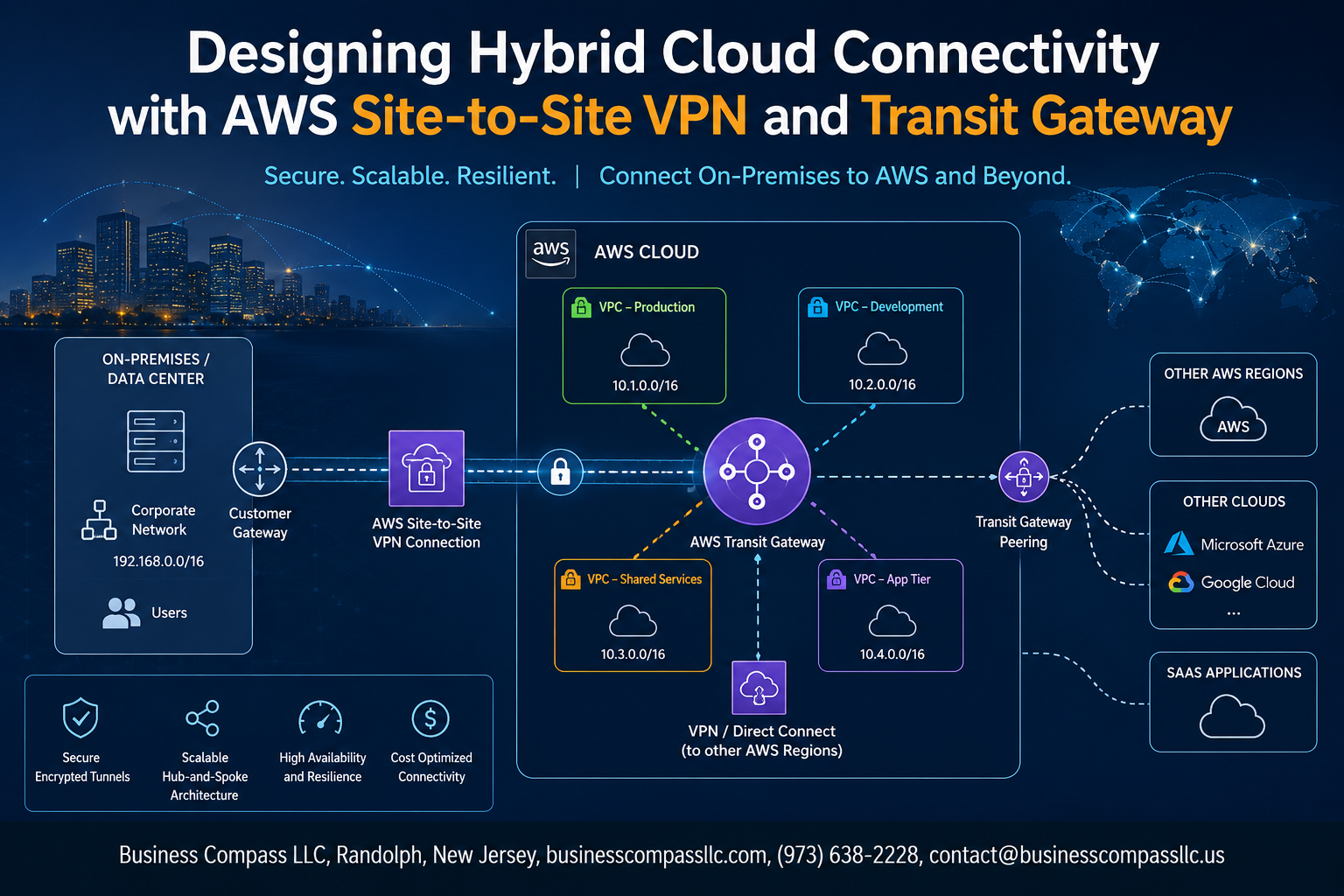
How AWS Site-to-Site VPN and Transit Gateway Work Together
Both tools pair perfectly: VPN encrypts traffic while Transit Gateway centralizes routing.
Getting to Know AWS Site-to-Site VPN

Core Components That Power Site-to-Site VPN Connections
AWS Site-to-Site VPN relies on three key pieces:
- Virtual Private Gateway (VGW) – AWS-side anchor
- Customer Gateway (CGW) – your on-premises router
- VPN tunnels – two redundant encrypted paths ensuring failover and reliable hybrid cloud connectivity
Unlocking the Power of AWS Transit Gateway

How Transit Gateway Simplifies Large-Scale Network Management
AWS Transit Gateway acts as a central hub, replacing complex VPC peering meshes. Instead of managing dozens of peer connections, everything routes through one gateway — saving time and reducing errors across your hybrid cloud architecture.
Key Features That Accelerate Multi-VPC and Multi-Account Connectivity
- Cross-account sharing via AWS Resource Access Manager
- Supports thousands of VPC attachments
- Native AWS Site-to-Site VPN integration
Transit Gateway Route Tables and Traffic Segmentation Benefits
Separate route tables isolate environments cleanly, keeping production traffic away from dev workloads effortlessly.
Designing a Scalable Hybrid Cloud Architecture

A. Map On-Premises Requirements First
Before touching AWS, document your existing subnets, routing protocols, and bandwidth needs.
B. Pick the Right Attachments
- VPC, VPN, or Direct Connect attachments
C. Structure Route Tables
Separate routes by environment to control traffic cleanly.
D. Advanced Modes
Enable Appliance Mode for stateful inspection.
E. Build for High Availability
Always deploy dual VPN tunnels across multiple Availability Zones.
Implementing Security Best Practices Across Hybrid Connections

Enforcing Least Privilege Access with IAM and Resource Policies
Scope IAM roles tightly—grant VPN and Transit Gateway permissions only to services that need them.
Encrypting Traffic End-to-End Across VPN Tunnels
Use IKEv2 with AES-256 on every AWS Site-to-Site VPN tunnel.
Using Network Firewall with Transit Gateway for Deep Packet Inspection
Route spoke VPC traffic through AWS Network Firewall via Transit Gateway for stateful inspection.
Monitoring and Optimizing Hybrid Network Performance

Leveraging CloudWatch Metrics to Track VPN Tunnel Health
Monitor TunnelState, TunnelDataIn, and TunnelDataOut metrics to catch drops early.
Using Transit Gateway Network Manager for Centralized Visibility
Get a single-pane view across all hybrid cloud connectivity paths.
Cost Optimization Strategies
- Delete unused VPN connections
- Right-size Transit Gateway attachments
Troubleshooting Common Issues
Check BGP route propagation first.

Hybrid cloud connectivity doesn’t have to be complicated. By combining AWS Site-to-Site VPN with Transit Gateway, you get a solid foundation for linking your on-premises infrastructure to the cloud in a way that’s scalable, secure, and easy to manage. From understanding the basics of hybrid networking to fine-tuning performance and locking down security, the pieces all work together to give your organization the flexibility it needs without sacrificing control.
Now it’s time to take what you’ve learned and put it into action. Start by mapping out your current network setup, identify where the gaps are, and build your hybrid architecture step by step. Keep an eye on performance metrics regularly and revisit your security configurations as your environment grows. The right hybrid cloud design isn’t a one-time project — it’s something you refine over time as your needs change.