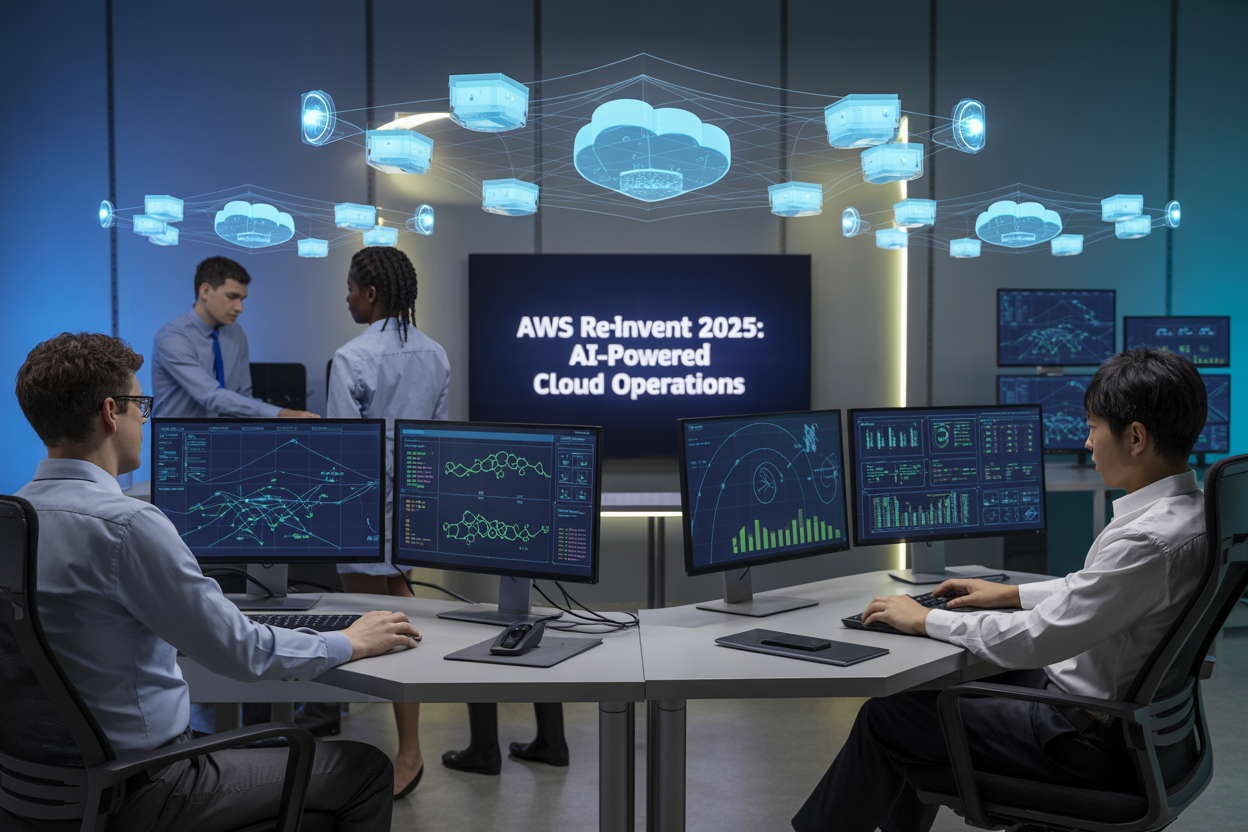
AWS re:Invent 2025 brings game-changing updates to cloud operations automation that every cloud engineer, DevOps professional, and IT leader needs to know about. Amazon’s latest announcements showcase how artificial intelligence networking and AI-powered cloud security are reshaping how teams monitor, protect, and optimize their infrastructure.
This deep dive covers the most impactful releases from AWS re:Invent 2025 for anyone managing cloud environments at scale. You’ll discover how AI-driven infrastructure monitoring transforms traditional observability approaches and learn practical ways these AWS cloud management innovations can streamline your operations.
We’ll explore three key areas: how machine learning observability tools are revolutionizing incident detection and response, the breakthrough networking capabilities that use AI to optimize performance automatically, and the integrated AWS observability tools that provide unprecedented visibility into your entire cloud stack. Each section includes real-world implementation guidance to help you leverage these intelligent cloud operations advances in your own environment.
AI-Powered Security Transformations in Cloud Operations

Automated Threat Detection and Response Capabilities
AWS re:Invent 2025 showcased groundbreaking advances in automated threat detection that transform how organizations handle security incidents. Modern AI-powered cloud security systems now analyze millions of data points in real-time, identifying potential threats within seconds rather than hours or days.
These intelligent systems combine behavioral analytics with pattern recognition to spot anomalous activities across your entire cloud infrastructure. When suspicious behavior emerges – whether it’s unusual login patterns, unexpected data transfers, or privilege escalation attempts – the AI automatically triggers response protocols. This includes isolating affected resources, blocking malicious traffic, and generating detailed incident reports for security teams.
Machine learning algorithms continuously adapt to new attack vectors, learning from each security event to improve future detection accuracy. The systems can now predict attack pathways before they fully execute, giving security teams precious time to implement countermeasures.
Machine Learning-Driven Vulnerability Assessments
Traditional vulnerability scanning tools often generate overwhelming reports filled with false positives. Artificial intelligence networking and security integration changes this dynamic completely. ML-driven assessments prioritize vulnerabilities based on your specific environment, business context, and potential impact.
These smart assessment tools analyze code repositories, infrastructure configurations, and runtime environments simultaneously. They understand the relationships between different components and can predict which vulnerabilities pose the greatest real-world risk to your operations.
The AI considers factors like:
- Current threat landscape trends
- Your organization’s attack surface
- Historical breach patterns in similar environments
- Business criticality of affected systems
This contextual analysis means security teams spend less time chasing insignificant issues and more time addressing genuine threats that could impact business operations.
Intelligent Access Controls and Zero-Trust Implementations
Zero-trust architecture gets a major upgrade with AI-powered decision engines that evaluate access requests in real-time. These systems go beyond simple role-based permissions, analyzing user behavior patterns, device health, network location, and contextual factors to make intelligent access decisions.
Cloud operations automation now includes dynamic policy adjustment based on risk assessment. When the AI detects unusual access patterns or potential compromise indicators, it automatically tightens access controls without completely blocking legitimate users.
Smart access controls adapt to your workforce patterns:
- Recognizing normal working hours and locations for different teams
- Understanding typical resource access patterns for various roles
- Adjusting permissions based on project phases and business cycles
- Implementing step-up authentication when risk levels increase
This approach maintains security without creating friction for users who need to access resources to do their jobs effectively.
Predictive Security Analytics for Proactive Protection
The most exciting development in AI-driven infrastructure monitoring is the shift from reactive to predictive security postures. Advanced analytics platforms now forecast potential security events before they occur, analyzing trends across global threat intelligence, your infrastructure patterns, and historical incident data.
Predictive models identify:
- Systems likely to be targeted based on configuration changes
- Time windows when attacks are most probable
- Resource combinations that create security vulnerabilities
- User accounts showing early compromise indicators
AWS cloud management platforms integrate these predictive insights directly into operational workflows. Security teams receive actionable recommendations for hardening specific systems, adjusting monitoring thresholds, and implementing additional protections before threats materialize.
The AI also predicts the potential impact of various security scenarios, helping teams prioritize their defensive investments and prepare incident response plans for the most likely attack vectors. This proactive approach dramatically reduces both the frequency and severity of successful security incidents.
Revolutionary Networking Enhancements Through Artificial Intelligence

Self-optimizing network performance and traffic management
Network performance optimization has reached a new level with AWS’s AI-powered solutions introduced at re:Invent 2025. These systems continuously analyze traffic patterns, bandwidth usage, and application demands to make real-time adjustments without human intervention. The artificial intelligence networking capabilities can predict traffic spikes before they happen, automatically scaling resources and rerouting data flows to prevent bottlenecks.
The smart traffic management system learns from historical data and current network conditions to optimize routing decisions. When an application suddenly experiences high demand, the AI algorithms instantly identify the most efficient paths and allocate bandwidth accordingly. This means your users get consistent performance even during unexpected traffic surges.
What makes this particularly powerful is the predictive element. The system doesn’t just react to problems – it prevents them. By analyzing patterns from millions of network interactions, the AI can spot early warning signs of congestion or performance degradation and take corrective action before users notice any impact.
| Traditional Networking | AI-Powered Networking |
|---|---|
| Manual traffic monitoring | Automated pattern recognition |
| Reactive problem solving | Predictive optimization |
| Static routing rules | Dynamic path selection |
| Manual scaling decisions | Intelligent auto-scaling |
Automated network provisioning and configuration
Gone are the days of spending hours configuring network settings manually. AWS’s new AI-driven provisioning tools can set up complex network architectures in minutes. The system understands your application requirements and automatically configures VPCs, subnets, security groups, and routing tables based on best practices and your specific needs.
The automation extends beyond initial setup. When you deploy new services or modify existing ones, the AI analyzes the changes and updates network configurations automatically. This includes adjusting firewall rules, updating load balancer settings, and modifying DNS configurations to ensure optimal connectivity.
The AI learns from each deployment, becoming smarter about your organization’s networking patterns and preferences. Over time, it develops a deep understanding of your infrastructure requirements and can suggest improvements or catch potential issues before they become problems.
Key automated provisioning features include:
- Intelligent subnet allocation based on projected growth
- Security group optimization for minimal attack surface
- Load balancer configuration matched to application patterns
- DNS management with intelligent failover strategies
AI-driven troubleshooting and remediation processes
Network troubleshooting traditionally involves detective work – gathering logs, analyzing metrics, and following hunches about where problems might be hiding. AWS’s AI-driven troubleshooting changes this completely by automatically correlating data from multiple sources to pinpoint issues in seconds rather than hours.
The system monitors thousands of network metrics simultaneously, looking for anomalies that might indicate problems. When it detects an issue, the AI doesn’t just alert you – it diagnoses the root cause and often fixes the problem automatically. This includes everything from rerouting traffic around failed components to adjusting security rules that might be blocking legitimate traffic.
The remediation capabilities are impressive. The AI can automatically restart failed services, switch to backup systems, or even provision new resources when needed. For more complex issues that require human attention, the system provides detailed analysis and recommended solutions, complete with step-by-step remediation plans.
Real-world examples of AI-driven fixes include:
- Automatically detecting and bypassing faulty network paths
- Identifying misconfigured security rules blocking application traffic
- Recognizing DDoS attack patterns and implementing countermeasures
- Optimizing database connection pools during high-traffic periods
The machine learning observability integration means the system gets better at troubleshooting over time, learning from each incident to improve its diagnostic accuracy and response speed.
Next-Generation Observability with Machine Learning Integration

Intelligent Monitoring and Alerting Systems
Modern cloud environments generate massive amounts of telemetry data, making traditional monitoring approaches increasingly inadequate. AI-powered cloud security and machine learning observability transform how organizations handle this data deluge. Advanced algorithms automatically sift through millions of metrics, logs, and traces to identify patterns that human operators would miss.
Smart alerting systems eliminate noise by learning your infrastructure’s baseline behavior. Instead of bombarding teams with false positives, these systems understand context and severity levels. They distinguish between a routine database spike during peak hours and a genuine performance degradation requiring immediate attention. The result? Significantly reduced alert fatigue and faster response times to actual incidents.
Machine learning models continuously adapt to your environment’s unique characteristics. They recognize seasonal traffic patterns, deployment cycles, and normal operational variations. This contextual awareness allows for dynamic threshold adjustments that prevent unnecessary alerts while maintaining sensitivity to real problems.
Automated Root Cause Analysis and Incident Correlation
When incidents occur across distributed systems, pinpointing the root cause traditionally requires extensive manual investigation. AWS observability tools now leverage artificial intelligence to trace problems through complex dependency chains automatically. These systems analyze correlation patterns between services, infrastructure components, and application layers.
AI algorithms examine historical incident data to identify recurring failure modes and their underlying causes. They build knowledge graphs that map relationships between different system components, enabling rapid identification of probable root causes when new incidents emerge. This capability dramatically reduces mean time to resolution (MTTR) from hours to minutes.
The correlation engine connects seemingly unrelated events across your infrastructure. A network latency spike in one availability zone might correlate with increased error rates in specific microservices, which the system automatically identifies. This holistic view prevents teams from chasing symptoms while the actual problem persists elsewhere in the stack.
Predictive Performance Optimization
Machine learning observability extends beyond reactive monitoring to proactive performance management. Predictive models analyze historical trends, resource utilization patterns, and application behavior to forecast future performance bottlenecks. Teams can address potential issues before they impact users.
Resource optimization algorithms recommend scaling decisions based on predicted demand patterns. They consider factors like seasonal variations, marketing campaigns, and business events that might affect system load. This predictive capability helps organizations right-size their infrastructure, reducing costs while maintaining performance standards.
Performance forecasting models identify gradual degradation trends that might indicate aging infrastructure or accumulating technical debt. They spot memory leaks, database query performance decline, and other issues that develop slowly over time. Early detection allows for planned maintenance rather than emergency fixes.
Real-Time Anomaly Detection Across Distributed Systems
AI-driven infrastructure monitoring excels at detecting anomalies across complex, distributed architectures. Unsupervised learning algorithms establish normal behavior baselines for each service and component without requiring predefined rules. They automatically adapt as systems evolve and business patterns change.
Real-time processing engines analyze streaming telemetry data with minimal latency. They detect subtle deviations from normal patterns that might signal security breaches, performance issues, or system failures. Multi-dimensional anomaly detection considers relationships between different metrics rather than evaluating them in isolation.
Cross-service anomaly correlation identifies problems that span multiple system boundaries. An unusual pattern in API response times might correlate with database connection pool exhaustion and increased memory utilization across multiple application instances. The system presents this information as a unified view rather than separate, disconnected alerts.
Custom Dashboards with AI-Powered Insights
Intelligent cloud operations platforms generate personalized dashboards that adapt to individual roles and responsibilities. Machine learning algorithms analyze user behavior, query patterns, and interaction history to surface the most relevant information for each team member. Operations engineers see different insights than application developers or business stakeholders.
Automated insight generation identifies trends, patterns, and opportunities that human analysts might overlook. These systems highlight cost optimization opportunities, security vulnerabilities, and performance improvements without requiring manual analysis. Natural language summaries explain complex data patterns in easily digestible formats.
Dynamic visualization recommendations suggest optimal chart types and data representations based on the underlying information. The system understands which visualization formats work best for different data types and user goals. This guidance helps teams create more effective dashboards that drive better decision-making across the organization.
Integrated Cloud Operations Platform Benefits

Unified management across security, networking, and observability
Breaking down silos between different operational domains becomes a reality with integrated cloud operations platforms. These systems connect security monitoring, network management, and application observability into a single coherent view. Teams no longer need to jump between multiple dashboards or correlate data manually across different tools.
The platform creates shared visibility where security events automatically connect to network performance metrics and application health indicators. When a DDoS attack occurs, operators see both the security threat and its impact on network bandwidth and application response times in real-time. This holistic view speeds up incident response and helps teams understand the full scope of any operational issue.
Cross-functional teams benefit from shared workflows and consistent data models. Security engineers can see network topology changes that might affect their monitoring rules, while network operators get alerts about security policies that could impact performance. The unified approach eliminates blind spots that traditionally existed between these operational domains.
Reduced operational overhead and manual interventions
Automation takes center stage when AI-powered cloud security and intelligent cloud operations work together. The platform learns from historical incident patterns and starts handling routine tasks without human intervention. System administrators spend less time on repetitive monitoring tasks and more time on strategic improvements.
Smart escalation workflows route issues to the right team members based on expertise, current workload, and severity levels. The system recognizes when problems require immediate attention versus when they can wait for regular business hours. This intelligent routing cuts down on false alarms and ensures critical issues get proper attention.
Predictive maintenance capabilities identify potential problems before they become outages. The platform spots unusual patterns in system behavior and suggests preventive actions. Teams can schedule maintenance windows proactively instead of scrambling to fix unexpected failures.
Machine learning observability enhances these capabilities by continuously improving prediction accuracy. The more data the system processes, the better it becomes at distinguishing between normal variations and genuine problems. This learning cycle reduces both false positives and missed incidents over time.
Enhanced scalability for enterprise environments
Enterprise-scale deployments demand platforms that grow seamlessly with business needs. AWS cloud management solutions built with AI foundations scale across thousands of resources without performance degradation. The system maintains response times and accuracy even as monitoring complexity increases exponentially.
Distributed processing architectures ensure that data collection and analysis happen close to where events occur. This approach minimizes network latency and provides faster insights for time-sensitive operations. Regional processing nodes can operate independently while still contributing to global intelligence.
Resource allocation becomes dynamic and intelligent. The platform monitors its own performance and automatically adjusts compute resources based on current load. During peak traffic periods or major incidents, additional processing power spins up automatically to maintain service quality.
Multi-tenant capabilities allow different business units or projects to operate with appropriate isolation while still benefiting from shared intelligence. Each tenant gets customized views and controls while the underlying platform learns from patterns across all tenants. This shared learning accelerates improvements for everyone while maintaining security boundaries.
Cost optimization happens automatically through intelligent resource management. The system identifies underused monitoring resources and consolidates workloads to reduce infrastructure spending. It also spots opportunities to use more cost-effective storage tiers for historical data without impacting operational capabilities.
Implementation Strategies for AI-Powered Cloud Operations

Migration planning and phased deployment approaches
Starting your journey with AI-powered cloud operations requires careful planning and a structured approach. The key lies in breaking down your transformation into manageable phases rather than attempting a complete overhaul overnight.
Begin with a comprehensive assessment of your current infrastructure and identify the areas that would benefit most from artificial intelligence networking and cloud operations automation. Create a roadmap that prioritizes low-risk, high-impact implementations first. For example, start with basic monitoring automation before moving to complex security orchestration.
A three-phase approach works exceptionally well:
- Phase 1: Deploy basic AI monitoring tools and establish baseline metrics
- Phase 2: Implement automated response systems and predictive analytics
- Phase 3: Full integration with advanced machine learning observability and autonomous operations
Each phase should include rollback procedures and checkpoint evaluations. Test everything in development environments first, then gradually roll out to staging and production systems. This approach minimizes disruption while building confidence in the new AI-driven systems.
Consider running parallel systems during critical transition periods. This allows you to compare AI-driven decisions with traditional approaches, validating performance before fully committing to automated responses.
Staff training and skill development requirements
Your team’s success with intelligent cloud operations depends heavily on developing new skills that bridge traditional IT operations with AI and machine learning concepts. The learning curve can be steep, but with the right approach, your staff can become proficient quickly.
Start by identifying skill gaps within your organization. Traditional system administrators need to understand how AI algorithms make decisions, while developers should learn about operational AI integration. Create customized training paths based on each team member’s current expertise and future responsibilities.
Essential training areas include:
- AI/ML fundamentals: Understanding how algorithms work and their limitations
- Data interpretation: Reading and acting on AI-generated insights
- Tool-specific training: Hands-on experience with AWS observability tools and automation platforms
- Troubleshooting AI systems: Diagnosing when AI recommendations are incorrect
Partner with training providers who offer hands-on labs and real-world scenarios. Many cloud providers offer specialized certification programs that align with AWS re:Invent 2025 innovations. Encourage team members to earn these certifications while working on actual implementation projects.
Establish mentorship programs where early adopters can guide others through the transition. Create internal documentation and playbooks that capture your organization’s specific use cases and lessons learned.
Cost optimization through intelligent automation
Cloud operations automation delivers significant cost savings when implemented strategically. AI systems can identify spending patterns and optimization opportunities that humans might miss, leading to substantial reductions in operational expenses.
Automated resource scaling represents one of the biggest cost-saving opportunities. AI algorithms can predict demand patterns and adjust resources accordingly, avoiding over-provisioning while maintaining performance standards. This becomes particularly powerful when combined with AI-driven infrastructure monitoring that understands application behavior patterns.
Key cost optimization strategies include:
| Strategy | Potential Savings | Implementation Complexity |
|---|---|---|
| Automated scaling | 20-40% | Medium |
| Predictive maintenance | 15-25% | High |
| Resource right-sizing | 10-30% | Low |
| Workload scheduling | 5-15% | Low |
Intelligent automation also reduces operational overhead by minimizing manual interventions. When AI systems handle routine tasks like patch management, capacity planning, and incident response, your team can focus on strategic initiatives that drive business value.
Track cost metrics continuously and adjust AI parameters based on actual results. Set up alerts for unusual spending patterns and regularly review automation decisions to ensure they align with business objectives.
Performance benchmarking and success metrics
Measuring the success of your AI-powered cloud security and operations transformation requires establishing clear metrics before implementation begins. Without proper benchmarks, you can’t demonstrate value or identify areas for improvement.
Start by documenting current performance baselines across all key areas. This includes mean time to detection (MTTD) for security incidents, mean time to resolution (MTTR) for operational issues, and overall system availability. These metrics provide the foundation for measuring AI impact.
Critical performance indicators to track:
- Incident response times: How quickly AI systems detect and respond to issues
- False positive rates: Accuracy of AI-generated alerts and recommendations
- Resource utilization efficiency: Optimization improvements from automated scaling
- Security posture improvements: Reduction in successful attacks and vulnerabilities
Establish both technical and business metrics. While technical teams care about response times and system performance, business stakeholders want to see cost savings, risk reduction, and improved customer experience.
Use dashboards that provide real-time visibility into AI system performance. Create regular reports that show trends and improvements over time. This data becomes crucial for justifying continued investment and expanding AI operations to additional areas.
Set realistic expectations for improvement timelines. While some benefits appear immediately, others like predictive maintenance and long-term trend analysis require months of data collection before showing meaningful results. Plan for this gradual improvement curve when communicating with stakeholders about expected outcomes.

AWS re:Invent 2025 has unveiled a game-changing approach to cloud operations that puts AI at the center of everything. The new security features use machine learning to spot threats before they become problems, while the networking improvements make connections faster and smarter than ever. The observability tools now give you insights that would have taken hours to uncover manually, all thanks to AI doing the heavy lifting behind the scenes.
The real magic happens when all these pieces work together on the integrated platform. Your security, networking, and monitoring tools can now talk to each other and share intelligence in real-time. If you’re ready to take your cloud operations to the next level, start small with one area that’s causing you the most headaches right now. Pick either security monitoring, network optimization, or observability enhancement, get comfortable with the AI features, and then expand from there. The future of cloud operations is here, and it’s smarter than we ever imagined.