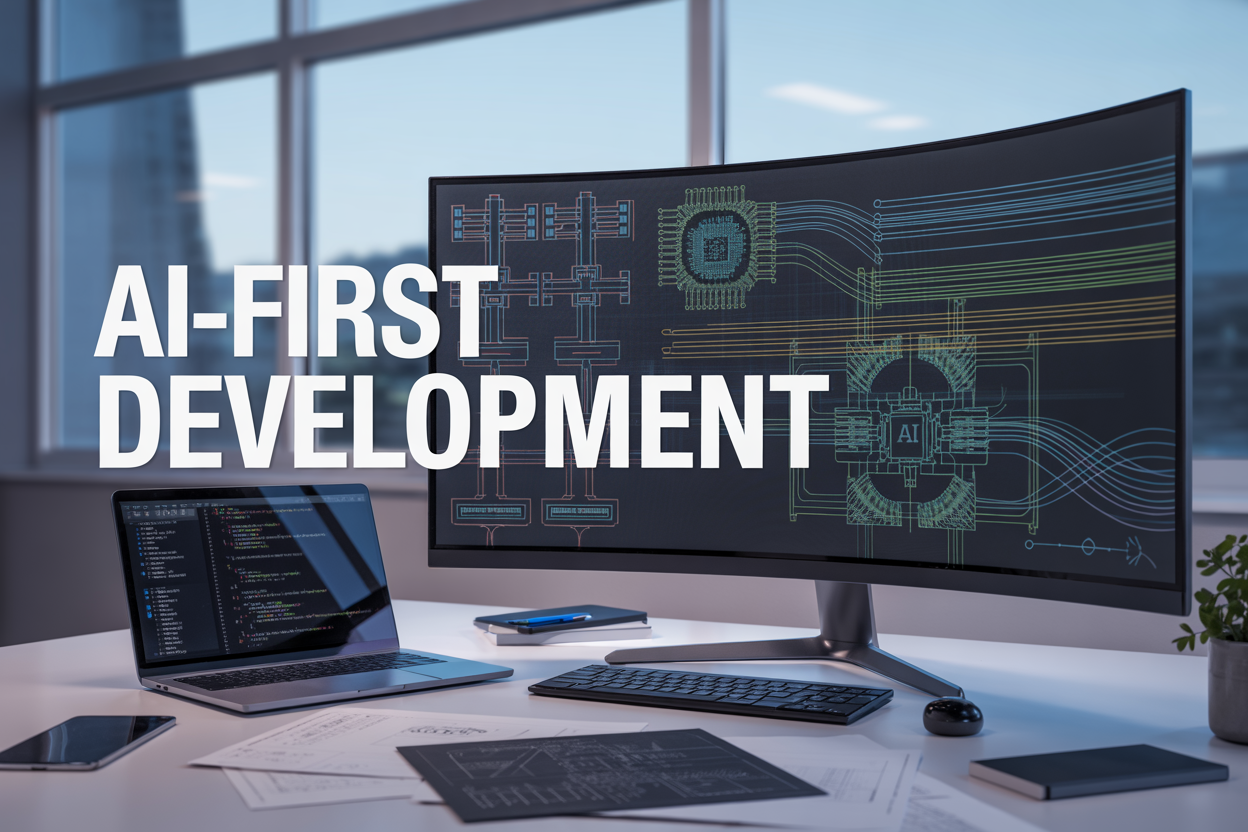
AI-First Development: Designing Systems with Intelligence at the Core
Building software today means thinking differently about how intelligence fits into your applications. AI-first development flips the traditional approach by making artificial intelligence development the foundation of your system architecture, not an afterthought bolted on later.
This guide is designed for software engineers, product managers, and development teams who want to create AI-powered applications that actually work in the real world. You’ll learn how to build systems where machine learning integration drives core functionality rather than just adding fancy features.
We’ll walk through the fundamentals of intelligent software design, showing you how to plan and architect systems with AI at their heart. You’ll discover proven AI development best practices that help you avoid common pitfalls and build applications that scale. Finally, we’ll cover practical implementation strategies and development workflows that turn AI concepts into production-ready intelligent application architecture.
Smart systems aren’t just about having the latest AI features—they’re about reimagining how software solves problems when intelligence becomes the core building block.
Understanding AI-First Development Fundamentals

Defining AI-First Architecture vs Traditional Development Approaches
Traditional software development follows a sequential approach where developers build core functionality first, then consider adding intelligent features as afterthoughts. AI-first development flips this paradigm completely. Instead of retrofitting intelligence into existing systems, AI-first architecture places artificial intelligence at the foundation of every design decision.
In conventional development, teams typically create static rule-based systems with predetermined logic flows. When they need smarter behavior, they patch on basic algorithms or simple automation. This approach creates technical debt and limits scalability. AI-first development, however, starts with intelligent components as primary building blocks. Every data flow, user interaction, and system process gets designed with machine learning integration in mind from day one.
| Traditional Approach | AI-First Development |
|---|---|
| Rule-based logic | Learning algorithms |
| Static workflows | Adaptive processes |
| Manual optimization | Self-improving systems |
| Reactive problem-solving | Predictive intelligence |
| Linear data processing | Pattern recognition focus |
The architectural differences run deep. Traditional systems rely on explicit programming for every scenario, while AI-powered applications learn from data patterns and user behavior. This means AI-first systems can handle edge cases and unexpected situations that would break conventional software. They also evolve and improve over time without requiring constant manual updates.
Core Principles That Drive Intelligent System Design
Data becomes the lifeblood of AI-first development. Every system component must capture, process, and learn from information continuously. This principle shapes how developers approach database design, API architecture, and user interface creation. Instead of treating data as static records, intelligent software design views data as dynamic fuel for machine learning models.
Adaptability stands as another fundamental principle. AI-driven development workflows prioritize systems that can modify their behavior based on new information. This means building flexible architectures that support model updates, parameter adjustments, and feature evolution without system downtime. The code itself becomes more modular, with clear separation between learning components and business logic.
Real-time decision-making capabilities define modern AI system architecture. Unlike traditional applications that follow predetermined paths, intelligent systems must evaluate multiple options and choose optimal actions in milliseconds. This requires:
- Event-driven architectures that respond to data changes instantly
- Microservices design enabling independent model deployment
- Streaming data pipelines for continuous learning
- API-first approaches supporting model integration
- Containerized deployments allowing rapid scaling
Transparency and explainability also drive design decisions. AI system implementation must include mechanisms for understanding how models make decisions. This principle influences logging strategies, monitoring approaches, and user interface design to provide clear insights into AI behavior.
Business Value and Competitive Advantages of AI-Centric Solutions
AI-first development delivers measurable business impact through automation of complex decision-making processes. Companies using intelligent application architecture report 30-50% improvements in operational efficiency compared to traditional systems. These gains come from reducing manual work, optimizing resource allocation, and enabling 24/7 intelligent operations.
Customer experience transformation represents the most visible advantage. AI-powered applications provide personalized interactions that adapt to individual user preferences and behaviors. This level of customization was impossible with static, rule-based systems. Users receive relevant recommendations, proactive support, and streamlined workflows tailored to their specific needs.
Market responsiveness improves dramatically with AI-centric solutions. While traditional applications require months of development to add new features or adapt to market changes, AI-first systems can learn and adjust automatically. This agility creates sustainable competitive advantages in rapidly changing markets.
Cost reduction opportunities emerge through intelligent automation and predictive maintenance. AI development best practices include building systems that identify potential issues before they become expensive problems. These predictive capabilities reduce downtime, optimize resource usage, and minimize manual intervention requirements.
Revenue growth acceleration happens when AI-first systems identify new business opportunities through pattern recognition and predictive analytics. Companies discover customer segments, market trends, and optimization opportunities that human analysis might miss. This intelligence enables faster decision-making and more strategic resource allocation.
Strategic Planning for AI-Integrated Systems

Identifying Optimal Use Cases for AI Implementation
The key to successful AI-first development lies in spotting the right opportunities where artificial intelligence can deliver genuine value. Start by examining your organization’s most time-consuming, repetitive, or data-heavy processes. These areas often present prime candidates for AI integration because machines excel at pattern recognition and automation.
Look for problems involving large datasets, complex decision trees, or tasks requiring 24/7 availability. Customer service chatbots, predictive maintenance systems, and automated content generation represent classic sweet spots where AI-powered applications can transform operations. Data-rich environments like e-commerce platforms, financial services, and healthcare systems particularly benefit from intelligent software design.
Avoid the temptation to implement AI everywhere at once. Instead, prioritize use cases based on three factors: potential impact, technical feasibility, and available data quality. High-impact, low-complexity scenarios make excellent starting points for building organizational confidence and demonstrating ROI.
Consider edge cases and exceptions carefully. While AI excels at handling common scenarios, you’ll need fallback mechanisms for unusual situations. Document these requirements early to prevent costly redesigns later in the development process.
Data Strategy and Infrastructure Requirements Assessment
Your data strategy forms the backbone of any AI-integrated system. Without quality data flowing through robust infrastructure, even the most sophisticated machine learning integration efforts will fail to deliver meaningful results.
Begin with a comprehensive audit of existing data sources, formats, and accessibility. Map out data lineage to understand how information flows through your current systems. This exercise often reveals surprising gaps or inconsistencies that could derail AI initiatives if left unaddressed.
| Infrastructure Component | Requirements | Considerations |
|---|---|---|
| Data Storage | Scalable, accessible formats | Cloud vs. on-premise costs |
| Processing Power | GPU/CPU for ML workloads | Peak usage patterns |
| Network Bandwidth | High-speed data transfer | Latency requirements |
| Security Measures | Encryption, access controls | Compliance standards |
Data quality requirements for AI systems typically exceed traditional applications. Plan for data cleaning, validation, and enrichment processes. Establish clear governance policies covering data collection, storage, and usage rights. Remember that AI development best practices demand consistent, well-labeled datasets for training and ongoing system improvement.
Storage architecture must handle both structured and unstructured data efficiently. Consider implementing data lakes or hybrid approaches that accommodate diverse AI workloads while maintaining performance standards.
Resource Allocation and Team Structure Planning
Building AI-first systems requires a different mix of skills compared to traditional software development. Your team structure should reflect the interdisciplinary nature of intelligent application architecture projects.
Core team roles include:
- AI/ML Engineers: Handle model development and optimization
- Data Engineers: Build and maintain data pipelines
- Software Developers: Integrate AI components with application logic
- DevOps Engineers: Manage AI-driven development workflows
- Domain Experts: Provide business context and validation
Budget allocation should account for both initial development costs and ongoing operational expenses. Cloud computing resources for training and inference can fluctuate significantly based on usage patterns. Factor in costs for specialized tools, third-party APIs, and potential hardware upgrades.
Training existing team members often proves more cost-effective than hiring exclusively from the external market. Invest in upskilling programs covering AI fundamentals, data science principles, and emerging technologies relevant to your use cases.
Consider partnering with external AI specialists for knowledge transfer and accelerated development timelines. This hybrid approach helps organizations build internal capabilities while maintaining project momentum.
Risk Assessment and Mitigation Strategies
AI system implementation introduces unique risks that traditional software projects don’t face. Model drift, data bias, and algorithmic transparency concerns require proactive management strategies.
Technical risks include model performance degradation over time, data quality issues, and integration challenges with existing systems. Establish monitoring systems that track model accuracy, data freshness, and system performance metrics continuously.
Common Risk Categories:
- Operational Risks: System downtime, performance bottlenecks
- Data Risks: Privacy breaches, bias amplification, quality degradation
- Regulatory Risks: Compliance violations, audit requirements
- Business Risks: User adoption challenges, competitive disadvantage
Develop rollback procedures for AI components that allow quick reversion to previous versions or manual processes when needed. Create comprehensive testing protocols that validate AI behavior across diverse scenarios and edge cases.
Documentation becomes critical for AI systems due to their complexity and regulatory requirements. Maintain detailed records of model training data, decision logic, and performance metrics. This documentation supports both technical maintenance and compliance auditing.
Establish clear escalation procedures for handling AI system failures or unexpected behaviors. Train support teams to recognize AI-specific issues and respond appropriately while technical teams investigate root causes.
Human oversight remains essential even in highly automated systems. Design review processes that allow human experts to validate AI decisions, especially in high-stakes scenarios where errors could have significant consequences.
Technical Architecture for AI-Enabled Applications

Designing Scalable Data Pipelines and Processing Systems
Building robust data pipelines forms the backbone of successful AI-first development. Your pipeline architecture needs to handle massive data volumes while maintaining low latency and high reliability. Start by implementing a modular approach using microservices that can scale independently based on demand.
Apache Kafka serves as an excellent message broker for real-time data streaming, while Apache Airflow helps orchestrate complex workflows. For batch processing, consider Apache Spark or Google Cloud Dataflow, which can handle petabytes of data efficiently. Design your pipelines with fault tolerance in mind – implement circuit breakers, retry mechanisms, and dead letter queues to handle failures gracefully.
Data quality becomes critical when feeding AI models. Build validation layers that check for schema compliance, data completeness, and statistical anomalies before data reaches your models. Create monitoring dashboards that track data drift, pipeline performance, and error rates in real-time.
Storage strategy matters significantly for AI system architecture. Use a combination of hot, warm, and cold storage tiers based on access patterns. Object storage like Amazon S3 works well for training datasets, while in-memory databases like Redis provide lightning-fast access for real-time inference data.
Model Integration Patterns and API Design Principles
Machine learning integration requires thoughtful API design that balances performance, flexibility, and maintainability. The most common patterns include synchronous REST APIs for real-time predictions, asynchronous messaging for batch processing, and streaming APIs for continuous inference.
Design your model APIs with versioning from day one. Use semantic versioning and maintain backward compatibility to avoid breaking existing integrations. Implement A/B testing capabilities directly in your API layer to compare model performances seamlessly.
| Integration Pattern | Use Case | Latency | Complexity |
|---|---|---|---|
| Synchronous API | Real-time predictions | Low (< 100ms) | Medium |
| Asynchronous Queue | Batch processing | High (minutes-hours) | Low |
| Streaming | Continuous inference | Very Low (< 10ms) | High |
Model serving frameworks like TensorFlow Serving, MLflow, or Seldon provide standardized deployment patterns. These frameworks handle model loading, scaling, and health monitoring automatically. Container orchestration with Kubernetes enables dynamic scaling based on traffic patterns.
Create standardized request/response schemas that include confidence scores, metadata, and explanation features. This consistency helps downstream consumers understand and trust AI predictions while enabling proper monitoring and debugging.
Real-Time Decision Making Frameworks
Real-time AI applications demand frameworks that can process inputs and deliver decisions within milliseconds. Event-driven architectures work best here, using technologies like Apache Storm or AWS Kinesis for stream processing.
Implement caching strategies at multiple levels – model predictions, feature computations, and preprocessed data. Redis Cluster or Apache Ignite can serve cached results in microseconds, dramatically reducing response times for repeated queries.
Feature stores become essential for real-time systems. Tools like Feast or Tecton provide low-latency feature serving while maintaining consistency between training and inference environments. Pre-compute features when possible and store them in fast-access databases.
Decision engines should include fallback mechanisms. When primary models fail or take too long, have simpler rule-based systems ready to provide reasonable responses. This approach maintains system availability even during model failures or extreme load conditions.
Performance Optimization and Resource Management
Intelligent application architecture requires careful resource planning and optimization strategies. Start by profiling your AI workloads to identify bottlenecks – whether they’re CPU-bound, memory-bound, or I/O-bound operations.
Model optimization techniques include quantization, pruning, and knowledge distillation. These methods can reduce model size by 90% while maintaining accuracy within acceptable bounds. ONNX Runtime and TensorRT provide optimized inference engines that leverage hardware-specific optimizations.
Implement auto-scaling policies based on custom metrics like queue depth, inference latency, or CPU utilization. Kubernetes Horizontal Pod Autoscaler works well for containerized deployments, while cloud-specific solutions like AWS Auto Scaling provide more advanced features.
Resource allocation strategies should consider GPU sharing for inference workloads. Multiple models can share GPU memory efficiently using techniques like model batching and dynamic memory allocation. Monitor GPU utilization closely to avoid expensive underutilized resources.
Security and Privacy Considerations in AI Systems
AI-powered applications face unique security challenges that traditional software doesn’t encounter. Model stealing attacks, adversarial inputs, and data poisoning represent new threat vectors requiring specialized defenses.
Implement input validation that goes beyond traditional sanitization. Check for adversarial patterns using detection models or statistical analysis. Rate limiting becomes crucial – limit requests per user to prevent model extraction attempts through excessive querying.
Data privacy requires encryption at rest and in transit, but AI systems need additional protections. Differential privacy techniques add noise to training data while preserving model utility. Federated learning enables training on distributed data without centralizing sensitive information.
Access controls should follow the principle of least privilege. Use role-based access control (RBAC) for model endpoints and implement API key rotation policies. Audit logs should capture not just who accessed what, but also the predictions made and confidence levels returned.
Model versioning and rollback capabilities provide security benefits too. When you detect compromised models or adversarial attacks, quick rollback to previous versions minimizes damage. Container registries with vulnerability scanning help ensure your deployment artifacts remain secure throughout the development lifecycle.
Implementation Best Practices and Development Workflows

Agile Development Methodologies for AI Projects
AI-first development thrives within agile frameworks, but traditional sprint cycles need thoughtful adaptation. Machine learning models don’t follow predictable timelines like standard software features. Data exploration might reveal unexpected patterns that shift your entire approach, or model training could take longer than anticipated.
Breaking down AI projects into manageable iterations requires a different mindset. Instead of focusing solely on feature delivery, teams should structure sprints around experimentation cycles. Each sprint might include data collection, model experimentation, validation testing, and integration work. This approach keeps the team moving forward while acknowledging the inherent uncertainty in AI development workflows.
Cross-functional collaboration becomes even more critical in AI-powered applications. Data scientists, software engineers, and domain experts must work closely together throughout each iteration. Regular stand-ups should include discussions about data quality issues, model performance metrics, and integration challenges. This constant communication prevents costly misalignments between different team members.
User stories for AI projects often look different too. Rather than “As a user, I want to click a button,” they might read “As a user, I want recommendations that improve my productivity by 20%.” These outcome-focused stories help teams stay aligned on business value while giving technical teams flexibility in implementation approaches.
Continuous Integration and Deployment for Machine Learning Models
Setting up CI/CD pipelines for AI systems requires handling both code and data versioning simultaneously. Your pipeline needs to track not just application code changes, but also dataset versions, model weights, hyperparameters, and training scripts. Tools like DVC (Data Version Control) integrate with Git to manage these complex dependencies effectively.
Automated testing in AI development workflows goes beyond traditional unit tests. Your CI pipeline should validate data schemas, check for data drift, run model performance benchmarks, and verify API compatibility. Each model update triggers a series of automated checks that ensure the new version maintains expected performance standards across different data segments.
Model deployment strategies need careful consideration of rollback capabilities. A/B testing frameworks let you gradually roll out new models while monitoring real-world performance. If a model starts making poor predictions in production, you can quickly revert to the previous version without manual intervention.
Container orchestration becomes particularly valuable for intelligent software design. Docker containers ensure consistent environments across development, testing, and production stages. Kubernetes can manage scaling based on inference demand, automatically spinning up additional model serving instances during peak usage periods.
Testing Strategies for AI-Powered Applications
Testing AI system implementation requires multiple validation layers that go far beyond traditional software testing approaches. Unit tests still matter for data processing functions and API endpoints, but you also need specialized tests for model behavior, data quality, and system integration points.
Model validation testing should include performance metrics across different data slices. Your test suite might check accuracy rates for various user demographics, geographic regions, or time periods. This comprehensive testing helps identify potential bias issues before they reach production environments.
Data quality testing deserves special attention in AI development best practices. Automated checks should validate incoming data against expected schemas, detect statistical anomalies, and flag potential data drift issues. These tests run continuously as new data flows into your system, alerting teams to quality problems that could degrade model performance.
Integration testing for AI-powered applications must account for the probabilistic nature of machine learning outputs. Instead of expecting exact matches, your tests should verify that outputs fall within acceptable ranges and maintain consistent behavior patterns. Mock services can simulate various model responses during testing phases.
End-to-end testing scenarios should mirror real user interactions with your AI features. These tests validate the complete user journey, from data input through model inference to final result presentation. Automated testing frameworks can simulate thousands of user interactions, helping identify edge cases that might not surface during manual testing sessions.
Overcoming Common Challenges in AI-First Development

Managing Model Accuracy and Performance Degradation
Model performance doesn’t stay consistent forever. Real-world data changes, user behavior shifts, and what worked perfectly in testing might struggle in production. The key is building systems that can detect and respond to these changes automatically.
Set up monitoring dashboards that track accuracy metrics across different user segments and data slices. When you notice drops in performance, dig deeper to understand whether it’s data drift, concept drift, or something else entirely. Data drift happens when the input distribution changes – maybe your e-commerce recommendation system suddenly sees a surge in mobile traffic with different browsing patterns. Concept drift occurs when the relationship between inputs and outputs changes – think about how shopping behavior shifted dramatically during the pandemic.
Create automated retraining pipelines that kick in when performance metrics drop below predefined thresholds. But don’t just retrain blindly. Analyze what’s causing the degradation first. Sometimes a simple data preprocessing adjustment fixes the issue without requiring a full model refresh.
Consider implementing ensemble methods or shadow models that run alongside your primary model. This gives you fallback options and helps validate that performance drops are real problems, not just temporary fluctuations. A/B testing different model versions in production can also help you make data-driven decisions about when to deploy updates.
Handling Data Quality and Bias Issues
Garbage in, garbage out – this old saying hits especially hard in AI-first development. Poor data quality will sabotage even the most sophisticated models, while bias can create serious ethical and business problems.
Start with comprehensive data validation pipelines that check for completeness, consistency, and accuracy. Build automated tests that flag outliers, missing values, and data format inconsistencies before they reach your models. Create data lineage tracking so you can trace problems back to their source when issues arise.
Bias detection requires ongoing vigilance. Your hiring algorithm might work great overall but systematically disadvantage certain demographic groups. Your fraud detection system could flag legitimate transactions from specific geographic regions more often. Regular bias audits should examine model performance across different subgroups, not just overall metrics.
Implement fairness constraints directly into your model training process. Techniques like adversarial debiasing or fairness-aware machine learning can help reduce discriminatory outcomes. But remember that technical solutions alone aren’t enough – you need diverse teams reviewing your data and models from multiple perspectives.
Document your data sources, collection methods, and known limitations. This transparency helps stakeholders understand what your models can and cannot do reliably. When bias issues surface, having clear documentation makes it easier to identify root causes and implement fixes.
Scaling AI Solutions Across Different Environments
Moving from a proof-of-concept running on your laptop to a production system serving millions of users presents unique challenges. Different environments have varying computational resources, latency requirements, and data access patterns.
Container orchestration platforms like Kubernetes can help manage AI workloads across different environments, but you’ll need to handle model-specific considerations. Large language models or computer vision systems might need GPU resources that aren’t available everywhere. Design your architecture to gracefully degrade when high-end hardware isn’t available – maybe switching to a smaller model variant or adjusting batch sizes.
Edge deployment introduces additional complexity. Your mobile app can’t run the same massive neural network that works fine in your data center. Model compression techniques like quantization, pruning, or knowledge distillation can help you create lightweight versions that maintain acceptable performance on resource-constrained devices.
Consider hybrid approaches where some processing happens locally and more complex operations get offloaded to cloud services. A camera app might do basic object detection on-device but send images to the cloud for detailed scene analysis. This balance gives you real-time responsiveness while leveraging powerful remote computing resources.
Build environment-agnostic abstractions that hide infrastructure differences from your application logic. Your AI service should work whether it’s running on AWS, Google Cloud, or on-premises servers. Infrastructure as code tools can help maintain consistent deployments across environments.
Maintaining System Reliability and Uptime
AI-powered applications face unique reliability challenges. Traditional software either works or doesn’t, but AI systems can fail gradually – giving increasingly poor results while technically still functioning. This makes monitoring and incident response more complex.
Implement circuit breakers that can detect when AI components are behaving abnormally and route traffic to backup systems or simplified logic. Your recommendation engine might fall back to popularity-based suggestions when the machine learning model starts returning nonsensical results.
Create comprehensive health checks that go beyond simple ping tests. Monitor prediction confidence scores, response time distributions, and error rates across different input types. Set up alerts for subtle problems like increasing response times or declining prediction quality before they become user-facing issues.
Plan for graceful degradation scenarios. When your natural language processing service goes down, your chatbot should have canned responses ready rather than simply breaking. Your fraud detection system should have rule-based fallbacks when the machine learning components fail.
Regular disaster recovery drills should include AI-specific scenarios. Practice recovering from corrupted model files, training data loss, or sudden model performance degradation. Document runbooks for common AI system failures so your on-call engineers know how to respond quickly.
Invest in observability tools designed for machine learning workloads. Traditional application monitoring misses important signals like feature drift, model staleness, or training pipeline failures. Purpose-built ML monitoring platforms can provide the visibility you need to maintain reliable AI-first systems.
Future-Proofing Your AI-First Systems

Emerging Technologies Integration Strategies
Building AI-first systems that remain relevant tomorrow requires careful attention to emerging technology trends. The rapid evolution of large language models, quantum computing, and edge AI creates both opportunities and challenges for development teams. Smart integration strategies focus on modular architectures that can adapt to new AI capabilities without requiring complete system overhauls.
Consider implementing abstraction layers that separate your core business logic from specific AI models or frameworks. This approach lets you swap out underlying AI technologies as better options emerge. For example, your natural language processing components should work equally well with different transformer models, whether you’re using GPT, BERT, or future architectures that haven’t been invented yet.
Edge AI integration deserves special attention as processing power moves closer to users. Design your AI-powered applications with hybrid cloud-edge architectures that can shift workloads based on performance requirements and cost considerations. This flexibility becomes crucial as 5G networks expand and edge computing capabilities improve.
Keep monitoring breakthroughs in specialized hardware like neuromorphic chips and quantum processors. While these technologies might seem distant, early preparation through compatible software architectures can provide significant advantages when they become mainstream.
Continuous Learning and Model Evolution Frameworks
Static AI models become obsolete quickly in today’s fast-moving landscape. Your AI-first development approach needs built-in mechanisms for continuous model improvement and evolution. This means designing systems that can learn from user interactions, adapt to changing patterns, and incorporate new training data without disrupting operations.
Implement automated retraining pipelines that monitor model performance metrics and trigger updates when accuracy drops below acceptable thresholds. These systems should handle everything from data collection and preprocessing to model validation and deployment. Version control becomes critical here – you need clear rollback mechanisms when new models underperform.
Data drift detection helps identify when your models encounter scenarios they weren’t trained for. Build monitoring systems that track input distributions and flag significant changes that might affect model reliability. This early warning system prevents quality degradation and maintains user trust.
Consider federated learning approaches for applications that handle sensitive data. This technique allows models to improve through distributed training while keeping private information secure. As privacy regulations tighten globally, federated learning frameworks provide competitive advantages in data-sensitive industries.
Active learning strategies help optimize your training data collection efforts. Instead of randomly sampling new examples, these systems identify the most valuable training cases that will improve model performance most efficiently.
Measuring Success and ROI of AI-First Initiatives
Demonstrating the business value of AI-first development requires comprehensive measurement frameworks that go beyond technical metrics. While model accuracy and inference speed matter, stakeholders care more about impact on revenue, customer satisfaction, and operational efficiency.
Establish baseline measurements before AI implementation to create clear before-and-after comparisons. Track both quantitative metrics like conversion rates, processing times, and error reduction, alongside qualitative measures such as user experience improvements and employee satisfaction.
| Metric Category | Key Performance Indicators | Measurement Frequency |
|---|---|---|
| Business Impact | Revenue growth, cost reduction, market share | Monthly/Quarterly |
| User Experience | Satisfaction scores, task completion rates, time-to-value | Weekly |
| Operational | System uptime, response times, resource utilization | Real-time |
| Model Performance | Accuracy, precision, recall, drift detection | Daily |
Financial ROI calculations for AI-first development should account for both direct cost savings and indirect benefits. Direct savings might include reduced manual processing or improved resource allocation. Indirect benefits often prove more valuable – better customer insights leading to improved products, or enhanced decision-making capabilities that create competitive advantages.
Time-to-value metrics help justify development investments and guide future AI initiatives. Track how quickly new AI features deliver measurable benefits and use this data to refine your development processes. Fast feedback loops between implementation and results measurement enable rapid iteration and improvement.
Remember that AI system value often compounds over time as models improve and teams develop expertise. Your measurement framework should capture these long-term benefits rather than focusing solely on immediate returns. This perspective helps secure ongoing investment in AI-first development initiatives and supports building truly intelligent software design capabilities.

Building AI-first systems isn’t just about adding smart features to existing apps—it’s about rethinking how we design and build software from the ground up. When you put intelligence at the heart of your system’s architecture, plan strategically for AI integration, and follow proven development practices, you create applications that can truly adapt and evolve with your users’ needs. The challenges are real, from data quality issues to scaling AI models, but they’re manageable when you approach them with the right mindset and tools.
The future belongs to systems that learn, adapt, and improve automatically. Start small, focus on solving real problems with AI, and build your expertise gradually. Your users will notice the difference when your applications anticipate their needs instead of just responding to them. The time to embrace AI-first development is now—your competition is already thinking about it.