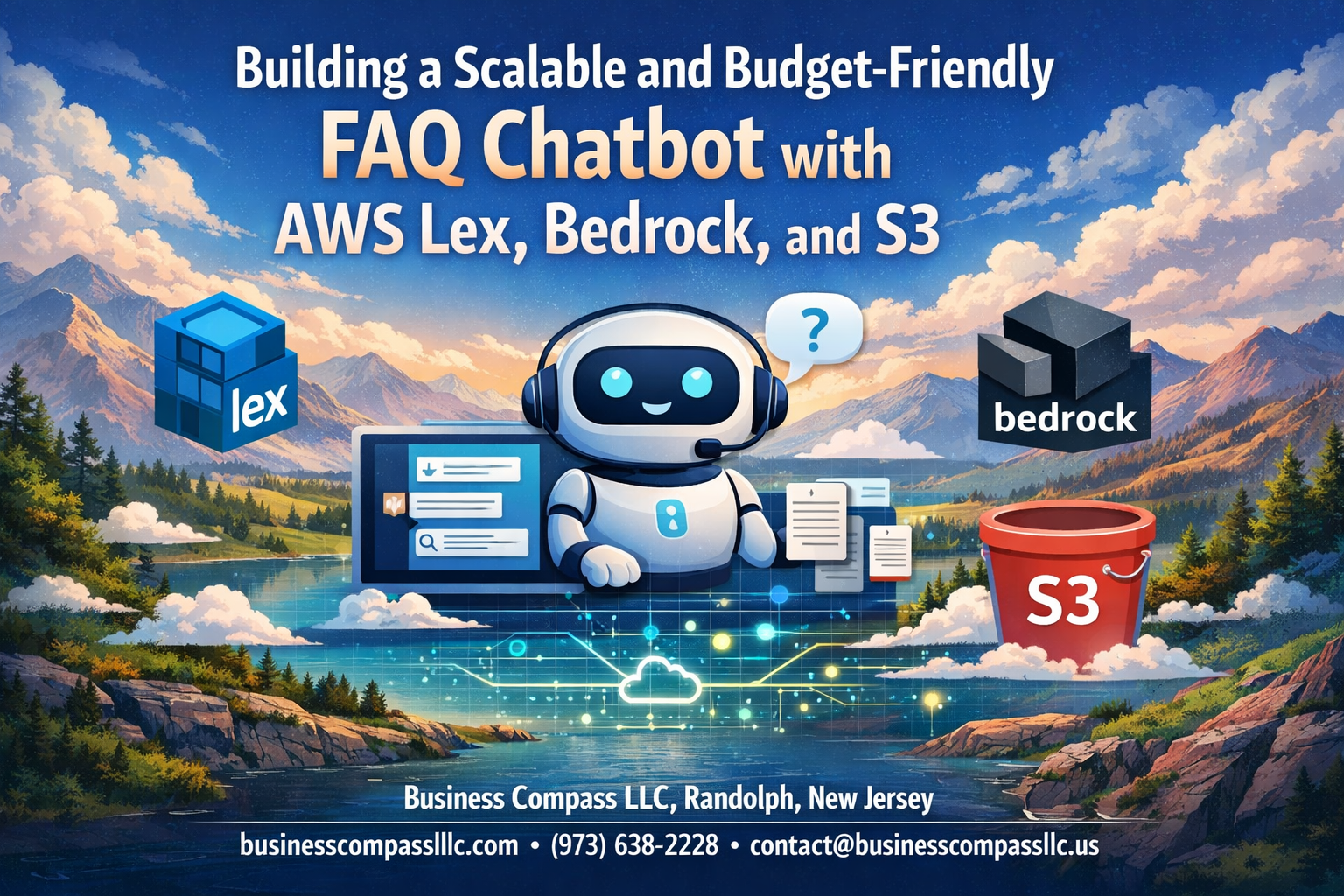
Customer support teams and developers face constant pressure to handle growing FAQ volumes without breaking their budgets. Building a scalable and budget-friendly FAQ chatbot with AWS Lex, Bedrock, and S3 offers a smart solution that grows with your business while keeping costs manageable.
This guide is designed for technical teams, startup founders, and small business owners who want to create an AI chatbot AWS solution without enterprise-level expenses. You don’t need deep machine learning expertise, but basic AWS knowledge will help you follow along.
We’ll walk through setting up AWS Lex for intent recognition chatbot functionality, showing you how to train your bot to understand user questions accurately. You’ll also learn how AWS Bedrock integration transforms simple keyword matching into intelligent, context-aware responses that actually help your customers. Finally, we’ll cover cost-effective chatbot solutions and scaling strategies that let your FAQ system handle traffic spikes without surprise bills.
By the end, you’ll have a working chatbot that delivers professional customer support while staying within your budget constraints.
Understanding AWS Services for FAQ Chatbot Development

AWS Lex capabilities for natural language processing
AWS Lex stands out as a powerful conversational AI service that brings the same technology behind Amazon Alexa to your FAQ chatbot development. This service excels at understanding user intent, even when people phrase questions differently. Your chatbot can recognize that “How do I reset my password?”, “I forgot my login details”, and “Password reset help” all point to the same underlying need.
The platform handles automatic speech recognition (ASR) and natural language understanding (NLU) seamlessly. You don’t need to worry about complex machine learning model training – AWS Lex does the heavy lifting. It supports multiple languages and can manage context across conversations, remembering what users discussed earlier in the chat session.
One of the biggest advantages is the built-in slot filling capability. When users ask incomplete questions like “I want to return something”, the bot can automatically prompt for missing details like order numbers or product types. This creates smooth, natural conversations that feel less robotic.
Bedrock’s generative AI features for enhanced responses
AWS Bedrock transforms your FAQ chatbot from a simple question-answer system into an intelligent conversational partner. Instead of providing rigid, pre-written responses, Bedrock generates contextually appropriate answers that sound natural and helpful.
The service offers access to multiple foundation models from companies like Anthropic, Cohere, and Stability AI. You can choose the model that best fits your specific use case and budget requirements. For FAQ chatbots, Claude models often perform exceptionally well at understanding complex queries and generating coherent explanations.
Bedrock’s real strength lies in its ability to understand context and nuance. When users ask follow-up questions or need clarification, the AI can maintain conversation flow while providing relevant information. It can also adapt its tone and complexity based on the type of question – offering simple answers for basic queries and detailed explanations for complex topics.
The retrieval-augmented generation (RAG) capabilities allow your chatbot to pull information from your specific knowledge base while generating responses. This means answers stay accurate and current with your business information, not just general AI training data.
S3 storage benefits for FAQ data management
Amazon S3 provides the perfect foundation for storing and managing your FAQ data at scale. Unlike traditional databases that can become expensive as your content grows, S3 offers virtually unlimited storage at remarkably low costs. You pay only for what you actually use, making it ideal for FAQ collections that might grow unpredictably.
The service handles different file formats effortlessly – whether you’re storing structured JSON files, plain text documents, or even multimedia FAQ content. S3’s versioning capabilities mean you can update FAQ content without losing previous versions, which proves invaluable when testing new responses or rolling back problematic changes.
Data retrieval speed remains consistently fast regardless of storage volume. Your chatbot can access FAQ information quickly, ensuring users don’t experience frustrating delays. The global content delivery network integration means responses stay snappy for users worldwide.
S3’s security features protect your FAQ data with encryption at rest and in transit. Fine-grained access controls ensure only authorized systems and personnel can modify your knowledge base, maintaining data integrity while enabling seamless chatbot operations.
Cost advantages of serverless architecture
Building your FAQ chatbot with serverless AWS services delivers significant cost advantages over traditional server-based approaches. You eliminate the need for always-running infrastructure, paying only when users actually interact with your bot.
AWS Lex charges per text or voice request processed, not for idle time. During quiet periods – nights, weekends, or seasonal lows – your costs drop to near zero. This usage-based pricing model particularly benefits businesses with variable customer inquiry patterns.
Bedrock’s on-demand pricing means you pay only for the AI processing power you consume. No need to provision expensive GPU instances that sit idle between conversations. The service automatically scales up during busy periods and scales down during quiet times, optimizing costs without manual intervention.
S3 storage costs remain incredibly low, often just pennies per month for typical FAQ datasets. Combined with the serverless compute model, you can run a sophisticated AI-powered FAQ chatbot for a fraction of traditional chatbot solution costs.
| Service | Pricing Model | Cost During Idle Time |
|---|---|---|
| AWS Lex | Per request | $0 |
| Bedrock | Per inference | $0 |
| S3 Storage | Per GB stored | Minimal (~$0.023/GB) |
| Traditional Server | Fixed monthly | Full server costs |
The automatic scaling capabilities mean you never over-provision resources. Whether you handle 10 questions per day or 10,000, the architecture adapts seamlessly while keeping costs proportional to actual usage.
Planning Your FAQ Chatbot Architecture

Identifying Business Requirements and Use Cases
Before diving into the technical aspects of your AWS Lex chatbot development, you need to clearly define what problem you’re solving and who you’re solving it for. Start by mapping out your most common customer inquiries and support tickets. Are users asking about product features, pricing, troubleshooting steps, or account management?
Consider the specific scenarios where your FAQ chatbot will provide the most value. For instance, e-commerce businesses often see high volumes of shipping and return policy questions, while SaaS companies typically handle feature explanations and billing inquiries. Document these patterns because they’ll directly influence your scalable chatbot architecture design.
Think about your support team’s current workload and identify which repetitive questions consume the most time. These become prime candidates for automation through your budget-friendly chatbot solution. Also consider peak support hours and seasonal spikes – your AWS-based system should handle these fluctuations without breaking your budget.
Define success metrics early. Are you aiming to reduce support ticket volume by 30%? Improve response times? Increase customer satisfaction scores? These goals will guide your technical decisions throughout the development process.
Designing Conversation Flows and User Intents
Your intent recognition chatbot needs to understand not just what users are asking, but how they’re asking it. People phrase the same question in dozens of different ways, so your AWS Lex integration must capture this variety.
Start by creating a comprehensive intent map that covers your primary use cases. For example, a “check order status” intent might include variations like “where is my package,” “track my shipment,” “delivery update,” and “order tracking.” Each intent should have multiple sample utterances that reflect real user language patterns.
Design your conversation flows with fallback options and escalation paths. When your AI chatbot AWS system encounters complex queries beyond its scope, it should gracefully hand off to human agents rather than frustrating users with irrelevant responses. Build branching logic that guides users through multi-step processes while keeping conversations natural and efficient.
Consider context switching within conversations. Users often ask follow-up questions or change topics mid-conversation. Your flow design should handle these transitions smoothly, maintaining conversation history when relevant and starting fresh when appropriate.
Structuring FAQ Content for Optimal Retrieval
Your AWS S3 storage strategy for FAQ content directly impacts your chatbot’s response accuracy and speed. Organize your knowledge base with clear categorization and tagging systems that align with your defined intents.
Create a hierarchical structure that mirrors how users think about your products or services. Use consistent formatting and include metadata tags for topics, product categories, and complexity levels. This structure enables your AWS Bedrock integration to retrieve the most relevant information quickly.
Consider content versioning and update mechanisms. Your FAQ database will evolve, and your cost-effective chatbot solutions should accommodate frequent content updates without requiring system downtime. Implement a content management workflow that allows subject matter experts to update information while maintaining quality control.
Structure your responses with multiple formats in mind. Some users prefer step-by-step instructions, while others want quick yes/no answers. Store both detailed explanations and concise summaries for each topic, allowing your chatbot performance optimization algorithms to select the most appropriate response length based on user context and preferences.
Plan for multilingual support if needed, organizing content to support future expansion into additional languages without restructuring your entire knowledge base architecture.
Setting Up AWS Lex for Intent Recognition

Creating and Configuring Your Lex Bot
Building your AWS Lex chatbot starts with creating a new bot instance in the AWS console. Navigate to the Lex service and click “Create bot” to begin the setup process. Choose the “Create a blank bot” option for maximum customization flexibility. When naming your bot, use descriptive identifiers like “FAQChatbot” or “SupportBot” to maintain clarity in your AWS environment.
During configuration, select the appropriate IAM role that grants necessary permissions for Lex to interact with other AWS services. The bot’s language settings should match your target audience – English (US) works well for most FAQ chatbot applications. Set the session timeout between 5-10 minutes to balance user experience with cost optimization.
Choose the “Draft” version initially, which allows unlimited testing and iterations without impacting production. The bot’s description field helps team members understand its purpose and scope, especially valuable for larger organizations managing multiple chatbots.
Defining Slots and Utterances for FAQ Queries
Slots represent the key information your AWS Lex chatbot needs to extract from user queries. For FAQ chatbots, common slots include product names, service categories, account types, or specific problem areas. Create custom slot types that align with your business domain – for example, “ProductCategory” might include values like “billing,” “technical support,” or “account management.”
Utterances are the various ways users might phrase their questions. Your FAQ chatbot development process should include collecting real customer inquiries to build comprehensive utterance lists. Instead of just “How do I reset my password,” consider variations like:
- “I forgot my password”
- “Can’t log into my account”
- “Password reset help”
- “I need to change my password”
Build at least 15-20 utterances per intent, mixing formal and casual language patterns. Include common typos and abbreviations that users typically make. This diversity improves your intent recognition chatbot’s accuracy across different user communication styles.
Training the Model with Sample Conversations
The training phase transforms your AWS Lex chatbot from a collection of rules into an intelligent conversational agent. Start by feeding the system diverse conversation flows that represent real user interactions. Create training data sets that include both successful question-answer pairs and edge cases where users might be unclear or provide incomplete information.
Sample conversation training should include multi-turn dialogues where users refine their questions or ask follow-up queries. For instance, a user might start with “I have a billing question” and then specify “Why was I charged twice this month?” This progressive conversation flow helps your chatbot maintain context and provide more accurate responses.
Upload conversation logs from existing customer service channels if available. This real-world data provides invaluable insights into how customers actually phrase their questions, which often differs significantly from how businesses think they’ll ask. The machine learning algorithms in Lex analyze these patterns to improve understanding of user intent.
Testing Intent Recognition Accuracy
Regular testing ensures your AWS Lex chatbot maintains high performance standards. Use the built-in testing console to evaluate how well your bot recognizes different user inputs. Start with the exact utterances you trained on, then gradually introduce variations and edge cases.
Create a testing spreadsheet that tracks recognition accuracy across different intent categories. Monitor confidence scores – Lex provides numerical confidence ratings for each intent match. Aim for confidence scores above 0.75 for production deployment, though some specialized domains might require higher thresholds.
Test with real team members who weren’t involved in the bot creation process. Their natural phrasing often reveals gaps in your utterance coverage. Document any misrecognized intents and add new training utterances to address these gaps.
Set up systematic testing schedules – weekly during development and monthly after deployment. This ongoing evaluation helps maintain your scalable chatbot architecture’s effectiveness as user behavior evolves over time.
Integrating AWS Bedrock for Intelligent Responses

Selecting the Right Foundation Model for Your Needs
Choosing the appropriate foundation model for your AWS Bedrock integration directly impacts your FAQ chatbot development success. Amazon Titan Text models excel at general-purpose question answering and work perfectly for straightforward FAQ responses. Claude models from Anthropic handle complex reasoning better, making them ideal when your chatbot needs to understand nuanced questions or provide detailed explanations.
For budget-friendly chatbot solutions, start with Amazon Titan Text Express, which offers the best cost-to-performance ratio for basic FAQ scenarios. If your use case involves technical documentation or requires more sophisticated language understanding, Claude Instant provides excellent value while maintaining reasonable costs.
| Model | Best Use Case | Cost Level | Response Quality |
|---|---|---|---|
| Amazon Titan Text Express | Simple FAQ responses | Low | Good |
| Amazon Titan Text Lite | Basic Q&A, high volume | Very Low | Basic |
| Claude Instant | Complex queries, reasoning | Medium | Excellent |
| Claude v2 | Advanced understanding | High | Superior |
Consider your FAQ complexity when making this choice. Simple product information or basic troubleshooting works well with Titan models, while customer service scenarios requiring empathy and context awareness benefit from Claude models.
Configuring Bedrock API Connections
Setting up your AWS Bedrock integration requires proper IAM permissions and API configuration within your Lambda function. Create a dedicated IAM role with bedrock:InvokeModel permissions, restricting access to only the models you’re using to maintain security best practices.
Your Lambda function needs the AWS SDK configured to communicate with Bedrock endpoints. Here’s the essential setup structure:
import boto3
import json

bedrock_client = boto3.client('bedrock-runtime', region_name='us-east-1')

def invoke_bedrock_model(prompt, model_id):
    body = json.dumps({
        "inputText": prompt,
        "textGenerationConfig": {
            "maxTokenCount": 512,
            "temperature": 0.1,
            "topP": 0.9
        }
    })

    response = bedrock_client.invoke_model(
        body=body,
        modelId=model_id,
        accept='application/json',
        contentType='application/json'
    )

    return json.loads(response['body'].read())
Configure timeout settings appropriately since Bedrock API calls can take several seconds. Set your Lambda timeout to at least 30 seconds to handle model inference delays without timing out.
Implementing Fallback Responses for Complex Queries
Your scalable chatbot architecture needs robust fallback mechanisms when Bedrock cannot provide satisfactory answers. Create a multi-tier response system that escalates based on confidence levels and query complexity.
First, implement confidence scoring for Bedrock responses. If the model returns generic or uncertain answers, trigger your fallback system. Common indicators include responses starting with “I don’t know” or containing multiple conditional phrases.
Design your fallback hierarchy:
- Primary: Direct FAQ database lookup
- Secondary: Bedrock model inference
- Tertiary: Generic helpful responses with escalation options
- Final: Human handoff triggers
Store fallback templates in AWS S3 storage alongside your FAQ data, making them easily updatable without code deployments. This approach keeps your cost-effective chatbot solutions flexible while maintaining consistent user experience.
Fine-tuning Response Quality and Relevance
Chatbot performance optimization requires continuous refinement of your Bedrock prompts and parameters. Temperature settings control response creativity – keep them low (0.1-0.3) for consistent FAQ answers, slightly higher (0.4-0.6) for more conversational responses.
Craft effective prompts that include context about your business and expected response format. Structure your prompts like this:
You are a customer service assistant for [Company Name].
Answer the following question based on our FAQ knowledge:
Question: {user_question}
Context: {relevant_faq_content}
Provide a helpful, concise answer in a friendly tone.
Monitor response quality through automated testing and user feedback loops. Track metrics like response relevance scores, user satisfaction ratings, and escalation rates to identify areas needing improvement.
Implement A/B testing for different prompt variations and model configurations. This data-driven approach helps you optimize both response quality and operational costs, ensuring your AI chatbot AWS solution continues improving over time.
Implementing S3 for FAQ Data Storage

Organizing FAQ documents in S3 buckets
Creating a well-structured AWS S3 storage system for your FAQ chatbot development requires strategic planning. Start by designing a logical folder hierarchy that separates different FAQ categories. For example, organize your buckets with prefixes like /products/, /billing/, /technical-support/, and /general/ to enable quick content retrieval.
Consider implementing versioning for your FAQ documents to track changes and maintain historical data. This approach proves invaluable when updating your scalable chatbot architecture, allowing you to roll back to previous versions if needed. Store FAQ content in JSON format for easy parsing by your AWS Lex chatbot, ensuring each document includes metadata like category, priority, and last updated timestamp.
Use S3 lifecycle policies to automatically transition older FAQ versions to cheaper storage classes like S3 Infrequent Access or Glacier. This strategy aligns with budget-friendly chatbot goals while maintaining data accessibility. Create separate buckets for different environments (development, staging, production) to prevent accidental data corruption during testing phases.
Implement consistent naming conventions using date stamps and version numbers. This practice becomes crucial when your AI chatbot AWS integration scales up, as it allows automated systems to identify the most current FAQ datasets effortlessly.
Setting up proper access permissions and security
Security configuration for your AWS S3 storage requires a multi-layered approach. Start by implementing least-privilege access using IAM roles specific to your chatbot components. Create dedicated service roles for your AWS Lex chatbot that grant read-only access to FAQ buckets, preventing unauthorized modifications to your knowledge base.
Enable S3 bucket encryption using AWS KMS keys to protect sensitive FAQ content. This security measure becomes essential when handling customer data or proprietary information within your cost-effective chatbot solutions. Configure bucket policies that restrict access based on IP addresses or VPC endpoints, adding an extra security layer for your production environment.
Set up CloudTrail logging to monitor all S3 access attempts. This monitoring capability helps identify unusual access patterns and potential security breaches. Enable S3 access logging to track detailed request information, which proves valuable when optimizing your chatbot performance optimization efforts.
| Security Feature | Purpose | Cost Impact |
|---|---|---|
| KMS Encryption | Data protection | Low |
| IAM Roles | Access control | None |
| CloudTrail | Audit logging | Minimal |
| VPC Endpoints | Network security | Low |
Configure Cross-Origin Resource Sharing (CORS) policies if your chatbot interfaces with web applications, ensuring secure communication between your frontend and S3 storage backend.
Creating efficient data retrieval mechanisms
Design your data retrieval system to minimize latency and reduce costs. Implement S3 Select to query specific portions of your FAQ documents instead of downloading entire files. This approach significantly reduces data transfer costs and improves response times for your AWS Bedrock integration.
Create a caching layer using Amazon ElastiCache to store frequently accessed FAQ responses. This strategy reduces S3 API calls and improves your intent recognition chatbot performance. Configure TTL (Time To Live) values based on how often your FAQ content changes, balancing freshness with performance.
Use S3 Transfer Acceleration for global deployments where users access your chatbot from different geographical regions. This feature routes requests through CloudFront edge locations, reducing latency and improving user experience.
Implement asynchronous data loading patterns in your application code. Instead of making synchronous S3 calls during user interactions, preload popular FAQ categories into memory or cache during off-peak hours. This proactive approach ensures your scalable chatbot architecture maintains consistent response times even under heavy load.
Consider using S3 Batch Operations for bulk FAQ updates. This service allows you to process thousands of FAQ documents simultaneously, making it ideal for large-scale content updates without impacting your chatbot’s real-time performance.
Set up S3 event notifications to trigger Lambda functions when FAQ content changes. This automation ensures your chatbot knowledge base stays current without manual intervention, supporting your budget-friendly chatbot maintenance goals.
Building Cost-Effective Scaling Strategies

Implementing pay-per-use pricing models
AWS services naturally align with cost-effective chatbot solutions through their pay-per-use structure. With AWS Lex, you only pay for text requests and speech requests processed, making it perfect for FAQ chatbots that experience variable traffic patterns. The pricing model charges approximately $0.00075 per voice request and $0.004 per text request, meaning a chatbot handling 10,000 monthly interactions would cost around $40.
AWS Bedrock follows a similar approach, charging based on input and output tokens consumed during AI processing. This eliminates the need for upfront infrastructure investments or maintaining idle capacity during low-traffic periods. For FAQ chatbot development, this translates to paying only when users actively engage with your bot.
S3 storage costs remain minimal for FAQ data, with standard storage priced at $0.023 per GB monthly. Even extensive FAQ databases rarely exceed a few gigabytes, keeping storage expenses under $1 monthly for most implementations.
Optimizing API calls to reduce expenses
Smart API call management significantly impacts your budget-friendly chatbot operations. Implement caching mechanisms to store frequently requested FAQ responses locally, reducing repeated calls to AWS Bedrock. Cache responses for 24-48 hours, refreshing only when FAQ content updates occur.
Batch processing multiple user queries can reduce API overhead. Instead of making individual calls for each user interaction, queue similar requests and process them together during peak usage periods. This approach works particularly well for common FAQ topics that multiple users ask simultaneously.
Configure session management to maintain conversation context without excessive API calls. AWS Lex sessions can persist for up to 24 hours, allowing users to ask follow-up questions without triggering new intent recognition processes each time.
Use AWS Lambda’s reserved concurrency features to control how many simultaneous API calls your chatbot makes to Bedrock. This prevents cost spikes during unexpected traffic surges while maintaining responsive performance.
Setting up monitoring and usage alerts
CloudWatch monitoring becomes essential for tracking your scalable chatbot architecture performance and costs. Set up custom metrics to monitor daily API call volumes, response times, and error rates across all AWS services.
Create billing alerts that trigger when monthly costs exceed predetermined thresholds. Configure alerts at 50%, 75%, and 90% of your budget to receive early warnings about potential overruns. These notifications help you adjust usage patterns before costs spiral out of control.
Implement detailed logging for all chatbot interactions using CloudTrail and CloudWatch Logs. This data helps identify which FAQ topics generate the most API calls, allowing you to optimize caching strategies for high-traffic queries.
Use AWS Cost Explorer to analyze spending patterns across different services. Track trends in Lex usage, Bedrock token consumption, and S3 storage costs to identify optimization opportunities.
Configuring auto-scaling for traffic spikes
Lambda functions backing your AWS Lex chatbot automatically scale based on incoming requests, but proper configuration ensures optimal performance during traffic spikes. Set reasonable timeout values (30-60 seconds) to prevent long-running processes from consuming unnecessary resources.
Configure concurrent execution limits to prevent runaway costs during unexpected traffic surges. Start with limits around 100-500 concurrent executions and adjust based on typical usage patterns.
Implement intelligent request throttling within your Lambda functions to handle sudden FAQ chatbot traffic increases gracefully. Use exponential backoff strategies when API rate limits are reached, ensuring users receive responses without overwhelming your infrastructure.
Set up Amazon API Gateway with caching enabled to reduce backend processing during high-traffic periods. Cache FAQ responses for 5-15 minutes, automatically serving repeated questions without triggering new Lambda executions or Bedrock API calls.
| Service | Auto-scaling Feature | Cost Impact |
|---|---|---|
| AWS Lambda | Automatic concurrency | Pay per execution |
| API Gateway | Request caching | Reduced backend calls |
| CloudWatch | Metric-based alerts | Early cost detection |
| Lex | Built-in scaling | Usage-based pricing |
Monitor scaling events through CloudWatch dashboards to understand traffic patterns and adjust configurations accordingly. This chatbot performance optimization approach ensures your FAQ system handles growth efficiently while maintaining budget control.
Testing and Optimizing Chatbot Performance

Conducting comprehensive user testing scenarios
Your AWS Lex chatbot might work perfectly in controlled environments, but real users will throw curveballs you never expected. Create diverse testing scenarios that mirror actual user behavior patterns. Start with happy path testing where users ask straightforward FAQ questions, then gradually introduce complexity with typos, slang, incomplete sentences, and multi-part questions.
Set up A/B testing frameworks to compare different conversation flows and response formats. Some users prefer bullet-point answers while others want detailed explanations. Test your intent recognition chatbot with various phrasings of the same question – people rarely ask things the exact same way twice.
Include edge case scenarios like users switching topics mid-conversation, asking follow-up questions, or trying to break your bot with nonsensical inputs. Document how your AWS Lex chatbot handles interruptions, context switching, and graceful failures when it can’t understand requests.
Create user personas representing different technical skill levels, age groups, and communication styles. Your grandmother and your tech-savvy colleague will interact with your FAQ chatbot very differently. Test with actual users from your target audience rather than just your development team.
Analyzing conversation logs for improvement opportunities
AWS CloudWatch captures every interaction your chatbot has, creating a goldmine of behavioral data. Dig into these conversation logs to spot patterns that reveal where users get stuck or frustrated. Look for repeated failed intents, abandoned conversations, and questions that consistently require human handoff.
Track metrics beyond simple success rates. Monitor conversation length, user satisfaction scores, and resolution rates. Short conversations might indicate quick problem-solving or user frustration – context matters. Long conversations could show engaged users or confused ones going in circles.
Pay attention to seasonal trends and peak usage times. Your budget-friendly chatbot architecture should handle traffic spikes without breaking the bank. Identify which FAQ topics generate the most questions and prioritize optimizing those flows first.
Use AWS Bedrock’s analytics capabilities to understand how well your AI-generated responses match user expectations. Look for conversations where users rephrase questions multiple times – this often signals that your initial response missed the mark.
Implementing feedback loops for continuous learning
Build feedback collection directly into your chatbot conversations. After resolving a query, ask users to rate their experience with simple thumbs up/down buttons or star ratings. Keep feedback requests short and optional to avoid annoying users who just want quick answers.
Create automated workflows that route negative feedback to your development queue. When users indicate dissatisfaction, capture the conversation context and user intent for manual review. This creates a direct pipeline from user frustration to chatbot improvements.
Set up regular review cycles where your team analyzes feedback trends and implements improvements. Weekly reviews work well for high-traffic chatbots, while monthly reviews might suffice for smaller deployments. Create dashboards that surface the most common user complaints and feature requests.
Implement machine learning feedback loops where successful conversation patterns reinforce your AI chatbot AWS responses. When users express satisfaction after specific response types, your system can learn to prioritize similar approaches in future interactions.
Consider implementing user-contributed improvements where satisfied customers can suggest better phrasings or additional FAQ topics. Your community becomes part of your chatbot performance optimization strategy, helping identify blind spots your team might miss.

Creating an effective FAQ chatbot doesn’t have to drain your budget or overwhelm your technical team. By combining AWS Lex for natural language processing, Bedrock for smart AI responses, and S3 for reliable data storage, you can build a solution that grows with your business needs. The key is starting simple with your most common questions and gradually expanding as you learn what your users actually need.
Smart scaling comes down to monitoring your usage patterns and making adjustments before costs spiral out of control. Set up proper alerts, test your chatbot regularly with real scenarios, and always keep an eye on performance metrics. Your customers will appreciate getting instant, accurate answers to their questions, and your support team will thank you for handling the repetitive stuff automatically. Start with a pilot version, gather feedback, and iterate from there – you’ll be surprised how quickly a well-designed FAQ bot becomes an essential part of your customer experience.