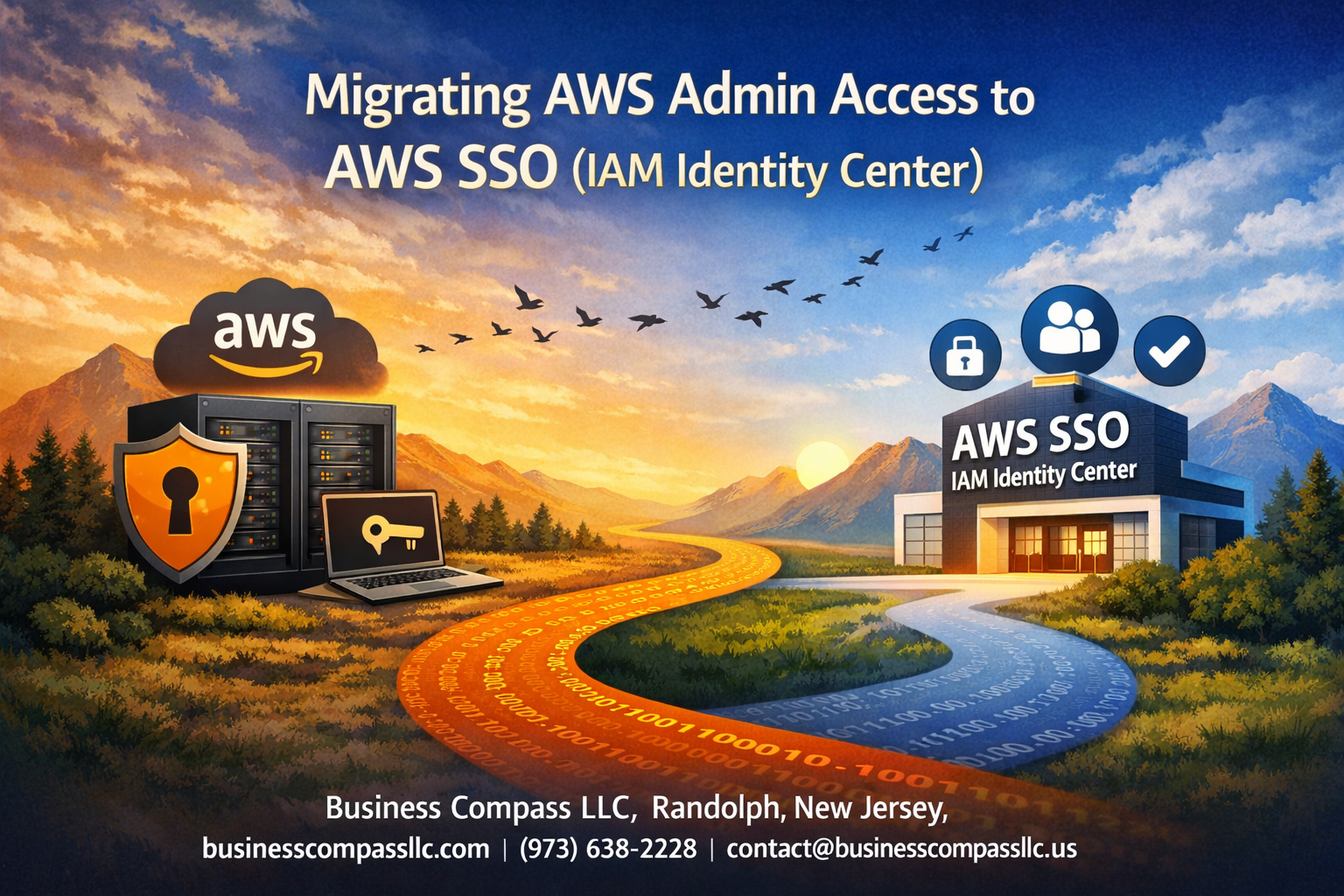
Moving your AWS admin access to AWS SSO (now called IAM Identity Center) can transform how your team manages permissions across multiple AWS accounts. This AWS SSO migration guide is designed for AWS administrators, DevOps engineers, and IT managers who want to centralize identity management and improve security posture.
Currently juggling multiple AWS accounts with scattered admin access? You’re not alone. Many organizations struggle with inconsistent permissions, password fatigue, and compliance headaches when managing AWS admin access across their infrastructure.
We’ll walk through the essential steps for a successful AWS SSO implementation, starting with how to assess your current setup and plan your migration strategy. You’ll also learn how to create AWS SSO permission sets that match your team’s needs and execute a smooth transition that minimizes downtime and maximizes security benefits.
Understanding AWS SSO and IAM Identity Center Benefits

Centralized Access Management Across Multiple AWS Accounts
AWS SSO migration brings your scattered AWS admin access under one unified roof. Instead of juggling multiple IAM users across dozens of AWS accounts, you get a single control panel where everything connects. Your team can access development, staging, and production environments without switching between different sets of credentials.
The beauty of centralized AWS identity management shows up when you’re managing enterprise-scale deployments. Picture having 50 AWS accounts for different business units, projects, and environments. Traditional IAM means creating separate users in each account, tracking who has what access, and updating permissions individually. AWS SSO flips this around by letting you define access once and apply it across your entire AWS organization.
This centralized approach means your security team can see who has access to what, when they used it, and what they did. No more hunting through CloudTrail logs across multiple accounts to piece together user activity. Everything flows through the IAM Identity Center, giving you that bird’s-eye view that makes compliance audits actually manageable.
Enhanced Security with Single Sign-On Capabilities
AWS single sign-on configuration eliminates the password fatigue that plagues most organizations. Your team logs in once and gains access to all their authorized AWS resources. This isn’t just convenient – it’s a security game-changer.
Multi-factor authentication becomes your default security posture across all AWS accounts. When someone tries to access your production environment, they’re not just entering a password they might have written on a sticky note. They’re going through your organization’s identity verification process, complete with MFA requirements that you control centrally.
The session management features give you granular control over how long people stay logged in and what they can do. Set up automatic session timeouts for sensitive environments, require re-authentication for high-risk operations, and ensure that departing employees lose access immediately across all AWS resources.
Your existing identity provider integrates directly with AWS SSO, so you’re not creating another identity silo. Whether you’re using Active Directory, Okta, or Azure AD, your users get seamless access to AWS resources using credentials they already know.
Reduced Administrative Overhead and Cost Savings
Managing AWS admin access through traditional IAM feels like herding cats. Every new team member means creating users across multiple accounts, setting up the right permissions, and hoping you didn’t miss anything. AWS SSO implementation cuts this administrative burden dramatically.
Your IT team spends less time on user provisioning and more time on projects that actually move your business forward. New hires get access to appropriate AWS resources through your standard onboarding process. When someone changes roles, you update their group membership once instead of hunting through individual account permissions.
The cost savings add up quickly when you consider the time your team spends on access management. Security audits become streamlined processes instead of multi-week investigations. Compliance reporting pulls directly from centralized logs rather than requiring manual data collection from scattered sources.
Automated user lifecycle management means departing employees lose access immediately without requiring manual cleanup across dozens of AWS accounts. This reduces both security risks and the administrative workload that comes with employee transitions.
Improved Compliance and Audit Trail Visibility
IAM Identity Center benefits shine brightest during compliance audits. Instead of explaining your complex web of cross-account IAM roles and trying to demonstrate who had access to what, you present a clear, centralized access management system.
AWS SSO permission sets create consistent access patterns that auditors can understand and verify. Your development team has the same type of access across all development accounts, your operations team has consistent production access, and exceptions are clearly documented and justified.
The audit trail becomes your friend rather than your nemesis. Every login, every role assumption, and every resource access gets logged centrally. When auditors ask about privileged access to your production database, you can show them exactly who accessed it, when, and what they did – all from one interface.
Compliance frameworks like SOC 2, PCI DSS, and HIPAA require demonstrable access controls and audit capabilities. AWS SSO gives you both without the custom tooling and complex reporting that traditional IAM setups demand. Your quarterly compliance reviews become routine status checks rather than stressful investigations.
Assessing Your Current AWS Admin Access Setup

Inventory existing IAM users and roles across accounts
Before jumping into your AWS SSO migration, you need a complete picture of what you’re working with. Start by cataloging every IAM user, service role, and cross-account role across all your AWS accounts. This discovery phase can be surprisingly revealing – most organizations find they have more IAM entities than expected.
Create a comprehensive spreadsheet or use AWS Config to track:
- Direct IAM users: List all human users with console access, API keys, and their last activity dates
- Service accounts: Document application-specific IAM users and their purposes
- Cross-account roles: Map out roles that allow access between different AWS accounts
- Federated access: Identify any existing SAML or OIDC integrations
- Programmatic access: Track users with API keys and their usage patterns
Pay special attention to dormant accounts – users who haven’t logged in for months might indicate over-provisioning or forgotten test accounts. Also note any IAM users with direct AWS console access, as these will be prime candidates for AWS SSO migration.
Document current permission sets and access patterns
Once you know who has access, map out exactly what permissions they have. This step often uncovers permission sprawl that’s accumulated over time. Review each user’s attached policies, both AWS managed and customer managed.
Look for these common patterns:
- Over-privileged users: Administrators with full access when they only need specific services
- Policy duplication: Multiple custom policies that essentially grant the same permissions
- Inconsistent access: Similar job functions with different permission levels across teams
- Emergency access patterns: How break-glass access currently works for critical situations
Document the business justification for each permission set. Ask teams why they need specific access levels and whether they actually use all granted permissions. This information becomes invaluable when designing AWS SSO permission sets later.
Create access pattern maps showing:
- Which users access which AWS accounts
- Frequency of cross-account access
- Time-based access needs (business hours vs. 24/7)
- Geographic access requirements
Identify security gaps in traditional IAM management
Traditional IAM management often reveals security vulnerabilities that AWS SSO can address. Look for these red flags in your current setup:
Password and credential issues frequently top the list. Check for users sharing credentials, weak passwords, or credentials that never rotate. Many organizations discover API keys embedded in code repositories or shared across teams.
Lack of centralized visibility makes it difficult to track who has access to what. Without proper logging and monitoring, unauthorized access changes can go unnoticed for months.
Inconsistent access reviews plague many AWS environments. Teams might review permissions quarterly in some accounts but never in others. This inconsistency creates security blind spots.
No session management means users stay logged in indefinitely. Look for accounts where session timeout policies are missing or too permissive.
Poor audit trails make compliance difficult. If you can’t easily answer “who did what when,” your current IAM setup has gaps that AWS Identity Center can fill.
Manual provisioning delays often lead to workarounds. When getting AWS access takes days or weeks, users find creative solutions that bypass security controls.
Document these gaps with specific examples and business impact. This documentation helps justify the AWS SSO migration to stakeholders and ensures your new identity management setup addresses real security concerns rather than just technical preferences.
Planning Your Migration Strategy

Define migration timeline and phases
Breaking down your AWS SSO migration strategy into manageable phases prevents overwhelming your team and reduces the risk of disrupting critical operations. Start by establishing a realistic timeline that accounts for your organization’s complexity and the number of AWS accounts involved.
Phase one should focus on setting up the foundational AWS SSO infrastructure and creating initial permission sets for non-production environments. This typically takes 2-4 weeks depending on your current setup complexity. Phase two involves migrating development and testing environments, allowing your team to gain confidence with the new system without affecting production workloads.
Phase three tackles staging environments, followed by the final phase targeting production systems. Each phase should include buffer time for testing, troubleshooting, and addressing unexpected issues. Consider seasonal business cycles, planned maintenance windows, and team availability when scheduling your AWS admin access migration strategy.
Document clear success criteria for each phase, including specific metrics for user adoption rates, permission validation, and system performance. Build in checkpoint reviews between phases to assess progress and make necessary adjustments before moving forward.
Map existing permissions to SSO permission sets
Creating an accurate inventory of your current IAM permissions forms the backbone of successful AWS SSO migration planning. Start by auditing all existing IAM users, groups, and roles across your AWS accounts, paying special attention to administrative access patterns and custom policies.
Use AWS tools like IAM Access Analyzer and AWS Config to generate comprehensive reports of current permissions and usage patterns. Document which users have console access versus programmatic access, and identify any service-specific permissions that might require custom permission sets in AWS SSO.
Group similar permission patterns together to create reusable AWS SSO permission sets that align with job functions rather than individual user requirements. Common patterns include:
- Full administrative access for senior engineers and DevOps teams
- Read-only access for auditors and compliance teams
- Service-specific access for developers working with particular AWS services
- Account-limited access for teams managing specific environments
Pay attention to any inline policies or permission boundaries that might not translate directly to standard AWS managed policies. These often require creating custom permission sets with specific policy documents.
Establish rollback procedures and contingency plans
Preparing for potential issues during your IAM Identity Center setup requires detailed rollback procedures that can quickly restore administrative access if problems arise. Document step-by-step rollback processes for each migration phase, including the specific commands and configurations needed to revert changes.
Create emergency access procedures that don’t depend on AWS SSO functionality. This includes maintaining at least one break-glass IAM user with administrative permissions in each AWS account, stored securely and accessible to designated team members. Test these emergency procedures regularly to ensure they work when needed.
Establish clear criteria for triggering rollback decisions, such as:
- More than 30% of users unable to access required resources
- Critical system outages lasting longer than predefined thresholds
- Security incidents related to the migration process
- Inability to complete essential business functions
Document communication protocols for rollback scenarios, including who makes the decision, how team members are notified, and what information needs to be communicated to stakeholders. Practice these scenarios through tabletop exercises to identify gaps in your planning.
Coordinate with stakeholders and team members
Effective stakeholder coordination starts with identifying everyone who will be impacted by the AWS SSO migration. This includes not just IT administrators, but also developers, security teams, compliance officers, and business users who rely on AWS resources for their daily work.
Create a communication plan that includes regular updates, training sessions, and feedback collection mechanisms. Schedule weekly progress meetings during active migration phases and establish clear escalation paths for issues that arise. Use multiple communication channels including email updates, team chat notifications, and dedicated migration status pages.
Provide hands-on training sessions for team members who will be managing AWS SSO permission sets and user assignments after the migration. Cover both routine administrative tasks and troubleshooting procedures to ensure your team can effectively support the new system.
Set up feedback loops to capture user experiences during each migration phase. This includes surveying users about access issues, collecting performance feedback, and monitoring support ticket volumes. Use this information to refine your approach for subsequent phases and improve the overall migration experience.
Assign specific roles and responsibilities to team members, including migration leads, technical implementers, communication coordinators, and user support personnel. Clear accountability helps ensure nothing falls through the cracks during the transition period.
Setting Up AWS SSO Infrastructure

Enable IAM Identity Center in your management account
Getting your AWS SSO infrastructure up and running starts with enabling IAM Identity Center in your AWS Organizations management account. This centralized approach gives you control over identity management across all member accounts in your organization.
Navigate to the IAM Identity Center console in your management account and click “Enable.” The setup process automatically creates the necessary service-linked roles and establishes the foundation for your AWS SSO implementation. Choose your region carefully – this becomes your Identity Center home region and can’t be changed later without recreating the entire setup.
During activation, AWS creates a unique Identity Center instance that becomes the central hub for managing user access across your organization. This instance includes default permission sets and establishes the trust relationships needed for cross-account access. The process typically takes a few minutes, and you’ll receive confirmation once the service is fully operational.
Configure identity source and user provisioning
Your identity source configuration determines how users authenticate and where their identity information comes from. You have three main options: the built-in Identity Center directory, Active Directory, or an external identity provider like Azure AD or Okta.
For organizations already using Active Directory, connecting your existing directory streamlines the AWS SSO migration process. Use AWS Directory Service to establish this connection, which enables automatic user synchronization and maintains your current password policies and group structures.
If you’re connecting an external identity provider, configure SAML 2.0 integration through the Identity Center console. This setup requires uploading metadata files and establishing attribute mappings between your external provider and Identity Center. Common attributes include:
- Username mapping (typically email address)
- Display name and first/last name fields
- Group memberships for automatic permission assignment
- Department or organizational unit information
For user provisioning, enable automatic provisioning using SCIM (System for Cross-domain Identity Management) if your identity source supports it. This keeps user accounts and group memberships synchronized automatically, reducing administrative overhead during and after your AWS admin access migration.
Create organizational units and account structure
Your AWS Organizations structure directly impacts how you’ll organize and manage access through IAM Identity Center. Review your current organizational units (OUs) and account groupings to ensure they align with your access management goals.
Create OUs that reflect your administrative boundaries – separate production from development environments, group accounts by business unit, or organize by geographic regions. This structure makes it easier to apply consistent permission sets across similar account types.
Consider creating dedicated OUs for different access levels:
- Production OU: Houses critical workload accounts with restricted access
- Development OU: Contains testing and development accounts with more flexible permissions
- Sandbox OU: Includes experimental or training accounts with broader access rights
- Security OU: Contains logging, monitoring, and security-focused accounts
Link your accounts to the appropriate OUs before proceeding with permission set assignments. This organizational foundation makes the remaining steps of your AWS SSO implementation much smoother and ensures consistent access patterns across similar account types.
Plan for future growth by creating placeholder OUs for new business units or regions. This forward-thinking approach prevents the need to restructure your IAM Identity Center configuration as your organization expands.
Creating and Configuring Permission Sets
Design permission sets based on job functions
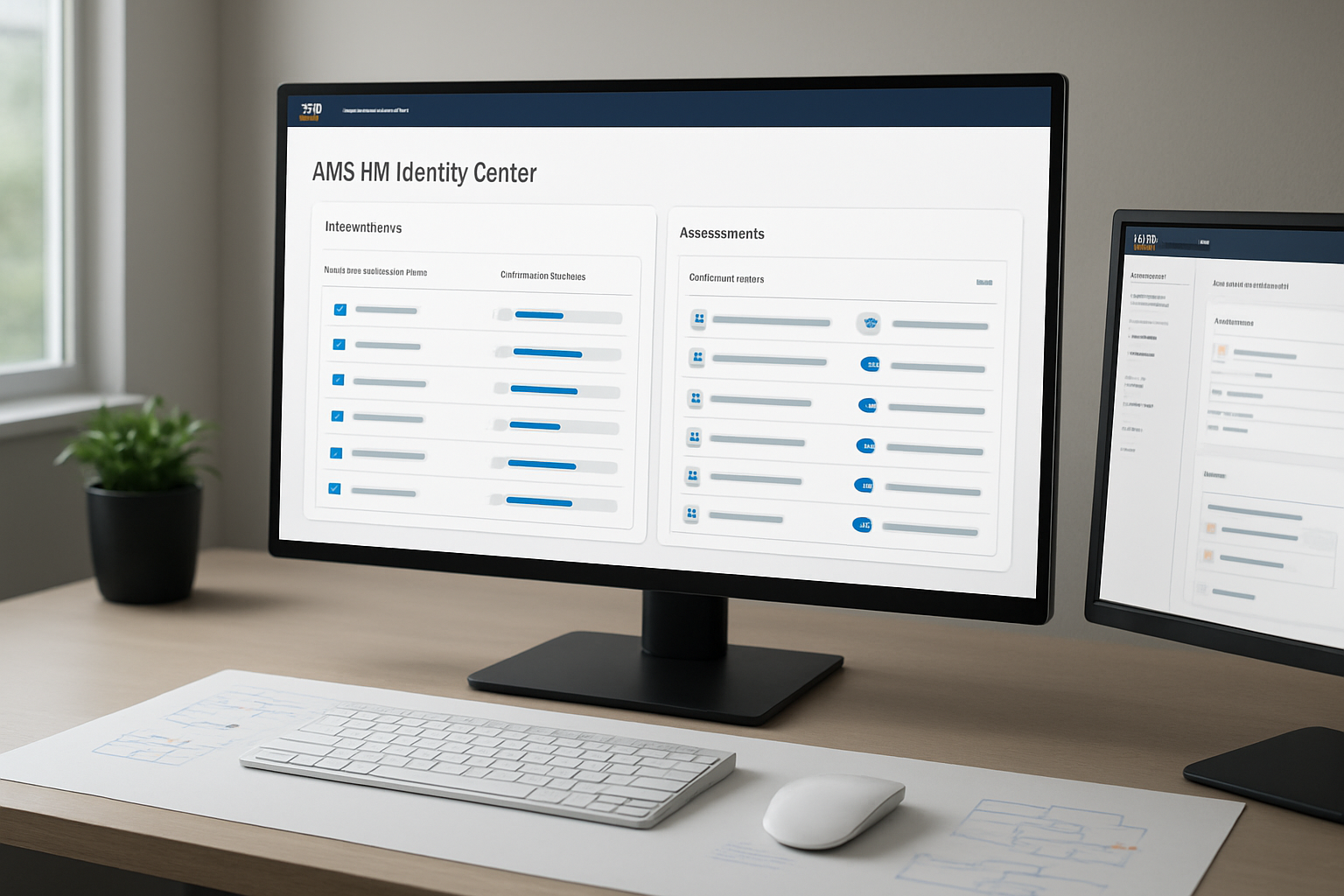
Creating effective AWS SSO permission sets starts with mapping your organization’s job functions to specific access requirements. Each role in your company needs different levels of AWS resource access, and permission sets should reflect these real-world responsibilities.
Start by identifying distinct job categories like developers, DevOps engineers, security analysts, and business users. Developers might need EC2 and Lambda access for application deployment, while security teams require CloudTrail and GuardDuty permissions. Database administrators need RDS and DynamoDB access, but shouldn’t have broad compute permissions.
Create standardized permission sets for each function rather than custom configurations for individual users. This approach simplifies management and ensures consistent access patterns across teams. Name your permission sets descriptively – “Developer-ReadWrite,” “SecurityAuditor-ReadOnly,” or “DatabaseAdmin-Full” – so their purpose is immediately clear.
Consider creating tiered permission sets within job functions. Junior developers might get read-only access to production resources, while senior developers receive read-write permissions. This granular approach supports career progression without requiring complete permission overhauls.
Document each permission set’s intended use case and the AWS services it covers. This documentation becomes invaluable during audits and helps new team members understand their access scope.
Implement least privilege access principles
AWS admin access migration requires strict adherence to least privilege principles. Users should receive only the minimum permissions necessary to perform their specific job functions, nothing more.
Begin by analyzing current IAM policies and identifying overprivileged users. Many organizations discover users with administrative access who only need read permissions, or developers with production write access when development environment access suffices.
Use AWS-managed policies as starting points, but customize them to match your organization’s specific needs. The “PowerUserAccess” managed policy might be too broad for most developers, while “ReadOnlyAccess” could be too restrictive. Create custom policies that sit between these extremes.
Implement conditional access based on resources, time, and location. Developers might access development resources anytime but need approval for production access. Database administrators could have full access to staging databases but read-only access to production during business hours.
Regular access reviews become easier with well-defined permission sets. Schedule quarterly reviews to validate that users still need their assigned permissions and remove access that’s no longer required.
Set up session duration and MFA requirements
Session management and multi-factor authentication form critical security layers in your AWS SSO implementation guide. Configure session durations based on risk levels and user needs.
High-privilege permission sets should have shorter session durations – typically 1-4 hours for administrative access. Regular users can have longer sessions, perhaps 8-12 hours, to balance security with productivity. Consider your organization’s work patterns when setting these limits.
Require MFA for all permission sets, with stronger authentication methods for elevated privileges. Administrative roles should require hardware tokens or biometric authentication, while standard users might use smartphone apps. Configure step-up authentication so users must re-authenticate when accessing sensitive resources.
Set different session policies for different access patterns. Users accessing AWS from corporate networks might get longer sessions than those connecting from external locations. Time-based restrictions can limit administrative access to business hours unless explicitly approved.
Configure automatic session termination for inactive users. This prevents abandoned sessions from remaining active, reducing security risks. Set reasonable timeouts that don’t disrupt legitimate work patterns.
Test permission sets in non-production environments
Thorough testing prevents access issues during your AWS SSO migration. Create test environments that mirror your production setup and validate each permission set before deployment.
Start with a comprehensive test matrix covering all user types and common tasks. Each permission set should be tested by actual users who will use those permissions in production. Developers should test code deployment, database administrators should verify backup procedures, and security teams should confirm monitoring access.
Use AWS CloudTrail to monitor test activities and identify permission gaps. When test users encounter access denied errors, determine whether the restriction is intentional or needs adjustment. This process often reveals edge cases not considered during initial permission set design.
Test cross-account access patterns if your organization uses multiple AWS accounts. Permission sets might work perfectly within single accounts but fail when users need to assume roles in other accounts. Validate that federation works correctly across your entire AWS organization structure.
Create rollback procedures for each permission set. If issues arise after deployment, you need quick ways to restore previous access levels. Document these procedures and ensure multiple team members understand the rollback process.
Run security scans on your test permission sets to identify potential privilege escalation paths. Tools like Prowler or custom scripts can identify overly permissive policies before they reach production environments.
Migrating Users and Access Patterns

Import existing users into IAM Identity Center
Moving your existing users into IAM Identity Center requires a strategic approach that minimizes disruption while maintaining security standards. The most efficient method depends on your current user management system.
If you’re currently managing users in Active Directory or another SAML-compatible identity provider, you can establish a federated connection. This approach preserves existing user credentials and authentication flows while extending AWS SSO capabilities. Configure the external identity source in IAM Identity Center by navigating to Settings > Identity source and selecting your provider type.
For organizations managing users directly in IAM or through local systems, user import becomes necessary. IAM Identity Center supports bulk user creation through CSV imports or API calls. Prepare your user data by collecting essential information including usernames, email addresses, display names, and group memberships. The CSV template available in the console streamlines this process.
Key considerations during user import:
- Maintain consistent naming conventions across all imported accounts
- Verify email addresses are accurate since they’re used for initial password setup
- Plan for temporary access disruption during the transition period
- Document existing user permissions before migration begins
Assign users to appropriate groups and permission sets
Effective group organization forms the backbone of successful AWS SSO implementation. Groups should reflect your organizational structure while supporting the principle of least privilege access.
Create groups that mirror your team structure and job functions. Common group patterns include:
- Team-based groups: DevOps-Team, SecurityTeam, DataAnalytics-Team
- Role-based groups: Administrators, Developers, ReadOnly-Users
- Environment-based groups: Production-Access, Staging-Access, Development-Access
Once groups are established, assign users based on their actual job responsibilities rather than their requested permissions. This approach helps identify over-privileged accounts and reduces security risks.
Permission set assignment follows group creation. Map each group to specific permission sets across relevant AWS accounts. A DevOps team might receive administrator access in development accounts but limited permissions in production environments. Document these mappings thoroughly since they become the foundation for your access control model.
Best practices for assignments:
- Start with minimal permissions and expand based on validated needs
- Use group assignments rather than individual user permissions
- Implement time-based access for sensitive environments when possible
- Regular review cycles to ensure continued appropriateness of access levels
Validate access across all target AWS accounts
Comprehensive testing ensures your AWS SSO migration maintains operational continuity while strengthening security posture. Validation should cover both functional access and security boundaries.
Begin testing in non-production environments to identify configuration issues without impacting critical systems. Have users from each group attempt to access their assigned AWS accounts through the SSO portal. Verify they can reach the correct accounts and assume their intended roles successfully.
Test permission boundaries by attempting actions that should be denied. This negative testing confirms your permission sets correctly restrict unauthorized activities. Pay special attention to cross-account access patterns and resource-specific permissions.
Systematic validation approach:
- User authentication testing: Verify all users can successfully log into the SSO portal
- Account access verification: Confirm users can access assigned AWS accounts without errors
- Permission validation: Test both allowed and restricted actions for each role
- Integration testing: Validate compatibility with existing tools and workflows
- Performance assessment: Monitor login times and account switching responsiveness
Document all test results and remediate issues before expanding to additional user groups. Create a rollback plan for each account migration in case unexpected issues arise during production testing.
Monitor CloudTrail logs during testing phases to identify unusual access patterns or permission escalations. This data provides valuable insights for refining your permission sets before full deployment.
Testing and Validation Process

Conduct Comprehensive Access Testing Scenarios
Before fully committing to your AWS SSO migration, create detailed test scenarios that mirror real-world usage patterns. Start by documenting every administrative task your team performs regularly – from launching EC2 instances to modifying IAM policies. Your test plan should cover different user personas: daily administrators, occasional users, and emergency responders.
Create test accounts that represent each permission set you’ve configured. Walk through typical workflows like accessing the AWS Console, using CLI tools, and switching between multiple AWS accounts. Test cross-account access patterns extensively, ensuring users can seamlessly move between development, staging, and production environments without friction.
Don’t forget to simulate edge cases. What happens when a user tries to access a resource they shouldn’t have permissions for? Test session timeouts, concurrent logins, and the behavior when permission sets are modified while users are actively working. Document every step, expected outcome, and actual result to identify gaps in your AWS SSO implementation guide.
Verify Administrative Functions Work Correctly
Administrative functions require special attention during testing since they form the backbone of your AWS identity management system. Focus on critical operations that administrators perform daily: user provisioning, permission modifications, and account management tasks.
Test the complete lifecycle of user management through AWS SSO. Create new users, assign them to groups, modify their permissions, and eventually deactivate accounts. Verify that group-based permissions work as expected and that users automatically inherit the correct access when added to specific groups.
Pay special attention to multi-account administrative scenarios. Ensure administrators can manage resources across different AWS accounts without encountering permission boundaries or authentication issues. Test bulk operations, permission inheritance, and the ability to delegate administrative tasks to other team members.
Validate that your AWS SSO permission sets correctly map to the administrative functions previously handled by direct IAM roles. Check that service-linked roles, cross-service permissions, and API access patterns continue working seamlessly after migration.
Ensure Emergency Access Procedures Remain Intact
Emergency access represents a critical safety net that must survive your AWS admin access migration. Review your existing break-glass procedures and adapt them to work with AWS SSO while maintaining security controls.
Create dedicated emergency access permission sets with elevated privileges that can bypass normal approval workflows. Test these emergency procedures under simulated crisis conditions – disable normal access paths and verify that authorized personnel can still reach critical systems quickly.
Document the complete emergency access workflow: who can activate these procedures, how to authenticate during an emergency, which systems remain accessible, and how to audit emergency activities afterward. Your emergency access should work independently of your primary authentication systems to avoid single points of failure.
Consider scenarios like AWS SSO service outages, network connectivity issues, or compromised primary authentication systems. Maintain alternative access methods such as emergency IAM users with strong MFA requirements, but ensure these backup methods integrate with your overall security monitoring and don’t create shadow access patterns.
Validate Logging and Monitoring Capabilities
Your AWS SSO migration must maintain or improve your security visibility. Configure comprehensive logging that captures authentication events, permission changes, and administrative activities across all connected AWS accounts.
Enable AWS CloudTrail integration to track all SSO-related API calls and user activities. Set up centralized log collection that aggregates authentication events, failed login attempts, and permission escalations. Your logging strategy should provide clear audit trails for compliance requirements and security investigations.
Test your monitoring alerts with realistic scenarios. Trigger alerts for suspicious login patterns, unusual permission usage, or administrative changes outside normal business hours. Verify that your security team receives actionable notifications without being overwhelmed by false positives.
Configure dashboards that provide real-time visibility into user access patterns, permission usage, and system health. Your monitoring should help identify unused permissions, over-privileged accounts, and potential security risks. Validate that your logging captures sufficient detail for forensic analysis while protecting sensitive information appropriately.
Test log retention, archival procedures, and the ability to quickly search and analyze authentication data during security incidents. Your monitoring capabilities should exceed what you had with traditional IAM approaches, providing better insights into user behavior and access patterns across your AWS infrastructure.
Go-Live and Post-Migration Activities

Execute the cutover to SSO-based access
The moment has arrived to flip the switch on your AWS SSO migration. Start by scheduling your cutover during a maintenance window when user activity is minimal. Create a detailed cutover checklist that includes all critical tasks and their dependencies.
Begin with a small group of pilot users before rolling out to everyone. This phased approach allows you to catch any last-minute issues without disrupting your entire team. Communicate the exact timeline to all stakeholders, including backup procedures if something goes wrong.
During the cutover, users will need to access AWS services through the new SSO portal rather than their traditional IAM user credentials. Update all documentation, bookmarks, and internal wikis with the new access URLs. Most users find the transition straightforward once they understand the new login flow.
Keep your incident response team on standby during the initial hours. Monitor authentication logs closely to ensure users can successfully log in and access their required resources.
Decommission legacy IAM users and roles
Don’t rush into deleting your old IAM users and roles immediately after go-live. Follow a structured decommissioning process that prioritizes safety over speed. Start by identifying which IAM entities are no longer needed based on your migration mapping.
Create a grace period of at least two weeks before permanently removing any IAM users. During this time, disable rather than delete these accounts. This approach gives you a safety net if users encounter access issues with their new SSO-based permissions.
For service accounts and programmatic access that can’t move to SSO, document these exceptions clearly. These might include CI/CD pipelines, monitoring tools, or third-party integrations that require long-term access keys.
Archive or export important metadata from IAM users before deletion, including creation dates, last activity timestamps, and permission histories. This information proves valuable for compliance audits and troubleshooting future access issues.
Use AWS Config or custom scripts to track which IAM entities remain active after your migration timeline. Set up alerts for any unexpected usage of legacy credentials to prevent shadow IT practices from creeping back in.
Monitor system performance and user adoption
Track key metrics that indicate the health of your AWS SSO implementation. Focus on authentication success rates, login duration, and permission resolution times. These metrics help identify performance bottlenecks before they impact productivity.
Set up CloudWatch dashboards specifically for SSO monitoring. Include metrics like failed login attempts, permission set assignments, and user session durations. Create automated alerts for unusual patterns that might indicate security issues or system problems.
User adoption metrics tell you how well your migration is working in practice. Monitor daily active users in the SSO portal compared to legacy IAM user activity. Look for patterns where users might be falling back to old access methods or struggling with new workflows.
Pay special attention to peak usage times when your team typically accesses AWS resources. SSO performance during these periods directly impacts user satisfaction and productivity. Document any performance degradation and have scaling plans ready.
Gather feedback and make necessary adjustments
Launch a feedback collection process within the first week after go-live. Create simple surveys or feedback forms that capture both positive experiences and pain points. Target specific user groups like developers, operations teams, and managers separately since their needs differ.
Schedule one-on-one sessions with power users who heavily rely on AWS access. These conversations often reveal workflow issues that surveys miss. Listen for common themes around permission gaps, workflow disruptions, or tools that need updating.
Address quick wins first – simple permission adjustments or documentation updates that improve the user experience immediately. These small improvements build confidence in the new system and show your team that their feedback matters.
Create a backlog of enhancement requests based on user feedback. Prioritize changes that affect the largest number of users or address security concerns. Some adjustments might require permission set modifications, while others could involve process changes or additional training.
Document lessons learned from the entire migration process. This knowledge becomes invaluable for future SSO expansions to other AWS accounts or for helping other teams in your organization with similar migrations.

Moving from traditional AWS admin access to AWS SSO represents a significant step forward in cloud security and management. By centralizing user management, implementing permission sets, and establishing consistent access patterns across your AWS environment, you create a more secure and scalable foundation for your organization. The migration process requires careful planning and thorough testing, but the long-term benefits of reduced complexity, improved security posture, and easier user management make the effort worthwhile.
Ready to make the switch? Start by auditing your current access setup and identifying the users and permissions that need migration. Take your time with the planning phase, set up your permission sets thoughtfully, and don’t skip the testing process. Once you go live, keep monitoring and refining your setup to get the most out of AWS SSO’s capabilities. Your future self will thank you for building a cleaner, more secure AWS access management system.