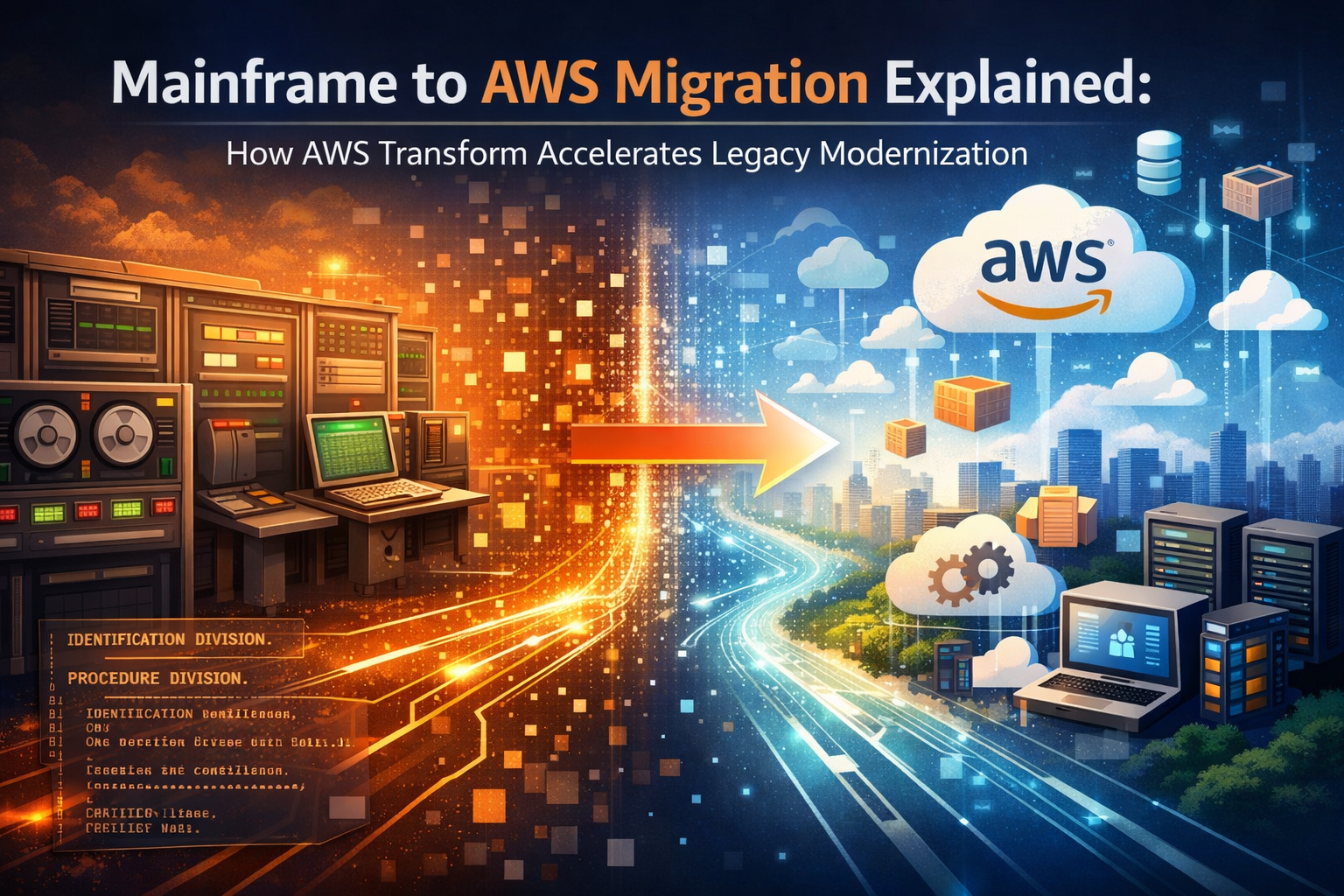
Moving your mainframe systems to AWS doesn’t have to feel like climbing Mount Everest. Mainframe migration to AWS has become a critical business priority for organizations stuck with expensive, hard-to-maintain legacy systems that slow down innovation and drain IT budgets.
This guide is designed for IT leaders, cloud architects, and enterprise decision-makers who need to understand how AWS Transform service can streamline their legacy system modernization journey without the typical headaches and massive resource commitments.
You’ll discover the core fundamentals of mainframe to cloud migration, including why traditional approaches often fail and what makes AWS’s approach different. We’ll walk through AWS Transform capabilities and how this AWS migration accelerator handles the heavy lifting of assessment, planning, and execution. Finally, you’ll learn proven strategies for cloud migration planning that reduce risk and accelerate time-to-value, plus how to optimize your newly migrated systems for peak performance and cost efficiency.
The days of putting off mainframe to AWS transformation due to complexity and risk are over. Let’s explore how AWS Transform makes legacy application migration faster, safer, and more predictable than ever before.
Understanding Mainframe to AWS Migration Fundamentals
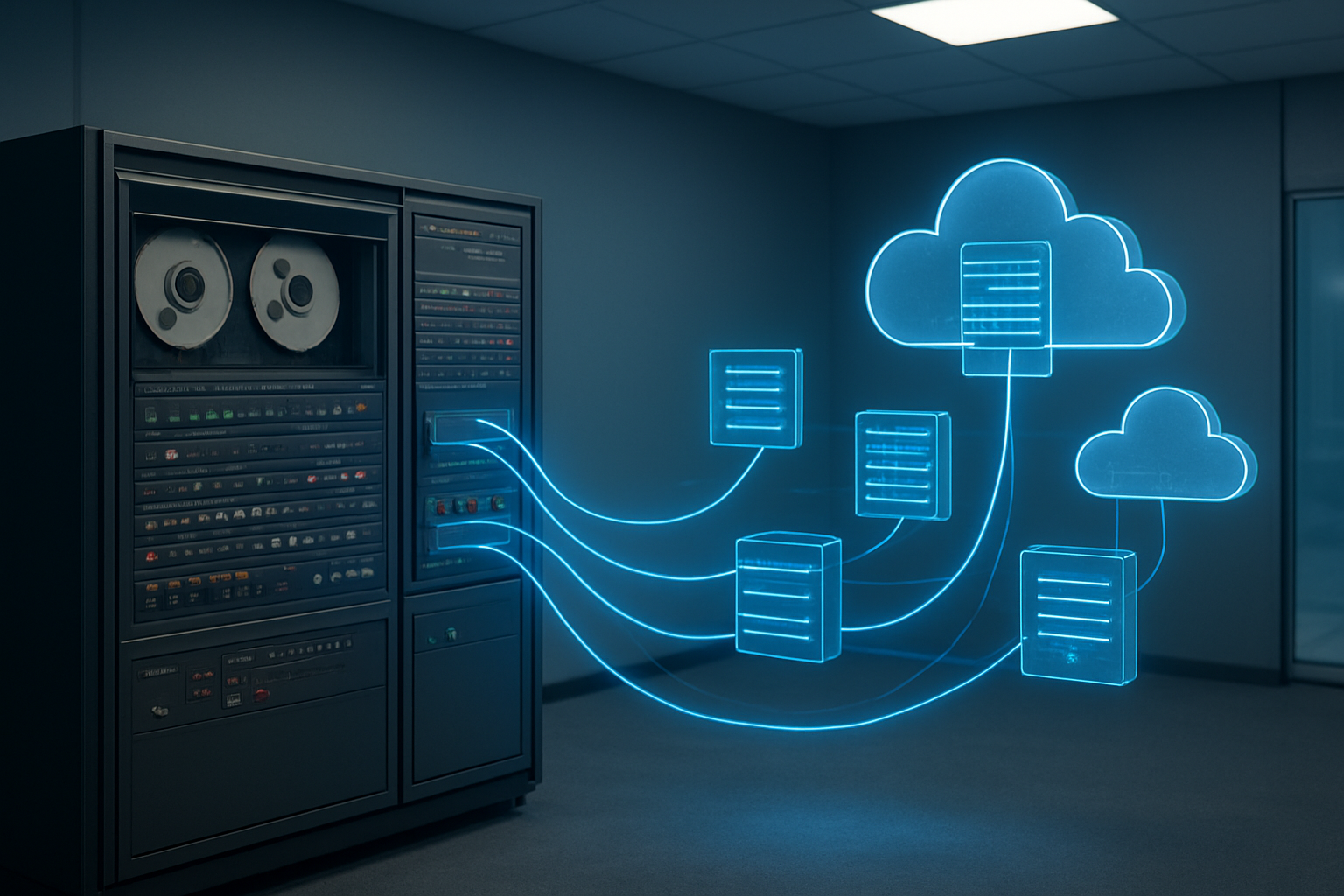
Key drivers behind mainframe modernization initiatives
Organizations face mounting pressure to modernize their mainframe systems as business demands evolve rapidly. The most significant driver is cost reduction – maintaining legacy mainframes requires specialized skills that command premium salaries, while hardware maintenance contracts continue to escalate year over year. Many companies discover they’re spending millions annually on systems that deliver diminishing returns.
Digital transformation requirements push organizations toward cloud platforms like AWS, where they can integrate modern technologies such as artificial intelligence, machine learning, and real-time analytics. Mainframes often create data silos that prevent businesses from leveraging these advanced capabilities effectively.
Talent scarcity presents another critical challenge. As experienced mainframe professionals retire, finding skilled replacements becomes increasingly difficult and expensive. Younger developers typically gravitate toward modern cloud technologies, leaving organizations vulnerable to knowledge gaps.
Regulatory compliance and security concerns also drive migration decisions. Modern cloud platforms offer sophisticated security features, automated compliance reporting, and disaster recovery capabilities that exceed what many aging mainframe environments can provide.
Business agility demands faster application deployment and scaling capabilities. Mainframes struggle to support the rapid development cycles that modern businesses require, while cloud platforms enable continuous integration and deployment practices that accelerate time-to-market.
Core benefits of migrating legacy systems to AWS cloud
AWS Transform service delivers immediate cost savings through its pay-as-you-use model, eliminating the need for expensive mainframe hardware refresh cycles. Organizations typically see 20-40% reduction in total computing costs within the first year after migration.
Scalability and flexibility become game-changers for businesses experiencing variable workloads. AWS automatically scales resources up or down based on demand, something traditional mainframes cannot match without significant capital investment.
Enhanced security through AWS’s shared responsibility model provides enterprise-grade protection with features like encryption at rest and in transit, identity and access management, and continuous monitoring. AWS maintains security certifications that many organizations couldn’t achieve independently.
Developer productivity increases dramatically when teams can access modern development tools, APIs, and services. The AWS ecosystem offers hundreds of services that developers can integrate seamlessly, reducing custom coding requirements and accelerating project delivery.
Global reach enables organizations to deploy applications closer to their customers worldwide, improving performance and user experience. AWS’s global infrastructure spans multiple regions and availability zones, providing built-in redundancy and disaster recovery capabilities.
Innovation acceleration becomes possible through access to cutting-edge AWS services like machine learning, IoT platforms, and serverless computing. These capabilities would require substantial investment and expertise to develop in-house on mainframe platforms.
Common challenges organizations face during migration
Data complexity represents the biggest hurdle in mainframe to cloud migration. Legacy systems often contain decades of accumulated data in proprietary formats that require careful analysis and transformation. Organizations frequently discover undocumented dependencies and business logic embedded within data structures.
Application interdependencies create migration complexity as mainframe applications typically share resources and communicate through methods that don’t translate directly to cloud architectures. Mapping these relationships requires extensive analysis to prevent breaking critical business processes.
Skills gap challenges teams throughout the migration process. While mainframe expertise is scarce, cloud migration also demands new skills in areas like containerization, microservices architecture, and cloud-native security practices.
Downtime concerns keep business leaders awake at night. Many mainframe applications support mission-critical operations that cannot tolerate extended outages. Planning migration strategies that minimize business disruption requires careful coordination and often involves complex parallel processing scenarios.
Compliance and governance requirements may impose restrictions on how and where data can be migrated. Financial services, healthcare, and government organizations face particularly stringent requirements that must be addressed throughout the migration process.
Testing and validation becomes exponentially more complex when migrating systems that have evolved over decades. Organizations must verify that all business logic translates correctly while ensuring performance meets or exceeds current mainframe capabilities.
Critical success factors for smooth transition
Executive sponsorship provides the foundation for successful mainframe modernization strategy. Leadership must commit adequate resources and maintain support throughout the multi-year journey that most migrations require.
Comprehensive assessment should precede any migration planning. Organizations need detailed inventory of applications, data dependencies, performance requirements, and compliance obligations. This assessment phase typically takes 3-6 months but prevents costly mistakes later.
Phased migration approach reduces risk and allows organizations to learn from early experiences. Starting with less critical applications provides valuable lessons that improve subsequent migration phases.
Change management ensures that end users and business stakeholders remain engaged throughout the transition. Regular communication, training programs, and feedback mechanisms help organizations maintain productivity during the migration process.
Partner selection can make or break migration success. Organizations should choose AWS partners with proven mainframe migration experience and access to automated tools that accelerate the transformation process.
Performance monitoring throughout migration phases helps teams identify and resolve issues before they impact business operations. Establishing baseline metrics and continuous monitoring ensures the new AWS environment meets performance expectations.
Security-first mindset protects organizations throughout the migration journey. Implementing AWS security best practices from day one prevents vulnerabilities and ensures compliance requirements are met consistently.
AWS Transform Service Overview and Capabilities
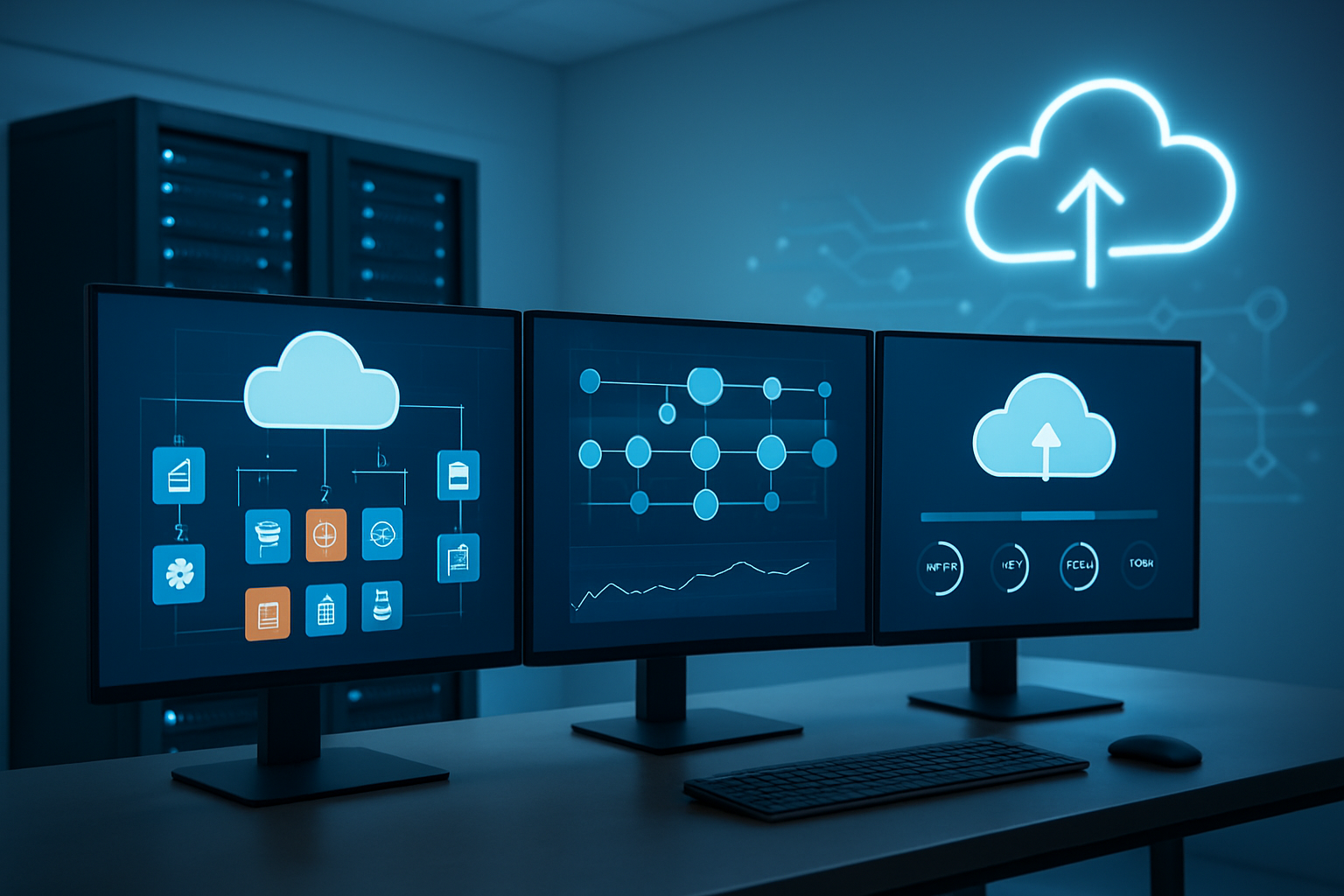
Comprehensive suite of transformation tools and services
AWS Transform delivers a complete ecosystem of specialized tools designed to handle every aspect of mainframe migration to AWS. The service includes automated discovery tools that map legacy application dependencies, data flow analyzers that trace information pathways through mainframe systems, and performance profiling utilities that establish baseline metrics for modernized applications.
The platform offers dedicated migration accelerators for popular mainframe languages including COBOL, PL/I, and Assembler. Each accelerator includes language-specific conversion engines, business logic preservation frameworks, and compliance validation modules. Database migration tools within the suite handle DB2, IMS, and VSAM data transformations while maintaining referential integrity and transaction consistency.
| Tool Category | Key Components | Primary Function |
|---|---|---|
| Discovery & Analysis | Dependency Mapper, Code Scanner | Application inventory and relationship mapping |
| Code Conversion | Language Accelerators, Syntax Translators | Transform legacy code to modern languages |
| Data Migration | Schema Converters, ETL Pipelines | Move and restructure mainframe data |
| Testing & Validation | Automated Test Generators, Regression Suites | Ensure migration accuracy |
Automated code conversion and refactoring features
The AWS Transform service automatically converts mainframe applications into cloud-native architectures using advanced pattern recognition and machine learning algorithms. The conversion engine analyzes COBOL business logic and transforms it into Java, Python, or C# while preserving the original functionality and business rules.
Smart refactoring capabilities break down monolithic mainframe applications into microservices architecture. The system identifies natural service boundaries within legacy code and suggests optimal decomposition strategies. Batch processing workflows get converted to event-driven serverless functions, while online transaction processing systems transform into REST APIs with appropriate scaling configurations.
The automated refactoring includes:
- Dead code elimination and optimization
- Modern design pattern implementation
- Database query optimization for cloud environments
- Security enhancement with AWS IAM integration
- Configuration externalization for container deployment
Built-in testing and validation mechanisms
AWS Transform includes comprehensive testing frameworks that automatically generate test cases based on existing mainframe data and transaction patterns. The system creates regression test suites that compare outputs between original mainframe applications and their modernized counterparts, ensuring functional equivalency throughout the migration process.
Performance validation tools continuously monitor application behavior during the transformation process. These mechanisms establish performance baselines from mainframe environments and validate that cloud-native versions meet or exceed original response times and throughput metrics. Load testing capabilities simulate mainframe workload patterns against AWS infrastructure to identify potential bottlenecks before production deployment.
Data integrity validation runs automatically during migration, comparing data checksums, record counts, and business rule compliance between source and target systems. Security validation ensures that access controls, data encryption, and audit trails maintain the same level of protection in the cloud environment.
Integration with existing AWS infrastructure services
AWS Transform seamlessly connects with the broader AWS ecosystem, enabling organizations to leverage existing cloud investments during mainframe modernization. The service integrates directly with AWS Database Migration Service for large-scale data transfers, Amazon RDS for managed database hosting, and AWS Lambda for serverless computing workloads.
Container orchestration through Amazon EKS allows modernized applications to run in scalable, managed Kubernetes environments. Integration with AWS CodePipeline enables continuous integration and deployment workflows, while AWS CloudFormation templates automate infrastructure provisioning for migrated applications.
The platform connects with AWS monitoring and observability services including CloudWatch, X-Ray, and AWS Config. This integration provides real-time visibility into application performance, security posture, and compliance status across the entire migration lifecycle. AWS Transform also works with existing AWS networking configurations, security groups, and VPC setups to maintain consistent security boundaries and network policies.
Strategic Migration Planning and Assessment

Legacy System Inventory and Dependency Mapping
Before jumping into a mainframe migration to AWS, you need to know exactly what you’re working with. Creating a comprehensive inventory of your legacy systems involves cataloging every application, database, middleware component, and integration point currently running on your mainframe infrastructure. This process goes beyond simple asset tracking – it requires documenting programming languages (COBOL, PL/I, Assembler), data formats, file structures, and batch processing schedules that have evolved over decades.
Dependency mapping reveals the intricate web of connections between systems that often surprises even seasoned IT teams. Modern dependency discovery tools can automatically trace data flows, API calls, and shared resources across your mainframe environment. However, manual validation remains crucial since legacy systems often contain undocumented connections and workarounds built by previous development teams.
Key areas to focus on during inventory include:
- Critical business applications and their processing schedules
- Data repositories including hierarchical databases and flat files
- Integration touchpoints with external systems and partners
- Security protocols and access control mechanisms
- Performance benchmarks and current resource utilization patterns
This foundation work directly supports your mainframe modernization strategy by identifying which components can move to AWS Transform service capabilities and which require custom migration approaches.
Cost-Benefit Analysis and ROI Projections
Building a compelling business case for AWS migration accelerator adoption requires detailed financial modeling that accounts for both immediate migration costs and long-term operational benefits. Start by establishing baseline costs for your current mainframe operations, including hardware maintenance contracts, software licensing fees, specialized personnel costs, and facility expenses that often reach six or seven figures annually.
AWS Transform service offers predictable pricing models that contrast sharply with traditional mainframe cost structures. Your analysis should compare current MIPS-based pricing against AWS’s consumption-based model, factoring in potential savings from:
| Cost Category | Mainframe | AWS Transform |
|---|---|---|
| Hardware refresh cycles | 3-5 year major investments | Pay-as-you-scale model |
| Software licensing | Annual enterprise fees | Usage-based pricing |
| Specialized staff | Premium salaries for rare skills | Broader cloud skillset availability |
| Facility costs | Dedicated data center space | Eliminated infrastructure overhead |
ROI projections should span 3-5 years and include quantifiable benefits like reduced time-to-market for new features, improved disaster recovery capabilities, and enhanced scalability for business growth. Many organizations discover that cloud migration planning reveals opportunities for process optimization that weren’t visible in the mainframe environment.
Don’t forget to account for productivity gains from modern development tools and CI/CD pipelines that replace cumbersome mainframe development cycles. These operational improvements often deliver returns that exceed pure cost savings.
Risk Assessment and Mitigation Strategies
Legacy application migration carries inherent risks that require proactive planning and systematic mitigation approaches. Data integrity tops the risk list – decades of business-critical information must transfer without corruption or loss. Implement comprehensive data validation frameworks that compare source and target systems at multiple checkpoints throughout the migration process.
Business continuity risks demand careful attention since mainframe systems often support mission-critical operations that can’t tolerate extended downtime. Your mitigation strategy should include:
- Phased migration approaches that minimize system disruption
- Parallel processing capabilities during transition periods
- Rollback procedures for each migration phase
- Real-time monitoring of system performance and data accuracy
Technical risks emerge from differences between mainframe and cloud architectures. COBOL programs optimized for batch processing may require significant refactoring for cloud-native environments. AWS Transform capabilities help address these challenges through automated code conversion tools, but custom applications often need manual intervention.
Skill gaps present another major risk factor. Your team needs training on AWS services and modern development practices while maintaining expertise in legacy systems during the transition. Start skill development programs early and consider partnering with AWS-certified consultants who specialize in mainframe to AWS transformation.
Regulatory compliance adds complexity, especially in heavily regulated industries like banking and healthcare. Document how your migrated systems will maintain audit trails, data retention policies, and security controls that meet current regulatory requirements. This documentation becomes crucial during compliance reviews and helps avoid costly remediation work after migration completion.
Technical Implementation Process

Data Migration Strategies and Best Practices
Migrating data from mainframes to AWS requires a careful balance between speed, accuracy, and minimal business disruption. AWS Transform provides multiple pathways for data migration depending on your specific requirements and constraints.
Bulk Transfer Approaches
For large datasets, AWS Snowball and Snowmobile services handle massive data volumes efficiently. These physical transfer methods work well when network bandwidth limitations make online transfers impractical. The service helps organizations move petabytes of data while maintaining data integrity through encrypted transfers.
Real-time Synchronization Methods
AWS Database Migration Service (DMS) enables continuous replication of mainframe data to cloud-based systems. This approach allows for gradual migration with minimal downtime. Change data capture (CDC) functionality ensures that updates made during migration don’t get lost, maintaining data consistency across both environments.
Data Transformation During Migration
Legacy data often requires format changes to work with modern cloud architectures. AWS Glue automates much of this transformation work, converting EBCDIC to ASCII, restructuring hierarchical data into relational formats, and handling date conversions between different systems.
Application Modernization Approaches
Lift-and-Shift Migration
Many organizations start with rehosting applications on AWS EC2 instances with minimal changes. This approach gets applications off mainframes quickly while providing immediate cost benefits. Though not fully optimized for cloud, it establishes a foundation for future modernization efforts.
Refactoring for Cloud-Native Architecture
Breaking monolithic mainframe applications into microservices creates more flexible, scalable systems. AWS Transform helps identify natural break points in legacy code where services can be separated. This process often reveals opportunities to replace custom code with managed AWS services.
API-First Integration Strategy
Creating APIs around existing mainframe functions allows gradual modernization without complete rewrites. AWS API Gateway manages these interfaces while Lambda functions handle lightweight processing tasks. This approach lets teams modernize piece by piece rather than tackling entire applications at once.
Infrastructure Provisioning and Configuration
Automated Infrastructure Deployment
AWS CloudFormation templates define infrastructure as code, making deployments repeatable and consistent. These templates capture mainframe workload requirements and translate them into appropriate AWS resource configurations. Version control systems track infrastructure changes, providing rollback capabilities when needed.
Network Architecture Design
Mainframe migration to AWS requires careful network planning to maintain performance and security. VPC design should account for data flow patterns from legacy systems. Direct Connect provides dedicated bandwidth for hybrid environments where some mainframe components remain on-premises during transition periods.
Compute Resource Sizing
Right-sizing AWS instances for mainframe workloads involves understanding CPU utilization patterns, memory requirements, and I/O characteristics. AWS Compute Optimizer analyzes these patterns and recommends optimal instance types. Reserved Instances can significantly reduce costs for predictable workloads.
Security Implementation and Compliance Alignment
Identity and Access Management
Migrating mainframe security models to AWS IAM requires mapping mainframe user roles and permissions to cloud-native controls. Multi-factor authentication and role-based access control maintain security standards while providing more granular permission management than traditional mainframe systems.
Data Encryption Standards
AWS provides encryption at rest and in transit for all data stores. KMS handles key management with hardware security modules (HSMs) meeting FIPS 140-2 Level 3 requirements. This often exceeds mainframe encryption capabilities while simplifying key rotation and management processes.
Compliance Framework Alignment
Industries with strict compliance requirements can leverage AWS compliance certifications. SOC 2, PCI DSS, HIPAA, and other frameworks are already validated, reducing audit burden. AWS Config continuously monitors resource configurations against compliance rules, automatically flagging deviations.
Performance Optimization Techniques
Database Performance Tuning
Migrated databases often benefit from cloud-native optimization techniques. Amazon RDS automated backups, Multi-AZ deployments, and read replicas improve availability and performance over traditional mainframe database setups. Parameter groups allow fine-tuning database engines for specific workload characteristics.
Caching Strategy Implementation
ElastiCache reduces database load by caching frequently accessed data in memory. This approach often eliminates performance bottlenecks that required expensive mainframe upgrades. Application-level caching with Redis or Memcached can dramatically improve response times for user-facing applications.
Auto Scaling Configuration
Unlike fixed mainframe capacity, AWS auto scaling adjusts resources based on actual demand. CloudWatch metrics trigger scaling events, ensuring applications have sufficient resources during peak periods while reducing costs during quiet times. This elasticity often provides better performance at lower overall costs than mainframe environments.
Accelerated Delivery Through AWS Transform
Reduced Manual Coding Requirements
AWS Transform dramatically cuts down the amount of hand-written code needed during mainframe migration to AWS. The service automatically converts COBOL, PL/I, and Assembler programs into modern Java applications, eliminating thousands of hours of manual translation work. This automated conversion process handles complex business logic, data structures, and system calls that would typically require specialized mainframe developers to rewrite from scratch.
The transformation engine analyzes existing mainframe applications and generates equivalent cloud-native code while preserving the original business functionality. Database schemas, file structures, and transaction processing logic all get converted automatically, reducing the risk of human error that comes with manual coding efforts. Development teams can focus on enhancing applications rather than spending months translating legacy code line by line.
Faster Time-to-Market for Modernized Applications
Speed becomes a competitive advantage when organizations leverage AWS Transform service capabilities. Traditional legacy system modernization projects often stretch across multiple years, but AWS Transform compresses these timelines significantly. Applications that would normally take 18-24 months to migrate and modernize can now be ready for production in 6-12 months.
The accelerated timeline comes from parallel processing capabilities built into the transformation workflow. While the service converts application code, teams can simultaneously work on infrastructure setup, testing frameworks, and user training. This parallel approach eliminates the sequential bottlenecks that plague traditional migration projects.
Early deployment opportunities emerge as individual application modules complete transformation. Organizations don’t need to wait for entire systems to finish conversion before realizing benefits. Incremental rollouts allow businesses to start capturing cloud advantages while other components continue through the transformation pipeline.
Minimized Business Disruption During Transition
Business continuity remains protected throughout the mainframe to cloud migration process. AWS Transform enables organizations to maintain existing operations while new cloud applications undergo development and testing in parallel environments. This dual-track approach prevents the operational disruptions that typically accompany major system changes.
The service supports gradual cutover strategies where individual business functions migrate incrementally rather than through risky “big bang” approaches. Critical processes continue running on mainframe systems until cloud alternatives prove stable and reliable. Data synchronization tools keep information consistent between old and new environments during transition periods.
User workflows remain largely unchanged during migration phases. Applications maintain familiar interfaces and functionality, reducing training requirements and user resistance. Behind-the-scenes transformations happen transparently, allowing employees to continue their daily work without significant interruption.
Enhanced Scalability and Reliability Outcomes
Cloud-native applications emerging from AWS Transform capabilities deliver superior performance characteristics compared to their mainframe predecessors. Automatic scaling responds to demand fluctuations without manual intervention, eliminating capacity planning guesswork and over-provisioning costs.
Modern architectures support distributed processing and fault tolerance that surpass traditional mainframe reliability models. Applications can span multiple availability zones and regions, providing disaster recovery capabilities that would be prohibitively expensive with legacy infrastructure.
Performance improvements become immediately apparent as applications leverage cloud services like managed databases, caching layers, and content delivery networks. Response times often improve dramatically while supporting higher concurrent user loads than original mainframe systems could handle.
Cost optimization opportunities multiply as applications gain access to cloud pricing models including reserved instances, spot computing, and pay-as-you-go services. Organizations typically see 20-40% cost reductions compared to maintaining equivalent mainframe capacity.
Post-Migration Optimization and Management

Continuous monitoring and performance tuning
Your mainframe to AWS migration success doesn’t end when systems go live. Real optimization happens through ongoing performance monitoring that catches issues before they impact users. AWS CloudWatch becomes your primary dashboard, tracking everything from CPU usage to database response times across your newly migrated applications.
Setting up comprehensive monitoring requires establishing baseline metrics from your legacy mainframe environment. Compare these against AWS performance data to identify bottlenecks and optimization opportunities. Many organizations discover their migrated applications perform better than expected, but without proper monitoring, you might miss chances to reduce costs or improve user experience.
Performance tuning often reveals surprising insights. Batch jobs that once took hours on mainframes might complete in minutes on AWS, opening opportunities to run them more frequently. Database queries that struggled with mainframe constraints can leverage AWS’s elastic capabilities for dramatic improvements.
Automated scaling policies help your systems adapt to changing workloads without manual intervention. Configure Auto Scaling groups to handle peak traffic periods while scaling down during quiet hours. This dynamic approach represents a fundamental shift from mainframe’s fixed resource model.
Cost optimization strategies for ongoing operations
Managing AWS costs after mainframe migration requires active attention and strategic planning. Reserved Instances offer significant savings for predictable workloads – often 30-60% less than on-demand pricing. Analyze your usage patterns over several months to identify stable workloads suitable for Reserved Instance commitments.
Spot Instances present another cost-cutting opportunity for non-critical batch processing and development environments. These can cost up to 90% less than on-demand instances, making them perfect for workloads that can tolerate interruptions.
Right-sizing remains crucial for ongoing cost control. Many migrations initially over-provision resources to ensure stability. Once systems stabilize, review instance types and sizes monthly. AWS Cost Explorer and Trusted Advisor provide detailed recommendations for optimization opportunities.
| Cost Optimization Strategy | Potential Savings | Best Use Cases |
|---|---|---|
| Reserved Instances | 30-60% | Steady-state workloads |
| Spot Instances | Up to 90% | Batch processing, dev/test |
| Right-sizing | 15-25% | Over-provisioned resources |
| Storage optimization | 20-40% | Infrequently accessed data |
Storage costs often surprise organizations post-migration. Implement lifecycle policies to automatically move infrequently accessed data to cheaper storage tiers like S3 Infrequent Access or Glacier. This simple strategy can reduce storage costs by 40% or more without affecting application performance.
Staff training and knowledge transfer programs
Your technical team needs new skills to manage AWS Transform-migrated applications effectively. Traditional mainframe administrators must learn cloud concepts like Infrastructure as Code, containerization, and serverless computing. This transition requires structured learning paths tailored to different roles.
Start with AWS fundamentals training for all team members. Cloud Practitioner certification provides essential vocabulary and concepts everyone needs. Then branch into specialized tracks – operations teams focus on monitoring and deployment, while developers dive into cloud-native services and APIs.
Hands-on experience accelerates learning more than theoretical training. Create sandbox environments where staff can experiment with AWS services safely. Encourage teams to rebuild simple applications using cloud-native approaches, helping them understand architectural differences between mainframe and AWS paradigms.
Knowledge transfer from migration partners becomes critical as external consultants wind down their involvement. Document not just what was built, but why specific architectural decisions were made. Create runbooks for common operational tasks and troubleshooting procedures.
Establish centers of excellence within your organization to maintain and grow cloud expertise. These groups become internal consultants, sharing best practices across teams and staying current with new AWS services that could benefit your modernized applications.
Cross-training prevents single points of failure in your cloud operations. Ensure multiple team members understand each critical system component. This redundancy becomes especially important during the first year post-migration when unexpected issues most commonly arise.

Moving your mainframe systems to AWS doesn’t have to be the overwhelming challenge many organizations fear it will be. AWS Transform provides a clear roadmap that takes you from initial assessment all the way through to optimized cloud operations. The service handles the heavy lifting of migration planning, automates much of the technical implementation, and gives you the tools needed to manage your newly modernized applications effectively.
The real game-changer here is how AWS Transform speeds up what used to be years-long projects into manageable timelines. If you’re sitting on legacy mainframe systems that are holding your business back, now’s the time to seriously explore this migration path. Start with a thorough assessment of your current environment, and don’t try to go it alone – leverage AWS Transform’s proven methodology to make your modernization journey as smooth as possible.