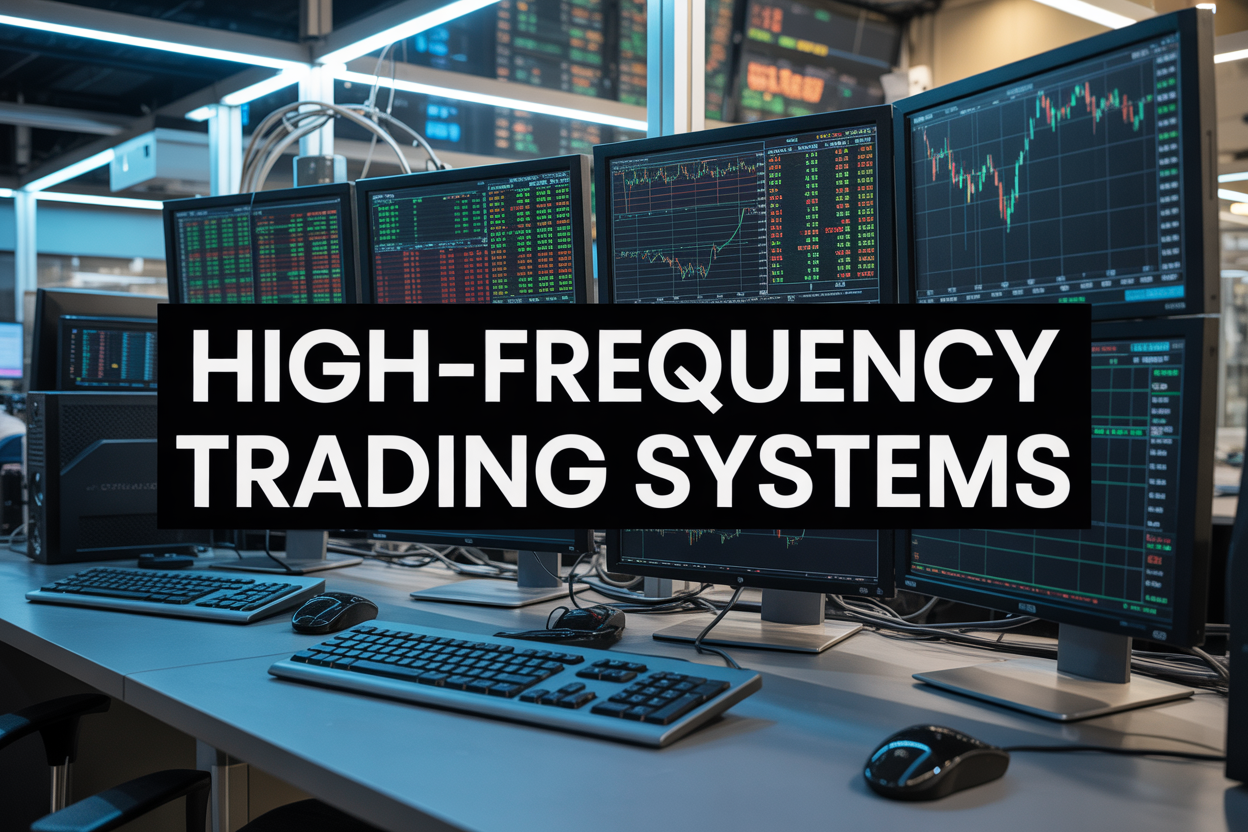
High-frequency trading systems power millions of trades per second across global financial markets, executing complex strategies in microseconds while processing massive streams of real-time data. This deep dive into HFT architecture is designed for quantitative developers, trading system architects, and financial technologists who build and maintain these sophisticated automated trading platforms.
You’ll discover how modern HFT algorithms work behind the scenes, from market-making strategies to statistical arbitrage techniques that drive today’s quantitative trading systems. We’ll break down the critical components of low latency trading infrastructure, including how execution engines achieve sub-millisecond performance and how real-time market data processing transforms raw feeds into actionable trading signals.
We’ll also explore the essential risk management frameworks that keep these high-speed systems stable and compliant with evolving regulations. Whether you’re optimizing existing algorithmic trading strategies or designing new trading execution engines from scratch, this guide covers the technical foundations that separate successful HFT operations from the rest.
Core Components of High-Frequency Trading Architecture

Ultra-low Latency Hardware Requirements and Specifications
High-frequency trading systems demand hardware that operates at the absolute edge of performance capabilities. The foundation starts with specialized processors designed for minimal instruction cycles. Field Programmable Gate Arrays (FPGAs) have become the gold standard, processing trades in nanoseconds rather than microseconds that traditional CPUs require. These chips can execute algorithmic trading strategies with deterministic timing, eliminating the unpredictable delays that plague software-based solutions.
Memory architecture plays a critical role in achieving sub-microsecond response times. DDR4 and DDR5 RAM modules must be carefully selected for their CAS latency specifications, with the fastest modules operating at CL14 or better. The memory controller configuration directly impacts data retrieval speeds, making quad-channel setups preferred for real-time market data processing.
Custom motherboards eliminate unnecessary components that introduce latency. Standard consumer boards contain circuits and features that add microseconds of delay – an eternity in HFT environments. Purpose-built trading motherboards strip away everything except essential pathways between processor, memory, and network interfaces.
Storage systems rely on NVMe SSDs with enterprise-grade controllers. These drives must handle continuous read/write operations while maintaining consistent sub-100 microsecond access times. The storage architecture typically employs RAID configurations optimized for both speed and redundancy, ensuring trading execution engines never face data bottlenecks.
Cooling systems require specialized design to maintain stable temperatures under intense computational loads. Traditional air cooling introduces vibrations that can affect sensitive timing circuits. Liquid cooling systems with custom loops provide stable thermal management while minimizing electromagnetic interference that could disrupt high-frequency operations.
Network Infrastructure Optimization for Millisecond Execution
Network latency represents the make-or-break factor in high-frequency trading systems. Achieving microsecond-level execution requires every component in the network path to operate with surgical precision. Ethernet controllers must support kernel bypass technologies like DPDK (Data Plane Development Kit) or OpenOnload, allowing applications to interact directly with network hardware without operating system interference.
The choice between 10GbE, 25GbE, or 100GbE connections depends on data volume requirements and budget constraints. Higher bandwidth connections reduce serialization delays – the time required to transmit each packet across the wire. For firms processing thousands of market data feeds simultaneously, 100GbE provides the necessary headroom to prevent congestion-related delays.
Switch selection focuses on cut-through forwarding capabilities rather than store-and-forward mechanisms. Cut-through switches begin forwarding packets immediately after reading the destination address, while store-and-forward switches wait for complete packet reception. This difference can add several microseconds per hop – significant when competing against rivals operating with nanosecond advantages.
Network topology design eliminates unnecessary hops between trading servers and exchange access points. Direct fiber connections to exchange data centers provide the shortest possible path. When multiple hops are unavoidable, each switch must be configured for minimal buffering and optimized forwarding tables.
Quality of Service (QoS) configuration prioritizes trading traffic over administrative communications. Market data feeds and order messages receive absolute priority, while lower-priority traffic like monitoring systems gets allocated remaining bandwidth. Traffic shaping prevents network congestion that could delay critical trading decisions.
Co-location Facilities and Proximity Hosting Advantages
Co-location represents the ultimate advantage in low latency trading infrastructure. Major exchanges offer rack space within their primary data centers, reducing signal travel time to absolute minimums. The physical distance between trading servers and exchange matching engines directly correlates to execution speed – every meter of fiber optic cable adds approximately 5 nanoseconds of delay.
Premium co-location facilities provide more than just proximity. These environments maintain enterprise-grade power systems with multiple redundant feeds, uninterruptible power supplies, and backup generators. Power quality directly affects server stability and timing precision. Voltage fluctuations or frequency variations can cause subtle timing errors that accumulate into significant performance degradation.
Rack positioning within co-location facilities creates competitive advantages measured in nanoseconds. Racks closest to exchange equipment achieve faster execution times than those positioned farther away. Some exchanges offer “cage” arrangements where multiple racks are grouped together, allowing firms to optimize their internal network topology while maintaining proximity to exchange systems.
Cross-connects between co-located trading systems and exchange infrastructure use the shortest possible fiber runs. Standard patch cables may introduce unnecessary length – premium installations use custom-length cables trimmed to exact specifications. Cable management systems ensure consistent routing without sharp bends that could affect signal propagation.
Environmental controls in co-location facilities maintain optimal operating conditions for sensitive trading hardware. Temperature variations affect electronic component performance and timing characteristics. Professional facilities maintain temperatures within ±1°C tolerance and humidity levels optimized for electronic equipment longevity and performance stability.
Memory Management Systems for Real-Time Data Processing
Real-time market data processing demands memory architectures that eliminate garbage collection pauses and unpredictable allocation delays. Traditional memory management approaches introduce latency spikes that can derail trading strategies during critical market moments. Advanced quantitative trading systems implement specialized memory pools designed for deterministic performance.
Pre-allocated memory pools reserve large contiguous blocks during system initialization, eliminating the need for dynamic allocation during trading hours. These pools are sized to handle peak market data volumes with substantial headroom. Ring buffers within these pools provide lock-free data structures that multiple threads can access simultaneously without synchronization delays.
Non-Uniform Memory Access (NUMA) optimization ensures processors access local memory banks rather than remote ones. Memory allocation strategies must consider processor topology, binding specific data structures to memory nodes closest to the processing cores that access them. This optimization can reduce memory access latency by 40-60% compared to naive allocation strategies.
Huge page configuration reduces Translation Lookaside Buffer (TLB) misses that can add microseconds of delay. Standard 4KB memory pages require frequent TLB updates as applications access different memory regions. Configuring 2MB or 1GB huge pages dramatically reduces TLB pressure, providing more consistent memory access performance for automated trading platforms.
Memory-mapped files enable direct access to market data without traditional file I/O operations. Exchange feeds can be mapped directly into process memory space, allowing applications to read market updates with simple memory dereferences rather than system calls. This approach eliminates kernel involvement in the data access path, reducing latency and improving deterministic performance characteristics essential for competitive trading operations.
Advanced Algorithmic Strategies in HFT Systems

Market Making Algorithms for Bid-Ask Spread Capture
Market making algorithms form the backbone of many successful high-frequency trading systems, continuously providing liquidity to markets while capturing profits from bid-ask spreads. These HFT algorithms operate by simultaneously placing buy and sell orders at slightly different prices, earning the difference when both orders execute.
The core mechanism involves sophisticated inventory management systems that monitor position exposure in real-time. When inventory levels become unbalanced, the algorithm adjusts quote prices to encourage trades that restore equilibrium. Modern market makers use adaptive spread pricing that responds to volatility, order flow patterns, and market depth.
Algorithmic trading strategies for market making incorporate adverse selection models to identify when informed traders might be present. The algorithm widens spreads or reduces position sizes when detecting potentially toxic order flow. Machine learning models analyze historical patterns to predict optimal quote placement and sizing.
Risk controls remain paramount, with position limits, maximum loss thresholds, and real-time P&L monitoring. The algorithms continuously calculate theoretical fair values using multiple data sources, adjusting quotes when prices deviate beyond acceptable ranges.
Statistical Arbitrage Models for Price Discrepancy Exploitation
Statistical arbitrage represents a sophisticated approach to identifying temporary price inefficiencies across related instruments. These models leverage historical correlations and cointegration relationships to predict when securities have moved out of their typical relative pricing patterns.
Pairs trading algorithms monitor price ratios between historically correlated stocks, triggering trades when ratios deviate significantly from their mean. The system simultaneously buys the underperforming security and sells the outperforming one, betting on convergence back to the historical relationship.
Multi-factor models expand beyond simple pairs to analyze baskets of securities. These quantitative trading systems use principal component analysis and factor decomposition to identify common risk factors and detect when individual securities exhibit unusual behavior relative to their factor loadings.
Real-time market data processing enables these models to operate at microsecond speeds, capturing fleeting arbitrage opportunities before they disappear. The algorithms continuously update correlation matrices and recalibrate models as market conditions evolve.
Momentum-Based Trading Strategies for Trend Identification
Momentum strategies in high-frequency trading systems capitalize on short-term price continuations, detecting and riding trends before they reverse. These algorithms analyze multiple timeframes simultaneously, from milliseconds to minutes, identifying when price movements gain sufficient momentum to justify directional positions.
Technical indicators adapted for high-frequency environments include modified moving averages, momentum oscillators, and volume-weighted measures. The algorithms combine these signals with order book analysis, looking for patterns that suggest continued directional movement.
Machine learning models enhance traditional momentum detection by identifying complex patterns in price action, volume, and order flow. Neural networks trained on historical data can recognize subtle momentum signatures that precede significant price moves.
Risk management becomes critical as momentum can quickly reverse. The algorithms implement dynamic stop-losses and position sizing rules that adapt to current volatility levels and market conditions.
Mean Reversion Algorithms for Price Correction Opportunities
Mean reversion strategies exploit the tendency for prices to return to their average values after extreme movements. These automated trading platforms continuously calculate dynamic fair value estimates and identify securities that have moved too far from their equilibrium prices.
Statistical measures like Bollinger Bands, z-scores, and regression channels help quantify when prices have reached extreme levels. The algorithms consider multiple factors including intraday patterns, volatility clustering, and market microstructure effects when determining entry and exit points.
Sophisticated mean reversion models incorporate regime detection to distinguish between trending and ranging market conditions. During trending periods, the algorithms reduce position sizes or temporarily cease trading to avoid fighting persistent directional moves.
The systems monitor multiple assets simultaneously, ranking opportunities by expected return-to-risk ratios and available liquidity. Position sizing algorithms optimize capital allocation across identified opportunities while maintaining overall portfolio risk within acceptable limits.
Order Flow Prediction Techniques Using Machine Learning
Advanced HFT algorithms now incorporate machine learning models to predict future order flow patterns and price movements. These systems analyze vast amounts of real-time market data including order book updates, trade executions, and timing patterns to forecast short-term price direction.
Deep learning models process sequential data from order books, identifying subtle patterns in bid-ask dynamics, order arrival rates, and cancellation behaviors. Recurrent neural networks and transformer architectures excel at capturing temporal dependencies in market microstructure data.
Feature engineering focuses on order book imbalances, trade size distributions, and inter-arrival times between market events. The models learn to distinguish between noise and meaningful signals in the constant stream of market updates.
These predictive models integrate directly into execution algorithms, optimizing order timing and placement based on forecasted market conditions. The systems continuously retrain models using recent market data to adapt to changing market dynamics and maintain predictive accuracy.
Real-Time Market Data Processing and Analysis

Direct Market Data Feeds and Vendor Comparison
High-frequency trading systems rely on ultra-fast market data feeds to maintain competitive edge. Direct market access (DMA) feeds from major exchanges like NYSE, NASDAQ, and CME provide raw, unfiltered price and volume data with microsecond timestamps. Primary vendors include Thomson Reuters, Bloomberg, and exchange-native feeds.
| Vendor | Latency | Coverage | Cost Structure |
|---|---|---|---|
| Exchange Native | 10-50 μs | Single venue | Per-symbol pricing |
| Thomson Reuters | 100-300 μs | Global multi-asset | Tiered subscription |
| Bloomberg | 150-400 μs | Comprehensive coverage | Enterprise licensing |
| Refinitiv | 80-250 μs | Cross-asset classes | Volume-based |
Co-location services reduce network latency by placing servers within exchange data centers. Microwave and fiber optic connections between venues enable sub-millisecond data transmission. Real-time market data processing requires dedicated network infrastructure with redundant pathways to prevent data loss during peak trading periods.
Tick-by-Tick Data Normalization and Standardization Methods
Raw market data arrives in venue-specific formats requiring immediate normalization for algorithmic trading strategies. Exchange protocols like FIX, FAST, and binary formats need standardization into common data structures. Price scaling varies across instruments – equities use decimal precision while futures may use tick increments.
Timestamp synchronization becomes critical when aggregating feeds from multiple sources. GPS-synchronized clocks ensure nanosecond accuracy across distributed systems. Data validation filters eliminate erroneous ticks, duplicate entries, and out-of-sequence messages that could trigger false trading signals.
Quantitative trading systems implement real-time data cleaning algorithms:
- Price band filters detecting anomalous quotes
- Volume spike detection for unusual activity
- Sequence number validation for gap identification
- Cross-reference checks against multiple data sources
Order Book Reconstruction for Depth Analysis
Level II market data provides order book depth beyond best bid/ask prices. HFT algorithms reconstruct full order books by processing individual order additions, modifications, and cancellations. This granular view reveals hidden liquidity and potential price movements before they impact top-of-book prices.
Order book maintenance requires tracking:
- Price level aggregation by size
- Order ID mapping for modifications
- Timestamp ordering for proper sequencing
- Implied orders in derivative markets
Market microstructure analysis depends on accurate book reconstruction. Algorithms detect order flow imbalances, large hidden orders, and institutional block trading patterns. Machine learning models trained on book dynamics can predict short-term price movements with statistical significance.
Cross-Venue Data Aggregation and Synchronization
Modern markets fragment across dozens of trading venues requiring sophisticated aggregation techniques. Low latency trading systems must consolidate order books from dark pools, ECNs, and traditional exchanges while maintaining microsecond update speeds.
Synchronization challenges include:
- Network jitter compensation across venues
- Clock drift adjustment between data centers
- Message prioritization during high-volume periods
- Conflated vs. non-conflated feed handling
Automated trading platforms implement smart order routing based on aggregated liquidity views. Real-time venue ranking algorithms consider fill rates, price improvement opportunities, and execution costs. Cross-venue arbitrage detection requires synchronized timestamps and consistent data normalization across all connected markets.
Quality metrics track data completeness, latency distributions, and synchronization accuracy to ensure trading decisions rely on accurate market representations.
Execution Engine Design and Performance Optimization

Smart Order Routing for Optimal Fill Rates
Smart order routing (SOR) serves as the brain behind execution decisions in high-frequency trading systems. Modern SOR algorithms analyze real-time market conditions across multiple venues, considering factors like displayed liquidity, hidden order flow, and venue-specific rebate structures. These systems dynamically calculate the probability of execution at each price level and route orders to venues offering the highest expected value.
Advanced SOR implementations track venue performance metrics continuously. They measure fill rates, adverse selection costs, and price improvement opportunities. Machine learning models predict optimal routing patterns based on historical performance data and current market microstructure conditions. The most sophisticated systems adjust routing logic in microseconds, responding to changing market dynamics.
| Venue Type | Execution Priority | Typical Fill Rate |
|---|---|---|
| Dark Pools | Hidden liquidity | 15-25% |
| Lit Markets | Speed advantage | 60-75% |
| ECNs | Price improvement | 40-55% |
Order Slicing Techniques to Minimize Market Impact
Order slicing breaks large positions into smaller parcels to avoid revealing trading intentions. Volume Weighted Average Price (VWAP) algorithms distribute orders based on historical volume patterns, while Time Weighted Average Price (TWAP) strategies spread executions across predefined time intervals. More sophisticated approaches use Implementation Shortfall algorithms that balance market impact against timing risk.
Dynamic slicing adapts to real-time market conditions. These algorithms monitor order book depth, recent trade patterns, and volatility measures to adjust slice sizes. When liquidity is abundant, slice sizes increase to accelerate execution. During periods of thin liquidity, algorithms reduce slice sizes and extend execution timelines.
Stealth algorithms add randomization to execution patterns. They vary timing, size, and routing decisions to prevent pattern detection by other market participants. Some implementations use game theory principles to optimize execution against sophisticated adversaries who might be trying to front-run large orders.
Risk Management Controls and Circuit Breakers
Trading execution engines incorporate multiple layers of risk controls that operate in real-time. Pre-trade risk checks validate order parameters against position limits, concentration rules, and market exposure thresholds. These checks occur within microseconds to maintain the speed requirements of low latency trading systems.
Real-time position monitoring tracks exposures across multiple assets and venues simultaneously. Risk engines calculate portfolio Greeks, value-at-risk metrics, and stress test scenarios continuously. When predefined thresholds are breached, automatic position reduction algorithms activate to bring exposures back within acceptable ranges.
Circuit breaker mechanisms provide emergency stops for various scenarios:
- Price circuit breakers: Halt trading when price movements exceed volatility thresholds
- Volume circuit breakers: Stop execution when trade volumes spike abnormally
- Error circuit breakers: Prevent execution when system anomalies are detected
- Regulatory circuit breakers: Comply with exchange-mandated trading halts
Latency Measurement and Monitoring Systems
Latency measurement in automated trading platforms requires precision timing infrastructure. Hardware timestamping captures order entry, routing decisions, and execution confirmations with nanosecond accuracy. These systems track one-way latency to exchanges, round-trip execution times, and internal processing delays.
Comprehensive monitoring covers the entire execution path. Network latency measurements include switch-to-switch delays, WAN transmission times, and exchange gateway processing. Application-level monitoring tracks algorithm decision times, risk check durations, and order formatting delays.
Modern monitoring systems use statistical process control to identify latency anomalies. They establish baseline performance metrics and trigger alerts when execution times deviate significantly from normal patterns. Machine learning models predict latency patterns and preemptively adjust routing decisions to maintain optimal performance.
Failover Mechanisms for System Reliability
Quantitative trading systems require robust failover capabilities to maintain continuous operation. Hot-standby systems maintain synchronized state with primary execution engines, ready to assume trading responsibilities within milliseconds. These standby systems replicate market data feeds, position information, and algorithm states in real-time.
Geographic redundancy protects against site-wide failures. Secondary data centers maintain complete trading infrastructure, including market connectivity, execution engines, and risk management systems. Automated failover procedures activate backup systems when primary sites become unavailable.
Application-level failover handles component failures within individual trading systems. Load balancers distribute trading flow across multiple execution engine instances. When individual components fail, traffic automatically reroutes to healthy instances without interrupting trading operations. Database failover mechanisms ensure position and trade data remain accessible during system transitions.
Risk Management and Regulatory Compliance

Position Sizing Algorithms and Exposure Limits
Modern high-frequency trading systems rely on sophisticated position sizing algorithms to maintain optimal capital allocation while preventing catastrophic losses. These algorithms continuously monitor market volatility, correlation matrices, and portfolio heat maps to calculate maximum position sizes in real-time. The most effective HFT algorithms incorporate dynamic risk scaling that adjusts position limits based on current market conditions, time of day, and asset liquidity.
Exposure limits operate across multiple dimensions – single instrument, sector, geography, and overall portfolio level. Advanced trading risk management systems implement hierarchical limit structures where breaching lower-tier limits triggers automatic position reductions, while upper-tier violations can halt trading entirely. Many quantitative trading systems use Value-at-Risk (VaR) models updated every few milliseconds to ensure positions remain within predetermined risk tolerance bands.
Real-time portfolio Greeks monitoring has become standard practice, with delta, gamma, and vega exposures tracked continuously. When these metrics approach predefined thresholds, the system automatically executes hedging trades or reduces position sizes to maintain portfolio neutrality.
Pre-trade Risk Checks and Validation Processes
Every order in high-frequency trading systems passes through multiple validation layers before reaching the market. The first checkpoint typically occurs within microseconds and validates basic order parameters – price reasonableness, quantity limits, and account authorization. More sophisticated checks analyze the order against current market conditions, comparing the proposed trade price against recent tick data to identify potentially erroneous orders.
Cross-validation algorithms examine order relationships, flagging unusual patterns that might indicate system malfunctions or unauthorized trading activity. These automated trading platforms maintain real-time position tracking, ensuring new orders won’t create excessive concentration in any single instrument or strategy.
Smart order routing systems incorporate additional validation steps, checking counterparty credit limits and market impact estimates before order transmission. Many HFT algorithms include “circuit breaker” logic that prevents order submission when market volatility exceeds predefined parameters or when the system detects unusual price movements that could indicate flash crash conditions.
Regulatory Reporting Requirements and Audit Trails
Regulatory compliance in high-frequency trading demands comprehensive audit trail maintenance with nanosecond-level precision. Modern systems capture every decision point within algorithmic trading strategies, from initial signal generation through final execution confirmation. This granular data collection supports regulatory requirements across multiple jurisdictions, including MiFID II in Europe, CAT reporting in the United States, and similar frameworks globally.
Automated reporting systems generate required regulatory filings without human intervention, pulling data directly from trading engines and market data processing systems. These reports include order-by-order details, algorithm behavior patterns, and risk management actions taken during each trading session.
Real-time surveillance systems monitor trading patterns for potential market manipulation or algorithmic malfunctions. When unusual activity is detected, these systems automatically flag transactions for review while simultaneously generating preliminary regulatory notifications. The audit trail architecture ensures that regulators can reconstruct any trading decision or market interaction with complete fidelity.
Kill Switches and Emergency Shutdown Procedures
Emergency shutdown capabilities represent the final line of defense in HFT risk management frameworks. Kill switches operate at multiple system levels – individual algorithm shutdown, strategy-specific halts, and complete trading cessation. These mechanisms can be triggered automatically by risk monitoring systems or manually by human operators.
Automatic kill switch activation occurs when predefined risk thresholds are breached, such as daily loss limits, position concentration violations, or system performance degradation. The shutdown process follows carefully orchestrated procedures: first halting new order generation, then canceling pending orders, and finally executing predefined exit strategies to unwind existing positions safely.
Low latency trading systems incorporate geographic kill switches that can halt trading activities across multiple data centers simultaneously. These distributed shutdown capabilities ensure that malfunctioning algorithms can’t continue operating through backup systems or alternative execution venues.
Recovery procedures include systematic position reconciliation, system health verification, and gradual trading resumption under enhanced monitoring. Emergency contact protocols notify key personnel, prime brokers, and regulatory authorities when kill switches are activated, ensuring transparent communication during crisis situations.

High-frequency trading systems represent some of the most sophisticated technological achievements in modern finance. The success of these platforms depends on seamlessly integrating robust architecture, smart algorithmic strategies, lightning-fast data processing, and optimized execution engines. Each component must work in perfect harmony to capture market opportunities that exist for mere milliseconds.
Building effective HFT systems isn’t just about speed anymore. You need comprehensive risk management frameworks and strict regulatory compliance to protect your investments and stay within legal boundaries. The firms that excel in this space are those that balance cutting-edge technology with disciplined risk controls. If you’re considering entering this arena, focus on mastering each core component before attempting to scale your operations. The market rewards precision and preparation, not just raw computational power.