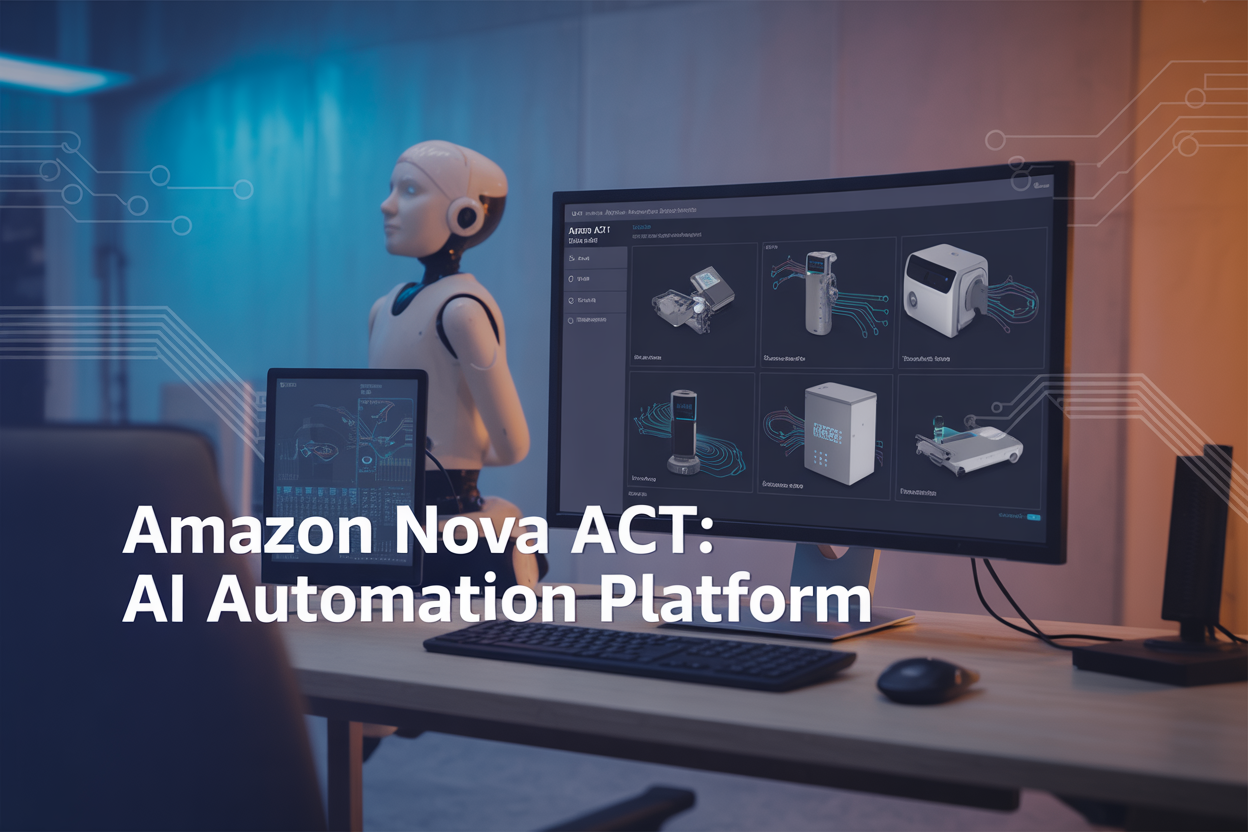
Amazon’s latest AI breakthrough is changing how businesses think about automation and intelligent task management. The Amazon Nova Act represents a major leap forward in AI agents deployment, offering companies a powerful way to automate complex workflows without the typical technical headaches.
This guide is designed for business leaders, IT professionals, and developers who want to understand how this AI automation platform can transform their operations. We’ll break down the core Amazon Nova functionality and show you exactly how to get started.
You’ll discover the concrete automation benefits AWS brings to your daily operations, from cutting manual work hours to improving accuracy across departments. We’ll also walk through the technical mechanics behind Amazon Nova Act, explaining how it actually works under the hood without getting lost in jargon. Finally, we’ll explore real Amazon Nova use cases across different industries, so you can see how other companies are already putting these AI agents to work and getting measurable results.
Understanding Amazon Nova Act and Its Core Functionality

Defining Amazon Nova Act’s Role in AI Automation
Amazon Nova Act represents AWS’s latest advancement in autonomous AI agent deployment and orchestration. Unlike basic automation scripts that follow predetermined paths, Amazon Nova Act creates intelligent agents capable of making contextual decisions, adapting to changing conditions, and executing complex multi-step workflows across various AWS services and external systems.
The platform functions as a bridge between traditional rule-based automation and fully autonomous artificial intelligence. Amazon Nova Act empowers organizations to deploy AI agents that can reason through problems, interact with different APIs, handle exceptions dynamically, and learn from operational patterns. These agents operate with varying degrees of autonomy, from supervised assistance to fully independent task execution.
What sets Amazon Nova Act apart is its ability to understand natural language instructions and convert them into executable automation workflows. Business users can describe their automation needs in plain English, and the platform translates these requirements into sophisticated AI agent behaviors without requiring extensive programming knowledge.
Key Components and Architecture Overview
The Amazon Nova functionality revolves around several interconnected architectural components working together to deliver seamless AI automation. At its core lies the Agent Runtime Environment, which provides the execution context for AI agents to operate securely within defined boundaries.
The Knowledge Integration Layer serves as the foundation for agent decision-making, connecting to various data sources including:
- AWS service APIs and monitoring systems
- External databases and knowledge repositories
- Real-time event streams and notification systems
- Custom business logic and rule engines
The Decision Engine processes contextual information and determines appropriate actions based on predefined objectives and learned behaviors. This component handles complex reasoning tasks, evaluates multiple solution paths, and selects optimal approaches for specific scenarios.
Memory and State Management ensures agents maintain context across interactions and can reference historical decisions when facing similar situations. This component enables agents to build institutional knowledge and improve performance over time.
The Safety and Governance Framework provides essential guardrails, ensuring agents operate within approved parameters while maintaining audit trails for compliance and monitoring purposes.
Integration with AWS Ecosystem
Amazon Nova Act seamlessly integrates with the broader AWS ecosystem, leveraging existing services to enhance AI automation platform capabilities. The platform connects directly with Amazon CloudWatch for monitoring and alerting, allowing agents to respond to infrastructure events and performance metrics in real-time.
Integration with AWS Lambda enables agents to trigger serverless functions as part of their automation workflows, while connections to Amazon S3 provide persistent storage for agent-generated reports and decision logs. The platform also works closely with AWS IAM to ensure secure access control and maintain least-privilege principles across all agent operations.
The deep AWS integration means organizations can deploy AI agents guide workflows that span multiple services without complex configuration. Agents can automatically scale EC2 instances based on demand patterns, optimize RDS configurations for performance, manage CloudFormation deployments, and coordinate with AWS Step Functions for complex orchestration scenarios.
Differentiators from Traditional Automation Tools
Traditional automation tools typically require explicit programming for every possible scenario and struggle with unexpected conditions. Amazon Nova Act fundamentally changes this approach by providing agents that can reason through novel situations and adapt their responses accordingly.
While conventional automation follows rigid if-then logic, Nova Act agents evaluate context, consider multiple variables simultaneously, and make nuanced decisions that account for business priorities and operational constraints. This adaptive capability means agents can handle edge cases and exceptions that would typically require human intervention.
The platform’s natural language processing capabilities eliminate the technical barriers associated with traditional automation deployment. Instead of writing complex scripts or configuring intricate rule engines, teams can describe their automation goals conversationally, and the AI agent implementation handles the technical translation.
Recovery and resilience represent another key differentiator. When traditional automation encounters failures, it typically stops execution and requires manual intervention. Amazon Nova Act agents can analyze failure conditions, attempt alternative approaches, and gracefully degrade functionality while maintaining core operations and notifying appropriate stakeholders.
Automation Benefits Delivered by Amazon Nova Act

Enhanced Operational Efficiency and Speed
Amazon Nova Act transforms business operations by dramatically accelerating task completion across complex workflows. The AI automation platform processes routine operations in minutes rather than hours, enabling teams to handle larger workloads without proportional increases in staffing. Real-time data processing capabilities allow Nova Act to analyze patterns and execute decisions faster than human operators, creating smoother business processes from start to finish.
The platform’s intelligent task routing automatically directs work to the most suitable AI agents based on complexity and specialization. This smart distribution prevents bottlenecks and keeps operations moving at peak efficiency. When businesses deploy AI agents through Nova Act, they experience immediate improvements in response times and throughput, particularly in customer service, data analysis, and document processing workflows.
Reduced Manual Workload and Human Error
Human error costs businesses millions annually, but Amazon Nova functionality addresses this challenge through consistent, precision-driven automation. AI agents deployed through Nova Act follow exact protocols without the fatigue, distraction, or oversight issues that affect human workers. Data entry errors drop significantly when automated systems handle repetitive tasks like form processing, inventory updates, and customer record management.
The automation benefits AWS provides through Nova Act extend beyond simple error reduction. Teams can redirect their energy from mundane, repetitive tasks to strategic initiatives that drive business growth. Customer support representatives can focus on complex problem-solving while AI agents handle routine inquiries. Financial teams can analyze trends and plan strategy while automated systems manage invoice processing and expense categorization.
Quality control improves dramatically since AI agents apply the same standards consistently across all tasks. This reliability creates predictable outcomes and reduces the need for extensive review processes that traditionally consume valuable time and resources.
Cost Savings and Resource Optimization
Organizations implementing Nova Act typically see substantial cost reductions within the first quarter of deployment. The AI automation platform eliminates the need for additional hiring during peak periods, as AI agents can handle increased workloads without overtime costs or benefits packages. Training expenses decrease since AI agents don’t require onboarding, sick leave, or professional development programs.
Infrastructure costs optimize naturally as Nova Act’s cloud-based architecture scales resources up or down based on actual demand. Companies avoid the traditional problem of maintaining expensive systems during low-activity periods. The platform’s intelligent resource allocation ensures maximum utilization of computing power and storage, translating directly into lower operational expenses.
Energy consumption drops when automated processes replace energy-intensive manual operations. Document digitization, automated reporting, and streamlined data flows reduce the need for physical storage and paper-based processes, creating both cost savings and environmental benefits.
Scalability for Growing Business Demands
Amazon Nova Act grows seamlessly alongside expanding businesses without the typical growing pains associated with rapid scaling. When order volumes spike during seasonal peaks or business growth phases, additional AI agents can be deployed instantly without recruitment delays or training periods. This flexibility allows companies to capture opportunities that might otherwise be lost due to capacity constraints.
The platform handles geographic expansion effortlessly, supporting multiple languages and regional compliance requirements through configurable AI agent parameters. Businesses can launch operations in new markets without establishing full local teams immediately, using AI agents to maintain service quality while building physical presence over time.
Integration capabilities ensure that Nova Act works with existing business systems, avoiding the costly and disruptive full-scale replacements that traditional scaling often requires. As companies add new software tools or update existing platforms, AI agents adapt to these changes through simple configuration updates rather than extensive reprogramming or retraining processes.
Technical Mechanics Behind Amazon Nova Act

AI Agent Processing and Decision-Making Framework
Amazon Nova Act operates on a sophisticated multi-layered architecture that processes information through distinct cognitive stages. The framework begins with input interpretation, where the system analyzes incoming requests and contextual data to understand user intent. This processing happens through a series of neural networks that work together to decode complex instructions and environmental signals.
The decision-making engine sits at the heart of Nova Act technical mechanics, employing reinforcement learning algorithms that continuously evaluate potential actions against predefined objectives. Each AI agent maintains its own decision tree, but can also collaborate with other agents through a shared knowledge base. This allows for dynamic problem-solving where multiple agents can contribute their specialized expertise to complex scenarios.
The system maintains state awareness across different interaction sessions, creating a persistent memory layer that helps agents make more informed decisions over time. When processing requests, agents evaluate multiple response pathways simultaneously, ranking them based on effectiveness, resource requirements, and alignment with user goals.
Risk assessment protocols are built directly into the decision-making framework, ensuring that AI agents can identify and avoid potentially harmful or inefficient actions before execution. This safety layer operates independently from the main processing pipeline, providing an additional checkpoint for all automated decisions.
Natural Language Processing Capabilities
The NLP engine powering Amazon Nova functionality leverages transformer-based architectures specifically optimized for conversational AI and task execution. Unlike traditional chatbots, Nova Act processes natural language with deep semantic understanding, recognizing not just words but the underlying intent and emotional context of user communications.
The system handles multiple languages simultaneously, allowing global teams to deploy AI agents without language barriers. Context switching happens seamlessly – an agent can start a conversation in English and continue in Spanish or French based on user preference, maintaining full comprehension throughout the interaction.
Advanced parsing capabilities enable the system to understand complex, multi-step instructions delivered in casual conversational language. Users don’t need to learn specific commands or syntax; they can communicate with AI agents using the same natural language they’d use with human colleagues.
The NLP layer also includes sentiment analysis and tone recognition, allowing agents to adjust their communication style based on user mood and preferences. This emotional intelligence component helps create more engaging and productive human-AI interactions, especially in customer service and support scenarios.
Machine Learning Model Training and Adaptation
Amazon Nova Act employs continuous learning mechanisms that allow AI agents to improve their performance without manual intervention. The training pipeline combines supervised learning from expert demonstrations with reinforcement learning from real-world interactions, creating agents that become more effective over time.
The adaptation process happens at multiple levels – individual agents learn from their specific task experiences while also benefiting from insights gathered across the entire Nova Act network. This collective intelligence approach means that improvements discovered by one agent can quickly propagate to others handling similar tasks.
Model updates occur through incremental learning techniques that preserve existing knowledge while incorporating new capabilities. This prevents the common problem of “catastrophic forgetting” where AI systems lose previously learned skills when training on new data. The AWS AI automation platform manages these updates automatically, ensuring consistent performance across all deployed agents.
Transfer learning capabilities allow organizations to rapidly deploy specialized agents by building on pre-trained foundation models. Rather than starting from scratch, new AI agent implementations can leverage existing knowledge bases and quickly adapt to specific industry requirements or organizational workflows.
Human feedback integration provides another crucial training dimension, where user ratings and corrections directly influence model behavior. This creates a collaborative learning environment where human expertise guides AI development in real-time.
Step-by-Step Deployment Guide for AI Agents

Prerequisites and System Requirements
Before diving into AI agents deployment with Amazon Nova Act, you’ll need specific technical foundations in place. Your AWS account requires appropriate IAM permissions for accessing Nova Act services, including agent creation, model access, and resource management capabilities. The deployment environment needs at least 8GB of available memory and sufficient compute resources to handle concurrent agent operations.
Network connectivity plays a crucial role in successful implementation. Ensure your VPC configuration allows outbound HTTPS traffic to AWS endpoints and consider setting up dedicated subnets for agent workloads. Security groups must permit communication between your application infrastructure and Nova Act services on the required ports.
Your development team should have familiarity with AWS CLI, Python or Node.js programming languages, and basic understanding of conversational AI principles. Install the latest AWS SDK version that supports Nova Act functionality, along with any required dependencies for your chosen programming language.
Configuration and Setup Process
Creating your first AI agent begins with defining the agent’s purpose and capabilities through the Nova Act console. Navigate to the Amazon Bedrock service and select the Nova Act option to access the agent creation workflow. Define your agent’s identity by providing a clear name, description, and the specific tasks it should handle.
The foundation model selection determines your agent’s reasoning capabilities. Choose between different Nova models based on your performance requirements and budget constraints. Configure the agent’s instructions using natural language prompts that clearly explain the expected behavior and response patterns.
Knowledge base integration requires uploading relevant documents or connecting to existing data sources. The system automatically processes these materials to create vector embeddings that your agent can reference during conversations. Action groups enable your agent to perform specific tasks by calling external APIs or Lambda functions.
Set up proper resource allocation by defining memory limits, timeout values, and concurrency settings. These parameters directly impact your agent’s performance and cost efficiency. Configure logging preferences to capture conversation history and system events for monitoring purposes.
Testing and Validation Procedures
Comprehensive testing ensures your Amazon Nova Act AI agent performs reliably across different scenarios. Start with basic functionality tests using the built-in chat interface to verify the agent responds appropriately to simple queries. Test edge cases where users might provide unclear instructions or ask questions outside the agent’s knowledge domain.
Create a structured test suite covering various conversation flows, including multi-turn dialogues where context retention becomes critical. Validate that your agent maintains conversation context accurately and provides relevant responses based on previous interactions. Test interrupt scenarios where users change topics mid-conversation.
Performance testing involves measuring response latency under different load conditions. Send concurrent requests to identify potential bottlenecks and verify the agent handles multiple simultaneous conversations without degradation. Monitor memory usage patterns and ensure the system remains stable during extended testing periods.
Accuracy validation requires comparing agent responses against expected outputs for known queries. Create benchmark datasets that cover your agent’s intended use cases and regularly evaluate response quality. Document any inconsistencies and adjust the agent’s configuration accordingly.
Monitoring and Performance Optimization
Establishing robust monitoring practices keeps your AI agent implementation running smoothly. CloudWatch metrics provide real-time visibility into agent performance, including response times, error rates, and resource consumption patterns. Set up custom alarms to notify your team when performance degrades below acceptable thresholds.
Regular performance analysis helps identify optimization opportunities. Review conversation logs to understand user interaction patterns and identify frequently asked questions that might benefit from knowledge base enhancements. Monitor token usage to manage costs effectively and adjust model selection if needed.
Implement automated scaling policies that adjust compute resources based on demand patterns. Configure auto-scaling triggers that respond to metrics like queue depth and response latency to maintain consistent performance during traffic spikes.
Cost optimization involves analyzing usage patterns and rightsizing your deployment. Review monthly spending reports to identify areas where you can reduce expenses without impacting user experience. Consider implementing conversation caching for frequently asked questions to reduce model inference costs.
Troubleshooting Common Implementation Issues
Authentication problems often stem from incorrect IAM permissions or expired credentials. Verify your service roles have the necessary policies attached and check that API keys remain valid. Cross-reference your permissions against AWS documentation to ensure all required actions are authorized.
Slow response times typically indicate resource constraints or inefficient knowledge base configurations. Check your compute allocation and consider upgrading to higher-performance instance types if needed. Large knowledge bases may require optimization through document chunking or relevance filtering to improve retrieval speed.
Knowledge base retrieval errors usually result from poorly formatted source documents or indexing failures. Review document formatting standards and ensure all uploaded content follows supported file types and size limits. Rebuild indexes if you suspect corruption or outdated embeddings.
Agent behavior inconsistencies often trace back to ambiguous instructions or conflicting prompt configurations. Review your agent’s system prompts for clarity and remove contradictory guidance. Test prompt variations to find the most effective instruction format for your specific use case.
Connection timeouts between your application and Nova Act services may indicate network configuration issues. Verify security group rules allow the required traffic and check if VPC endpoints are properly configured. Consider implementing retry logic with exponential backoff to handle temporary connectivity issues gracefully.
Real-World Applications and Industry Use Cases

Customer Service and Support Automation
Amazon Nova Act transforms customer service operations by powering AI agents that handle inquiries around the clock. These agents understand context, sentiment, and complex customer needs while maintaining natural conversation flow. Companies deploy these AI agents to manage live chat, email responses, and ticket routing with remarkable accuracy.
The platform excels at multilingual support, breaking down language barriers that traditionally required large customer service teams. AI agents powered by Amazon Nova Act can instantly switch between languages, understand cultural nuances, and provide culturally appropriate responses. This capability proves invaluable for global businesses serving diverse customer bases.
Escalation management becomes seamless when Nova Act agents recognize situations requiring human intervention. The system smoothly transfers complex cases to human agents while providing complete conversation history and suggested solutions. This hybrid approach reduces response times while maintaining service quality.
Content Creation and Marketing Workflows
Marketing teams leverage Amazon Nova functionality to streamline content production across multiple channels. AI agents excel at generating product descriptions, social media posts, email campaigns, and blog content that aligns with brand voice and marketing objectives. The system analyzes successful past campaigns to replicate winning formulas.
Personalization reaches new heights when Nova Act agents tailor content for specific audience segments. These agents process customer data, browsing patterns, and engagement metrics to craft personalized messages that resonate with individual preferences. A/B testing becomes automated, with agents continuously optimizing content performance.
Campaign management transforms from manual coordination to intelligent orchestration. AI agents monitor campaign performance, adjust targeting parameters, and redistribute budgets based on real-time results. They automatically pause underperforming campaigns and scale successful ones, maximizing marketing ROI without constant manual oversight.
Data Analysis and Business Intelligence
AWS AI automation through Nova Act revolutionizes how organizations extract insights from complex datasets. AI agents process vast amounts of structured and unstructured data, identifying patterns humans might miss. These agents generate actionable reports, highlight anomalies, and predict trends with impressive accuracy.
Real-time analytics become accessible to non-technical users when AI agents translate complex data into digestible insights. They create natural language summaries of performance metrics, explain statistical trends in plain English, and suggest data-driven actions. This democratization of analytics empowers teams across organizations to make informed decisions.
Predictive modeling capabilities enable proactive business strategies. Nova Act agents analyze historical data to forecast demand, identify potential risks, and recommend preventive measures. They continuously learn from new data, refining predictions and improving accuracy over time.
E-commerce and Retail Operations
E-commerce platforms benefit significantly from Amazon Nova use cases in inventory management and customer experience optimization. AI agents monitor stock levels, predict demand fluctuations, and automatically reorder products before stockouts occur. They analyze seasonal trends, promotional impacts, and external factors affecting inventory needs.
Product recommendation engines powered by Nova Act deliver personalized shopping experiences that drive conversions. These agents understand customer preferences, browsing behavior, and purchase history to suggest relevant products at optimal moments. They adapt recommendations based on real-time interactions, creating dynamic shopping experiences.
Order fulfillment optimization becomes automated when AI agents coordinate warehouse operations, shipping logistics, and delivery schedules. They identify the most efficient routes, predict delivery delays, and proactively communicate with customers about order status. This end-to-end automation reduces operational costs while improving customer satisfaction.
Price optimization strategies benefit from AI agents that monitor competitor pricing, market conditions, and demand patterns. They automatically adjust prices to maximize profitability while remaining competitive, ensuring optimal revenue generation across product catalogs.

Amazon Nova Act represents a significant leap forward in AI-powered automation, offering businesses the tools to streamline operations and boost productivity across multiple domains. From reducing manual workloads to enabling intelligent decision-making, this platform delivers tangible benefits that can transform how organizations handle routine and complex tasks alike. The straightforward deployment process makes it accessible to teams with varying technical expertise, while its robust functionality ensures scalability as business needs evolve.
The real-world applications we’ve explored demonstrate Nova Act’s versatility across industries, proving its value in everything from customer service automation to data analysis and workflow optimization. If you’re ready to embrace the future of intelligent automation, start by identifying your most time-consuming processes and consider how Nova Act’s AI agents could handle these tasks more efficiently. Take the first step today by exploring Amazon’s Nova Act documentation and begin planning your organization’s journey toward smarter, more automated operations.