Managing code across multiple developers while deploying to AWS EC2 can turn into chaos without the right strategy. Teams often struggle with merge conflicts, broken deployments, and unclear code promotion processes that slow down development and frustrate everyone involved.
This comprehensive guide is designed for development team leads, DevOps engineers, and project managers who need to establish a reliable git branching strategy and AWS EC2 deployment workflow that scales with their team.
You’ll learn how to build a structured git workflow for teams that prevents conflicts and keeps everyone moving forward smoothly. We’ll also walk through setting up automated deployment pipeline systems that connect your Git repositories directly to your AWS infrastructure setup, eliminating manual deployment headaches. Finally, you’ll discover proven environment management strategies that make code promotion from development to production predictable and safe.
By the end, you’ll have a complete system that handles everything from developer commits to production deployments, making your team more productive and your releases more reliable.
Establish Core Git Branching Framework for Team Collaboration

Configure master and develop branch hierarchy for stable releases
Your git branching strategy starts with establishing a solid foundation using the dual-branch approach. The master branch serves as your production-ready codebase – think of it as the golden standard that mirrors what’s currently running in production. This branch should remain stable at all times, containing only thoroughly tested and approved code.
The develop branch acts as your integration hub where all feature development converges. This is where developers merge their completed work before it moves toward production. Unlike master, the develop branch can experience some instability as new features integrate, but it represents the bleeding edge of your project’s progress.
| Branch Type | Purpose | Stability Level | Merge Frequency |
|---|---|---|---|
| Master | Production-ready code | Highest | Weekly/Bi-weekly |
| Develop | Feature integration | Moderate | Daily |
Set up branch protection rules to prevent direct pushes to master. All changes must flow through pull requests with mandatory code reviews. The develop branch should also require pull request reviews, though you can be slightly more flexible here depending on team size and velocity needs.
Implement feature branch workflows to isolate development work
Feature branches create isolated development environments for each new piece of functionality. Start each feature branch from the latest develop branch, not from master. This ensures you’re building on the most current integrated codebase.
Name your feature branches descriptively using a consistent pattern like feature/user-authentication or feature/payment-integration. This naming convention helps team members quickly understand what work is happening across different branches.
When working on feature branches, developers can experiment freely without affecting the main codebase. Push your feature branches regularly to the remote repository – this creates backups and allows other team members to see your progress or collaborate when needed.
Feature Branch Workflow Steps:
- Create branch from develop:
git checkout -b feature/new-dashboard develop - Work on your feature with regular commits
- Push branch to remote:
git push origin feature/new-dashboard - Open pull request to merge into develop
- Delete feature branch after successful merge
Keep feature branches focused on single pieces of functionality. Large features should be broken down into smaller, manageable chunks that can be completed within a few days to a week. This approach reduces merge conflicts and makes code reviews more effective.
Set up hotfix branches for urgent production fixes
Production issues don’t wait for your regular release cycle, which is why hotfix branches exist. These branches allow you to quickly patch critical bugs without disrupting ongoing development work on the develop branch.
Create hotfix branches directly from master since you need to fix the exact code that’s currently in production. Name them clearly like hotfix/security-patch or hotfix/payment-bug-fix. This immediate branching from master ensures your fix targets the actual production environment.
After completing the hotfix, merge it into both master and develop branches. The master merge gets the fix into production immediately, while the develop merge ensures your fix doesn’t get lost in future releases. Some teams use cherry-picking instead of merging into develop, but merging provides better tracking of changes.
Hotfix Process:
- Branch from master:
git checkout -b hotfix/critical-bug master - Make minimal changes to fix the issue
- Test the fix thoroughly
- Merge to master: Creates immediate production release
- Merge to develop: Incorporates fix into ongoing development
- Tag the new master commit with version number
Tag your hotfix releases with incremented patch versions (like v1.2.3 to v1.2.4). This creates clear reference points for tracking which fixes are deployed where.
Create release branches for controlled deployment preparation
Release branches provide a staging area where you prepare code for production deployment. Create these branches from develop when you’re ready to bundle features for the next release. The branch name should reflect the target version like release/v2.1.0.
During the release branch phase, focus on final testing, documentation updates, and minor bug fixes. No new features should enter the release branch – save those for the next development cycle. This discipline keeps releases predictable and reduces last-minute complications.
Use release branches to freeze feature development while allowing critical bug fixes. Your QA team can thoroughly test the release branch while developers continue working on new features in develop. This parallel workflow prevents bottlenecks and maintains development velocity.
Release Branch Activities:
- Final integration testing
- Performance testing on staging environment
- Documentation updates
- Version number updates
- Last-minute bug fixes only
Once testing completes successfully, merge the release branch into both master and develop. The master merge creates your production release, while the develop merge ensures any last-minute fixes are preserved for future development. Tag the master commit with the release version number.
This branching framework creates clear separation between different types of work while maintaining flexibility for your multi-developer workflow. Each branch type serves a specific purpose in your git workflow for teams, making collaboration smoother and reducing conflicts between parallel development efforts.
Design Multi-Developer Git Workflow Standards

Define branch naming conventions and commit message formats
Creating consistent naming patterns for your git workflow for teams starts with establishing clear conventions that everyone follows. Your branch names should tell a story about what’s happening in the code. Use prefixes like feature/, bugfix/, hotfix/, and release/ followed by a brief description using kebab-case formatting.
Here’s a proven naming structure that works across different team sizes:
| Branch Type | Format | Example |
|---|---|---|
| Feature | feature/ticket-number-description |
feature/JIRA-123-user-authentication |
| Bug Fix | bugfix/ticket-number-description |
bugfix/JIRA-456-login-validation-error |
| Hotfix | hotfix/ticket-number-description |
hotfix/JIRA-789-payment-gateway-timeout |
| Release | release/version-number |
release/v2.1.0 |
Commit messages need the same level of attention. Follow the conventional commit format with a type, optional scope, and clear description. Start with action words like “add,” “fix,” “update,” or “remove” in the imperative mood.
Structure your commits like this:
type(scope): subject

body (optional)

footer (optional)
Examples of well-formatted commit messages:
feat(auth): add two-factor authentication for user loginfix(payment): resolve timeout issue in payment processingdocs(readme): update deployment instructions for EC2
Establish code review processes using pull requests
Pull requests serve as your quality gate and knowledge-sharing mechanism in any multi-developer workflow. Set up mandatory code reviews where at least two team members must approve changes before merging into main branches. This catches bugs early and spreads knowledge across your team.
Configure your repository settings to require:
- At least two approving reviews
- Up-to-date branch status checks
- Dismiss stale reviews when new commits are pushed
- Restrict push access to protected branches
Create pull request templates that guide reviewers through your checklist. Include sections for:
- Summary: What changes were made and why
- Testing: How the changes were tested
- Deployment notes: Any special considerations for AWS EC2 deployment
- Breaking changes: Impact on existing functionality
Assign reviewers based on code ownership and expertise. The original author should address all feedback before requesting re-review. Use GitHub’s suggestion feature to propose specific code changes directly in the review.
Configure merge strategies to maintain clean project history
Your merge strategy shapes how your project history looks and affects your git branching strategy long-term. Choose between merge commits, squash merging, and rebase merging based on your team’s needs and the type of changes being integrated.
Squash merging works best for feature branches where you want to compress multiple commits into a single, clean commit on the main branch. This keeps your main branch history readable and makes it easier to track when features were added to your AWS EC2 deployment pipeline.
Merge commits preserve the full history of feature development and show exactly when branches were integrated. Use this approach when you need to maintain detailed audit trails or when working on complex features that benefit from preserving intermediate commits.
Rebase merging creates a linear history by replaying commits on top of the target branch. This approach works well for small bug fixes and maintains a clean timeline without merge commit noise.
Set up branch protection rules that enforce your chosen strategy:
Protection Rules:
- Require pull request reviews before merging
- Require status checks to pass before merging
- Require branches to be up to date before merging
- Include administrators in restrictions
Configure your default merge strategy in repository settings and train your team on when to use alternatives. Document these decisions in your team’s git workflow guidelines so new developers can quickly understand and follow your established patterns.
Set Up AWS EC2 Infrastructure for Scalable Deployments

Configure Production and Staging EC2 Instances with Proper Sizing
Setting up your AWS EC2 infrastructure starts with choosing the right instance types for both production and staging environments. Your production environment needs robust performance to handle real user traffic, while staging should mirror production capabilities for accurate testing.
For production environments, consider starting with t3.medium or t3.large instances for small to medium applications, scaling up to m5.large or c5.xlarge for CPU-intensive workloads. The key is matching your application’s resource requirements with EC2 instance capabilities.
Staging environments can typically run on smaller instances like t3.small or t3.micro since they handle lower traffic volumes. However, keep the instance family consistent between environments to avoid deployment surprises.
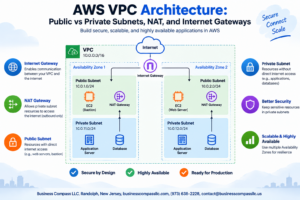
Create separate Virtual Private Clouds (VPCs) for production and staging to maintain complete isolation. Within each VPC, distribute instances across multiple Availability Zones for fault tolerance. Use private subnets for application servers and public subnets for load balancers.
Instance Configuration Recommendations:
| Environment | Instance Type | vCPUs | Memory | Use Case |
|---|---|---|---|---|
| Production | t3.large | 2 | 8 GB | Web applications |
| Production | m5.xlarge | 4 | 16 GB | Database servers |
| Staging | t3.medium | 2 | 4 GB | Testing environment |
| Development | t3.small | 2 | 2 GB | Development testing |
Configure your instances with appropriate storage options. Use gp3 EBS volumes for general-purpose workloads, providing better price-performance than gp2. For database servers requiring high IOPS, consider io2 volumes with provisioned IOPS.
Implement Security Groups and Access Controls for Team Members
Security groups act as virtual firewalls controlling traffic to your EC2 instances. Create specific security groups for different application tiers and team access patterns to maintain the principle of least privilege.
Start by creating a bastion host security group that only allows SSH access from your team’s IP addresses. This creates a secure entry point for your multi-developer team to access private instances. Never allow direct SSH access to production servers from the internet.
Essential Security Group Rules:
- Web Tier Security Group: Allow HTTP (port 80) and HTTPS (port 443) from anywhere, SSH (port 22) only from bastion hosts
- Application Tier Security Group: Allow application ports only from web tier security group, SSH from bastion hosts
- Database Tier Security Group: Allow database ports only from application tier security group, no direct external access
- Bastion Host Security Group: SSH access only from team IP addresses
Implement IAM roles and policies for your EC2 instances instead of storing AWS credentials on servers. Create specific roles for different instance types:
# Example IAM role for application servers
{
  "Version": "2012-10-17",
  "Statement": [
    ",
      "Action": [
        "s3:GetObject",
        "s3:PutObject"
      ],
      "Resource": "arn:aws:s3:::your-app-bucket/*"
    }
  ]
}
Use AWS Systems Manager Session Manager instead of traditional SSH for secure access. This eliminates the need to manage SSH keys while providing detailed audit logs of all sessions.
Set Up Load Balancers and Auto-Scaling for High Availability
Application Load Balancers (ALBs) distribute incoming traffic across multiple EC2 instances, providing high availability and fault tolerance for your scalable EC2 deployment. Configure ALBs in public subnets across multiple Availability Zones to handle traffic distribution effectively.
Create target groups for different application components and configure health checks to automatically remove unhealthy instances from rotation. Set health check intervals to 30 seconds with a healthy threshold of 2 consecutive successful checks.
Auto Scaling Configuration Steps:
- Launch Template Creation: Define instance configuration including AMI ID, instance type, security groups, and user data scripts
- Auto Scaling Group Setup: Specify minimum, desired, and maximum instance counts across multiple AZs
- Scaling Policies: Configure CloudWatch alarms for CPU utilization, memory usage, and custom application metrics
- Target Tracking: Set target CPU utilization around 70% for optimal cost and performance balance
# Example Auto Scaling configuration
MinSize: 2
MaxSize: 10
DesiredCapacity: 3
TargetGroupARNs:
  - arn:aws:elasticloadbalancing:region:account:targetgroup/app-targets
HealthCheckType: ELB
HealthCheckGracePeriod: 300
Configure predictive scaling for workloads with predictable traffic patterns. This proactively launches instances before traffic spikes, ensuring your automated deployment pipeline can handle increased demand without performance degradation.
Configure Monitoring and Logging Systems for Performance Tracking
Comprehensive monitoring ensures your AWS infrastructure setup maintains optimal performance while providing insights for your multi-developer workflow. CloudWatch serves as the foundation for monitoring EC2 instances, but enhanced monitoring provides deeper visibility.
Enable detailed monitoring on all production instances to collect metrics every minute instead of the default five-minute intervals. This granular data helps identify performance issues quickly and triggers auto-scaling events more responsively.
Essential CloudWatch Metrics to Monitor:
- System Metrics: CPU utilization, memory usage, disk I/O, network throughput
- Application Metrics: Response times, error rates, active connections, queue depths
- Custom Metrics: Business-specific KPIs, application performance indicators
Set up CloudWatch Logs agents on all instances to centralize log collection. Create separate log groups for different application components:
/aws/ec2/application– Application server logs/aws/ec2/web– Web server access and error logs/aws/ec2/system– System-level logs and security events
Configure log retention policies to balance cost and compliance requirements. Retain critical logs for 30-90 days while archiving historical data to S3 for long-term storage.
Alerting Configuration:
Create CloudWatch alarms for critical thresholds:
- CPU utilization above 80% for 5 minutes
- Memory utilization above 85% for 3 minutes
- Disk space utilization above 90%
- Application error rate above 5%
Integrate alerts with SNS topics to notify your team through email, Slack, or PagerDuty. Use different notification channels for different severity levels to avoid alert fatigue.
Consider implementing AWS X-Ray for distributed tracing across your application stack. This provides end-to-end visibility of requests flowing through your multi-tier architecture, helping identify performance bottlenecks and optimize your deployment strategy.
Automate CI/CD Pipeline Integration Between Git and AWS

Connect Git repositories to automated build triggers
Setting up automated build triggers transforms your development workflow from manual deployments to seamless automation. Most cloud platforms offer webhook integration that monitors your Git repositories for specific events like pushes to main branches or pull request merges.
Start by configuring webhooks in your Git repository settings. These webhooks send HTTP POST requests to your CI/CD service whenever code changes occur. Popular services like GitHub Actions, GitLab CI, or AWS CodePipeline can receive these triggers and automatically start build processes.
For AWS EC2 deployment, AWS CodePipeline works exceptionally well as your central orchestrator. Create a pipeline that connects directly to your Git repository through AWS CodeCommit, GitHub, or Bitbucket. Configure the source stage to trigger on commits to your main branch, development branch, or specific tags depending on your branching strategy.
The key is mapping different Git branches to different deployment environments. Your development branch might trigger builds to a staging environment, while the main branch deploys to production. This automated git workflow for teams ensures consistent deployments without manual intervention.
Consider implementing branch-specific triggers using conditional logic. You can set rules where only certain file changes trigger builds, preventing unnecessary deployments when documentation updates occur.
Configure deployment scripts for seamless EC2 updates
Deployment scripts serve as the bridge between your code changes and live EC2 instances. These scripts handle everything from downloading the latest code to restarting services and updating configurations.
Create deployment scripts using tools like AWS CodeDeploy, which provides native integration with EC2 instances. CodeDeploy agents run on your instances and execute predefined deployment steps when triggered by your CI/CD pipeline integration.
Structure your deployment scripts with clear phases:
- Pre-deployment: Stop services, backup current version, validate prerequisites
- Deployment: Pull latest code, install dependencies, update configurations
- Post-deployment: Start services, run health checks, verify functionality
Use infrastructure as code tools like AWS CloudFormation or Terraform to manage EC2 configurations. This approach ensures your deployment scripts work with consistently configured instances across all environments.
Store deployment scripts in your repository alongside your application code. This practice keeps deployment logic version-controlled and allows different branches to use different deployment strategies if needed.
For blue-green deployments, create scripts that spin up new EC2 instances, deploy code to them, then switch traffic using load balancers. This method provides zero-downtime deployments and easy rollback capabilities.
Implement automated testing gates before production releases
Automated testing gates act as quality checkpoints that prevent broken code from reaching production environments. These gates run comprehensive test suites and block deployments when failures occur.
Design a multi-layered testing approach within your automated deployment pipeline:
Unit Testing Gate: Runs fast, isolated tests that verify individual components function correctly. These tests should complete within minutes and catch basic functionality issues.
Integration Testing Gate: Validates that different system components work together properly. These tests might interact with databases, external APIs, or other services in a controlled environment.
Security Scanning Gate: Performs automated vulnerability scans on your code and dependencies. Tools like AWS CodeGuru or third-party security scanners can identify potential security issues before deployment.
Performance Testing Gate: Runs load tests or performance benchmarks to ensure new code doesn’t introduce performance regressions.
Configure your CI/CD pipeline to halt deployment immediately when any testing gate fails. Send notifications to the development team with detailed failure reports, including logs and suggested fixes.
For teams practicing continuous integration AWS workflows, implement parallel testing where possible. Running tests concurrently reduces overall pipeline execution time while maintaining thorough coverage.
Set up different testing requirements for different environments. Development environments might only require unit tests, while production deployments need the full testing suite to pass.
Set up rollback mechanisms for failed deployments
Rollback mechanisms provide safety nets when deployments go wrong, allowing teams to quickly revert to previous working versions. Planning rollback strategies before problems occur saves valuable time during critical incidents.
Implement automated rollback triggers based on health check failures. Configure monitoring systems to detect application errors, high response times, or service outages within minutes of deployment. When these conditions occur, automatic rollback processes can restore previous versions without manual intervention.
AWS CodeDeploy offers built-in rollback capabilities that monitor CloudWatch alarms and automatically revert deployments when thresholds are breached. Set up alarms for key metrics like error rates, response times, and server health checks.
For database schema changes, maintain backward compatibility whenever possible. When breaking changes are necessary, implement a multi-phase rollback strategy:
- Phase 1: Deploy new code that supports both old and new schema
- Phase 2: Migrate data to new schema format
- Phase 3: Remove old schema support after validation
Version your deployment artifacts clearly using semantic versioning or Git commit hashes. Store these artifacts in S3 buckets or container registries where they can be quickly retrieved for rollback operations.
Create rollback playbooks that document step-by-step procedures for different failure scenarios. Include commands for reverting code, restoring databases, and updating configurations. Train team members on these procedures so anyone can execute rollbacks when needed.
Test rollback procedures regularly in non-production environments to ensure they work correctly when you need them most.
Implement Environment Management and Code Promotion

Configure separate environments for development, staging, and production
Setting up distinct environments creates the foundation for reliable code promotion strategy and ensures your multi-developer team can work without stepping on each other’s toes. Each environment serves a specific purpose and requires different configurations on your AWS EC2 infrastructure.
Your development environment should mirror production as closely as possible while remaining cost-effective. Deploy development instances using smaller EC2 instance types like t3.medium or t3.large, depending on your application’s resource requirements. Configure auto-scaling groups with minimum capacity set to zero to save costs during off-hours. Use separate VPCs or subnets to isolate development traffic completely from production systems.
The staging environment acts as your production rehearsal space. This environment must match production specifications exactly – same instance types, security groups, load balancer configurations, and database settings. Deploy staging on EC2 instances identical to production to catch environment-specific issues before they reach users. Many teams make the mistake of using smaller instances for staging, only to discover performance issues in production.
Production environments demand the highest security and reliability standards. Implement multiple availability zones, robust monitoring with CloudWatch, and automated backups. Configure your production EC2 instances with appropriate instance types based on actual load testing results from staging deployments.
| Environment | Purpose | EC2 Instance Type | Auto-scaling | Monitoring Level |
|---|---|---|---|---|
| Development | Feature testing | t3.medium | Aggressive scale-down | Basic |
| Staging | Production rehearsal | Same as production | Production-like | Full monitoring |
| Production | Live users | Load-tested sizing | Conservative | Maximum |
Establish promotion criteria between environments
Creating clear promotion criteria prevents buggy code from reaching users and establishes accountability within your git workflow for teams. Each promotion gate should include automated checks and manual approval processes that align with your team’s risk tolerance.
Development to staging promotion requires passing all automated tests, code review approval from at least one senior developer, and successful deployment verification. Configure your CI/CD pipeline integration to automatically trigger staging deployments only after these criteria are met. Include smoke tests that verify basic application functionality immediately after deployment.
Staging to production promotion demands more rigorous validation. Require sign-off from product owners, QA teams, and technical leads. Run comprehensive integration tests, performance benchmarks, and security scans. Many successful teams implement a “staging soak period” where code must run successfully in staging for at least 24-48 hours before production consideration.
Automated Promotion Checklist:
- All unit tests pass with 90%+ code coverage
- Integration tests complete successfully
- Security vulnerability scans show no critical issues
- Performance benchmarks meet established thresholds
- Database migration scripts execute without errors
- Smoke tests verify core functionality
Manual Approval Requirements:
- Code review from senior team member
- QA testing sign-off for user-facing changes
- Product owner approval for feature releases
- Infrastructure team approval for system changes
Set up database migration strategies across environments
Database migrations require special attention in environment management AWS setups because data consistency and rollback capabilities can make or break your deployment success. Your migration strategy should handle schema changes, data transformations, and rollback scenarios seamlessly across all environments.
Implement forward-compatible migrations that allow old and new code versions to coexist temporarily. This approach prevents deployment failures when database schema changes don’t align perfectly with application code updates. Structure migrations as small, atomic changes rather than large batch operations that could cause extended downtime.
Use separate database instances for each environment, but maintain data parity through automated anonymization and sampling processes. Production databases contain sensitive user data that shouldn’t exist in development environments. Create scripts that generate realistic test data or safely anonymize production data subsets for development and staging use.
Version control all database migrations alongside application code in your git branching strategy. This practice ensures migrations deploy in the correct order and provides clear audit trails for database changes. Tag migrations with environment-specific metadata to prevent accidental execution in wrong environments.
Migration Execution Flow:
- Test migrations on development database copies
- Validate migration rollback procedures
- Execute migrations in staging during deployment
- Monitor staging database performance for 24+ hours
- Schedule production migration during maintenance windows
- Execute production migrations with real-time monitoring
- Verify data integrity and application functionality
Configure automated database backups before every migration execution. AWS RDS automated backups provide point-in-time recovery, but create additional manual snapshots before major schema changes. This redundancy ensures quick recovery if migrations cause unexpected issues or data corruption.
Optimize Team Communication and Conflict Resolution

Create branch protection rules to prevent direct commits to main branches
Branch protection rules serve as your first line of defense against accidental code pushes to critical branches. In your Git repository settings, configure protection rules that require pull requests for all changes to main and production branches. These rules should mandate at least one approval from a team member before merging, ensuring code review becomes mandatory rather than optional.
Set up status checks that prevent merging until automated tests pass and CI/CD pipeline validation completes. This creates a safety net where broken code can’t accidentally reach production environments. For teams working with AWS EC2 deployment pipelines, consider adding deployment-specific checks that verify infrastructure compatibility before allowing merges.
Configure dismissal settings for stale reviews when new commits are pushed, forcing reviewers to re-examine changes. This prevents old approvals from bypassing new code that might introduce issues. Branch protection rules also support requiring administrators to follow the same process, eliminating special privileges that could circumvent team collaboration git standards.
Implement merge conflict resolution protocols
Merge conflicts are inevitable in multi-developer workflow environments, but having clear protocols reduces stress and maintains code quality. Establish a standard approach where the person making the pull request takes responsibility for resolving conflicts before requesting review.
Create documentation that outlines conflict resolution steps:
- Communication first: Before resolving conflicts, discuss with the original author if changes affect core functionality
- Test thoroughly: After resolution, run local tests and verify the merged code works as expected
- Document decisions: Record why specific conflict resolutions were chosen, especially for complex business logic
- Pair programming: For critical conflicts, involve a second developer to review resolution strategies
When conflicts involve AWS infrastructure setup or deployment configurations, require infrastructure team approval before merging. This prevents configuration drift that could break automated deployment processes.
Set up notifications for deployment status and issues
Real-time communication about deployment status keeps everyone informed without creating notification fatigue. Configure your CI/CD pipeline integration to send targeted notifications based on team roles and responsibilities.
Set up Slack or Microsoft Teams integrations that post deployment updates to relevant channels:
| Notification Type | Recipients | Timing |
|---|---|---|
| Deployment Start | Development Team | Pipeline initiation |
| Deployment Success | Project Stakeholders | Completion |
| Deployment Failure | On-call Engineers | Immediate |
| Performance Alerts | DevOps Team | Real-time monitoring |
Configure GitHub or GitLab webhooks to trigger notifications when pull requests are created, approved, or merged. This keeps code reviewers aware of pending work without overwhelming their inboxes. For AWS EC2 deployment failures, integrate with AWS SNS to send immediate alerts to responsible team members.
Consider implementing notification hierarchies where initial failures go to the development team, but escalate to senior engineers if issues persist beyond defined timeframes.
Establish documentation standards for deployment procedures
Documentation standards create consistency across your git branching strategy and deployment processes. Every deployment procedure should include step-by-step instructions that any team member can follow, reducing dependency on specific individuals.
Create templates for common documentation needs:
- Environment setup guides: Cover local development, staging, and production environment configuration
- Deployment runbooks: Detail rollback procedures and troubleshooting steps for common issues
- Code promotion workflows: Document how code moves from development through staging to production
- Emergency procedures: Outline steps for hotfix deployments and incident response
Store documentation in your repository alongside code, using markdown files that version control tracks. This ensures documentation stays current with code changes and deployment pipeline updates. Include diagrams showing environment management AWS architecture and data flow between services.
Require documentation updates as part of pull request reviews when changes affect deployment processes. This prevents documentation drift that often occurs when procedures evolve but records don’t keep pace.

Working with multiple developers on the same project doesn’t have to be a nightmare of merge conflicts and deployment headaches. By setting up a solid Git branching strategy and connecting it to a well-planned AWS EC2 deployment pipeline, your team can work together smoothly and ship code with confidence. The key pieces – a clear branching workflow, automated CI/CD integration, proper environment management, and good team communication – all work together to keep everyone on the same page and reduce those frustrating moments when someone’s code breaks production.
Start by getting your team aligned on the branching strategy and deployment process before diving into your next sprint. Set up those AWS environments, automate your pipeline, and establish clear guidelines for how code moves from development to production. Your future self (and your teammates) will thank you when deployments become routine instead of stressful events that keep everyone up at night.