Building effective data analytics on AWS can feel overwhelming with dozens of services to choose from and countless ways to combine them. This guide is designed for data engineers, solution architects, and analytics teams who need practical guidance on selecting the right AWS analytics tools and designing scalable data architectures.
You’ll discover how to compare core AWS analytics services like Redshift, Athena, and EMR to find the best fit for your workloads. We’ll walk through proven data lake architecture patterns that handle both batch and real-time data processing workflows. Finally, you’ll learn data pipeline best practices that help you build reliable, cost-effective analytics solutions while maintaining security and compliance standards.
Core AWS Data Analytics Services Overview
Amazon S3 for scalable data storage and archiving
Amazon S3 serves as the backbone of AWS data analytics architecture, offering virtually unlimited storage capacity with multiple storage classes optimized for different access patterns. Data lakes built on S3 provide cost-effective storage for structured, semi-structured, and unstructured data while supporting analytics workloads across various AWS services. S3’s integration with lifecycle policies enables automatic data archiving to Glacier for long-term retention at reduced costs.
Amazon Redshift for enterprise data warehousing
Amazon Redshift delivers petabyte-scale data warehouse solutions with columnar storage and parallel processing capabilities. The service supports both provisioned clusters and serverless options, allowing organizations to scale compute resources based on workload demands. Redshift Spectrum extends querying capabilities directly to S3 data lakes, eliminating the need for data movement while maintaining enterprise-grade performance for complex analytical queries.
Amazon EMR for big data processing frameworks
Amazon EMR provides managed Hadoop ecosystem services including Spark, Hive, HBase, and Presto for large-scale data processing. The platform supports both long-running clusters and transient workloads, optimizing costs through spot instances and auto-scaling capabilities. EMR integrates seamlessly with S3 for data storage and supports popular machine learning frameworks, making it ideal for data science and advanced analytics workloads.
AWS Glue for automated ETL operations
AWS Glue offers serverless ETL services with automatic schema discovery and code generation capabilities. The Data Catalog provides centralized metadata management across multiple data sources, enabling consistent data governance and discovery. Glue crawlers automatically detect schema changes and update table definitions, while Glue jobs handle complex data transformations using Apache Spark engines without infrastructure management overhead.
Real-time Data Processing Solutions
Amazon Kinesis for Streaming Data Ingestion
Amazon Kinesis delivers real-time data analytics on AWS through three core services. Kinesis Data Streams captures and stores streaming data from sources like IoT devices, application logs, and clickstreams. Kinesis Data Firehose automatically loads streaming data into data lakes, warehouses, and analytics services without requiring custom code. Kinesis Data Analytics processes streaming data using SQL queries or Apache Flink applications, enabling real-time insights. Each service scales automatically to handle varying data volumes, supports multiple data formats including JSON and Avro, and integrates seamlessly with downstream AWS analytics services for comprehensive data pipeline architectures.
AWS Lambda for Serverless Data Transformations
AWS Lambda transforms streaming data without managing servers, making it perfect for serverless analytics AWS architectures. Lambda functions automatically scale to process thousands of concurrent data streams, handling tasks like data cleansing, enrichment, and format conversion. When paired with Kinesis triggers, Lambda processes each data record in real-time, applying business logic, validating data quality, and routing records to appropriate destinations. The pay-per-execution model eliminates infrastructure costs during idle periods, while built-in error handling and dead letter queues ensure reliable data processing. Lambda supports multiple programming languages and integrates with AWS analytics tools for end-to-end data pipeline best practices AWS implementations.
Amazon MSK for Managed Apache Kafka Clusters
Amazon MSK provides fully managed Apache Kafka clusters for real-time data processing AWS environments. MSK handles cluster provisioning, scaling, and maintenance while preserving native Kafka APIs for existing applications. The service supports multiple Kafka versions, automatic patching, and encryption at rest and in transit. MSK Connect enables easy integration with external data sources and sinks using pre-built connectors, while MSK Serverless automatically scales compute and storage based on demand. Security features include VPC isolation, IAM authentication, and AWS PrivateLink connectivity. Organizations migrating from on-premises Kafka benefit from reduced operational overhead while maintaining performance and compatibility with existing streaming data workflows.
Data Lake Architecture Patterns
Multi-tier storage strategies with S3 storage classes
Smart storage tiering becomes essential when managing petabytes of data across different access patterns. Amazon S3 Intelligent-Tiering automatically moves objects between Standard, Standard-IA, and Archive tiers based on access frequency, reducing storage costs by up to 68% without operational overhead. Configure lifecycle policies to transition raw data through Standard for frequent access, Standard-IA for monthly reports, Glacier for compliance archives, and Deep Archive for long-term retention. Hot data stays in Standard class for immediate analytics workloads, while warm data transitions to IA after 30 days of inactivity.
AWS Lake Formation for centralized data governance
Lake Formation simplifies building secure AWS data lake architecture by automating data ingestion, cataloging, and access controls from a single console. Create fine-grained permissions at database, table, and column levels using Lake Formation’s security model instead of managing complex S3 bucket policies. The service integrates with AWS Glue Data Catalog to maintain metadata consistency across analytics services like Athena, EMR, and Redshift Spectrum. Cross-account data sharing becomes straightforward through Lake Formation’s resource sharing capabilities, enabling secure collaboration between different business units while maintaining regulatory compliance.
Partition strategies for optimal query performance
Effective partitioning dramatically improves query performance and reduces costs in serverless analytics AWS environments. Choose partition keys based on your most common query patterns – date-based partitioning works well for time-series data, while geographic or department-based partitioning suits operational datasets. Avoid creating too many small partitions (under 100MB) or too few large ones (over 1GB) to maintain optimal performance. Use Hive-style partitioning with year/month/day structure for time-based data, enabling Athena and other engines to eliminate entire partitions during query execution, reducing scan costs significantly.
Schema evolution and data cataloging approaches
Modern data architectures require flexible schema management to handle evolving business requirements without breaking downstream applications. AWS Glue Schema Registry provides centralized schema versioning with built-in compatibility checking for Apache Avro, JSON, and Protocol Buffers formats. Implement schema-on-read patterns for semi-structured data while maintaining schema-on-write for critical business data requiring strict validation. Use AWS Glue crawlers to automatically discover and catalog new data sources, keeping metadata synchronized across your data lake. Delta Lake on EMR enables ACID transactions and schema evolution capabilities, allowing safe schema changes without reprocessing historical data.
Analytics Engine Comparisons
Amazon Athena vs Redshift Spectrum for ad-hoc queries
Athena excels at serverless, pay-per-query analytics with zero infrastructure management, making it perfect for sporadic data exploration and cost-conscious environments. Redshift Spectrum integrates seamlessly with existing Redshift clusters, offering better performance for complex joins between warehouse tables and S3 data lakes. Choose Athena for simple queries and flexible usage patterns, or Spectrum when you need consistent performance and already have Redshift infrastructure.
EMR vs Glue for batch processing workloads
EMR provides complete control over Spark, Hadoop, and custom frameworks, supporting complex machine learning pipelines and resource-intensive processing tasks. AWS Glue offers serverless simplicity with automatic scaling and built-in job scheduling, ideal for ETL workflows and data preparation tasks. EMR works best for data scientists needing custom configurations and long-running clusters, while Glue handles routine data transformations without operational overhead.
QuickSight vs third-party BI tools integration
QuickSight delivers native AWS integration with automatic scaling and competitive pricing, supporting embedded analytics and machine learning insights. Third-party tools like Tableau or Power BI offer advanced visualization capabilities and broader data source connectivity beyond AWS. QuickSight makes sense for AWS-native environments prioritizing cost and simplicity, while established BI platforms work better for organizations with existing tool investments and complex visualization requirements.
Data Pipeline Design Best Practices
Event-driven architectures using CloudWatch and EventBridge
Event-driven data pipelines on AWS create responsive, scalable systems that react to data changes in real-time. CloudWatch Events trigger pipeline executions based on S3 uploads, DynamoDB changes, or custom metrics thresholds. EventBridge enhances this with cross-account event routing and third-party integrations. Configure Lambda functions to process events asynchronously, enabling elastic scaling and reducing idle resource costs. Use event patterns to filter relevant triggers and implement dead letter queues for failed event processing.
Error handling and retry mechanisms for reliable processing
Robust error handling ensures data pipeline reliability through exponential backoff strategies and circuit breaker patterns. AWS Step Functions provide built-in retry logic with customizable delay intervals and maximum attempt limits. Implement idempotent processing to handle duplicate events safely. Use SQS dead letter queues to capture failed messages for analysis and reprocessing. Configure CloudWatch alarms to detect error rate spikes and automatically trigger remediation workflows. Design graceful degradation modes that continue processing partial datasets when downstream services fail.
Cost optimization through spot instances and reserved capacity
Smart capacity planning reduces AWS data analytics costs significantly. Use Spot Instances for EMR clusters handling non-time-sensitive batch processing, achieving up to 90% cost savings. Configure Spot Fleet requests with multiple instance types to maintain availability. Reserve capacity for predictable workloads like daily ETL jobs using Reserved Instances or Savings Plans. Implement auto-scaling policies that terminate idle resources and scale based on queue depth. Use S3 Intelligent Tiering for automatic data lifecycle management and Athena query result caching to reduce repeated processing costs.
Monitoring and alerting strategies for production pipelines
Comprehensive monitoring covers pipeline performance, data quality, and business metrics across the entire AWS data analytics stack. Create CloudWatch dashboards displaying pipeline throughput, error rates, and processing latency. Set up custom metrics for data freshness and completeness validation. Configure multi-level alerting with immediate notifications for critical failures and trend-based alerts for performance degradation. Use AWS X-Ray for distributed tracing across Lambda functions and microservices. Implement automated health checks that verify end-to-end data flow and trigger rollback procedures when anomalies are detected.
Security and Compliance Framework
IAM Policies for Granular Access Control
Setting up IAM policies for AWS data analytics requires precision and strategic thinking. Create role-based access patterns that separate data engineers, analysts, and consumers into distinct permission groups. Use resource-based policies to control access to specific S3 buckets, databases, or analytics services. Implement least privilege principles by granting only necessary permissions for each user role. Consider using IAM policy conditions to restrict access based on IP addresses, time windows, or MFA requirements. Tag-based access control provides dynamic permission management as your data infrastructure scales.
Encryption at Rest and in Transit Implementation
Data protection in AWS analytics architecture demands comprehensive encryption strategies across all touchpoints. Enable S3 bucket encryption using KMS keys for data lakes, ensuring both server-side and client-side encryption options align with compliance requirements. Configure SSL/TLS certificates for all data transfer operations between services like Kinesis, EMR, and Redshift. Use AWS Certificate Manager to automate certificate provisioning and rotation. Implement field-level encryption for sensitive data elements within your analytics pipelines. Database encryption should be enabled by default for RDS, Aurora, and Redshift clusters with customer-managed keys when regulatory standards require enhanced control.
VPC Configurations for Network Isolation
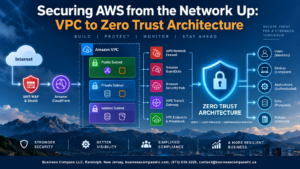
Network isolation forms the backbone of secure AWS data analytics implementations. Design dedicated VPCs for analytics workloads with private subnets hosting sensitive data processing services. Configure NAT gateways to enable outbound internet access while maintaining inbound protection. Use VPC endpoints for direct AWS service connections without internet routing, reducing attack surfaces and improving performance. Implement security groups and NACLs with restrictive rules allowing only necessary traffic flows between analytics components. Create separate availability zones for high availability while maintaining consistent security postures across regions.
Audit Trails with AWS CloudTrail Integration
CloudTrail integration provides comprehensive visibility into data analytics operations and access patterns. Enable CloudTrail logging across all regions where analytics services operate, capturing API calls, user activities, and service interactions. Configure log file validation to detect tampering and ensure audit integrity. Set up CloudWatch alarms for suspicious activities like unauthorized data access attempts or unusual query patterns. Create custom metrics to monitor specific analytics service usage and performance indicators. Store CloudTrail logs in dedicated S3 buckets with appropriate retention policies and cross-region replication for disaster recovery scenarios.
Building a robust data analytics architecture on AWS requires careful selection of the right tools and patterns for your specific needs. The platform offers powerful services like Kinesis for real-time processing, S3 and Lake Formation for data lakes, and various analytics engines from Athena to EMR that can handle different workload requirements. The key is understanding how these services work together and choosing the combination that best fits your data volume, processing speed, and budget constraints.
Start by mapping out your data flow and identifying where real-time processing adds value versus where batch processing is sufficient. Design your data lake with clear zones for raw, processed, and curated data, and don’t forget to build security and compliance into your architecture from day one rather than adding it later. The AWS ecosystem gives you the flexibility to start small and scale up, so pick a core set of services that solve your immediate problems and expand from there as your analytics needs grow.