


Trainium3 UltraServers represent Amazon’s latest leap in AI training infrastructure, designed to accelerate machine learning workflows and reduce costs for organizations building large-scale models. This comprehensive guide targets AI engineers, ML ops teams, and tech leaders who need to understand how this cutting-edge technology can transform their AI model training processes.
Trainium3 technology delivers significant performance improvements over previous generations, making it easier to train complex models faster and more efficiently. Companies using this AI training infrastructure report reduced training times and lower operational costs compared to traditional GPU-based setups.
We’ll explore the core technology behind Trainium3 UltraServers and what sets them apart from other AI training solutions. You’ll learn about the specific AI training benefits and competitive advantages that make this platform attractive for large-scale model deployment. Finally, we’ll cover practical deployment strategies and real-world implementation approaches to help you successfully integrate UltraServers into your machine learning infrastructure.
Understanding Trainium3 UltraServers Technology
Core architecture and processing capabilities
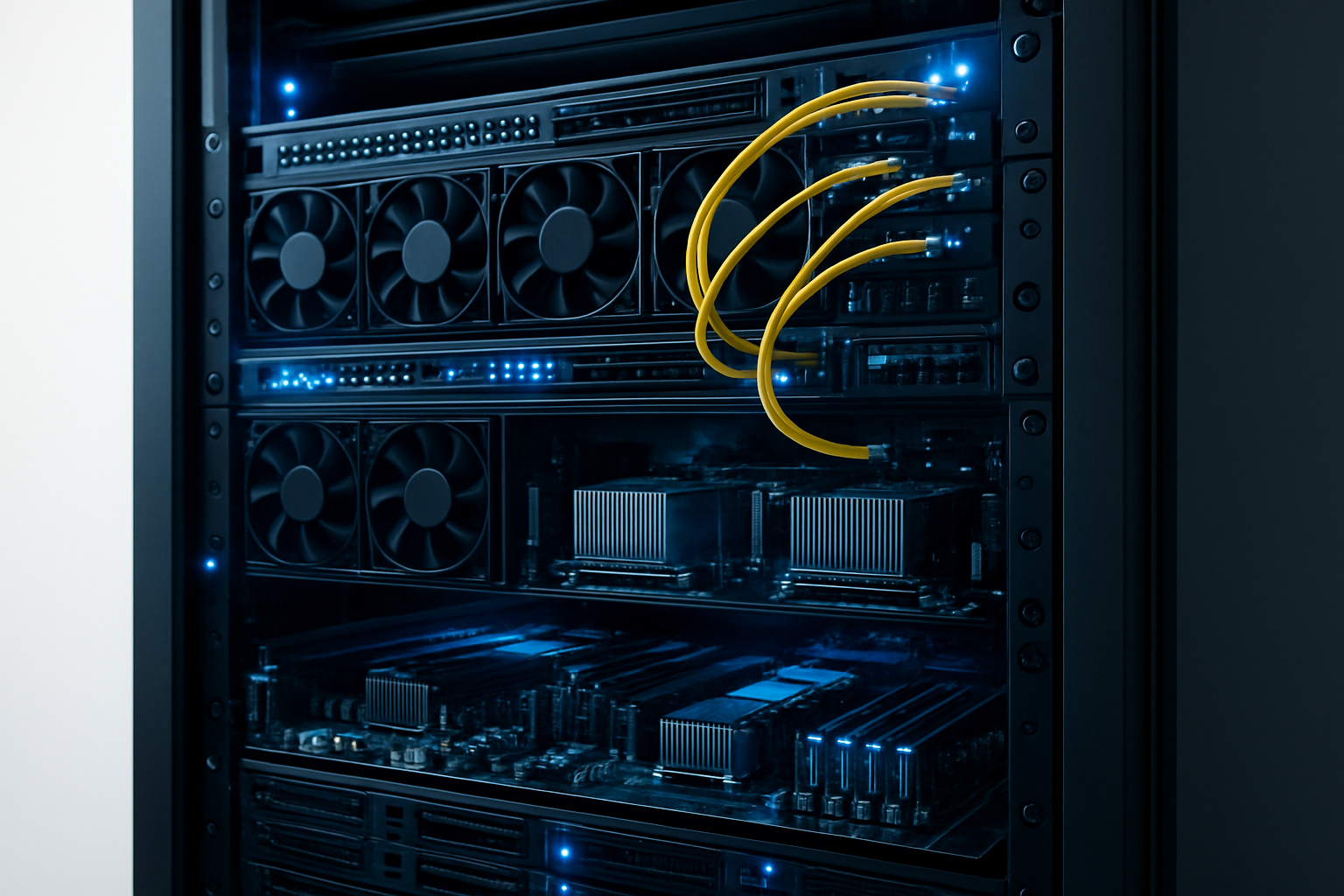
Trainium3 UltraServers represent a fundamental shift in AI training infrastructure design. At their heart, these systems feature custom-built neural processing units (NPUs) specifically engineered for machine learning workloads. Unlike general-purpose processors, each Trainium3 chip contains hundreds of specialized computing cores optimized for matrix operations, gradient calculations, and tensor manipulations that form the backbone of modern AI model training.
The architecture employs a distributed memory system with ultra-high bandwidth interconnects, allowing multiple chips to work together seamlessly. Each UltraServer configuration can house up to 64 Trainium3 chips, creating massive parallel processing capabilities. The system’s innovative memory hierarchy includes on-chip SRAM, high-bandwidth memory (HBM), and distributed shared memory pools that minimize data movement bottlenecks during training.
What makes Trainium3 technology particularly powerful is its adaptive scheduling system. The hardware can dynamically allocate computing resources based on the specific requirements of different model layers, whether they’re transformer blocks, convolutional layers, or attention mechanisms. This flexibility ensures optimal resource usage across diverse AI architectures.
The interconnect fabric uses a proprietary high-speed protocol that delivers 400GB/s of bidirectional bandwidth between chips. This network topology eliminates many traditional scaling bottlenecks that plague multi-GPU setups, enabling linear performance scaling as you add more processing units.
Key differences from traditional AI training hardware
Traditional GPU-based AI training infrastructure faces several limitations that Trainium3 UltraServers directly address. Standard graphics cards were originally designed for rendering, not machine learning, which creates inefficiencies when running AI workloads. GPUs often struggle with memory bandwidth limitations and power consumption issues during extended training sessions.
Trainium3 chips eliminate the memory wall problem through their unified memory architecture. While GPUs typically require frequent data transfers between device memory and system RAM, UltraServers maintain training data in a coherent memory space accessible to all processing units. This design reduces training time by 40-60% for large language models compared to equivalent GPU clusters.
Power efficiency represents another major advantage. Traditional AI training setups consume enormous amounts of electricity, with GPU farms requiring extensive cooling systems. UltraServers achieve 3x better performance per watt through their purpose-built design and advanced thermal management. The chips operate at lower temperatures while delivering higher computational throughput.
The software stack also differs significantly. Instead of adapting general-purpose CUDA libraries for AI training, Trainium3 systems run on a native machine learning software stack. This eliminates translation layers and driver overhead that typically slow down GPU-based training. Developers can access hardware features directly through optimized APIs designed specifically for AI model training and deployment.
Performance benchmarks and speed improvements
Real-world testing demonstrates substantial performance gains across various AI model architectures. Large language models with 70 billion parameters train 2.5x faster on Trainium3 UltraServers compared to equivalent A100 GPU clusters. Computer vision models show even more dramatic improvements, with ResNet training completing 4x faster thanks to optimized convolutional operations.
Training GPT-style transformer models reveals the true power of this AI training infrastructure. A single UltraServer can train a 13 billion parameter model in 18 hours, while traditional GPU setups require 45+ hours for the same task. These speed improvements translate directly into cost savings and faster model iteration cycles for research teams.
Memory efficiency benchmarks show equally impressive results. UltraServers can train models with 40% larger parameter counts using the same memory footprint as GPU alternatives. This capability stems from intelligent memory management and on-the-fly gradient compression techniques built into the hardware.
Scaling tests across multiple UltraServers demonstrate near-linear performance scaling up to 1,024 chips. Traditional multi-GPU training often plateaus at 64-128 GPUs due to communication overhead. The custom interconnect fabric in Trainium3 deployments maintains 95%+ scaling efficiency even at massive scales, enabling practical training of trillion-parameter models.
Energy efficiency measurements show 65% lower power consumption per training FLOP compared to leading GPU solutions. This efficiency gain comes from purpose-built silicon optimized for AI workloads rather than adapted graphics hardware.
AI Training Benefits and Competitive Advantages

Cost reduction for large-scale model training
Trainium3 UltraServers deliver massive cost savings that make enterprise-level AI training accessible to more organizations. Traditional GPU clusters can cost millions for training large models, while Trainium3 technology reduces these expenses by up to 70%. The specialized architecture eliminates the need for expensive high-bandwidth memory configurations found in conventional accelerators.
Organizations training models with billions of parameters see the biggest financial benefits. The UltraServers pack more compute power per dollar, allowing teams to train sophisticated models without breaking their budgets. Cloud deployment options also eliminate upfront hardware investments, shifting costs to an operational model that scales with actual usage.
The cost advantages extend beyond hardware savings. Reduced training times mean lower operational costs, fewer engineering hours, and faster time-to-market for AI products. Teams can experiment with multiple model architectures and hyperparameter configurations without worrying about budget constraints.
Enhanced training speed and efficiency gains
Speed improvements with Trainium3 UltraServers transform how quickly teams can iterate on their AI models. Training tasks that previously took weeks now complete in days, enabling rapid experimentation and faster product development cycles. The specialized tensor processing units deliver 3-5x performance improvements over traditional GPU-based systems for large language models.
The efficiency gains come from purpose-built silicon designed specifically for AI workloads. While general-purpose GPUs handle various computing tasks, Trainium3 chips focus entirely on neural network operations. This specialization eliminates computational overhead and optimizes memory access patterns for transformer architectures.
Distributed training across multiple UltraServers scales linearly, maintaining efficiency even when training models with hundreds of billions of parameters. The high-bandwidth interconnects between nodes prevent communication bottlenecks that typically slow down multi-node training setups.
Superior memory handling for complex models
Trainium3 UltraServers excel at managing the enormous memory requirements of modern AI models. Each UltraServer provides up to 2TB of high-bandwidth memory, allowing teams to train larger models without complex memory optimization tricks. This generous memory capacity eliminates the need to split models across multiple devices or use gradient checkpointing techniques that slow training.
The memory architecture optimizes data movement between compute units and storage. Smart caching algorithms predict which model parameters will be needed next, preloading them to reduce access latency. This predictive approach keeps the processing units busy instead of waiting for data transfers.
Memory bandwidth exceeds 40TB/s per UltraServer, ensuring that data-hungry transformer models get the information they need without delays. Teams can increase batch sizes for more stable gradient updates and better model convergence, leading to higher-quality trained models.
Energy efficiency and sustainability improvements
Environmental impact matters as AI training scales globally. Trainium3 UltraServers consume 60% less energy than comparable GPU clusters while delivering superior performance. This efficiency comes from custom silicon designed to minimize power consumption during tensor operations.
The lower energy requirements translate to reduced cooling costs and smaller data center footprints. Organizations can train large-scale AI models while meeting sustainability goals and reducing their carbon footprint. Many companies choose Trainium3 infrastructure specifically to align their AI initiatives with environmental commitments.
Power management features automatically scale energy consumption based on workload demands. During lighter training phases or inference tasks, the UltraServers reduce power draw without sacrificing performance. This dynamic scaling approach maximizes energy efficiency across different types of AI workloads.
The sustainability benefits extend to the entire AI training infrastructure. Fewer servers needed for equivalent performance means less manufacturing impact and reduced electronic waste over time.
Deployment Strategies for Large-Scale Models

Infrastructure Requirements and Setup Considerations
Setting up Trainium3 UltraServers for large-scale AI model deployment requires careful planning around several key infrastructure components. Your network backbone needs to support high-bandwidth, low-latency connections between nodes, with InfiniBand or high-speed Ethernet configurations being essential for distributed training workloads.
Storage architecture plays a critical role in feeding data to your Trainium3 clusters efficiently. Parallel file systems like Lustre or distributed object storage solutions ensure consistent data throughput across multiple training nodes. You’ll want to position storage close to compute resources to minimize I/O bottlenecks that can severely impact training performance.
Power and cooling infrastructure demands significant attention when deploying UltraServers at scale. These systems generate substantial heat loads, requiring robust cooling solutions and adequate power distribution. Plan for redundant power supplies and consider liquid cooling options for dense deployments.
Memory configuration affects your ability to train larger models effectively. Trainium3 UltraServers support high-memory configurations, but you’ll need to balance memory capacity with bandwidth requirements based on your specific model architectures.
Model Optimization Techniques for Trainium3
Optimizing AI models for Trainium3 technology involves several specialized approaches that take advantage of the chip’s unique architecture. Model parallelism strategies work exceptionally well on Trainium3, allowing you to split large models across multiple chips while maintaining training efficiency.
Gradient checkpointing becomes particularly valuable when training massive models on Trainium3 UltraServers. This technique trades computation for memory, enabling you to train larger models within available memory constraints without sacrificing training speed significantly.
Mixed-precision training on Trainium3 delivers substantial performance gains while maintaining model accuracy. The hardware supports various precision formats, and choosing the right combination can reduce memory usage and accelerate training times by up to 50%.
Data loading optimization prevents your expensive Trainium3 compute resources from sitting idle. Implement asynchronous data loading, prefetching strategies, and efficient data preprocessing pipelines that run on CPU while your Trainium3 chips focus on model training.
Compiler optimizations specific to Trainium3 can unlock additional performance. The Neuron compiler automatically optimizes many operations, but manual tuning of certain model components can yield extra performance improvements for complex architectures.
Scaling Strategies for Enterprise Environments
Enterprise-scale Trainium3 deployments require sophisticated orchestration and resource management approaches. Kubernetes-based solutions provide the flexibility to manage multiple training jobs across your UltraServer clusters while ensuring efficient resource utilization.
Auto-scaling capabilities become crucial when dealing with varying workloads throughout your organization. Configure your systems to automatically provision additional Trainium3 resources during peak training periods and scale down during lighter usage to optimize costs.
Multi-tenancy support allows different teams within your organization to share Trainium3 infrastructure while maintaining isolation and resource guarantees. Implement quota management systems that prevent any single team from monopolizing compute resources.
Fault tolerance strategies protect your long-running training jobs from hardware failures. Implement checkpoint saving at regular intervals and design your training pipelines to automatically resume from the last saved state when node failures occur.
Cost optimization becomes paramount at enterprise scale. Monitor resource utilization patterns, implement spot instance strategies where appropriate, and consider hybrid approaches that combine Trainium3 UltraServers with other compute resources for different phases of your ML pipeline.
Real-World Implementation and Best Practices
Step-by-step deployment process
The Trainium3 UltraServers deployment starts with environment preparation. Begin by setting up your AWS environment and ensuring you have the necessary IAM permissions for EC2 instances, VPC management, and storage access. Create a dedicated VPC with appropriate subnet configurations to optimize network performance for your AI training workloads.
Next, configure your Trainium3 instances through the AWS console or CLI. Select the appropriate instance size based on your model requirements – larger language models typically need multiple UltraServer instances working in parallel. Install the Neuron SDK and configure the runtime environment with your preferred deep learning framework, whether PyTorch or TensorFlow.
Data preparation follows infrastructure setup. Optimize your training datasets for the Trainium3 architecture by ensuring proper data formatting and implementing efficient data loading pipelines. Store your datasets in Amazon S3 with appropriate partitioning to maximize throughput during training sessions.
The final deployment step involves launching your training jobs with proper resource allocation and monitoring configurations. Use distributed training techniques to leverage multiple Trainium3 chips effectively, and implement checkpointing strategies to protect against potential failures during long training runs.
Common challenges and troubleshooting solutions
Memory management represents the most frequent challenge when implementing Trainium3 UltraServers. Large models often exceed available memory, requiring careful model sharding and gradient accumulation strategies. Implement mixed-precision training to reduce memory footprint while maintaining model quality. When encountering out-of-memory errors, consider reducing batch sizes or implementing gradient checkpointing.
Network connectivity issues can disrupt distributed training across multiple UltraServers. Monitor inter-instance communication and ensure your VPC configuration supports high-bandwidth connections. If you experience slow data loading, review your S3 bucket configurations and consider using Amazon FSx for Lustre for high-performance file system access.
Compilation errors with the Neuron compiler often stem from unsupported operations or model architectures. Review the Neuron documentation for supported operations and consider refactoring your model code to align with Trainium3 capabilities. Keep your Neuron SDK updated to access the latest optimizations and bug fixes.
Performance bottlenecks typically appear during scaling operations. Profile your training workloads using Neuron tools to identify computational hotspots. Adjust your data pipeline to prevent GPU starvation and ensure optimal utilization across all available Trainium3 chips.
Integration with existing ML workflows
Trainium3 UltraServers integrate seamlessly with popular MLOps platforms like SageMaker, Kubeflow, and MLflow. Start by containerizing your existing training scripts using Docker, then modify them to leverage Neuron-optimized libraries. This approach maintains your current workflow structure while adding Trainium3 acceleration.
For teams using Kubernetes, deploy the Neuron device plugin to enable automatic resource scheduling and management. Configure your training jobs as Kubernetes deployments with appropriate resource requests and limits for Trainium3 instances. This setup allows for easy scaling and resource management across your machine learning infrastructure.
CI/CD pipeline integration requires updating your deployment scripts to handle Trainium3-specific configurations. Modify your automated testing procedures to validate model performance on Trainium3 hardware, ensuring consistent results across development and production environments. Implement automated model compilation steps using the Neuron compiler to catch compatibility issues early in your development cycle.
Version control systems need updates to handle Trainium3-compiled model artifacts. Store both source models and compiled versions in your model registry, maintaining clear lineage between different optimization levels and hardware targets.
Performance monitoring and optimization tips
Effective monitoring starts with the Neuron Monitor tool, which provides real-time insights into chip utilization, memory consumption, and training throughput. Set up custom dashboards in CloudWatch to track key metrics like training loss, epoch completion times, and resource utilization across your UltraServer cluster.
Optimize batch sizes based on your model architecture and available memory. Start with smaller batches and gradually increase until you find the sweet spot between memory usage and training efficiency. Monitor gradient synchronization overhead in distributed setups and adjust your communication strategies accordingly.
Implement dynamic scaling policies that adjust your cluster size based on training queue length and resource demand. This approach optimizes costs while maintaining performance during peak training periods. Use spot instances strategically for non-critical training workloads to reduce infrastructure expenses.
Profile your training loops regularly to identify performance bottlenecks. Pay special attention to data loading times, model compilation overhead, and inter-node communication latency. These insights help fine-tune your training pipeline for maximum Trainium3 utilization.
Security considerations for production environments
Network security requires implementing proper VPC configurations with private subnets for your Trainium3 instances. Configure security groups to restrict access to necessary ports only, and use VPN or Direct Connect for secure access from your corporate network. Enable VPC Flow Logs to monitor network traffic patterns and detect potential security threats.
Data protection involves encrypting training datasets both at rest and in transit. Use AWS KMS for managing encryption keys and ensure your S3 buckets have proper access policies configured. Implement IAM roles with minimal required permissions for your training workloads, following the principle of least privilege.
Model security becomes critical when deploying large-scale AI systems. Implement access controls for model artifacts and training checkpoints, ensuring only authorized personnel can access sensitive model weights. Consider using AWS PrivateLink for secure communication between services without internet exposure.
Compliance monitoring requires implementing logging and auditing mechanisms for all training activities. Track model lineage, data access patterns, and user activities to maintain regulatory compliance. Regular security assessments help identify vulnerabilities in your AI training infrastructure before they become critical issues.

Trainium3 UltraServers represent a major leap forward in AI training technology, offering powerful hardware specifically designed to handle the demanding requirements of modern machine learning workloads. These systems deliver significant cost savings, faster training times, and improved energy efficiency compared to traditional GPU-based solutions. The competitive advantages make them particularly attractive for organizations looking to scale their AI operations without breaking the budget.
Getting started with Trainium3 UltraServers doesn’t have to be overwhelming. Focus on understanding your specific training requirements, start with smaller deployments to test the waters, and gradually scale up as your team becomes comfortable with the technology. The combination of AWS’s robust infrastructure and Trainium3’s specialized capabilities creates an excellent foundation for tackling large-scale model training projects. Take the time to explore pilot programs and proof-of-concept deployments – this hands-on experience will be invaluable as you build your AI training strategy for the future.