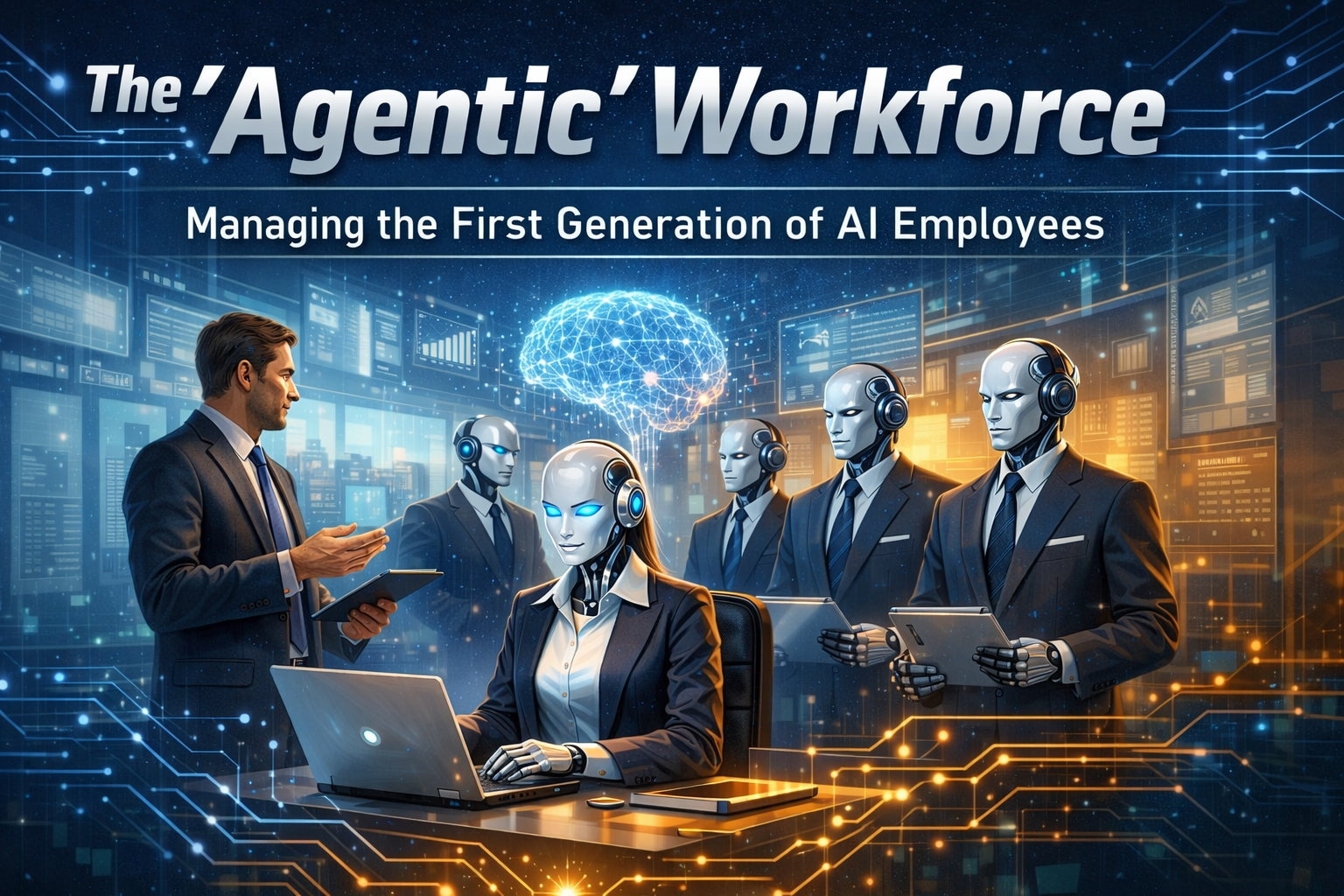
AI employees are no longer science fiction—they’re clocking in at companies worldwide and changing how we think about work. This guide is designed for executives, HR leaders, and team managers who need practical strategies for integrating AI agents into their existing workforce without the chaos.
Managing an agentic workforce means dealing with artificial intelligence that can make decisions, complete complex tasks, and work alongside your human team members. These autonomous AI workers don’t need coffee breaks, but they do need careful oversight, clear boundaries, and smart integration strategies.
We’ll walk through building a solid AI workforce strategy that aligns with your business goals and show you the management frameworks that actually work for AI employee oversight. You’ll also discover how to handle the legal and ethical challenges that come with AI workplace integration, plus proven methods for AI workforce optimization that deliver real ROI.
The first generation of AI employees is here, and the companies that learn to manage them effectively will have a massive competitive advantage.
Understanding AI Agents and Their Capabilities in the Modern Workplace

Defining Autonomous AI Systems and Their Decision-Making Abilities
Autonomous AI systems represent a fundamental shift from simple task automation to intelligent decision-making entities. These AI agents operate independently within defined parameters, analyzing complex situations and choosing appropriate responses without constant human oversight. Unlike rule-based systems that follow predetermined scripts, agentic AI can adapt its approach based on changing circumstances and learned experiences.
The decision-making architecture of these systems combines machine learning algorithms, natural language processing, and reasoning engines to evaluate multiple variables simultaneously. They can assess priorities, weigh trade-offs, and execute actions while maintaining alignment with organizational objectives. This cognitive flexibility allows AI employees to handle unexpected scenarios that would typically require human intervention.
Key Differences Between Traditional Automation and Agentic AI
| Traditional Automation | Agentic AI |
|---|---|
| Rule-based responses | Adaptive decision-making |
| Linear task execution | Multi-dimensional problem solving |
| Human-defined workflows | Self-directed goal achievement |
| Static capabilities | Continuous learning and improvement |
| Single-function focus | Cross-functional integration |
Traditional automation excels at repetitive, well-defined processes but struggles with ambiguity or exceptions. Agentic workforce members, however, can interpret context, understand nuances, and make judgment calls. They don’t just execute predefined steps—they determine which steps are necessary based on the situation at hand.
The learning component sets autonomous AI workers apart significantly. While traditional systems require manual updates to handle new scenarios, AI agents continuously refine their approaches through experience and feedback, becoming more effective over time.
Current Applications of AI Agents Across Industries
AI workplace integration has gained momentum across diverse sectors, with organizations discovering innovative ways to deploy intelligent agents:
Customer Service and Support
- Advanced chatbots that escalate complex issues intelligently
- Virtual assistants managing appointment scheduling and follow-ups
- Sentiment analysis agents monitoring customer satisfaction in real-time
Financial Services
- Fraud detection agents analyzing transaction patterns autonomously
- Risk assessment AI evaluating loan applications and investment opportunities
- Trading algorithms making split-second market decisions
Healthcare and Life Sciences
- Diagnostic support agents assisting radiologists with image analysis
- Drug discovery AI identifying potential compound interactions
- Patient monitoring systems alerting medical staff to critical changes
Manufacturing and Supply Chain
- Predictive maintenance agents scheduling equipment servicing
- Inventory optimization AI adjusting stock levels dynamically
- Quality control systems identifying defects and process improvements
Human Resources
- Recruitment agents screening candidates and scheduling interviews
- Performance analysis AI identifying training opportunities and career paths
- Employee engagement systems monitoring workplace satisfaction
Cognitive Skills and Problem-Solving Capabilities of AI Employees
Modern AI employees demonstrate sophisticated cognitive abilities that mirror human thinking patterns while offering unique advantages. Their problem-solving arsenal includes pattern recognition across vast datasets, logical reasoning through complex scenarios, and creative solution generation for novel challenges.
Memory and Learning Capabilities
AI agents maintain perfect recall of all interactions and experiences, building comprehensive knowledge bases that inform future decisions. They learn from successes and failures without emotional bias, continuously optimizing their performance based on objective outcomes.
Multi-Modal Processing
These systems can simultaneously process text, images, audio, and numerical data, providing holistic analysis that humans might miss when focusing on single information streams. This comprehensive perception enables more accurate assessments and well-rounded solutions.
Speed and Scalability
AI workforce optimization benefits tremendously from agents’ ability to process information and execute decisions at superhuman speeds. They can handle multiple complex tasks simultaneously without fatigue or decreased accuracy, making them invaluable for high-volume operations.
Emotional Intelligence Simulation
Advanced AI agents workplace implementations can recognize emotional cues in communication and adjust their responses accordingly. While they don’t experience emotions themselves, they can effectively navigate social dynamics and maintain positive relationships with human colleagues and customers.
Analytical Reasoning
These systems excel at breaking down complex problems into manageable components, identifying root causes, and developing systematic solutions. They can evaluate multiple scenarios simultaneously, considering various outcome probabilities and recommending optimal approaches based on defined success metrics.
Building Your AI Workforce Strategy

Identifying optimal roles and tasks for AI agents
The key to successful AI workforce integration starts with matching the right tasks to AI capabilities. AI employees excel at handling repetitive, data-heavy work that follows predictable patterns. Think customer service inquiries, data entry, financial reconciliation, and basic content moderation. These autonomous AI workers can process thousands of transactions per hour without fatigue or errors.
Look for roles where decisions follow clear rules and outcomes are measurable. Email filtering, appointment scheduling, inventory management, and basic research tasks are perfect starting points. AI agents workplace deployment works best when you can define success metrics clearly – response times, accuracy rates, or volume processed.
However, avoid assigning tasks requiring emotional intelligence, creative problem-solving, or complex human judgment to your agentic workforce. While AI can draft emails, humans should handle sensitive customer complaints. AI can analyze market data, but humans should make strategic business decisions based on that analysis.
Create a task audit matrix listing current business processes, their complexity level, data requirements, and human interaction needs. This helps identify quick wins where AI can make an immediate impact while preserving human roles for high-value activities.
Integration planning with existing human teams
Successful AI workforce integration requires careful coordination with your human teams. Start by involving department heads in the planning process. They understand workflow bottlenecks and can identify where AI support would be most valuable.
Design complementary workflows where AI handles routine tasks, freeing humans for strategic work. For example, AI can pre-screen job applications and schedule interviews, while recruiters focus on candidate evaluation and relationship building. This collaboration model reduces resistance and demonstrates AI as a productivity enhancer rather than a threat.
Establish clear handoff protocols between AI and human workers. Define when AI should escalate issues, how to transfer context between systems and people, and who takes responsibility for final decisions. Communication channels matter too – create shared dashboards where teams can monitor AI performance and adjust parameters as needed.
Training becomes critical for smooth integration. Your human employees need to understand AI capabilities and limitations. They should know how to work alongside AI employees effectively, interpret AI outputs, and provide feedback for continuous improvement.
Technology infrastructure requirements and investments
Building an effective managing AI workforce requires robust technical foundations. Start with data infrastructure – your AI agents need clean, accessible data to function properly. This often means upgrading data warehouses, implementing proper APIs, and ensuring real-time data flows between systems.
Cloud computing resources become essential for scaling your artificial intelligence management operations. Most enterprise AI management solutions require significant computational power, especially for natural language processing and complex decision-making tasks. Budget for increased cloud costs and consider hybrid solutions for sensitive data.
| Infrastructure Component | Initial Investment | Ongoing Costs | ROI Timeline |
|---|---|---|---|
| Data Platform Upgrades | $50K-200K | $10K-30K/month | 6-12 months |
| AI Software Licensing | $25K-100K/year | Variable usage fees | 3-6 months |
| Integration Tools | $15K-75K | $5K-15K/month | 4-8 months |
| Monitoring Systems | $10K-40K | $2K-8K/month | 2-4 months |
Security infrastructure needs special attention. AI workforce optimization involves processing sensitive business data, so implement proper encryption, access controls, and audit trails. Your AI agents need secure communication channels and isolated computing environments to prevent data breaches.
Don’t forget about monitoring and analytics tools. You need real-time visibility into AI performance, error rates, and resource consumption. These systems help you optimize costs and identify improvement opportunities.
Timeline and phased implementation approaches
Smart AI employee strategy deployment happens in phases rather than all at once. Start with a pilot program focusing on one department or specific use case. This approach minimizes risk while providing valuable learning opportunities.
Phase 1 (Months 1-3): Select a low-risk, high-impact pilot project. Deploy AI for simple tasks like data entry or basic customer inquiries. Focus on getting the technical integration right and training your human teams.
Phase 2 (Months 4-8): Expand to additional departments or more complex tasks based on pilot success. Refine your management processes and scale up infrastructure as needed. This phase should prove ROI and build organizational confidence.
Phase 3 (Months 9-18): Roll out enterprise-wide deployment with multiple AI agents handling various business functions. Implement advanced analytics and optimization features. Focus on continuous improvement and advanced use cases.
Build in flexibility for your timeline. Technology challenges, team resistance, or changing business needs might require adjustments. Plan for 20-30% longer implementation times than initial estimates.
Regular milestone reviews keep implementation on track. Schedule monthly check-ins during each phase to assess progress, address challenges, and plan next steps. This iterative approach helps you adapt quickly and maintain momentum throughout your AI workplace integration journey.
Essential Management Frameworks for AI Employees

Performance Monitoring and Productivity Measurement Systems
Managing AI employees requires completely different metrics than traditional human workforce management. You can’t measure an AI agent’s productivity by hours worked or coffee breaks taken. Instead, focus on output quality, task completion rates, and accuracy metrics that actually matter for your business goals.
Start by establishing baseline performance indicators for each AI employee in your agentic workforce. Track key metrics like response time, error rates, successful task completions, and the complexity of problems solved. Create dashboards that show real-time performance data, allowing you to spot issues before they impact your operations.
The beauty of AI employee strategy lies in the granular data available. Unlike human workers, AI agents generate detailed logs of every action, decision, and process. Use this data to identify patterns and optimization opportunities. Set up automated alerts when performance drops below acceptable thresholds, and implement continuous monitoring systems that track productivity across different time periods and workload variations.
Consider implementing performance scoring systems that weight different aspects of AI agent output based on your specific business needs. For customer service AI employees, emphasize response accuracy and customer satisfaction scores. For data analysis agents, focus on processing speed and insight quality.
Goal-Setting and Task Delegation Methodologies
Effective AI workforce optimization starts with clear, measurable objectives. AI agents excel when given specific, well-defined tasks with clear success criteria. Vague instructions lead to inconsistent results and wasted computational resources.
Break down complex projects into smaller, manageable tasks that align with each AI agent’s specialized capabilities. Create task hierarchies that allow autonomous AI workers to understand priorities and dependencies. Use structured frameworks like OKRs (Objectives and Key Results) adapted for artificial intelligence management, where objectives are quantifiable and results can be automatically measured.
Implement dynamic task allocation systems that consider current workload, agent capabilities, and deadline requirements. Your AI employees can handle multiple tasks simultaneously, but optimal performance comes from strategic distribution based on complexity and urgency.
| Task Type | Best AI Agent Profile | Success Metrics |
|---|---|---|
| Data Processing | High-volume analytical agents | Speed, accuracy, throughput |
| Customer Interaction | Language-optimized agents | Satisfaction scores, resolution time |
| Content Generation | Creative-focused agents | Quality ratings, engagement metrics |
| Quality Assurance | Detail-oriented validation agents | Error detection rate, compliance scores |
Quality Control and Output Validation Processes
Quality assurance for your agentic workforce requires multi-layered validation systems. AI employees can produce high-volume output, but without proper quality controls, errors can compound quickly and damage your business reputation.
Establish automated quality gates that check AI agent output before it reaches end users or moves to the next process stage. Implement peer review systems where different AI agents validate each other’s work, creating redundancy and catching errors that single-agent validation might miss.
Create feedback loops that allow your AI employees to learn from quality control findings. When an AI agent makes an error, use that information to improve future performance rather than just correcting the mistake. This continuous improvement approach maximizes your AI workplace integration investment.
Set up human oversight checkpoints for critical outputs, especially in areas involving customer communication, financial decisions, or regulatory compliance. Your enterprise AI management strategy should include clear escalation protocols that route complex or ambiguous situations to human supervisors.
Regular quality audits help maintain consistent standards across your AI workforce. Sample outputs randomly and systematically review them against your quality criteria. Document common error patterns and adjust your AI employee training or parameters accordingly. This proactive approach prevents quality degradation and maintains the high performance standards your business requires.
Navigating Legal and Ethical Considerations

Liability and Accountability Frameworks for AI Decisions
When your AI employees make decisions that impact your business, the question of responsibility becomes complex. Traditional employment law doesn’t cover artificial intelligence management scenarios, leaving companies to navigate uncharted territory. The key challenge lies in determining who bears responsibility when an AI agent makes a costly mistake or causes harm.
Current legal frameworks generally place liability on the deploying organization rather than the AI system itself. This means your company remains accountable for decisions made by your agentic workforce, regardless of their autonomous nature. Smart businesses are establishing clear decision-making hierarchies that define which choices require human oversight and which can be fully delegated to AI employees.
Documentation becomes your best defense. Every AI agent deployment should include detailed logs of decision-making processes, training data sources, and operational parameters. This creates an audit trail that can protect your organization during legal challenges while demonstrating due diligence in AI workforce management.
Insurance companies are beginning to offer specialized coverage for AI-related incidents, but policies remain limited and expensive. Many organizations are creating internal risk assessment protocols that evaluate potential liability exposure before deploying autonomous AI workers in critical business functions.
Data Privacy and Security Compliance Requirements
Managing an agentic workforce means handling unprecedented volumes of sensitive information. Your AI employees process customer data, internal communications, and proprietary business intelligence at lightning speed, creating new vulnerabilities that traditional security frameworks weren’t designed to address.
GDPR, CCPA, and other privacy regulations apply equally to data processed by AI agents as they do to human employees. However, the speed and scale at which artificial intelligence management operates can amplify compliance risks exponentially. A single misconfigured AI agent could expose thousands of customer records in minutes.
Data minimization becomes critical when training and deploying AI employees. These systems often perform better with more data, but privacy laws require collecting only what’s necessary for specific business purposes. Striking this balance requires careful planning and ongoing monitoring of your AI workforce optimization efforts.
Cross-border data transfers present additional challenges. AI agents may process information across multiple jurisdictions without human awareness, potentially violating data sovereignty requirements. Implementing geographic restrictions and data localization controls helps ensure your autonomous AI workers respect international privacy boundaries.
Regular privacy impact assessments should become standard practice when onboarding new AI employees. These evaluations help identify potential compliance gaps before they become costly violations.
Regulatory Landscape and Emerging AI Governance Standards
The regulatory environment for enterprise AI management is evolving rapidly. The EU’s AI Act, China’s AI regulations, and emerging US federal guidelines are creating a patchwork of compliance requirements that companies must navigate carefully.
Risk-based classification systems are becoming the norm. High-risk AI applications face stricter oversight requirements, while lower-risk implementations enjoy more operational freedom. Understanding where your AI employees fall within these classifications directly impacts your compliance obligations and operational costs.
Industry-specific regulations add another layer of complexity. Financial services, healthcare, and other regulated sectors face additional scrutiny when deploying autonomous AI workers. Banking regulators, for instance, require explainable AI decisions for credit-related functions, which may limit the types of AI agents you can deploy in customer-facing roles.
Certification and auditing requirements are emerging across multiple jurisdictions. Some regions now mandate third-party assessments of AI systems before deployment, while others require ongoing monitoring and reporting. These requirements significantly impact the total cost of ownership for your agentic workforce.
International coordination efforts are underway, but harmonized standards remain years away. Companies operating globally must prepare for continued regulatory fragmentation and build flexible compliance frameworks that can adapt to changing requirements.
Ethical Guidelines for AI Employee Deployment
Building ethical standards for your AI workforce goes beyond legal compliance—it protects your brand reputation and employee trust. The decisions your AI agents make reflect your company’s values, making ethical deployment frameworks essential for long-term success.
Bias prevention starts with diverse training data and regular algorithmic auditing. AI employees can inadvertently perpetuate historical discrimination if their training data reflects past inequities. Regular testing across different demographic groups helps identify and correct problematic patterns before they impact real decisions.
Transparency requirements vary by use case, but stakeholders increasingly expect explanations for AI-driven decisions. Your agentic workforce should be capable of providing clear reasoning for their actions, especially when those decisions affect employees, customers, or business partners.
Human oversight mechanisms prevent autonomous AI workers from operating completely independently. Even the most sophisticated AI agents need human checkpoints for decisions involving significant financial, legal, or ethical implications. Defining these escalation triggers protects both your organization and the people affected by AI decisions.
Job displacement concerns require thoughtful communication and planning. While AI employees can enhance human productivity, they also change traditional roles. Successful companies address these concerns proactively through retraining programs, role redefinition, and honest communication about workforce changes.
Environmental impact considerations are gaining importance as AI workloads consume increasing amounts of energy. Choosing efficient AI architectures and monitoring computational costs helps balance performance goals with sustainability commitments.
Maximizing ROI and Performance Optimization

Cost-Benefit Analysis and Productivity Metrics
The financial impact of your agentic workforce becomes crystal clear when you track the right metrics. Start by measuring direct cost savings: reduced labor expenses, decreased error rates, and faster task completion times. A typical AI employee handling customer service inquiries can process 10x more requests than human staff while working 24/7 without breaks, overtime pay, or benefits.
Key productivity metrics to monitor include task completion rates, accuracy percentages, and processing speed improvements. For instance, an AI agent managing invoice processing might reduce processing time from hours to minutes while maintaining 99.8% accuracy. Track these numbers against baseline human performance to calculate your true ROI.
Don’t forget hidden costs like training, integration, and ongoing maintenance. However, most organizations see positive returns within 6-12 months when AI employees are properly deployed. Create detailed dashboards showing real-time performance data, cost per task, and efficiency gains to justify continued investment and expansion.
Continuous Learning and AI Model Improvement Strategies
Your AI employees get smarter over time, but only with the right improvement strategies. Implement feedback loops that capture performance data and feed it back into model training. When an AI agent makes errors, use those instances as training opportunities rather than just corrections.
Regular model updates keep your artificial intelligence management strategy competitive. Schedule monthly reviews of AI performance data to identify areas for improvement. Some AI agents benefit from retraining on new data sets, while others need fine-tuning of existing parameters.
Consider implementing A/B testing for different AI configurations. Run parallel versions of your AI employees with slight variations to see which performs better. This approach helps optimize everything from response times to decision-making accuracy. Documentation of these improvements creates a knowledge base for future AI workforce optimization efforts.
Scaling Successful AI Implementations Across Departments
Once you’ve proven success with AI agents in one area, smart scaling becomes your next priority. Start by identifying departments with similar workflow patterns to your initial success story. If customer service AI employees excel, consider deploying similar agents in technical support or sales inquiries.
Create standardized deployment templates that capture your successful configurations. This includes training protocols, integration requirements, and performance benchmarks. Your IT team can then rapidly deploy new AI employees using proven frameworks rather than starting from scratch each time.
Cross-departmental collaboration prevents duplicate efforts and shares best practices. Regular meetings between department heads using AI employees help identify new opportunities and avoid common pitfalls. Some organizations create AI centers of excellence to coordinate these efforts and maintain consistency across all autonomous AI workers.
Measuring Long-Term Business Impact and Efficiency Gains
Long-term success measurement goes beyond simple cost savings. Track how your agentic workforce affects customer satisfaction scores, employee morale, and business growth. AI employees often free human workers to focus on higher-value tasks, leading to increased innovation and strategic thinking.
Monitor scalability metrics like how quickly you can add new AI employees versus hiring human staff. Many companies find they can expand operations 300% faster with AI agents compared to traditional hiring processes. This agility becomes a significant competitive advantage in rapidly changing markets.
Quarterly business reviews should include AI workforce performance alongside traditional metrics. Look for improvements in customer response times, reduced operational bottlenecks, and increased capacity for handling peak demand periods. These efficiency gains often compound over time, making the long-term impact even more substantial than initial projections suggest.

AI agents are already changing how we work, and companies that start building their AI workforce strategy now will have a huge advantage. The key is treating these digital employees with the same thoughtfulness you’d give to hiring and managing any team member. You need clear frameworks, solid legal groundwork, and a focus on getting real value from your investment.
The smartest move right now is to start small with one or two AI agents in specific roles where you can measure their impact. Learn what works, figure out the management style that clicks, and then scale up from there. Your future competitors are probably already experimenting with AI employees – don’t let them get too far ahead while you’re still thinking about it.