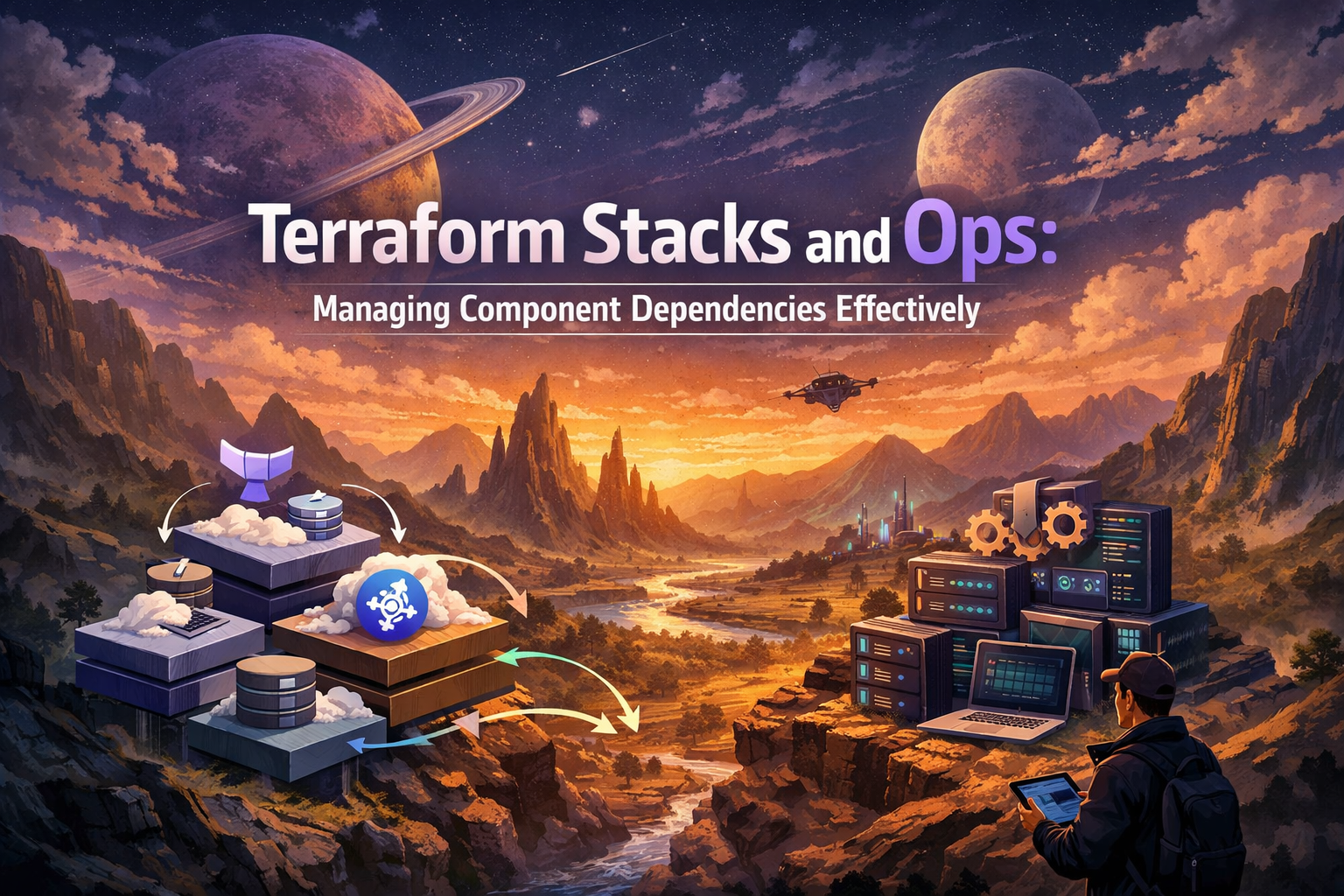
Managing complex infrastructure deployments gets messy fast when terraform component dependencies spiral out of control. This guide is designed for DevOps engineers, infrastructure architects, and platform teams who need to build scalable terraform infrastructure without getting tangled in dependency nightmares.
You’ll discover proven strategies for organizing terraform stacks that actually work in production environments. We’ll walk through strategic design patterns that keep your components loosely coupled yet properly coordinated. Plus, you’ll learn how to optimize terraform ops workflows so your team can deploy complex infrastructure changes confidently and consistently.
By the end, you’ll have a clear roadmap for implementing terraform stack architecture that scales with your organization while avoiding the common pitfalls that turn infrastructure management into a constant firefighting exercise.
Understanding Terraform Stacks Architecture for Scalable Infrastructure

Breaking Down Monolithic Infrastructure into Manageable Components
Traditional infrastructure-as-code approaches often result in massive, unwieldy configurations that become nightmares to maintain. Terraform stacks solve this problem by allowing you to decompose your infrastructure into logical, reusable components that mirror your application architecture.
Think of your infrastructure like a house – instead of building everything as one giant block, you create separate rooms (components) for different purposes. Your networking stack handles subnets and security groups, while your application stack focuses on compute resources and load balancers. Each component has a specific responsibility and can be developed, tested, and deployed independently.
This modular approach brings immediate benefits. Teams can work on different infrastructure pieces simultaneously without stepping on each other’s toes. When you need to update your database configuration, you don’t risk breaking your entire application stack. The blast radius of changes shrinks dramatically, making your operations more predictable and safer.
Component boundaries should align with your organizational structure and deployment patterns. If your database team manages all data storage resources, create dedicated stacks for RDS instances, backup policies, and monitoring. Application teams get their own stacks for compute resources, auto-scaling groups, and application-specific networking rules.
The key is finding the right granularity. Too many tiny components create overhead and complex dependency webs. Too few large components defeat the purpose of modularity. Start with logical business domains and refine based on your team’s operational needs.
Leveraging Stack Hierarchies to Organize Related Resources
Terraform stack architecture shines when you establish clear hierarchies that reflect your infrastructure’s natural dependencies. Foundation stacks contain your core networking, security policies, and shared services. Application stacks build on top of these foundations, consuming outputs from lower-level stacks.
Your hierarchy might look like this: Platform stacks at the bottom provide VPCs, IAM roles, and monitoring infrastructure. Service stacks in the middle layer deploy databases, message queues, and shared application services. Finally, application stacks at the top deploy your specific workloads that consume everything below.
This layered approach makes dependency management intuitive. Lower layers change infrequently and provide stable interfaces for higher layers. When you need to add a new application, you simply reference existing platform and service components rather than recreating basic infrastructure.
Stack hierarchies also align with different change velocities in your organization. Network configurations might change quarterly, while application deployments happen multiple times daily. By separating these concerns into different stack levels, you avoid unnecessary coupling between fast-changing and slow-changing resources.
Consider using naming conventions that reflect your hierarchy. Something like platform-networking-prod, service-database-prod, and app-frontend-prod immediately communicates the stack’s position in your infrastructure ecosystem.
Implementing Environment Separation Through Stack Boundaries
Environment separation becomes natural when you design your terraform stack architecture with clear boundaries. Instead of complex conditional logic within single configurations, each environment gets its own stack instances with appropriate sizing, security policies, and resource configurations.
Development environments can use smaller instance types and relaxed security policies, while production stacks enforce strict compliance requirements and high-availability configurations. This separation prevents accidental changes from affecting production systems and allows teams to experiment freely in development environments.
Stack boundaries also enable different deployment cadences per environment. Development stacks might deploy continuously with every code change, staging environments could have daily deployments, and production stacks follow weekly release schedules. Each environment maintains its own state file and deployment pipeline, reducing the risk of cross-environment contamination.
Environment-specific configuration becomes manageable through variable files and stack parameters. Your base stack configuration remains the same across environments, while variables handle environment-specific differences like instance counts, security group rules, and backup retention periods.
Consider implementing progressive deployment patterns where changes flow through your stack hierarchy. New configurations start in development stacks, get validated in staging, and finally reach production. This approach catches issues early while maintaining production stability through your scalable terraform infrastructure design.
Mastering Component Dependencies with Strategic Design Patterns

Identifying Critical Dependencies Between Infrastructure Components
Mapping out terraform component dependencies starts with understanding how your infrastructure pieces connect and rely on each other. Think of it like building a house – you can’t put up the roof before the walls are ready, and you can’t install the walls without a solid foundation.
The most common dependency patterns emerge between network resources, compute instances, and data stores. Your VPC needs to exist before subnets can be created, subnets must be ready before security groups can reference them, and security groups have to be in place before EC2 instances can use them. These relationships form dependency chains that terraform stacks must respect during both creation and destruction.
Database dependencies often create the trickiest scenarios. Your application servers depend on RDS instances, but those databases might need specific subnet groups and parameter configurations first. Storage dependencies follow similar patterns – EBS volumes need availability zones, S3 buckets require proper IAM policies, and backup systems depend on the resources they’re protecting.
Start by sketching out your architecture visually. Draw boxes for each major component and connect them with arrows showing the dependency flow. This exercise reveals hidden dependencies you might miss when writing code. Pay special attention to circular dependencies – these will break your deployments and cause headaches later.
Implementing Data Sources for Cross-Stack Communication
Data sources act as the communication bridge between different terraform stacks, letting one stack discover and use resources created by another. Instead of hardcoding values or passing variables manually, data sources query the actual state of your infrastructure.
data "aws_vpc" "main" {
  filter {
    name   = "tag:Name"
    values = ["production-vpc"]
  }
}

data "aws_subnet_ids" "private" {
  vpc_id = data.aws_vpc.main.id

  tags = {
    Tier = "private"
  }
}
The beauty of data sources lies in their real-time accuracy. When your network team updates the VPC configuration, your application stack automatically picks up those changes without manual intervention. This approach eliminates the brittle connections that come from hardcoded resource IDs.
Tag-based filtering provides the most flexible approach for resource discovery. Create consistent tagging strategies across your organization so stacks can reliably find the resources they need. Environment tags, project tags, and tier tags work particularly well for this purpose.
Data sources also handle resource lifecycle management gracefully. If a referenced resource gets recreated with a new ID, the data source automatically discovers the new resource during the next terraform run. This resilience makes your terraform stack architecture much more robust.
Using Remote State References to Share Resources Safely
Remote state references create direct connections between terraform stacks by reading output values from other state files. This method provides stronger guarantees than data sources because it relies on terraform’s own state management rather than external API queries.
data "terraform_remote_state" "network" {
  backend = "s3"
  config = {
    bucket = "company-terraform-state"
    key    = "network/terraform.tfstate"
    region = "us-west-2"
  }
}

resource "aws_instance" "web" {
  subnet_id = data.terraform_remote_state.network.outputs.private_subnet_id
  # ... other configuration
}
The consuming stack reads output values that the producing stack explicitly exports. This creates a clear contract between stacks – the network stack promises to provide certain outputs, and the application stack depends on those specific values.
Version your remote state carefully when using this approach. Changes to output names or types in the producing stack will break consuming stacks. Use semantic versioning for your infrastructure and maintain backward compatibility during transitions.
Remote state references work best for stable, foundational resources like networking, IAM roles, and shared services. Avoid using them for frequently changing resources because updates become more complex when multiple stacks depend on the same state file.
Creating Explicit Dependencies Through Variable Passing
Variable passing creates the most explicit and controlled form of terraform component dependencies. Rather than discovering resources automatically, this approach requires intentional configuration at deployment time, giving you complete control over how stacks connect.
variable "vpc_id" {
  description = "ID of the VPC where resources will be created"
  type        = string
}

variable "database_endpoint" {
  description = "RDS instance endpoint for application configuration"
  type        = string
}

resource "aws_instance" "app" {
  vpc_security_group_ids = [aws_security_group.app.id]
  user_data = templatefile("app-config.sh", {
    db_endpoint = var.database_endpoint
  })
}
This method shines in complex environments where multiple teams manage different infrastructure layers. The database team can provide connection details to the application team without exposing their entire terraform state or requiring API access for resource discovery.
Variable passing also supports testing and development workflows better than other dependency methods. You can easily point development stacks at different databases or networks by changing variable values, without modifying the terraform code itself.
Create variable validation rules to catch configuration errors early. Check that VPC IDs match expected patterns, verify that database endpoints use proper formatting, and validate that required variables are actually provided. These safeguards prevent deployment failures and make dependency issues easier to debug.
Use structured variable types like objects and maps when passing complex resource information. Instead of separate variables for database host, port, and name, create a single database object that contains all related properties. This approach keeps related configuration together and reduces the chance of mismatched values.
Optimizing Terraform Ops Workflows for Complex Deployments

Establishing Deployment Order Through Dependency Mapping
Creating a visual dependency map serves as the foundation for successful terraform ops workflows in complex environments. Start by documenting each terraform component and its relationships to other resources, including databases, networking components, and external services. This mapping process reveals critical deployment sequences that prevent resource conflicts and circular dependencies.
When building your dependency map, identify hard dependencies where resources cannot exist without their prerequisites, and soft dependencies that can be deployed in parallel. For example, your VPC and subnets must exist before launching EC2 instances, while multiple application stacks might deploy simultaneously once the networking foundation is ready.
Use tools like Terraform Graph or custom scripts to automatically generate dependency visualizations. These diagrams help teams understand the deployment flow and identify potential bottlenecks. Document deployment windows and estimated completion times for each component to create realistic deployment schedules.
Consider implementing dependency tags within your terraform stacks to programmatically determine deployment order. This approach enables automated systems to parse dependencies and execute deployments in the correct sequence without manual intervention.
Automating Stack Orchestration with CI/CD Pipelines
Modern terraform component dependencies require sophisticated automation to manage complex deployments effectively. Design your CI/CD pipelines to handle multi-stack deployments with proper dependency resolution and parallel execution where possible.
Structure your pipeline stages to mirror your dependency map, creating distinct phases for foundational infrastructure, middleware services, and application components. Each stage should include comprehensive validation steps, including terraform plan reviews, security scanning, and integration testing before proceeding to the next phase.
Implement pipeline triggers that respond to changes in dependent stacks. When a shared networking stack updates, automatically trigger validation and potential redeployment of dependent application stacks. This reactive approach ensures consistency across your infrastructure while minimizing manual coordination efforts.
Build in approval gates for critical dependencies, especially those affecting production environments. Automated systems can handle routine updates, but significant architectural changes should require human oversight. Configure your pipeline to pause deployment and request approvals when detecting high-impact changes in terraform stack architecture.
Create rollback checkpoints at each major dependency boundary. Store terraform state snapshots and configuration versions that enable rapid recovery if downstream dependencies fail during deployment.
Implementing Rollback Strategies for Failed Dependencies
Robust rollback strategies protect your infrastructure when dependency chains break during deployment. Design your terraform stacks with rollback capabilities built into the architecture from day one, rather than treating recovery as an afterthought.
Implement state isolation between dependency layers to prevent cascading failures. When a dependent component fails, the failure should not corrupt the state of upstream dependencies. Use separate state files and backend configurations for different dependency levels to maintain clean separation.
Create automated rollback triggers based on health checks and deployment success metrics. Monitor key indicators like resource creation success rates, application health endpoints, and infrastructure performance metrics. When thresholds breach acceptable limits, trigger automatic rollback procedures to restore the last known good configuration.
Develop rollback runbooks that document exact procedures for different failure scenarios. Include terraform commands, state manipulation steps, and manual verification checkpoints. Test these procedures regularly in non-production environments to ensure they work when needed.
Consider implementing blue-green deployment patterns for critical terraform components with complex dependencies. Maintain parallel infrastructure versions and switch traffic between them during updates. This approach provides instant rollback capabilities without complex state manipulation or resource recreation.
Store dependency snapshots at regular intervals, including terraform state files, variable configurations, and deployment artifacts. Automated systems should create these snapshots before major deployments and retain them according to your recovery time objectives.
Advanced Dependency Management Techniques for Production Environments

Utilizing Terraform Modules for Reusable Component Patterns
Terraform modules serve as the backbone for creating reusable component patterns in production environments. When managing terraform component dependencies across multiple teams and projects, modules provide a standardized approach that reduces configuration drift and ensures consistent infrastructure deployments.
Building effective module hierarchies starts with identifying common infrastructure patterns within your organization. Network modules typically form the foundation layer, followed by security groups, compute resources, and application-specific components. Each module should encapsulate a specific business capability while exposing only necessary variables for customization.
- Input validation: Implement comprehensive variable validation using Terraform’s validation blocks to catch configuration errors early
- Output standardization: Define consistent output naming conventions across modules to simplify dependency mapping
- Version pinning: Always pin module versions in production to prevent unexpected changes during deployments
- Documentation: Include clear examples and parameter descriptions within each module
Module composition becomes critical when dealing with complex terraform stack architecture. Child modules should reference parent module outputs through data sources or remote state, creating explicit dependency chains that Terraform can properly sequence during execution.
Implementing Conditional Dependencies Based on Environment Variables
Environment-specific dependency management requires sophisticated conditional logic that adapts infrastructure based on deployment context. Terraform’s conditional expressions and dynamic blocks enable this flexibility while maintaining infrastructure as code dependency management principles.
Conditional resource creation based on environment variables allows teams to optimize costs and complexity. Development environments might skip expensive redundancy features like multi-AZ deployments or backup systems, while production environments enforce these requirements through variable-driven conditions.
- Variable-driven feature flags: Create boolean variables that control resource creation across environments
- Environment-specific resource sizing: Adjust instance types, storage capacities, and networking configurations based on environment needs
- Conditional module inclusion: Load different modules entirely based on environment context
- Security policy variations: Apply stricter security rules in production while allowing development flexibility
Local values become particularly powerful when implementing environment-based conditions. They allow complex logic evaluation once during planning, reducing repetition and improving readability throughout your terraform ops workflows.
Managing Cross-Region Dependencies in Multi-Cloud Setups
Cross-region dependencies introduce significant complexity in managing terraform dependencies, especially when spanning multiple cloud providers. Data replication, network connectivity, and service discovery require careful orchestration to maintain system reliability.
Remote state management becomes crucial when dealing with cross-region deployments. Each region typically maintains its own state file, but shared resources like DNS zones or global load balancers need coordination mechanisms. Terraform workspaces or separate state backends for global resources help manage this complexity.
- State backend separation: Use different state backends for regional and global resources to prevent lock contention
- Data source dependencies: Leverage data sources to query cross-region resource attributes without direct state dependencies
- Eventual consistency handling: Build retry mechanisms and dependency waits for resources that aren’t immediately consistent across regions
- Network peering automation: Automate VPC peering or transit gateway configurations to ensure connectivity between regions
Multi-cloud scenarios add another layer of complexity where provider-specific features and networking models must integrate seamlessly. Abstraction layers through custom modules help normalize differences between cloud providers while maintaining deployment flexibility.
Handling Database and Network Dependencies Across Stacks
Database and network dependencies often span multiple terraform stacks, requiring careful coordination to prevent circular dependencies and ensure proper initialization ordering. Network infrastructure typically serves as the foundation for all other resources, while databases often have complex startup sequences and migration requirements.
Network dependency patterns follow a hierarchical structure where VPCs and subnets must exist before security groups, which must exist before instances or databases. Breaking these dependencies across stacks requires explicit data source references and sometimes external coordination through configuration management tools.
- Network resource outputs: Export subnet IDs, security group references, and route table information for consumption by dependent stacks
- Database initialization sequencing: Coordinate database creation, schema initialization, and application deployment through external orchestration
- Connection string management: Store database connection information in secure parameter stores for cross-stack access
- Health check dependencies: Implement health checks and readiness probes to ensure services are available before dependent resources start
Production database dependencies often require zero-downtime migration strategies. Blue-green deployments at the stack level allow database schema changes without impacting running applications, while connection pooling and service discovery help manage the transition between database versions.
Cross-stack communication through parameter stores or service discovery mechanisms provides loose coupling while maintaining dependency relationships. This approach allows independent stack deployments while ensuring runtime dependencies remain satisfied across your scalable terraform infrastructure.
Troubleshooting Common Dependency Issues in Terraform Stacks

Resolving Circular Dependencies Between Components
Circular dependencies can turn your terraform stacks into a nightmare. Picture this: Stack A needs data from Stack B, but Stack B depends on outputs from Stack A. You’re stuck in an endless loop that prevents any deployments from succeeding.
The first step in breaking these cycles involves mapping out your dependency chain visually. Create a simple diagram showing which components depend on what. You’ll often spot the circular pattern immediately once it’s laid out clearly.
Common solutions include:
- Dependency inversion: Move shared resources to a separate foundation stack that both components can reference
- Data source refactoring: Replace direct stack dependencies with data sources that query existing resources
- Resource splitting: Break apart tightly coupled components into smaller, more focused stacks
When dealing with networking dependencies, create a dedicated network stack first. Application stacks can then reference network outputs without creating circular relationships. This pattern works particularly well in terraform stack architecture where clear separation of concerns prevents dependency conflicts.
Debugging Remote State Access Problems
Remote state issues often appear as cryptic error messages during terraform ops workflows. These problems typically stem from authentication failures, incorrect state bucket configurations, or missing permissions.
Start by verifying your state backend configuration. Check that your S3 bucket (or equivalent) exists and your Terraform has proper read/write access. Run terraform init -reconfigure to refresh the backend configuration if you suspect corruption.
Key debugging steps:
- Confirm state file permissions match your current authentication context
- Verify state locking mechanisms aren’t stuck from previous failed runs
- Check network connectivity to your remote state storage
- Validate encryption keys match across all team members
State file corruption requires immediate attention. Always maintain regular backups of your state files, and consider implementing state file versioning. If you’re managing terraform dependencies across multiple environments, ensure each environment uses isolated state storage to prevent cross-contamination.
Managing Provider Version Conflicts Across Stacks
Provider version mismatches create subtle bugs that can break your infrastructure as code dependency management. Different stacks using incompatible provider versions lead to inconsistent resource configurations and deployment failures.
Establish a provider version management strategy early. Pin provider versions explicitly in your configuration rather than using loose constraints. This prevents unexpected updates from breaking existing stacks.
Best practices for version management:
- Use exact version pinning for production environments
- Maintain a centralized provider version registry
- Test provider updates in staging before production rollouts
- Document breaking changes between provider versions
When upgrading providers across multiple stacks, create a systematic approach. Upgrade non-critical stacks first, validate functionality, then proceed to production systems. Keep detailed records of which provider versions work together to avoid compatibility issues during future updates.
Handling Resource Deletion Dependencies During Cleanup
Destroying terraform stacks becomes complex when resources have dependencies that weren’t properly modeled. You might encounter situations where Terraform can’t delete resources because other components still reference them.
Before running terraform destroy, review your dependency graph using terraform graph. This reveals hidden relationships that might prevent clean deletion. Pay special attention to security groups, IAM roles, and networking components that often have unexpected dependencies.
Deletion strategies:
- Use
terraform destroy -targetfor selective resource removal - Implement proper depends_on relationships in your configurations
- Create deletion scripts that remove resources in the correct order
- Maintain cleanup runbooks for complex multi-stack environments
When managing terraform dependencies in production environments, consider implementing protection mechanisms. Use lifecycle rules to prevent accidental deletion of critical resources. Set up approval workflows for destruction operations that affect shared infrastructure components.
Resource deletion often fails due to external references not tracked by Terraform. Check for manual configurations, other Terraform stacks, or third-party tools that might reference your resources before attempting cleanup operations.

Managing complex infrastructure with Terraform Stacks becomes much easier when you understand how components work together and depend on each other. The key is building a solid foundation with the right architecture, using smart design patterns that make sense for your specific needs, and setting up workflows that can handle even the most complicated deployments. When you get these pieces right, your infrastructure becomes more reliable and much easier to maintain.
Don’t let dependency issues slow down your team or cause production headaches. Start by mapping out how your components connect, then gradually implement the advanced techniques that fit your environment best. The time you spend getting your Terraform Stacks organized properly will pay off big time when you need to scale up or troubleshoot problems quickly. Your future self will thank you for taking the time to do it right from the beginning.