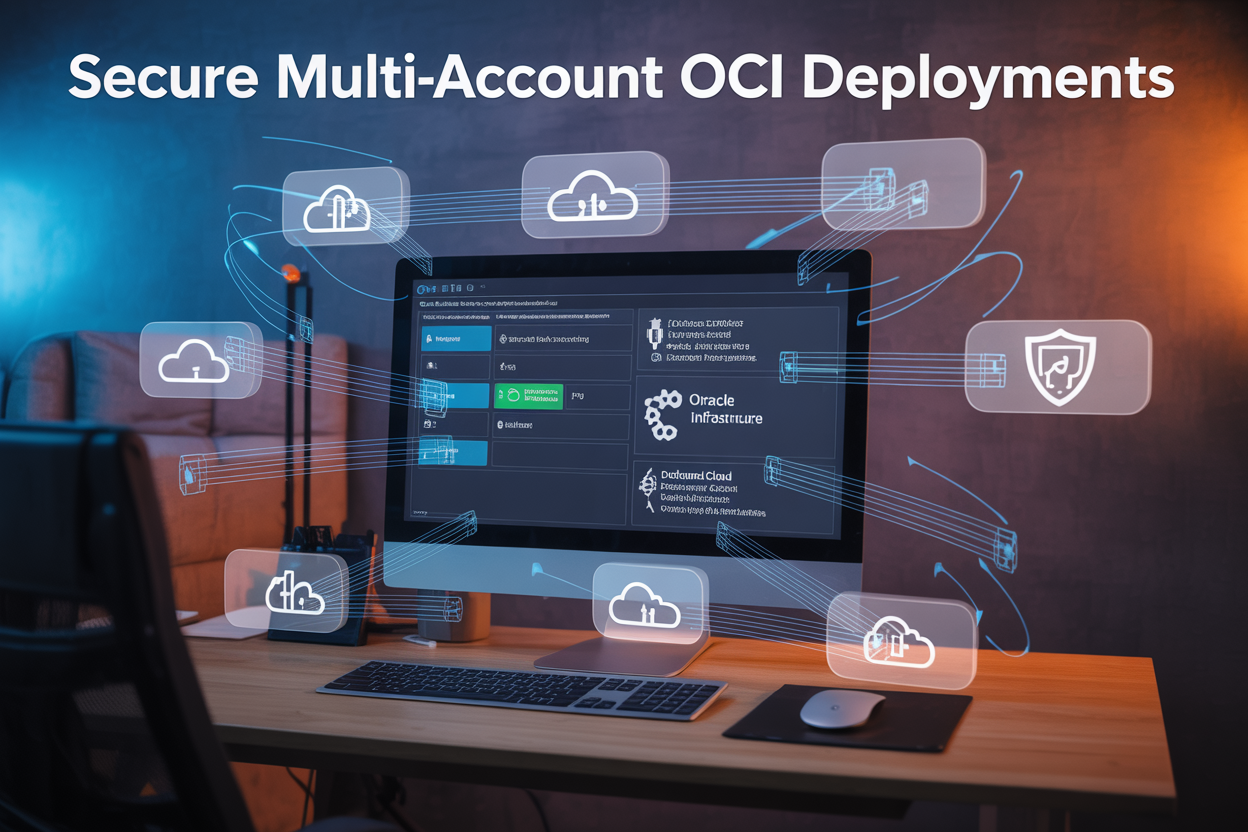
Managing Oracle Cloud Infrastructure across multiple accounts from a single codebase can transform your deployment workflow while maintaining security and consistency. This guide walks DevOps engineers, cloud architects, and development teams through building secure multi-account OCI deployments with GitHub Actions OCI integration.
Many organizations struggle with maintaining separate codebases for different environments or accounts, leading to configuration drift and security gaps. A single codebase approach using infrastructure as code streamlines your workflow and reduces maintenance overhead.
We’ll cover how to design secure cross-account deployment workflows that protect sensitive resources while enabling automated deployments. You’ll also learn advanced GitHub Actions CI/CD pipeline strategies specific to OCI terraform deployment, including environment-specific configurations and approval gates.
Finally, we’ll explore DevOps security best practices for production-ready deployments, covering secrets management, role-based access controls, and monitoring strategies that keep your multi-tenant cloud architecture secure and compliant.
Understanding Multi-Account OCI Architecture Benefits
Improved Security Through Environment Isolation
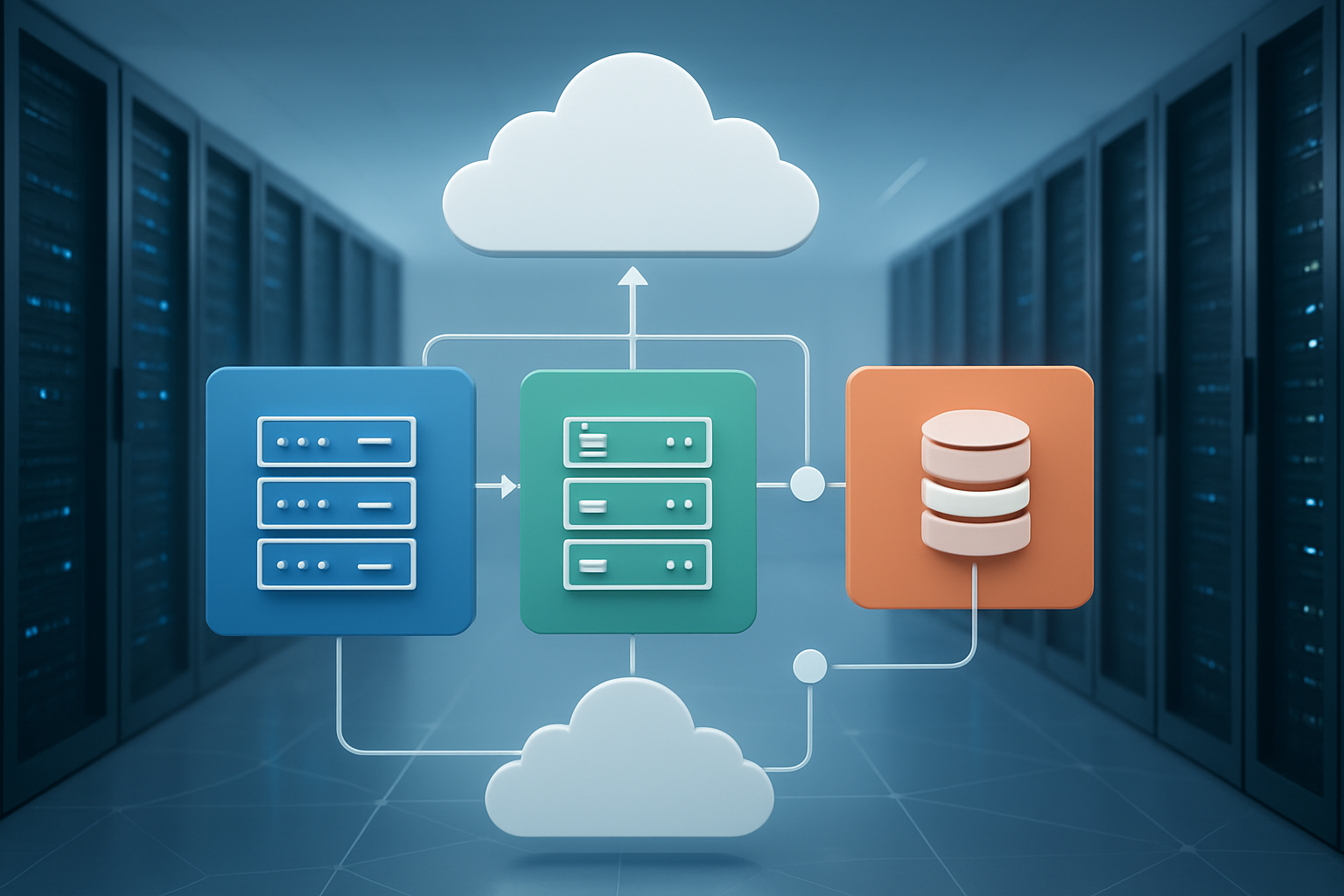
Multi-account OCI architecture creates distinct security boundaries that traditional single-account setups simply can’t match. Each environment—development, staging, and production—operates within its own isolated Oracle Cloud Infrastructure tenancy, eliminating the risk of accidental cross-environment access or resource interference.
This isolation acts as a natural firewall between environments. When developers work in the development account, they can’t accidentally modify production resources, even with elevated permissions. The blast radius of any security incident or misconfiguration stays contained within a single account boundary.
Identity and Access Management (IAM) policies become more precise and easier to manage across separate accounts. You can grant developers full access to development resources while maintaining strict production controls through completely separate permission structures. This approach significantly reduces the complexity of role-based access control compared to managing everything within a single account.
Network-level isolation provides additional security layers. Each account maintains its own Virtual Cloud Networks (VCNs), subnets, and security lists. This separation prevents network-level attacks from propagating across environments and allows for environment-specific security configurations without affecting other workloads.
Enhanced Compliance and Governance Controls
Regulatory compliance becomes more straightforward with multi-account OCI deployments. Different environments can implement varying levels of compliance controls based on their specific requirements. Production environments can enforce strict audit logging, encryption, and access controls while allowing more flexibility in development environments.
Audit trails remain clean and environment-specific, making compliance reporting much simpler. When auditors need to review production access patterns, they only examine the production account’s logs rather than filtering through mixed-environment data. This separation speeds up compliance assessments and reduces the chance of missing critical security events.
| Environment | Compliance Level | Required Controls |
|---|---|---|
| Development | Basic | Activity logging, basic encryption |
| Staging | Enhanced | Audit trails, data masking, access reviews |
| Production | Strict | Full compliance suite, real-time monitoring |
Data residency requirements become easier to manage when each environment can be deployed in different OCI regions or with specific governance policies. Organizations subject to regulations like GDPR or HIPAA can implement environment-specific controls without affecting development productivity.
Streamlined Resource Management Across Environments
Managing resources across multiple environments becomes more organized and predictable with separate OCI accounts. Each environment maintains its own resource quotas, service limits, and capacity planning, preventing development workloads from impacting production availability.
Resource naming conventions and tagging strategies work more effectively when applied at the account level. Production resources can follow strict naming patterns for operational clarity while development environments allow more flexible approaches. This separation makes automated resource management through GitHub Actions CI/CD pipelines more reliable and less prone to naming conflicts.
Environment-specific resource lifecycle management becomes straightforward. Development environments can automatically shut down after hours or on weekends to save costs, while production maintains 24/7 availability. Staging environments can be rebuilt regularly for testing without affecting other workloads.
The separation also enables better resource monitoring and alerting. Each environment can have monitoring thresholds and alert configurations appropriate for its purpose. Production alerts for high CPU usage might trigger immediate responses, while development environment alerts could simply log for later analysis.
Cost Optimization Through Granular Billing
Multi-account OCI architecture provides detailed cost visibility that’s impossible to achieve with single-account deployments. Each environment generates separate billing reports, making it easy to track spending by project stage, team, or business unit. This granular visibility helps organizations understand the true cost of their development lifecycle.
Chargeback and showback models become much simpler to implement. Finance teams can directly allocate development costs to specific projects or departments without complex tagging schemes or cost allocation rules. Production costs remain clearly separated from experimentation and development expenses.
Cost optimization strategies can be applied differently across environments. Development accounts might use smaller instance sizes or different storage classes, while production maintains performance-optimized configurations. This flexibility allows teams to balance cost and performance based on actual business requirements rather than applying one-size-fits-all approaches.
Budget controls and spending limits work more effectively at the account level. Development teams can receive fixed monthly budgets for their accounts, while production environments operate under different financial controls. This separation prevents development experiments from causing unexpected production cost spikes and enables more accurate financial planning.
Setting Up GitHub Actions for OCI Integration
Configuring OCI API Keys and Authentication
Authentication forms the backbone of any OCI multi-account deployment strategy. Start by creating dedicated service accounts for GitHub Actions rather than using your personal OCI credentials. Navigate to the OCI Console and create a new user specifically for automation purposes – something like “github-actions-deployer” works well.
Generate an API key pair for this service user. Download the private key file and note the key fingerprint, tenancy OCID, user OCID, and region identifier. These values will become your authentication foundation across all target accounts.
For multi-account setups, create identical service users in each target compartment or tenancy. This approach maintains consistency while allowing granular access control per environment. Consider using OCI Identity and Access Management (IAM) policies to restrict each service account to specific compartments – development accounts should never have production access.
Store the private key content as a single-line string by removing line breaks and keeping only the key material. This format prevents common formatting issues when transferring between GitHub secrets and OCI SDK calls.
Creating Secure GitHub Repository Secrets
GitHub repository secrets provide encrypted storage for sensitive OCI credentials. Create these essential secrets for your OCI terraform deployment workflows:
OCI_PRIVATE_KEY: The private key content (formatted as single-line string)OCI_KEY_FINGERPRINT: Your API key fingerprintOCI_TENANCY_OCID: Tenancy identifierOCI_REGION: Target deployment regionOCI_USER_OCID: Service user identifier
For multi-account scenarios, use environment-specific naming conventions like OCI_DEV_PRIVATE_KEY, OCI_STAGING_PRIVATE_KEY, and OCI_PROD_PRIVATE_KEY. This pattern supports secure cross-account deployment strategies while maintaining clear separation between environments.
Consider using GitHub Environments for additional security layers. Environments allow you to require manual approvals for production deployments and restrict which branches can deploy to specific accounts.
Organization-level secrets work well for shared values like region configurations, while repository-specific secrets handle sensitive account credentials. Never commit credentials to your infrastructure as code single codebase – GitHub’s secret scanning will flag exposed keys automatically.
Installing Required GitHub Actions Marketplace Extensions
The GitHub Actions marketplace offers several pre-built actions that streamline OCI integration workflows. Install these essential extensions for robust DevOps security best practices:
Oracle Cloud Infrastructure CLI Action (oracle-actions/configure-oci-cli@v1) handles OCI SDK setup and authentication. This action automatically configures the OCI CLI using your repository secrets, eliminating manual setup steps in each workflow run.
Terraform GitHub Actions (hashicorp/setup-terraform@v2) provides Terraform binary installation and caching. Specify your preferred Terraform version for consistency across all GitHub Actions CI/CD pipeline executions.
Checkout Action (actions/checkout@v3) remains essential for accessing your repository code. Use the latest version for improved performance and security features.
Consider adding OIDC Token Exchange actions for enhanced security. OpenID Connect eliminates long-lived credentials by generating temporary tokens during workflow execution. Configure OCI Identity Providers to trust GitHub’s OIDC issuer for seamless Oracle Cloud Infrastructure automation.
Custom composite actions deserve consideration for repetitive tasks. Create reusable actions that combine OCI authentication, Terraform initialization, and deployment steps into single, testable units. Store these in a dedicated .github/actions directory within your repository.
| Action | Purpose | Version Recommendation |
|---|---|---|
| configure-oci-cli | OCI authentication setup | @v1 |
| setup-terraform | Terraform installation | @v2 |
| checkout | Repository access | @v3 |
| cache | Dependency caching | @v3 |
Pin action versions using commit SHAs for production workflows to prevent supply chain attacks while maintaining reproducible builds across your multi-tenant cloud architecture.
Implementing Single Codebase Infrastructure as Code

Structuring Terraform configurations for multiple accounts
Managing infrastructure as code single codebase across multiple OCI accounts requires a thoughtful directory structure that promotes code reuse while maintaining clear separation between environments. Start by organizing your Terraform configurations into a hierarchy that separates shared resources from account-specific configurations.
Create a root directory structure with distinct folders for environments (dev, staging, prod) and a shared modules directory. Each environment folder should contain its own main.tf, variables.tf, and terraform.tfvars files, while the modules directory houses reusable components that work across all accounts.
terraform/
├── environments/
│   ├── dev/
│   ├── staging/
│   └── production/
├── modules/
│   ├── networking/
│   ├── compute/
│   └── security/
└── shared/
    └── backend.tf
This approach enables your GitHub Actions CI/CD pipeline to dynamically target specific environments while pulling from the same codebase, essential for OCI multi-account deployment scenarios.
Managing environment-specific variables and configurations
Environment-specific configurations require a robust variable management strategy that keeps sensitive data secure while allowing flexibility across accounts. Use Terraform’s built-in variable precedence to create a cascading configuration system.
Implement a three-tier variable structure: global defaults in your modules, environment-specific overrides in terraform.tfvars, and runtime secrets managed through GitHub Actions secrets. This pattern ensures your OCI terraform deployment maintains consistency while adapting to each account’s unique requirements.
| Variable Type | Storage Location | Example Use Case |
|---|---|---|
| Global defaults | Module variables.tf | Instance shapes, common tags |
| Environment-specific | terraform.tfvars | Network CIDRs, region settings |
| Sensitive data | GitHub Secrets | API keys, passwords |
For secure cloud deployment workflows, never commit sensitive values to your repository. Instead, reference GitHub Actions secrets in your workflow files and pass them as environment variables during terraform execution.
Creating reusable modules for consistent deployments
Building reusable Terraform modules forms the backbone of successful multi-tenant cloud architecture. Design modules that accept parameters for account-specific customizations while maintaining core functionality consistency across deployments.
Focus on creating modules for common OCI resources like VCNs, compute instances, and load balancers. Each module should include proper input validation, output values for cross-module references, and comprehensive documentation. This modular approach supports your GitHub Actions OCI integration by enabling parallel deployments across accounts using identical infrastructure patterns.
Structure modules with clear interfaces:
- Input variables for customization points
- Local values for computed configurations
- Resource blocks with consistent naming conventions
- Output values for integration with other modules
Implementing proper state management strategies
State management becomes critical when deploying across multiple OCI accounts from a single codebase. Implement separate state files for each environment while using remote backend storage for team collaboration and DevOps security best practices.
Configure OCI Object Storage buckets as remote backends, with each environment maintaining its own state file. This isolation prevents accidental cross-environment modifications while enabling your GitHub Actions OCI integration to manage state locks automatically.
Use workspace-based separation or distinct backend configurations per environment. The backend configuration should reference environment-specific storage locations, ensuring complete isolation between dev, staging, and production deployments.
Your cross-account deployment strategies benefit from implementing state file encryption and access controls. Configure bucket policies that restrict access based on the deploying GitHub Actions runner’s identity, adding an extra security layer to your automation pipeline.
Designing Secure Cross-Account Deployment Workflows

Establishing least-privilege access controls
Building secure cross-account deployment workflows starts with implementing strict access controls that follow the principle of least privilege. When working with OCI multi-account deployment setups, your GitHub Actions workflows need specific permissions that are limited to only what’s required for each deployment target.
Start by creating dedicated OCI service accounts for each environment – development, staging, and production should each have their own identity with tailored permissions. These service accounts should only access the compartments and resources they need to deploy. For example, your development deployment service account doesn’t need write access to production compartments.
Use OCI’s identity and access management (IAM) policies to create granular permission sets. Instead of granting broad administrative privileges, define policies that allow specific actions like creating compute instances, managing load balancers, or updating database configurations only within designated compartments. This approach significantly reduces the blast radius if credentials are compromised.
Store your OCI credentials as encrypted secrets in GitHub Actions, using different secret names for each environment (like OCI_DEV_KEY, OCI_STAGING_KEY, OCI_PROD_KEY). This separation ensures that a workflow targeting development environments cannot accidentally deploy to production systems.
Consider implementing time-bound access tokens where possible. OCI supports session tokens that expire after a defined period, adding an extra security layer to your automated deployments.
Implementing approval gates for production deployments
Production deployments require human oversight, even in automated workflows. GitHub Actions provides environment protection rules that create mandatory approval gates before sensitive deployments proceed.
Set up GitHub environments for each of your OCI accounts – typically development, staging, and production. Configure the production environment with required reviewers who must approve deployments before they execute. Choose reviewers based on their expertise and responsibility for the target systems, such as senior developers, DevOps engineers, or security team members.
Add environment-specific deployment delays to provide additional safety nets. A 10-15 minute wait period after approval gives teams time to cancel deployments if issues are discovered. This delay also allows for final verification of deployment plans and infrastructure changes.
Implement conditional approvals based on the scope of changes. Small configuration updates might require one approver, while major infrastructure modifications should need multiple team members to sign off. Use GitHub’s branch protection rules alongside environment protections to create layered security.
Consider integrating external approval systems if your organization uses tools like ServiceNow or Jira for change management. Custom webhook actions can pause deployments until proper change tickets are approved through your existing processes.
Creating environment-specific deployment branches
Branch-based deployment strategies provide clear separation between environments while maintaining a single codebase for your OCI infrastructure as code. This approach gives teams control over what gets deployed where and when.
Structure your branching strategy around environment promotion flows. Use main or master as your production-ready branch, staging for pre-production testing, and feature branches for development work. Each branch triggers deployments to its corresponding OCI account when changes are pushed or pull requests are merged.
Configure branch protection rules that prevent direct pushes to production branches. All changes should flow through pull requests with required reviews and status checks. This process ensures that infrastructure changes are peer-reviewed before reaching production environments.
Use different workflow triggers for each environment. Development branches might deploy automatically on every push for rapid iteration, while staging deployments trigger on pull request merges, and production deployments only run when releases are tagged or manually triggered after approvals.
Implement environment-specific configuration through branch-based parameter files or environment variables. Your Terraform or OCI CLI configurations can reference different variable files based on the target environment, ensuring consistent deployment patterns across accounts while maintaining environment-specific settings.
Setting up automated security scanning and validation
Security scanning should be integrated directly into your GitHub Actions CI/CD pipeline for OCI deployments. Automated validation catches security issues before they reach production environments.
Integrate infrastructure security scanning tools like Checkov, Terrascan, or OPA (Open Policy Agent) into your workflow. These tools analyze your infrastructure as code files and identify security misconfigurations, compliance violations, and potential vulnerabilities before deployment.
Set up automated credential scanning to prevent accidental exposure of sensitive information. Tools like GitLeaks or TruffleHog scan your codebase for hardcoded passwords, API keys, or other secrets that could compromise your OCI accounts.
Implement drift detection workflows that regularly compare your deployed infrastructure against your code definitions. Schedule these scans to run daily or weekly, alerting teams when manual changes have been made outside of your automated deployment process.
Add vulnerability scanning for container images and dependencies if your deployments include containerized applications. GitHub’s built-in Dependabot can automatically scan for vulnerable packages and create pull requests with security updates.
Configure policy-as-code validation that checks deployments against your organization’s security standards. Define policies that verify network configurations, encryption settings, access controls, and compliance requirements specific to your industry or regulatory environment.
Advanced GitHub Actions Strategies for OCI

Implementing parallel deployments across accounts
Running deployments across multiple OCI accounts simultaneously transforms your GitHub Actions CI/CD pipeline into a powerhouse of efficiency. The key lies in structuring your workflow matrix to handle different account contexts while maintaining isolation between environments.
Start by configuring your GitHub Actions workflow with a matrix strategy that defines each target account as a separate job:
strategy:
  matrix:
    account:
      - production-west
      - production-east
      - staging
      - development
    include:
      - account: production-west
        oci_region: us-phoenix-1
        compartment_id: $_WEST_COMPARTMENT }}
      - account: production-east
        oci_region: us-ashburn-1
        compartment_id: ${{ secrets.PROD_EAST_COMPARTMENT }}
Each parallel job should authenticate independently using account-specific service principals stored as repository secrets. This approach prevents credential bleeding between accounts while enabling secure cross-account deployment strategies.
Consider implementing deployment groups where certain accounts deploy together while others wait for dependencies. For instance, staging environments can run in parallel with development, but production deployments might need staging validation first.
Monitor resource limits carefully when running parallel OCI terraform deployment jobs. GitHub Actions has concurrent job limits, and OCI APIs have rate limiting that could throttle simultaneous requests across accounts.
Creating custom actions for OCI-specific tasks
Custom actions eliminate repetitive code and standardize OCI multi-account deployment procedures across your organization. Building reusable actions for common OCI tasks saves time and reduces configuration drift between projects.
Create a composite action for OCI authentication that handles the complexity of setting up credentials, regions, and compartments:
name: 'OCI Authentication'
description: 'Authenticate with Oracle Cloud Infrastructure'
inputs:
  tenancy_ocid:
    description: 'OCI Tenancy OCID'
    required: true
  user_ocid:
    description: 'OCI User OCID'
    required: true
  private_key:
    description: 'OCI Private Key'
    required: true
  region:
    description: 'OCI Region'
    required: true
runs:
  using: 'composite'
  steps:
    - name: Setup OCI CLI
      uses: oracle-actions/configure-oci-cli@v1
      with:
        tenancy: ${{ inputs.tenancy_ocid }}
        user: $
        key: ${{ inputs.private_key }}
        region: ${{ inputs.region }}
Build specialized actions for common OCI operations like compartment creation, network setup, or compute instance provisioning. These actions should include built-in error handling, retry logic, and proper output formatting for downstream workflow steps.
Package your custom actions in a separate repository with proper versioning using semantic tags. This enables teams to reference specific action versions and maintain stability across different projects using GitHub Actions OCI integration.
Managing deployment dependencies and ordering
Orchestrating deployment order becomes critical when infrastructure components depend on each other across multiple OCI accounts. Network foundations must deploy before compute resources, and shared services need to be available before applications that consume them.
Implement dependency management using GitHub Actions job dependencies with the needs keyword:
jobs:
  deploy-shared-infrastructure:
    runs-on: ubuntu-latest
    strategy:
      matrix:
        account: [shared-services, networking]
    # deployment steps

  deploy-application-infrastructure:
    needs: deploy-shared-infrastructure
    runs-on: ubuntu-latest
    strategy:
      matrix:
        account: [production, staging]
    # deployment steps
For complex dependency chains, consider using a deployment orchestration file that defines the relationship between different infrastructure components. This YAML or JSON file can drive workflow execution and make dependencies explicit:
deployment_order:
  phase_1:
    - shared-networking
    - identity-management
  phase_2:
    - compute-infrastructure
    - storage-systems
  phase_3:
    - application-services
    - monitoring-stack
Use conditional logic in workflows to skip deployments when dependencies aren’t met. Check for required resources using OCI CLI commands or API calls before proceeding with dependent infrastructure deployment.
Build status checks that verify infrastructure state before marking deployment phases complete. This prevents race conditions where dependent resources attempt to use infrastructure that isn’t fully provisioned yet.
Setting up rollback mechanisms for failed deployments
Automated rollback capabilities protect your multi-tenant cloud architecture from deployment failures that could cascade across multiple accounts. Design rollback strategies that can quickly restore previous working states without manual intervention.
Implement state snapshots before each deployment phase. Store Terraform state files, configuration backups, and resource inventories in OCI Object Storage with timestamp-based naming:
- name: Create deployment snapshot
  run: |
    TIMESTAMP=$(date +%Y%m%d-%H%M%S)
    oci os object put --bucket-name deployment-snapshots \
      --file terraform.tfstate \
      --name "snapshots/$ matrix.account }}/${TIMESTAMP}/terraform.tfstate"
Build rollback workflows that can be triggered manually or automatically when deployment health checks fail. These workflows should restore the previous known-good state and clean up any partially created resources.
Create deployment health validation steps that run immediately after infrastructure changes. These checks should verify that critical services are responding, network connectivity is working, and dependent resources are accessible.
Use OCI Resource Manager stacks with versioning to enable point-in-time rollbacks. Each deployment creates a new stack version, making it possible to revert to any previous configuration quickly.
Implement circuit breaker patterns that halt deployments across all accounts when failures reach a threshold. This prevents cascade failures from affecting multiple environments simultaneously.
Monitoring and alerting integration
Real-time monitoring transforms your DevOps security best practices from reactive to proactive by catching issues before they impact users. Integrate monitoring directly into your deployment workflows to create feedback loops that improve reliability.
Configure deployment status notifications that alert teams when infrastructure changes complete or fail. Use GitHub’s built-in notification system combined with external services like Slack or Microsoft Teams:
- name: Notify deployment status
  if: always()
  uses: 8398a7/action-slack@v3
  with:
    status: ${{ job.status }}
    text: "OCI deployment to ${{ matrix.account }} completed with status: ${{ job.status }}"
  env:
    SLACK_WEBHOOK_URL: ${{ secrets.SLACK_WEBHOOK }}
Embed monitoring agent deployment into your infrastructure as code single codebase. Include OCI Monitoring, Application Performance Monitoring, and Logging Analytics configuration as part of your Terraform modules.
Set up post-deployment health checks that validate service availability across all deployed accounts. These checks should run for several minutes after deployment completion to catch delayed failures or performance degradation.
Create monitoring dashboards that track deployment frequency, success rates, and rollback frequency across all OCI accounts. This data helps identify problematic patterns and optimize deployment processes over time.
Implement synthetic monitoring that continuously validates critical application paths after deployments. These monitors should test functionality from an end-user perspective and alert when issues arise.
Best Practices for Production-Ready Deployments

Implementing Comprehensive Logging and Audit Trails
Robust logging forms the backbone of any production-ready OCI multi-account deployment strategy. Your GitHub Actions CI/CD pipeline should capture every deployment action, configuration change, and security event across all Oracle Cloud Infrastructure environments. Configure centralized logging using OCI Logging service to aggregate logs from multiple compartments and regions into a unified view.
Set up structured logging with JSON formatting to enable efficient parsing and analysis. Your logging strategy should track:
- Deployment Events: Every terraform apply, resource creation, and modification
- Authentication Activities: Service principal logins, API key usage, and token refreshes
- Resource Access: Who accessed what resources and when
- Configuration Changes: Infrastructure as code modifications and their outcomes
- Error Conditions: Failed deployments, permission denials, and system errors
Implement real-time alerting for critical events like unauthorized access attempts or deployment failures. Use OCI Events service to trigger notifications when specific log patterns occur. Store audit logs in immutable storage with appropriate retention policies that meet your compliance requirements.
Create dashboards that visualize deployment patterns, success rates, and security metrics across your multi-account architecture. This visibility helps identify potential issues before they impact production systems.
Managing Secrets Rotation and Credential Lifecycle
Effective secrets management prevents credential sprawl and reduces security risks in your GitHub Actions OCI integration. Implement automated rotation for all service account credentials, API keys, and certificates used in your secure cloud deployment workflows.
Use GitHub Secrets for storing sensitive information, but layer additional security measures on top:
| Secret Type | Rotation Frequency | Storage Method | Automation Level |
|---|---|---|---|
| OCI API Keys | 90 days | GitHub Secrets + OCI Vault | Fully Automated |
| Service Principals | 180 days | GitHub Secrets | Semi-Automated |
| SSL Certificates | 365 days | OCI Certificates Service | Automated |
| Database Passwords | 30 days | OCI Vault | Fully Automated |
Create separate credential sets for each environment and account to limit blast radius during security incidents. Your rotation process should:
- Generate new credentials before old ones expire
- Update all systems that depend on the credentials
- Verify connectivity with new credentials
- Safely remove old credentials after confirmation
- Log all rotation activities for audit purposes
Establish credential lifecycle policies that automatically expire unused credentials and alert teams when manual intervention is required. This approach significantly reduces the attack surface of your DevOps security best practices.
Establishing Disaster Recovery Procedures
Disaster recovery planning ensures your OCI terraform deployment infrastructure can recover quickly from various failure scenarios. Design your recovery procedures to handle both technical failures and human errors that might occur during deployments.
Your disaster recovery strategy should address multiple failure types:
Infrastructure Failures: Create cross-region backups of your terraform state files and OCI resources. Use OCI Object Storage with cross-region replication to ensure state file availability even during regional outages. Implement automated failover mechanisms that can redirect traffic and workloads to healthy regions.
Deployment Pipeline Failures: Maintain backup deployment mechanisms outside of GitHub Actions. This might include local terraform execution capabilities or alternative CI/CD platforms. Document step-by-step manual deployment procedures for emergency situations.
Data Loss Scenarios: Implement point-in-time recovery capabilities for databases and critical application data. Schedule regular backup verification tests to ensure recovery procedures actually work when needed.
Security Incidents: Develop playbooks for credential compromise scenarios. These should include steps for immediate credential rotation, access revocation, and system isolation. Practice these procedures regularly through tabletop exercises.
Create recovery time objectives (RTO) and recovery point objectives (RPO) for each component of your multi-tenant cloud architecture. Test your disaster recovery procedures monthly to identify gaps and improve response times. Document all procedures clearly so any team member can execute recovery steps during high-stress situations.
Automate as much of the recovery process as possible while maintaining human oversight for critical decisions. This balance ensures rapid response while preventing automated systems from making recovery situations worse.
Managing multiple Oracle Cloud Infrastructure accounts through GitHub Actions transforms how teams handle deployments. The single codebase approach eliminates inconsistencies while GitHub’s workflow automation ensures reliable, repeatable deployments across different environments. Setting up proper authentication, organizing your infrastructure code effectively, and designing secure cross-account workflows creates a foundation that scales with your organization’s growth.
The key to success lies in balancing automation with security. Start small with a pilot environment, implement proper secrets management from day one, and gradually expand your deployment pipeline as you gain confidence. Your future self will thank you for investing time upfront in creating clean, maintainable workflows that your entire team can understand and contribute to.