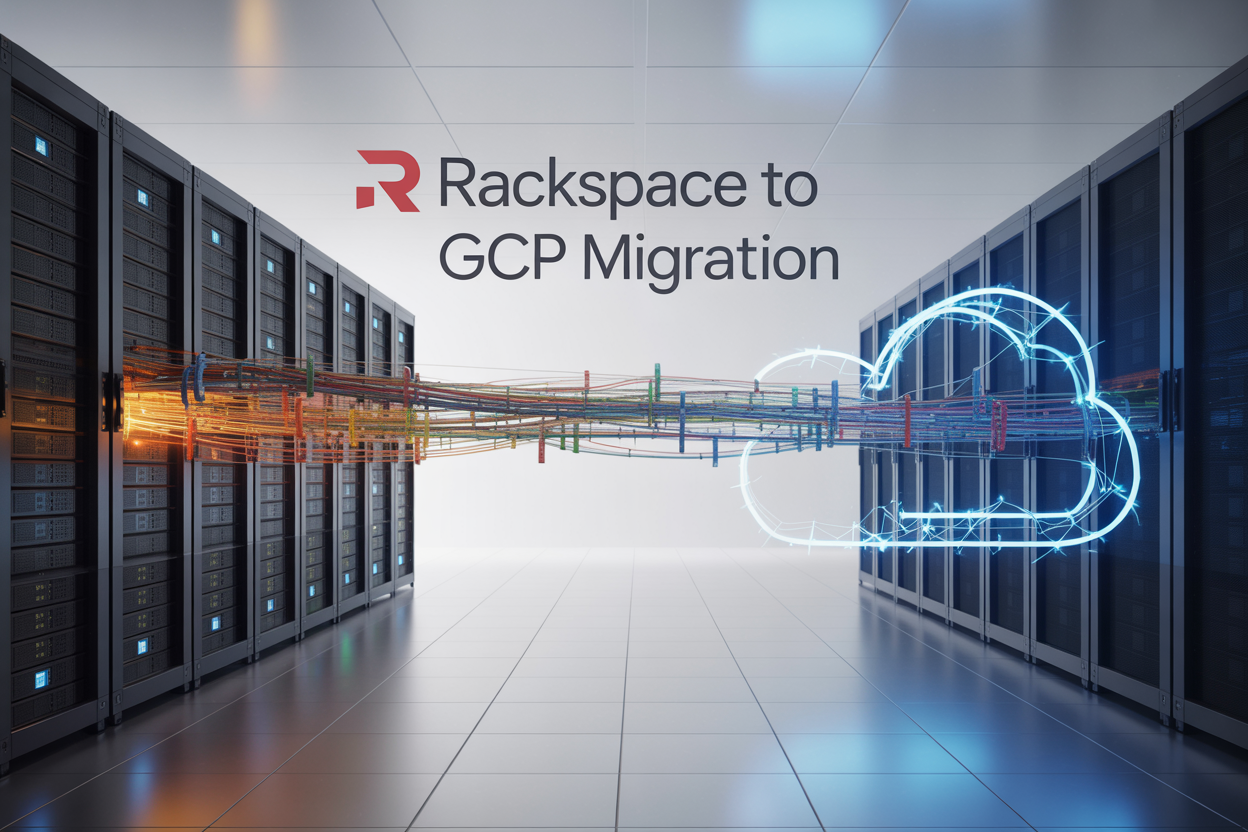
Moving from Rackspace to Google Cloud Platform can transform your business operations, but only when done right. This Rackspace to GCP migration guide is designed for IT leaders, cloud architects, and decision-makers who want to upgrade their infrastructure without the common pitfalls that derail enterprise cloud migration projects.
Your current Rackspace setup might be reliable, but GCP offers superior scalability, advanced analytics tools, and often significant cost savings. The challenge lies in making the switch smoothly while maintaining business continuity and maximizing the benefits of your new cloud environment.
We’ll walk you through the essential steps of cloud migration strategy, starting with how to assess your current infrastructure and determine migration readiness. You’ll learn proven GCP migration best practices for planning and executing a phased approach that minimizes risk. Finally, we’ll cover cloud migration cost optimization techniques and performance tuning strategies that ensure your Google Cloud Platform migration delivers measurable improvements from day one.
Assessing Your Current Rackspace Infrastructure for Migration Readiness

Inventory and analyze existing workloads and dependencies
Your Rackspace to GCP migration success hinges on understanding exactly what you’re moving. Start by cataloging every application, database, service, and virtual machine running in your current environment. Don’t overlook background processes, scheduled jobs, or legacy applications that might seem dormant but still serve critical functions.
Map out the relationships between your systems. Which applications talk to each other? What databases do your web servers depend on? Understanding these connections prevents the nightmare scenario where you migrate an application only to discover its critical dependency got left behind. Create a visual dependency map that shows data flows, API connections, and shared storage relationships.
Pay special attention to third-party integrations and external services. Your CRM might connect to your billing system through specific network configurations that need recreation in GCP. Document every integration point, including authentication methods, IP whitelisting, and API endpoints.
Consider workload types when planning your cloud migration strategy. Some applications work better as lift-and-shift candidates, while others benefit from refactoring to cloud-native services. Identify stateless applications that can easily scale horizontally versus legacy systems requiring specific hardware configurations.
Evaluate current performance metrics and bottlenecks
Gather performance data over at least 30 days to capture usage patterns and peak loads. Look at CPU usage, memory consumption, disk I/O, and network traffic for each system. This baseline becomes your benchmark for measuring improvement after migration to Google Cloud Platform.
Identify existing performance bottlenecks that have been plaguing your infrastructure. Maybe your database struggles during monthly reporting cycles, or your web servers max out during marketing campaigns. These pain points represent opportunities for improvement in GCP through auto-scaling, load balancing, and managed services.
Monitor application response times and user experience metrics. Slow page loads or API timeouts indicate areas where GCP’s global infrastructure and CDN capabilities could deliver immediate improvements. Document which geographic regions experience slower performance – GCP’s worldwide presence might solve latency issues for international users.
Don’t forget about backup and disaster recovery performance. How long do current backups take? What’s your actual recovery time when systems fail? GCP’s automated backup solutions and multi-region redundancy often dramatically improve these metrics.
Document security configurations and compliance requirements
Create a comprehensive security audit of your current Rackspace environment. Document firewall rules, access controls, encryption methods, and user permissions. This inventory ensures you don’t accidentally create security gaps during migration.
List all compliance requirements your organization must meet. Healthcare organizations need HIPAA compliance, financial services require SOX adherence, and international companies must handle GDPR requirements. GCP offers extensive compliance certifications, but you need to configure services correctly to maintain compliance throughout your enterprise cloud migration.
Review your current authentication and authorization systems. Active Directory integrations, multi-factor authentication setups, and role-based access controls all need careful planning for GCP implementation. Google Cloud IAM provides granular permissions, but migrating existing user roles requires thoughtful mapping.
Examine data classification and handling procedures. Which databases contain sensitive information? What encryption standards do you currently use? GCP provides robust encryption options, including customer-managed encryption keys, but your security team needs time to evaluate and implement appropriate protections.
Calculate total cost of ownership for baseline comparison
Build a detailed cost model of your current Rackspace infrastructure. Include obvious expenses like server hosting and bandwidth, but don’t miss hidden costs such as backup storage, support contracts, and internal IT labor for maintenance and monitoring.
Factor in the full cost of downtime and performance issues. How much revenue does your organization lose when systems are slow or unavailable? These “soft costs” often justify migration investments even when direct hosting costs seem comparable.
Consider growth projections when calculating baseline costs. Your current infrastructure might handle today’s load, but what happens when traffic doubles next year? GCP migration cost optimization starts with understanding how your current setup would scale versus cloud-native auto-scaling capabilities.
Include opportunity costs in your analysis. How many IT projects get delayed because your team spends time managing infrastructure instead of building new features? Moving to managed GCP services frees your developers to focus on business value rather than server maintenance, representing significant hidden savings in your cloud migration strategy.
Strategic Planning for GCP Migration Success

Define Business Objectives and Success Metrics
Success starts with crystal-clear goals. Your Rackspace to GCP migration needs specific, measurable objectives that align with your business strategy. Start by identifying what you want to achieve beyond just moving servers around.
Performance improvements should be quantifiable. Set targets like reducing application response time by 30% or achieving 99.9% uptime. Cost optimization goals might include cutting infrastructure expenses by 25% or eliminating hardware refresh cycles entirely.
Establish baseline metrics from your current Rackspace environment:
- Monthly infrastructure costs
- Application performance benchmarks
- Security compliance scores
- Team productivity metrics
- Disaster recovery capabilities
Track business-focused outcomes too. Revenue impact, customer satisfaction scores, and time-to-market improvements all matter. Create a dashboard that shows progress against these targets throughout your cloud migration strategy.
Set realistic timelines with milestone checkpoints. Phase your objectives so teams can celebrate wins along the way while building momentum for the complete transformation.
Choose Optimal GCP Services for Your Workload Requirements
Matching workloads to the right Google Cloud Platform migration services makes or breaks your success. Start with a detailed inventory of your current applications, databases, and infrastructure components.
For compute workloads, evaluate whether virtual machines on Compute Engine fit your needs or if containerizing applications for Google Kubernetes Engine offers better scalability. Legacy applications might run perfectly on Compute Engine initially, while modern microservices thrive in managed container environments.
Database decisions carry significant weight. Cloud SQL works well for traditional relational databases, while BigQuery transforms analytics workloads. Consider Cloud Spanner for globally distributed applications needing strong consistency.
Storage requirements vary dramatically across workloads:
- Cloud Storage for object storage and backups
- Persistent Disks for high-performance block storage
- Filestore for applications requiring shared file systems
Networking choices impact both performance and cost. VPC design affects security and connectivity, while load balancing options determine how traffic reaches your applications.
Don’t overlook managed services that eliminate operational overhead. Cloud Functions replace simple scripts, while Cloud Run handles containerized applications without Kubernetes complexity.
Design Scalable Architecture Leveraging Cloud-Native Features
Transform your traditional infrastructure mindset into cloud-native thinking. GCP migration best practices emphasize designing for failure, scaling horizontally, and embracing managed services.
Build resilience through regional distribution. Spread critical workloads across multiple zones within a region, and consider multi-region deployment for disaster recovery. Design applications to handle zone failures gracefully without service interruption.
Implement auto-scaling from day one. Configure instance groups that respond to traffic patterns, and design applications to scale horizontally rather than vertically. Use Cloud Load Balancing to distribute traffic intelligently across healthy instances.
Adopt microservices architecture where practical. Break monolithic applications into smaller, independent services that scale and deploy separately. Use Cloud Run or GKE for container orchestration, enabling teams to update components without affecting the entire system.
Security becomes architectural, not just operational. Implement identity and access management at every layer, use private Google Access for secure connectivity, and encrypt data both in transit and at rest. Design zero-trust networking principles into your VPC structure.
Plan for cloud migration cost optimization through intelligent resource allocation. Use committed use contracts for predictable workloads, preemptible instances for fault-tolerant batch processing, and automatic rightsizing recommendations to match resources to actual usage patterns.
Consider serverless options that eliminate infrastructure management entirely. Cloud Functions handle event-driven workloads, while Cloud Run manages containerized services automatically, scaling to zero when not in use.
Pre-Migration Preparation and Risk Mitigation

Establish Secure Network Connectivity Between Environments
Setting up secure connectivity forms the backbone of any successful Rackspace to GCP migration. Your migration strategy requires establishing multiple connection pathways that ensure data flows securely between your existing Rackspace infrastructure and your new GCP environment.
VPN connections offer the most straightforward approach for smaller migrations. Google Cloud VPN provides site-to-site connectivity that encrypts traffic between your Rackspace datacenter and GCP regions. For enterprise-grade migrations requiring higher bandwidth and lower latency, Google Cloud Interconnect delivers dedicated physical connections.
Network security groups and firewall rules need careful configuration during this phase. Create specific security policies that allow only necessary traffic between environments while blocking potential threats. Consider implementing network segmentation to isolate migration traffic from production workloads.
Bandwidth planning becomes critical when moving large datasets. Calculate your data transfer requirements and establish sufficient network capacity to handle peak migration loads without disrupting ongoing operations. Monitor network utilization patterns to identify optimal migration windows.
Create Comprehensive Backup and Rollback Procedures
Your GCP migration best practices must include robust backup strategies that protect against data loss during transition. Before moving any workload, create complete snapshots of your Rackspace environment, including databases, application configurations, and user data.
Design rollback procedures that can quickly restore services to their original Rackspace state if migration issues arise. Document specific rollback triggers and decision criteria to avoid confusion during high-stress situations. Test these procedures thoroughly in non-production environments to verify their effectiveness.
Implement incremental backup strategies that capture changes made during the migration window. This approach minimizes data loss potential and reduces recovery time objectives. Consider using GCP’s native backup services like Cloud SQL automated backups and Persistent Disk snapshots for ongoing protection.
Version control becomes essential for configuration management during migration. Track all infrastructure changes, application modifications, and deployment scripts to enable precise rollbacks when needed.
Set Up Monitoring and Alerting for Migration Tracking
Comprehensive monitoring transforms your cloud migration strategy from guesswork into data-driven decisions. Deploy monitoring solutions that track both source and destination environments simultaneously, providing real-time visibility into migration progress and system health.
Google Cloud Operations Suite offers native monitoring capabilities that integrate seamlessly with GCP services. Configure custom metrics that track migration-specific indicators like data transfer rates, application response times, and error frequencies. Set up alerting thresholds that notify your team when migration metrics deviate from expected ranges.
Application performance monitoring becomes crucial during the transition period. Install monitoring agents on both Rackspace and GCP instances to compare performance metrics and identify potential issues before they impact users. Track key performance indicators like CPU utilization, memory consumption, and network latency.
Create migration dashboards that consolidate all relevant metrics into single views. These dashboards help migration teams quickly assess progress, identify bottlenecks, and make informed decisions about next steps. Include business-level metrics alongside technical indicators to maintain stakeholder visibility.
Train Your Team on GCP Tools and Best Practices
Team preparation determines migration success more than any technical factor. Your cloud infrastructure migration requires team members who understand GCP’s unique characteristics, tooling, and operational procedures.
Start with foundational GCP training that covers core services, pricing models, and architectural patterns. Focus on services most relevant to your migration, such as Compute Engine, Cloud Storage, and Cloud SQL. Hands-on workshops work better than theoretical training for building practical skills.
Security training deserves special attention during Rackspace GCP migration planning. GCP’s shared responsibility model differs significantly from traditional hosting environments. Team members need to understand their security obligations and learn to configure Identity and Access Management (IAM) policies, security groups, and encryption settings properly.
Operational training should cover GCP-specific tools for deployment, monitoring, and troubleshooting. Familiarize your team with Cloud Shell, gcloud CLI, and Terraform for GCP. Practice common operational tasks like scaling instances, managing storage, and responding to alerts in sandbox environments.
Establish certification goals for key team members. Google Cloud Professional certifications validate skills and provide structured learning paths. Consider creating internal knowledge sharing sessions where certified team members teach others about specific GCP capabilities and migration techniques.
Executing a Phased Migration Approach

Migrate non-critical workloads first for testing and validation
Starting your Rackspace to GCP migration with non-critical workloads gives you a safety net to learn and refine your approach. Pick development environments, test systems, or internal tools that won’t bring your business to a halt if something goes wrong. These workloads serve as your migration laboratory where you can test your GCP migration strategy without sweating about customer impact.
When selecting your first candidates, look for applications with simple architectures and minimal dependencies. Static websites, backup systems, and staging environments make excellent starting points. Document every step of the process, including configuration changes, performance differences, and any unexpected challenges. This documentation becomes your playbook for tackling more complex systems later.
Use this phase to validate your migration tools and processes. Test your backup and rollback procedures thoroughly – you’ll want these working perfectly before touching production systems. Monitor performance metrics closely and compare them against your Rackspace baseline. This early feedback helps you spot potential issues and adjust your cloud migration strategy before they become bigger problems.
Implement data transfer strategies for minimal downtime
Data transfer planning makes or breaks your enterprise cloud migration timeline. Large datasets require careful orchestration to avoid extended downtime that could hurt your business operations. Start by cataloging your data volumes, transfer requirements, and acceptable downtime windows for each workload.
Google Cloud Platform migration offers several transfer options depending on your data size and timeline constraints. For smaller datasets under 1TB, online transfer through Google Cloud Storage Transfer Service works well. Larger volumes might benefit from Google Transfer Appliance or partner solutions that can handle petabyte-scale migrations efficiently.
Consider implementing incremental data synchronization strategies. Set up initial bulk transfers during off-peak hours, then use delta sync to capture changes until your cutover window. This approach dramatically reduces the final migration time since you’re only moving recent changes rather than entire datasets.
Network bandwidth planning prevents bottlenecks that could stretch your migration timeline. Test your actual transfer speeds early and factor in network congestion, especially if you’re transferring during business hours. Some organizations opt for temporary bandwidth upgrades during migration periods to accelerate the process.
Execute production workload migration with safety checkpoints
Production migration demands military-grade precision and multiple safety nets. Establish clear go/no-go criteria before touching any production system. Define specific performance benchmarks, functionality tests, and rollback triggers that must pass before proceeding to the next phase.
Build comprehensive testing protocols for each production workload. This includes functional testing to verify all features work correctly, performance testing to ensure GCP performance optimization meets your requirements, and integration testing to confirm connectivity with other systems. Run these tests in your GCP staging environment using production-like data before attempting the actual migration.
Create detailed rollback procedures for every production workload. Practice these rollback scenarios during your non-production migrations so your team knows exactly what to do if something goes sideways. Keep your Rackspace infrastructure running in parallel until you’re confident everything works perfectly in GCP.
Schedule production migrations during maintenance windows or low-traffic periods. Coordinate with your business stakeholders to identify optimal timing that minimizes impact on customers and critical operations. Consider migrating in smaller batches rather than attempting a “big bang” approach that could amplify any issues.
Implement real-time monitoring throughout the migration process. Set up alerts for key performance indicators, error rates, and system availability. Having visibility into system health during the transition helps you catch and address issues before they escalate into major problems.
Optimizing Performance in Your New GCP Environment
Leverage auto-scaling and load balancing for improved reliability
Google Cloud Platform’s auto-scaling capabilities transform how your applications handle varying workloads after your Rackspace to GCP migration. Auto Scaling Groups automatically adjust your compute capacity based on real-time demand, eliminating the manual resource management that may have constrained your Rackspace environment.
Configure horizontal pod autoscaling (HPA) for containerized applications running on Google Kubernetes Engine (GKE). This feature monitors CPU usage, memory consumption, and custom metrics to scale pods up or down automatically. For traditional VM-based workloads, Managed Instance Groups provide similar functionality by adding or removing instances based on predefined policies.
Cloud Load Balancing distributes incoming traffic across multiple instances, regions, and even multiple clouds. Unlike basic load balancers, GCP’s solution offers global load balancing that routes users to the nearest healthy backend, reducing latency and improving user experience. The health check mechanism continuously monitors backend services, automatically removing unhealthy instances from the rotation.
Set up backend services with appropriate session affinity configurations for applications requiring sticky sessions. Configure connection draining periods to gracefully handle instance shutdowns during scaling events, preventing user disruptions during your GCP migration optimization phase.
Implement caching strategies and content delivery networks
Cloud CDN accelerates content delivery by caching static and dynamic content at Google’s globally distributed edge locations. This reduces origin server load while dramatically improving response times for users worldwide – a significant upgrade from typical Rackspace configurations.
Enable Cloud CDN for your load balancer backends, configuring cache keys and TTL values based on your content patterns. Static assets like images, CSS, and JavaScript files benefit from longer cache durations, while API responses may require shorter TTLs or custom cache invalidation strategies.
Memorystore for Redis provides managed in-memory caching for frequently accessed data. Deploy Redis clusters to cache database query results, session data, and computed values that would otherwise require expensive recalculation. This reduces database load and improves application response times significantly.
Cloud Storage with appropriate lifecycle policies serves as an additional caching layer for large files and backups. Configure regional buckets for frequently accessed data and nearline storage for less critical content, optimizing both performance and costs in your post-migration environment.
Use GCP’s machine learning tools for intelligent resource management
Cloud Operations Suite incorporates AI-powered insights to optimize resource allocation automatically. The Recommender API analyzes your usage patterns and suggests rightsizing opportunities, identifying over-provisioned instances that increase costs without improving performance.
Implement predictive scaling using time-series forecasting models that learn from historical usage data. These models anticipate traffic spikes and scale resources proactively, avoiding performance degradation during peak periods that might have affected your Rackspace infrastructure.
BigQuery ML enables you to build custom models for analyzing application performance metrics and user behavior patterns. Create models that predict resource requirements based on business metrics, seasonal trends, and application-specific factors unique to your workload.
AutoML Tables can process operational data to identify optimization opportunities across your entire GCP environment. Train models on historical performance data, cost metrics, and resource usage patterns to make intelligent decisions about instance types, storage classes, and scaling policies.
Fine-tune compute instances for optimal price-performance ratios
Choose the right machine families for specific workloads after analyzing your current Rackspace resource usage. General-purpose E2 instances offer balanced CPU and memory ratios for web applications, while compute-optimized C2 instances excel for CPU-intensive tasks. Memory-optimized M1 instances handle in-memory databases and analytics workloads efficiently.
Preemptible VM instances provide up to 80% cost savings for fault-tolerant workloads like batch processing and development environments. Combine preemptible instances with persistent disks to maintain data while benefiting from significant cost reductions during your GCP migration cost optimization efforts.
Custom machine types allow precise resource allocation, eliminating waste from standard configurations that don’t match your application requirements. Create instances with exactly the CPU and memory combinations your applications need, avoiding the oversized instances that may have driven up costs in your previous Rackspace setup.
Sustained use discounts automatically apply to instances running for significant portions of the month, while committed use discounts offer additional savings for predictable workloads. Spot VMs provide the deepest discounts for interruption-tolerant batch jobs and development workloads.
Monitor performance metrics continuously using Cloud Monitoring to identify underused resources and rightsizing opportunities that maintain optimal performance while reducing costs.
Achieving Long-Term Cost Efficiency and Governance

Implement Automated Cost Monitoring and Budget Alerts
Post-migration cost management separates successful GCP migrations from those that spiral into budget overruns. Setting up automated monitoring becomes your financial safety net, catching unexpected spikes before they impact your bottom line.
Configure Cloud Billing budgets with tiered alert thresholds at 50%, 80%, and 90% of your monthly allocation. These alerts should trigger immediate notifications to both technical teams and finance stakeholders. Google Cloud’s budget alerts integrate seamlessly with Slack, email, and PagerDuty for real-time visibility.
Billing Export to BigQuery provides granular spend analysis that surpasses Rackspace’s native reporting capabilities. This setup enables custom dashboards in Data Studio or Looker, giving you department-level cost breakdowns and trending analysis. Schedule daily cost reports to identify anomalies before they compound.
Cloud Monitoring’s custom metrics track resource utilization against spend, helping identify over-provisioned instances or underutilized services. Set up automated scaling policies that respond to both performance metrics and cost thresholds, ensuring your GCP migration cost optimization stays on track.
Establish Resource Tagging and Allocation Strategies
Proper resource organization transforms cost chaos into actionable insights. GCP’s labeling system offers more flexibility than Rackspace’s traditional billing structures, but requires disciplined implementation from day one.
Create a standardized labeling taxonomy covering:
- Environment (production, staging, development)
- Department (engineering, marketing, sales)
- Project (application name, initiative)
- Owner (team or individual responsible)
- Cost Center (for chargeback allocation)
Policy enforcement through Organization Policy Service prevents resource creation without proper labels. This automated governance reduces manual oversight while ensuring compliance across all teams migrating from Rackspace.
Implement Resource Hierarchy best practices using folders and projects to mirror your organizational structure. This approach simplifies billing allocation and access control compared to Rackspace’s account-based model. Each project inherits parent-level policies while maintaining granular control.
Use Cloud Asset Inventory for regular audits of untagged resources. Schedule weekly reports highlighting resources without proper labels, enabling proactive cleanup of orphaned instances that drive unnecessary costs.
Leverage Sustained Use Discounts and Committed Use Contracts
GCP’s pricing models offer significant advantages over Rackspace’s traditional hourly billing, but require strategic planning to maximize savings potential.
Sustained Use Discounts automatically apply when instances run for more than 25% of a month, reaching up to 30% savings at 100% usage. This automatic benefit requires no upfront commitment, making it perfect for workloads transitioning from Rackspace’s fixed pricing structure.
Committed Use Contracts (CUDs) provide up to 57% savings for predictable workloads. Analyze your Rackspace usage patterns to identify stable compute requirements suitable for 1-year or 3-year commitments. Start conservatively with shorter terms while establishing baseline usage patterns in your new GCP environment.
Preemptible VM instances offer up to 80% cost reduction for fault-tolerant workloads like batch processing or development environments. These instances work well for workloads previously running on Rackspace’s standard compute offerings where high availability isn’t critical.
Rightsizing Recommendations continuously analyze your instances and suggest optimal machine types based on actual usage. This automated optimization catches over-provisioned resources that commonly occur during Rackspace to GCP migrations when teams initially mirror existing configurations without considering GCP’s diverse instance families.
Combine multiple discount types strategically – sustained use discounts stack with committed use contracts, while custom machine types let you avoid paying for unused vCPU or memory capacity.

Moving from Rackspace to Google Cloud Platform doesn’t have to be overwhelming when you break it down into manageable steps. By carefully assessing your current setup, creating a solid migration plan, and preparing for potential risks, you set yourself up for success. The phased approach gives you control over the process while minimizing disruptions to your business operations.
Once you’re running on GCP, the real benefits start showing up. Better performance, improved reliability, and significant cost savings become reality when you optimize your new environment and establish proper governance practices. Take the first step by evaluating your current infrastructure today – your future self will thank you for making the move to a more efficient, scalable cloud solution.