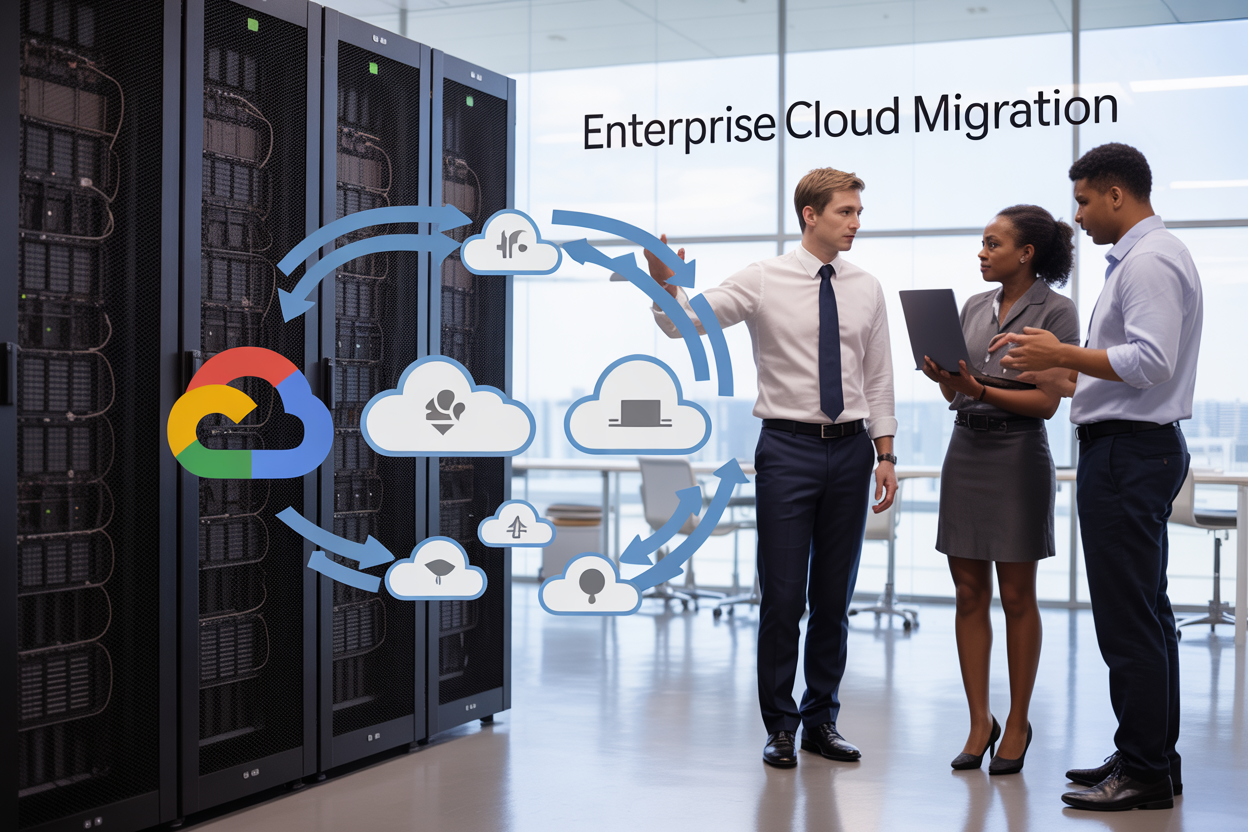
Moving your enterprise from on-premise infrastructure to Google Cloud Platform isn’t just a tech upgrade—it’s a complete business transformation. This guide is designed for IT leaders, cloud architects, and enterprise decision-makers who need a clear roadmap for their GCP migration strategy.
Many companies struggle with outdated systems that drain resources and limit growth. On-premise to cloud migration offers a path to scalable, cost-effective operations, but only when done right. The key lies in understanding modern cloud infrastructure design and following proven cloud migration best practices.
We’ll walk you through the essential steps of enterprise GCP implementation, starting with how to build a solid business case that gets stakeholder buy-in. You’ll learn practical techniques for conducting an on-premise infrastructure assessment that reveals what you’re really working with. We’ll also cover GCP architecture design principles that set your organization up for long-term success, plus cloud migration planning strategies that minimize disruption to your daily operations.
Understanding the Business Case for Cloud Migration

Cost reduction through optimized infrastructure spending
Moving from on-premise to GCP migration strategy brings immediate financial benefits that show up on your bottom line within months. Traditional data centers eat money through hardware purchases, maintenance contracts, and the constant cycle of equipment refreshes every 3-5 years. With Google Cloud Platform migration, you shift from capital expenditures to operational costs, paying only for what you actually use.
The savings stack up quickly. Most enterprises see 20-30% cost reduction in the first year alone. You eliminate the need for physical server rooms, cooling systems, and the army of technicians needed to keep everything running. GCP’s auto-scaling capabilities mean you’re not paying for idle capacity during off-peak hours or quiet business periods.
Storage costs drop dramatically too. Instead of buying expensive SANs that sit half-empty, you get flexible cloud storage that grows and shrinks with your needs. The shared infrastructure model means you benefit from Google’s massive scale and efficiency improvements they pass down to customers.
Enhanced scalability and flexibility for growing enterprises
Enterprise cloud architecture on GCP gives you superpowers when demand spikes hit unexpectedly. Remember the last time your website crashed during a product launch or holiday sale? Those days are over. GCP automatically spins up additional resources within minutes, handling traffic surges that would have brought your on-premise infrastructure to its knees.
Modern cloud infrastructure adapts to your business rhythm. During busy seasons, you get the computing power you need. When things slow down, resources scale back automatically. This elasticity is impossible with physical servers that take weeks to procure and configure.
Global expansion becomes a breeze. Opening a new office in Asia? Your applications can run from GCP’s Asian data centers instantly, giving local users lightning-fast performance. No more shipping servers overseas or dealing with complex international IT setups.
The flexibility extends to your development teams too. They can spin up test environments in minutes instead of waiting weeks for hardware approval. This speed boost transforms how quickly you can innovate and respond to market opportunities.
Improved security and compliance capabilities
GCP provides enterprise-grade security that most organizations could never build or maintain on their own. Google invests billions annually in security infrastructure, employing thousands of security experts who focus solely on protecting their platform. Your on-premise setup simply can’t match this level of dedicated expertise and resources.
The shared security model works in your favor. Google handles the underlying infrastructure security, while you focus on securing your applications and data. Built-in encryption, identity management, and threat detection come standard, not as expensive add-ons.
Compliance becomes much easier too. GCP maintains certifications for major standards like SOC 2, ISO 27001, HIPAA, and PCI DSS. Instead of going through lengthy audit processes yourself, you inherit these certifications. The platform provides detailed audit logs and reporting tools that compliance officers love.
Data residency requirements get handled automatically. You can specify exactly which geographic regions store your data, meeting local regulations without the headache of managing multiple data centers.
Accelerated innovation through modern cloud services
Cloud migration best practices unlock access to cutting-edge technologies that would take years to develop in-house. Machine learning, artificial intelligence, advanced analytics, and IoT platforms become available instantly. Your developers can integrate these services into applications within days, not months.
The pace of innovation picks up dramatically. Google constantly releases new services and improvements. You get automatic access to these advancements without any effort on your part. Your infrastructure stays current with the latest technology trends without the usual upgrade projects and budget battles.
Microservices architecture becomes practical on GCP. Instead of monolithic applications that take forever to update, you can build modular systems that update independently. This approach lets you roll out new features faster and with less risk.
Development cycles compress from months to weeks. With managed databases, serverless computing, and automated deployment pipelines, your teams spend more time building features and less time managing infrastructure. The competitive advantage this creates is enormous in today’s fast-moving business environment.
Assessing Your Current On-Premise Infrastructure

Inventory and dependency mapping of existing systems
Before jumping into a GCP migration strategy, you need a crystal-clear picture of what you’re working with. Think of this as creating a detailed map of your digital landscape – every server, database, application, and connection matters.
Start by cataloging all physical and virtual machines, including their specifications, operating systems, and current workloads. Document every application running in your environment, from mission-critical ERP systems to that forgotten legacy tool someone built five years ago. Pay special attention to databases, middleware, and integration points that often become migration bottlenecks.
Dependency mapping reveals the hidden connections between systems. That customer portal might seem standalone until you discover it relies on three different databases, two web services, and a file server. Create visual diagrams showing these relationships – they’ll become invaluable when planning your migration sequence. Tools like application discovery agents can automate much of this process, but manual validation remains essential for accuracy.
Don’t overlook networking components, storage systems, and backup solutions. These infrastructure elements often have subtle dependencies that only surface during migration. Document network configurations, firewall rules, and bandwidth requirements to ensure your GCP architecture design accommodates current traffic patterns and security policies.
Performance bottleneck identification and analysis
Your on-premise infrastructure assessment must identify where systems struggle under current loads. This analysis directly impacts your cloud migration planning by revealing which workloads need immediate attention and which can migrate as-is.
Monitor CPU utilization, memory consumption, disk I/O patterns, and network throughput across all systems during peak and off-peak periods. Look for consistent high-utilization resources that might benefit from cloud scalability. Database performance metrics deserve special scrutiny – slow query response times, high lock contention, and storage bottlenecks often indicate systems ready for cloud modernization.
Application response times tell a different story than infrastructure metrics. User experience data reveals whether performance issues stem from infrastructure limitations or application design problems. Document application-specific bottlenecks like batch processing delays, report generation times, and peak-hour slowdowns.
Storage performance analysis helps determine appropriate GCP storage solutions. Traditional spinning disk arrays might benefit from persistent SSD options, while infrequently accessed data could move to cost-effective nearline storage. Network latency measurements between different system tiers inform your Google Cloud Platform migration architecture decisions.
Security vulnerability assessment and compliance gaps
Security assessment forms the foundation of successful enterprise cloud architecture planning. Your current security posture directly influences GCP implementation strategies and determines which cloud-native security services you’ll need.
Start with vulnerability scanning across all systems, identifying outdated software, missing patches, and known security weaknesses. Pay attention to legacy applications that may lack modern security features – these often require additional cloud security layers or complete replacement during migration.
Access control analysis reveals another critical dimension. Document who has access to what systems, how authentication works, and whether you’re using role-based access controls effectively. Many on-premise environments suffer from privilege creep, where users accumulate unnecessary permissions over time. Cloud migration offers an opportunity to implement zero-trust security principles and clean up access controls.
Compliance requirements vary by industry, but most enterprises must address frameworks like SOC 2, PCI DSS, or HIPAA. Compare your current compliance posture against GCP’s compliance certifications to identify gaps and opportunities. Some compliance requirements might actually become easier to meet in the cloud, while others require specific architectural considerations.
Data classification and encryption practices need thorough review. Understanding which data requires encryption at rest and in transit helps plan appropriate GCP security controls. Document current backup and disaster recovery procedures to ensure your cloud architecture maintains or improves upon existing data protection standards.
GCP Architecture Design Principles for Enterprise Success

Multi-region deployment strategies for high availability
Designing multi-region deployments on Google Cloud Platform requires careful planning to balance performance, cost, and resilience. The key lies in understanding your application’s availability requirements and user distribution patterns.
Start by selecting primary and secondary regions based on your user base location and GCP’s global infrastructure. For enterprise applications, consider using regions like us-central1 and europe-west1 for maximum coverage across major markets. Deploy critical workloads across multiple zones within each region to protect against single zone failures.
Load balancing becomes crucial in multi-region setups. Google Cloud Load Balancer can automatically route traffic to the nearest healthy region, providing seamless failover capabilities. Configure health checks that accurately reflect your application’s status, not just basic connectivity.
Data synchronization presents unique challenges. Implement eventual consistency models for non-critical data while maintaining strong consistency for transactional systems. Cloud SQL cross-region replicas and Cloud Spanner’s multi-region capabilities offer different approaches depending on your consistency requirements.
Consider implementing circuit breaker patterns and retry logic in your applications to handle regional outages gracefully. This prevents cascading failures when one region experiences issues.
Microservices architecture implementation best practices
Breaking monolithic applications into microservices during GCP migration strategy development opens new possibilities for scalability and maintainability. Each service should own its data and expose well-defined APIs.
Container orchestration with Google Kubernetes Engine (GKE) provides the foundation for microservices deployment. Design services to be stateless whenever possible, storing session data in external systems like Cloud Memorystore or Firestore. This enables horizontal scaling and simplified deployment strategies.
API design becomes critical for service communication. Use REST APIs with proper versioning strategies, or consider gRPC for internal service-to-service communication. Implement API gateways using Cloud Endpoints or third-party solutions to manage external API access, authentication, and rate limiting.
Service discovery and configuration management require special attention. Tools like Consul or Kubernetes’ native service discovery can help services find each other dynamically. Store configuration in external systems like Secret Manager rather than hardcoding values.
Monitoring and observability grow complex with distributed systems. Implement distributed tracing using Cloud Trace and centralized logging with Cloud Logging. Each service should expose health check endpoints and metrics for monitoring tools.
Data governance and storage optimization frameworks
Enterprise GCP implementation demands robust data governance frameworks that address compliance, security, and operational efficiency. Start by classifying your data based on sensitivity, regulatory requirements, and access patterns.
Choose appropriate storage solutions based on data characteristics. Cloud Storage works well for unstructured data with different storage classes for various access patterns. Cloud SQL handles transactional workloads, while BigQuery excels at analytics workloads. Cloud Firestore serves real-time applications requiring low-latency access.
Implement data lifecycle policies to automatically transition data between storage classes or delete outdated information. This optimizes costs while maintaining compliance with data retention requirements. Use Cloud Storage’s lifecycle management rules and BigQuery’s table expiration settings.
Data encryption requires a multi-layered approach. Enable encryption at rest by default and consider customer-managed encryption keys for sensitive data. Implement encryption in transit for all data movement between services and external systems.
Establish clear data access patterns and implement proper indexing strategies. For BigQuery, partition tables by date or other logical boundaries to improve query performance and reduce costs. In Cloud SQL, create indexes based on actual query patterns rather than assumptions.
Network security and connectivity planning
Network architecture forms the backbone of secure enterprise cloud architecture. Virtual Private Clouds (VPCs) should follow the principle of least privilege, segmenting different application tiers and environments.
Design subnet structures that align with your security requirements. Place web servers in public subnets with controlled internet access, while database servers reside in private subnets accessible only through application servers. Use shared VPCs for multi-project deployments to maintain centralized network control.
Implement firewall rules that explicitly define allowed traffic patterns. Default-deny policies provide better security than permissive rules. Tag resources appropriately to simplify firewall rule management and ensure consistent security policies across similar resources.
Consider hybrid connectivity requirements early in your planning. Cloud VPN provides cost-effective connectivity for lower bandwidth needs, while Cloud Interconnect offers dedicated connections for high-bandwidth, low-latency requirements. Plan for redundancy with multiple connection points.
Network monitoring and logging help detect unusual patterns and potential security threats. Enable VPC Flow Logs and integrate with Security Command Center for comprehensive visibility into network traffic patterns.
Identity and access management integration
Integrating existing identity systems with Google Cloud IAM requires careful mapping of roles and permissions. Start by inventorying current access patterns and identifying which users need access to specific GCP resources.
Google Cloud’s Identity and Access Management follows the principle of least privilege. Create custom roles that match your organization’s specific needs rather than using overly broad predefined roles. Group related permissions together and assign roles based on job functions rather than individual users.
Single sign-on integration streamlines user experience while maintaining security. Google Cloud supports SAML and OIDC integration with popular identity providers like Active Directory, Okta, and Azure AD. Configure multi-factor authentication requirements based on resource sensitivity and user roles.
Service accounts handle application-to-application authentication. Create dedicated service accounts for each application or service with minimal required permissions. Use service account keys sparingly, preferring workload identity for applications running on GKE or Compute Engine.
Regular access reviews ensure permissions remain appropriate as roles change. Implement automated processes to review and revoke unused permissions. Use Cloud Asset Inventory to track resource access patterns and identify potential security gaps.
Migration Strategy Development and Planning

Phased Migration Approach with Minimal Business Disruption
A successful GCP migration strategy demands breaking down the massive undertaking into manageable chunks. Starting with a pilot group of non-critical applications helps your team learn the ropes without risking your core business operations. This test-and-learn approach builds confidence while exposing potential roadblocks early in the process.
The key lies in establishing migration waves that gradually increase in complexity and business importance. Wave one typically includes development and testing environments, followed by less critical applications in wave two. Your mission-critical systems come last, once your team has mastered the migration process and proven the new cloud architecture’s reliability.
During each phase, maintain parallel systems until you’ve thoroughly validated the migrated components. This dual-running approach might seem costly upfront, but it’s far less expensive than dealing with extended downtime or data loss. Plan for rollback procedures at every stage – having an escape route reduces stress and enables faster decision-making when issues arise.
Communication becomes crucial during phased migrations. Keep stakeholders informed about timelines, expected impacts, and backup plans. Regular check-ins with business units help identify scheduling conflicts with peak business periods, ensuring your cloud migration planning doesn’t coincide with quarterly reporting or holiday shopping seasons.
Application Prioritization Based on Complexity and Business Impact
Smart prioritization separates successful migrations from chaotic disasters. Create a comprehensive application inventory that maps each system’s business criticality, technical complexity, and interdependencies. Applications with low business impact and minimal complexity make perfect candidates for your initial migration waves.
Legacy systems with tight coupling to other applications present the biggest challenges. These monolithic architectures often require significant refactoring before they’re cloud-ready. Consider breaking these systems into smaller, more manageable components or replacing them entirely with cloud-native solutions during the migration process.
Evaluate each application’s cloud-readiness using criteria like:
- Database dependencies and licensing requirements
- Network latency sensitivity
- Compliance and regulatory constraints
- Integration points with other systems
- Resource utilization patterns
Applications with predictable workloads and loose coupling migrate more smoothly than those with complex dependencies. Your enterprise GCP implementation benefits from starting with these simpler systems while your team develops expertise with Google Cloud Platform migration tools and processes.
Don’t overlook the human factor in prioritization. Applications managed by teams with strong cloud skills or enthusiasm for change should move earlier in the queue. Their success creates momentum and generates internal advocates for your broader cloud migration best practices.
Data Migration Strategies and Backup Considerations
Data represents your organization’s most valuable asset, making migration strategy development critically important for this component. The sheer volume of enterprise data means you can’t simply copy everything overnight. Instead, develop a multi-pronged approach that combines different migration methods based on data characteristics and business requirements.
For large datasets with minimal change frequency, consider offline transfer methods like Google’s Transfer Appliance. This physical device can handle petabytes of data without consuming your network bandwidth or impacting daily operations. Active datasets require online transfer tools that can sync changes incrementally, minimizing the cutover window.
Database migrations demand special attention due to their complexity and business criticality. Plan for schema conversions, especially when moving from proprietary databases to cloud-native options like Cloud SQL or BigQuery. Test these conversions thoroughly in non-production environments, paying close attention to performance characteristics and query optimization needs.
Backup strategies must evolve alongside your migration timeline. Maintain comprehensive backups of your on-premise infrastructure assessment data throughout the process, while simultaneously establishing backup procedures in GCP. Consider cross-platform backup solutions that can restore data to either environment, providing maximum flexibility during the transition period.
Data validation becomes essential at every migration milestone. Implement automated checks that verify data integrity, completeness, and consistency between source and target systems. This validation process should run continuously during the migration window, alerting your team to any discrepancies that require immediate attention.
Implementation Best Practices and Common Pitfalls
Automated Deployment Pipelines and CI/CD Integration
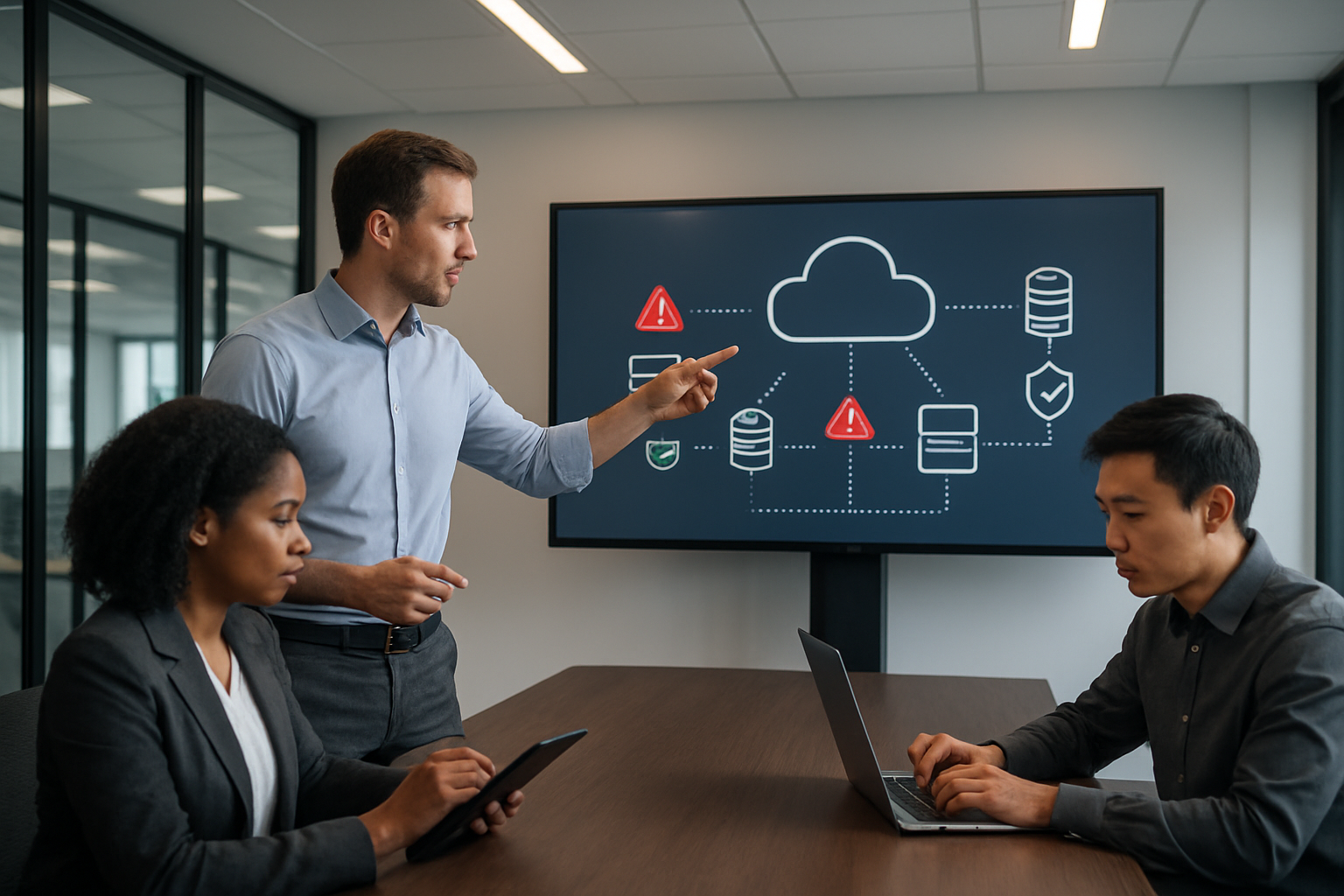
Building robust automated deployment pipelines is the backbone of successful GCP migration strategy. Start by setting up Cloud Build as your primary CI/CD platform, integrating it with your existing version control systems like GitHub or GitLab. Create separate pipelines for different environments – development, staging, and production – each with specific validation checkpoints and approval gates.
Infrastructure as Code (IaC) becomes your best friend during enterprise GCP implementation. Use Terraform or Google Cloud Deployment Manager to define your cloud resources declaratively. This approach ensures consistency across environments and makes rollbacks painless when things go sideways. Store your IaC templates in version control alongside your application code to maintain a single source of truth.
Set up automated testing at multiple stages of your pipeline. Include unit tests, integration tests, security scans, and performance benchmarks. Google Cloud’s Security Command Center can integrate directly into your pipeline to catch vulnerabilities before they reach production. Don’t forget to implement canary deployments and blue-green deployment strategies to minimize downtime during updates.
Consider using Cloud Functions or Cloud Run for microservices deployments, as they naturally support continuous deployment patterns. For containerized applications, Google Kubernetes Engine (GKE) with Helm charts provides excellent automation capabilities. Remember to implement proper secret management using Secret Manager rather than hardcoding sensitive information in your deployment scripts.
Performance Monitoring and Optimization Techniques
Google Cloud Operations Suite (formerly Stackdriver) should be your monitoring command center from day one. Set up comprehensive logging, metrics collection, and alerting before your applications go live. Create custom dashboards that reflect your business KPIs, not just technical metrics. Your executives care more about user experience and revenue impact than CPU utilization.
Implement distributed tracing using Cloud Trace to understand how requests flow through your microservices architecture. This visibility becomes crucial when troubleshooting performance bottlenecks in complex distributed systems. Combine this with Error Reporting to catch and categorize application errors automatically.
Performance optimization starts with right-sizing your resources. Use Google Cloud’s Committed Use Discounts and Sustained Use Discounts to reduce costs while maintaining performance. Implement auto-scaling policies for your Compute Engine instances and GKE clusters based on actual usage patterns, not guesswork.
Database performance often becomes the bottleneck in cloud migration best practices. Use Cloud SQL Performance Insights to identify slow queries and optimize your database operations. Consider Cloud Spanner for globally distributed applications or Firestore for document-based workloads that need automatic scaling.
Network optimization plays a huge role in user experience. Implement Cloud CDN for static content delivery and use Premium Network Tier for improved global connectivity. Monitor your network performance using Network Intelligence Center to identify and resolve connectivity issues proactively.
Change Management and Team Training Requirements
Your technical team needs hands-on experience with GCP services before migration begins. Start with Google Cloud certification programs for key team members, focusing on roles like Cloud Architect, Cloud Engineer, and Cloud Security Engineer. Invest in workshops and boot camps that provide practical experience with your specific use cases.
Create internal documentation that bridges the gap between your on-premise processes and cloud-native approaches. Your team knows how to manage physical servers, but managing ephemeral cloud resources requires a different mindset. Document common scenarios like scaling applications, handling failures, and managing security policies in the cloud context.
Establish cloud governance policies early in your migration journey. Define resource naming conventions, tagging strategies, and access control patterns that make sense for your organization. Use Google Cloud Organization policies to enforce these standards automatically across all projects and teams.
Cross-functional collaboration becomes even more important in cloud environments. Break down silos between development, operations, and security teams by implementing shared responsibility models. Security becomes everyone’s job, not just the security team’s concern.
Plan for cultural resistance to change. Some team members might feel overwhelmed by the pace of cloud innovation or concerned about job security. Address these concerns directly through transparent communication about career development opportunities and the strategic importance of cloud skills.
Risk Mitigation Strategies for Critical Business Applications
Start by classifying your applications based on business criticality and risk tolerance. Mission-critical applications deserve extra attention during modern cloud infrastructure migration. Implement comprehensive backup strategies using Google Cloud’s automated backup services for databases and persistent disks.
Design disaster recovery plans that align with your business recovery objectives. Use multi-regional deployments for your most critical workloads, but balance this against cost considerations. Test your disaster recovery procedures regularly – a plan that hasn’t been tested is just documentation.
Implement robust security controls from the beginning. Use Identity and Access Management (IAM) with the principle of least privilege, enable audit logging for all critical resources, and implement network security using VPC firewalls and private clusters. Consider using Binary Authorization to ensure only verified container images run in your production environment.
Create rollback procedures for every major change. This includes database schema changes, application deployments, and infrastructure updates. Use Cloud SQL’s point-in-time recovery capabilities and maintain versioned backups of your application configurations.
Monitor business metrics closely during and after migration. Set up alerts for key performance indicators like transaction volumes, error rates, and user satisfaction scores. Sometimes technical metrics look fine while business metrics show problems that could impact revenue.
Establish clear escalation procedures and communication plans for incidents. Your stakeholders need to know who to contact when problems occur and what steps are being taken to resolve issues. Regular communication during outages builds trust and demonstrates professional incident management.
Post-Migration Optimization and Ongoing Management

Cost Optimization Through Rightsizing and Resource Management
Moving to GCP opens up incredible opportunities for cost savings, but success depends on actively managing your resources rather than just migrating and forgetting. Right after your on-premise to cloud migration, you’ll likely notice immediate cost benefits, but the real savings come from ongoing optimization efforts.
Start by implementing automated rightsizing policies that continuously monitor resource usage patterns. GCP’s Compute Engine provides detailed metrics showing CPU, memory, and disk utilization across all instances. Set up alerts when resources consistently run below 50% capacity – these are prime candidates for downsizing. Many enterprises discover they can reduce compute costs by 30-40% simply by matching instance sizes to actual workload requirements.
Resource scheduling becomes your best friend for non-production environments. Development and testing workloads rarely need 24/7 availability, so configure automatic shutdown schedules during off-hours. Use GCP’s preemptible instances for batch processing and fault-tolerant workloads – they cost up to 80% less than regular instances.
Storage optimization requires ongoing attention too. Implement lifecycle policies that automatically move infrequently accessed data to cheaper storage classes like Nearline or Coldline. Set up regular audits to identify and delete orphaned disks, unused snapshots, and redundant backups that accumulate over time.
Budget alerts and spending forecasts help prevent cost overruns before they happen. Configure multiple threshold alerts at 50%, 80%, and 90% of your monthly budget to maintain spending visibility across teams.
Performance Tuning and Continuous Improvement Processes
Enterprise cloud architecture requires constant fine-tuning to deliver optimal performance. Your GCP migration strategy should include establishing baseline performance metrics immediately after migration, then implementing continuous monitoring and improvement cycles.
Network performance often becomes the first bottleneck enterprises encounter. Use VPC peering and dedicated interconnect options to reduce latency between on-premise systems and GCP resources. Configure load balancers with health checks and auto-scaling policies that respond to traffic patterns in real-time.
Database performance tuning deserves special attention during your enterprise GCP implementation. Cloud SQL and Cloud Spanner offer different optimization approaches – Cloud SQL benefits from read replicas and connection pooling, while Spanner requires careful key design to avoid hotspots. Monitor query performance regularly and optimize slow-running queries that consume excessive resources.
Application-level improvements come through leveraging GCP’s managed services. Replace custom logging solutions with Cloud Logging, move file processing to Cloud Functions, and use Pub/Sub for asynchronous messaging. These services scale automatically and reduce the operational overhead of managing infrastructure.
Set up comprehensive monitoring dashboards using Cloud Operations Suite (formerly Stackdriver) to track key performance indicators across your entire infrastructure. Create custom metrics for business-specific performance indicators and establish SLA monitoring that alerts teams when performance degrades.
Disaster Recovery and Business Continuity Planning
Modern cloud infrastructure provides unprecedented disaster recovery capabilities, but success requires careful planning and regular testing. Your disaster recovery strategy should account for both regional outages and application-level failures.
Multi-region deployment strategies form the foundation of robust business continuity planning. Distribute critical workloads across at least two GCP regions, with automated failover mechanisms that can redirect traffic within minutes. Use Cloud Load Balancing’s global capabilities to route traffic away from failed regions automatically.
Backup strategies need evolution beyond traditional approaches. Implement automated snapshot schedules for persistent disks, but also consider cross-region backup replication for critical data. Database backups should include both automated daily backups and point-in-time recovery capabilities for mission-critical systems.
Recovery time objectives (RTO) and recovery point objectives (RPO) become more achievable in the cloud, but require proper architecture. Hot-standby systems in secondary regions can provide RTOs under 5 minutes, while cold standby approaches might take 30-60 minutes but cost significantly less.
Regular disaster recovery testing reveals gaps that theoretical planning misses. Schedule quarterly failover tests that simulate real outage scenarios. Document recovery procedures in runbooks and train operations teams on emergency response protocols. Track recovery metrics during tests to identify improvement opportunities.
Cloud-native backup solutions like Cloud Storage with versioning provide additional protection layers. Implement the 3-2-1 backup rule using cloud services – three copies of data, on two different storage types, with one copy in a different geographic location.

Moving your business from on-premise systems to Google Cloud Platform isn’t just about following the latest tech trend – it’s about setting your company up for real growth and efficiency. The journey requires careful planning, from understanding why your business needs this change to designing the right cloud architecture that actually works for your specific needs. Getting your migration strategy right from the start saves you countless headaches and costs down the road.
The best part about GCP migration is what happens after you’ve made the move. Your teams can focus on building great products instead of managing server rooms, and your business gets the flexibility to scale up or down based on what’s actually happening in the market. Start by taking a honest look at what you have now, create a solid plan that fits your timeline and budget, and don’t try to move everything at once. Your future self will thank you for doing this migration the right way.