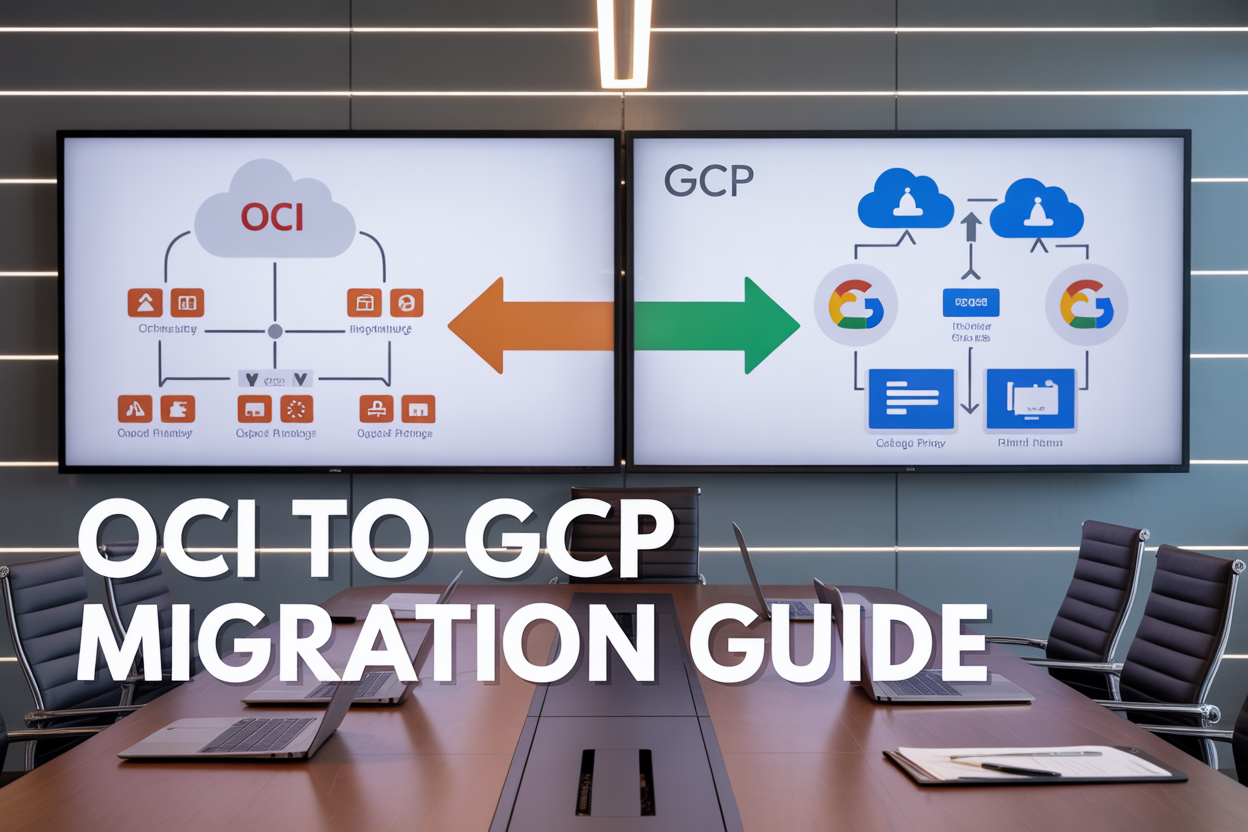
Moving your enterprise workloads from Oracle Cloud Infrastructure (OCI) to Google Cloud Platform (GCP) doesn’t have to mean costly downtime or service interruptions. This comprehensive OCI to GCP migration guide walks IT leaders, cloud architects, and DevOps teams through proven strategies for seamless cloud workload migration.
Enterprise organizations often face pressure to optimize cloud costs, improve performance, or access better services—making Oracle Cloud to Google Cloud transitions increasingly common. The challenge lies in executing these moves without disrupting critical business operations or compromising data integrity.
This guide covers the essential components of successful zero downtime migration, starting with thorough pre-migration planning and assessment to identify dependencies and potential risks. You’ll also discover proven zero downtime cloud migration strategies that keep your applications running while data transfers happen in the background. Finally, we’ll explore the enterprise cloud migration tools and automation techniques that make large-scale transitions manageable and reliable.
By the end, you’ll have a clear roadmap for migrating your enterprise workloads with confidence and minimal business impact.
Pre-Migration Planning and Assessment

Comprehensive workload inventory and dependency mapping
Starting your OCI to GCP migration without a complete understanding of your current environment is like trying to move a house without knowing where all the electrical wires run. You need to catalog every single component of your Oracle Cloud infrastructure, from the obvious virtual machines and databases to the often-overlooked monitoring tools and backup scripts.
Begin by documenting all compute instances, storage volumes, networking configurations, and databases across your OCI tenancies. Don’t forget about the smaller pieces that keep everything running smoothly – load balancers, DNS configurations, security groups, and IAM policies. These supporting elements often create unexpected dependencies that can derail your migration timeline if not properly mapped.
Dependency mapping becomes critical when dealing with enterprise workloads that have evolved over years. Applications rarely exist in isolation, and understanding how your systems communicate helps prevent breaking critical business processes during migration. Use automated discovery tools to trace network traffic patterns, API calls, and data flows between services. Map out both technical dependencies (like database connections and shared storage) and business dependencies (such as batch processing sequences that must complete before other systems can start).
Create detailed documentation that includes application owners, business criticality levels, and peak usage patterns. This information becomes invaluable when planning your zero downtime migration approach and determining which workloads can move together versus those requiring isolated migration windows.
Cost-benefit analysis and ROI calculations
Moving from OCI to GCP isn’t just a technical decision – it’s a significant financial undertaking that requires careful analysis of both immediate costs and long-term benefits. Your cost-benefit analysis should account for migration expenses, ongoing operational costs, and the business value of improved capabilities.
Calculate direct migration costs including professional services, temporary infrastructure for running parallel environments, staff time, and potential downtime costs. Don’t underestimate the hidden expenses like training, new tooling licenses, and extended project timelines due to unexpected complexities.
On the benefits side, GCP often provides cost advantages through more granular pricing models, sustained use discounts, and committed use contracts. Compare OCI’s pricing structure with GCP’s offerings for equivalent workloads, factoring in Google’s per-second billing and automatic scaling capabilities that can reduce over-provisioning costs.
Quantify operational improvements like reduced management overhead through Google’s managed services, better disaster recovery capabilities, and enhanced security features. Consider the business impact of improved performance, global availability, and integration with Google’s AI and analytics platforms.
Build ROI projections over a 3-5 year period, including scenarios for different growth rates and usage patterns. This analysis helps justify the migration investment and provides benchmarks for measuring success after completion.
Risk assessment and mitigation strategies
Every cloud migration carries inherent risks, and OCI to GCP migration presents unique challenges that require proactive planning. Start by identifying technical risks such as application compatibility issues, data transfer failures, and performance degradation during transition periods.
Network connectivity poses significant risks, especially for applications requiring low latency or high bandwidth. Plan for redundant connections and test failover scenarios before go-live dates. Data integrity risks demand special attention – establish checksum verification processes and maintain backup strategies that span both cloud environments during the migration window.
Business continuity risks extend beyond technical failures. Consider the impact of extended migration timelines on business operations, staff availability during critical migration phases, and potential vendor lock-in scenarios. Develop contingency plans that allow for rollback to OCI if critical issues emerge during migration.
Security risks require careful evaluation of differences between OCI and GCP security models. Review compliance requirements and ensure GCP configurations meet your industry standards. Plan for potential security gaps during transition periods when systems may temporarily operate with elevated privileges or broader network access.
Create risk registers with probability assessments, impact ratings, and specific mitigation strategies for each identified risk. Assign risk owners and establish monitoring processes to track risk indicators throughout the migration process.
Timeline development and resource allocation
Successful zero downtime migration requires meticulous timeline planning that balances business requirements with technical realities. Start by categorizing workloads based on complexity, dependencies, and business criticality to establish migration phases that minimize risk and business impact.
Develop realistic timelines that account for testing phases, rollback procedures, and buffer time for unexpected issues. Plan migration windows during low-usage periods and consider seasonal business cycles that might affect system availability requirements. Factor in time for staff training on GCP services and tools before they’re needed for production migrations.
Resource allocation extends beyond technical staff to include project management, security reviews, and business stakeholder coordination. Ensure you have adequate expertise in both OCI and GCP environments, and consider engaging specialized migration consultants for complex workloads or tight timelines.
Plan for infrastructure costs during transition periods when you’ll be running workloads in both environments. Budget for additional monitoring tools, testing environments, and potential data transfer charges. Allocate time for performance baseline establishment and post-migration optimization activities.
Create detailed project schedules with clear milestones, dependencies, and resource assignments. Build in regular checkpoint reviews to assess progress against original timelines and adjust plans based on lessons learned from earlier migration phases.
OCI and GCP Architecture Comparison
Core Service Mappings Between Platforms
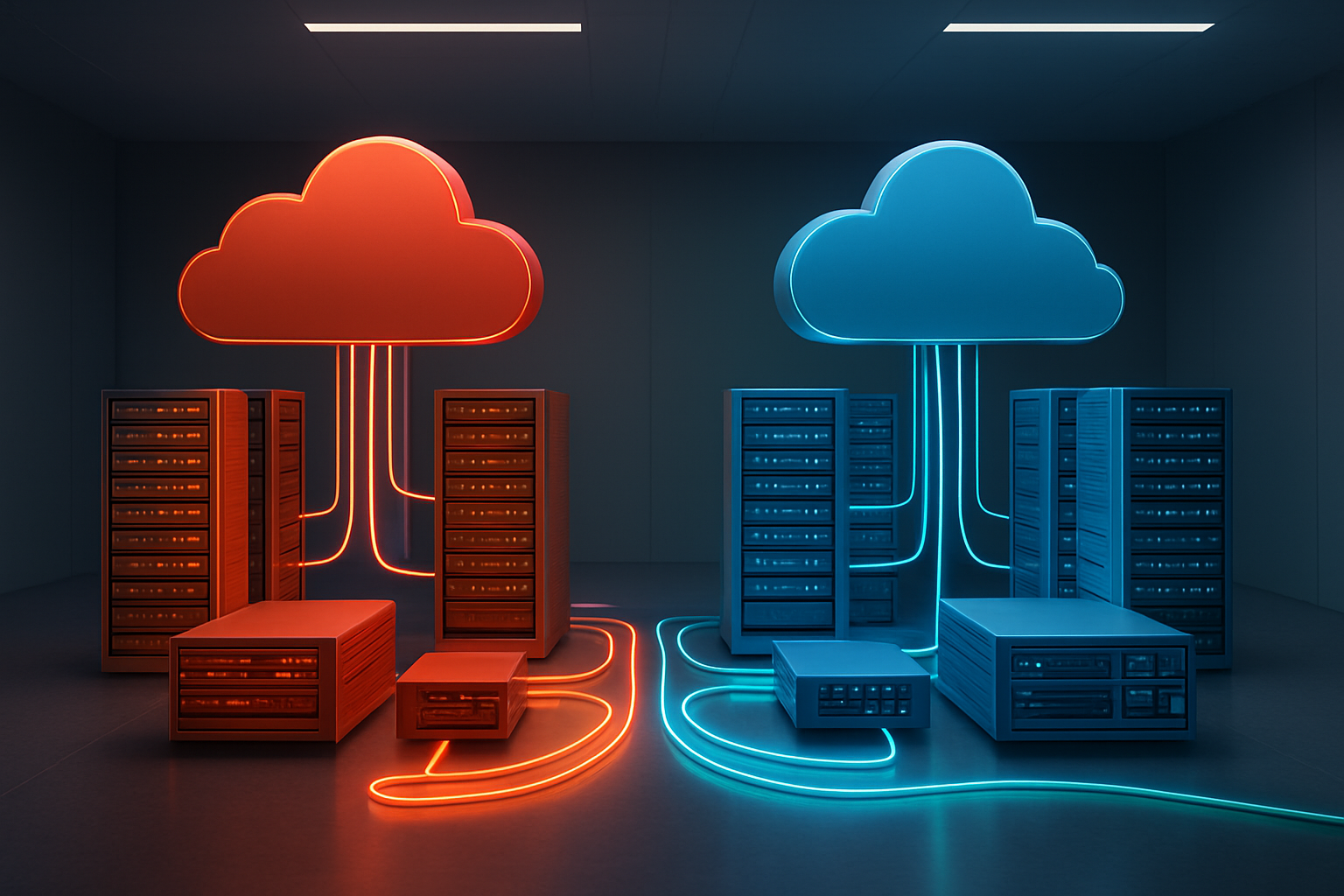
Moving from OCI to GCP requires understanding how services translate between platforms. Oracle Cloud’s Compute instances map directly to Google Compute Engine, though GCP offers more granular machine types and custom configurations. OCI’s Container Engine for Kubernetes becomes Google Kubernetes Engine (GKE), with GCP providing enhanced autopilot features and better integration with Google’s AI/ML services.
For serverless computing, OCI Functions translates to Google Cloud Functions, while Oracle’s Application Container Cloud Service finds its equivalent in Google Cloud Run. Database services see Oracle Autonomous Database mapping to Cloud SQL or Cloud Spanner, depending on scalability needs. OCI’s Object Storage becomes Cloud Storage, with similar tiered storage options but different pricing models.
Key service mappings include:
- OCI Load Balancer → Cloud Load Balancing
- Oracle Integration Cloud → Cloud Integration
- OCI Analytics Cloud → BigQuery + Looker Studio
- Oracle Content and Experience Cloud → Firebase Hosting + Cloud CDN
- OCI Identity and Access Management → Cloud Identity & Access Management
Network and Security Model Differences
GCP’s network architecture differs significantly from OCI’s approach to enterprise cloud migration. OCI uses Virtual Cloud Networks (VCNs) with compartment-based isolation, while GCP employs Virtual Private Clouds (VPCs) with project-level organization. GCP’s global VPC model allows resources across regions to communicate privately without complex peering arrangements.
Security models present notable contrasts for OCI to GCP migration planning. Oracle’s security lists function similarly to GCP’s firewall rules, but GCP offers more sophisticated network security through hierarchical firewalls and VPC Service Controls. Identity management varies substantially – OCI’s compartment structure requires restructuring into GCP’s resource hierarchy using organizations, folders, and projects.
Network considerations:
- Subnet design: OCI’s availability domain-specific subnets vs GCP’s regional subnets
- Connectivity: Oracle FastConnect vs Google Cloud Interconnect
- DNS: OCI DNS vs Cloud DNS with different resolution behaviors
- Network monitoring: Different toolsets and logging approaches
Storage and Database Equivalencies
Storage migration from OCI to GCP involves matching performance tiers and access patterns. OCI’s Block Volume service corresponds to Persistent Disk, though GCP offers additional SSD options and regional persistent disks for higher availability. File Storage translates to Filestore, with similar NFS compatibility but different performance characteristics.
Database equivalencies require careful architecture comparison during zero downtime migration strategies. Oracle Autonomous Database Serverless maps well to Cloud SQL with automatic scaling, while Autonomous Data Warehouse aligns with BigQuery for analytics workloads. For NoSQL needs, OCI NoSQL Database becomes Firestore or Bigtable, depending on usage patterns.
Storage and database mapping:
- Archive Storage → Coldline/Archive Storage
- Oracle Database Cloud Service → Cloud SQL for MySQL/PostgreSQL or bare metal solutions
- MySQL Database Service → Cloud SQL for MySQL
- Redis Cluster → Memorystore for Redis
- Elasticsearch Service → Elasticsearch Service on Google Cloud
Performance characteristics vary between platforms, requiring thorough testing during migration execution. GCP’s multi-regional storage options provide better global distribution, while database replication strategies differ significantly between the two cloud providers.
Zero Downtime Migration Strategies
Blue-green deployment methodology
Blue-green deployment stands as the gold standard for achieving zero downtime migration from OCI to GCP. This approach creates two identical production environments – the “blue” environment running your current OCI workload and the “green” environment hosting your new GCP setup. The beauty lies in the seamless switch between environments once testing confirms everything works perfectly.
Start by replicating your entire OCI infrastructure on GCP while keeping your original environment fully operational. Users continue accessing the blue environment without any interruption while you configure, test, and validate the green environment. This parallel setup gives you confidence that your migration will work flawlessly before making the switch.
The actual cutover happens through DNS changes or load balancer updates, redirecting traffic from blue to green in seconds. If issues arise, you can instantly switch back to the blue environment. This methodology works exceptionally well for stateless applications, microservices architectures, and web applications where you can manage data synchronization effectively.
Success depends on maintaining data consistency between both environments during the migration window. Plan for database synchronization, session management, and any stateful components that need careful handling during the transition.
Database replication and synchronization techniques
Database migration represents the most critical aspect of any zero downtime cloud migration strategy. Real-time replication ensures your GCP databases stay synchronized with OCI sources until you’re ready to make the switch.
Set up continuous data replication using native database tools or third-party solutions like AWS Database Migration Service, Google Cloud SQL, or Oracle GoldenGate. These tools capture changes in real-time and apply them to your target GCP databases, maintaining data consistency throughout the migration process.
For Oracle databases moving to Cloud SQL or Spanner, establish logical replication streams that handle schema differences and data type conversions automatically. PostgreSQL and MySQL databases can leverage built-in replication features with minimal configuration overhead.
Monitor replication lag closely during the migration process. Lag times under one second typically work for most enterprise workloads, but mission-critical applications might need even tighter synchronization. Test your replication setup thoroughly with production-like data volumes to identify potential bottlenecks.
Plan your cutover window during low-traffic periods when you can briefly pause write operations, complete the final synchronization, and switch database connections to GCP. This approach typically requires only minutes of downtime for the database layer while maintaining application availability through cached data and read replicas.
Load balancer configuration for seamless traffic switching
Load balancers serve as traffic directors during your OCI to GCP migration, enabling smooth transitions between cloud environments. Configure your load balancing strategy to gradually shift traffic from OCI to GCP while monitoring performance metrics and user experience.
Start with a canary deployment approach, directing a small percentage of traffic to your GCP environment while the majority continues using OCI. Google Cloud Load Balancer and third-party solutions like F5 or Citrix NetScaler can handle this traffic distribution with precise control over routing rules.
Implement health checks on both environments to automatically route traffic away from any failing components. Configure these checks to verify application responsiveness, database connectivity, and critical service availability every few seconds.
Use weighted routing to gradually increase GCP traffic from 5% to 25%, then 50%, and finally 100% over several hours or days. This gradual approach helps identify issues before they affect all users while building confidence in your new GCP infrastructure.
DNS-based routing offers another effective approach for traffic switching, especially for geographically distributed applications. Update DNS records with shorter TTL values before migration, allowing faster propagation of routing changes when you’re ready to switch.
Rollback procedures and contingency planning
Every zero downtime migration needs a solid rollback plan that can restore service within minutes if problems arise. Build automated rollback procedures that reverse traffic routing, database connections, and service configurations without manual intervention.
Create rollback triggers based on specific metrics like error rates exceeding 2%, response times increasing by 50%, or user complaints reaching predefined thresholds. Automated monitoring systems should detect these conditions and initiate rollback procedures without waiting for human intervention.
Document step-by-step rollback procedures for different failure scenarios – application issues, database problems, network connectivity failures, or performance degradation. Include specific commands, configuration files, and contact information for escalation if automated rollback fails.
Test your rollback procedures regularly during pre-production migrations to ensure they work under pressure. Time how long each rollback takes and identify opportunities to reduce recovery time through automation or improved procedures.
Maintain communication channels with stakeholders during migration windows, providing real-time status updates and immediate notification if rollback becomes necessary. Establish clear decision-making authority so rollback decisions can happen quickly without bureaucratic delays that extend downtime.
Keep your OCI environment fully operational for at least 48-72 hours after migration completion, giving you confidence that GCP performance meets expectations before decommissioning original infrastructure. This safety net provides peace of mind and additional rollback options if delayed issues surface after migration.
Essential Migration Tools and Technologies
Native GCP migration services and capabilities
Google Cloud provides a comprehensive suite of native tools designed specifically for enterprise cloud migration scenarios, including OCI to GCP migration projects. Migration Center serves as the primary orchestration platform, offering centralized visibility and management across your entire migration journey. This service automatically discovers your OCI infrastructure, analyzes dependencies, and creates detailed migration plans with cost estimates.
Database Migration Service stands out as a powerful tool for moving Oracle databases to Google Cloud SQL or Cloud SQL for PostgreSQL. The service supports live migration with minimal downtime, automatically handling schema conversion and data replication. For virtual machine workloads, Migrate to Virtual Machines streamlines the process of moving compute instances from OCI to Google Compute Engine, preserving configurations and reducing manual intervention.
Application Migration for Google Kubernetes Engine excels at containerizing and modernizing applications during the migration process. This service automatically converts traditional VM-based applications into cloud-native containerized workloads, making them more resilient and scalable on GCP.
Cloud Storage Transfer Service handles bulk data movement between OCI Object Storage and Google Cloud Storage with built-in validation and error handling. The service maintains data integrity while optimizing transfer speeds through parallel processing and bandwidth management.
Third-party migration automation platforms
Several enterprise-grade third-party platforms complement GCP’s native tools, offering advanced automation and specialized capabilities for complex OCI GCP migration scenarios. CloudEndure Migration (now part of AWS but still applicable for cross-cloud scenarios) provides continuous replication and automated cutover processes that minimize downtime windows.
Carbonite Move specializes in real-time data replication and synchronization, making it ideal for zero downtime migration strategies. The platform supports heterogeneous environments and can replicate data between different storage systems while maintaining consistency.
Velostrata (acquired by Google) offers live migration capabilities that keep applications running during the migration process. This technology creates a hybrid cloud environment where applications can start running on GCP while data gradually moves from OCI in the background.
Platform9 provides managed Kubernetes services that simplify application modernization during migration. Their platform abstracts the complexity of container orchestration while providing enterprise-grade security and compliance features.
Turbonomic delivers intelligent workload optimization throughout the migration process, automatically right-sizing resources and predicting performance bottlenecks before they impact production systems.
Monitoring and validation tools for migration success
Effective monitoring and validation are critical for ensuring migration success and maintaining system reliability throughout the OCI to GCP migration process. Google Cloud Monitoring provides comprehensive observability across your migrated workloads, offering real-time metrics, custom dashboards, and intelligent alerting.
Cloud Logging centralizes log data from all GCP services, making it easy to track migration progress and troubleshoot issues. The service integrates seamlessly with popular log analysis tools and supports custom log parsing for OCI-specific formats.
For database migrations, Cloud SQL Insights offers performance monitoring and query analysis to ensure your migrated databases perform optimally. The tool identifies slow queries and suggests optimization strategies specific to GCP’s infrastructure.
Network Intelligence Center provides visibility into network performance and connectivity issues that might arise during migration. This service helps validate that network configurations work correctly after migration and identifies potential security gaps.
Third-party validation tools like Datadog and New Relic offer cross-cloud monitoring capabilities, allowing you to compare performance metrics between OCI and GCP environments during the transition period. These tools provide detailed application performance monitoring and can detect subtle issues that might not be apparent through basic infrastructure monitoring.
Cloud Asset Inventory helps maintain an accurate inventory of all migrated resources, ensuring nothing gets lost during the transition and providing a foundation for ongoing governance and cost management.
Step-by-Step Migration Execution

Infrastructure provisioning and configuration
Starting with infrastructure setup, you’ll want to create your GCP environment to mirror your OCI architecture. Begin by establishing your VPC networks, subnets, and security groups in Google Cloud. Pay close attention to IP address ranges – make sure they don’t overlap with your existing OCI networks if you plan to maintain connectivity during migration.
Set up your compute instances with matching specifications to your OCI virtual machines. Google Cloud’s machine types might not directly correspond to OCI’s shapes, so test performance thoroughly. Create managed instance groups for auto-scaling applications and configure load balancers to handle traffic distribution.
Storage provisioning requires careful planning. Map your OCI block volumes to Google Cloud Persistent Disks, and set up Cloud Storage buckets for object storage needs. Configure backup schedules and snapshot policies to match your current data protection strategy.
Don’t forget about networking components like VPN gateways, Cloud NAT, and firewall rules. These elements form the backbone of your zero downtime migration strategy by enabling secure communication between OCI and GCP during the transition period.
Data migration with live synchronization
Data migration represents the most critical phase of your OCI to GCP migration. Start by cataloging all your databases, file systems, and storage volumes. Prioritize based on business criticality and data interdependencies.
For database migration, use Google Cloud’s Database Migration Service when possible. For Oracle databases, consider using Oracle GoldenGate or AWS Database Migration Service (which supports Google Cloud as a target). These tools enable real-time replication, keeping your source and target databases synchronized throughout the migration process.
File-level synchronization can be achieved using tools like rclone or Google Cloud’s Transfer Service. Set up continuous sync jobs that monitor changes in your OCI object storage and replicate them to Google Cloud Storage. This approach minimizes the final cutover window.
Large datasets benefit from initial bulk transfers followed by incremental synchronization. Consider using physical transfer appliances for multi-terabyte datasets where network transfer would be prohibitively slow. Google Cloud’s Transfer Appliance can help move massive amounts of data efficiently.
Monitor replication lag closely during this phase. Establish acceptable lag thresholds and have rollback procedures ready if synchronization falls behind. Test your sync processes with non-production data first to identify potential bottlenecks.
Application deployment and testing protocols
Deploy your applications in GCP while maintaining the running versions in OCI. This parallel deployment strategy enables thorough testing without impacting production services. Use containerization where possible to ensure consistency between environments.
Implement comprehensive testing protocols that cover functionality, performance, and integration scenarios. Load testing becomes particularly important when moving between cloud providers, as network characteristics and underlying infrastructure can affect application behavior.
Set up monitoring and logging systems in GCP that match your OCI configuration. Tools like Google Cloud Operations Suite should capture the same metrics you’re tracking in OCI. This parallel monitoring helps identify performance differences early.
Create automated deployment pipelines using tools like Cloud Build or Jenkins. These pipelines should deploy to both environments initially, allowing you to compare behavior and catch environment-specific issues. Gradually shift the pipeline to favor GCP as confidence grows.
User acceptance testing should involve actual business users working with the GCP-hosted applications. Their feedback helps identify subtle differences that automated tests might miss. Document any configuration changes needed to achieve feature parity with the OCI environment.
DNS cutover and traffic redirection
DNS cutover marks the moment when users start accessing your applications in GCP instead of OCI. Plan this step meticulously, as timing and execution directly impact user experience.
Reduce DNS TTL values days or weeks before cutover. Lower TTL values (300 seconds or less) ensure faster propagation of DNS changes. This preparation step often gets overlooked but significantly reduces the cutover window.
Implement a phased traffic redirection strategy. Start by redirecting a small percentage of traffic to GCP using weighted DNS records or load balancer configurations. Monitor application performance and user experience closely during this phase.
Consider using a traffic management service like Google Cloud Load Balancing with global load balancing capabilities. This approach allows gradual traffic shifting and provides immediate rollback options if issues arise.
Have your DNS changes scripted and tested in advance. Manual DNS updates during cutover introduce unnecessary risk and delay. Use infrastructure-as-code tools to ensure consistent and rapid DNS modifications across all relevant records.
Post-migration validation and performance optimization
Validation begins immediately after DNS cutover. Monitor all critical business processes and user journeys to ensure they function correctly in the GCP environment. Pay special attention to integrations with external systems that might behave differently with the new network paths.
Performance monitoring should compare GCP metrics against OCI baselines established before migration. Look for changes in response times, throughput, and resource utilization. Some performance differences are expected, but significant degradations need immediate attention.
Cost optimization starts with rightsizing your GCP resources based on actual usage patterns. Google Cloud’s recommender service provides suggestions for underutilized resources. Review your storage classes, instance types, and networking configurations for cost efficiency.
Security validation involves confirming that all security controls function properly in the new environment. Test access controls, encryption, and monitoring systems. Run vulnerability scans and penetration tests to ensure your security posture remains intact.
Document lessons learned and update your migration playbook for future use. This knowledge proves valuable for additional workload migrations or disaster recovery scenarios. Create operational runbooks specific to your GCP deployment to help your team manage the new environment effectively.
Security and Compliance Considerations

Identity and Access Management Migration
Migrating from OCI’s Identity and Access Management (IAM) to Google Cloud’s IAM requires careful mapping of existing policies and permissions. OCI uses compartments and policies for resource access control, while GCP operates on projects with role-based access control (RBAC) and resource-level permissions.
Start by auditing all existing OCI users, groups, and service accounts. Document their current permissions and map them to equivalent GCP roles. OCI’s dynamic groups need special attention as they translate differently to GCP’s service accounts with workload identity.
Key migration considerations:
- Export OCI user lists and group memberships
- Map OCI policies to GCP IAM roles (predefined, custom, or primitive)
- Recreate service accounts and configure workload identity federation
- Implement temporary dual-access during the OCI to GCP migration phase
- Test permission sets in GCP staging environments before production deployment
Multi-factor authentication settings and identity providers require reconfiguration. If you’re using SAML or OIDC providers with OCI, these integrations need updating to work with Google Cloud Identity or Cloud IAM.
Encryption Key Management and Data Protection
Data protection during enterprise cloud migration demands robust encryption strategies for data at rest, in transit, and in use. OCI Vault’s key management translates to Google Cloud KMS, but the migration process requires careful key lifecycle management.
Create a comprehensive encryption inventory before starting your zero downtime migration. Document all encrypted resources, key types, and rotation schedules in OCI. This inventory becomes your blueprint for GCP encryption setup.
Migration workflow for encryption:
- Generate new encryption keys in Google Cloud KMS
- Establish cross-cloud key access during migration windows
- Implement envelope encryption for large datasets
- Configure customer-managed encryption keys (CMEK) for sensitive workloads
- Set up automatic key rotation schedules matching your security policies
Database encryption requires special attention. Oracle Database Transparent Data Encryption (TDE) keys need careful handling when migrating to Google Cloud SQL or other database services. Consider using database migration tools that maintain encryption during transfer.
Application-level encryption may need code updates to work with GCP’s encryption libraries and APIs. Test all encryption workflows in development environments before production migration.
Regulatory Compliance Verification Across Platforms
Compliance requirements don’t pause during cloud migrations. Your OCI GCP migration guide must address regulatory frameworks like SOC 2, ISO 27001, HIPAA, PCI DSS, and regional requirements such as GDPR.
Both Oracle Cloud and Google Cloud maintain extensive compliance certifications, but resource configurations may differ. Review your current compliance posture in OCI and map required controls to GCP services.
Compliance verification steps:
- Document current compliance configurations and audit trails
- Review GCP compliance reports and shared responsibility models
- Configure logging and monitoring to match compliance requirements
- Implement data residency controls if required by regulations
- Set up compliance automation tools for continuous monitoring
Data residency becomes critical during migration. Verify that your chosen GCP regions meet regulatory requirements for data location. Some industries require data to remain within specific geographical boundaries.
Audit logging configuration needs immediate attention. GCP Cloud Audit Logs should capture the same events your compliance framework requires from OCI audit logs. Configure log retention periods and secure storage to meet regulatory standards.
Consider engaging compliance specialists familiar with both platforms during your zero downtime cloud migration strategies. They can validate that security controls remain effective throughout the migration process and help avoid compliance gaps that could result in penalties or audit findings.
Performance Optimization and Cost Management

Right-sizing resources for optimal GCP performance
Moving from OCI to GCP requires careful attention to resource allocation since what worked on Oracle’s infrastructure may not be the best fit for Google’s platform. GCP offers a vast array of machine types and configurations that can significantly impact both performance and costs during your enterprise cloud migration.
Start by analyzing your current OCI workload patterns using GCP’s Migrate for Compute Engine, which provides detailed insights into CPU, memory, and storage utilization. This data becomes crucial for selecting appropriate GCP machine types. For compute-intensive workloads, consider GCP’s N2 or N2D instances, while memory-optimized tasks perform better on M1 or M2 machine families.
Google’s custom machine types feature allows you to fine-tune CPU and memory ratios to match your exact requirements, eliminating the need to overprovision resources. This flexibility often results in 20-40% cost savings compared to fixed instance sizes.
Pay special attention to storage optimization during your OCI GCP migration. Replace traditional persistent disks with SSD persistent disks for databases and high-IOPS applications. For archival data, leverage Google Cloud Storage’s different storage classes – Nearline for monthly access, Coldline for quarterly access, and Archive for long-term retention.
Network performance optimization involves selecting the right region and availability zones. Place resources close to your users and consider GCP’s Premium Network Tier for global applications requiring consistent performance.
Implementing GCP-native cost optimization features
Google Cloud provides several built-in features that can dramatically reduce operational costs when properly configured during your zero downtime migration from OCI to GCP.
Sustained Use Discounts automatically apply when you run specific Compute Engine resources for a significant portion of the month. These discounts increase the longer your instances run, reaching up to 30% savings for instances running the entire month. Unlike OCI’s model, these discounts require no upfront commitment.
Committed Use Discounts offer even greater savings – up to 57% for a 1-year commitment and 70% for 3-year commitments on compute resources. These work particularly well for stable, predictable workloads that you’re migrating from OCI.
Preemptible VMs can reduce compute costs by up to 80% for fault-tolerant workloads. These instances can be terminated by Google with 30 seconds’ notice, making them perfect for batch processing, data analysis, and development environments during your cloud workload migration.
Google’s Recommender service continuously analyzes your resource usage and provides specific suggestions for cost optimization. It identifies idle resources, oversized instances, and opportunities to switch to more cost-effective machine types.
Set up budget alerts and billing exports to BigQuery for detailed cost analysis. This visibility helps track migration costs and ensures your OCI to GCP migration stays within financial targets.
Performance monitoring and continuous improvement strategies
Establishing robust monitoring from day one of your cloud migration planning ensures optimal performance and helps identify issues before they impact users.
Google Cloud Operations Suite (formerly Stackdriver) provides comprehensive monitoring capabilities that surpass many OCI alternatives. Configure custom dashboards that track key performance indicators specific to your migrated workloads. Set up alerting policies for CPU utilization, memory usage, disk I/O, and application-specific metrics.
Implement distributed tracing using Cloud Trace to understand how requests flow through your migrated applications. This becomes especially valuable for microservices architectures where performance bottlenecks can be difficult to identify across service boundaries.
Cloud Profiler helps identify CPU and memory inefficiencies in your applications post-migration. This continuous profiling service runs with minimal overhead and provides insights that can lead to significant performance improvements.
Create performance baselines immediately after migration and establish regular review cycles. Weekly performance reviews during the first month, then monthly thereafter, help catch degradation trends early.
Use Cloud Monitoring’s SLI/SLO framework to define and track service reliability targets. This approach provides clear metrics for measuring migration success and ongoing operational excellence.
Implement automated remediation where possible. Cloud Functions can automatically respond to performance alerts by scaling resources, restarting unhealthy instances, or triggering manual intervention workflows.
Regular performance testing using tools like Cloud Load Testing ensures your migrated applications maintain optimal performance under various load conditions, validating that your zero downtime cloud migration strategies continue to deliver expected results.
Moving your enterprise workloads from OCI to GCP doesn’t have to be a nightmare that keeps you up at night. With proper planning, the right tools, and a solid understanding of both platforms, you can pull off this migration without your users ever noticing. The key lies in taking your time with the assessment phase, picking the migration strategy that fits your specific needs, and having your security and compliance ducks in a row before you start moving anything.
The best part? Once you’re done, you’ll likely find that GCP offers better cost optimization opportunities and performance improvements that make the whole effort worth it. Start small with a pilot migration, learn from that experience, and then scale up your approach. Your future self will thank you for doing this migration the right way instead of rushing through it and dealing with the headaches later.