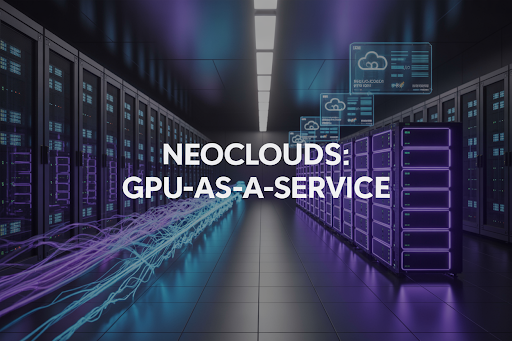
Traditional cloud computing is getting a major shakeup, and neoclouds are leading the charge. These new players are breaking apart the monolithic cloud model that’s dominated for over a decade, offering specialized GPU-as-a-Service solutions that make high-performance computing accessible to everyone from AI startups to indie game developers.
This guide is for developers, CTOs, data scientists, and business leaders who want to understand how cloud unbundling is creating new opportunities and cost savings. You’ll also learn whether these alternative cloud providers make sense for your specific workloads.
We’ll break down how neoclouds work and why they’re gaining traction against tech giants like AWS and Google Cloud. You’ll discover the real-world applications driving adoption, from machine learning training to blockchain validation. Finally, we’ll compare costs, performance, and reliability so you can decide if switching to decentralized cloud infrastructure is right for your organization.
The cloud landscape is shifting fast, and understanding these changes could save you thousands on your next GPU-intensive project.
Understanding Neoclouds and Their Revolutionary Approach
Definition of neoclouds and how they differ from traditional cloud providers
Neoclouds represent a new generation of cloud service providers that challenge the established dominance of traditional hyperscalers like AWS, Google Cloud, and Microsoft Azure. Unlike these monolithic platforms that offer everything from basic compute to advanced AI services under one umbrella, neoclouds take a laser-focused approach by specializing in specific computing domains.
The fundamental difference lies in their architecture and business model. Traditional cloud providers built massive, centralized data centers and created comprehensive service catalogs to serve every possible use case. Neoclouds, on the other hand, emerged with specialized expertise in particular areas – most notably GPU-as-a-Service and high-performance computing. They aggregate computing resources from multiple sources, including underutilized hardware from gaming rigs, mining farms, and dedicated data centers, creating a more distributed GPU computing ecosystem.
This approach creates several key distinctions:
| Traditional Cloud Providers | Neoclouds |
|---|---|
| Comprehensive service catalios | Specialized focus areas |
| Centralized infrastructure | Distributed resource networks |
| Premium pricing models | Cost-competitive alternatives |
| Complex pricing structures | Transparent, usage-based pricing |
| One-size-fits-all solutions | Purpose-built for specific workloads |
Key characteristics that make neoclouds more agile and specialized
Neoclouds demonstrate remarkable agility through their streamlined operational models. Their specialized focus allows them to innovate faster in their chosen domains compared to traditional providers who must balance resources across hundreds of different services.
Resource Flexibility: Alternative cloud providers in the neocloud space can rapidly scale GPU capacity by tapping into diverse hardware sources. This distributed approach to decentralized cloud infrastructure means they can offer competitive pricing while maintaining high availability.
Innovation Speed: Without the bureaucratic overhead of massive organizations, neoclouds can implement new features, support cutting-edge hardware, and adapt to market demands much faster. They often support the latest GPU architectures before traditional providers integrate them into their offerings.
Customer-Centric Approach: These GPU cloud platforms typically offer more personalized support and can customize solutions for specific use cases. Their smaller scale allows for direct relationships with customers and rapid response to feedback.
Pricing Transparency: Most neoclouds embrace simple, transparent pricing models for their on-demand GPU resources, eliminating the complex tier structures and hidden fees common with traditional providers.
The shift from monolithic cloud services to focused solutions
The cloud unbundling phenomenon represents a broader industry transformation where specialized providers challenge the “everything under one roof” approach of traditional hyperscalers. This shift mirrors what happened in other industries – from department stores giving way to specialized retailers to bundled software suites being replaced by best-of-breed point solutions.
Market Forces Driving Unbundling:
- Rising costs of traditional cloud services
- Specific performance requirements that generalist providers struggle to meet efficiently
- Demand for more competitive pricing in specialized use cases
- Need for expert-level support in niche computing domains
Benefits of Focused Solutions:
- Deeper expertise in specific technologies
- More cost-effective resource allocation
- Faster innovation cycles
- Better performance optimization for targeted workloads
This unbundling creates opportunities for organizations to build hybrid cloud strategies, combining traditional cloud services for general computing needs with specialized neoclouds for specific requirements like AI training, rendering, or scientific computing. The result is a more diverse, competitive cloud ecosystem that better serves the varied needs of modern businesses and developers.
GPU-as-a-Service: Democratizing High-Performance Computing

What GPU-as-a-Service Means for Businesses and Developers
GPU-as-a-Service transforms how organizations access high-performance computing power by removing the traditional barriers of hardware ownership. Instead of purchasing expensive graphics processing units outright, businesses and developers can tap into distributed GPU computing resources through cloud-based platforms. This model mirrors the success of Software-as-a-Service but applies to computational hardware.
For developers working on machine learning projects, GPU-as-a-Service means instant access to powerful processing capabilities without waiting weeks for hardware procurement. A data scientist can spin up multiple GPU instances, train complex neural networks, and scale down resources when projects complete. Businesses gain operational flexibility, allowing them to respond quickly to computational demands without the overhead of maintaining physical infrastructure.
Neoclouds have particularly excelled in this space by offering specialized GPU cloud platforms that cater to specific workloads. Unlike traditional cloud providers that bundle GPU access with numerous other services, these focused platforms deliver optimized performance for AI and graphics-intensive applications.
Cost Advantages Compared to Purchasing and Maintaining Physical GPUs
The financial benefits of GPU-as-a-Service become apparent when comparing total ownership costs. A high-end GPU suitable for machine learning can cost $10,000-$50,000, with additional expenses for compatible servers, cooling systems, and power infrastructure. Organizations often discover that their actual GPU utilization rates hover around 20-30%, making the investment inefficient.
Cloud GPU rental eliminates these capital expenditures and converts them to operational expenses. Users pay only for actual compute time, which can reduce costs by 60-80% for typical workloads. Consider these cost comparisons:
| Scenario | Physical GPU | GPU-as-a-Service |
|---|---|---|
| Initial Investment | $30,000+ | $0 |
| Monthly Utilization (100 hours) | $2,500 (amortized) | $400-800 |
| Maintenance & Support | $500/month | Included |
| Upgrade Costs | Full replacement | Automatic access |
Maintenance costs disappear entirely with cloud-based solutions. No more dealing with hardware failures, driver updates, or compatibility issues. The cloud provider handles infrastructure management, allowing teams to focus on their core projects rather than IT operations.
Instant Scalability for AI, Machine Learning, and Graphics Workloads
Traditional GPU setups struggle with demand fluctuations. A computer vision startup might need 10 GPUs for a major training run but only 2 GPUs for regular inference tasks. On-demand GPU resources solve this challenge by providing elastic scaling capabilities.
Machine learning teams benefit enormously from this flexibility. During model training phases, they can access dozens of high-performance computing units simultaneously. Once training completes, they scale down to minimal resources for serving predictions. This pattern works particularly well for:
- Batch processing jobs that require intensive computation for short periods
- Research experiments with unpredictable resource needs
- Seasonal workloads in retail, finance, and entertainment sectors
- Proof-of-concept projects that need powerful hardware temporarily
Alternative cloud providers specializing in GPU services often provide better scaling options than traditional giants. They understand the specific needs of AI workloads and optimize their platforms accordingly, offering features like automatic spot instance management and workload-aware resource allocation.
Access to Cutting-Edge GPU Technology Without Capital Investment
Hardware refresh cycles in GPU technology move incredibly fast. What costs $50,000 today becomes outdated within 18-24 months as new architectures emerge. Organizations purchasing physical hardware face the constant dilemma of when to upgrade and how to justify replacing relatively new equipment.
Decentralized cloud infrastructure providers solve this by continuously updating their hardware fleets. Users automatically gain access to the latest GPU generations without additional investment. When NVIDIA releases new architectures or AMD introduces improved chips, cloud users can immediately leverage these advances.
This access democratizes cutting-edge technology for smaller organizations. A startup can run experiments on the same hardware used by tech giants, leveling the competitive playing field. Research institutions can access specialized hardware like tensor processing units or quantum computing simulators without massive budget allocations.
The neocloud model particularly shines here because these providers often specialize in staying current with the latest hardware. Unlike traditional cloud providers that might standardize on older, proven hardware for stability, neoclouds frequently offer bleeding-edge options that appeal to developers pushing technological boundaries.
The Unbundling Revolution Transforming Cloud Computing

How Traditional Cloud Giants Bundle Services and Create Vendor Lock-in
The major cloud providers like AWS, Microsoft Azure, and Google Cloud have built their empires on a simple premise: offer everything under one roof. They package compute, storage, networking, databases, AI/ML tools, and hundreds of other services into comprehensive platforms. While convenient, this bundled approach creates significant dependencies.
When organizations choose these platforms, they often find themselves deeply integrated with proprietary APIs, custom database formats, and vendor-specific tools. Moving workloads between providers becomes expensive and time-consuming. A company running applications on AWS Lambda functions, using RDS databases, and storing data in S3 buckets faces substantial migration costs if they want to switch providers.
The pricing models reinforce this lock-in strategy. Volume discounts and reserved instance pricing encourage long-term commitments, while complex billing structures make cost comparisons with alternative cloud providers challenging. Many enterprises discover they’re paying premium prices for services they barely use, simply because they’re part of the bundled package.
Benefits of Choosing Specialized Providers Over All-in-One Solutions
Neoclouds and specialized providers flip this model entirely. Instead of forcing customers into comprehensive ecosystems, they focus on delivering exceptional performance in specific areas. GPU cloud platforms excel at high-performance computing tasks, offering access to cutting-edge hardware configurations that traditional providers might not prioritize.
This specialization translates into tangible advantages:
- Performance optimization: Providers dedicated to GPU-as-a-Service can offer faster deployment times, better hardware utilization, and more flexible configurations than generalist platforms
- Cost efficiency: Without subsidizing dozens of unused services, customers pay only for what they actually need
- Rapid innovation: Specialized teams can iterate faster on specific technologies rather than maintaining vast service portfolios
- Expert support: Technical teams understand the nuances of specific workloads, providing more targeted assistance
Organizations running AI training workloads, for example, can access the latest GPU architectures and optimized networking configurations that might take months to appear on traditional platforms. The distributed GPU computing model allows them to scale resources precisely when needed without long-term commitments.
Increased Competition Driving Innovation and Better Pricing
Cloud unbundling has unleashed intense competition across specialized niches. Alternative cloud providers compete not just on price but on performance metrics that matter most to specific use cases. GPU cloud rental providers battle over training speeds, memory configurations, and interconnect performance rather than generic compute benchmarks.
This competition benefits customers in multiple ways:
| Traditional Bundled Approach | Unbundled Specialized Approach |
|---|---|
| Limited hardware choices | Access to latest, specialized hardware |
| Complex, opaque pricing | Transparent, usage-based pricing |
| Slow feature rollouts | Rapid innovation cycles |
| Generic optimization | Workload-specific optimization |
Decentralized cloud infrastructure providers are pushing boundaries even further, leveraging underutilized resources to offer competitive pricing while maintaining performance standards. This creates downward pressure on costs across the entire ecosystem.
The result is a more dynamic marketplace where providers must continuously innovate to maintain their competitive edge. Customers benefit from better performance, lower costs, and more choices tailored to their specific requirements. Rather than accepting whatever configuration a major provider offers, organizations can select the exact combination of services that optimizes their workloads and budgets.
Real-World Applications Driving Neocloud Adoption
AI and Machine Learning Model Training at Scale
Training sophisticated AI models requires massive computational power that traditional infrastructure simply can’t deliver cost-effectively. Neoclouds have emerged as game-changers for machine learning engineers and data scientists who need access to high-end GPUs without the astronomical costs of building their own clusters.
Companies like Anthropic, OpenAI competitors, and smaller AI startups now tap into distributed GPU computing networks to train everything from large language models to computer vision systems. The beauty of GPU-as-a-Service lies in its flexibility – teams can spin up hundreds of GPUs for intensive training sessions, then scale down immediately when the job’s done.
Popular AI training scenarios powered by neoclouds:
- Large language model pre-training requiring 100+ GPUs
- Computer vision model development for autonomous vehicles
- Natural language processing for chatbots and virtual assistants
- Reinforcement learning for gaming AI and robotics
High-Performance Computing for Scientific Research
Research institutions and universities face a constant challenge: cutting-edge scientific computing demands expensive hardware that often sits idle between projects. Neoclouds solve this problem by providing on-demand GPU resources that researchers can access globally.
Climate modeling, protein folding simulations, and astrophysics calculations that once required dedicated supercomputers can now run on decentralized cloud infrastructure. This democratization means smaller research teams can compete with well-funded institutions, accelerating scientific discovery across the board.
Research applications thriving on neoclouds:
- Weather and climate prediction models
- Drug discovery and molecular dynamics simulations
- Genomics and bioinformatics analysis
- Particle physics data processing
- Astronomical image processing and analysis
Gaming and Virtual Reality Development
Game developers know the pain of rendering complex 3D environments and testing VR experiences across multiple platforms. Traditional cloud providers often fall short when it comes to specialized gaming workloads that need specific GPU configurations and real-time performance.
Neoclouds fill this gap perfectly. Indie game studios can access the same high-performance computing power that big publishers use, leveling the playing field. Virtual reality developers particularly benefit from distributed GPU networks that can handle the intensive rendering required for immersive experiences.
Gaming use cases driving neocloud adoption:
- Real-time ray tracing development and testing
- Multiplayer game server hosting with GPU acceleration
- VR content creation and optimization
- Game asset rendering and texture generation
- Cross-platform compatibility testing
Cryptocurrency Mining and Blockchain Applications
The crypto mining landscape has evolved dramatically, and neoclouds represent the next frontier. Instead of investing in expensive mining rigs that depreciate quickly, miners can rent GPU power on-demand, switching between different cryptocurrencies based on profitability.
Beyond traditional mining, blockchain developers use GPU cloud platforms for smart contract testing, decentralized application development, and running validator nodes. This approach eliminates the need for significant upfront hardware investments while maintaining competitive mining capabilities.
Blockchain applications powered by neoclouds:
- Flexible cryptocurrency mining operations
- DeFi protocol development and testing
- NFT creation and minting platforms
- Blockchain network validation
- Cryptocurrency trading algorithm backtesting
Video Rendering and Content Creation Workflows
Content creators and production studios face tight deadlines and varying workload demands that make owning expensive rendering farms impractical. Neoclouds have revolutionized how video content gets produced, from YouTube videos to Hollywood blockbusters.
Professional editors can now access industrial-grade rendering power for a fraction of traditional costs. Cloud GPU rental platforms enable everything from simple video transcoding to complex visual effects rendering, making high-quality content creation accessible to creators at every level.
Content creation scenarios leveraging neoclouds:
- 4K and 8K video rendering and encoding
- Motion graphics and visual effects processing
- 3D animation and CGI rendering
- Live streaming with real-time effects
- Virtual production and LED wall content
- Podcast and audio processing with AI enhancement
The shift toward alternative cloud providers isn’t just about cost savings – it’s about accessing specialized infrastructure that traditional hyperscale clouds can’t match. These real-world applications demonstrate how neoclouds are reshaping entire industries by making high-performance computing truly accessible.
Comparing Neoclouds to Traditional Cloud Providers
Performance Advantages of Specialized Infrastructure
Neoclouds shine when it comes to raw performance because they’re built from the ground up for specific workloads. Unlike traditional cloud providers who need to balance general-purpose computing with specialized needs, GPU cloud platforms focus entirely on delivering maximum compute power for AI, machine learning, and high-performance computing tasks.
The hardware selection process alone sets neoclouds apart. While AWS or Google Cloud might offer a limited selection of GPU instances with standardized configurations, alternative cloud providers in the neocloud space often provide access to the latest NVIDIA H100s, A100s, and even experimental chips that haven’t made it to mainstream cloud platforms yet. This translates to 20-40% better performance for training large language models or running complex simulations.
Network architecture also plays a crucial role. Traditional cloud providers route traffic through multiple virtualization layers, adding latency and reducing bandwidth. Neoclouds typically offer bare-metal GPU access with high-speed InfiniBand connections, enabling distributed GPU computing scenarios that would struggle on conventional platforms.
Pricing Transparency and Cost-effectiveness
Traditional cloud providers have notoriously complex pricing structures. You’ll find yourself navigating through data transfer fees, storage costs, networking charges, and various service tiers that make it nearly impossible to predict your monthly bill. GPU-as-a-Service platforms from neoclouds take a refreshingly different approach.
| Factor | Traditional Cloud | Neoclouds |
|---|---|---|
| Pricing Model | Complex, multi-layered | Simple hourly/monthly rates |
| Hidden Fees | Data egress, network, storage | Minimal to none |
| Commitment Requirements | Often required for discounts | Flexible, pay-as-you-go |
| Price Predictability | Low | High |
Most neoclouds offer straightforward per-GPU-hour pricing with no surprises. You know exactly what you’re paying for on-demand GPU resources without worrying about bandwidth overages or storage tier migrations. This transparency often results in 30-60% cost savings compared to equivalent workloads on major cloud platforms, especially for compute-intensive tasks that don’t require extensive cloud ecosystem integration.
Customer Support and Technical Expertise Differences
The support experience between traditional cloud providers and neoclouds feels like comparing a call center to a specialized engineering consultancy. Major cloud providers handle millions of customers across every conceivable use case, which means their support teams often lack deep expertise in GPU computing and high-performance computing scenarios.
Neocloud support teams are typically staffed by engineers who understand the nuances of CUDA programming, PyTorch optimization, and distributed training architectures. When you run into a performance bottleneck or configuration issue, you’re talking to someone who has likely faced similar challenges rather than reading from a troubleshooting script.
Response times tell the story too. While traditional cloud support might take 12-24 hours to escalate GPU-specific issues to specialists, neocloud platforms often provide direct access to technical experts within hours, sometimes minutes for critical workloads.
Flexibility in Choosing the Right Tools for Specific Needs
Traditional cloud providers excel at providing comprehensive ecosystems, but this comes with ecosystem lock-in. You’re encouraged to use their databases, storage solutions, networking tools, and management interfaces. This works great for general web applications but can be limiting for specialized decentralized cloud infrastructure needs.
Neoclouds embrace a more modular approach. You can mix and match GPU resources from one provider with storage from another, networking from a third, and orchestration tools of your choice. This cloud unbundling approach lets you optimize each component of your stack independently.
The container and Kubernetes support also differs significantly. While major cloud providers offer managed Kubernetes services with their own customizations and limitations, neoclouds typically provide standard, vanilla Kubernetes implementations that work exactly like your on-premises setup. This makes migration easier and reduces vendor lock-in concerns.
Development workflows become more flexible too. You can use the same Docker containers, the same CI/CD pipelines, and the same monitoring tools across different neocloud providers, making it easy to switch between platforms or run workloads across multiple providers for redundancy and cost optimization.
Strategic Considerations for Adopting Neocloud Solutions

Evaluating Your Workload Requirements and Performance Needs
Before diving into neoclouds, you need to honestly assess what your applications actually require. Start by mapping out your computational demands – are you running AI training models that need massive parallel processing, or are you handling video rendering that benefits from specialized GPU architectures? Different workloads have vastly different requirements, and neoclouds excel in specific scenarios.
GPU-intensive applications like machine learning training, cryptocurrency mining, or scientific simulations are prime candidates for neocloud solutions. These platforms often provide access to cutting-edge hardware that might be cost-prohibitive to purchase outright. However, if your workloads are CPU-heavy or require consistent, always-on computing resources, traditional cloud providers might still make more sense.
Consider your scaling patterns too. Neoclouds shine when you need burst capacity or specialized hardware for short-term projects. If you’re running inference workloads that spike during certain hours or training models that require weeks of intensive GPU time, the on-demand nature of GPU-as-a-Service becomes incredibly valuable.
Performance benchmarking is crucial. Many neocloud providers offer different GPU generations and configurations. Test your specific workloads across different providers to understand real-world performance differences. Don’t just look at raw specifications – network latency, storage speeds, and driver optimization can significantly impact your actual results.
Integration Challenges with Existing Cloud Infrastructure
Moving workloads to neoclouds creates integration complexities that traditional single-provider setups avoid. Your existing data pipelines, monitoring systems, and deployment workflows need modification to work across multiple cloud environments. This multi-cloud approach, while powerful, introduces orchestration challenges.
Data movement becomes a critical consideration. If your training data lives in AWS S3 but your GPU compute runs on a neocloud platform, you’ll face bandwidth costs and latency issues. Some organizations solve this by maintaining data replicas across providers, but this adds storage costs and synchronization complexity.
Authentication and access management across different platforms requires careful planning. Your team needs consistent access patterns, and your security policies must adapt to multiple provider ecosystems. Single sign-on solutions and federated identity management become essential rather than optional.
Container orchestration tools like Kubernetes can help bridge these gaps, but they require additional expertise. Many organizations underestimate the operational overhead of managing workloads across heterogeneous cloud environments. Your DevOps team needs familiarity with different APIs, billing models, and support systems.
Network connectivity between your primary cloud environment and neocloud providers affects application architecture decisions. High-throughput applications might need dedicated network connections or careful placement of compute resources to minimize data transfer costs.
Security and Compliance Considerations for Specialized Providers
Neocloud providers often operate with different security models than established cloud giants. While many offer robust security controls, the landscape varies significantly between providers. Some focus purely on compute services without comprehensive security tooling, while others provide enterprise-grade security features.
Due diligence becomes more complex when working with specialized providers. You need to evaluate each provider’s security certifications, audit reports, and incident response capabilities. Unlike major cloud providers with extensive compliance documentation, some neocloud platforms might have limited third-party security assessments.
Data residency requirements can be challenging with distributed GPU computing platforms. If your organization operates under strict data governance rules (like GDPR or HIPAA), ensure your chosen providers offer appropriate geographic controls and data handling guarantees. Some decentralized cloud infrastructure models might not provide the location guarantees required for compliance.
Shared responsibility models differ between providers. While AWS clearly defines what they secure versus what customers must secure, newer GPU cloud platforms might have less mature documentation around security responsibilities. This ambiguity can create compliance gaps if not addressed proactively.
Consider implementing additional security layers when working with alternative cloud providers. End-to-end encryption, network segmentation, and enhanced monitoring become more critical when distributing workloads across multiple specialized platforms. Your security team needs visibility into all environments where sensitive workloads execute.
Regular security assessments should include all cloud providers in your stack. This means extending penetration testing, vulnerability scanning, and compliance audits to cover your entire multi-cloud architecture, not just your primary cloud environment.
The rise of neoclouds represents a fundamental shift in how we think about cloud computing. These specialized platforms are breaking down the monolithic structures of traditional cloud providers, offering targeted solutions that make high-performance computing accessible to businesses of all sizes. By focusing on GPU-as-a-Service and unbundled infrastructure, neoclouds are democratizing access to powerful computing resources that were once reserved for tech giants with massive budgets.
As organizations increasingly rely on AI, machine learning, and data-intensive workloads, the flexibility and cost-effectiveness of neocloud solutions become even more compelling. The ability to access specialized hardware on-demand, without the overhead of unused services, gives businesses the agility they need to compete in today’s fast-moving market. If your organization is struggling with the limitations or costs of traditional cloud providers, exploring neocloud options could unlock new possibilities for innovation and growth while keeping your infrastructure spending in check.