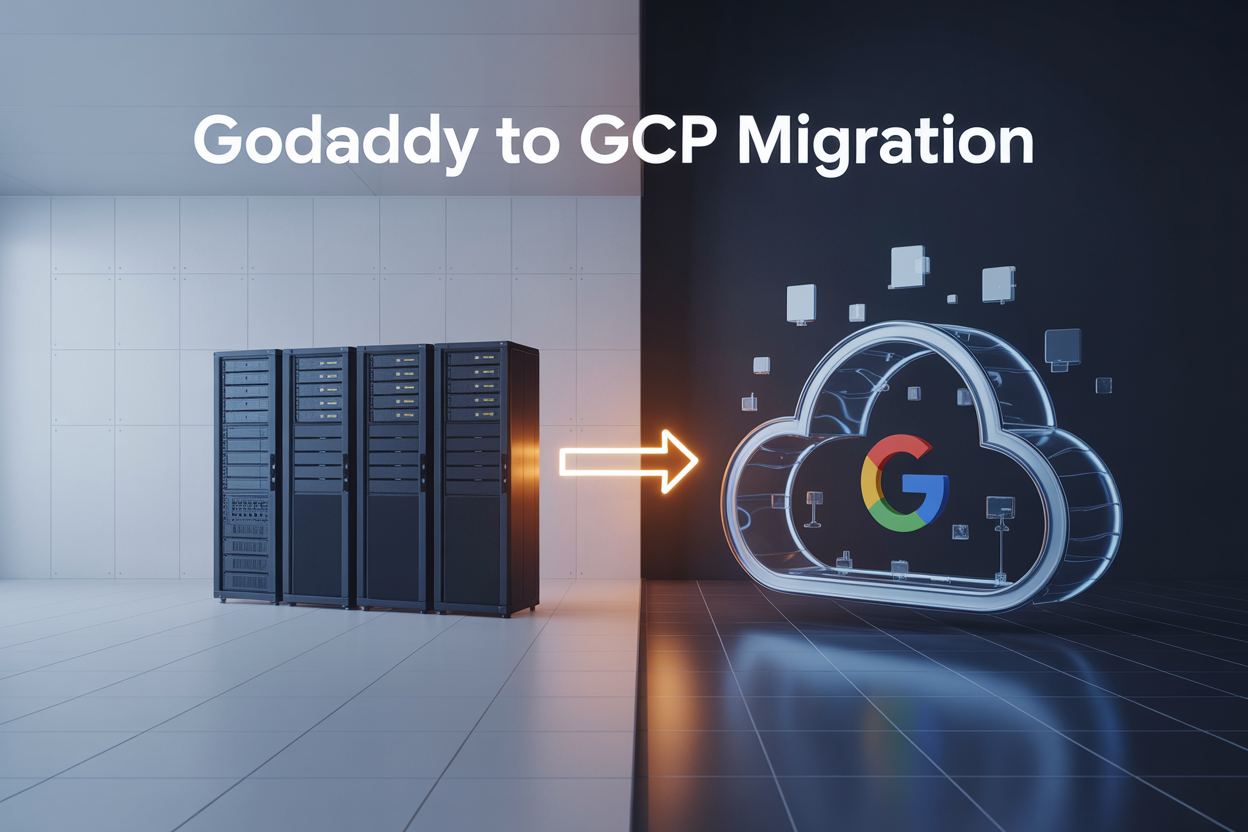
If you’re running a website on GoDaddy and feeling held back by slow performance, limited scalability, or sky-high renewal costs, you’re not alone. Many website owners, developers, and businesses eventually hit a wall with traditional shared hosting providers and start looking for better options.
This comprehensive guide is designed for anyone ready to migrate from GoDaddy to Google Cloud Platform – whether you’re a small business owner wanting faster load times, a developer seeking more control, or an enterprise looking to modernize hosting infrastructure for better performance and cost efficiency.
We’ll walk you through everything you need to know about making the switch, starting with why GoDaddy’s limitations might be costing you visitors and revenue. You’ll discover the real Google Cloud Platform hosting benefits that can transform your website’s performance and your bottom line.
Then we’ll dive into the practical stuff: how to plan your migration without breaking your site, set up your new GCP environment from scratch, and move all your files and data safely. By the end of this website migration tutorial, you’ll have a faster, more reliable hosting setup that can actually grow with your business.
Understanding the Limitations of GoDaddy Hosting

Performance bottlenecks that impact your business growth
GoDaddy’s shared hosting environment creates significant performance challenges that directly affect your bottom line. When your website shares server resources with hundreds of other sites, you’re essentially competing for CPU power, memory, and bandwidth. This resource contention leads to unpredictable load times, especially during peak traffic periods when neighboring sites consume excessive resources.
The impact becomes painfully obvious during critical business moments. Imagine running a flash sale or product launch only to watch potential customers bounce due to slow page loads. Studies show that a one-second delay in page load time can reduce conversions by 7%, making GoDaddy’s performance limitations a direct threat to revenue growth.
Database queries run sluggishly on GoDaddy’s oversold servers, creating cascading delays throughout your application. Content delivery relies on basic infrastructure without the global edge networks that modern businesses require. These bottlenecks compound as your traffic grows, creating a ceiling on your business expansion that becomes increasingly expensive to break through.
Scalability restrictions that hold back your website
GoDaddy’s hosting plans operate within rigid resource boundaries that don’t adapt to your actual needs. When traffic spikes occur – whether from marketing campaigns, viral content, or seasonal demand – your website hits hard limits that can’t be adjusted in real-time. This inflexibility forces you into higher-tier plans even when you only need temporary resource boosts.
The upgrade process itself becomes a barrier to growth. Moving between GoDaddy plans often requires downtime and manual intervention, making it impossible to respond quickly to opportunities. You’re locked into predetermined resource packages that rarely match your actual usage patterns, leading to either performance issues or paying for unused capacity.
Auto-scaling doesn’t exist in GoDaddy’s traditional hosting model. Your website either struggles under unexpected load or you overpay for resources sitting idle most of the time. This binary approach to resource allocation creates artificial growth barriers that force businesses to choose between poor performance and budget overruns.
Limited customization options for advanced configurations
GoDaddy’s managed hosting environment restricts server-level access and configuration options that growing businesses need. You can’t install custom software, modify server settings, or implement specialized security configurations. This limitation becomes particularly problematic for applications requiring specific PHP versions, custom databases, or specialized caching mechanisms.
Development workflows suffer under these restrictions. Staging environments mirror production limitations, making it difficult to test advanced features or optimize performance. CI/CD pipelines become nearly impossible to implement properly when you lack control over the underlying infrastructure and deployment processes.
Security customization remains limited to basic options available through control panels. You can’t implement enterprise-grade security measures, custom firewalls, or advanced monitoring solutions that modern applications require. This lack of control forces businesses to accept GoDaddy’s security baseline rather than implementing tailored protection strategies.
Cost inefficiencies at scale
GoDaddy’s pricing structure becomes increasingly expensive as your requirements grow beyond basic hosting needs. What starts as an affordable shared hosting plan quickly escalates to costly dedicated servers or managed WordPress hosting when you need better performance or additional features.
The hidden costs add up quickly. SSL certificates, premium support, daily backups, and performance optimization features that come standard with cloud platforms require separate purchases on GoDaddy. These add-ons can double or triple your hosting costs while still delivering inferior performance compared to modern cloud alternatives.
Resource utilization remains inefficient since you’re paying for fixed allocations regardless of actual usage. During low-traffic periods, you’re still paying for peak capacity, while high-traffic times may exceed your plan limits anyway. This pricing model penalizes both success and efficiency, making it particularly unsuitable for businesses with variable or growing traffic patterns.
Why Google Cloud Platform is the Superior Choice
Unmatched global infrastructure and network performance
Google Cloud Platform operates one of the world’s largest and most advanced networking infrastructures, spanning 35 regions and over 100 zones globally. This massive scale translates to lightning-fast loading times for your website visitors, regardless of their geographic location. When you migrate from GoDaddy to Google Cloud Platform, you’re tapping into the same infrastructure that powers Google Search, YouTube, and Gmail.
The real game-changer lies in Google’s private fiber optic network, which connects data centers directly without relying on public internet routes. This means your website data travels on dedicated highways rather than crowded public roads, resulting in significantly reduced latency and improved reliability. Your visitors will experience faster page loads, especially during peak traffic periods when traditional hosting providers often struggle.
Google’s edge caching automatically stores your content at strategic locations worldwide, ensuring users always connect to the nearest server. This intelligent distribution system is particularly beneficial for businesses targeting multiple geographic markets, something that GoDaddy’s limited server locations simply can’t match.
Enterprise-grade security and compliance features
Security isn’t an afterthought with Google Cloud Platform—it’s built into every layer of the infrastructure. Google employs over 750 security experts who work around the clock to protect your data, a level of dedicated security expertise that far exceeds what traditional hosting providers like GoDaddy can offer.
Your data enjoys multiple layers of protection, including:
- Encryption at rest and in transit: All data is automatically encrypted using industry-leading AES-256 encryption
- Identity and Access Management (IAM): Granular control over who can access what resources
- DDoS protection: Built-in defense against distributed denial-of-service attacks
- Security scanning: Automatic vulnerability detection and threat analysis
- Compliance certifications: SOC 2, ISO 27001, HIPAA, PCI DSS, and many others
These security features operate seamlessly in the background, requiring minimal configuration from your end while providing enterprise-level protection that would typically cost thousands of dollars monthly with specialized security providers.
Advanced scalability with auto-scaling capabilities
Traditional hosting solutions force you to guess your resource needs and pay for capacity you might never use. Google Cloud Platform’s auto-scaling capabilities eliminate this guesswork by automatically adjusting resources based on real-time demand.
During traffic spikes—whether from viral content, seasonal sales, or unexpected media coverage—your website seamlessly scales up to handle the increased load. When traffic returns to normal levels, resources scale back down, ensuring you only pay for what you actually use. This intelligent scaling happens in seconds, not the hours or days required with traditional hosting providers.
The platform offers several scaling options:
- Horizontal scaling: Adding more server instances during high traffic
- Vertical scaling: Increasing CPU and memory for existing instances
- Load balancing: Distributing traffic across multiple servers automatically
- Container orchestration: Advanced scaling for modern web applications
Cost-effective pricing models and resource optimization
Google Cloud Platform’s pricing structure represents a fundamental shift from the rigid hosting plans offered by providers like GoDaddy. Instead of paying for predetermined packages that may include features you don’t need, GCP operates on a pay-as-you-go model that charges only for actual resource consumption.
The platform provides detailed usage analytics and cost optimization recommendations, helping you identify opportunities to reduce expenses without sacrificing performance. Features like sustained use discounts automatically lower costs for workloads that run consistently, while committed use contracts can reduce expenses by up to 57% for predictable workloads.
Resource optimization tools continuously monitor your infrastructure and suggest improvements:
- Right-sizing recommendations: Alerts when instances are over or under-provisioned
- Idle resource detection: Identifies unused resources consuming budget
- Storage class optimization: Automatically moves infrequently accessed data to cheaper storage tiers
- Preemptible instances: Access to spare computing capacity at significantly reduced rates
This intelligent cost management often results in 30-50% lower hosting costs compared to traditional providers, while delivering superior performance and reliability. The savings become even more pronounced as your website grows, making GCP an increasingly attractive option for scaling businesses.
Pre-Migration Planning and Assessment

Auditing Your Current GoDaddy Setup and Dependencies
Before making the jump to Google Cloud Platform, you need a complete picture of what you’re working with on GoDaddy. Start by documenting every aspect of your current hosting environment – this includes your website files, databases, email accounts, domain settings, and any third-party integrations.
Check your file structure and note any custom configurations you’ve made to your hosting environment. Many GoDaddy users have WordPress installations with specific plugins, themes, and customizations that need careful attention during migration. Document your PHP version, MySQL database version, and any server-specific settings that might affect compatibility with GCP services.
Don’t forget about your email setup. If you’re using GoDaddy’s email hosting, you’ll need to plan for migrating these accounts or setting up new email solutions on GCP. List all email addresses, forwarding rules, and autoresponders currently in use.
Examine your domain configuration, including DNS records, subdomains, and any SSL certificates. GoDaddy often manages these automatically, but you’ll need to recreate them manually in your new GCP environment. Take screenshots of your current DNS settings as reference points.
Review your website’s traffic patterns, storage usage, and bandwidth consumption from GoDaddy’s analytics. This data becomes essential when sizing your GCP resources correctly and avoiding over-provisioning or under-provisioning your new cloud infrastructure.
Choosing the Right GCP Services for Your Specific Needs
Google Cloud Platform offers dozens of services, but you don’t need them all. Focus on selecting the right combination based on your website’s requirements and growth plans.
For most websites migrating from GoDaddy to Google Cloud Platform, Compute Engine provides the closest equivalent to traditional shared hosting. If you want maximum control and familiar Linux server management, this route works well. However, consider App Engine for automatic scaling and reduced server management overhead – it’s perfect for websites that experience traffic spikes.
Cloud SQL handles your database needs with automated backups, patches, and high availability options that far exceed GoDaddy’s basic MySQL offerings. For WordPress sites, Cloud SQL for MySQL provides seamless compatibility with your existing database structure.
Cloud Storage becomes your new home for static files, images, and backups. Unlike GoDaddy’s limited storage options, Cloud Storage scales infinitely and costs significantly less for large files. Set up different storage classes for frequently accessed content versus archived materials.
Cloud DNS replaces GoDaddy’s DNS management with enterprise-grade reliability and faster global resolution times. The pricing is transparent and much more affordable than premium DNS services.
For websites requiring content delivery, Cloud CDN integrates seamlessly with other GCP services to accelerate your site globally. This represents a major upgrade from GoDaddy’s basic content delivery options.
Creating a Comprehensive Migration Timeline and Checklist
A successful GoDaddy to GCP migration guide requires careful timing and systematic execution. Plan for at least two weeks of preparation and testing before going live, especially for business-critical websites.
Week 1: Preparation Phase
- Set up your GCP account and billing
- Create your project structure and enable necessary APIs
- Provision your chosen services (Compute Engine, Cloud SQL, etc.)
- Configure your development environment for testing
- Create full backups of your GoDaddy hosting account
Week 2: Testing and Configuration
- Upload your website files to GCP
- Import your databases to Cloud SQL
- Configure DNS settings (but don’t switch nameservers yet)
- Set up SSL certificates through Google-managed certificates
- Test all website functionality in your new environment
- Configure monitoring and alerting systems
Migration Day Checklist:
- Verify all backups are current and accessible
- Update DNS TTL values to minimize propagation delays
- Switch nameservers from GoDaddy to Cloud DNS
- Monitor website performance and functionality
- Update any hardcoded URLs or configurations
- Test email functionality if migrating email services
- Verify SSL certificate installation and HTTPS redirects
Keep your GoDaddy account active for at least 24-48 hours after migration to handle any DNS propagation delays or unexpected issues. This safety net prevents downtime while your new GCP infrastructure proves itself stable.
Create rollback procedures for each major component – know exactly how to revert DNS changes, restore databases, and switch back to GoDaddy if critical issues arise during the migration window.
Setting Up Your GCP Environment

Creating and Configuring Your Google Cloud Project
Your journey to Google Cloud Platform hosting begins with setting up a proper foundation. Start by navigating to the Google Cloud Console and creating a new project specifically for your website migration. Choose a descriptive project name that reflects your website or business – this makes management easier down the road.
During project creation, you’ll need to enable billing by linking a payment method. Don’t worry about costs spiraling out of control; Google Cloud provides detailed billing alerts and budget controls. Set up billing alerts at 50%, 75%, and 90% of your monthly budget to stay informed about spending.
Next, enable the essential APIs your hosting infrastructure will need. The Compute Engine API is crucial for virtual machines, while the Cloud DNS API handles domain management. If you’re planning to use databases, enable the Cloud SQL API. For content delivery, activate the Cloud Storage API. These APIs form the backbone of your modernized hosting infrastructure.
Configure your project’s organization policies to align with your security requirements. Set constraints on VM creation, external IP addresses, and resource locations to maintain control over your infrastructure deployment.
Establishing Proper IAM Roles and Security Permissions
Security configuration is where Google Cloud Platform truly shines compared to traditional hosting providers. The Identity and Access Management (IAM) system gives you granular control over who can access what resources in your project.
Create service accounts for different functions rather than using your personal account for everything. Set up a dedicated service account for your web application with only the permissions it needs to function. This principle of least privilege significantly reduces security risks.
For team members, assign roles based on their actual responsibilities:
- Compute Instance Admin for developers who need to manage virtual machines
- Storage Object Viewer for team members who only need to access files
- Project Editor for senior developers who need broader access
- Billing Account User for team members handling cost management
Enable two-factor authentication for all team accounts and consider using Google Cloud Identity for centralized user management. Set up Cloud Asset Inventory to track all resources and their permissions – this visibility helps prevent security gaps that often plague traditional hosting setups.
Review and audit permissions regularly. Google Cloud’s built-in security recommendations will flag overly permissive access and suggest improvements to your security posture.
Setting up Networking and Firewall Configurations
Your network configuration directly impacts your website’s performance and security. Create a custom Virtual Private Cloud (VPC) network instead of using the default network. This gives you complete control over IP address ranges and subnet configurations.
Design your subnet structure thoughtfully. Create separate subnets for different tiers of your application – web servers in one subnet, databases in another. This segmentation improves security and makes traffic management more straightforward.
Configure firewall rules that follow security best practices:
- Allow HTTP (port 80) and HTTPS (port 443) traffic for your web servers
- Restrict SSH access (port 22) to specific IP addresses or ranges
- Block all unnecessary ports and protocols
- Create separate rules for internal communication between your services
Set up Cloud Load Balancing to distribute traffic across multiple instances. This not only improves performance but also provides automatic failover capabilities that basic GoDaddy hosting simply cannot match.
Consider implementing Cloud CDN to cache your content at Google’s edge locations worldwide. This dramatically improves page load times for visitors regardless of their geographic location.
Reserve static external IP addresses for your production servers to ensure consistency. Dynamic IPs can cause issues with DNS configuration and SSL certificates.
Configuring Monitoring and Logging Systems
Visibility into your infrastructure’s performance and health is essential for maintaining a reliable hosting environment. Google Cloud’s monitoring capabilities far exceed what you get with traditional shared hosting.
Enable Cloud Monitoring for your entire project. Set up custom dashboards that display the metrics most important to your website’s performance – CPU usage, memory consumption, disk I/O, and network traffic. Create separate dashboards for different aspects of your infrastructure to avoid information overload.
Configure alerting policies that notify you when issues arise:
- CPU usage above 80% for more than 5 minutes
- Available memory below 20%
- Disk usage exceeding 85%
- HTTP error rate above your acceptable threshold
- SSL certificate expiration warnings
Cloud Logging automatically captures logs from your virtual machines and applications. Set up log-based metrics to track application-specific events like user registrations, failed login attempts, or database connection errors. These insights help you optimize your website’s performance and identify potential security issues.
Create custom log sinks to export important logs to Cloud Storage for long-term retention. This proves invaluable for debugging issues and maintaining compliance requirements.
Set up uptime checks to monitor your website’s availability from multiple global locations. These synthetic tests run continuously and alert you immediately if your site becomes unreachable.
Migrating Your Website and Data

Transferring files and databases with zero downtime
Setting up a parallel environment on GCP while keeping your GoDaddy site running is the smartest approach for a seamless migration. Start by configuring your GCP infrastructure to mirror your current setup, then sync your files and databases without affecting live traffic.
For file transfers, use rsync or SCP to move static content, themes, and media files to your new GCP instance. If you’re running WordPress, copy the wp-content directory and configuration files first. For larger sites, consider using Google Cloud Storage Transfer Service, which can handle bulk transfers efficiently and provides automatic retry mechanisms.
Database migration requires more precision. Create a full backup of your current database, then restore it to your new GCP MySQL or PostgreSQL instance. For MySQL databases, use mysqldump for the initial transfer, then implement binary log replication to keep databases synchronized until the final cutover. This approach ensures your new environment stays current with any changes made during the migration window.
The key to zero downtime lies in coordinating the final switchover. Plan this during low-traffic periods and have rollback procedures ready. Test database connections thoroughly and verify all file paths work correctly before proceeding to DNS changes.
Updating DNS settings and domain configurations
DNS changes are where your migration becomes visible to users, so timing and preparation matter significantly. Start by lowering your current DNS TTL values to 300 seconds at least 24 hours before migration. This ensures faster propagation when you make the actual switch.
In your GCP console, set up Cloud DNS or configure your chosen DNS provider with the new server IP addresses. Create A records pointing to your GCP load balancer or Compute Engine instances. Don’t forget CNAME records for subdomains like www, mail, or ftp if you’re using them.
If you’re keeping email services with GoDaddy temporarily, maintain your MX records unchanged during the website migration. You can migrate email services separately later. However, if you’re moving everything to Google Workspace, update MX records to point to Google’s mail servers.
The actual DNS switch should be quick and decisive. Change your nameservers or update A records simultaneously, then monitor propagation using tools like dig or online DNS checkers. Keep your old GoDaddy hosting active for 24-48 hours after DNS changes to catch any traffic that hasn’t propagated yet.
Testing functionality and performance post-migration
Once DNS propagation begins, comprehensive testing becomes critical to ensure your site performs as expected on GCP. Start with basic functionality checks – verify all pages load correctly, forms submit properly, and user authentication works. Test from multiple geographic locations since GCP’s global infrastructure might affect loading patterns differently than GoDaddy’s hosting.
Performance testing on Google Cloud Platform often reveals significant improvements over traditional shared hosting. Use tools like Google PageSpeed Insights, GTmetrix, or WebPageTest to benchmark your new setup against your old GoDaddy performance metrics. Pay attention to Time to First Byte (TTFB), which typically improves dramatically on GCP’s infrastructure.
Database performance deserves special attention during testing. Run queries that were slow on GoDaddy and measure their execution times on GCP. Most users see substantial improvements, especially for complex queries or sites with high concurrent user loads. Test your backup and restore procedures to ensure data protection measures work correctly.
Check all third-party integrations, payment processors, and API connections. Sometimes IP address changes can trigger security alerts or require whitelist updates with external services. Verify SSL certificates are working across all subdomains and that redirects function properly.
Implementing SSL certificates and security measures
GCP provides several options for SSL certificate management that surpass typical shared hosting offerings. Google-managed SSL certificates offer the simplest approach – they automatically provision and renew Let’s Encrypt certificates for your domains. Simply enable them in your load balancer configuration, and GCP handles the rest.
For custom SSL certificates or wildcard domains, upload your existing certificates to GCP Certificate Manager or obtain new ones through your preferred certificate authority. The Cloud Load Balancer can terminate SSL connections efficiently, reducing the computational load on your backend servers while maintaining security.
Configure security headers that weren’t easily available on GoDaddy hosting. Set up HSTS (HTTP Strict Transport Security), CSP (Content Security Policy), and X-Frame-Options headers through your load balancer or web server configuration. These headers significantly improve your site’s security posture against common web vulnerabilities.
Cloud Armor provides Web Application Firewall (WAF) capabilities that go far beyond basic shared hosting security. Configure rules to block common attack patterns, rate-limit suspicious traffic, and geo-block regions that don’t serve your business needs. Enable DDoS protection through Cloud Armor’s built-in capabilities, which can handle attacks that would overwhelm traditional hosting environments.
Set up monitoring and alerting through Cloud Monitoring to track security events, unusual traffic patterns, and certificate expiration dates. This proactive approach to security management represents a significant upgrade from the limited monitoring options typically available with shared hosting providers.
Optimizing Your New GCP Infrastructure

Fine-tuning performance with load balancing and CDN
Google Cloud Load Balancer transforms how your website handles traffic spikes and distributes requests across multiple instances. When you migrate from GoDaddy to Google Cloud Platform, implementing load balancing becomes one of your most powerful performance tools. Set up HTTP(S) Load Balancing to automatically route incoming requests to the healthiest backend instances, preventing any single server from becoming overwhelmed.
Cloud CDN works hand-in-hand with your load balancer to cache static content at Google’s global edge locations. Your users in Tokyo will load your images and CSS files from servers physically close to them, not from your primary instance in Iowa. This dramatically reduces page load times and bandwidth costs.
Configure backend services with appropriate health checks to ensure traffic only flows to responsive instances. Set up autoscaling groups that automatically add or remove compute instances based on CPU usage, memory consumption, or custom metrics. Your website will handle Black Friday traffic surges without manual intervention.
For dynamic content, enable Cloud CDN’s cache modes and configure appropriate cache headers. Static assets like images, CSS, and JavaScript files should cache for longer periods, while API responses might cache for minutes or hours depending on your application logic.
Setting up automated backups and disaster recovery
Cloud Storage snapshots create point-in-time copies of your persistent disks automatically. Schedule daily snapshots of your web server disks and database volumes, with retention policies that keep recent backups longer and gradually thin out older ones. Unlike GoDaddy’s basic backup options, GCP snapshots are incremental, storing only changed data blocks to minimize costs.
Database backups require special attention during your hosting infrastructure upgrade. Cloud SQL automatically creates backups, but you should also export database dumps to Cloud Storage buckets in different regions. Set up cross-region replication for critical databases to maintain read replicas in geographically distant locations.
Create a comprehensive disaster recovery plan that includes Recovery Time Objectives (RTO) and Recovery Point Objectives (RPO). Document the exact steps to restore your website from backups, including DNS changes, SSL certificate deployment, and database restoration procedures. Test this process quarterly to ensure your team can execute recovery quickly when needed.
Consider implementing blue-green deployment strategies using Cloud Deployment Manager or Terraform. Maintain parallel environments where you can switch traffic instantly if your primary environment encounters issues.
Implementing cost monitoring and optimization strategies
Cloud Billing alerts prevent surprise charges that often plague users migrating from fixed-cost providers like GoDaddy. Set up budget alerts at different thresholds (50%, 80%, 100% of your expected monthly spend) with notifications sent to multiple team members. Configure alerts to trigger automated responses like scaling down non-production environments.
Committed Use Discounts offer significant savings when you predict steady resource consumption. After running your workload on GCP for a few months, analyze usage patterns and commit to specific machine types or memory amounts for one to three years. This can reduce compute costs by up to 57% compared to on-demand pricing.
Right-size your instances using GCP’s recommendations engine. The system analyzes your actual resource usage and suggests moving to smaller or larger machine types. Many websites migrating from shared hosting initially over-provision resources, leading to unnecessary costs.
Implement resource labels and organize projects by environment (production, staging, development) to track spending granularly. Use Cloud Asset Inventory to identify unused resources like orphaned disks, idle load balancers, or forgotten compute instances. Schedule non-production environments to shut down during nights and weekends using Cloud Scheduler.
Preemptible instances can handle batch processing, development work, or stateless applications at 80% lower costs. While these instances can be terminated with 30 seconds notice, they’re perfect for workloads that can restart gracefully.

Making the switch from GoDaddy to Google Cloud Platform isn’t just about changing hosting providers – it’s about unlocking your website’s true potential. You’ve seen how GoDaddy’s shared hosting environment can hold back your site’s performance, limit your scalability options, and restrict your ability to customize your setup. On the flip side, GCP offers enterprise-grade infrastructure, advanced security features, and the flexibility to scale resources up or down based on your actual needs. The migration process might seem complex at first, but with proper planning and a systematic approach, you can move your entire digital presence without breaking a sweat.
Your website deserves better than basic shared hosting, and your visitors will notice the difference immediately. Faster load times, better uptime, and improved security aren’t just nice-to-haves – they’re essential for staying competitive online. Start by backing up everything, map out your current setup, and take it one step at a time. The initial investment in time and effort will pay dividends as your site runs smoother, ranks better in search results, and handles traffic spikes like a champ. Don’t wait for your current hosting to become a bottleneck – your online success depends on having the right foundation in place.