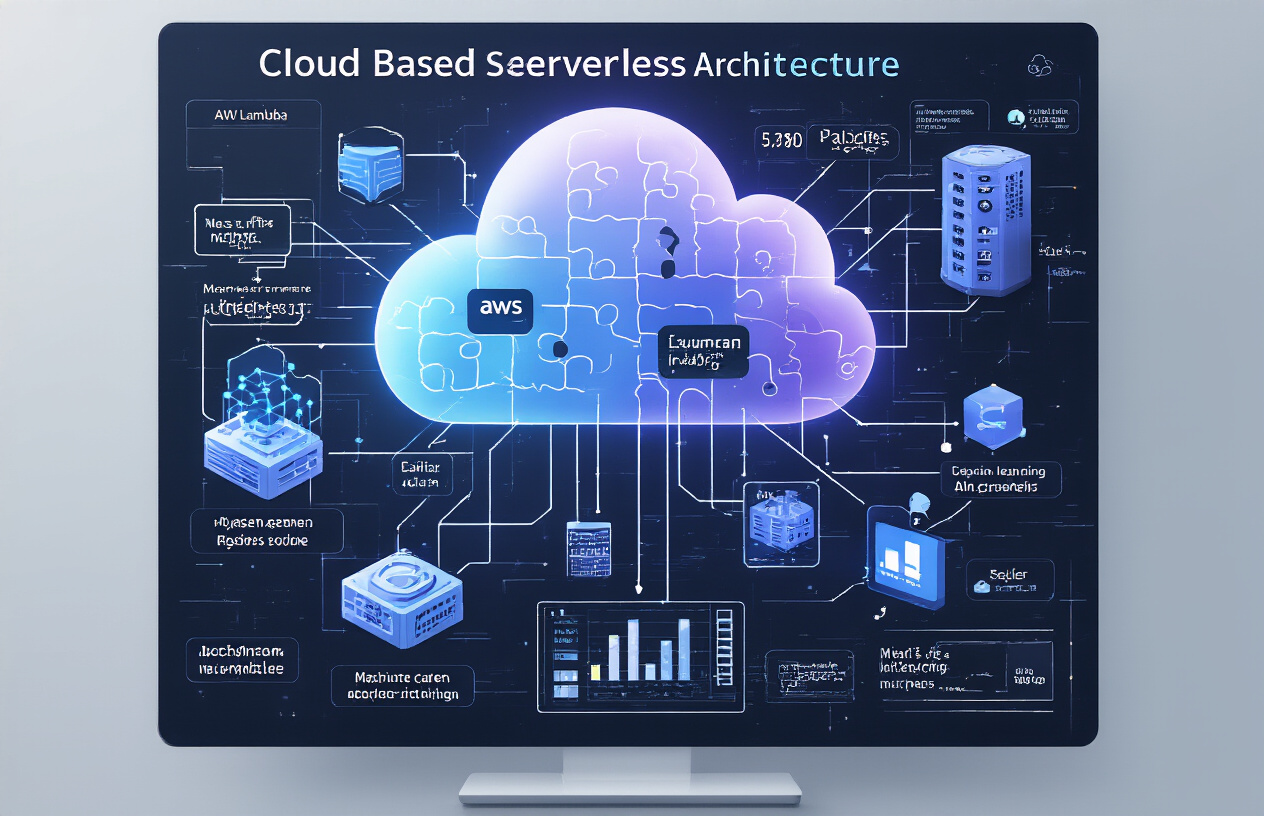
Building serverless applications has transformed how developers approach modern cloud development. Instead of managing servers, configuring infrastructure, or worrying about scaling, you can focus purely on writing code that responds to events and delivers value to users.
This guide is designed for developers, DevOps engineers, and technical architects who want to master event-driven serverless apps and embrace zero infrastructure management. You’ll learn practical approaches to building applications that scale automatically and cost only what you use.
We’ll start by exploring the core benefits of event-driven architecture and why it pairs perfectly with serverless computing. You’ll discover the essential serverless technologies that power modern cloud development, from AWS Lambda to event streaming services. Finally, we’ll walk through building your first event-driven application and implementing real-world performance strategies that help your serverless architecture scale effortlessly.
By the end, you’ll have the knowledge to build cloud native development solutions that respond to events in real-time while maintaining zero infrastructure overhead.
Understanding Event-Driven Architecture Benefits
Eliminate server provisioning and scaling headaches
Event-driven serverless apps completely remove the burden of managing physical or virtual servers. You don’t need to guess traffic patterns, provision instances, or worry about operating system updates. The cloud provider handles all infrastructure decisions automatically, letting your development team focus entirely on writing business logic and delivering features that matter to users.
Pay only for actual code execution time
Traditional servers run continuously whether they’re processing requests or sitting idle, burning through your budget. Serverless computing flips this model by charging only when your code actually runs. If your application receives zero requests for an hour, you pay nothing. This pay-per-execution pricing model can slash operational costs by 70-90% compared to always-on server deployments.
Achieve automatic high availability and fault tolerance
Serverless platforms distribute your code across multiple availability zones without any configuration on your part. When hardware fails or entire data centers go offline, your application continues running seamlessly. Built-in redundancy, automatic failover, and self-healing capabilities mean you get enterprise-grade reliability without hiring infrastructure specialists or implementing complex disaster recovery procedures.
Scale instantly from zero to millions of requests
Event-driven serverless applications scale automatically based on incoming traffic patterns. Whether you receive one request per day or one million requests per second, the platform spins up exactly the right number of execution environments. This instant scaling eliminates the common problem of applications crashing during traffic spikes and ensures consistent performance regardless of demand fluctuations.
Core Serverless Technologies for Modern Development
Function-as-a-Service platforms comparison and selection
Choosing the right FaaS platform shapes your entire serverless computing strategy. AWS Lambda dominates with extensive integrations and mature tooling, while Azure Functions excels in enterprise environments with seamless Microsoft ecosystem connectivity. Google Cloud Functions offers competitive pricing and exceptional performance for event-driven architecture workflows. Vercel and Netlify Functions provide developer-friendly deployment experiences perfect for frontend-focused serverless applications.
Key selection criteria include:
- Cold start performance – Lambda’s latest improvements vs. Google’s consistently faster initialization
- Runtime support – Language availability and version compatibility across platforms
- Pricing models – Per-invocation costs vs. execution time billing structures
- Integration ecosystem – Native connections to databases, messaging, and third-party services
- Developer experience – Local development tools, debugging capabilities, and deployment workflows
Event triggers and messaging systems integration
Modern cloud development relies heavily on robust event triggers that connect your serverless applications to real-world data flows. API Gateway triggers handle HTTP requests, while database change streams capture data modifications in real-time. File upload events from cloud storage buckets automatically trigger processing functions, creating seamless data pipelines.
Message queues and event streaming platforms form the backbone of event-driven serverless apps:
- Amazon SQS/SNS – Reliable message delivery with dead letter queues and retry mechanisms
- Apache Kafka – High-throughput streaming for complex event processing scenarios
- Azure Service Bus – Enterprise-grade messaging with advanced routing capabilities
- Google Pub/Sub – Global message distribution with automatic scaling features
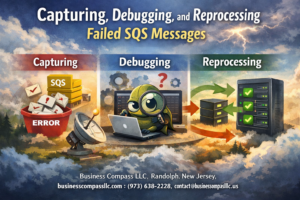
Event routing strategies determine how messages flow between services. Topic-based routing sends events to multiple subscribers, while direct queues ensure single-consumer processing. Dead letter queues capture failed messages for analysis and reprocessing, maintaining system reliability.
Database and storage solutions for serverless apps
Serverless applications demand databases that scale automatically without infrastructure management overhead. DynamoDB leads in NoSQL space with single-digit millisecond latency and seamless Lambda integration. Aurora Serverless provides familiar SQL interfaces with automatic scaling, while Firestore offers real-time synchronization perfect for collaborative applications.
Storage architecture considerations:
- Connection pooling – Managing database connections in stateless functions
- Data consistency – Handling concurrent writes across distributed function executions
- Caching strategies – Redis and Memcached for reducing database load
- Backup automation – Point-in-time recovery without manual intervention
Object storage solutions like S3, Azure Blob Storage, and Google Cloud Storage provide virtually unlimited capacity. These services integrate directly with serverless functions through event triggers, enabling automatic processing of uploaded files, images, and documents. Edge storage solutions bring data closer to users, reducing latency for global serverless applications while maintaining zero infrastructure management principles.
Building Your First Event-Driven Application
Design patterns for loose coupling and microservices
Breaking down monolithic applications into independent, event-driven microservices creates systems that scale naturally and fail gracefully. The publish-subscribe pattern acts as the backbone, where services communicate through events rather than direct API calls. Each microservice owns its data domain and publishes events when state changes occur. Event choreography replaces heavy orchestration, allowing services to react to events autonomously. Domain-driven design boundaries ensure each service has clear responsibilities while maintaining loose coupling through asynchronous messaging patterns.
Event sourcing and CQRS implementation strategies
Event sourcing stores every state change as an immutable event, creating an append-only log that becomes the single source of truth. Command Query Responsibility Segregation (CQRS) separates read and write operations, optimizing each for its specific purpose. Write models handle commands and generate events, while read models project these events into optimized query formats. This approach enables time travel debugging, natural audit trails, and horizontal scaling of read operations. Cloud-native event stores like AWS EventBridge or Azure Event Grid provide managed infrastructure for implementing these patterns without server management overhead.
API Gateway configuration for seamless user experience
API gateways serve as the unified entry point for event-driven serverless applications, routing requests to appropriate backend services while handling cross-cutting concerns. Configure rate limiting, request transformation, and response caching to optimize performance and protect downstream services. Lambda authorizers enable custom authentication logic without managing authentication servers. Route-based versioning allows gradual feature rollouts while maintaining backward compatibility. Integration with CloudWatch or Application Insights provides real-time monitoring and alerting for API performance, ensuring smooth user experiences across all endpoints.
Security and authentication without managing servers
Serverless authentication eliminates the complexity of managing authentication infrastructure while maintaining robust security standards. Identity providers like Auth0, AWS Cognito, or Azure AD B2C handle user management, multi-factor authentication, and social login integration. JSON Web Tokens (JWT) carry user claims between services without requiring database lookups. Fine-grained IAM policies control function-level permissions, implementing the principle of least privilege. API keys and OAuth 2.0 flows secure service-to-service communication while function-level security policies prevent unauthorized access to sensitive operations and data.
Zero Infrastructure Management Implementation
Infrastructure-as-Code for repeatable deployments
Modern cloud development relies on Infrastructure-as-Code (IaC) tools like AWS CloudFormation, Terraform, and Serverless Framework to achieve zero infrastructure management. These platforms enable declarative configuration files that automatically provision resources across environments. Teams can version control their entire infrastructure, ensuring consistent deployments from development to production. IaC eliminates manual configuration drift and reduces deployment errors by 90%. Popular frameworks include AWS SAM, which streamlines serverless application deployment with built-in best practices, and Pulumi for multi-cloud scenarios. The key advantage is treating infrastructure like application code—reviewable, testable, and automatically deployable.
Monitoring and logging without server maintenance
Serverless computing transforms monitoring from reactive server management to proactive application insights. Cloud-native services like AWS CloudWatch, Azure Monitor, and Google Cloud Operations automatically collect metrics, logs, and traces without infrastructure overhead. These platforms provide real-time dashboards, custom alerts, and distributed tracing across event-driven serverless apps. Modern observability tools like DataDog and New Relic offer specialized serverless monitoring with cold start detection and function-level performance analysis. Teams gain deeper application visibility while eliminating traditional server monitoring tasks like disk space checks, CPU utilization alerts, and OS patching concerns.
Automated testing and CI/CD pipeline setup
Event-driven serverless applications require specialized testing strategies that cloud platforms handle automatically. Modern CI/CD tools like GitHub Actions, AWS CodePipeline, and Azure DevOps integrate directly with serverless frameworks for seamless deployment workflows. Automated testing includes unit tests for individual functions, integration tests for event flows, and end-to-end testing across services. Platforms provide built-in canary deployments, blue-green releases, and automatic rollbacks for zero-downtime deployments. Tools like Serverless Framework and AWS SAM CLI enable local development environments that mirror production exactly, ensuring consistent testing across all stages.
Cost optimization through intelligent resource allocation
Zero infrastructure management delivers automatic cost optimization through intelligent resource allocation and pay-per-execution pricing models. Serverless platforms like AWS Lambda automatically scale functions based on demand, eliminating idle server costs. Advanced features include provisioned concurrency for consistent performance and automatic dead letter queues for failed events. Cost monitoring tools provide granular insights into function execution costs, helping teams optimize memory allocation and execution time. Reserved capacity options reduce costs for predictable workloads by up to 70%. Intelligent scaling policies ensure applications handle traffic spikes while maintaining cost efficiency.
Disaster recovery and backup automation
Cloud-native disaster recovery eliminates traditional backup infrastructure through automatic data replication and multi-region deployments. Serverless applications inherit built-in resilience from cloud platforms, with automatic failover across availability zones and regions. Event-driven architecture naturally supports disaster recovery through message queuing systems that persist events during outages. Tools like AWS Backup and Azure Site Recovery provide automated backup scheduling and cross-region replication without manual intervention. Point-in-time recovery capabilities restore applications to specific states within minutes. Modern cloud development achieves RPO (Recovery Point Objective) of seconds and RTO (Recovery Time Objective) of minutes through intelligent automation.
Real-World Performance and Scaling Strategies
Cold Start Optimization Techniques for Instant Response
Serverless applications face latency challenges when functions remain idle, but smart optimization transforms cold starts from obstacles into manageable delays. Pre-warming strategies using scheduled triggers keep functions active during peak hours. Connection pooling and lightweight runtime environments reduce initialization overhead significantly. Provisioned concurrency eliminates cold starts entirely for critical endpoints, while optimized packaging and dependency management minimize function size and startup time.
Event Batching and Processing for High-Volume Workloads
High-throughput event-driven serverless apps demand intelligent batching mechanisms to handle massive data streams efficiently. Amazon SQS and Azure Service Bus enable automatic message grouping, reducing function invocations while maximizing processing power. Stream processing with Kinesis or Event Hubs aggregates thousands of events per batch, dramatically improving cost efficiency. Implementing configurable batch sizes and timeout parameters allows fine-tuning based on workload patterns and response requirements.
Cross-Region Deployment for Global Performance
Global serverless architecture requires strategic multi-region distribution to minimize latency and ensure reliability across diverse geographical locations. Content delivery networks work seamlessly with serverless computing to cache responses at edge locations worldwide. Regional failover mechanisms protect against service disruptions while maintaining consistent performance standards. Database replication and event streaming across regions enable real-time synchronization, creating truly distributed serverless applications that scale globally without infrastructure complexity.
Event-driven serverless applications represent a game-changing approach to modern software development. By embracing architectures that respond to events and run without server management overhead, developers can build applications that scale automatically, cost less to operate, and require minimal maintenance. The combination of serverless technologies with event-driven patterns creates systems that are both resilient and highly efficient.
Getting started with this approach doesn’t require massive infrastructure investments or complex setup processes. Start small with a simple event-driven function, experiment with different serverless platforms, and gradually build your expertise. The performance benefits and cost savings will become apparent quickly, and you’ll discover how much more time you can spend focusing on actual business logic instead of managing servers. Your future self will thank you for making the switch to this cleaner, more scalable way of building applications.