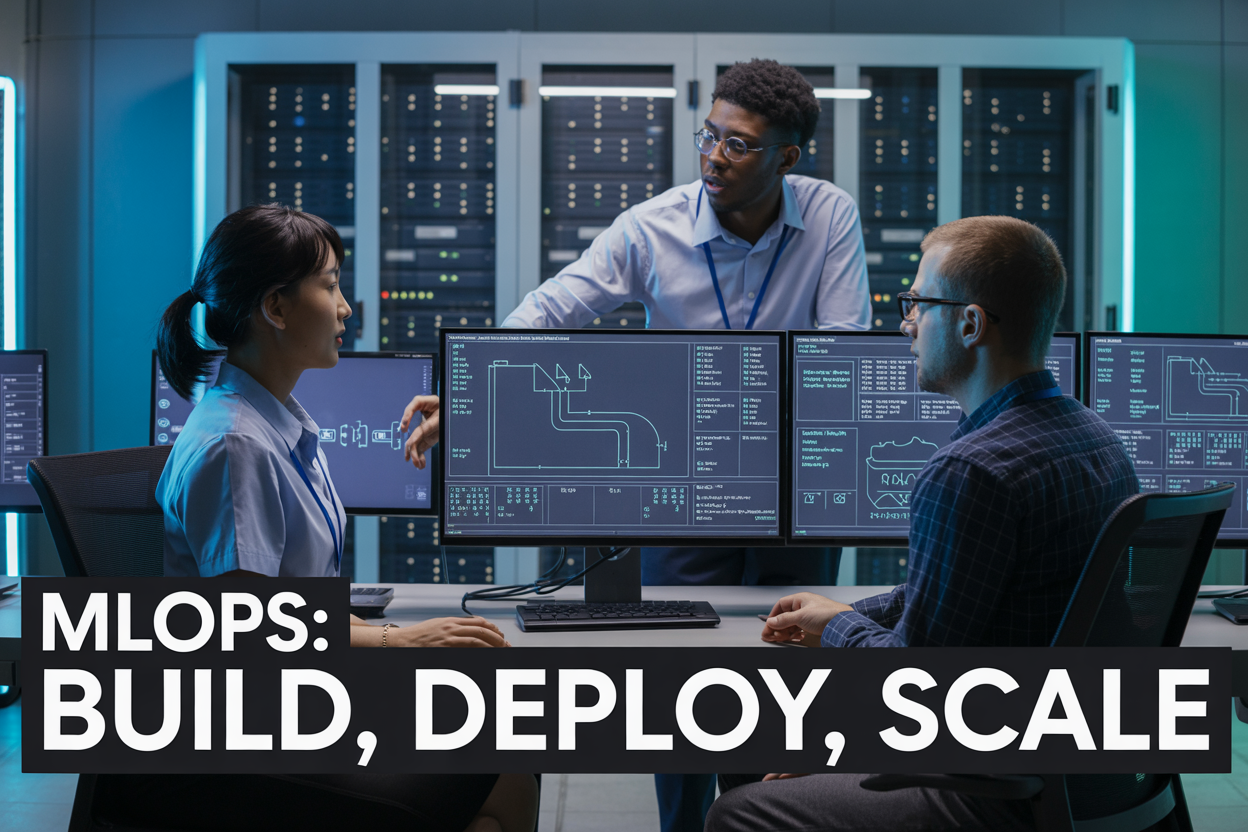
Machine learning models sitting idle in notebooks don’t create business value. MLOps bridges the gap between experimental data science and production-ready systems that deliver real results at scale.
This comprehensive guide is designed for data scientists, ML engineers, DevOps professionals, and technical leaders who need to move beyond proof-of-concepts and build reliable machine learning operations. You’ll discover how to transform scattered ML experiments into automated, scalable systems that your organization can depend on.
We’ll walk through building robust MLOps infrastructure that supports your entire machine learning lifecycle. You’ll learn practical strategies for creating efficient ML model deployment workflows that get your models into production faster and more reliably. Plus, we’ll cover proven approaches for scaling machine learning operations as your team and data volumes grow, including essential MLOps best practices for model governance and compliance.
Ready to turn your ML experiments into production powerhouses? Let’s dive into the world of machine learning operations.
Understanding MLOps Fundamentals and Core Benefits

Define MLOps and its role in modern machine learning workflows
MLOps, short for machine learning operations, brings together machine learning development with operational practices to create a seamless pipeline from data science experimentation to production deployment. Think of it as the bridge between your data scientists’ brilliant models and the real-world applications that customers actually use.
At its core, MLOps combines the collaborative culture and practices of DevOps with the unique challenges of machine learning workflows. While traditional software development deals with static code, machine learning operations must handle dynamic datasets, evolving models, and continuous retraining cycles. MLOps provides the framework to manage these complexities through automated pipelines, version control for both code and data, and robust monitoring systems.
The role of MLOps in modern machine learning workflows extends far beyond simple deployment. It creates standardized processes for data validation, feature engineering, model training, testing, and deployment. This systematic approach ensures that models move from research notebooks to production environments reliably and efficiently. MLOps also establishes feedback loops that capture model performance in real-world scenarios, enabling continuous improvement and adaptation.
Key differences between traditional DevOps and MLOps practices
| Aspect | Traditional DevOps | MLOps |
|---|---|---|
| Code Management | Version control for application code | Version control for code, data, and model artifacts |
| Testing | Unit tests, integration tests | Data validation, model performance tests, A/B testing |
| Deployment | Deploy static applications | Deploy models with dynamic behavior |
| Monitoring | System performance, uptime | Model accuracy, data drift, feature degradation |
| Rollback Strategy | Code rollback to previous version | Model rollback plus data lineage tracking |
Traditional DevOps focuses on shipping software quickly and reliably, but MLOps must account for the experimental nature of data science work. While DevOps teams work with predictable code behavior, MLOps practitioners deal with models that can degrade over time as real-world data changes. This fundamental difference requires specialized tools and practices.
Data plays a central role in MLOps that doesn’t exist in traditional DevOps. Every model depends on training data quality, feature consistency, and ongoing data pipeline health. MLOps teams must implement data validation checks, monitor for data drift, and maintain data lineage tracking – concerns that rarely arise in traditional software deployment.
Critical business advantages of implementing MLOps in your organization
Organizations that implement robust MLOps practices see dramatic improvements in their machine learning ROI. The most immediate benefit is faster time-to-market for ML models. Instead of spending months manually shepherding models from development to production, automated MLOps pipelines reduce deployment time from weeks to days or even hours.
Cost reduction represents another major advantage. MLOps automation eliminates manual handoffs between data science and engineering teams, reducing the human resources needed to maintain ML systems. Automated model monitoring and retraining also prevent costly model degradation that could impact business metrics.
Risk mitigation becomes crucial as ML models increasingly drive business decisions. MLOps provides governance frameworks that ensure models meet compliance requirements, maintain audit trails, and follow approval workflows. This systematic approach protects organizations from regulatory issues and reduces the risk of biased or faulty models reaching production.
Scalability improvements allow organizations to deploy hundreds or thousands of models without proportionally increasing operational overhead. Standardized MLOps infrastructure means that each new model benefits from existing monitoring, deployment, and maintenance systems rather than requiring custom solutions.
Common challenges MLOps solves for data science teams
Data scientists often struggle with the “research to production” gap, where promising notebook experiments fail to translate into reliable business applications. MLOps bridges this gap by providing standardized environments and reproducible workflows that ensure what works in development also works in production.
Model versioning and experiment tracking become manageable with MLOps tools. Instead of losing track of which model version performed best or being unable to reproduce previous results, teams can maintain clear lineage from raw data through feature engineering to final model artifacts. This transparency accelerates iteration cycles and builds confidence in model deployment decisions.
Collaboration friction between data science and engineering teams dissolves when MLOps establishes shared tools and processes. Data scientists no longer need to hand off complex models with inadequate documentation, while engineers gain visibility into model requirements and performance characteristics.
Production monitoring challenges that plague many ML deployments get addressed through automated alerting systems that track both technical metrics and business KPIs. Teams can detect model degradation before it impacts customers and respond quickly with retraining or rollback procedures.
Resource management becomes predictable when MLOps automation handles compute scaling, job scheduling, and infrastructure provisioning. This removes the operational burden from data science teams while ensuring models have the resources they need to perform optimally in production environments.
Essential Components of a Robust MLOps Infrastructure

Model versioning and experiment tracking systems
Building reliable machine learning operations starts with proper model versioning and experiment tracking. These systems act as the foundation for organized ML development, letting teams track every change, compare results, and roll back when needed.
Modern MLOps infrastructure requires tools like MLflow, Neptune, or Weights & Biases to capture experiment metadata automatically. These platforms log hyperparameters, metrics, model artifacts, and code versions without disrupting your workflow. When you run hundreds of experiments, having this organized history becomes crucial for understanding what actually works.
Version control extends beyond just code to include model weights, datasets, and configuration files. Git-based solutions like DVC (Data Version Control) handle large files that traditional Git can’t manage efficiently. This approach creates reproducible experiments where any team member can recreate exact results from weeks or months ago.
Smart tagging systems help categorize models by performance, business metrics, or deployment status. Teams can quickly identify champion models, compare A/B test variants, and maintain clear lineage from experiment to production.
Data pipeline automation and validation frameworks
Data pipeline automation transforms raw information into ML-ready datasets without manual intervention. These frameworks handle data ingestion, transformation, feature engineering, and quality checks across multiple environments.
Apache Airflow and Prefect lead the orchestration space, scheduling complex workflows that adapt to data availability and system resources. These tools manage dependencies between pipeline steps, retry failed tasks, and send alerts when issues arise.
Data validation catches problems before they reach your models. Great Expectations and similar frameworks define data contracts that specify acceptable ranges, formats, and distributions. When incoming data violates these rules, the pipeline stops and notifies stakeholders instead of silently corrupting model performance.
Feature stores like Feast or Tecton centralize feature engineering and serving. They ensure training and inference use identical transformations while enabling feature sharing across different ML teams. This consistency eliminates training-serving skew, a common source of production failures.
Continuous integration and continuous deployment for ML models
CI/CD for machine learning extends traditional software practices to handle model-specific challenges. Unlike regular applications, ML systems must validate model quality, not just code functionality.
Automated testing includes unit tests for data processing functions, integration tests for pipeline components, and model validation tests that check prediction quality on holdout datasets. These tests run whenever code changes, catching regressions early in development.
Model deployment pipelines package trained models with their runtime dependencies, creating portable artifacts that work across environments. Container technologies like Docker ensure consistency between development, staging, and production systems.
Canary deployments gradually shift traffic from old models to new ones, monitoring performance metrics and business KPIs. If the new model underperforms, automated rollback mechanisms restore the previous version within minutes.
Monitoring and observability tools for production models
Production model monitoring goes beyond traditional application metrics to track prediction quality, data drift, and business impact. These systems provide early warnings before model degradation affects user experience.
Data drift detection compares incoming data distributions against training baselines. Tools like Evidently AI or Alibi Detect identify when feature distributions shift significantly, suggesting potential model retraining needs.
Prediction monitoring tracks output patterns, flagging unusual prediction confidence levels or output distributions. This catches model failures that accuracy metrics might miss, especially in classification tasks with imbalanced classes.
Business metric correlation links ML predictions to downstream outcomes like conversion rates, revenue, or customer satisfaction. This connection proves model value and guides improvement priorities.
Real-time dashboards aggregate these signals into actionable insights. Teams can spot issues quickly and understand their scope without diving into log files or running complex queries.
Collaborative platforms for cross-functional team coordination
Successful MLOps requires seamless collaboration between data scientists, engineers, product managers, and business stakeholders. These platforms break down silos and align different perspectives around shared goals.
Model registries serve as central hubs where teams document model purposes, performance characteristics, and deployment status. Tools like MLflow Model Registry or AWS SageMaker Model Registry provide standardized interfaces for model promotion through development stages.
Shared experiment tracking lets business stakeholders understand model development progress without technical deep-dives. Clear metric visualizations and plain-language model descriptions bridge the gap between technical capabilities and business requirements.
Code collaboration extends beyond traditional Git workflows to include notebook sharing, environment reproduction, and result discussion. Platforms like Jupyter Hub or Google Colab enable real-time collaboration on analysis and model development.
Communication tools integrate with MLOps pipelines, sending updates about experiment completion, deployment status, or performance alerts to relevant Slack channels or email lists. This keeps everyone informed without overwhelming them with unnecessary technical details.
Building Effective Machine Learning Pipelines

Design Principles for Reproducible and Maintainable ML Workflows
Building an effective MLOps pipeline starts with establishing clear design principles that ensure your machine learning workflows remain consistent and manageable over time. Version control forms the backbone of any reproducible ML system – every dataset, model configuration, and code change should be tracked with tools like Git and DVC (Data Version Control).
Modular architecture proves essential for long-term success. Break your MLOps pipeline into distinct, interchangeable components that handle specific tasks like data ingestion, feature engineering, model training, and validation. This approach allows teams to modify individual components without disrupting the entire workflow.
Environment consistency across development, staging, and production environments prevents the dreaded “it works on my machine” problem. Docker containers and tools like MLflow help package your entire ML environment, including dependencies, libraries, and configuration settings, ensuring identical behavior across different deployment scenarios.
Documentation and metadata tracking create transparency throughout your machine learning operations. Record everything from data lineage and feature definitions to model hyperparameters and performance metrics. This practice enables team collaboration and simplifies debugging when models behave unexpectedly in production.
Automated Data Preprocessing and Feature Engineering Strategies
Smart automation in data preprocessing eliminates manual bottlenecks while maintaining data quality standards. Apache Airflow and Kubeflow Pipelines offer robust orchestration platforms that can schedule, monitor, and retry data processing tasks automatically.
Feature stores have become game-changers for machine learning infrastructure, providing centralized repositories for storing, versioning, and serving features across multiple models and teams. Platforms like Feast and Tecton enable consistent feature definitions and reduce redundant feature engineering work.
Data validation pipelines should run automatically before any model training begins. Tools like Great Expectations and TensorFlow Data Validation can detect schema drift, missing values, and statistical anomalies that could compromise model performance. Set up alerts for data quality issues to catch problems early.
Real-time feature engineering presents unique challenges that batch processing doesn’t face. Stream processing frameworks like Apache Kafka and Apache Flink enable low-latency feature computation for models that need immediate responses. Design your feature engineering logic to work consistently across both batch and streaming contexts.
Model Training Orchestration and Resource Optimization
Efficient resource management during model training can dramatically reduce costs while improving training speed. Kubernetes provides excellent autoscaling capabilities that spin up GPU instances only when needed and terminate them when training completes.
Distributed training strategies become necessary when dealing with large datasets or complex models. PyTorch Distributed and TensorFlow’s distribution strategies allow you to split training across multiple machines, reducing training time from days to hours.
Hyperparameter optimization shouldn’t be a manual guessing game. Tools like Optuna, Ray Tune, and Hyperopt automate the search for optimal hyperparameters while efficiently allocating computational resources. These tools can run hundreds of experiments in parallel and stop unpromising trials early.
Model checkpointing and experiment tracking ensure you never lose valuable training progress. MLflow and Weights & Biases automatically save model snapshots during training and track performance metrics across different experiment runs, making it easy to compare results and rollback to previous versions.
Testing Methodologies for ML Models and Data Quality Assurance
Testing machine learning models requires different approaches than traditional software testing. Unit tests should cover individual functions in your data preprocessing and model inference code, while integration tests verify that your entire MLOps pipeline works end-to-end.
Data drift detection helps maintain model performance over time. Statistical tests like the Kolmogorov-Smirnov test can identify when incoming data distributions differ significantly from training data. Set up monitoring dashboards that alert your team when drift exceeds acceptable thresholds.
Model performance testing goes beyond accuracy metrics. Test your models against edge cases, adversarial examples, and biased inputs to ensure robust behavior in production. A/B testing frameworks allow you to compare new model versions against existing ones using real user traffic.
Shadow testing provides a safe way to validate new models before full deployment. Run candidate models alongside production models, comparing their predictions without affecting user experience. This approach reveals performance differences and helps build confidence in new model versions before switching traffic over.
Deploying Models to Production Environments

Choosing the Right Deployment Strategy for Your Use Case
Different ML models require different deployment approaches based on their performance requirements, latency needs, and business constraints. Batch prediction works best for scenarios where you can process data in scheduled intervals, like fraud detection systems that analyze transactions overnight or recommendation engines that update user preferences daily. This approach allows you to handle large volumes of data efficiently without real-time pressure.
Real-time inference serves applications that need immediate responses, such as chatbots, image recognition apps, or dynamic pricing systems. These deployments require careful attention to latency optimization and resource allocation. Edge deployment brings models directly to devices or local networks, reducing latency and improving privacy for applications like autonomous vehicles or IoT sensors.
Consider your data freshness requirements when selecting a strategy. Models that rely on static features work well with batch deployment, while dynamic features that change frequently need real-time or near-real-time processing capabilities.
Containerization and Orchestration Best Practices for ML Models
Docker containers provide consistent environments for ML model deployment, eliminating the “works on my machine” problem that plagues many production deployments. Create lightweight base images with only essential dependencies to reduce attack surface and improve startup times. Layer your container builds strategically, placing frequently changing model artifacts in separate layers from stable dependencies.
Kubernetes offers robust orchestration capabilities for containerized ML models. Configure resource limits and requests based on your model’s memory and CPU requirements. Use horizontal pod autoscaling to handle varying traffic loads automatically. Implement health checks that verify both container health and model functionality.
| Container Practice | Benefit | Implementation |
|---|---|---|
| Multi-stage builds | Smaller production images | Separate build and runtime stages |
| Version pinning | Reproducible deployments | Lock dependency versions |
| Security scanning | Reduced vulnerabilities | Integrate scanning in CI/CD |
| Resource optimization | Better performance | Profile memory and CPU usage |
Set up proper logging and monitoring within your containers to track model performance and resource usage. Use init containers for model loading or data preprocessing tasks that need to complete before the main application starts.
API Development and Endpoint Management for Model Serving
RESTful APIs provide the most common interface for ML model deployment, offering simplicity and broad compatibility across different systems. Design your API endpoints with clear versioning strategies to support multiple model versions simultaneously. Use semantic versioning to communicate breaking changes and maintain backward compatibility when possible.
Implement proper input validation to prevent malformed data from reaching your models. Define clear schemas for request and response formats using OpenAPI specifications. This documentation helps other teams integrate with your ML services effectively.
Consider these key aspects when building model serving APIs:
- Authentication and authorization: Protect your models with appropriate access controls
- Rate limiting: Prevent abuse and ensure fair resource allocation
- Request batching: Improve throughput by processing multiple predictions together
- Caching strategies: Store frequently requested predictions to reduce computational load
- Error handling: Provide meaningful error messages and graceful degradation
GraphQL offers an alternative for complex querying scenarios where clients need flexible data selection. This approach works well when serving multiple related models or when clients have varying data requirements.
Use API gateways to manage cross-cutting concerns like authentication, logging, and routing. These tools help centralize common functionality and provide better visibility into API usage patterns.
Blue-Green and Canary Deployment Techniques for Risk Mitigation
Blue-green deployment maintains two identical production environments, allowing instant rollbacks if issues arise. Keep the blue environment running your current model version while preparing the green environment with your new model. Switch traffic between environments once validation completes. This MLOps best practices approach minimizes downtime and provides confidence during ML production deployment.
Canary deployments offer more gradual risk management by routing a small percentage of traffic to the new model version. Start with 5-10% of requests going to the canary version while monitoring key metrics like prediction accuracy, latency, and error rates. Gradually increase traffic as confidence grows in the new model’s performance.
Monitor these critical metrics during canary deployments:
- Model accuracy: Compare predictions against ground truth when available
- Response latency: Ensure the new model meets performance requirements
- Error rates: Track both technical errors and prediction quality issues
- Resource utilization: Monitor CPU, memory, and GPU usage patterns
- Business metrics: Measure downstream impact on key business indicators
Feature flags provide additional control over model deployment, allowing you to toggle between model versions without code changes. This technique works particularly well with A/B testing frameworks where you want to compare model performance across different user segments.
Automated rollback triggers help respond quickly to performance degradation. Set up alerts that automatically revert to the previous model version when error rates exceed thresholds or when prediction quality drops significantly. This safety net protects your production systems while your team investigates issues with new model versions.
Scaling Machine Learning Operations for Enterprise Growth

Infrastructure Optimization Strategies for Handling Increased Model Loads
Growing ML workloads demand smart infrastructure choices that can adapt without breaking the bank. Container orchestration platforms like Kubernetes have become the backbone of scalable MLOps infrastructure, allowing teams to automatically spin up resources when model inference requests spike during peak business hours.
Auto-scaling groups work wonders for handling unpredictable traffic patterns. Set up horizontal pod autoscalers that monitor CPU and memory usage, then automatically deploy additional model serving instances when thresholds are exceeded. This approach keeps response times consistent even when your recommendation engine suddenly gets hit with Black Friday traffic.
Consider implementing model caching strategies using Redis or Memcached to reduce computational overhead for frequently requested predictions. Smart caching can cut inference latency by 60-80% for repetitive queries, especially valuable for real-time applications like fraud detection systems.
Load balancing becomes critical when running multiple model versions simultaneously. Deploy sticky session configurations to ensure A/B testing consistency while distributing traffic evenly across your MLOps pipeline infrastructure. Blue-green deployments paired with feature flags let you roll out model updates gradually without disrupting live services.
Multi-Environment Management Across Development, Staging, and Production
Managing consistent environments across your ML model deployment lifecycle prevents those dreaded “works on my machine” scenarios that plague production releases. Infrastructure as Code (IaC) tools like Terraform or Pulumi create reproducible environments with identical configurations across all stages.
Environment isolation protects production systems while enabling safe experimentation. Development teams can test aggressive model updates in sandboxed environments without affecting customer-facing applications. Staging environments should mirror production as closely as possible, including data volumes, network configurations, and security policies.
| Environment | Purpose | Resource Allocation | Data Access |
|---|---|---|---|
| Development | Feature development, quick iteration | Minimal compute, shared resources | Synthetic/anonymized data |
| Staging | Pre-production testing, integration validation | Production-like resources | Production data subset |
| Production | Live customer traffic | Full resource allocation | Complete production data |
Configuration management tools like Ansible or Chef ensure consistent software versions and environment variables across all stages. Version pinning for dependencies, ML frameworks, and system libraries eliminates compatibility issues that commonly surface during promotion between environments.
Cost Optimization Techniques for Large-Scale ML Operations
Cloud costs can spiral out of control quickly when running machine learning operations at scale. Spot instances offer 60-90% savings for training workloads that can tolerate interruptions. Design your training pipeline to checkpoint model state regularly, allowing jobs to resume seamlessly when spot instances terminate.
Right-sizing compute resources prevents overspending on underutilized instances. Monitor actual resource consumption patterns and adjust instance types accordingly. Many teams discover their inference servers only use 30% of allocated CPU, presenting immediate optimization opportunities.
Reserved instances provide significant cost reductions for predictable workloads like daily batch processing jobs. Committing to 1-3 year terms typically saves 30-60% compared to on-demand pricing for steady-state operations.
Implement automated resource scheduling to shut down non-production environments during off-hours. Development and staging servers running 24/7 unnecessarily drain budgets. Simple automation scripts can save thousands monthly by powering down resources outside business hours.
Data storage optimization often gets overlooked but impacts long-term costs substantially. Archive older training datasets to cheaper storage tiers, implement data lifecycle policies, and compress large model artifacts. These practices reduce storage costs by 40-70% while maintaining accessibility for compliance requirements.
Performance Monitoring and Automatic Scaling Implementation
Real-time performance monitoring forms the foundation of reliable automatic scaling decisions. Set up comprehensive metrics collection covering model prediction latency, throughput, resource utilization, and business KPIs like conversion rates or recommendation click-through rates.
Implement custom metrics dashboards using tools like Grafana or DataDog to visualize system health across your entire machine learning infrastructure. Alert thresholds should trigger before performance degrades noticeably to users. Proactive scaling prevents the dreaded user experience issues that damage business metrics.
Model performance drift detection requires continuous monitoring beyond basic system metrics. Track prediction accuracy, feature distributions, and output patterns to identify when models need retraining. Automated alerts when accuracy drops below acceptable thresholds enable rapid response to changing data patterns.
Circuit breakers protect downstream systems when ML services become overwhelmed. Implement fallback mechanisms that serve cached predictions or default recommendations when primary models can’t handle request volumes. This graceful degradation maintains user experience during scaling events or system failures.
Health checks should validate both system availability and model quality. Simple ping tests aren’t sufficient for ML services – implement semantic health checks that verify models return sensible predictions for known test inputs. This deeper validation catches subtle issues before they impact production traffic.
Implementing Effective Model Governance and Compliance

Model performance monitoring and drift detection systems
Model performance monitoring acts as your early warning system for production machine learning models. Without constant vigilance, models silently degrade as real-world data shifts away from training distributions. MLOps teams need automated monitoring systems that track key performance indicators like accuracy, precision, recall, and business-specific metrics across different time windows.
Data drift detection represents one of the most critical aspects of ML model management. Input features can change gradually due to evolving user behavior, seasonal patterns, or sudden market shifts. Statistical tests like Kolmogorov-Smirnov, Jensen-Shannon divergence, and Population Stability Index help identify when feature distributions deviate significantly from baseline expectations.
Concept drift poses an even greater challenge, where the relationship between inputs and outputs changes over time. A fraud detection model might become less effective as criminals adapt their tactics, requiring continuous retraining cycles. Modern MLOps platforms integrate automated retraining triggers based on performance thresholds, ensuring models stay relevant without manual intervention.
Real-time monitoring dashboards provide instant visibility into model health across your entire machine learning infrastructure. These systems should alert teams when performance drops below acceptable levels, enabling rapid response before business impact occurs. Setting up proper alerting mechanisms prevents costly delays in addressing model degradation.
Audit trails and documentation requirements for regulated industries
Regulated industries like finance, healthcare, and insurance face strict documentation requirements for machine learning operations. Every model decision, training run, and deployment must be traceable through comprehensive audit trails that satisfy regulatory scrutiny. MLOps best practices include maintaining detailed logs of data lineage, model versioning, and decision rationale.
Documentation standards must capture the complete model lifecycle from conception to retirement. This includes training data sources, feature engineering steps, hyperparameter tuning decisions, validation methodologies, and approval workflows. Automated documentation tools integrated into your MLOps pipeline ensure consistency and reduce manual effort while meeting compliance standards.
Model explainability becomes paramount in regulated environments where algorithms impact critical decisions. Financial institutions need clear explanations for loan approvals, while healthcare providers must justify diagnostic recommendations. MLOps tools should incorporate explainable AI techniques like SHAP values, LIME, or attention mechanisms that provide human-interpretable insights into model predictions.
Version control extends beyond code to encompass complete model artifacts, including training datasets, preprocessing scripts, and evaluation metrics. Every change requires approval workflows with proper authorization levels, creating an immutable record of model evolution. This systematic approach protects organizations during regulatory audits and internal reviews.
Security protocols and access control for sensitive ML assets
Machine learning assets contain valuable intellectual property and sensitive data requiring robust security measures. MLOps teams must implement role-based access control (RBAC) that restricts model access based on job functions and clearance levels. Data scientists might need read access to training datasets, while only senior engineers can deploy models to production environments.
Encryption protocols protect ML models and data both at rest and in transit. Model parameters, training datasets, and prediction logs should use industry-standard encryption algorithms like AES-256. Secure communication channels between MLOps pipeline components prevent unauthorized interception of sensitive information during model training and inference operations.
Container security becomes essential when deploying models using Docker or Kubernetes platforms. Base images must be regularly scanned for vulnerabilities, and containers should run with minimal privileges to reduce attack surfaces. Network segmentation isolates ML workloads from other systems, limiting potential breach impacts across your machine learning infrastructure.
API security protects model endpoints from unauthorized access and abuse. Rate limiting, authentication tokens, and input validation prevent malicious attacks while maintaining legitimate user access. Monitoring API usage patterns helps identify suspicious behavior that might indicate security threats or compliance violations.
Regular security audits and penetration testing validate the effectiveness of your MLOps security measures. These assessments should cover the entire machine learning automation pipeline, from data ingestion to model serving, identifying vulnerabilities before they become exploitable weaknesses.

MLOps transforms how businesses handle machine learning by bringing together development, operations, and governance into one streamlined approach. The key components we’ve covered – from building solid infrastructure and automated pipelines to deploying models safely in production – work together to create a system that can grow with your business needs. When you add proper scaling strategies and strong governance practices, you get machine learning operations that actually deliver consistent results.
Getting started with MLOps doesn’t mean overhauling everything at once. Pick one area where you’re facing the biggest pain points, whether that’s slow model deployments or keeping track of model performance over time. Start building your MLOps foundation there and expand gradually. The investment in proper MLOps practices pays off quickly through faster deployment cycles, better model reliability, and the confidence that comes from knowing your machine learning systems can handle whatever your business throws at them.