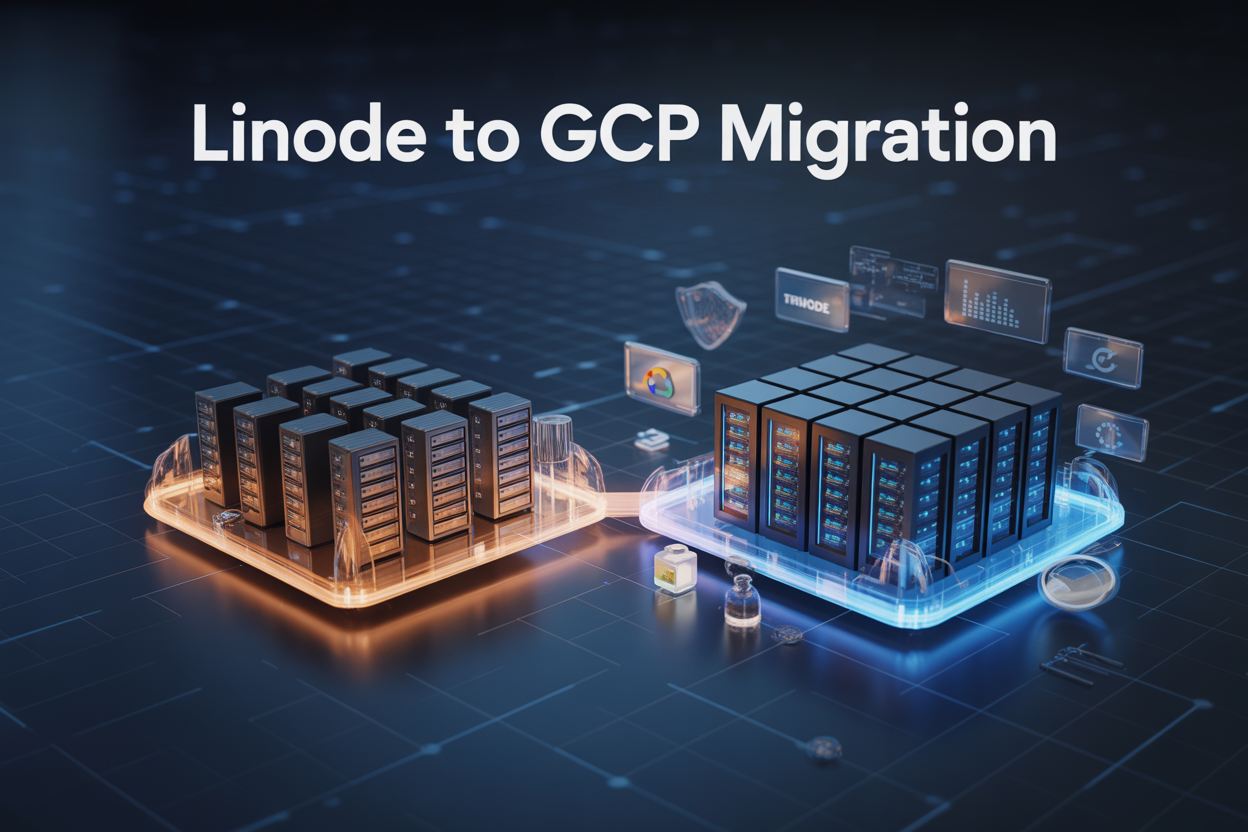
Your business has outgrown Linode’s capabilities, and you’re ready to move to Google Cloud Platform for better scalability, rock-solid reliability, and worldwide reach. This Linode to GCP migration roadmap is designed for IT teams, cloud architects, and business leaders planning their cloud infrastructure migration to Google Cloud Platform.
Making the jump from Linode to Google Cloud isn’t just about moving servers – it’s about transforming how your applications perform and scale globally. You’ll get access to GCP’s advanced services, better security features, and the ability to handle traffic spikes without breaking a sweat.
This comprehensive GCP migration strategy guide walks you through every step of migrating from Linode to Google Cloud. We’ll cover how to assess your current setup and plan your move, including choosing the right GCP services and designing your new architecture. You’ll also learn proven data migration strategies and application migration processes that minimize downtime and keep your business running smoothly. Finally, we’ll show you how to optimize performance and take advantage of Google Cloud’s global network to serve customers faster than ever before.
Pre-Migration Assessment and Planning

Evaluate Current Linode Infrastructure and Workloads
Start by taking a complete inventory of your existing Linode setup. Document every virtual machine, storage volume, networking configuration, and service dependency. Create a detailed map showing how your applications communicate with each other and which databases they rely on. This includes cataloging your current resource usage patterns – CPU, memory, storage, and bandwidth consumption during peak and off-peak hours.
Pay special attention to workload characteristics. Some applications might be CPU-intensive while others are memory-heavy or require high IOPS storage. Understanding these patterns helps you choose the right GCP instance types later. Don’t forget about your backup schedules, monitoring setup, and any custom scripts or automation you’ve built around your Linode infrastructure.
Identify GCP Services That Match Your Requirements
Once you know what you’re working with, research Google Cloud Platform migration options that align with your needs. For standard virtual machines, Compute Engine offers various machine types that can match or exceed your current Linode specifications. If you’re running containerized applications, Google Kubernetes Engine might be a better fit than traditional VMs.
Consider managed services that could replace your self-managed components. Cloud SQL can handle your MySQL or PostgreSQL databases, while Cloud Storage can replace traditional file storage. Load balancing, DNS, and monitoring services have direct GCP equivalents that often provide better features than what you’re managing yourself.
Calculate Cost Implications and Budget Planning
Run detailed cost comparisons between your current Linode spending and projected GCP expenses. Use Google’s pricing calculator to estimate costs based on your actual usage patterns. Remember that GCP offers sustained use discounts and committed use contracts that can significantly reduce costs for steady workloads.
Factor in migration-related expenses like data transfer costs, potential downtime, and the time your team will spend on the migration process. Some organizations see initial cost increases during the transition period when running both environments simultaneously. Plan for these temporary expenses in your Linode to GCP migration budget.
Define Migration Timeline and Success Metrics
Create a realistic timeline that accounts for complexity and potential roadblocks. Break the migration into phases, starting with non-critical systems to test your processes before moving mission-critical applications. Most cloud migration roadmap projects take 3-6 months depending on infrastructure complexity.
Establish clear success metrics before you begin. These might include maximum allowable downtime, performance benchmarks, cost targets, and security compliance requirements. Having measurable goals helps you stay on track and demonstrates the value of your Google Cloud Platform migration to stakeholders.
GCP Service Selection and Architecture Design

Choose Optimal Compute Engine and Container Solutions
Your Linode to GCP migration starts with picking the right compute services that match your workload requirements. Google Cloud offers several compute options, and choosing wisely can make or break your migration success.
For traditional virtual machines, Compute Engine serves as GCP’s equivalent to Linode instances. The key difference? Machine types. GCP provides predefined machine types (e1-standard, n2-standard) and custom machine types where you can specify exact CPU and memory combinations. This flexibility often leads to better cost optimization compared to Linode’s fixed instance sizes.
Container workloads deserve special attention during your Google Cloud Platform migration. If you’re running Docker containers on Linode, consider these GCP alternatives:
- Cloud Run for serverless containers with automatic scaling
- Google Kubernetes Engine (GKE) for full container orchestration
- GKE Autopilot for managed Kubernetes without cluster management overhead
Preemptible instances and Spot VMs can slash compute costs by up to 80% for fault-tolerant workloads. These work perfectly for batch processing, CI/CD pipelines, and development environments that previously ran on Linode’s standard instances.
Sustained use discounts automatically apply when instances run for significant portions of the month, providing savings without upfront commitments. This differs from Linode’s pricing model and can result in substantial cost reductions for always-on services.
Select Database Services for Enhanced Performance
Database migration represents one of the most critical aspects of your GCP migration strategy. Moving from Linode’s self-managed databases to GCP’s managed services unlocks significant operational benefits.
Cloud SQL supports MySQL, PostgreSQL, and SQL Server with automatic backups, high availability, and read replicas across regions. This managed approach eliminates the database maintenance overhead you experienced on Linode while providing better disaster recovery capabilities.
For NoSQL requirements, consider these GCP options:
- Firestore for document databases with real-time synchronization
- Cloud Bigtable for large-scale analytical workloads
- Cloud Memorystore for Redis and Memcached caching layers
Performance optimization comes through proper instance sizing and regional placement. Cloud SQL offers machine types from shared-core instances to high-memory configurations with up to 624GB RAM. Choose based on your current Linode database performance metrics.
Database migration tools like Database Migration Service simplify the transition from self-managed databases. The service handles schema conversion, data replication, and minimal downtime cutover for supported database engines.
Backup and recovery improvements include point-in-time recovery, automated backups with configurable retention, and cross-region backup storage for disaster recovery scenarios that weren’t easily achievable with basic Linode setups.
Design Network Architecture for Global Distribution
Network design becomes crucial when leveraging GCP’s global infrastructure advantages over Linode’s more limited geographic presence. Your cloud infrastructure migration should capitalize on Google’s worldwide network backbone.
Virtual Private Cloud (VPC) design starts with regional subnets that automatically span multiple zones. Unlike Linode’s simpler networking model, GCP VPCs provide global connectivity between regions through private Google backbone networks, reducing latency and improving security.
Load balancing options significantly exceed Linode’s capabilities:
- Global HTTP(S) Load Balancer for worldwide traffic distribution
- Regional Network Load Balancer for TCP/UDP traffic within regions
- Internal Load Balancer for private traffic between services
Cloud CDN integration accelerates content delivery globally without additional third-party services. This built-in capability often replaces separate CDN solutions you might have used with Linode.
Firewall rules and Identity and Access Management (IAM) provide granular security controls. Create network tags for resource grouping and apply security policies consistently across your infrastructure.
Interconnect options enable hybrid scenarios where some workloads remain on-premises or in other clouds. Dedicated Interconnect provides private connections with guaranteed bandwidth, while Partner Interconnect offers flexible connectivity through service providers.
Private Google Access allows instances without external IP addresses to reach Google services, improving security while maintaining functionality. This feature proves especially valuable for database servers and internal application components that don’t require internet access.
Data Migration Strategy and Execution

Plan Database Migration with Minimal Downtime
Successfully migrating databases from Linode to GCP requires careful orchestration to keep your applications running smoothly. Google Cloud Database Migration Service (DMS) streamlines this process by handling most of the heavy lifting for you. Start by creating a comprehensive inventory of your existing databases, noting versions, sizes, and current connection patterns.
The key to minimal downtime lies in using continuous replication. Set up Cloud SQL instances in GCP that mirror your Linode databases, then establish real-time sync between source and destination. This approach allows your applications to continue operating normally while data copies in the background.
For MySQL and PostgreSQL migrations, DMS offers near-zero downtime capabilities. Configure the migration job to replicate all changes from your Linode database to the target Cloud SQL instance. Once the initial data transfer completes and replication catches up, you can perform a quick cutover during a maintenance window.
MongoDB migrations benefit from replica set configurations. Add a new GCP-based replica to your existing Linode replica set, let it sync completely, then promote it to primary while demoting the original. This process typically requires only minutes of downtime.
Don’t forget to update connection strings and firewall rules ahead of time. Test these configurations thoroughly in your staging environment to avoid last-minute surprises during the actual migration window.
Transfer Application Data and Static Assets
Moving your application data and static files from Linode to GCP involves multiple transfer methods depending on your data types and volumes. Google Cloud Storage Transfer Service excels at moving large datasets efficiently, while smaller transfers might work better with gsutil command-line tools.
For static assets like images, videos, and documents, Cloud Storage buckets provide excellent performance and cost optimization. Use lifecycle policies to automatically transition older files to cheaper storage classes. The Transfer Service can pull data directly from your Linode object storage or file systems using scheduled jobs that run during off-peak hours.
Application configuration files and user-generated content require special attention. Create a detailed manifest of all data locations, including hidden directories and temporary files that applications might depend on. Consider using Cloud Storage FUSE to mount buckets as file systems, making the transition smoother for applications expecting traditional file system access.
Session data and cache contents often don’t need migration if you’re implementing new caching strategies. However, user profiles, transaction logs, and business-critical files must transfer completely. Use checksums and verification tools to confirm data integrity after each transfer batch.
Large file transfers benefit from parallel uploads and compression. The gsutil tool supports multi-threading and can resume interrupted transfers automatically. For extremely large datasets, consider Google’s Transfer Appliance service for offline data shipping.
Implement Real-Time Data Synchronization
Real-time synchronization ensures your GCP environment stays current with ongoing changes during the migration period. This capability becomes crucial for maintaining data consistency across both platforms while you validate your new infrastructure.
Cloud Pub/Sub works brilliantly for streaming application events and database changes from Linode to GCP. Set up publishers on your Linode systems to capture database writes, file updates, and user actions. Configure subscribers in GCP to process these events and update your target systems accordingly.
For database synchronization specifically, leverage change data capture (CDC) tools that monitor transaction logs. These tools detect every insert, update, and delete operation, then replay them on your GCP databases in real-time. Popular options include Debezium for open-source solutions or Google’s native DMS for supported database types.
Application-level synchronization might require custom solutions depending on your architecture. Message queues, event sourcing patterns, and API-based sync mechanisms can bridge the gap between platforms. Design these systems with idempotency in mind to handle duplicate events gracefully.
Monitor synchronization lag carefully using Cloud Monitoring dashboards. Set up alerts when replication falls behind acceptable thresholds. This monitoring proves essential for determining when your GCP environment is ready to handle production traffic and when you can safely decommission Linode resources.
Application and Infrastructure Migration Process

Migrate Web Applications and APIs
Moving your web applications and APIs from Linode to Google Cloud requires careful orchestration to minimize downtime and ensure seamless functionality. Start by containerizing your applications using Docker, which makes them portable across different cloud environments. Google Kubernetes Engine (GKE) provides excellent container orchestration capabilities that can handle your Linode workloads efficiently.
Create a migration strategy that moves applications in phases rather than all at once. Begin with less critical services to test your migration process, then gradually move production workloads. Use Cloud Build to establish CI/CD pipelines that automatically deploy your applications to GCP. This approach maintains consistency between your development and production environments.
For APIs, leverage Google Cloud Endpoints or API Gateway to manage traffic routing and authentication. These services provide built-in monitoring and security features that enhance your API performance. Consider implementing blue-green deployment strategies using Google Cloud Load Balancer to switch traffic between old and new environments without service interruption.
Database connections require special attention during the Linode to GCP migration process. Update connection strings to point to your new Cloud SQL or other GCP database services. Use Cloud VPN or Private Google Access to maintain secure connectivity during the transition period.
Configure Load Balancing and Auto-Scaling
Google Cloud’s load balancing capabilities far exceed typical shared hosting solutions, offering global reach and intelligent traffic distribution. Set up HTTP(S) Load Balancer for web applications, which automatically routes traffic to the closest healthy backend instance. This configuration dramatically improves user experience across different geographical locations.
Implement Compute Engine’s managed instance groups with auto-scaling policies based on CPU usage, request rate, or custom metrics. Unlike static Linode configurations, GCP auto-scaling dynamically adjusts resources based on actual demand, optimizing both performance and costs. Configure scaling policies with appropriate cooldown periods to prevent rapid scaling fluctuations.
For containerized applications, GKE’s Horizontal Pod Autoscaler automatically scales pods based on resource utilization. Combine this with Cluster Autoscaler to add or remove nodes as needed. This two-tier scaling approach ensures your GCP migration strategy includes efficient resource utilization at both the application and infrastructure levels.
Regional persistent disks provide high availability for your scaled instances, ensuring data consistency across zones. Network load balancers handle TCP/UDP traffic efficiently, perfect for database connections or specialized applications that don’t use HTTP protocols.
Set Up Monitoring and Logging Systems
Google Cloud’s monitoring ecosystem provides comprehensive visibility into your migrated infrastructure. Cloud Monitoring collects metrics from all GCP services automatically, giving you insights that were difficult to achieve with traditional Linode setups. Create custom dashboards that track application performance, infrastructure health, and business metrics in real-time.
Cloud Logging centralizes logs from all your applications and services, making troubleshooting significantly easier than managing multiple log files across different servers. Set up structured logging using JSON formats to enable powerful query capabilities. Log-based metrics can trigger alerts or auto-scaling events based on specific application behaviors.
Implement Error Reporting to automatically detect and group application errors. This service analyzes stack traces and provides detailed error analytics that help identify recurring issues. Create notification channels that alert your team through email, SMS, or third-party tools like Slack.
Use Cloud Trace for application performance monitoring, especially useful for microservices architectures. This tool helps identify latency bottlenecks and optimize request flows across your distributed systems. Combined with Cloud Profiler, you get deep insights into application performance that guide optimization efforts.
Establish Backup and Disaster Recovery Solutions
Cloud infrastructure migration requires robust backup strategies that protect against data loss and ensure business continuity. Google Cloud Storage provides multiple storage classes for different backup scenarios – use Nearline or Coldline storage for long-term archival with cost-effective pricing.
Implement automated backup schedules for Compute Engine instances using persistent disk snapshots. These snapshots capture point-in-time copies of your disks and can be restored quickly when needed. Schedule regular snapshots and implement retention policies to manage storage costs effectively.
For databases, Cloud SQL offers automated backups with point-in-time recovery capabilities. Binary logging enables recovery to specific timestamps, providing granular restore options. Cross-region replication ensures your data remains available even during regional outages.
Design your disaster recovery plan around GCP’s multi-region architecture. Deploy critical applications across multiple zones or regions to eliminate single points of failure. Use Cloud DNS with health checks to automatically route traffic away from failed instances. Document recovery procedures and test them regularly to ensure your team can execute them under pressure.
Store backup verification scripts and disaster recovery playbooks in Cloud Source Repositories for version control and easy access during emergencies. Regular disaster recovery testing validates your procedures and identifies potential improvements before actual incidents occur.
Security and Compliance Enhancement

Implement GCP Identity and Access Management
Moving from Linode to GCP requires establishing robust identity and access controls from day one. Google Cloud’s Identity and Access Management (IAM) system operates differently from Linode’s simpler permission structure, offering granular control over who can access what resources and when.
Start by creating organizational units that mirror your team structure. Map existing Linode users to appropriate Google Cloud identities, taking advantage of Google Workspace integration if your organization already uses Gmail or other Google services. This integration streamlines the user onboarding process during your Linode to GCP migration.
Create custom roles beyond the predefined ones to match your specific security requirements. Unlike Linode’s basic admin/user distinction, GCP allows you to craft roles with precise permissions. For example, you might create a “Database Viewer” role that can read Cloud SQL instances but cannot modify configurations.
Implement service accounts for application-to-application communication. These automated identities replace the SSH key management you might have used on Linode. Service accounts provide better security auditing and can be easily rotated without manual intervention.
Set up conditional access policies based on location, device type, or time of day. This adds an extra security layer that wasn’t readily available in your previous Linode setup. Multi-factor authentication becomes mandatory for privileged accounts, ensuring your cloud migration roadmap includes comprehensive access protection.
Configure Advanced Security Features and Encryption
Google Cloud Platform migration opens doors to enterprise-grade security features that surpass Linode’s offerings. Enable Cloud Security Command Center to get a unified view of your security posture across all GCP resources. This central dashboard identifies vulnerabilities, misconfigurations, and potential threats in real-time.
Activate VPC Flow Logs to monitor network traffic patterns. Unlike Linode’s network monitoring, GCP provides detailed packet-level analysis that helps identify suspicious activities or performance bottlenecks. Configure firewall rules using tags and service accounts rather than IP addresses, making your security policies more dynamic and maintainable.
Implement encryption at multiple layers. Enable encryption at rest for all storage services including Cloud Storage, Cloud SQL, and Compute Engine persistent disks. Use Customer-Managed Encryption Keys (CMEK) when regulatory requirements demand additional control over encryption keys. This level of encryption management wasn’t available in your Linode environment.
Deploy Cloud Armor for DDoS protection and web application firewall capabilities. Configure rate limiting, IP whitelisting, and geographic restrictions to protect your applications. Binary Authorization ensures only verified container images run in your GKE clusters, preventing supply chain attacks.
Enable audit logging across all services to maintain compliance records. GCP’s audit logs capture API calls, data access, and administrative actions with much more detail than Linode’s basic logging capabilities.
Ensure Regulatory Compliance Standards
Your Google Cloud migration planning must address compliance requirements that may have been challenging to meet on Linode’s infrastructure. GCP holds numerous compliance certifications including SOC 2, ISO 27001, HIPAA, PCI DSS, and GDPR, providing pre-built compliance frameworks.
Configure data residency controls to meet geographic requirements. Unlike Linode’s limited regional options, GCP allows you to specify exact data locations and prevent data from crossing jurisdictional boundaries. This becomes critical for organizations handling European data under GDPR or healthcare information under HIPAA.
Implement data classification and protection using Cloud Data Loss Prevention (DLP). This service automatically discovers, classifies, and protects sensitive information like credit card numbers, social security numbers, or personal identifiers. Linode lacked these automated compliance tools, making manual compliance efforts time-intensive.
Set up retention policies that automatically delete data according to regulatory requirements. Configure legal holds when necessary to prevent data deletion during litigation or investigations. These governance features integrate seamlessly with your existing compliance workflows.
Enable organization policy constraints to enforce compliance rules at the infrastructure level. These policies prevent developers from accidentally violating compliance standards by restricting certain configurations or resource types. Create policies that require encryption, limit external IP addresses, or enforce specific machine types for sensitive workloads.
Deploy Cloud Asset Inventory to maintain real-time visibility into all resources and their compliance status. This service tracks configuration changes and helps generate compliance reports required for audits, something that required manual effort in your previous Linode setup.
Performance Optimization and Global Scaling

Leverage GCP Global Network Infrastructure
Your Linode to GCP migration opens the door to one of the world’s most robust global network infrastructures. Google operates over 140 points of presence across 200+ countries and territories, connecting through a private fiber network that spans the globe. This premium network tier automatically routes your traffic through Google’s backbone rather than the public internet, reducing latency by 41% and packet loss by 13% compared to standard routing.
The magic happens at Google’s edge locations, where your applications can leverage dedicated interconnects and Cloud CDN caching. When you migrate from Linode to Google Cloud, your applications gain access to subsea cables and terrestrial networks that Google has invested billions in developing. This translates to faster response times for your users regardless of their geographic location.
Google’s network intelligence continuously optimizes routing decisions using real-time performance data. Cold potato routing ensures traffic enters Google’s network as quickly as possible and travels on their premium infrastructure, while hot potato routing keeps traffic on Google’s network as long as possible before exiting to the destination.
Optimize Application Performance with CDN Integration
Cloud CDN integration becomes a game-changer for applications migrating from Linode’s limited CDN options. Google’s CDN leverages the same infrastructure that serves YouTube and Google Search, delivering content from cache locations closest to your users. The integration process is straightforward – simply enable Cloud CDN for your load balancer and configure cache policies based on your content types.
Dynamic content acceleration through Cloud CDN goes beyond traditional static file caching. The service optimizes TCP connections, enables HTTP/2 server push, and provides intelligent compression that adapts to different content types. Your database queries can benefit from edge caching strategies, reducing load on your primary servers while improving response times.
Cache invalidation becomes surgical with Cloud CDN’s tag-based system. Instead of purging entire cache buckets, you can invalidate specific content groups using custom tags. This granular control means your users always receive fresh content while maintaining optimal cache hit rates for unchanged resources.
Configure Multi-Region Deployment Strategies
Multi-region deployments in GCP offer resilience that goes far beyond Linode’s single-region approach. Google’s global load balancer automatically directs traffic to the closest healthy region, providing both performance benefits and disaster recovery capabilities. You can deploy identical application stacks across multiple regions while maintaining data consistency through Cloud Spanner or regional persistent disks with cross-region replication.
Active-active configurations become practical with GCP’s global load balancing and managed instance groups. Traffic distribution happens at the DNS level, directing users to their optimal region while maintaining session affinity when needed. Regional health checks ensure automatic failover occurs within seconds when issues arise.
Database replication strategies vary based on your consistency requirements. Cloud SQL offers read replicas across regions for improved read performance, while Cloud Spanner provides globally consistent transactions with automatic regional failovers. For applications requiring eventual consistency, Cloud Firestore’s multi-region configuration replicates data across multiple regions automatically.
Fine-Tune Resource Allocation and Cost Management
Resource right-sizing becomes data-driven with GCP’s recommendation engine analyzing your actual usage patterns. The platform suggests optimal machine types, identifies idle resources, and recommends sustained use discounts based on your workload patterns. Custom machine types let you match exact CPU and memory requirements instead of paying for oversized predefined instances.
Preemptible instances can reduce compute costs by up to 80% for fault-tolerant workloads. These instances work perfectly for batch processing, rendering, and development environments where occasional interruptions are acceptable. Managed instance groups can mix preemptible and standard instances, maintaining availability while optimizing costs.
Committed use discounts provide significant savings for predictable workloads. One-year and three-year commitments offer up to 57% discounts on compute resources. The flexibility to change machine families within your commitment means you can adapt to changing requirements without losing your discount benefits.
Budget alerts and spending controls prevent cost overruns through automated notifications and spending limits. Project-level budgets can trigger alerts at various thresholds, while billing account budgets provide organization-wide visibility. Custom cost allocation labels help track spending across teams, applications, or environments, making your GCP migration strategy both performant and cost-effective.
Testing, Validation, and Go-Live Strategy

Conduct Comprehensive Performance Testing
Performance testing marks the critical checkpoint where your Linode to GCP migration strategy proves itself under real-world conditions. Start by establishing baseline metrics from your current Linode environment, capturing response times, throughput, and resource utilization patterns across peak and normal usage periods.
Design test scenarios that mirror your production workload, including:
- Load testing to verify your GCP infrastructure handles expected traffic volumes
- Stress testing to identify breaking points and ensure graceful degradation
- Spike testing to validate auto-scaling capabilities during traffic surges
- Endurance testing to check for memory leaks and performance degradation over extended periods
Configure monitoring dashboards using Google Cloud’s operations suite to track key metrics like CPU usage, memory consumption, network latency, and database query performance. Compare these results against your Linode baseline to verify you’re meeting or exceeding previous performance levels.
Pay special attention to network latency between services, as GCP’s global infrastructure might introduce different connection patterns. Test your application’s behavior across multiple GCP regions to ensure optimal user experience regardless of geographic location.
Validate Data Integrity and Application Functionality
Data integrity validation requires meticulous verification that every piece of information migrated correctly from Linode to Google Cloud Platform. Run comprehensive data reconciliation checks comparing source and destination databases using automated scripts that count records, verify checksums, and validate data types across all tables.
Execute functional testing across your entire application stack:
- API testing to ensure all endpoints respond correctly
- Database connectivity tests to verify proper connection pooling and query execution
- File system checks to confirm all assets and configurations transferred properly
- Integration testing between microservices and external dependencies
- User acceptance testing with real business scenarios
Create automated test suites that can run repeatedly throughout your migration process. This approach catches issues early and provides confidence that your Google Cloud migration maintains business continuity. Document any discrepancies immediately and establish rollback procedures for each application component.
Test backup and disaster recovery procedures in your new GCP environment. Verify that your backup restoration process works correctly and meets your recovery time objectives.
Execute Phased Rollout and Traffic Migration
A phased rollout minimizes risk during your cloud platform migration process by gradually shifting users to your new GCP infrastructure. Start with a small percentage of traffic—typically 5-10%—directed to your Google Cloud environment while keeping the majority on Linode.
Implement traffic splitting using DNS management or load balancers that can route requests based on predetermined criteria:
- Geographic routing to test specific regions first
- User segment routing to migrate internal users before external customers
- Feature-based routing to test specific application modules independently
- Time-based routing during low-traffic periods
Monitor application performance, error rates, and user feedback closely during each phase. Establish clear success criteria for advancing to the next phase, including acceptable error thresholds and performance benchmarks.
Plan rollback procedures for each phase, ensuring you can quickly redirect traffic back to Linode if issues arise. Keep your Linode infrastructure running in parallel until you’ve successfully migrated 100% of traffic and validated system stability for at least 48-72 hours.
Gradually increase traffic percentages—moving from 10% to 25%, then 50%, 75%, and finally 100%—based on your comfort level and system performance. This methodical approach to your GCP migration strategy ensures minimal disruption to users while providing multiple opportunities to catch and resolve issues before they impact your entire user base.

Moving from Linode to Google Cloud Platform opens up a world of possibilities for businesses ready to scale. The migration journey covers everything from initial assessment and planning to selecting the right GCP services, moving your data and applications, and optimizing performance across global regions. Each step builds on the previous one, creating a solid foundation for your cloud infrastructure that can grow with your business needs.
The real value comes from GCP’s advanced security features, compliance tools, and global network that reaches users wherever they are. Once you’ve completed the migration and tested everything thoroughly, you’ll have access to cutting-edge technologies like AI and machine learning services that weren’t available before. Start your migration planning today and take advantage of GCP’s powerful infrastructure to drive your business forward.