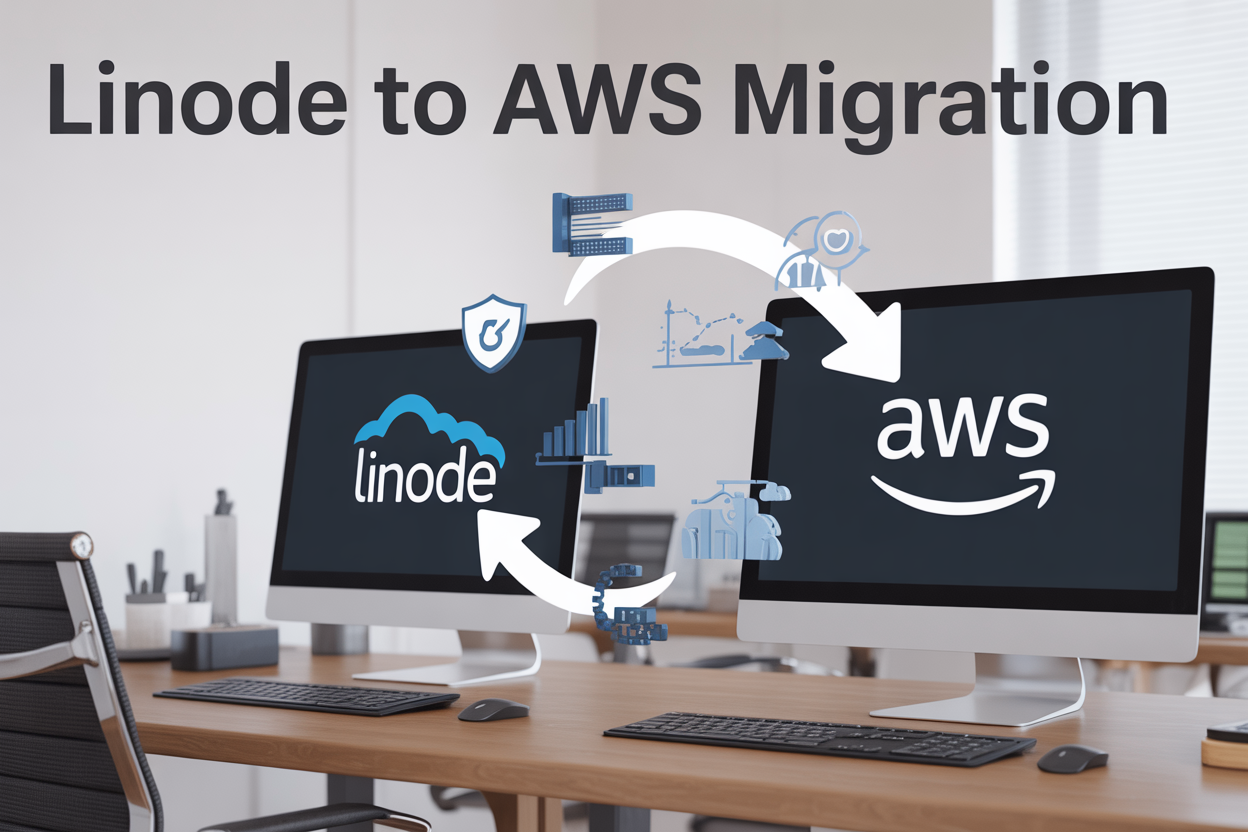
Moving from Linode to AWS can transform your cloud infrastructure, giving you access to better scalability, rock-solid reliability, and a global network that reaches every corner of the world. This Linode to AWS migration guide is designed for DevOps engineers, IT managers, and cloud architects who want a clear cloud migration roadmap that delivers real results without the headaches.
Many companies stick with their current cloud provider because migration feels overwhelming. But with the right AWS migration strategies and proper cloud migration planning, you can make the switch smoothly while setting up your business for long-term growth. AWS offers enterprise-grade services, advanced security features, and cost optimization tools that can significantly improve your operations.
We’ll walk you through the essential steps of cloud infrastructure migration, starting with a thorough pre-migration assessment that maps out your current setup and identifies potential challenges before they become problems. You’ll also learn about AWS service selection and architecture design, where we’ll show you how to pick the right AWS services and design an infrastructure that matches your specific needs. Finally, we’ll cover data migration strategies and tools, including the best cloud migration tools and AWS migration best practices to move your data safely and efficiently without downtime.
Pre-Migration Assessment and Planning

Analyze Current Linode Infrastructure and Dependencies
Understanding your existing Linode setup forms the backbone of a successful AWS migration roadmap. Start by creating a comprehensive inventory of your current resources, including virtual machines, storage volumes, networking configurations, and load balancers. Document CPU, memory, and storage specifications for each instance, along with their operating systems and installed applications.
Map out your application dependencies to identify potential migration challenges. Some applications might have tight coupling with specific Linode services or configurations that need careful consideration during the transition. Pay special attention to database connections, API integrations, and inter-service communication patterns that could impact your AWS architecture design.
Network topology analysis reveals critical insights about traffic patterns, security groups, and firewall rules. Document your current bandwidth usage, peak traffic periods, and any custom networking configurations. This information helps you select appropriate AWS networking services and estimate data transfer costs.
Don’t overlook your backup strategies, monitoring systems, and disaster recovery procedures. Understanding these operational aspects ensures continuity during migration and helps you identify equivalent AWS services that match your current reliability standards.
Define AWS Target Architecture for Maximum Performance
Your AWS target architecture should leverage cloud-native services while maintaining performance standards. Start by mapping your Linode instances to appropriate EC2 instance types, considering CPU, memory, and network requirements. AWS offers a broader range of instance families optimized for different workloads – compute-optimized, memory-optimized, or general-purpose instances.
Design your architecture with scalability in mind. Replace static Linode configurations with Auto Scaling Groups that can handle traffic fluctuations automatically. Consider implementing Elastic Load Balancing to distribute traffic across multiple availability zones, enhancing both performance and reliability.
Storage architecture deserves special attention in your migration planning. Map your Linode block storage to appropriate AWS storage services like EBS volumes, EFS for shared file systems, or S3 for object storage. Each service offers different performance characteristics and cost structures that align with specific use cases.
Database migration often requires the most careful planning. Evaluate whether to migrate your existing databases to EC2 instances or transition to managed services like RDS, Aurora, or DynamoDB. Managed services reduce operational overhead while providing built-in high availability and backup features.
Calculate Total Cost of Ownership and ROI Projections
Accurate cost analysis drives informed migration decisions and helps secure stakeholder buy-in. Use the AWS Pricing Calculator to estimate monthly costs based on your target architecture. Include compute instances, storage, data transfer, and managed services in your calculations.
Compare your current Linode monthly expenses with projected AWS costs across different time horizons. Remember that AWS pricing often decreases with longer commitments through Reserved Instances or Savings Plans. Factor in potential cost optimizations like spot instances for non-critical workloads or automated scaling that reduces idle resources.
| Cost Component | Linode (Monthly) | AWS Initial (Monthly) | AWS Optimized (Monthly) |
|---|---|---|---|
| Compute | $X | $Y | $Z |
| Storage | $X | $Y | $Z |
| Networking | $X | $Y | $Z |
| Managed Services | $X | $Y | $Z |
Beyond infrastructure costs, calculate operational savings from reduced management overhead. AWS managed services eliminate many routine maintenance tasks, freeing up your team for strategic initiatives. Quantify these savings by estimating time saved on server patching, backup management, and infrastructure monitoring.
Consider the revenue impact of improved performance and reliability. AWS’s global infrastructure can reduce latency for international users, potentially increasing customer satisfaction and retention. Enhanced disaster recovery capabilities minimize downtime costs.
Establish Migration Timeline and Resource Allocation
A well-structured migration timeline balances speed with risk management. Break down your migration into phases, starting with less critical systems to gain experience before moving production workloads. This phased approach allows you to refine your processes and address unexpected challenges early.
Create detailed task lists for each migration phase, including infrastructure setup, application testing, data synchronization, and cutover procedures. Assign realistic timeframes that account for testing periods and potential rollback scenarios. Most organizations underestimate testing time, so allocate adequate resources for thorough validation.
Resource allocation extends beyond technical personnel. Identify team members responsible for different migration aspects – infrastructure setup, application configuration, testing, and go-live support. Consider whether you need additional training or external consulting support for specialized AWS services.
Plan for parallel operations during the migration window. Your Linode infrastructure needs to remain operational while AWS resources are prepared and tested. This dual-environment approach requires careful coordination but minimizes business disruption.
Communication planning keeps stakeholders informed throughout the migration process. Establish regular check-ins with business users, create status dashboards, and prepare contingency communication for any issues that arise during cutover windows.
AWS Service Selection and Architecture Design

Choose Optimal AWS Compute Services for Your Workload
Selecting the right AWS compute service makes or breaks your Linode to AWS migration success. Amazon EC2 instances serve as the backbone for most migrations, offering familiar virtual machines that mirror your existing Linode setup. Start by mapping your current Linode instances to EC2 instance types based on CPU, memory, and storage requirements.
For applications requiring consistent performance, choose Dedicated Hosts or Dedicated Instances. If your workload tolerates interruptions, Spot Instances can slash costs by up to 90%. Reserved Instances provide significant savings for predictable, long-term workloads that ran continuously on Linode.
Container-based applications benefit from Amazon ECS or EKS, especially if you’re modernizing during migration. AWS Fargate removes server management overhead entirely, letting you focus on application deployment. For serverless functions, Lambda handles event-driven workloads without provisioning servers.
| Workload Type | Recommended AWS Service | Key Benefits |
|---|---|---|
| Web Applications | EC2 with ALB | Familiar VM experience, flexible scaling |
| Microservices | ECS/EKS | Container orchestration, service mesh |
| Event Processing | Lambda | Serverless, pay-per-execution |
| Batch Jobs | Batch + Spot | Cost optimization, automatic scaling |
Design Multi-Region Setup for Global Reach
AWS’s global infrastructure transforms your migration into an opportunity for worldwide expansion. Unlike Linode’s limited data center options, AWS provides 31 regions across six continents, enabling you to place workloads closer to your users.
Design your architecture around a primary region where your main application runs, with secondary regions for disaster recovery or global user base support. Route 53 geolocation routing automatically directs users to the nearest region, reducing latency significantly.
Cross-region replication becomes straightforward with services like RDS, S3, and DynamoDB Global Tables. Configure automated failover using Route 53 health checks that redirect traffic when your primary region experiences issues.
Consider regulatory compliance when choosing regions. GDPR requirements might mandate EU-based regions for European users, while data sovereignty laws in other countries influence region selection. AWS regions offer built-in compliance frameworks that simplify meeting these requirements.
Implement Auto-Scaling and Load Balancing Solutions
Auto-scaling transforms fixed Linode infrastructure into dynamic, responsive AWS architecture. Application Load Balancers distribute traffic across healthy instances while performing health checks to remove failing servers from rotation automatically.
Configure Auto Scaling Groups with CloudWatch metrics to scale based on CPU usage, network traffic, or custom application metrics. Target tracking scaling policies maintain optimal performance by adding instances when demand increases and removing them during quiet periods.
Predictive scaling uses machine learning to anticipate traffic patterns, pre-scaling your infrastructure before demand spikes hit. This proves especially valuable for applications with regular traffic patterns or seasonal variations.
Network Load Balancers handle extreme traffic volumes with ultra-low latency, perfect for gaming or real-time applications. For internal services, Gateway Load Balancers provide transparent network traffic inspection and security appliance integration.
Set up multiple Availability Zones within your chosen region to achieve high availability that exceeds single-datacenter Linode deployments. This architecture automatically recovers from hardware failures or entire datacenter outages without manual intervention.
Data Migration Strategies and Tools

Select the Right Data Transfer Method for Your Volume
Choosing the right data transfer approach can make or break your Linode to AWS migration timeline and budget. Small datasets under 100GB often work well with network-based transfers using AWS DataSync or native tools like rsync. These methods offer real-time monitoring and automatic retry capabilities that keep your migration on track.
For larger workloads exceeding 1TB, AWS Snowball devices become game-changers. These physical storage appliances bypass internet bandwidth limitations and can transfer up to 80TB per device. AWS also offers Snowball Edge for compute-intensive workloads and Snowmobile for enterprise-scale transfers reaching petabyte levels.
| Transfer Method | Best For | Transfer Speed | Cost Consideration |
|---|---|---|---|
| AWS DataSync | <100GB | Network dependent | Pay-per-GB transferred |
| AWS Snowball | 1TB-80TB | ~1 week total | Device rental + shipping |
| AWS Direct Connect | Ongoing transfers | Up to 100Gbps | Monthly port charges |
| Third-party tools | Mixed environments | Varies | Licensing costs |
Hybrid approaches often deliver the best results. Use Snowball for initial bulk transfers, then switch to DataSync for ongoing synchronization and final cutover data. This strategy minimizes both transfer time and network congestion during your AWS migration planning phase.
Minimize Downtime with Strategic Cutover Planning
Smart cutover planning transforms potentially disruptive migrations into seamless transitions. Start by mapping your application dependencies and identifying which services can migrate independently versus those requiring coordinated moves.
Database migrations typically require the most careful timing. Use AWS Database Migration Service (DMS) to set up continuous replication from your Linode databases to AWS RDS or EC2 instances. This approach keeps your source and target databases synchronized until you’re ready to switch traffic.
Create detailed cutover runbooks that include specific timing windows, rollback procedures, and communication protocols. Schedule migrations during low-traffic periods and consider geographic user patterns. Applications serving global audiences might need staggered regional cutovers to maintain service availability.
Blue-green deployment strategies work exceptionally well for web applications. Keep your Linode environment running while building identical infrastructure on AWS. Once testing validates the AWS environment, simply redirect DNS traffic to complete the migration. This approach reduces downtime to mere minutes rather than hours.
Test your cutover procedures multiple times with non-production data. Each rehearsal reveals timing bottlenecks and process gaps that could extend your maintenance window.
Validate Data Integrity Throughout the Migration Process
Data integrity verification isn’t optional – it’s the foundation of successful cloud migration strategies. Start with baseline checksums of your source data before beginning any transfer operations. These fingerprints become your validation anchor points throughout the entire process.
Implement multi-layer verification approaches:
- File-level checksums using MD5 or SHA-256 algorithms
- Database row counts and sample record comparisons
- Application-level testing with real user scenarios
- Performance benchmarks comparing response times and throughput
AWS offers built-in integrity checking through services like DataSync, which automatically verifies transferred files. For database migrations, AWS DMS provides validation features that compare source and target schemas, data types, and record counts.
Schedule validation checkpoints at regular intervals rather than waiting until migration completion. Early detection of data corruption or sync issues prevents cascading problems that become exponentially harder to fix later.
Create automated validation scripts that run continuously during your migration window. These scripts should flag discrepancies immediately and trigger alerts to your migration team. Document all validation results for compliance auditing and post-migration reviews.
Implement Backup and Disaster Recovery Solutions
Robust backup strategies protect your migration investment and provide confidence during the transition process. AWS backup solutions offer significant advantages over traditional Linode backup approaches, including automated scheduling, cross-region replication, and point-in-time recovery options.
Configure AWS Backup to create migration-specific snapshots before, during, and after your cutover activities. These snapshots serve as rollback points if issues emerge post-migration. Set retention policies that balance compliance requirements with storage costs.
Cross-region backup replication provides disaster recovery capabilities that many Linode configurations lack. AWS offers automated backup copying to different availability zones and regions, protecting against both local failures and regional outages.
For critical databases, implement more granular backup strategies:
- Transaction log backups every 15 minutes for minimal data loss
- Full database backups daily with encrypted storage
- Point-in-time recovery capabilities for precise rollback scenarios
Test your backup and recovery procedures regularly using non-production environments. Create detailed recovery runbooks that include estimated recovery times and step-by-step instructions. These procedures become invaluable during high-stress incident response situations.
Consider AWS Disaster Recovery solutions like AWS Elastic Disaster Recovery for complete infrastructure protection. These services can replicate your entire environment automatically and failover within minutes if needed.
Security and Compliance Enhancement

Leverage AWS Identity and Access Management Best Practices
Moving from Linode to AWS migration opens doors to sophisticated identity management capabilities that far exceed traditional hosting environments. AWS Identity and Access Management (IAM) becomes your security cornerstone, replacing simple SSH key management with granular permission controls.
Start by creating dedicated IAM roles for different functions rather than sharing root credentials. Database administrators need different access levels than web developers, and your AWS migration strategies should reflect this principle from day one. Implement the principle of least privilege by granting only the minimum permissions required for each role to function effectively.
Multi-factor authentication (MFA) transforms from optional to mandatory during your Linode to AWS migration. Configure MFA for all human users, especially those with administrative privileges. AWS supports various MFA devices, from virtual authenticators to hardware tokens, giving you flexibility based on your security requirements.
Cross-account access patterns become crucial as your AWS environment grows. Instead of creating duplicate users across multiple AWS accounts, establish cross-account roles that allow secure access without credential duplication. This approach streamlines your cloud migration best practices while maintaining security boundaries.
Regular access reviews prevent permission creep that commonly occurs during rapid migration phases. Schedule quarterly reviews of IAM permissions, removing unused roles and tightening overly broad policies. AWS Access Analyzer helps identify unused permissions and external access patterns that might indicate security risks.
Implement Advanced Network Security with VPC Configuration
Virtual Private Cloud (VPC) architecture represents a fundamental shift from Linode’s simpler networking model to AWS’s enterprise-grade network isolation. Your AWS migration planning must prioritize VPC design as the foundation for all subsequent security measures.
Design your VPC with multiple subnets across different availability zones to achieve both security and high availability. Public subnets should host only resources that require direct internet access, like load balancers and NAT gateways. Private subnets become the secure home for your application servers and databases, accessible only through carefully controlled routes.
Security groups act as virtual firewalls, replacing traditional iptables configurations with dynamic, stateful rules. Unlike Linode’s server-level firewall rules, AWS security groups apply at the instance level and support sophisticated rule combinations. Create specific security groups for each tier of your application stack – web servers, application servers, and databases each need different access patterns.
Network Access Control Lists (NACLs) provide an additional security layer at the subnet level. While security groups handle allow rules, NACLs can explicitly deny traffic, creating defense in depth. Configure NACLs to block suspicious traffic patterns and provide backup protection if security group rules become misconfigured.
VPC Flow Logs capture detailed information about network traffic, enabling security monitoring that wasn’t possible in traditional hosting environments. Enable VPC Flow Logs for all subnets to track connection attempts, data transfer patterns, and potential security incidents.
Enable Comprehensive Monitoring and Logging Capabilities
AWS CloudTrail revolutionizes audit capabilities during your cloud infrastructure migration by recording every API call made within your AWS environment. Unlike Linode’s basic logging, CloudTrail provides a comprehensive audit trail showing who did what, when, and from where.
Configure CloudTrail to log all regions and services, storing logs in a dedicated S3 bucket with restricted access. Enable log file integrity validation to detect any tampering attempts. Multi-region CloudTrail setup ensures you capture all activity across your global AWS infrastructure, supporting compliance requirements that may have been impossible with Linode’s limited geographic presence.
Amazon GuardDuty provides intelligent threat detection that analyzes your AWS environment for malicious activity. This managed threat detection service monitors for unusual behavior patterns, compromised instances, and potential data exfiltration attempts. GuardDuty’s machine learning algorithms adapt to your normal traffic patterns, reducing false positives while maintaining high detection rates.
AWS Config continuously monitors your resource configurations and compliance status. Set up Config rules to automatically check for security best practices, like ensuring all S3 buckets block public access or verifying that security groups don’t allow unrestricted SSH access. Config can automatically remediate certain violations, maintaining security posture without manual intervention.
Centralized logging through CloudWatch Logs aggregates application logs, system logs, and custom metrics in a searchable format. Create custom dashboards that visualize key security metrics and set up automated alerts for suspicious activities. This level of monitoring sophistication represents a significant upgrade from basic server monitoring available in traditional hosting environments.
Performance Optimization and Cost Management

Utilize AWS Reserved Instances for Long-Term Savings
After completing your Linode to AWS migration, Reserved Instances become your secret weapon for slashing compute costs by up to 75% compared to On-Demand pricing. Unlike Linode’s straightforward monthly billing, AWS offers flexible commitment options spanning one to three years. When you know your baseline workload requirements, Reserved Instances provide predictable pricing while maintaining the same performance characteristics.
Standard Reserved Instances work best for steady-state applications with consistent usage patterns. Convertible Reserved Instances offer more flexibility, allowing you to modify instance families, sizes, or regions as your needs evolve. For workloads with flexible timing requirements, Scheduled Reserved Instances provide cost savings for predictable recurring capacity needs.
The savings planning calculator helps determine optimal reservation strategies based on your historical usage data from Linode. Start conservatively with shorter-term commitments while you establish usage patterns in AWS, then gradually increase reservation coverage as confidence grows in your capacity planning.
Implement CloudWatch Monitoring for Proactive Management
CloudWatch transforms your AWS migration from reactive firefighting to proactive infrastructure management. Unlike basic monitoring available on Linode, CloudWatch provides deep visibility into every aspect of your AWS environment through customizable dashboards and automated alerting.
Set up custom metrics that align with your business objectives, tracking everything from application response times to database connection pools. CloudWatch Logs centralizes log management across all services, making troubleshooting significantly more efficient than managing individual log files on Linode instances.
Create intelligent alarms that trigger automated responses before issues impact users. For example, configure CPU utilization alerts that automatically scale resources or notify administrators when thresholds exceed normal operating ranges. CloudWatch Events enables workflow automation, connecting monitoring data to remediation actions without manual intervention.
The unified monitoring approach reduces operational overhead while improving system reliability. Integration with other AWS services creates comprehensive observability that extends far beyond traditional server monitoring.
Optimize Resource Allocation with AWS Trusted Advisor
AWS Trusted Advisor acts as your personal cloud consultant, identifying optimization opportunities that might take months to discover manually. This service analyzes your entire AWS environment across five key categories: cost optimization, security, fault tolerance, performance, and service limits.
Cost optimization recommendations highlight unused or underutilized resources, suggesting rightsizing opportunities for EC2 instances that consistently operate below capacity. Security checks identify configuration gaps, such as unrestricted security groups or publicly accessible RDS snapshots that could compromise your migration.
Performance recommendations suggest improvements like enabling CloudFront distributions for global content delivery or upgrading to newer instance types with better price-performance ratios. The service automatically updates recommendations as your environment evolves, ensuring optimization efforts remain relevant.
Review Trusted Advisor findings weekly during the initial months post-migration, then transition to monthly reviews as your environment stabilizes. Implement recommendations incrementally to avoid disrupting production workloads while maximizing the benefits of your AWS migration.
Configure Automated Scaling Policies for Peak Efficiency
Auto Scaling transforms your AWS infrastructure into a dynamic, responsive system that adapts to changing demand without manual intervention. Unlike Linode’s manual scaling approach, AWS Auto Scaling automatically adjusts capacity based on predefined policies and real-time metrics.
Target Tracking Scaling maintains desired performance levels by automatically increasing or decreasing capacity to keep metrics like CPU utilization at optimal levels. Step Scaling provides more granular control, defining specific scaling actions based on alarm thresholds. Predictive Scaling leverages machine learning to forecast demand and proactively adjust capacity.
Configure scaling policies for both scale-out and scale-in scenarios to optimize costs during low-demand periods. Set conservative cooldown periods initially to prevent rapid scaling oscillations while you fine-tune thresholds based on actual workload behavior.
Application Load Balancer integration ensures new instances automatically join the load-balanced pool, maintaining seamless user experiences during scaling events. Combine Auto Scaling with Spot Instances for additional cost savings on fault-tolerant workloads.
Set Up Cost Alerts and Budget Controls
AWS Budgets and Cost Explorer provide financial guardrails that prevent surprise billing scenarios common during cloud migrations. Unlike Linode’s predictable monthly costs, AWS’s pay-as-you-go model requires proactive budget management to avoid unexpected expenses.
Create multiple budget categories covering different aspects of your migration: overall monthly spending, service-specific budgets for EC2 and RDS, and project-based budgets for development environments. Set alert thresholds at 80% and 100% of budget limits, with different notification recipients based on severity levels.
Cost anomaly detection automatically identifies unusual spending patterns that might indicate misconfigured resources or unexpected usage spikes. This feature proves invaluable during the post-migration period when usage patterns may fluctuate as teams adapt to new workflows.
Use Cost Explorer to analyze spending trends and identify optimization opportunities through detailed filtering by service, region, or custom tags. Schedule regular cost reviews with stakeholders to ensure spending aligns with business objectives and migration ROI expectations.
Implement resource tagging strategies that enable accurate cost allocation across departments, projects, or environments. Proper tagging facilitates chargeback models and helps identify which parts of your migration deliver the highest value.
Post-Migration Validation and Monitoring

Conduct Comprehensive Performance Testing and Benchmarking
After completing your Linode to AWS migration, you need to verify that your applications perform as expected in their new environment. Performance testing should cover all critical workloads and compare them against baseline metrics from your Linode infrastructure.
Start with load testing using tools like Apache JMeter, Artillery, or AWS’s own load testing solutions. Test your applications under normal, peak, and stress conditions to identify any bottlenecks or performance degradation. Pay special attention to network latency, database response times, and application throughput. Your AWS migration strategies should include provisions for handling traffic spikes that might reveal unexpected performance issues.
Create benchmarking scripts that measure key performance indicators such as response times, concurrent user capacity, and resource utilization. Compare these results with your pre-migration baselines to validate that the migration met your performance objectives. If you notice any degradation, investigate whether it’s due to incorrect instance sizing, network configuration issues, or the need for additional AWS services like CloudFront or ElastiCache.
Run synthetic transactions that mirror real user behavior patterns. This approach helps identify performance issues that might not surface during basic load testing but could affect actual user experience. Document all test results and create a performance baseline for future reference.
Establish Ongoing Monitoring and Alerting Systems
Monitoring your AWS infrastructure requires a different approach than what you used on Linode. AWS provides native monitoring tools like CloudWatch, but you’ll need to configure them properly to get meaningful insights into your system’s health and performance.
Set up CloudWatch dashboards that display critical metrics for your specific workloads. Create custom metrics for application-level monitoring that goes beyond basic infrastructure metrics. Configure alarms for key thresholds such as CPU utilization, memory consumption, disk usage, and network performance. Don’t forget to monitor AWS-specific metrics like EBS volume performance and RDS connection counts.
Implement distributed tracing using AWS X-Ray to track requests across multiple services and identify performance bottlenecks in microservices architectures. This becomes particularly important if your cloud migration roadmap includes breaking down monolithic applications into smaller, distributed components.
Consider using third-party monitoring solutions like Datadog, New Relic, or Grafana for enhanced visualization and alerting capabilities. These tools often provide better integration with multiple cloud platforms and can help you maintain monitoring consistency if you’re running hybrid environments.
Configure notification channels for different types of alerts. Critical infrastructure issues should trigger immediate notifications via SMS or phone calls, while less urgent alerts can go through email or Slack channels. Create escalation procedures for alerts that don’t get acknowledged within specific timeframes.
Document New Operational Procedures and Best Practices
Your operational procedures will change significantly after migrating from Linode to AWS. The cloud migration tools and processes you used during migration need to be documented for future reference, but daily operations require entirely new documentation.
Create runbooks for common operational tasks such as scaling resources, deploying updates, backing up data, and handling incident response. Include step-by-step instructions for using AWS services like Auto Scaling Groups, CloudFormation templates, and RDS snapshots. Your team needs clear guidance on how to perform tasks that might have been simpler in the Linode environment.
Document your new backup and disaster recovery procedures. AWS offers different backup options than Linode, and your team needs to understand how to use services like AWS Backup, EBS snapshots, and cross-region replication. Include recovery time objectives (RTO) and recovery point objectives (RPO) for different types of failures.
Establish change management procedures for your AWS environment. Document how to request and approve infrastructure changes, deploy application updates, and roll back problematic deployments. Include guidelines for using AWS services like CodeDeploy, CodePipeline, and CloudFormation for automated deployments.
Create security operational procedures that cover IAM management, security group modifications, and incident response protocols. Your Linode AWS migration guide should include security best practices specific to AWS, such as enabling GuardDuty, configuring AWS Config rules, and managing service-linked roles.
Develop cost management procedures that help your team monitor and control AWS spending. Include guidelines for rightsizing instances, using Reserved Instances or Savings Plans, and implementing cost allocation tags. Regular cost reviews should become part of your operational routine to prevent unexpected billing surprises.

Making the jump from Linode to AWS might seem overwhelming at first, but with the right planning and approach, you’ll unlock incredible benefits that make the effort worthwhile. By carefully assessing your current setup, choosing the right AWS services, and implementing solid migration strategies, you’re setting your business up for enhanced scalability and global reach. The security improvements and cost management opportunities alone can transform how your applications perform and how much you spend on infrastructure.
Start your migration journey today by conducting that initial assessment we discussed. Take inventory of your current Linode resources, map out your AWS architecture, and create a timeline that works for your team. Remember, successful migrations happen step by step, not all at once. With AWS’s robust tools and global infrastructure waiting for you, there’s no better time to make the move and give your applications the foundation they deserve.