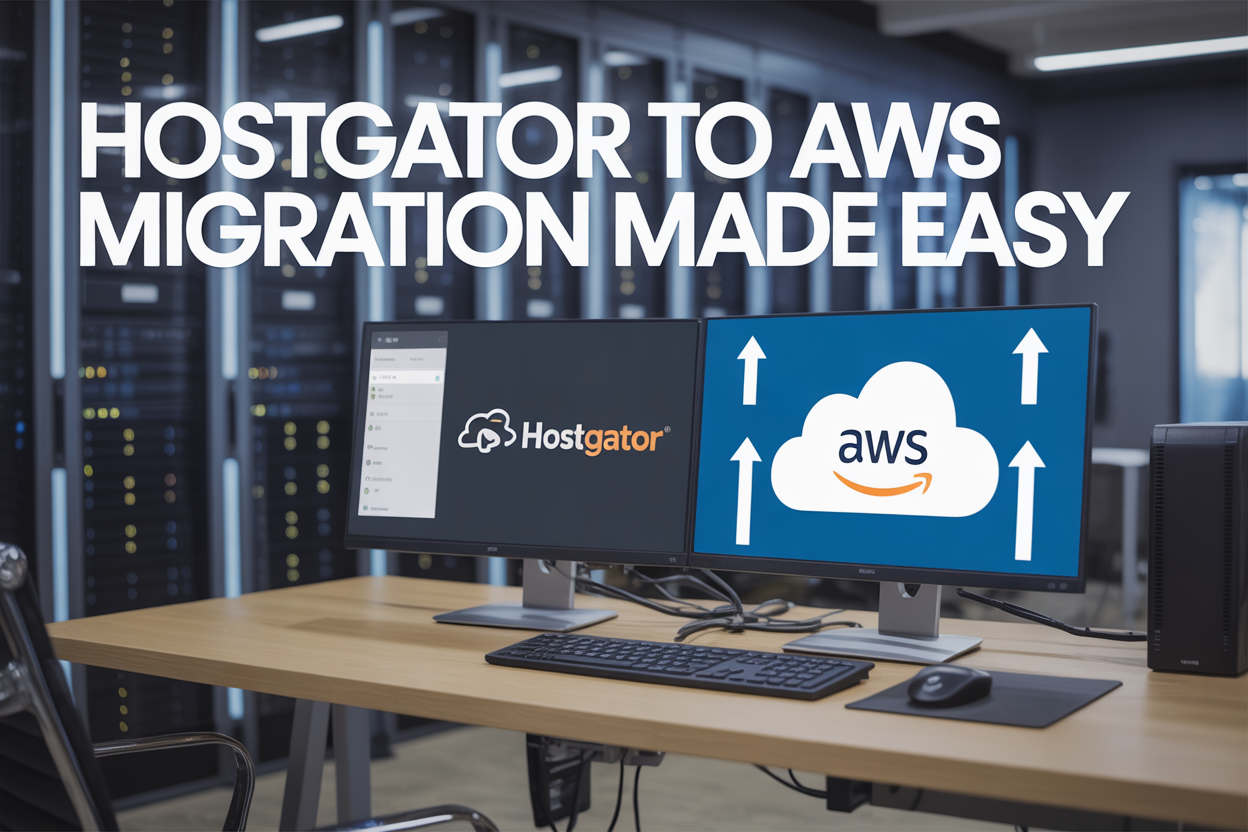
Your HostGator hosting might be holding your business back from reaching its full potential. If you’re running a growing website, e-commerce store, or web application on shared hosting, you’ve probably noticed performance bottlenecks, security limitations, and scaling frustrations that come with traditional hosting platforms.
This comprehensive HostGator to AWS migration guide is designed for business owners, developers, and IT teams ready to move beyond the constraints of shared hosting. We’ll walk you through why AWS hosting benefits far exceed what HostGator can offer, and show you exactly how to make the switch without breaking your website or your budget.
You’ll discover why AWS outperforms HostGator for modern businesses, including superior security advantages and unlimited scalability features that adapt to your traffic spikes. We’ll also cover our proven step-by-step HostGator migration process that minimizes downtime and protects your data. Finally, you’ll learn practical AWS cost optimization strategies and how to leverage cloud hosting migration benefits for long-term business growth.
Ready to leave shared hosting limitations behind? Let’s get your website running on enterprise-grade infrastructure that scales with your success.
Why AWS Outperforms HostGator for Modern Businesses

Superior Infrastructure and Global Reach
AWS operates one of the world’s most extensive cloud infrastructure networks, with over 30 regions and 100+ availability zones spanning six continents. This massive global footprint puts AWS in a completely different league compared to HostGator’s traditional shared hosting environment. When you migrate from HostGator to AWS, you gain access to data centers strategically positioned worldwide, allowing you to serve content from locations closest to your users.
The infrastructure advantage goes beyond geographic coverage. AWS data centers feature redundant power supplies, advanced cooling systems, and multiple internet service providers to ensure maximum uptime. While HostGator typically houses thousands of websites on shared servers, AWS provides dedicated virtual environments that eliminate the “noisy neighbor” problem where other websites can impact your performance.
Each AWS region operates independently, creating natural disaster recovery capabilities that shared hosting simply cannot match. Your website can automatically failover to different regions during outages, maintaining availability even during major infrastructure disruptions.
Enhanced Performance and Speed Capabilities
Performance represents one of the most compelling reasons for HostGator to AWS migration. AWS offers multiple instance types optimized for different workloads – from CPU-intensive applications to memory-heavy databases. This level of customization allows you to match your infrastructure precisely to your application’s needs, rather than settling for a one-size-fits-all shared hosting solution.
Content delivery becomes dramatically faster through Amazon CloudFront, AWS’s global content delivery network. This service caches your static content across 400+ edge locations worldwide, reducing load times by up to 60% compared to traditional hosting. HostGator’s basic CDN offerings pale in comparison to this enterprise-grade solution.
AWS also provides advanced caching options through ElastiCache (Redis/Memcached) and database acceleration through services like DynamoDB Accelerator. These tools can reduce database query times from hundreds of milliseconds to single-digit microseconds, creating a responsive user experience that keeps visitors engaged.
Auto-scaling capabilities ensure your website maintains optimal performance during traffic spikes. While HostGator websites often slow down or crash during high-traffic periods, AWS automatically provisions additional resources to handle increased demand and scales back down when traffic normalizes.
Advanced Security Features and Compliance Standards
Security represents a critical advantage in any AWS vs HostGator comparison. AWS maintains compliance with over 100 security standards and certifications, including SOC 1/2/3, PCI DSS Level 1, and ISO 27001. This comprehensive compliance framework provides peace of mind for businesses handling sensitive data or operating in regulated industries.
The platform includes built-in DDoS protection through AWS Shield, which automatically detects and mitigates attacks without requiring manual intervention. Advanced threat protection comes standard, whereas HostGator customers often need to purchase additional security services.
AWS Identity and Access Management (IAM) provides granular control over user permissions and access levels. You can create specific roles for developers, administrators, and applications, ensuring each entity has exactly the permissions needed and nothing more. This level of security control is impossible with traditional shared hosting accounts.
Data encryption options include encryption at rest, in transit, and in use. AWS Key Management Service handles encryption keys securely, while HostGator’s basic SSL certificates provide only basic protection during data transmission.
Regular security patches and updates happen automatically across the AWS infrastructure, eliminating the manual maintenance requirements that plague traditional hosting environments.
Cost-Effective Pricing Models for Growing Businesses
AWS pricing models offer significant advantages for growing businesses through pay-as-you-use billing structures. Unlike HostGator’s fixed monthly fees that charge for resources whether you use them or not, AWS cost optimization allows you to pay only for consumed resources.
The Reserved Instance program provides up to 75% discounts for predictable workloads, while Spot Instances offer up to 90% savings for flexible applications. These pricing options don’t exist in traditional hosting environments.
Businesses can start small with AWS Free Tier, which includes 12 months of free services for new accounts. This allows companies to test and develop applications without upfront costs, then scale pricing alongside business growth.
Cost transparency tools like AWS Cost Explorer and Budgets provide detailed insights into spending patterns, enabling proactive cost management. You can set alerts for unexpected spending spikes and identify optimization opportunities that keep costs under control.
The elimination of hardware maintenance, software licensing, and data center costs creates additional savings. While HostGator customers pay for the overhead of maintaining shared infrastructure, AWS customers benefit from economies of scale across millions of users.
Pre-Migration Planning for Seamless Transition

Comprehensive Website and Database Assessment
Before starting your HostGator to AWS migration, you need to know exactly what you’re working with. Start by creating a detailed inventory of your current setup. List all your websites, applications, databases, email accounts, and file storage. Don’t forget about those forgotten subdomains or staging sites that might be lurking around.
Check your website’s current resource usage through HostGator’s control panel. Look at your monthly bandwidth consumption, storage usage, CPU utilization, and memory requirements. This data helps determine which AWS services you’ll need and what instance sizes make sense for your workload.
Database assessment requires special attention during AWS migration planning. Export your MySQL or PostgreSQL databases and note their sizes, structures, and any custom configurations. If you’re running WordPress, Joomla, or other CMS platforms, document all installed plugins, themes, and customizations. Some plugins might not work identically in the AWS environment, so plan for testing and potential alternatives.
Review your current backup schedules and retention policies. HostGator’s backup system won’t transfer to AWS, so you’ll need to implement new backup strategies using AWS services like automated snapshots or third-party backup solutions.
Choosing the Right AWS Services for Your Needs
AWS offers dozens of services, but for most HostGator migration projects, you’ll focus on a core set of services that match your current hosting needs.
For web hosting, Amazon EC2 provides virtual servers similar to HostGator’s shared or VPS hosting, but with much more control and scalability. If you’re running simple websites with moderate traffic, a t3.micro or t3.small instance often provides a good starting point. High-traffic sites might need larger instances or even multiple servers behind a load balancer.
Database hosting depends on your current setup. Amazon RDS works perfectly for MySQL or PostgreSQL databases and handles maintenance, backups, and scaling automatically. For WordPress sites, RDS MySQL instances typically provide better performance and reliability than the database options on traditional shared hosting.
| Current HostGator Setup | Recommended AWS Services |
|---|---|
| Shared Hosting | EC2 t3.micro + RDS MySQL |
| VPS Hosting | EC2 t3.small/medium + RDS |
| Dedicated Server | EC2 m5.large+ + RDS |
| Multiple Sites | EC2 + Application Load Balancer |
Amazon S3 handles file storage and can serve static content like images, CSS, and JavaScript files more efficiently than traditional web hosting. CloudFront, AWS’s content delivery network, speeds up your site globally by caching content at edge locations worldwide.
Route 53 manages your domain names and DNS records, replacing HostGator’s DNS management with enterprise-grade reliability and advanced routing features.
Creating a Detailed Migration Timeline and Backup Strategy
Your HostGator to AWS migration timeline should spread the work over several weeks to avoid rushed decisions and minimize downtime. Start planning at least 30 days before your target migration date.
Week 1 focuses on AWS account setup and initial service configuration. Create your AWS account, set up billing alerts, and launch your first EC2 instance in a test environment. Install and configure your web server software (Apache, Nginx, or your preferred stack) to match your current HostGator setup.
Week 2 involves database migration and initial testing. Create your RDS instance and import a copy of your production database. Test database connectivity and run through your application’s core functions to catch any compatibility issues early.
Week 3 handles file migration and DNS preparation. Transfer your website files to EC2 and S3, configure your web server, and thoroughly test everything in the AWS environment. Set up your production domain in Route 53 but don’t switch DNS yet.
Week 4 executes the final migration. Lower your DNS TTL values to 300 seconds a few days before switching. When ready, update your DNS records to point to AWS, monitor for issues, and keep HostGator running as a backup for 24-48 hours.
Your backup strategy should include both pre-migration and post-migration elements. Before starting, create complete backups of everything on HostGator – websites, databases, email, and configuration files. Store these backups in multiple locations, including local storage and cloud storage outside of both HostGator and AWS.
During migration, take snapshots of your AWS instances at each major step. This lets you roll back quickly if something goes wrong. After going live, implement automated daily backups using AWS backup services and test your restore procedures regularly.
Keep your HostGator account active for at least 30 days after migration as an additional safety net. This overlap period provides peace of mind and gives you time to ensure everything works perfectly in the AWS environment before fully committing to the cloud hosting migration.
Step-by-Step HostGator to AWS Migration Process

Setting Up Your AWS Environment and Security Groups
Your HostGator to AWS migration starts with building a secure foundation in the cloud. Begin by creating an AWS account if you haven’t already, then set up a Virtual Private Cloud (VPC) to establish your network infrastructure. Think of this as creating your digital neighborhood where all your resources will live.
Configure security groups as your first line of defense. These act like smart firewalls that control traffic flow to your instances. Create separate security groups for web servers (allowing HTTP/HTTPS traffic), database servers (restricting access to your application tier), and administrative access (limiting SSH/RDP to your IP addresses). This layered approach protects your AWS hosting environment from day one.
Next, launch your EC2 instances based on your website’s requirements. For most WordPress sites migrating from HostGator, a t3.medium instance provides excellent performance and cost balance. Choose Amazon Linux 2 or Ubuntu for your operating system, as both offer strong security and extensive documentation for web hosting configurations.
Set up IAM (Identity and Access Management) roles with minimal required permissions. Create separate users for different functions – one for migration tasks, another for ongoing maintenance, and restricted access for developers. This granular control gives you security advantages that traditional shared hosting simply can’t match.
Migrating Files, Databases, and Email Accounts
File migration represents the bulk of your HostGator migration process. Start by creating a complete backup of your HostGator hosting account through cPanel’s backup wizard. Download your website files, databases, and email data to your local machine as a safety net.
For file transfer to AWS, use secure methods like SCP or SFTP to move your website files to your EC2 instance. If you’re dealing with large amounts of data, consider AWS DataSync or even shipping a storage device through AWS Snowball for massive datasets. Most standard websites transfer smoothly using FileZilla or command-line tools.
Database migration requires special attention. Export your MySQL databases from HostGator using phpMyAdmin or command-line tools. Create an Amazon RDS instance for managed database hosting, or install MySQL directly on your EC2 instance for more control. Import your databases using standard MySQL import commands, but test thoroughly to ensure data integrity.
Email migration presents unique challenges since AWS doesn’t provide email hosting directly. You have several options: migrate to Amazon WorkMail, use third-party services like Google Workspace, or set up your own mail server on EC2. Most businesses find external email services more reliable and easier to manage than self-hosted solutions.
Domain Name and DNS Configuration Transfer
DNS configuration changes mark the final step before going live with your website migration to AWS. Before making any changes, document your current DNS settings from HostGator’s control panel. Screenshot or export your DNS zone file to avoid losing any important records like MX records for email or CNAME records for subdomains.
Set up your DNS in AWS Route 53 for maximum integration with other AWS services. Route 53 offers advanced features like health checks, latency-based routing, and geographic DNS that can improve your website’s performance globally. Create a hosted zone for your domain and configure A records pointing to your EC2 instance’s Elastic IP address.
Lower your DNS TTL (Time To Live) values 24-48 hours before the migration. This step reduces the time it takes for DNS changes to propagate worldwide. A TTL of 300 seconds (5 minutes) works well during migration, though you can increase it back to 3600 seconds (1 hour) after everything stabilizes.
Update your domain registrar’s nameservers to point to Route 53’s nameservers. This change typically takes 24-48 hours to fully propagate, but most users will see your new AWS-hosted site within a few hours. Keep your HostGator hosting active during this transition period to catch any users still hitting the old servers.
SSL Certificate Installation and Validation
SSL certificates are non-negotiable for modern websites, and AWS makes certificate management simpler than traditional hosting. AWS Certificate Manager (ACM) provides free SSL certificates that automatically renew, eliminating the headache of manual certificate management you might have experienced with HostGator.
Request a certificate through ACM by entering your domain name and any subdomains you need to secure. AWS will validate your domain ownership through email or DNS validation. DNS validation works seamlessly if you’re using Route 53, as AWS automatically adds the required validation records.
Configure your web server to use the SSL certificate. If you’re using an Application Load Balancer (ALB), attach the ACM certificate directly to the load balancer and let it handle SSL termination. For direct EC2 installations, download the certificate and configure it in your web server (Apache, Nginx, etc.).
Test your SSL installation using tools like SSL Labs’ SSL Test. This free tool checks your certificate configuration, identifies potential security issues, and provides recommendations for optimization. Aim for an A or A+ grade to ensure your AWS security advantages are fully realized.
Testing Website Functionality and Performance
Comprehensive testing ensures your HostGator to AWS migration delivers improved performance without breaking existing functionality. Start by testing your website using a temporary domain or by modifying your local hosts file to point your domain to your new AWS server before making DNS changes public.
Create a systematic testing checklist covering all website features: contact forms, shopping cart functionality, user registration, search features, and any custom applications. Test across different browsers and devices to ensure compatibility. Pay special attention to any WordPress plugins or custom scripts that might behave differently in the new environment.
Performance testing reveals the benefits of your cloud migration from HostGator. Use tools like GTmetrix, Google PageSpeed Insights, and Pingdom to measure loading times, identify bottlenecks, and compare performance against your old HostGator setup. Most users see significant speed improvements, especially for database-heavy websites.
Monitor your AWS resources during testing using CloudWatch. Set up basic monitoring for CPU usage, memory consumption, and network traffic. This baseline data helps you understand your resource needs and identify any performance issues before they affect real users.
Run load testing if your website experiences traffic spikes. Tools like Apache JMeter or cloud-based services can simulate multiple users accessing your site simultaneously. This testing reveals how your new AWS infrastructure handles traffic loads and helps you configure auto-scaling if needed.
Post-Migration Optimization and Security Enhancement

Implementing Advanced AWS Security Best Practices
Moving your website from HostGator to AWS opens up a world of enterprise-grade security features that shared hosting simply can’t match. Your first priority should be setting up Identity and Access Management (IAM) policies correctly. Create specific user roles for different team members and avoid using root account credentials for daily operations. This approach limits potential damage if credentials get compromised.
Enable AWS CloudTrail to track all API calls and user activities across your infrastructure. This creates an audit trail that’s essential for compliance and security monitoring. Pair this with AWS Config to monitor configuration changes and ensure your resources stay within security guidelines.
Set up AWS WAF (Web Application Firewall) to protect against common web exploits like SQL injection and cross-site scripting. Unlike basic HostGator security, AWS WAF offers customizable rules and real-time threat intelligence. Configure rate limiting to prevent DDoS attacks and create IP whitelists for administrative access.
Enable encryption at rest for your data using AWS KMS (Key Management Service). This protects your databases, file storage, and backups with military-grade encryption. Also activate encryption in transit by implementing SSL/TLS certificates through AWS Certificate Manager, which provides free certificates that auto-renew.
Setting Up Automated Backups and Monitoring Systems
AWS backup automation goes far beyond the basic daily backups HostGator provides. Use AWS Backup to create cross-region backup policies that protect against regional disasters. Set up multiple backup frequencies – hourly for critical databases, daily for application data, and weekly for less critical content.
Configure Amazon CloudWatch to monitor your infrastructure 24/7. Set up custom metrics for your specific application needs, such as database connection counts, memory usage, and custom application errors. Create CloudWatch alarms that automatically notify you when thresholds are breached or when unusual patterns emerge.
Implement AWS Systems Manager for automated patch management. This ensures your operating systems and applications stay updated with security patches without manual intervention. Schedule maintenance windows during low-traffic periods to minimize impact on your users.
Set up AWS SNS (Simple Notification Service) to send alerts via email, SMS, or Slack when monitoring thresholds are crossed. This proactive approach means you’ll know about issues before your users do, unlike traditional shared hosting where you often discover problems after they’ve affected your site’s performance.
Performance Tuning and Resource Optimization
Right-sizing your AWS resources is crucial for both performance and cost optimization after your HostGator migration. Use AWS Trusted Advisor to identify underutilized resources and get recommendations for instance types that better match your workload patterns.
Implement Amazon CloudFront CDN to dramatically improve your website’s loading times worldwide. Unlike HostGator’s limited caching options, CloudFront provides edge locations globally and integrates seamlessly with your AWS infrastructure. Configure appropriate cache policies for different content types – static assets can be cached for longer periods while dynamic content needs shorter cache times.
Optimize your database performance by implementing Amazon RDS with Multi-AZ deployments for high availability. Use read replicas to distribute database load and improve response times for read-heavy applications. Enable Performance Insights to identify slow queries and optimization opportunities.
Configure Auto Scaling groups to automatically adjust your server capacity based on traffic patterns. This ensures optimal performance during traffic spikes while reducing costs during low-traffic periods. Set up scaling policies based on CPU utilization, memory usage, or custom metrics specific to your application.
Use AWS Lambda for serverless computing where appropriate, especially for background tasks or API endpoints with variable usage patterns. This eliminates the need to maintain always-on servers for sporadic workloads and can significantly reduce costs compared to traditional hosting approaches.
Leveraging AWS Scalability Features for Business Growth

Auto-Scaling Configuration for Traffic Spikes
AWS Auto Scaling takes the guesswork out of handling sudden traffic surges that would have crashed your HostGator shared hosting plan. When you migrate to AWS, you can set up automatic scaling policies that add or remove server instances based on real-time metrics like CPU usage, memory consumption, or active connections.
The EC2 Auto Scaling feature monitors your application’s performance and automatically launches additional instances when demand increases. During Black Friday sales or viral content moments, your website stays responsive while AWS handles the infrastructure scaling behind the scenes. You can configure scaling policies to be aggressive for rapid growth or conservative for gradual increases.
Launch configurations define the template for new instances, including AMI selection, instance types, and security groups. Target tracking scaling policies maintain specific metrics like keeping CPU utilization around 70%, while step scaling allows more granular control over scaling actions based on alarm thresholds.
Load Balancing Setup for High Availability
Application Load Balancers distribute incoming traffic across multiple EC2 instances, ensuring your website remains accessible even if individual servers fail. This redundancy was impossible with HostGator’s single-server shared hosting environment.
Elastic Load Balancing offers three types: Application Load Balancer for HTTP/HTTPS traffic with advanced routing, Network Load Balancer for ultra-high performance TCP traffic, and Classic Load Balancer for legacy applications. Health checks automatically route traffic away from unhealthy instances to maintain service availability.
Cross-zone load balancing distributes traffic evenly across all healthy instances in multiple Availability Zones. You can configure sticky sessions for applications requiring user session persistence, while path-based routing directs different URL patterns to specific target groups.
Content Delivery Network Integration for Global Performance
Amazon CloudFront accelerates your website’s global performance by caching content at edge locations worldwide. Users access your site from the nearest geographic location, dramatically reducing load times compared to HostGator’s limited server locations.
CloudFront integrates seamlessly with S3 for static content delivery, EC2 for dynamic content, and Route 53 for DNS management. You can configure different caching behaviors for various file types – aggressive caching for images and CSS files, shorter TTLs for frequently updated content.
Origin failover provides additional redundancy by automatically switching to backup origins when primary servers become unavailable. Real-time metrics show cache hit ratios, helping optimize caching strategies for better performance and cost efficiency.
Database Scaling Options for Increased Demand
Amazon RDS offers multiple scaling approaches that surpass HostGator’s basic MySQL limitations. Read replicas handle increased read traffic by creating copies of your primary database, perfect for content-heavy websites with many simultaneous users reading data.
Vertical scaling increases instance size for more CPU and memory when your database needs more processing power. RDS supports easy instance class changes with minimal downtime during maintenance windows.
Aurora Serverless automatically adjusts database capacity based on application demand, scaling from zero to thousands of transactions per second. Multi-AZ deployments provide automatic failover capabilities, maintaining database availability during hardware failures or maintenance events that would cause extended downtime on traditional shared hosting platforms.
Cost Management and Monitoring on AWS

Understanding AWS Pricing Models and Cost Optimization
After completing your HostGator to AWS migration, understanding AWS’s pricing structure becomes crucial for maintaining cost efficiency. Unlike HostGator’s fixed monthly fees, AWS operates on a pay-as-you-use model across different service tiers and regions.
AWS offers three primary pricing models: On-Demand, Reserved Instances, and Spot Instances. On-Demand pricing provides flexibility but costs more per hour. Reserved Instances offer significant discounts (up to 75%) when you commit to one or three-year terms. Spot Instances use spare AWS capacity at heavily discounted rates, perfect for non-critical workloads.
Cost optimization starts with choosing the right instance types and sizes for your workloads. AWS provides various instance families optimized for compute, memory, or storage-intensive applications. Tools like AWS Cost Explorer and AWS Trusted Advisor help identify underused resources and recommend cost-saving opportunities.
Enable Auto Scaling to automatically adjust resources based on demand. This prevents paying for idle capacity during low-traffic periods while ensuring performance during peak times. Consider using AWS Lambda for serverless computing to pay only for actual execution time rather than maintaining always-on servers.
Storage optimization involves choosing between S3 storage classes based on access patterns. Infrequently accessed data can move to S3 Standard-IA or Glacier for substantial savings. Implement lifecycle policies to automatically transition objects between storage classes as they age.
Setting Up Billing Alerts and Budget Controls
Proactive cost monitoring prevents unexpected charges that could exceed your HostGator migration budget. AWS Billing and Cost Management provides comprehensive tools to track spending and set up automated alerts.
Start by creating billing alerts through CloudWatch. Set up multiple threshold alerts at different spending levels (25%, 50%, 75%, and 100% of your monthly budget) to receive notifications via email or SMS before costs spiral out of control. Configure alerts for both forecasted and actual spending to catch trends early.
AWS Budgets offers more sophisticated controls than basic billing alerts. Create cost budgets for specific services, linked accounts, or cost categories. Set up usage budgets to monitor service utilization metrics like EC2 running hours or S3 storage consumption. Performance budgets track cost efficiency metrics to ensure you’re getting optimal value.
Budget actions automatically trigger responses when thresholds are exceeded. Configure actions to stop EC2 instances, disable services, or send notifications to specific team members. This automated approach prevents manual oversight from causing cost overruns.
Use AWS Cost Categories to organize and track expenses by business units, projects, or environments. This granular visibility helps identify which areas consume the most resources and where optimization efforts should focus. Tag resources consistently to enable detailed cost allocation reports.
Regular Cost Analysis and Resource Right-Sizing
Ongoing cost analysis ensures your AWS infrastructure remains optimized long after your initial HostGator to AWS migration. Monthly reviews help identify cost trends, unused resources, and optimization opportunities.
AWS Cost Explorer provides detailed spending analysis with filtering and grouping capabilities. Analyze costs by service, region, instance type, or custom tags to understand spending patterns. The rightsizing recommendations feature identifies over-provisioned resources and suggests smaller instance types without impacting performance.
Use AWS Trusted Advisor’s cost optimization checks to find unused load balancers, idle RDS instances, and unattached EBS volumes. These forgotten resources often accumulate significant charges over time. The tool also identifies opportunities to use Reserved Instances for consistent workloads.
Resource right-sizing involves matching instance specifications to actual workload requirements. Monitor CPU utilization, memory consumption, and network traffic using CloudWatch metrics. Instances consistently running below 10% CPU utilization likely need downsizing. Memory-intensive applications might benefit from memory-optimized instance types.
Schedule regular cost review meetings to discuss spending trends with your team. Create dashboards showing cost per customer, cost per transaction, or other business-relevant metrics. This approach transforms cost management from a technical exercise into a business optimization strategy.
Consider using third-party tools like CloudHealth or Cloudability for advanced cost analysis and recommendations. These platforms provide additional insights beyond native AWS tools, especially helpful for complex multi-account environments.

Moving from HostGator to AWS might seem like a big step, but the benefits make it completely worth the effort. You get better security, unlimited scalability, and the kind of modern hosting infrastructure that can actually grow with your business. The migration process itself isn’t as scary as it sounds – with proper planning and the right approach, you can make the switch smoothly without major downtime or headaches.
Once you’re on AWS, you’ll have access to tools and features that HostGator simply can’t match. The ability to scale resources up or down based on your needs, combined with robust security options and detailed cost monitoring, puts you in complete control of your hosting environment. Take the time to plan your migration carefully, follow the step-by-step process, and don’t forget to optimize everything once you’re up and running. Your website performance and your peace of mind will thank you for making the switch.