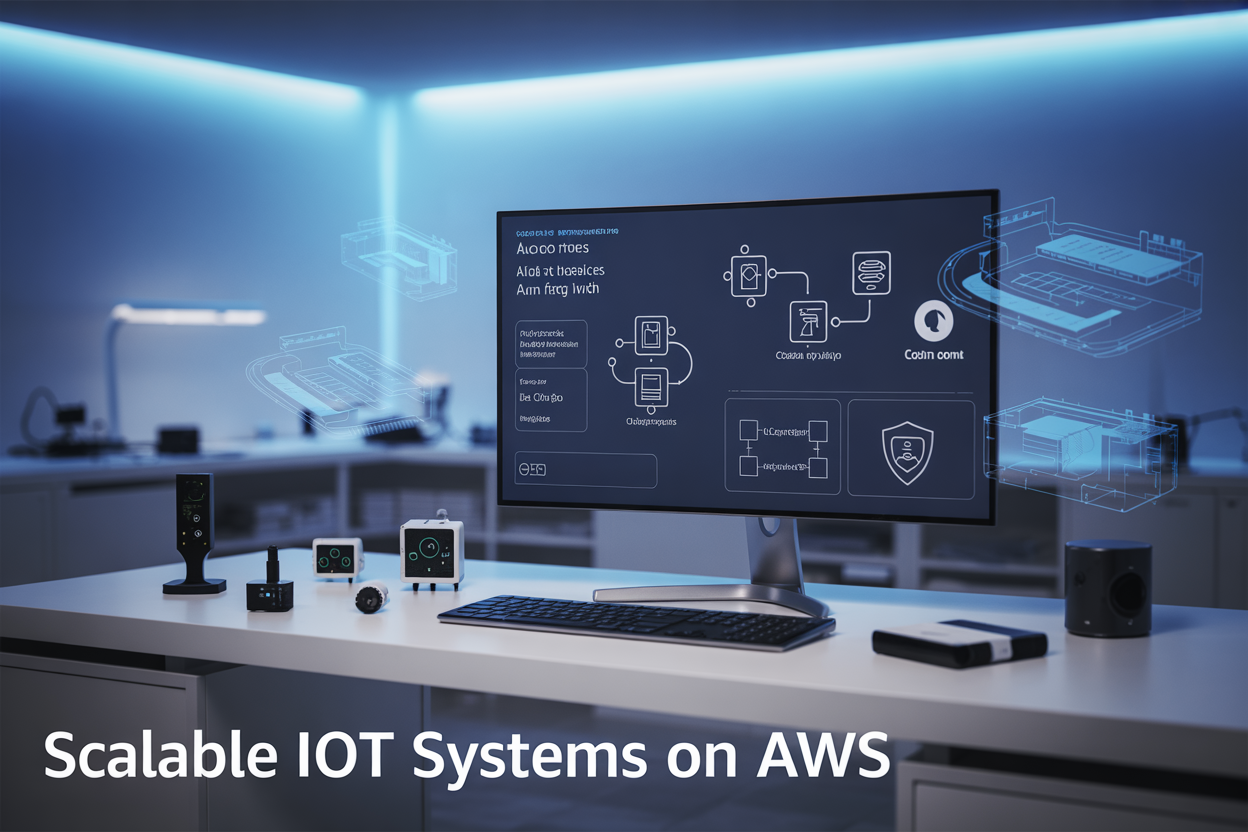
Building connected devices that can handle thousands or millions of endpoints requires more than just spinning up a few AWS services. This guide walks through designing scalable IoT architecture on AWS, covering everything from getting devices connected securely to processing their data streams efficiently.
Who this is for: IoT engineers, cloud architects, and development teams building connected products that need to scale from prototype to production without breaking the bank or compromising security.
You’ll learn how to set up robust IoT device onboarding AWS processes that can handle massive device fleets, implement zero trust IoT security that protects your entire system, and build AWS IoT data pipelines that keep your data flowing smoothly even under heavy loads. We’ll also dive deep into cost optimization IoT AWS strategies and AWS IoT Core implementation best practices that prevent common scaling pitfalls.
By the end, you’ll have a clear roadmap for building AWS IoT scalable systems that grow with your business while maintaining the security and performance your users expect.
Building Your AWS IoT Foundation

Choosing the Right AWS IoT Services for Your Architecture
AWS offers an extensive suite of IoT services, and picking the right combination makes or breaks your scalable IoT architecture. AWS IoT Core serves as the foundation, handling secure device connections and message routing for millions of devices. For device management at scale, AWS IoT Device Management provides fleet-wide capabilities like over-the-air updates and remote monitoring.
When building AWS IoT scalable systems, consider AWS IoT Analytics for processing and analyzing IoT data streams. This service automatically scales to handle varying data volumes while providing SQL-based queries and machine learning insights. AWS IoT Events complements this by detecting and responding to patterns in your IoT data in real-time.
For edge computing scenarios, AWS IoT Greengrass extends cloud capabilities to local devices, enabling offline operation and reduced latency. AWS IoT SiteWise specifically targets industrial use cases, collecting and organizing equipment data for manufacturing operations.
| Service | Primary Use Case | Scaling Capability |
|---|---|---|
| IoT Core | Device connectivity & messaging | Millions of devices |
| IoT Device Management | Fleet management | Global device fleets |
| IoT Analytics | Data processing | Auto-scaling pipelines |
| IoT Greengrass | Edge computing | Distributed edge nodes |
Setting Up AWS IoT Core for Massive Device Connectivity
AWS IoT Core implementation begins with understanding your device connection patterns and message throughput requirements. The service automatically scales to handle billions of messages across millions of simultaneously connected devices, but proper configuration ensures optimal performance.
Start by configuring device certificates and policies through AWS IoT Device Management. Each device needs a unique X.509 certificate for authentication, and you can automate certificate generation using AWS Certificate Manager or your own certificate authority. Create IoT policies that grant devices specific permissions based on their role and data access requirements.
Message routing rules determine how device data flows through your system. Use SQL-based rules to filter, transform, and route messages to different AWS services like Lambda, DynamoDB, or S3. Design your topic structure thoughtfully – hierarchical topics like factory/production-line-1/sensor-data enable efficient message filtering and reduce processing overhead.
Connection management becomes critical at scale. Implement exponential backoff for connection retries and use persistent sessions to reduce connection overhead. AWS IoT Core supports both MQTT and HTTP protocols, with MQTT typically providing better performance for high-frequency data transmission.
Monitor connection metrics through CloudWatch to track device connectivity, message rates, and error patterns. Set up alarms for connection failures or unusual traffic spikes to maintain system reliability.
Configuring Virtual Private Clouds for IoT Workloads
IoT data pipelines require secure network isolation, making VPC configuration essential for production deployments. Create dedicated subnets for different IoT workload components – separate your data processing services, databases, and application servers into distinct network segments.
Design your VPC with multiple Availability Zones to ensure high availability. Place your IoT data processing Lambda functions and analytics services across different subnets in separate AZs. This approach provides fault tolerance and enables seamless failover during outages.
Network Access Control Lists (NACLs) and Security Groups work together to create defense layers. Use NACLs for subnet-level filtering and Security Groups for instance-level access control. For IoT workloads, create Security Groups that allow only necessary ports – typically 8883 for MQTT over TLS and 443 for HTTPS communication.
VPC Endpoints reduce data transfer costs and improve security by keeping traffic within AWS’s network. Configure VPC Endpoints for services like S3, DynamoDB, and Lambda to avoid routing IoT data through the public internet. This setup particularly benefits high-volume IoT data ingestion pipelines that process continuous sensor streams.
Consider using AWS PrivateLink for accessing third-party services or on-premises systems while maintaining network isolation. This becomes valuable when integrating with existing industrial systems or legacy databases.
Establishing Multi-Region Infrastructure for Global Reach
Global IoT deployments require multi-region architecture to reduce latency and ensure regulatory compliance. AWS IoT Core is available in multiple regions, allowing you to deploy device connectivity closer to your physical devices.
Choose primary regions based on device concentration and data sovereignty requirements. European devices should connect to EU regions like Frankfurt or Ireland, while North American devices connect to US regions. This geographic distribution significantly reduces connection latency and improves device responsiveness.
Cross-region data replication enables global data access while maintaining local processing capabilities. Use DynamoDB Global Tables for device metadata and configuration data that needs global availability. S3 Cross-Region Replication handles large-scale IoT data archives and ensures data durability across regions.
Implement region failover strategies for business continuity. AWS Route 53 health checks can automatically redirect device connections to healthy regions during outages. Design your device firmware to support multiple IoT Core endpoints and implement retry logic that switches regions when primary connections fail.
Cost optimization IoT AWS strategies include using regional data processing to minimize cross-region data transfer charges. Process and aggregate data locally before replicating summaries or alerts to other regions. This approach reduces bandwidth costs while maintaining global visibility into your IoT operations.
Consider regulatory requirements when designing multi-region architecture. Some industries require data to remain within specific geographic boundaries, making region selection a compliance rather than performance decision.
Streamlining Device Onboarding at Scale

Implementing Just-in-Time Registration for Zero-Touch Provisioning
Zero-touch provisioning transforms how devices connect to your AWS IoT infrastructure by eliminating manual intervention during the initial setup process. This approach uses AWS IoT Device Management’s just-in-time registration (JITR) feature to automatically authenticate and register devices when they first attempt to connect.
The foundation of JITR relies on a registration certificate authority (CA) that you upload to AWS IoT Core. When a device connects using a certificate signed by this CA, AWS IoT automatically triggers a Lambda function that validates the device and creates the necessary IoT policies and thing resources. This automation removes the bottleneck of manual device registration while maintaining security standards.
Configure your JITR workflow by creating a Lambda function that performs device validation, policy attachment, and fleet assignment based on device attributes embedded in the client certificate. The function can extract device metadata like model type, manufacturing batch, or customer information to apply appropriate policies and group assignments automatically.
For optimal scalability, design your certificate hierarchy to support different device types and customer segments. Use certificate extensions to embed device metadata that your registration Lambda can parse, enabling dynamic policy assignment and fleet organization without manual configuration.
Creating Automated Certificate Management Workflows
Managing X.509 certificates across thousands or millions of IoT devices requires sophisticated automation to prevent security gaps and operational overhead. AWS IoT Device Management provides certificate lifecycle management capabilities that integrate seamlessly with your existing certificate infrastructure.
Build automated certificate renewal workflows using AWS Lambda functions triggered by CloudWatch Events. Set up monitoring for certificates approaching expiration and automatically generate renewal notifications or trigger over-the-air updates. Your renewal process should include certificate validation, device authentication, and secure delivery mechanisms to ensure uninterrupted device connectivity.
Implement certificate revocation procedures that automatically update Certificate Revocation Lists (CRLs) and notify affected devices. Use AWS IoT Jobs to distribute new certificates and coordinate the transition from old to new credentials across your device fleet. This approach minimizes service disruption while maintaining security compliance.
Consider implementing certificate pinning strategies for high-security environments where additional validation layers are required. Store certificate fingerprints in your device registry and validate them during the connection process to prevent man-in-the-middle attacks.
Building Device Fleet Provisioning Templates
Fleet provisioning templates standardize the onboarding process across different device types while accommodating specific requirements for each product line. AWS IoT Device Management’s fleet provisioning feature allows you to create templates that define device policies, thing types, and billing groups automatically during registration.
Create provisioning templates that capture common device configurations while allowing customization through template parameters. Define device-specific attributes like hardware capabilities, sensor types, and communication protocols within the template structure. This standardization reduces configuration errors and ensures consistent security policy application across your device fleet.
Your templates should include conditional logic to handle different device categories and customer requirements. Use template variables to customize device names, policy permissions, and group assignments based on manufacturing data or customer specifications. This flexibility enables a single template to serve multiple device variants while maintaining configuration consistency.
Implement template versioning to manage updates and rollbacks effectively. As your device requirements evolve, create new template versions that incorporate security updates or feature additions while maintaining backward compatibility with existing devices. Use AWS IoT Jobs to migrate devices to new template versions in a controlled manner.
Designing Self-Service Onboarding Portals for Device Manufacturers
Self-service portals empower device manufacturers to manage their own device onboarding while maintaining your security and operational standards. Build web-based portals using AWS Amplify or API Gateway that provide manufacturers with controlled access to device registration and management functions.
Design your portal interface to guide manufacturers through the device registration process with clear workflows and validation checkpoints. Implement multi-tenant architecture that isolates manufacturer data while sharing common AWS IoT infrastructure. Use AWS Cognito for manufacturer authentication and authorization, ensuring each manufacturer can only access their assigned device fleets and configurations.
Create automated validation workflows that verify device compliance with your security and technical requirements before allowing registration. Implement batch upload capabilities for manufacturers who need to register large quantities of devices simultaneously. Provide real-time feedback on registration status and any validation errors that require attention.
Your portal should include comprehensive analytics and reporting features that help manufacturers track their device deployment progress and identify potential issues. Integrate with your existing billing systems to automatically track device usage and generate accurate cost allocation reports. This transparency builds trust while enabling efficient resource management across multiple manufacturer relationships.
Implement role-based access controls within the portal to support different user types within manufacturer organizations. Device engineers might need technical configuration access, while business users require reporting and analytics capabilities. This granular permission system ensures appropriate access levels while maintaining operational security.
Implementing Zero-Trust Security Architecture

Configuring Device Authentication with X.509 Certificates
X.509 certificates form the backbone of secure device authentication in zero trust IoT security implementations. Each device requires a unique certificate that serves as its digital identity when connecting to AWS IoT Core. The certificate contains cryptographic keys and metadata that prove the device’s authenticity.
Start by setting up a Certificate Authority (CA) to manage your device certificates. AWS IoT supports both AWS-managed and customer-managed CAs. Customer-managed CAs offer greater control over certificate lifecycle and security policies. Create a root CA certificate and register it with AWS IoT Core using the RegisterCACertificate API.
When provisioning devices, generate unique private keys on each device and create Certificate Signing Requests (CSRs). The CA signs these CSRs to produce device certificates. Store the private key securely in hardware security modules (HSMs) or secure elements whenever possible to prevent key extraction.
Configure certificate validation rules in AWS IoT Core to ensure only properly signed certificates can connect. Set up certificate revocation mechanisms using Certificate Revocation Lists (CRLs) to disable compromised devices immediately. Implement automated certificate rotation before expiration to maintain continuous security without service interruption.
Monitor certificate usage through CloudWatch metrics and set up alerts for unusual authentication patterns. This proactive approach helps identify potential security breaches or device misconfigurations before they impact your scalable IoT architecture.
Setting Up Fine-Grained Authorization Policies
AWS IoT policies control what authenticated devices can do after successful connection. Unlike traditional network security, zero trust requires explicit permission for every action a device attempts to perform. This granular approach prevents lateral movement and limits the blast radius of potential security incidents.
Create IoT policies that follow the principle of least privilege. Define specific topic patterns that devices can publish to and subscribe from based on their function and location. For example, a temperature sensor should only publish to sensors/temperature/{deviceId} and subscribe to commands/{deviceId}/temperature.
Use policy variables to create dynamic, context-aware permissions. The ${iot:ClientId} variable ensures devices can only access resources associated with their specific identity. Combine multiple variables like ${iot:Certificate.Subject.CommonName} and ${iot:Connection.Thing.ThingName} for more sophisticated access control patterns.
Implement attribute-based access control (ABAC) by leveraging device attributes stored in the Thing Registry. Devices can be granted permissions based on their device type, location, or custom metadata. This approach scales better than role-based access control when managing thousands of diverse devices.
| Policy Element | Example | Purpose |
|---|---|---|
| Resource | topic/sensor/${iot:ClientId}/* |
Limits access to device-specific topics |
| Action | iot:Publish, iot:Subscribe |
Controls permitted operations |
| Condition | "DateGreaterThan": {"aws:CurrentTime": "2024-01-01T00:00:00Z"} |
Adds time-based restrictions |
Regular policy auditing prevents permission creep and identifies overprivileged devices that could pose security risks.
Enabling End-to-End Message Encryption
Transport Layer Security (TLS) 1.2 encrypts data in transit between devices and AWS IoT Core, but comprehensive zero trust IoT security requires additional encryption layers. Implement message-level encryption to protect sensitive data even if TLS is compromised or traffic is intercepted within AWS infrastructure.
Use AWS IoT Device SDK’s built-in encryption capabilities or implement custom encryption at the application layer. AES-256 provides strong symmetric encryption for IoT data with minimal computational overhead on resource-constrained devices. Generate unique encryption keys per device or per message type based on your security requirements.
Implement key rotation schedules that balance security with device capabilities. Embedded devices with limited connectivity might require longer key lifespans, while connected devices should rotate keys frequently. Use AWS Key Management Service (KMS) to generate, store, and rotate encryption keys securely.
For highly sensitive applications, consider implementing Perfect Forward Secrecy (PFS) where each message uses a unique encryption key. This approach ensures that even if long-term keys are compromised, individual messages remain secure.
Set up encrypted storage for keys on devices using secure boot processes and hardware-backed key storage when available. Software-based key storage should use platform-specific secure storage APIs rather than plain file systems.
Monitoring Security Threats with AWS IoT Device Defender
AWS IoT Device Defender provides continuous security monitoring for your scalable IoT systems, detecting anomalies and potential threats across your device fleet. This service integrates seamlessly with zero trust architectures by providing real-time visibility into device behavior and security posture.
Configure security profiles that define normal behavior patterns for different device types. Define metrics like connection frequency, data transfer volumes, and communication patterns. Device Defender uses machine learning to establish baselines and detect deviations that might indicate compromised devices or malicious activity.
| Security Check | Detection Capability | Action |
|---|---|---|
| Authentication failures | Brute force attacks | Block device connections |
| Unusual traffic patterns | Data exfiltration | Trigger investigation |
| Certificate anomalies | Invalid or expired certificates | Revoke access |
| Protocol violations | Non-compliant MQTT usage | Log and alert |
Set up automated responses to security alerts using AWS Lambda functions and SNS notifications. Critical threats should trigger immediate device isolation, while lower-priority alerts can queue for manual investigation. Create custom security metrics specific to your application requirements and compliance needs.
Integrate Device Defender findings with your Security Information and Event Management (SIEM) system for centralized threat analysis. Export security data to Amazon S3 for long-term analysis and compliance reporting.
Implementing Device Shadow Security Controls
Device shadows store the desired and reported states of IoT devices, creating potential security vulnerabilities if not properly secured. Apply zero trust principles to shadow access by implementing strict access controls and encryption for sensitive state information.
Configure shadow access policies that restrict which services and users can read or modify device shadows. Use IAM policies to control management plane access and IoT policies for device-level permissions. Separate read and write permissions based on operational requirements.
Encrypt sensitive data stored in device shadows using field-level encryption. While shadows are encrypted at rest by default, additional encryption protects against insider threats and provides defense in depth. Use different encryption keys for different data sensitivity levels.
Implement shadow versioning and change tracking to detect unauthorized modifications. Set up CloudWatch alarms for unexpected shadow updates or access patterns. Log all shadow operations to CloudTrail for audit purposes and forensic analysis.
Create shadow access patterns that minimize the attack surface. Devices should only access their own shadows unless cross-device coordination is explicitly required. Use shadow topics with device-specific naming conventions to prevent accidental cross-device access.
Monitor shadow usage metrics to identify performance bottlenecks and unusual access patterns. Large shadows or frequent updates might indicate inefficient device implementations or potential security issues that require investigation.
Designing High-Performance Data Ingestion Pipelines

Optimizing MQTT Message Routing with AWS IoT Rules Engine
The AWS IoT Rules Engine acts as the nerve center for processing incoming device messages, transforming raw MQTT payloads into actionable data streams. When thousands of IoT devices simultaneously publish messages, efficient routing becomes critical for maintaining system performance and reducing latency.
Setting up effective rules requires understanding your data flow patterns. Start by analyzing message frequency, payload sizes, and processing requirements for different device types. Create targeted rules that filter messages based on specific criteria like device ID, message type, or sensor values. This approach prevents unnecessary processing and reduces costs associated with downstream services.
Rule actions determine where your data flows after initial processing. Popular destinations include Amazon DynamoDB for real-time device state storage, Amazon S3 for long-term analytics, and Amazon SQS for decoupled message processing. The key is matching the right storage solution to your use case – hot data goes to DynamoDB, while cold archival data lands in S3.
SQL-based filtering within rules provides powerful data manipulation capabilities. You can extract specific JSON fields, perform basic calculations, and even enrich messages with static data. For example, a rule might extract temperature readings above critical thresholds and route them to immediate alert systems while storing all readings in a time-series database.
Error handling deserves special attention in production systems. Configure error actions that capture failed message processing attempts, sending problematic payloads to a dead letter queue for later analysis. This prevents data loss and provides visibility into system issues before they impact your IoT applications.
Implementing Real-Time Stream Processing with Amazon Kinesis
Amazon Kinesis transforms your AWS IoT data pipelines into real-time processing powerhouses, handling millions of data points per second while maintaining low latency. The service provides three main components that work together: Kinesis Data Streams for ingestion, Kinesis Data Analytics for real-time analysis, and Kinesis Data Firehose for delivery.
Kinesis Data Streams serves as your primary ingestion point, receiving data from AWS IoT Rules Engine actions. Proper shard configuration determines throughput capacity – each shard handles 1,000 records per second or 1 MB per second, whichever comes first. Start with a conservative shard count and enable auto-scaling to handle traffic spikes without over-provisioning resources.
Partitioning strategy significantly impacts performance and cost. Use device IDs or sensor types as partition keys to ensure even distribution across shards. Avoid using timestamps or sequential identifiers that create “hot” shards receiving disproportionate traffic. Well-distributed partitions enable parallel processing and prevent bottlenecks in downstream applications.
Real-time analytics capabilities shine when processing streaming IoT data. Kinesis Data Analytics uses SQL queries to calculate moving averages, detect anomalies, and trigger alerts based on sliding time windows. For example, you might calculate the average temperature across multiple sensors every five minutes, alerting maintenance teams when readings exceed normal operating ranges.
Integration with AWS Lambda enables custom processing logic for complex transformations. Lambda functions can enrich streaming data with external APIs, perform machine learning inference, or implement custom business rules. The combination creates flexible, serverless architectures that scale automatically with your data volume.
Building Serverless Data Transformation Workflows
Serverless architectures eliminate infrastructure management overhead while providing infinite scalability for IoT data transformation workflows. AWS Lambda functions process individual messages or small batches, applying business logic, data validation, and format conversions before routing data to final destinations.
Function design patterns significantly impact performance and cost. Single-purpose functions that handle specific transformation tasks offer better maintainability and debugging capabilities compared to monolithic processors. Create separate Lambda functions for data validation, format conversion, and enrichment operations, chaining them together using Amazon EventBridge or Step Functions.
Cold start optimization becomes crucial when processing high-frequency IoT messages. Keep functions warm using CloudWatch Events that trigger them periodically with small payloads. Provision concurrency for critical functions ensures consistent performance during peak traffic periods, though this increases costs for constantly running instances.
Memory allocation directly affects processing speed and cost. Start with minimal memory settings and gradually increase based on performance metrics. CPU power scales proportionally with memory, so compute-intensive transformations benefit from higher memory configurations even when not using the additional RAM.
Batch processing strategies reduce invocation costs while maintaining reasonable latency. Configure Lambda triggers to process multiple messages simultaneously rather than individual payloads. Amazon SQS provides batch sizes up to 10 messages, while Kinesis supports batches up to 100 records, significantly reducing per-message processing costs.
Error handling and retry logic prevent data loss during transformation failures. Implement dead letter queues for messages that fail multiple processing attempts, and use exponential backoff strategies for temporary failures. CloudWatch alarms monitoring error rates and processing latencies provide early warning signs of system issues requiring attention.
Environment variable management simplifies configuration changes without code deployments. Store database connection strings, API endpoints, and processing parameters as environment variables, enabling quick adjustments to transformation logic without rebuilding Lambda packages.
Creating Scalable Data Storage Solutions

Choosing Between Time-Series and NoSQL Databases
Time-series databases like Amazon Timestream shine when handling IoT sensor data with timestamps. These databases excel at storing metrics, events, and measurements that arrive continuously from your devices. Amazon Timestream automatically optimizes storage costs by moving older data to cheaper tiers while maintaining lightning-fast queries for recent data.
NoSQL databases such as DynamoDB work better for device metadata, configuration settings, and user profiles. DynamoDB handles variable schemas gracefully and scales automatically based on traffic patterns. The global secondary indexes make it perfect for complex queries across different device attributes.
Consider hybrid approaches for comprehensive IoT solutions. Store real-time sensor readings in Timestream while keeping device registration data, user preferences, and configuration states in DynamoDB. This combination provides the best performance for each data type.
| Database Type | Best Use Cases | AWS Service | Key Benefits |
|---|---|---|---|
| Time-Series | Sensor data, metrics, logs | Timestream | Automatic tiering, fast analytics |
| NoSQL | Device metadata, user data | DynamoDB | Flexible schema, global scale |
| Relational | Complex relationships | RDS/Aurora | ACID compliance, joins |
Implementing Data Partitioning Strategies for Query Performance
Smart partitioning dramatically improves query performance across your AWS IoT scalable systems. For time-series data, partition by time intervals that match your query patterns. Daily partitions work well for recent data analysis, while monthly partitions suit historical reporting needs.
Device-based partitioning makes sense when queries typically focus on specific devices or device groups. Hash partitioning distributes load evenly across storage nodes, preventing hot spots that slow down your entire system.
Geographic partitioning helps when your IoT deployment spans multiple regions. Store data close to where it gets generated and consumed, reducing latency and data transfer costs.
DynamoDB partition keys should distribute traffic evenly. Avoid using device IDs that create hot partitions – instead, combine device ID with timestamp or use hash prefixes to spread the load.
Effective Partitioning Strategies:
- Time-based: Partition by hour/day/month depending on data volume
- Device-based: Group similar devices or use hash-based distribution
- Geographic: Separate partitions for different regions or facilities
- Hybrid: Combine multiple strategies for complex access patterns
Setting Up Automated Data Lifecycle Management
Automated lifecycle management keeps storage costs under control while maintaining data accessibility. Start by defining clear retention policies based on business requirements and compliance needs. Hot data stays in high-performance storage for immediate access, while warm data moves to standard storage, and cold data archives to cheaper long-term storage.
Amazon S3 Intelligent-Tiering automatically moves objects between access tiers based on usage patterns. This feature works perfectly for IoT data where access frequency drops over time. Configure lifecycle rules that transition objects automatically – for example, move to Infrequent Access after 30 days and Glacier after 90 days.
DynamoDB Time to Live (TTL) automatically deletes expired items, reducing storage costs and maintenance overhead. Set TTL attributes on records that have natural expiration dates, like temporary device sessions or cached calculations.
Timestream’s automatic data lifecycle management handles the heavy lifting for time-series data. It moves data from memory store to magnetic store based on age, then eventually to S3 for long-term archival.
Lifecycle Management Best Practices:
- Define retention periods based on business and compliance needs
- Use S3 Intelligent-Tiering for variable access patterns
- Implement DynamoDB TTL for temporary data
- Monitor storage costs and adjust policies regularly
- Document retention policies for audit compliance
Designing Cost-Effective Cold Storage Archives
Cold storage archives provide extremely low-cost options for long-term data retention. Amazon S3 Glacier and Glacier Deep Archive offer the most economical storage for data that rarely gets accessed but must be preserved for compliance or historical analysis.
S3 Glacier works well for data you might need within hours, while Glacier Deep Archive suits data with retrieval times measured in hours to days. The key is matching retrieval requirements with storage costs – Deep Archive costs 75% less than Glacier but takes longer to retrieve.
Design your archive strategy around predictable access patterns. Batch similar data together to optimize retrieval costs. When you need historical data, retrieving larger chunks costs less per gigabyte than frequent small requests.
Consider using S3 Select to query data directly in Glacier without full restoration. This feature dramatically reduces costs when you need specific subsets of archived data rather than entire files.
Implement intelligent archiving rules that compress and deduplicate data before storage. JSON logs compress extremely well, often achieving 80-90% size reduction. Use formats like Parquet for structured data archives to maximize compression and enable efficient querying.
Cold Storage Optimization Techniques:
- Choose appropriate Glacier tier based on retrieval needs
- Compress data before archiving to reduce storage costs
- Use S3 Select for querying without full restoration
- Implement deduplication for repetitive IoT data
- Design batch retrieval strategies to minimize costs
- Monitor archive access patterns and adjust strategies accordingly
Optimizing Performance and Cost Efficiency

Implementing Auto-Scaling for Variable IoT Workloads
Auto-scaling for AWS IoT scalable systems requires careful orchestration across multiple services to handle fluctuating device connections and data volumes. AWS Application Auto Scaling integrates with IoT Core, Lambda, and Kinesis to automatically adjust capacity based on real-time demand patterns.
Configure Lambda function concurrency scaling to handle sudden spikes in device messages. Set reserved concurrency limits for critical functions while allowing unreserved capacity for burst traffic. Create CloudWatch alarms that trigger scaling actions when concurrent executions exceed 80% of allocated capacity.
For IoT data ingestion pipelines, implement Kinesis Data Streams auto-scaling using the UpdateShardCount API. Monitor incoming records per second and provision additional shards when utilization crosses predefined thresholds. Amazon Kinesis Scaling Utility automates this process, adjusting shard counts based on CloudWatch metrics.
Configure Application Load Balancer target groups with auto-scaling policies for containerized IoT applications running on ECS or EKS. Define scaling policies based on CPU utilization, memory consumption, and custom metrics like device connection rates.
| Resource Type | Scaling Trigger | Target Metric | Scale-out Threshold |
|---|---|---|---|
| Lambda Functions | Concurrent Executions | 80% of reserved capacity | > 100 concurrent |
| Kinesis Shards | Incoming Records/sec | Records per shard | > 1000 records/sec |
| ECS Services | CPU/Memory | Average utilization | > 70% |
| DynamoDB | Read/Write Capacity | Consumed capacity | > 70% |
Monitoring System Performance with CloudWatch Metrics
CloudWatch custom metrics provide deep visibility into IoT system performance beyond standard AWS metrics. Create custom dashboards tracking device connectivity patterns, message processing latency, and data pipeline throughput.
Implement custom metric filters on CloudWatch Logs to extract business-critical KPIs. Track device registration success rates, authentication failures, and message delivery confirmations. Use CloudWatch Insights queries to analyze log patterns and identify performance bottlenecks.
Set up composite alarms combining multiple metrics for intelligent alerting. Create alarm hierarchies that escalate based on severity levels – warning alerts for minor performance degradation and critical alerts for system-wide issues.
Key metrics to monitor include:
- Device Metrics: Connection success rate, message publish rate, disconnect frequency
- Pipeline Metrics: End-to-end message latency, processing throughput, error rates
- Storage Metrics: DynamoDB throttling events, S3 put/get latencies, query performance
- Security Metrics: Failed authentication attempts, certificate expiration warnings, policy violations
Configure CloudWatch anomaly detection for baseline metrics like daily message volumes and connection patterns. Machine learning models identify unusual behavior that might indicate security threats or system issues.
Reducing Data Transfer Costs Through Edge Computing
AWS IoT Greengrass enables local processing that dramatically reduces data transfer costs by filtering and aggregating data at the edge. Deploy Greengrass Core devices as local gateways that preprocess sensor data before sending summarized information to the cloud.
Implement intelligent data filtering using Greengrass Lambda functions. Process raw sensor readings locally and transmit only anomalies or aggregated summaries. For example, temperature sensors might send hourly averages instead of per-minute readings, reducing data transfer by 98%.
Configure local machine learning inference using SageMaker Neo-compiled models on Greengrass devices. Run predictive maintenance algorithms locally and send only critical predictions or maintenance alerts to AWS IoT Core.
Use AWS IoT Device Shadow service for efficient state synchronization. Instead of continuously streaming all device parameters, synchronize only changed states through delta updates. This approach reduces bandwidth consumption by up to 90% for devices with infrequent state changes.
Optimize message payloads using binary protocols like Protocol Buffers or Apache Avro instead of JSON. These formats typically reduce payload sizes by 30-50% while maintaining structure and type safety.
Create data tiering strategies where time-sensitive data uses premium connectivity while historical data uses lower-cost batch transfers. Configure devices to cache non-critical data locally and upload during off-peak hours when data transfer rates are reduced.
Setting Up Proactive Cost Management and Alerts
AWS Cost Explorer and Budgets provide granular cost tracking for IoT infrastructure components. Create custom cost allocation tags for different IoT projects, device types, and data processing workflows to identify cost drivers accurately.
Implement automated cost governance using AWS Config rules and Lambda functions. Create rules that automatically shut down non-production IoT resources during off-hours or delete unused device certificates and thing objects.
Set up multi-dimensional budgets tracking costs across different IoT services:
- Device Management Budget: IoT Core device connections, message routing, device shadow operations
- Data Processing Budget: Lambda executions, Kinesis shard hours, analytics queries
- Storage Budget: DynamoDB capacity units, S3 storage and requests, TimeStream ingestion
Configure budget alerts at 50%, 80%, and 100% of projected spend with different escalation paths. Integrate alerts with SNS topics that trigger automated cost optimization actions like scaling down non-critical resources.
Use AWS Trusted Advisor recommendations to identify cost optimization opportunities. Review underutilized resources, right-size recommendations, and reserved capacity suggestions monthly.
Create cost optimization playbooks documenting specific actions for different spending scenarios. Include automated remediation scripts for common cost overruns like forgotten test environments or misconfigured auto-scaling policies.
Monitor unit economics by tracking cost per device, cost per message, and cost per data point processed. These metrics help identify scaling inefficiencies and guide architectural decisions for cost optimization IoT AWS deployments.

Building scalable IoT systems on AWS doesn’t have to be overwhelming when you break it down into these core components. Start with a solid foundation using AWS IoT Core, then focus on automating your device onboarding process to handle thousands of devices without manual intervention. Your security architecture should never trust any device by default – implement certificate-based authentication, regular key rotation, and monitor everything that connects to your network.
The real magic happens when your data pipelines work seamlessly together. Design your ingestion system to handle traffic spikes, choose storage solutions that match your query patterns, and always keep an eye on your costs. Remember that the best IoT architecture is one that grows with your business needs while staying secure and cost-effective. Take these concepts and start small – you can always scale up as your requirements evolve.