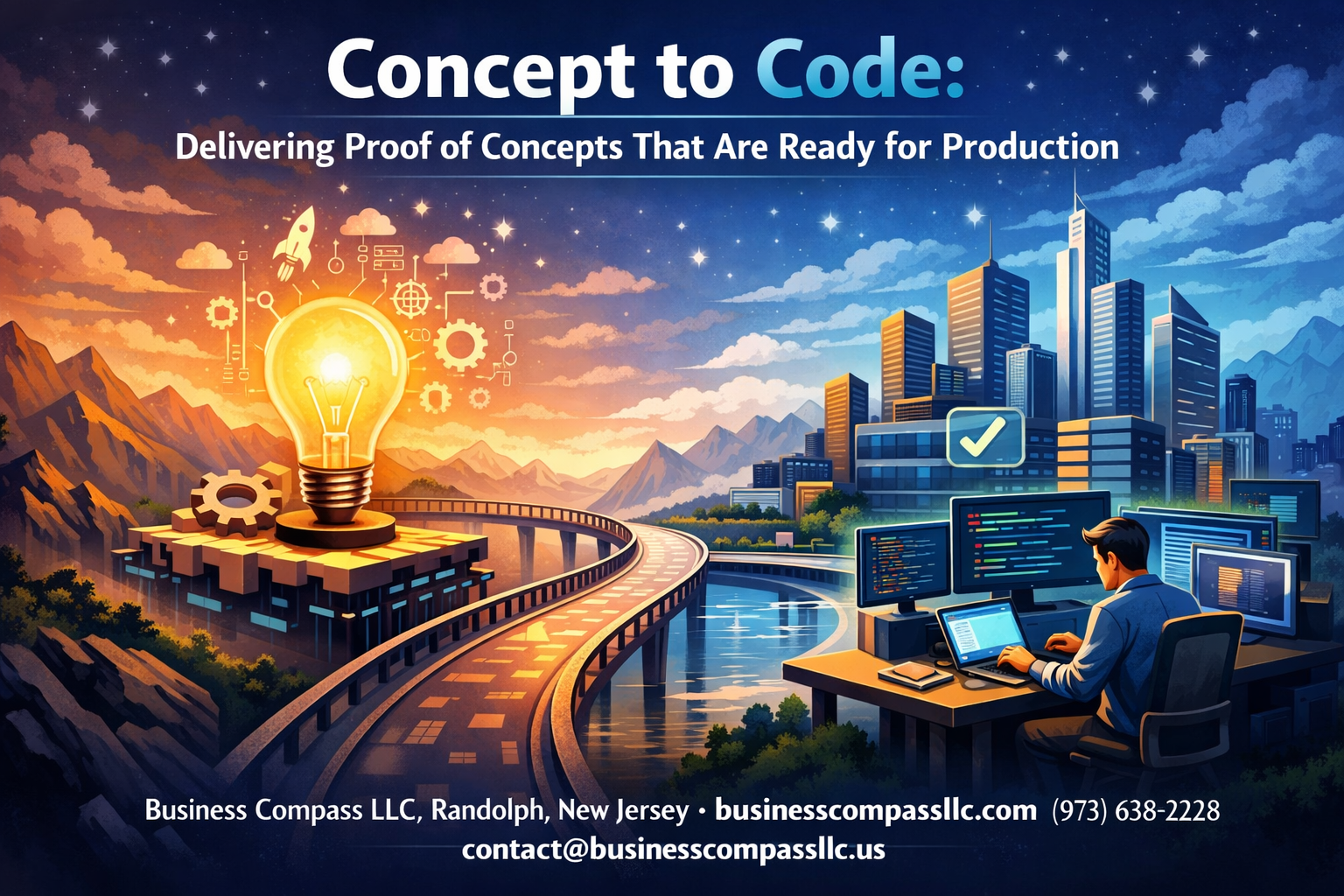
Most proof of concept development projects fail when it’s time to move from prototype to production pipeline. Teams build brilliant demos that work perfectly in controlled environments, then face months of rewrites, architectural overhauls, and painful scaling issues when real users get involved.
This guide is for engineering managers, startup founders, and development teams who want to create POCs that become production-ready code from day one. Instead of treating prototypes as throwaway experiments, you’ll learn how to build MVPs that grow into enterprise software deployment without starting over.
We’ll cover how to design with production architecture in mind so your proof of concept scales seamlessly. You’ll discover practical strategies for building quality into your development process from the beginning, not as an afterthought. Finally, we’ll walk through creating a solid production migration strategy that turns your prototype into reliable, scalable software architecture that your business can actually depend on.
Bridge the Gap Between Prototype and Production

Understand the difference between proof of concept and production-ready code
Most developers create proof of concept development projects with a “just make it work” mindset. This approach gets results fast, but it creates a massive gap between what you build and what actually runs in production. A POC focuses on validating core functionality with minimal code structure, basic error handling, and hardcoded configurations. Production-ready code demands robust architecture, comprehensive testing, security measures, and scalability considerations.
Think of a POC as a quick sketch that proves your idea works. You might use mock data, skip authentication, and write everything in a single file. Production code requires proper database connections, user management systems, logging frameworks, and deployment configurations. The difference lies in reliability, maintainability, and performance under real-world conditions.
| Aspect | Proof of Concept | Production-Ready Code |
|---|---|---|
| Error Handling | Basic try-catch blocks | Comprehensive error management |
| Data Storage | Mock data or simple files | Proper database with migrations |
| Security | Often bypassed | Authentication, authorization, encryption |
| Testing | Manual verification | Automated unit, integration, and end-to-end tests |
| Configuration | Hardcoded values | Environment-based configuration |
| Performance | Not optimized | Optimized for scale and efficiency |
Identify common pitfalls that prevent POCs from scaling
Technical debt accumulates rapidly when teams rush from prototype to production without addressing fundamental architectural decisions. Hardcoded database connections break when moving between environments. Single-threaded processes that worked fine with test data crash under production load. Missing input validation becomes a security nightmare when real users interact with your system.
Poor separation of concerns creates another major roadblock. POCs often mix business logic with presentation code, making it impossible to scale individual components. When your proof of concept handles user authentication, data processing, and API responses in the same function, you can’t optimize performance bottlenecks or fix bugs without affecting everything else.
Resource management issues surface quickly in production environments. Your POC might create database connections without properly closing them, leading to connection pool exhaustion. Memory leaks that don’t matter during short demo sessions become critical problems when your application runs 24/7 serving thousands of users.
Common scaling pitfalls include:
- Absence of proper logging and monitoring capabilities
- No backup or disaster recovery mechanisms
- Insufficient documentation for deployment and maintenance
- Missing dependency management and version control
- Lack of automated testing preventing confident code changes
- Inadequate security measures exposing sensitive data
Establish clear success criteria from the start
Setting specific, measurable goals prevents feature creep and keeps your MVP development process focused on production readiness. Define performance benchmarks early: response times under specific loads, acceptable error rates, and scalability targets. Your success criteria should include both functional requirements (what the system does) and non-functional requirements (how well it performs).
Create a production readiness checklist covering security standards, monitoring requirements, and deployment procedures. This checklist becomes your roadmap from concept to production deployment. Include metrics like code coverage percentages, security scan results, and load testing outcomes. When everyone understands the finish line, teams make better architectural decisions throughout development.
Business stakeholders need clear criteria too. Define user acceptance scenarios, performance expectations, and compliance requirements upfront. Document which features are essential for launch versus nice-to-have additions. This prevents the classic “just one more feature” requests that delay production releases and compromise code quality assurance.
Success criteria should cover:
- Performance: Maximum response times, concurrent user limits, throughput requirements
- Reliability: Uptime targets, error rate thresholds, recovery time objectives
- Security: Compliance standards, authentication methods, data protection measures
- Maintainability: Code documentation standards, automated testing coverage, deployment automation
- Business Value: Key performance indicators, user engagement metrics, revenue impact goals
Design with Production Architecture in Mind

Choose scalable technology stacks and frameworks
Building a proof of concept with production-ready technology stacks makes all the difference when you’re planning for scale. Modern frameworks like React, Vue.js, or Angular for frontend development come with built-in performance optimizations and large community support that will serve you well in production. For backend development, consider proven frameworks such as Node.js with Express, Python’s Django or FastAPI, or Java’s Spring Boot.
When selecting your tech stack, think about your team’s expertise and the long-term maintenance requirements. A POC built with trendy but unstable frameworks might work for demonstration purposes, but you’ll face serious challenges during production migration strategy implementation. Stick with established technologies that have strong documentation, active communities, and proven scalability patterns.
Cloud-native architectures deserve special attention in your proof of concept development process. Containerization with Docker and orchestration through Kubernetes provide scalable software architecture foundations that translate directly to production environments. Microservices architecture, while complex, offers better scalability and maintainability compared to monolithic approaches when building enterprise-level applications.
Implement proper data modeling and database design
Your database design decisions during the POC phase will directly impact your production system’s performance and scalability. Start with a normalized data model that reflects your business logic clearly, but don’t be afraid to denormalize strategically for performance gains when needed.
Choose database technologies that align with your data patterns and scaling requirements. PostgreSQL offers excellent ACID compliance and complex query capabilities for relational data, while MongoDB provides flexibility for document-based storage. For applications requiring high-speed reads and writes, consider incorporating Redis for caching layers or time-series databases for analytics workloads.
Database indexing strategy should be part of your initial design rather than an afterthought. Identify the most common query patterns in your POC and create appropriate indexes. Plan for data partitioning and sharding strategies early, especially if you anticipate large data volumes in production.
Connection pooling, query optimization, and data archiving strategies need consideration during the POC phase. These elements become critical when transitioning from prototype to production pipeline, where hundreds or thousands of concurrent users will stress your data layer.
Plan for security and compliance requirements
Security can’t be retrofitted effectively, so building it into your POC from day one saves enormous effort during production deployment. Start with authentication and authorization frameworks that can scale with your application. OAuth 2.0 with OpenID Connect provides a solid foundation for user authentication, while role-based access control (RBAC) ensures proper permission management.
Data encryption should be implemented at multiple layers – in transit using TLS/SSL and at rest using database encryption features. Don’t store sensitive information like passwords or API keys in plain text, even in your development environment. Use environment variables and secure vaults for credential management.
Input validation and sanitization protect against common vulnerabilities like SQL injection and cross-site scripting (XSS). Implement these protections consistently across all user input points in your POC. Regular security scanning tools can identify potential vulnerabilities before they reach production.
Compliance requirements vary by industry, but common standards like GDPR, HIPAA, or SOC 2 have specific technical requirements that impact your architecture decisions. Document your data flows, implement audit logging, and ensure you can demonstrate data lineage and user consent management.
Consider integration points and API design
Your POC’s API design will become the foundation for all future integrations, so invest time in creating clean, RESTful endpoints that follow industry standards. Use consistent naming conventions, proper HTTP status codes, and comprehensive error handling. Version your APIs from the beginning to prevent breaking changes during production updates.
API documentation becomes crucial when transitioning to production-ready code. Tools like Swagger/OpenAPI or Postman can generate interactive documentation that helps both internal teams and external partners understand your endpoints. Include example requests and responses, authentication requirements, and rate limiting information.
Rate limiting and throttling mechanisms should be part of your POC design, not added later. These features protect your system from abuse and help maintain consistent performance under varying loads. Implement circuit breaker patterns for external service calls to prevent cascading failures.
Plan your integration architecture to support both synchronous and asynchronous communication patterns. While REST APIs work well for real-time interactions, message queues like RabbitMQ or Apache Kafka enable better decoupling and resilience for background processing tasks. Your POC should demonstrate these patterns even if you’re not processing large volumes yet.
Build Quality Into Your Development Process

Establish coding standards and best practices early
Creating consistent coding standards from day one transforms your proof of concept development into a structured, maintainable foundation. When your team follows agreed-upon conventions for naming variables, structuring files, and organizing code architecture, you eliminate the technical debt that typically plagues rapid prototyping phases.
Start by defining clear guidelines for code formatting, commenting practices, and architectural patterns. Popular style guides like Google’s or Airbnb’s provide excellent starting points that you can customize for your specific technology stack. These standards become even more critical when multiple developers contribute to your POC, ensuring that production-ready code emerges naturally from your development process.
Version control practices deserve equal attention. Establish branching strategies, commit message formats, and code review requirements that mirror production environments. This approach means your prototype to production pipeline maintains quality throughout every iteration, rather than requiring massive refactoring later.
Implement automated testing strategies
Automated testing transforms unreliable prototypes into robust, production-ready systems. Start with unit tests covering core business logic, then expand to integration tests that validate component interactions. This layered approach catches bugs early when they’re cheaper and easier to fix.
Your testing strategy should include:
- Unit tests for individual functions and components
- Integration tests for API endpoints and database operations
- End-to-end tests for critical user workflows
- Performance tests to identify bottlenecks early
Test-driven development works particularly well for proof of concept development because it forces you to think through requirements and edge cases upfront. Writing tests first creates a specification that guides your implementation and provides immediate feedback on code quality.
Mock external dependencies during testing to create predictable, fast-running test suites. This practice becomes invaluable when your POC evolves into a complex system with multiple integrations.
Set up continuous integration and deployment pipelines
CI/CD pipelines automate the journey from proof of concept to production-ready software. Set up automated builds that run your test suite on every code commit, catching integration issues before they reach your main branch. This approach maintains code quality assurance throughout your development lifecycle.
Your pipeline should include these essential stages:
| Stage | Purpose | Tools |
|---|---|---|
| Build | Compile and package code | Jenkins, GitHub Actions, GitLab CI |
| Test | Run automated test suites | Jest, pytest, Selenium |
| Security | Scan for vulnerabilities | SonarQube, Snyk, OWASP |
| Deploy | Push to staging/production | Docker, Kubernetes, AWS CodeDeploy |
Start with a simple pipeline that builds and tests your code, then gradually add deployment stages as your POC matures. This incremental approach prevents overwhelming complexity while establishing the infrastructure patterns you’ll need for scalable software architecture.
Automated deployment reduces human error and creates repeatable processes that work reliably across different environments. Your team spends less time on manual deployments and more time building features that matter.
Document code and system architecture thoroughly
Clear documentation bridges the gap between prototype experimentation and production maintenance. Document your architectural decisions, API specifications, and deployment procedures as you build them. This practice prevents knowledge silos and accelerates onboarding for new team members.
Focus on these key documentation areas:
- API documentation with request/response examples
- Architecture diagrams showing system components and data flow
- Setup and deployment instructions for different environments
- Database schemas and migration procedures
- Configuration management and environment variables
Use tools like Swagger for API documentation, draw.io for architecture diagrams, and README files for setup instructions. Keep documentation close to your code repository so it stays current with your implementation changes.
Living documentation that updates automatically from code comments and annotations reduces maintenance overhead while ensuring accuracy. Tools like JSDoc, Sphinx, or GitBook can generate comprehensive documentation from your codebase annotations.
Regular documentation reviews during code reviews ensure that your proof of concept development includes the knowledge transfer mechanisms needed for successful production deployment and long-term maintenance.
Optimize Performance and Scalability

Identify and Address Performance Bottlenecks
Performance issues can make or break your POC to production transition. Start by establishing baseline metrics during development rather than waiting until deployment. Use profiling tools to monitor CPU usage, memory consumption, database query times, and network latency patterns. Tools like Chrome DevTools for frontend applications, or APM solutions like New Relic and DataDog for backend services, help pinpoint exactly where slowdowns occur.
Database queries often become the biggest culprit in performance degradation. Review your SQL statements, add proper indexes, and consider query optimization techniques. For APIs, implement request monitoring to identify endpoints that consistently take longer than acceptable thresholds. Set up alerts when response times exceed your performance targets.
Memory leaks present another common challenge during the prototype to production pipeline. Monitor memory usage patterns over extended periods and watch for gradual increases that signal potential leaks. Code reviews should specifically focus on resource cleanup, especially in languages like JavaScript or Python where garbage collection might not catch everything immediately.
Design for Horizontal and Vertical Scaling
Scalable software architecture requires planning from day one of your proof of concept development. Vertical scaling means adding more power to existing machines, while horizontal scaling involves adding more machines to handle increased load. Design your application to support both approaches.
Break down monolithic structures into microservices or modular components that can scale independently. Database connections should use connection pooling, and stateless application design allows for easier horizontal scaling. Load balancers become essential components for distributing traffic across multiple instances.
Consider your data storage strategy carefully. Relational databases work well for many applications but might require read replicas or sharding for high-traffic scenarios. NoSQL databases like MongoDB or Cassandra handle horizontal scaling more naturally but come with their own trade-offs.
Container orchestration platforms like Kubernetes make horizontal scaling more manageable by automatically spinning up new instances based on demand. Configure auto-scaling policies that monitor key metrics and respond appropriately to traffic spikes.
Implement Efficient Caching Strategies
Caching dramatically improves application performance when implemented strategically. Multiple caching layers work together to create a comprehensive strategy. Browser caching reduces server requests for static assets like images, CSS, and JavaScript files. Set appropriate cache headers to control how long browsers store these resources.
Application-level caching stores frequently requested data in memory using solutions like Redis or Memcached. Database query results, API responses, and computed values make excellent caching candidates. Implement cache invalidation strategies to ensure data freshness while maintaining performance benefits.
Content Delivery Networks (CDNs) cache static content closer to users geographically. This reduces latency and server load while improving user experience globally. Configure CDN settings to cache different content types for appropriate durations.
Consider implementing smart caching patterns like cache-aside, write-through, or write-behind depending on your application’s read/write patterns. Monitor cache hit rates and adjust strategies based on actual usage patterns rather than assumptions.
| Caching Layer | Best For | TTL Recommendations |
|---|---|---|
| Browser Cache | Static assets | 1 hour – 1 year |
| Application Cache | Database queries, API responses | 5 minutes – 1 hour |
| CDN Cache | Images, videos, static content | 1 day – 1 month |
Ensure Security and Compliance Readiness

Integrate security measures throughout development
Building security into your proof of concept development from day one prevents costly retrofitting later. Instead of treating security as an afterthought, weave it into every decision you make during the development process. Start by conducting threat modeling sessions early in your POC to production pipeline, identifying potential attack vectors and designing defensive measures.
Implement secure coding practices right from the first line of code. Use static analysis tools to catch security vulnerabilities during development, not after deployment. Set up automated security scans in your CI/CD pipeline to flag issues before they reach production environments. This approach creates a security-first mindset that carries through your entire production-ready code development.
Choose libraries and frameworks with strong security track records and active maintenance. Keep dependencies updated and monitor them for known vulnerabilities. Document your security decisions and assumptions so future developers understand the reasoning behind specific implementations.
Address data privacy and regulatory requirements
Data protection regulations like GDPR, CCPA, and industry-specific compliance requirements must shape your POC architecture from the beginning. Map out what data your application collects, processes, and stores, then implement appropriate safeguards for each category.
Design data retention policies that automatically purge unnecessary information. Build user consent mechanisms that are clear and granular, allowing users to control how their data gets used. Implement data portability features that let users export their information when requested.
Consider geographic data residency requirements early in your scalable software architecture planning. Some regulations require data to stay within specific regions, which affects your infrastructure choices and deployment strategy. Plan for data encryption both in transit and at rest, using industry-standard algorithms and key management practices.
Implement proper authentication and authorization
Authentication and authorization form the backbone of application security. Design a flexible identity management system that can scale with your production needs. Consider using established protocols like OAuth 2.0 and OpenID Connect rather than building custom authentication from scratch.
Implement multi-factor authentication (MFA) as a standard feature, not an optional add-on. Plan for different authentication methods including social logins, enterprise SSO integration, and passwordless options. Build role-based access control (RBAC) that can accommodate complex permission structures as your application grows.
Design your authorization system to support fine-grained permissions and attribute-based access control when needed. Create audit logs that track authentication attempts and authorization decisions. These logs become valuable for security monitoring and compliance reporting in production environments.
Plan for vulnerability management and updates
Establish a clear process for handling security vulnerabilities discovered after deployment. Create a security incident response plan that defines roles, responsibilities, and communication channels. This planning during your software development lifecycle prevents chaos when real security issues arise.
Set up automated dependency scanning to monitor third-party libraries for new vulnerabilities. Create a patch management strategy that prioritizes critical security updates while maintaining system stability. Design your deployment process to support emergency security patches that can be rolled out quickly when needed.
Build monitoring capabilities that detect unusual application behavior that might indicate security breaches. Implement logging that captures security-relevant events without exposing sensitive information. Plan for regular security assessments and penetration testing as part of your ongoing enterprise software deployment strategy.
Plan Your Production Migration Strategy

Create a phased rollout approach
Moving your proof of concept development into production requires careful orchestration. A phased rollout minimizes risk while providing valuable feedback at each stage of your production migration strategy.
Start with a limited beta release to internal stakeholders or a small subset of trusted users. This initial phase helps identify issues that testing environments might have missed. Your POC to production pipeline should include automated deployment scripts that can handle different environment configurations seamlessly.
The second phase expands access to a broader user group, typically 10-20% of your target audience. Monitor system performance closely during this stage, as real-world usage patterns often differ significantly from development scenarios. Document any configuration changes or patches needed to maintain stability.
Full production rollout comes last, but only after validating system behavior under increasing loads. Your prototype to production pipeline should include feature flags that allow you to quickly disable problematic functionality without requiring a complete rollback.
Each phase should have clear success criteria and exit conditions. Define metrics that matter for your specific use case – response times, error rates, user engagement, or business KPIs. This data-driven approach ensures your production-ready code meets both technical and business requirements before widespread deployment.
Establish monitoring and alerting systems
Production environments demand comprehensive visibility into system health and performance. Set up monitoring infrastructure before your first deployment to capture baseline metrics and establish normal operating parameters.
Implement application performance monitoring (APM) tools that track response times, throughput, and error rates. These tools should integrate with your scalable software architecture to provide insights across all system components. Database performance, API response times, and third-party service dependencies all need continuous monitoring.
Create tiered alerting that escalates based on severity and duration. Warning alerts might notify development teams about performance degradation, while critical alerts should immediately page on-call personnel. Your enterprise software deployment strategy should include runbooks that guide responders through common scenarios.
Log aggregation becomes essential as your system grows. Centralized logging helps debug issues across distributed components and provides audit trails for compliance requirements. Structure your logs consistently and include correlation IDs that track requests across service boundaries.
Business metrics monitoring often gets overlooked but proves equally important. Track user adoption rates, feature usage, and conversion metrics to validate that your MVP development process delivered the intended value. These insights inform future development priorities and help justify continued investment in the platform.
Prepare rollback and disaster recovery procedures
Every production deployment needs a safety net. Rollback procedures should be tested and documented before you need them, not during a crisis when systems are failing and stakeholders are demanding answers.
Database schema changes require special attention in your software development lifecycle. Backward-compatible changes allow for easier rollbacks, while breaking changes need careful coordination with application code updates. Maintain database backups with point-in-time recovery capabilities, and test restoration procedures regularly.
Blue-green deployments offer a robust rollback strategy where you maintain two identical production environments. Deploy new versions to the inactive environment, validate functionality, then switch traffic over. If issues arise, switching back takes seconds rather than minutes or hours required for traditional rollbacks.
Document your disaster recovery time objectives (RTO) and recovery point objectives (RPO). Different system components might have different requirements – customer-facing features might need immediate restoration while internal reporting tools could tolerate longer downtimes.
Test your disaster recovery procedures quarterly through scheduled drills. These exercises reveal gaps in documentation, expose dependencies you hadn’t considered, and build team confidence in handling real emergencies. Your code quality assurance process should include recovery testing as a standard practice.
Create incident response playbooks that define roles, communication channels, and decision-making authority during outages. Clear procedures reduce response time and prevent confusion when every minute of downtime impacts your business and users.

Building proof of concepts that can smoothly transition to production isn’t just about writing code that works—it’s about thinking ahead from day one. When you design with production architecture in mind, bake quality into your development process, and plan for performance and scalability early on, you’re setting yourself up for success. Security and compliance can’t be afterthoughts either; they need to be part of your foundation.
The real magic happens when you have a clear migration strategy that turns your POC into a production-ready system without starting from scratch. This approach saves time, reduces risk, and keeps stakeholders happy because they can see their investment paying off quickly. Start your next proof of concept with the end goal in sight, and watch how much smoother your path to production becomes.