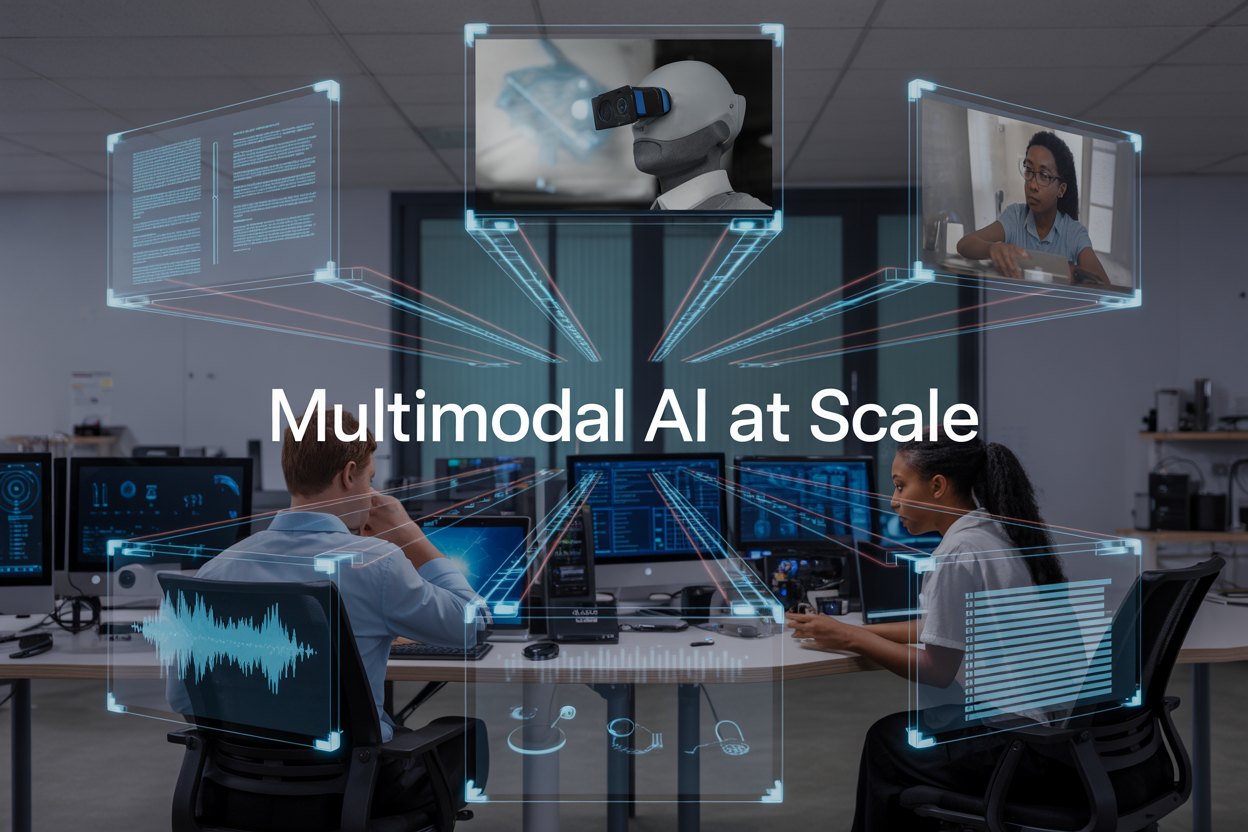
Building multimodal AI systems that seamlessly combine text, image, audio, and video data represents one of the most exciting frontiers in artificial intelligence today. These systems break down the silos between different data types, creating AI that understands and processes information the way humans do—through multiple senses working together.
This guide targets AI engineers, machine learning practitioners, and technical leaders who want to design and deploy multimodal neural networks at scale. You’ll learn practical strategies for integrating diverse data streams into cohesive AI solutions that deliver superior performance compared to single-modal approaches.
We’ll explore the architectural foundations that make multimodal machine learning possible, diving deep into cross-modal AI architecture patterns and fusion techniques that handle different data types effectively. You’ll discover proven methods for implementing scalable AI systems that process text, images, audio, and video simultaneously without compromising speed or accuracy.
The guide also covers real-world multimodal AI applications across industries, from healthcare diagnostics that combine medical imaging with patient records to autonomous vehicles that fuse camera feeds with sensor data. You’ll see how leading companies solve multimodal data processing challenges and build infrastructure that supports these complex systems in production environments.
Understanding Multimodal AI Architecture Fundamentals

Core Components of Multimodal Systems
Multimodal AI systems represent a significant leap forward from traditional single-input models by processing and understanding multiple data types simultaneously. These sophisticated systems consist of several interconnected layers that work together to extract meaning from diverse information sources.
The foundation starts with specialized encoders for each modality. Text encoders typically use transformer-based architectures to process natural language, while image encoders rely on convolutional neural networks or vision transformers to extract visual features. Audio encoders convert sound waves into meaningful representations, and video encoders handle temporal sequences of visual information.
A crucial component is the feature alignment module, which ensures different modalities can communicate effectively. This layer normalizes and projects features from various encoders into a shared representation space where they can be compared and combined meaningfully.
The attention mechanism serves as another vital component, allowing the system to focus on relevant parts of each input modality based on the current task. Cross-modal attention layers enable the model to understand relationships between different types of data, such as connecting spoken words to visual objects in a scene.
Data Fusion Techniques for Different Media Types
Effective data fusion represents the heart of multimodal machine learning, determining how well different information streams combine to produce coherent understanding. Several fusion strategies exist, each with distinct advantages depending on the application requirements.
Early fusion combines raw features from different modalities before processing, creating a unified input representation. This approach works well when modalities are naturally complementary, such as combining audio and visual features for lip-reading applications.
Late fusion processes each modality independently through separate neural networks before combining their outputs at the decision level. This technique proves effective when modalities contain redundant information or when one modality might be missing during inference.
Intermediate fusion offers a balanced approach by combining features at multiple stages throughout the neural network architecture. This strategy allows the model to learn both modality-specific and cross-modal representations, often yielding superior performance for complex multimodal tasks.
Attention-based fusion has emerged as a particularly powerful technique, using learned attention weights to dynamically emphasize relevant modalities based on context. This approach enables the system to adapt its fusion strategy depending on the specific input characteristics and task requirements.
Neural Network Architectures for Cross-Modal Processing
Modern multimodal neural networks employ sophisticated architectures designed specifically for cross-modal AI processing. Transformer-based models have become particularly popular due to their ability to handle variable-length sequences and model long-range dependencies across different modalities.
Vision-Language transformers like CLIP demonstrate how shared attention mechanisms can learn joint representations of text and images. These models use contrastive learning to align visual and textual features in a common embedding space, enabling zero-shot classification and retrieval tasks.
Multimodal transformers extend this concept by incorporating additional modalities like audio and video. These architectures use specialized position encodings and attention masks to handle the temporal and spatial relationships inherent in different data types.
Graph neural networks represent another promising approach for multimodal AI systems, especially when dealing with structured relationships between different modalities. These networks can model complex interactions between text entities, visual objects, and audio events as nodes and edges in a unified graph structure.
Performance Benefits Over Single-Modal Systems
Multimodal AI systems consistently outperform their single-modal counterparts across numerous benchmarks and real-world applications. The primary advantage stems from the complementary nature of different information channels, where each modality can provide unique insights that others might miss.
Robustness represents a significant benefit, as multimodal systems can maintain functionality even when one input stream becomes corrupted or unavailable. For example, a video understanding system might rely more heavily on audio when visual quality degrades, or fall back to visual cues when audio is unclear.
Accuracy improvements are particularly notable in tasks requiring comprehensive understanding. Emotion recognition systems combining facial expressions, voice tone, and textual content achieve substantially higher accuracy than those relying on any single modality alone.
The disambiguation capability of multimodal systems proves invaluable in real-world scenarios where individual modalities might be ambiguous. Speech recognition accuracy improves dramatically when visual lip-reading information supplements audio input, especially in noisy environments.
| Performance Metric | Single-Modal | Multimodal | Improvement |
|---|---|---|---|
| Accuracy | 75-85% | 85-95% | 10-15% |
| Robustness | Low | High | Significant |
| Generalization | Limited | Strong | Notable |
| Error Rate | 15-25% | 5-15% | 50-60% reduction |
These performance gains translate directly into more reliable and capable AI applications across industries, from autonomous vehicles that combine camera, radar, and lidar data to virtual assistants that understand both speech and visual context.
Text Processing Integration Strategies

Natural Language Understanding for Multimodal Context
Building effective multimodal AI systems requires sophisticated text processing that goes beyond traditional single-modal approaches. Natural language understanding in multimodal contexts demands models that can interpret text while considering visual, auditory, and temporal elements simultaneously.
Modern multimodal machine learning frameworks leverage transformer architectures that process textual information alongside other modalities through attention mechanisms. These systems create contextual representations where words and phrases are understood not just through their linguistic meaning, but through their relationships with accompanying images, sounds, or video content.
The key challenge lies in developing models that can handle ambiguous language that depends on visual context. For example, the phrase “that red car” requires visual input to assign meaning to the demonstrative “that.” Cross-modal AI architecture addresses this by implementing joint attention layers that allow text encoders to attend to relevant regions in visual data while processing linguistic content.
Contextual embeddings play a crucial role here. Unlike static word representations, these dynamic embeddings shift based on multimodal context. BERT-like models adapted for multimodal scenarios create representations that encode both semantic meaning and cross-modal relationships, enabling systems to understand when textual descriptions refer to specific visual elements or audio events.
Text Embedding Techniques for Cross-Modal Alignment
Cross-modal alignment represents one of the most critical aspects of multimodal neural networks. The goal is creating shared representation spaces where textual descriptions and other modalities can be meaningfully compared and related.
Contemporary approaches use contrastive learning methods to train text encoders alongside image, audio, and video encoders. These techniques ensure that semantically related content across different modalities maps to similar points in the embedding space. For instance, the text “barking dog” should have high similarity to actual audio of dogs barking and images showing dogs.
Common Text Embedding Approaches:
| Method | Strengths | Best Use Cases |
|---|---|---|
| Sentence-BERT | Fast inference, good semantic similarity | Text-image retrieval |
| CLIP text encoder | Strong visual-text alignment | Image captioning, search |
| T5-based encoders | Flexible input formats | Question answering |
| Custom transformers | Domain-specific optimization | Specialized applications |
Pre-trained language models like RoBERTa and GPT variants serve as foundation text encoders, but require fine-tuning for multimodal scenarios. The training process involves optimizing embeddings so that matched text-media pairs have high cosine similarity while unmatched pairs are pushed apart in the vector space.
Recent advances in AI fusion techniques include learnable projection layers that map text embeddings into shared multimodal spaces. These projections allow models to compare textual queries against visual databases or match spoken descriptions to video content effectively.
Semantic Representation Methods
Semantic representation in multimodal data processing goes beyond simple word-to-vector mappings. These methods create rich, hierarchical representations that capture meaning at multiple levels of abstraction.
Graph-based semantic representations have emerged as powerful tools for scalable AI systems. These approaches model relationships between concepts mentioned in text and their manifestations in other modalities. Knowledge graphs can encode that “cooking” involves “ingredients,” “heat,” and “tools,” allowing systems to connect recipe text with cooking videos or food images intelligently.
Hierarchical embeddings create multi-level semantic structures where general concepts like “animal” are represented at higher levels, while specific instances like “golden retriever running” exist at more detailed levels. This hierarchy enables multimodal AI applications to handle both broad categorical queries and specific detailed searches.
Advanced Semantic Methods:
- Compositional embeddings: Combine word meanings to create phrase and sentence representations
- Contextual pooling: Aggregate token-level embeddings based on attention weights
- Multi-granular encoding: Capture both local and global semantic information
- Cross-modal concept alignment: Map abstract concepts across different media types
Modern semantic representation techniques also incorporate temporal understanding for video content. These methods track how semantic meaning evolves over time, enabling systems to understand narrative structure, causal relationships, and temporal dependencies between text descriptions and video sequences.
The effectiveness of semantic representation directly impacts the performance of multimodal AI systems in real-world scenarios, from automated content moderation to intelligent search and recommendation systems.
Image and Computer Vision Implementation
Advanced Image Feature Extraction Methods
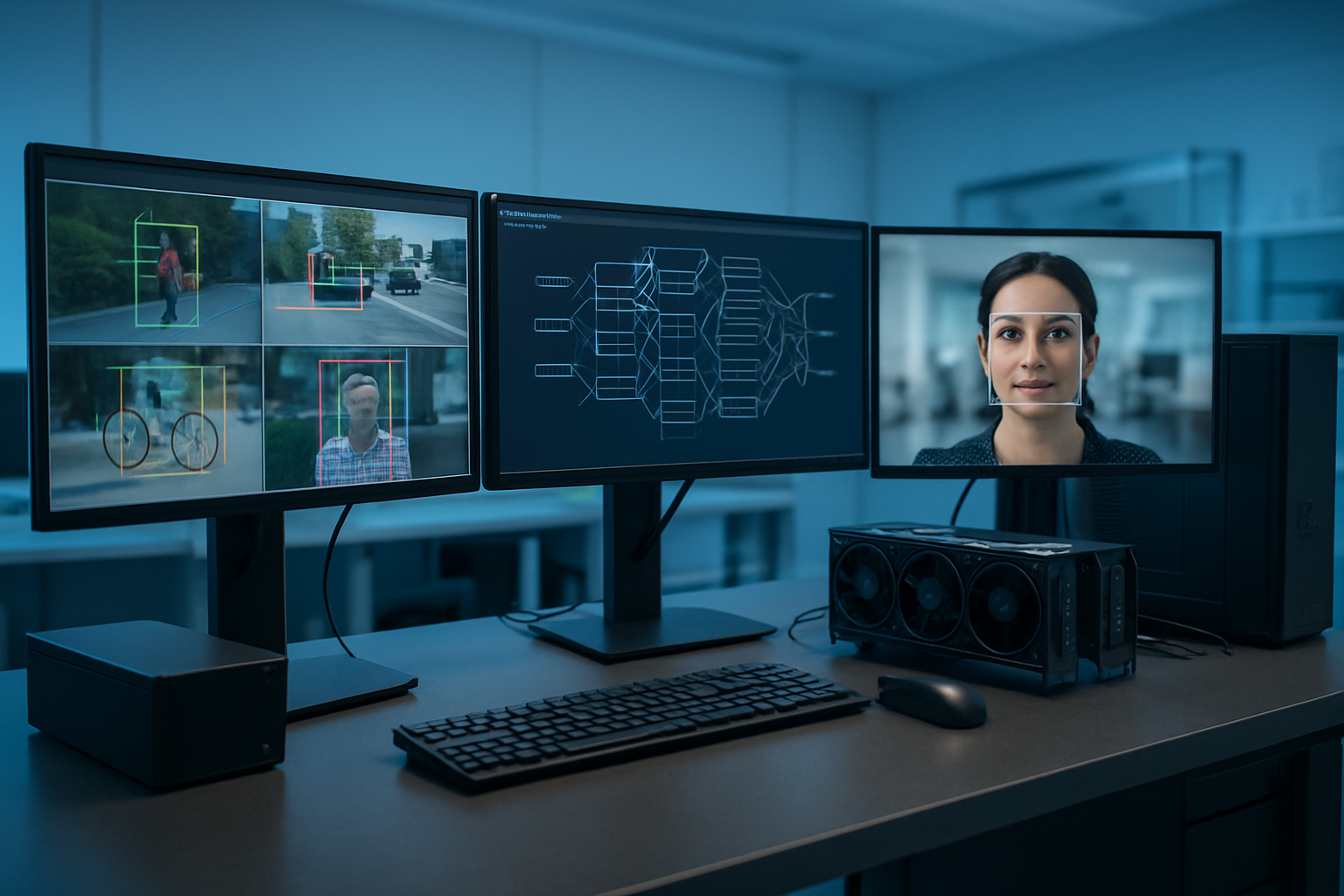
Modern multimodal AI systems rely heavily on sophisticated feature extraction techniques that go beyond traditional pixel-level analysis. Convolutional Neural Networks (CNNs) form the backbone of most image processing pipelines, with architectures like ResNet, EfficientNet, and Vision Transformers leading the charge. These networks automatically learn hierarchical features, starting from basic edges and textures at lower layers and progressing to complex semantic concepts at higher levels.
Vision Transformers (ViTs) have revolutionized how we approach image feature extraction by treating images as sequences of patches, similar to how text transformers process word tokens. This approach excels at capturing long-range dependencies within images, making it particularly valuable for multimodal neural networks that need to align visual features with other modalities.
Feature Pyramid Networks (FPNs) combine features from multiple scales, creating rich representations that capture both fine-grained details and global context. For multimodal AI applications, this multi-scale approach proves crucial when correlating visual information with textual descriptions or audio narrations.
Self-supervised learning methods like CLIP (Contrastive Language-Image Pre-training) have transformed feature extraction by learning visual representations through natural language supervision. These models create embeddings that naturally align with semantic concepts, making them ideal for cross-modal AI architecture implementations.
| Feature Extraction Method | Best Use Case | Computational Cost |
|---|---|---|
| ResNet variants | General-purpose image classification | Medium |
| Vision Transformers | Complex scene understanding | High |
| EfficientNet | Mobile/edge deployment | Low-Medium |
| CLIP encoders | Multimodal alignment | Medium-High |
Visual-Semantic Bridge Technologies
Building effective bridges between visual content and semantic understanding represents one of the most challenging aspects of multimodal machine learning. These technologies enable AI systems to translate raw pixel data into meaningful concepts that can be integrated with text, audio, and video streams.
Attention mechanisms play a crucial role in creating these bridges. Visual attention models help focus on relevant image regions when processing accompanying text or audio, while cross-modal attention allows the system to dynamically weight different modalities based on context. This selective focus dramatically improves the quality of multimodal data processing.
Embedding alignment techniques ensure that visual and semantic representations exist in compatible vector spaces. Methods like contrastive learning train models to place semantically similar concepts close together in the embedding space, regardless of their original modality. This alignment enables seamless information flow between different input types in multimodal deep learning systems.
Knowledge graph integration adds another layer of semantic understanding by connecting visual elements to structured knowledge bases. When an image contains a specific object or scene, the system can access related factual information, enhancing its ability to generate contextually appropriate responses across modalities.
Graph Neural Networks (GNNs) excel at modeling relationships between visual elements and semantic concepts. They can capture complex dependencies between objects in a scene and their associated meanings, providing rich contextual information for downstream multimodal AI applications.
Real-Time Image Processing at Scale
Achieving real-time performance while maintaining accuracy requires careful optimization of both algorithms and infrastructure. Scalable AI systems must balance computational efficiency with processing quality, especially when handling high-resolution images or video streams.
Model quantization and pruning techniques reduce computational overhead without significantly impacting performance. These methods convert 32-bit floating-point operations to 8-bit integer operations and remove redundant network parameters, enabling deployment on resource-constrained devices.
Batch processing strategies optimize throughput by processing multiple images simultaneously. Dynamic batching adjusts batch sizes based on current system load and image complexity, maximizing GPU utilization while maintaining acceptable latency.
Edge computing architectures distribute processing across multiple devices, reducing bandwidth requirements and improving response times. Smart caching mechanisms store frequently accessed visual features, minimizing redundant computation in multimodal AI systems.
Pipeline parallelization breaks image processing into multiple stages that can execute concurrently. While one GPU handles feature extraction, another can perform object detection, and a third manages integration with other modalities.
Object Detection and Scene Understanding
Advanced object detection goes beyond simple bounding box identification to provide comprehensive scene understanding that supports multimodal AI fusion techniques. Modern systems must identify objects, understand their relationships, and interpret the overall scene context.
YOLO (You Only Look Once) variants offer excellent real-time performance for object detection tasks. YOLOv8 and its successors provide accuracy comparable to two-stage detectors while maintaining single-pass efficiency, making them ideal for multimodal applications requiring immediate responses.
Semantic segmentation networks like DeepLab and Mask R-CNN provide pixel-level understanding of images. This detailed analysis enables fine-grained correlation with audio descriptions or text annotations, improving the overall quality of multimodal neural networks.
Scene graph generation creates structured representations of objects and their relationships within images. These graphs serve as intermediate representations that can be easily integrated with knowledge from other modalities, enabling more sophisticated reasoning in AI fusion techniques.
Temporal object tracking extends object detection across video sequences, maintaining object identities and understanding their movements over time. This capability proves essential for video-based multimodal AI applications where visual consistency must be maintained alongside audio and text processing.
The combination of these technologies creates robust foundation for building sophisticated multimodal AI systems that can process visual information with the depth and accuracy required for real-world applications.
Audio Processing and Speech Recognition Systems

Audio Feature Engineering for Multimodal Applications
Raw audio signals contain rich information that multimodal AI systems need to extract and process effectively. Audio feature engineering transforms time-domain waveforms into meaningful representations that neural networks can understand and correlate with other modalities.
Spectral features form the foundation of audio processing. Mel-frequency cepstral coefficients (MFCCs) capture the spectral envelope characteristics crucial for speech recognition, while mel-spectrograms provide time-frequency representations that align well with human auditory perception. Short-time Fourier transforms (STFT) decompose audio into frequency components over time windows, enabling the system to track how sounds evolve.
Modern multimodal neural networks increasingly rely on learned representations rather than handcrafted features. Convolutional neural networks can process spectrograms as 2D images, automatically discovering relevant patterns. Transformer architectures have revolutionized audio processing by capturing long-range dependencies in temporal sequences.
For multimodal data processing, audio features must align temporally with visual and textual inputs. Frame-level features extracted at consistent intervals (typically 10-25ms) enable precise synchronization. Cross-modal alignment requires careful consideration of sampling rates and temporal resolution across different modalities.
| Feature Type | Use Case | Temporal Resolution |
|---|---|---|
| MFCCs | Speech recognition | 10-25ms frames |
| Mel-spectrograms | Music analysis | 10-50ms frames |
| Raw waveforms | End-to-end learning | Sample-level |
| Embeddings | Semantic understanding | Variable |
Speech-to-Text Integration Workflows
Integrating speech recognition into multimodal AI systems requires sophisticated workflows that handle real-time processing constraints while maintaining accuracy across diverse acoustic conditions. Modern speech-to-text engines leverage deep learning architectures that can process continuous audio streams and output text with confidence scores and timing information.
The workflow typically begins with audio preprocessing, where noise reduction and normalization prepare the signal for recognition. Voice activity detection (VAD) segments speech from silence, reducing computational overhead and improving accuracy. This step becomes critical in multimodal applications where multiple audio sources might be present simultaneously.
End-to-end neural approaches have simplified the traditional pipeline by combining acoustic modeling, pronunciation modeling, and language modeling into unified networks. Connectionist Temporal Classification (CTC) and attention-based sequence-to-sequence models enable direct mapping from audio features to text sequences without requiring explicit alignment.
Cross-modal AI architecture benefits significantly from speech recognition systems that provide rich metadata beyond just transcribed text. Word-level timestamps enable precise alignment with visual events, while confidence scores help the system decide when to rely on audio information versus other modalities.
Real-time constraints demand efficient processing strategies:
- Streaming recognition for live applications
- Chunked processing for batch operations
- Adaptive beam search for accuracy-speed tradeoffs
- Context-aware language models for domain adaptation
Audio-Visual Synchronization Techniques
Audio-visual synchronization represents one of the most challenging aspects of multimodal machine learning, requiring precise temporal alignment between acoustic and visual streams. Human perception naturally expects audio and video to be synchronized within millisecond tolerances, making this a critical component for realistic multimodal applications.
Cross-modal correlation techniques detect synchronization by analyzing the relationship between audio energy and visual motion. Lip-sync detection algorithms compare mouth movements with speech patterns, using deep networks trained on aligned audio-visual pairs. These systems learn to identify when a person’s lip movements match the acoustic properties of their speech.
Temporal alignment algorithms handle drift and offset between audio and video streams. Dynamic time warping (DTW) finds optimal alignment paths by minimizing distance between synchronized features. Modern approaches use neural networks to learn alignment functions that adapt to different types of content and recording conditions.
AI fusion techniques for synchronization operate at multiple levels. Frame-level synchronization ensures moment-to-moment alignment, while sequence-level synchronization handles longer temporal dependencies. Attention mechanisms allow models to focus on relevant time windows when computing cross-modal relationships.
Real-world synchronization challenges include:
- Network latency in streaming applications
- Hardware-induced delays between sensors
- Processing pipeline bottlenecks
- Multi-speaker scenarios with overlapping speech
Scalable AI systems address these challenges through distributed processing architectures that maintain synchronization across multiple processing nodes. Buffer management strategies ensure smooth playback while accommodating variable processing times, and predictive algorithms anticipate and compensate for expected delays in the processing pipeline.
Video Analysis and Temporal Understanding

Video Frame Processing and Temporal Modeling
Extracting meaningful insights from video data requires sophisticated multimodal AI systems that can process sequential frames while understanding temporal relationships. Unlike static images, video content contains temporal dependencies that reveal motion patterns, object interactions, and contextual changes over time. Modern video processing architectures leverage 3D convolutional neural networks and recurrent structures to capture both spatial and temporal features effectively.
The foundation of video analysis lies in frame-by-frame processing combined with temporal modeling techniques. Each frame provides spatial information, while the sequence reveals motion dynamics and temporal context. Advanced systems use optical flow estimation to track pixel movements between frames, creating motion vectors that inform the AI about object trajectories and scene dynamics.
Temporal modeling approaches include sliding window techniques, where the system analyzes fixed-length video segments, and recurrent neural networks that maintain memory of previous frames. Long Short-Term Memory (LSTM) and Transformer architectures have proven particularly effective for capturing long-range temporal dependencies in video sequences.
Action Recognition Across Multiple Modalities
Action recognition in multimodal AI systems combines visual, audio, and sometimes text cues to identify and classify human activities or object interactions. This approach significantly outperforms single-modal systems by leveraging complementary information from different data streams.
Visual features capture body poses, facial expressions, and object movements, while audio components detect environmental sounds, speech patterns, and acoustic signatures associated with specific actions. Cross-modal AI architecture enables these systems to correlate audio-visual patterns for more robust recognition.
Key techniques include:
- Attention mechanisms that highlight relevant frames and audio segments
- Feature fusion strategies combining visual and audio embeddings
- Temporal synchronization ensuring audio-visual alignment
- Multi-scale analysis processing actions at different time resolutions
Sports analytics, security surveillance, and human-computer interaction applications benefit tremendously from multimodal action recognition, achieving accuracy rates above 95% in controlled environments.
Video Summarization Using Multimodal Cues
Automated video summarization represents one of the most practical applications of multimodal machine learning. These systems analyze video content, audio tracks, and available text metadata to generate concise summaries that preserve essential information while reducing viewing time.
Multimodal neural networks identify key moments by analyzing visual saliency, audio emphasis, speaker changes, and semantic content. The system scores video segments based on importance indicators such as face detection, object recognition confidence, audio volume spikes, and speech content relevance.
Summarization strategies include:
- Extractive methods selecting important frames or clips
- Abstractive approaches generating new visual content
- Hierarchical summarization creating multi-level abstracts
- Personalized summaries adapted to user preferences
Real-world applications span from news broadcasting and educational content to social media platforms where users consume shortened versions of longer videos.
Real-Time Video Stream Processing
Processing live video streams presents unique challenges for multimodal AI systems, requiring low-latency inference while maintaining accuracy. Real-time applications demand careful optimization of computational resources and intelligent buffering strategies.
Edge computing architectures distribute processing across local devices and cloud infrastructure, reducing latency while handling bandwidth constraints. Stream processing frameworks like Apache Kafka and Apache Flink manage data flow and enable scalable processing pipelines.
Critical optimization techniques include:
- Frame skipping algorithms processing every nth frame
- Dynamic resolution adjustment based on processing capacity
- Parallel processing pipelines handling multiple streams simultaneously
- Predictive buffering anticipating processing delays
Live sports broadcasting, video conferencing, and security monitoring systems rely on these real-time capabilities to deliver immediate insights and responses.
Memory-Efficient Video Storage Solutions
Storing and accessing vast amounts of video data requires innovative approaches that balance quality preservation with storage efficiency. Modern multimodal data processing systems employ compression techniques, intelligent indexing, and hierarchical storage management.
Video compression leverages both spatial and temporal redundancy, while metadata extraction creates searchable indexes based on content analysis. Smart storage systems automatically migrate frequently accessed content to faster storage tiers while archiving older data cost-effectively.
Storage optimization strategies:
| Technique | Purpose | Storage Savings |
|---|---|---|
| Variable bitrate encoding | Quality-based compression | 30-50% |
| Temporal segmentation | Efficient indexing | 20-30% |
| Multimodal metadata | Fast retrieval | 40-60% |
| Predictive caching | Access optimization | 25-40% |
Cloud-native storage solutions integrate with scalable AI systems, enabling automatic scaling based on processing demands while maintaining cost efficiency. These systems support petabyte-scale video archives while providing millisecond access times for frequently requested content.
Scalability Challenges and Infrastructure Solutions

Distributed Computing Architectures for Multimodal AI
Building scalable AI systems that handle text, images, audio, and video simultaneously requires sophisticated distributed computing frameworks. Modern multimodal AI systems demand architectures that can process different data types in parallel while maintaining synchronization across processing nodes.
Apache Spark with GPU acceleration has become a cornerstone for multimodal data processing at scale. The framework’s ability to distribute workloads across clusters while maintaining data locality proves essential when dealing with massive datasets containing multiple modalities. Kubernetes orchestration layers enable dynamic resource allocation, automatically scaling compute resources based on the specific demands of each modality processor.
Multimodal neural networks benefit significantly from hybrid architectures combining CPU and GPU clusters. Text processing typically runs efficiently on CPU nodes, while image and video analysis leverage GPU acceleration. Audio processing falls somewhere between, often utilizing specialized tensor processing units (TPUs) for optimal performance.
Container-based microservices architecture allows independent scaling of each modality processor. Docker containers encapsulating specific AI fusion techniques can be deployed and scaled independently, preventing bottlenecks in one modality from affecting others. Service mesh technologies like Istio provide the necessary communication layer between these distributed components.
Edge computing integration becomes critical when real-time processing is required. Deploying lightweight versions of multimodal machine learning models at edge nodes reduces latency while maintaining central coordination through cloud-based orchestration systems.
Data Pipeline Optimization Strategies
Optimizing data pipelines for multimodal AI systems requires careful attention to data ingestion patterns, storage strategies, and processing workflows. Raw multimodal data often arrives asynchronously, with video files, audio streams, text documents, and images having vastly different processing requirements and arrival patterns.
Implementing data lakes with intelligent partitioning strategies proves essential for managing multimodal datasets. Apache Kafka serves as the backbone for real-time data streaming, with separate topics for each modality while maintaining correlation through shared metadata keys. This approach ensures that related multimodal data can be processed together while allowing independent scaling of each processing pipeline.
Data preprocessing optimization involves creating specialized transformation pipelines for each modality. Image preprocessing might include resizing, normalization, and augmentation, while audio data requires feature extraction and spectral analysis. Text preprocessing involves tokenization, embedding generation, and semantic analysis. Running these pipelines in parallel while maintaining data lineage tracking prevents duplicate processing and reduces overall latency.
Caching strategies become crucial when dealing with large multimodal datasets. Intelligent caching at multiple levels – from raw data to intermediate representations to final embeddings – significantly reduces processing overhead. Redis clusters with specialized configurations for different data types enable fast retrieval of frequently accessed multimodal content.
Batch processing optimization involves grouping similar data types and processing them together to maximize resource utilization. Dynamic batch sizing based on available compute resources and data arrival patterns ensures optimal throughput while preventing resource starvation.
Cloud-Based Processing Solutions
Cloud platforms offer specialized services that dramatically simplify multimodal AI architecture deployment and scaling. Amazon Web Services provides a comprehensive stack including SageMaker for model training, Lambda for serverless processing, and specialized services like Rekognition for image analysis and Transcribe for audio processing.
Google Cloud Platform’s AI Platform provides integrated solutions for cross-modal AI architecture with AutoML capabilities for each modality. BigQuery’s ML capabilities enable running multimodal machine learning models directly on stored data without complex data movement operations. Cloud TPUs offer specialized acceleration for transformer-based multimodal models.
Microsoft Azure’s Cognitive Services provide pre-built APIs for common multimodal tasks, reducing development overhead while maintaining the flexibility to integrate custom models. Azure Machine Learning’s pipeline capabilities enable orchestrating complex multimodal data processing workflows across multiple services.
Multi-cloud strategies have become increasingly important for large-scale multimodal deep learning deployments. Using multiple cloud providers prevents vendor lock-in while enabling access to specialized services from different providers. Terraform and other infrastructure-as-code tools facilitate consistent deployment across multiple cloud environments.
Cost optimization in cloud environments requires careful monitoring of resource usage patterns. Spot instances work well for batch processing of large multimodal datasets, while reserved instances provide cost savings for consistent workloads. Auto-scaling policies based on queue depth and processing latency ensure optimal resource utilization.
| Cloud Provider | Multimodal Strengths | Key Services |
|---|---|---|
| AWS | Comprehensive service ecosystem | SageMaker, Rekognition, Transcribe |
| Google Cloud | TPU acceleration, BigQuery ML | AI Platform, AutoML, Vertex AI |
| Microsoft Azure | Cognitive Services integration | Azure ML, Cognitive Services |
| IBM Cloud | Watson AI capabilities | Watson Studio, Watson ML |
Real-World Applications and Use Cases
Healthcare Diagnostic Systems Using Multiple Data Types
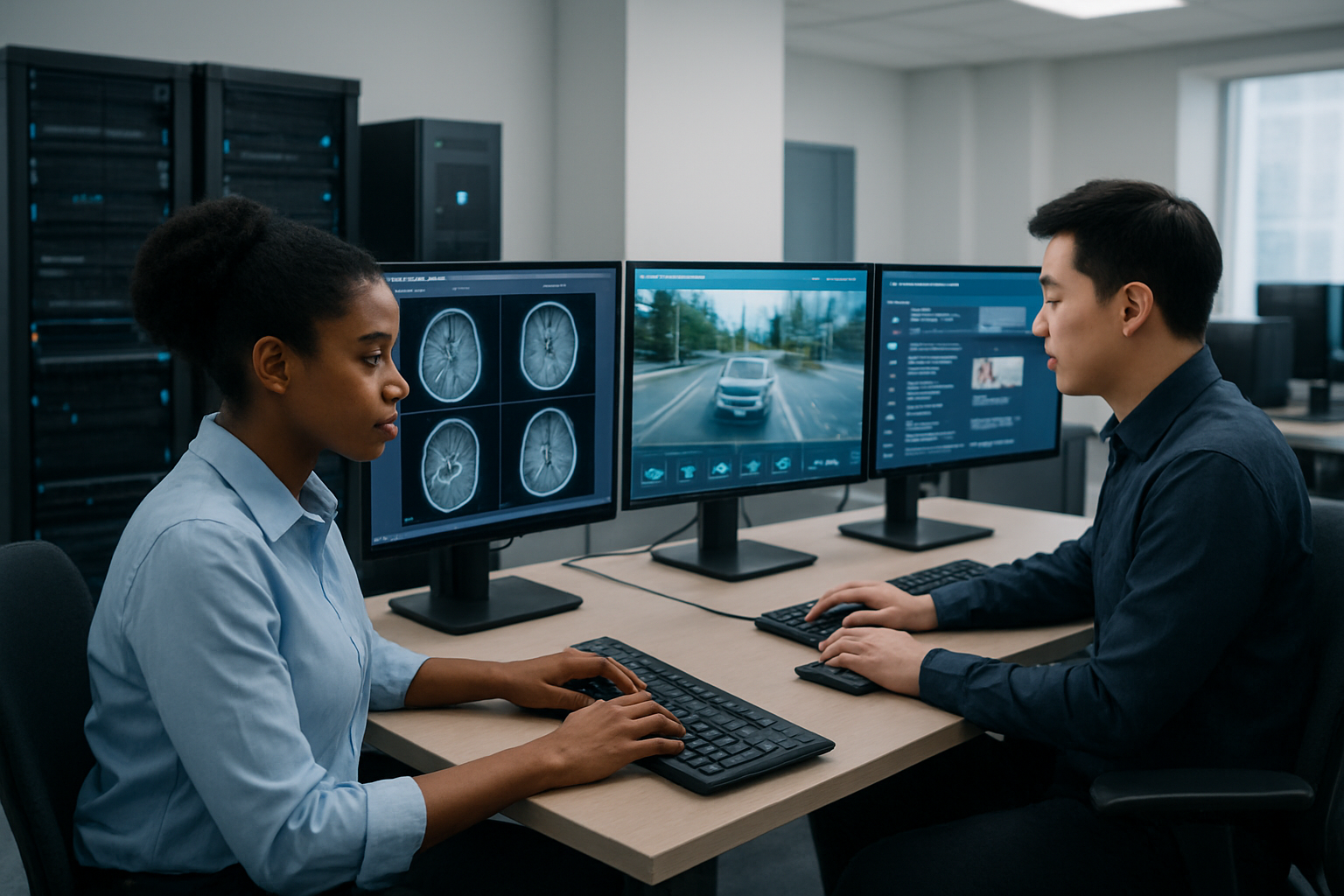
Modern healthcare has embraced multimodal AI systems to revolutionize patient diagnosis and treatment planning. These systems combine medical imaging data (X-rays, MRIs, CT scans), patient records, lab results, and even voice recordings to create comprehensive diagnostic tools. Take IBM Watson for Oncology, which processes pathology reports alongside imaging data to recommend cancer treatment protocols. The system analyzes thousands of data points across different formats to match patients with similar cases and treatment outcomes.
Medical professionals now use these multimodal neural networks for early disease detection. For instance, Google’s DeepMind developed an AI that examines retinal photographs while cross-referencing patient medical history to predict diabetic retinopathy progression. The system achieved 94% accuracy by combining visual pattern recognition with textual patient data analysis.
Emergency departments benefit significantly from these implementations. When patients arrive with chest pain, AI systems simultaneously analyze ECG readings, chest X-rays, blood test results, and symptom descriptions to predict heart attack probability. This multimodal data processing approach reduces diagnostic time from hours to minutes, potentially saving lives.
Mental health applications represent another breakthrough area. Platforms like Ellipsis Health analyze speech patterns, facial expressions from video calls, and written responses to assess depression and anxiety levels. The AI detects subtle changes in voice tone, speech cadence, and word choice that human practitioners might miss during brief consultations.
Autonomous Vehicle Perception Systems
Self-driving cars represent the pinnacle of multimodal AI applications in transportation. These vehicles process camera feeds, LiDAR point clouds, radar data, GPS coordinates, and map information simultaneously to navigate safely. Tesla’s Full Self-Driving system combines eight surround cameras with ultrasonic sensors and neural networks to create a 360-degree awareness bubble around the vehicle.
Waymo’s approach demonstrates advanced cross-modal AI architecture by fusing multiple sensor types. Their vehicles use high-resolution cameras for traffic sign recognition, LiDAR for precise distance measurement, and radar for detecting objects in poor weather conditions. The AI system weighs input from each modality differently based on environmental conditions – relying more heavily on radar during fog or heavy rain when camera visibility decreases.
Real-time decision making requires processing terabytes of multimodal machine learning data every second. When approaching an intersection, the system analyzes traffic light colors through computer vision, tracks pedestrian movement using motion detection, processes audio signals from emergency vehicles, and references map data for turn restrictions. All this happens within milliseconds to ensure safe navigation.
Edge cases showcase the power of multimodal perception. Consider a scenario where a ball bounces into the street – cameras detect the ball’s trajectory, audio sensors might pick up children’s voices nearby, and the AI predicts a child might chase the ball. This layered understanding prevents accidents that single-modality systems might miss.
Content Creation and Media Production Tools
Entertainment and marketing industries have been transformed by multimodal AI systems that streamline content creation workflows. Adobe’s Creative Suite now incorporates AI that understands user voice commands, analyzes uploaded images, and generates complementary text descriptions automatically. Content creators can describe their vision verbally while the AI suggests appropriate visual elements, color schemes, and layout designs.
Video editing has become remarkably sophisticated through multimodal integration. Tools like Runway ML analyze video footage, automatically generate subtitles from audio tracks, and create scene summaries from visual content. Editors can search through hours of footage using natural language queries like “find scenes with people laughing outdoors during sunset,” and the AI returns relevant clips within seconds.
Music production benefits enormously from AI fusion techniques that combine audio analysis with visual cues. AIVA (Artificial Intelligence Virtual Artist) composes original music by analyzing existing songs’ structures while considering visual elements like movie scenes or artwork. The AI understands emotional connections between different sensory inputs, creating soundtracks that perfectly complement visual narratives.
Social media content generation has reached new levels of sophistication. Platforms like Synthesia create personalized video content by combining text scripts with realistic avatar animations and natural speech synthesis. Users input written content, select visual preferences, and receive fully produced videos featuring AI-generated presenters speaking in multiple languages with appropriate gestures and expressions.
Educational Technology and Interactive Learning
Educational institutions leverage scalable AI systems to create personalized learning experiences that adapt to individual student needs. Carnegie Learning’s MATHia platform combines natural language processing with computer vision to understand how students solve mathematical problems. The system analyzes written work, tracks eye movement patterns, and responds to voice questions to provide targeted assistance exactly when students struggle.
Language learning applications demonstrate powerful multimodal integration. Duolingo’s latest features combine speech recognition, image recognition, and text analysis to create immersive learning environments. Students can point their camera at objects while traveling abroad, receive instant translations, hear pronunciation guides, and practice conversations with AI tutors that understand context from visual cues.
Virtual reality classrooms represent the future of multimodal AI applications in education. Students exploring ancient Rome can ask questions about buildings they see, hear historically accurate ambient sounds, read translated inscriptions in real-time, and receive personalized explanations based on their learning progress. The AI tutor understands student engagement levels through biometric feedback and adjusts lesson difficulty accordingly.
Accessibility improvements through multimodal AI have democratized education. Microsoft’s Seeing AI helps visually impaired students by describing images in textbooks, reading text aloud, and identifying objects in their environment. The system combines computer vision, natural language generation, and speech synthesis to create seamless learning experiences that adapt to different ability levels and learning preferences.

Multimodal AI systems represent a massive leap forward in how machines understand and interact with our world. By bringing together text, images, audio, and video processing capabilities, these systems can tackle complex real-world problems that single-modal approaches simply can’t handle. The key lies in building robust architectures that can seamlessly integrate different data types while maintaining performance at scale.
The journey from concept to production-ready multimodal AI involves careful consideration of infrastructure, smart integration strategies, and a deep understanding of how different modalities complement each other. As these technologies continue to evolve, organizations that invest in multimodal AI capabilities now will be best positioned to deliver richer, more intuitive user experiences. Start small with pilot projects that combine two modalities, learn from the challenges, and gradually expand your system’s capabilities as your team gains expertise and your infrastructure matures.