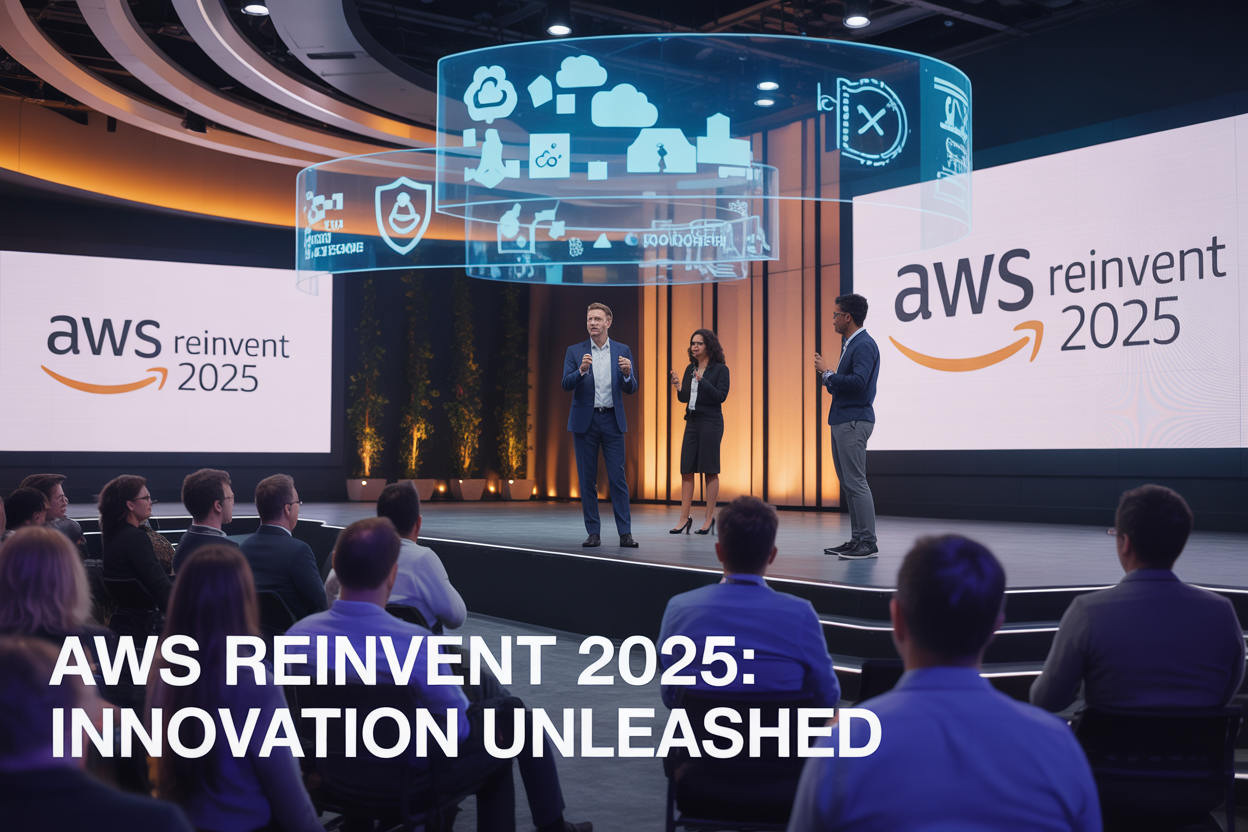
AWS re:Invent 2025 delivered major announcements that will reshape how teams build, secure, and manage cloud infrastructure. This comprehensive breakdown is designed for developers seeking cutting-edge tools, security teams evaluating new compliance solutions, and CIOs planning strategic cloud investments.
Amazon unveiled game-changing developer tools that streamline application building and deployment processes. The security announcements introduce enterprise-grade features that strengthen AWS compliance solutions and protect sensitive workloads at scale. CIOs will find valuable insights on AWS cost optimization strategies and infrastructure management innovations that drive business value.
We’ll explore the standout AWS developer tools that accelerate development cycles and the enterprise cloud security enhancements that address modern threat landscapes. You’ll also discover how the latest AWS industry solutions can transform your organization’s cloud migration strategies and overall technology roadmap.
Game-Changing Developer Tools and Services

Revolutionary AI-powered coding assistants and automation features
Amazon CodeWhisperer has evolved into something developers didn’t see coming. The new 2025 version now understands entire codebases, not just individual functions. You can ask it to refactor legacy applications, generate comprehensive test suites, and even suggest architectural improvements based on your specific use patterns. The AI assistant now supports over 50 programming languages and frameworks, including emerging technologies like WebAssembly and Rust.
What’s really exciting is the new auto-remediation feature. When CodeWhisperer detects security vulnerabilities or performance bottlenecks in your code, it doesn’t just flag them—it writes the fixes for you. The AI can automatically update dependency versions, patch security holes, and optimize database queries while maintaining your coding style and project conventions.
The integration with AWS developer tools means CodeWhisperer now works seamlessly across your entire development pipeline. It can generate Infrastructure as Code templates, create monitoring dashboards, and even write deployment scripts that follow your organization’s best practices.
Enhanced serverless computing capabilities for faster deployment
AWS Lambda has received major upgrades that address the biggest pain points developers face. Cold start times have dropped by 75% through new initialization optimizations and intelligent pre-warming. The platform now supports larger memory configurations up to 10GB and extended execution times of up to 30 minutes for complex workloads.
Lambda’s new deployment pipeline automatically handles blue-green deployments with zero-downtime rollbacks. You can now deploy functions with built-in A/B testing capabilities, allowing you to gradually shift traffic between versions based on performance metrics or business rules.
The serverless experience extends beyond Lambda with enhanced AWS Fargate capabilities. Container startup times have improved dramatically, and the new spot integration can reduce costs by up to 60% for fault-tolerant workloads. Event-driven architectures get a boost with improved EventBridge processing and native support for complex event patterns.
New container orchestration and microservices management tools
Amazon EKS introduces service mesh capabilities that work out of the box. The new built-in service mesh eliminates the complexity of setting up Istio or Linkerd while providing the same traffic management, security policies, and observability features. Cross-cluster communication becomes straightforward with automatic mTLS encryption and intelligent load balancing.
The EKS control plane now includes GitOps workflows as a native feature. You can connect your Git repositories directly to EKS clusters, enabling continuous deployment without third-party tools. The platform automatically syncs cluster state with your Git repositories and provides detailed audit logs for all changes.
Container image management gets simpler with the new Amazon ECR features. Vulnerability scanning now happens in real-time as images are built, and the service can automatically patch base images when security updates become available. Multi-region replication ensures your container images are available globally with minimal latency.
Advanced debugging and performance monitoring solutions
AWS X-Ray has transformed into a comprehensive application intelligence platform. The new version provides real-time dependency mapping that shows how services interact across your entire stack. You can trace requests from the frontend through multiple microservices and into database calls with unprecedented detail.
Performance insights now include predictive analytics that warn you about potential issues before they impact users. The system learns your application’s normal behavior patterns and alerts you when metrics deviate from expected ranges. Root cause analysis becomes automated—X-Ray can pinpoint the exact code changes or infrastructure modifications that caused performance degradation.
CloudWatch receives AI-powered anomaly detection that goes beyond simple threshold monitoring. The service can identify complex patterns like seasonal traffic variations, gradual performance degradation, and cascading failure scenarios. Custom dashboards now generate automatically based on your application architecture and the metrics that matter most to your specific use case.
Enterprise Security Enhancements and Compliance Features

Zero-trust architecture implementations and identity management upgrades
AWS security features at re:Invent 2025 center around a comprehensive zero-trust framework that treats every access request as potentially hostile. The new Amazon Verified Permissions service integrates directly with AWS Identity Center, creating granular policy enforcement that evaluates user context, device health, and behavioral patterns in real-time.
The enhanced AWS IAM Identity Center now includes adaptive authentication that adjusts security requirements based on risk scores calculated from over 40 data points. Users accessing sensitive resources from unfamiliar locations or devices face stepped-up verification, while trusted patterns enable smoother workflows.
AWS introduced the Identity Graph service, mapping relationships between users, applications, and resources across your entire infrastructure. This visual representation helps security teams identify privilege escalation paths and enforce least-privilege access more effectively.
The new AWS Private Certificate Authority integration with identity management creates automated certificate lifecycle management for device authentication. Each endpoint receives unique cryptographic identities that rotate automatically, eliminating the security risks of shared credentials or static certificates.
Multi-account identity federation received significant upgrades through AWS Organizations integration. Security administrators can now push identity policies across hundreds of accounts simultaneously, while maintaining granular control over exceptions and special access requirements.
Advanced threat detection and automated response mechanisms
AWS GuardDuty evolved into an intelligent security orchestration platform that goes far beyond traditional threat detection. The service now analyzes network traffic patterns, API call sequences, and resource usage anomalies using machine learning models trained on global threat intelligence.
The new AWS Security Hub response automation creates playbooks that trigger automatically when specific threat patterns emerge. These playbooks can isolate compromised instances, rotate credentials, block suspicious IP ranges, and notify security teams through integrated communication channels.
Amazon Detective received enhanced investigation capabilities that reconstruct attack timelines with unprecedented detail. Security analysts can now trace threat actors’ movements across your AWS environment, identifying entry points, lateral movement patterns, and potential data exfiltration attempts through interactive visual analysis.
AWS introduced the Threat Intelligence service, aggregating indicators from commercial feeds, government sources, and AWS’s own security research. This intelligence automatically updates security group rules, WAF configurations, and endpoint protection policies to block known malicious infrastructure.
The CloudTrail Insights feature now uses behavioral analysis to identify unusual administrative activities that might indicate compromised credentials or insider threats. The system establishes baseline patterns for each user and alerts when activities deviate significantly from established norms.
Enhanced data encryption and privacy protection capabilities
AWS compliance solutions received major upgrades focused on automated data classification and protection. The new Amazon Macie integration with AWS KMS creates automatic encryption policies based on data sensitivity classifications, ensuring that personally identifiable information and sensitive business data receive appropriate protection levels.
The enhanced AWS CloudHSM service now supports quantum-resistant encryption algorithms, preparing organizations for post-quantum cryptography requirements. These hardware security modules can generate and manage encryption keys that remain secure against future quantum computing attacks.
AWS introduced the Data Residency service, providing granular control over where your data gets stored, processed, and backed up. Organizations can specify geographic boundaries at the resource level, with automated compliance reporting that demonstrates adherence to local data protection regulations.
The new AWS Nitro Enclaves integration with database services creates confidential computing environments for processing sensitive information. Applications can perform analytics on encrypted data without exposing the underlying information to the operating system or cloud provider.
Client-side encryption received significant improvements through the AWS Encryption SDK updates. Developers can now implement field-level encryption with minimal code changes, while the service automatically handles key rotation, algorithm updates, and compliance reporting requirements.
CIO-Focused Infrastructure and Cost Management Innovations

Strategic multi-cloud and hybrid cloud management solutions
AWS re:Invent 2025 brought exciting news for CIOs seeking better control over complex cloud environments. The new AWS Multi-Cloud Operations Center gives you a single dashboard to manage resources across different cloud providers, breaking down the silos that have frustrated IT teams for years.
Think of it as your command center for everything cloud-related. You can monitor AWS, Azure, and Google Cloud resources from one place, track spending across platforms, and even automate workload placement based on cost and performance criteria. The hybrid cloud connector has also gotten smarter, automatically syncing policies between on-premises infrastructure and cloud environments without manual intervention.
Security policies now flow seamlessly between different cloud platforms through the new Cross-Cloud Security Bridge. This means your team can set governance rules once and watch them apply consistently whether workloads run on AWS, your private data center, or other public clouds.
Intelligent cost optimization and resource allocation tools
Cost management got a major upgrade with AWS FinOps Assistant, an AI-powered tool that spots spending patterns humans might miss. Instead of sifting through endless billing reports, you get personalized recommendations that actually make sense for your business.
The tool goes beyond basic rightsizing suggestions. It analyzes your application performance requirements, usage patterns, and business priorities to recommend the perfect mix of on-demand, reserved, and spot instances. Real-time cost alerts now come with actionable advice, not just warnings that your bill is climbing.
Resource allocation has become smarter too. The new Predictive Scaling Engine uses machine learning to anticipate demand spikes before they happen, automatically adjusting capacity to match actual needs rather than guesswork.
| Feature | Previous Version | AWS re:Invent 2025 Update |
|---|---|---|
| Cost Alerts | Basic threshold notifications | AI-driven recommendations with context |
| Resource Planning | Manual capacity estimation | Predictive analytics with business impact |
| Rightsizing | Static suggestions | Dynamic optimization based on workload patterns |
Enterprise-grade governance and compliance automation
Compliance automation reached new heights with the introduction of AWS Compliance Autopilot. This system continuously monitors your cloud infrastructure against regulatory frameworks like SOC 2, GDPR, HIPAA, and PCI DSS, automatically fixing violations where possible and flagging issues that need human attention.
The Policy-as-Code framework now supports natural language input, so you can write governance rules in plain English rather than complex JSON. Your legal and compliance teams can directly contribute to policy creation without learning technical syntax.
Audit trails have become more intelligent, creating narrative reports that explain not just what happened, but why certain decisions were made. This storytelling approach helps during regulatory reviews and internal audits, turning dry logs into compelling evidence of proper governance.
Advanced analytics and business intelligence platform updates
AWS QuickSight received substantial improvements for enterprise users, including real-time collaboration features that let teams work together on dashboards like they would in Google Docs. The new embedded analytics capabilities mean you can drop sophisticated visualizations directly into your existing business applications.
Machine learning integration has become more accessible through the ML Insights Panel, which surfaces anomalies and trends without requiring data science expertise. Your business users can now ask questions in natural language and get chart-based answers that update automatically as new data arrives.
Cross-platform data connectivity improved dramatically, with pre-built connectors for popular enterprise systems like SAP, Salesforce, and ServiceNow. Data preparation tasks that once took days now complete in hours through automated data quality checks and transformation suggestions.
Scalable disaster recovery and business continuity improvements
Business continuity planning got simpler with AWS Resilience Hub’s new Scenario Builder. Instead of creating disaster recovery plans from scratch, you can model different failure scenarios and get automated recommendations for backup strategies, failover procedures, and recovery time objectives.
The Cross-Region Backup Orchestrator now handles complex dependencies between applications, ensuring your systems come back online in the right sequence during a recovery. Testing disaster recovery procedures happens automatically through synthetic disaster simulations that don’t impact production workloads.
Recovery time objectives that once seemed impossible are now achievable through the new Instant Recovery feature for critical workloads. This creates constantly updated snapshots that can spin up in under five minutes, turning potential disasters into minor inconveniences.
Cloud infrastructure management has never been more sophisticated, giving CIOs the tools they need to run efficient, secure, and resilient operations at scale.
Industry-Specific Solutions and Vertical Market Innovations

Healthcare and life sciences specialized cloud services
AWS re:Invent 2025 unveiled groundbreaking healthcare-specific solutions that address the industry’s most pressing challenges around data privacy, interoperability, and regulatory compliance. The new AWS HealthLake Advanced Analytics platform combines machine learning capabilities with FHIR-compliant data storage, enabling healthcare organizations to unlock insights from disparate medical records while maintaining HIPAA compliance.
The standout announcement was AWS Genomics Workbench 2.0, which dramatically reduces the time needed for genetic analysis from weeks to hours. This platform integrates seamlessly with existing laboratory information management systems and provides pre-built workflows for common genomic research tasks. Clinical research organizations can now process whole genome sequencing data at scale while automatically generating compliance reports for FDA submissions.
Drug discovery accelerates through the new AWS Drug Development Studio, which combines computational chemistry tools with AI-powered molecular design. Pharmaceutical companies can model drug interactions, predict side effects, and optimize compound structures using quantum computing resources. Early adopters report 40% faster time-to-market for new therapeutics.
Telemedicine capabilities expand with AWS Connected Health Services, offering real-time patient monitoring dashboards and secure video consultation platforms. These tools integrate with major electronic health record systems and automatically encrypt patient data using field-level encryption protocols.
Financial services compliance and regulatory tools
Financial institutions gained powerful new weapons in their fight against fraud and regulatory complexity. AWS Financial Crime Prevention Suite introduces advanced pattern recognition algorithms that identify suspicious transactions across multiple currencies and payment channels. Machine learning models continuously adapt to emerging threat patterns, reducing false positives by 60% compared to traditional rule-based systems.
The enhanced AWS Control Tower for Financial Services now includes pre-configured guardrails for PCI DSS, SOX, and Basel III compliance requirements. Banks can automatically provision compliant environments and maintain audit trails without manual intervention. Real-time compliance monitoring alerts teams to potential violations before they impact regulatory standing.
Risk management transforms through AWS Risk Analytics Engine, which aggregates market data, credit exposures, and operational metrics into comprehensive dashboards. Monte Carlo simulations run continuously in the background, providing stress testing results that meet regulatory capital requirements. Investment firms can now calculate Value at Risk metrics in real-time rather than overnight batch processes.
Open banking initiatives benefit from AWS API Gateway for Financial Services, which includes built-in security protocols for PSD2 compliance and automatic rate limiting. Third-party developers can access customer data through standardized APIs while maintaining strict authentication controls. Financial institutions report 75% faster API deployment cycles using these pre-built templates.
Manufacturing and IoT edge computing advancements
Manufacturing environments receive unprecedented connectivity and processing power through AWS IoT Edge Computing Stack. This solution brings cloud capabilities directly to factory floors, enabling real-time decision making without relying on internet connectivity. Predictive maintenance algorithms analyze vibration patterns, temperature fluctuations, and acoustic signatures to prevent equipment failures before they occur.
The new AWS Industrial Twin platform creates digital replicas of entire manufacturing processes, allowing engineers to simulate production changes before implementing them in real facilities. Machine learning models trained on historical production data predict optimal operating parameters for maximum efficiency. Early implementations show 25% reductions in energy consumption and 15% increases in overall equipment effectiveness.
Supply chain visibility improves dramatically through AWS Supply Chain Transparency Network, which tracks materials and components from raw suppliers through final delivery. Blockchain-based provenance records ensure authenticity while IoT sensors monitor environmental conditions throughout the transportation process. Manufacturers can now provide customers with complete product histories and verify ethical sourcing claims.
Quality control reaches new levels of precision with AWS Computer Vision for Manufacturing. Cameras positioned along production lines automatically identify defects that human inspectors might miss. The system learns from each inspection, continuously improving accuracy while reducing inspection time by 80%. Automotive manufacturers report catching paint defects and dimensional variations that previously required expensive rework.
Implementation Strategies and Migration Pathways

Proven methodologies for seamless cloud adoption
AWS re:Invent 2025 unveiled the Enhanced Migration Hub, a comprehensive platform that streamlines cloud migration strategies with AI-powered assessment tools. The new framework introduces six-phase migration methodology that reduces deployment time by up to 40% compared to traditional approaches.
The Well-Architected Framework 2025 now includes industry-specific playbooks for financial services, healthcare, and manufacturing sectors. These playbooks provide pre-configured templates and compliance checklists that accelerate adoption while maintaining security standards. Organizations can leverage the new Migration Acceleration Program, which offers dedicated support teams and automated risk assessment tools.
Key migration patterns include:
- Lift and Shift Plus: Automated containerization during migration with minimal code changes
- Refactor at Scale: AI-assisted code modernization for legacy applications
- Hybrid Integration: Seamless connectivity between on-premises and cloud resources
The platform’s new Discovery Service automatically maps application dependencies and identifies optimization opportunities before migration begins. Real-time cost modeling helps teams understand financial implications upfront, while automated testing frameworks validate functionality throughout the transition process.
Training and certification programs for technical teams
AWS introduced the Skills Builder 2025 program, featuring hands-on labs that simulate real production environments. The program targets three primary audiences: developers seeking serverless expertise, security professionals mastering zero-trust architectures, and infrastructure teams learning container orchestration.
New certification tracks include:
| Certification | Duration | Focus Area | Prerequisites |
|---|---|---|---|
| Cloud Native Developer | 3 months | Microservices, AI/ML integration | Basic AWS knowledge |
| Security Architect Pro | 4 months | Compliance, threat detection | 2 years security experience |
| Infrastructure Specialist | 6 months | Cost optimization, automation | Network fundamentals |
The program features personalized learning paths powered by machine learning algorithms that adapt based on individual progress and career goals. Virtual reality labs allow teams to practice disaster recovery scenarios and security incident response without impacting production systems.
Corporate training packages include dedicated instructors, custom curriculum development, and progress tracking dashboards for management teams. The new mentorship program connects learners with AWS experts for guidance on real-world projects and career advancement strategies.
Partnership ecosystem and third-party integration opportunities
The expanded AWS Partner Network now includes over 500 specialized consulting partners with validated expertise in specific industries and technologies. The new Partner Competency Program recognizes organizations that demonstrate proven success in areas like AI implementation, security modernization, and cost optimization.
Strategic alliance programs with major software vendors provide pre-integrated solutions that reduce implementation complexity. Partners like Salesforce, ServiceNow, and MongoDB offer native AWS integrations with simplified deployment workflows and shared support models.
Technology integration highlights include:
- ISV Marketplace: One-click deployment of enterprise software with AWS billing integration
- Solution Providers: Certified consultants offering industry-specific implementation services
- Managed Service Partners: Ongoing operational support with guaranteed SLAs
The new Partner Solutions Library contains over 1,000 validated reference architectures covering common use cases across different industries. These templates include infrastructure as code, security configurations, and monitoring setups that accelerate time-to-value for new implementations.
Joint go-to-market programs provide co-selling opportunities and shared marketing resources, while technical enablement tracks help partners develop specialized skills in emerging technologies like quantum computing and edge AI deployment.

AWS re:Invent 2025 delivered some serious upgrades that are already changing how teams work. The new developer tools are making coding faster and more intuitive, while the security enhancements give peace of mind without slowing down workflows. CIOs finally have the cost management tools they’ve been asking for, and the industry-specific solutions show AWS really gets what different businesses need.
The biggest win here is how these updates work together as a complete package rather than isolated features. Whether you’re a developer wanting better tools, a security team needing stronger defenses, or a CIO balancing budgets and performance, there’s something concrete you can implement right away. Start small with one or two features that directly solve your current pain points, then build from there. The migration pathways AWS laid out make it easier than ever to adopt these innovations without disrupting your existing operations.