Medical imaging in healthcare generates massive amounts of sensitive patient data that requires careful protection before sharing or research use. AWS medical image de-identification offers a scalable solution through cloud-based processing pipelines that strip identifying information while preserving diagnostic value.
This guide is designed for healthcare IT professionals, medical researchers, and DevOps engineers who need to implement secure, compliant image processing workflows in the cloud. You’ll learn how to build robust systems that handle both standard DICOM files and complex whole-slide images while meeting strict privacy requirements.
We’ll walk through setting up a Docker DICOM processing environment that automates the entire de-identification workflow. You’ll discover how Docker containerization medical workflows provide consistent, portable solutions that scale across different AWS environments. We’ll also cover the unique challenges of whole slide image processing and show you practical techniques for handling these large, complex datasets efficiently.
By the end, you’ll have a complete medical image redaction pipeline running on AWS infrastructure, ready to process thousands of images while maintaining the security and compliance standards your organization demands.
Understanding Medical Image De-identification Requirements
HIPAA Compliance Standards for Protected Health Information
HIPAA regulations define strict requirements for protecting patient health information in medical images. The Privacy Rule specifically addresses how covered entities must handle protected health information (PHI) found in various formats, including digital medical imaging. Medical images often contain embedded patient identifiers in DICOM headers, burned-in text overlays, and visible annotations that require careful removal.
The Security Rule complements these privacy requirements by mandating administrative, physical, and technical safeguards for electronic PHI. When implementing AWS medical image de-identification workflows, organizations must ensure end-to-end encryption, access controls, and audit logging capabilities. Docker containerization medical workflows provide an additional layer of security by isolating processing environments and maintaining consistent security configurations across deployments.
HIPAA’s Minimum Necessary Standard requires that only the minimum amount of PHI needed for a specific purpose should be used or disclosed. This principle directly impacts medical image redaction pipeline design, as systems must selectively remove identifiable information while preserving clinically relevant data for research or secondary use purposes.
Critical Data Elements Requiring Redaction in Medical Images
Medical images contain various PHI elements that require systematic identification and removal. DICOM headers store extensive metadata including patient names, dates of birth, medical record numbers, and referring physician information. These structured data elements represent the most straightforward targets for DICOM de-identification techniques.
| Data Element Category | Examples | Redaction Complexity |
|---|---|---|
| DICOM Header Fields | Patient Name, ID, DOB | Low |
| Burned-in Text | Patient identifiers on images | Medium |
| Anatomical Features | Facial features, tattoos | High |
| Acquisition Parameters | Institution names, device IDs | Medium |
Burned-in annotations pose greater challenges as they appear directly on image pixels rather than metadata fields. Optical character recognition (OCR) combined with machine learning algorithms can detect and redact these textual overlays. Whole slide image processing presents unique challenges due to massive file sizes and potential for microscopic text elements embedded within tissue samples.
Facial recognition capabilities in radiology images require specialized algorithms to detect and blur or remove facial features while preserving diagnostic quality. Modern deep learning models can identify anatomical landmarks that might enable patient identification, including dental structures, surgical hardware, and unique anatomical variations.
Legal and Regulatory Frameworks for Healthcare Data Privacy
Healthcare organizations operate within complex regulatory environments extending beyond HIPAA. The 21st Century Cures Act establishes additional requirements for data interoperability while maintaining privacy protections. State-level privacy laws may impose stricter requirements than federal regulations, creating compliance challenges for multi-state healthcare systems.
International data transfer regulations like GDPR affect AWS healthcare cloud infrastructure deployments when processing data from European patients. These frameworks require explicit consent mechanisms, data portability rights, and the right to erasure that impact medical image storage and processing architectures.
FDA regulations for medical device software increasingly apply to AI-powered image processing systems. When Docker DICOM processing workflows incorporate machine learning algorithms for automated redaction, they may fall under FDA oversight requirements. Organizations must consider regulatory approval pathways for software-as-medical-device components.
Research use cases involve additional frameworks including IRB approvals, data use agreements, and Common Rule requirements. De-identification procedures must align with research protocols while maintaining scientific validity of imaging data.
Risk Assessment for Unprotected Medical Image Data
Unprotected medical imaging data creates significant organizational and patient risks. Financial penalties for HIPAA violations range from hundreds to millions of dollars, with repeat violations carrying enhanced penalties. Recent enforcement actions have specifically targeted healthcare organizations with inadequate technical safeguards for electronic PHI.
Patient privacy breaches involving medical images carry unique reputational risks due to the sensitive and personally identifiable nature of anatomical imaging. Social media platforms and search engines can perpetuate privacy violations when unredacted medical images become publicly accessible.
Cyber security threats specifically target healthcare imaging systems due to their high value on dark web markets. Ransomware attacks frequently target PACS systems and imaging archives, making robust medical image privacy protection essential for business continuity.
Research integrity risks emerge when inadequately de-identified datasets enable patient re-identification through linkage attacks. Modern computational techniques can correlate seemingly anonymous medical images with public databases, creating unexpected privacy vulnerabilities. Healthcare data de-identification AWS implementations must account for evolving re-identification techniques and maintain appropriate safeguards against future attack vectors.
AWS Cloud Infrastructure for Medical Image Processing

Scalable Storage Solutions for Large Medical Image Datasets
AWS healthcare cloud infrastructure offers several storage solutions perfectly suited for managing massive medical datasets. Amazon S3 provides virtually unlimited storage capacity with multiple storage classes that align with different access patterns. For frequently accessed DICOM files and whole slide images, S3 Standard delivers immediate availability, while S3 Intelligent Tiering automatically moves data between access tiers based on usage patterns.
Medical imaging workflows generate enormous volumes of data – a single whole slide image can exceed 10GB, and hospitals typically process thousands of studies daily. Amazon EBS offers high-performance block storage for active processing workloads, while S3 Glacier provides cost-effective long-term archival for compliance requirements.
The key advantage lies in S3’s object storage architecture, which eliminates the traditional limitations of file systems. Each DICOM file becomes an object with metadata, enabling sophisticated tagging strategies for patient privacy tracking and de-identification status monitoring.
Compute Resources Optimization for Image Processing Workloads
Medical image processing demands substantial computational power, especially for DICOM de-identification techniques and whole slide image processing. AWS provides flexible compute options that scale dynamically based on workload requirements.
EC2 instances offer diverse configurations optimized for different processing needs:
| Instance Type | Best For | Key Features |
|---|---|---|
| C5/C6i | CPU-intensive de-identification | High-frequency processors |
| M5/M6i | Balanced medical workflows | Memory-optimized for DICOM processing |
| R5/R6i | Large whole slide images | High memory-to-CPU ratios |
| G4/G5 | AI-powered anonymization | GPU acceleration |
AWS Batch simplifies running containerized medical image processing jobs at scale. It automatically provisions compute resources based on queue depth, making it perfect for variable workloads where processing demands fluctuate throughout the day.
For Docker DICOM processing pipelines, AWS Fargate eliminates server management overhead while providing precise resource allocation. Each container receives exactly the CPU and memory needed for specific de-identification tasks.
Security Features and Encryption Standards in AWS
AWS medical image de-identification workflows require robust security measures that exceed standard IT practices. Healthcare data demands HIPAA compliance, making encryption and access controls critical components of any processing pipeline.
Encryption protection operates at multiple layers. EBS volumes support encryption at rest using AWS KMS, ensuring DICOM files remain protected even if physical storage is compromised. S3 automatically encrypts objects using SSE-S3, SSE-KMS, or customer-managed keys, providing granular control over encryption key management.
VPC isolation creates network boundaries around medical image processing resources. Security groups act as virtual firewalls, restricting network access to only necessary ports and protocols. For additional protection, VPC endpoints enable private communication between services without internet exposure.
AWS CloudTrail logs every API call, creating comprehensive audit trails essential for healthcare compliance. CloudWatch monitors resource usage and access patterns, alerting administrators to unusual activity that might indicate security breaches.
IAM policies provide fine-grained access control, ensuring only authorized personnel can access sensitive medical images during the de-identification process.
Cost-Effective Resource Management Strategies
Managing costs while maintaining performance requires strategic resource planning tailored to medical imaging workflows. AWS offers several cost optimization approaches that work particularly well for medical image redaction pipelines.
Spot instances can reduce compute costs by up to 90% for fault-tolerant workloads. Since DICOM de-identification tasks can typically resume from checkpoints, spot instances work well for batch processing scenarios where immediate completion isn’t critical.
Reserved instances provide significant discounts for predictable workloads. Hospitals processing consistent volumes of medical images daily benefit from committing to specific instance types for one or three-year terms.
Storage cost optimization involves intelligent lifecycle policies. Medical images often follow predictable access patterns – frequent access immediately after acquisition, occasional access for clinical review, and rare access for long-term archival. S3 lifecycle rules automatically transition objects through storage classes, reducing costs without manual intervention.
Auto Scaling groups ensure compute resources match actual demand. During peak processing hours, additional instances launch automatically. During quiet periods, resources scale down, eliminating charges for unused capacity.
AWS Cost Explorer and detailed billing reports help track spending patterns across different components of the medical image processing pipeline, enabling data-driven optimization decisions.
Docker Containerization Benefits for Medical Workflows

Consistent Environment Deployment Across Development and Production
Docker containerization transforms how medical image processing workflows move from development to production environments. When working with AWS medical image de-identification systems, developers face the challenge of ensuring their DICOM processing applications behave identically across different environments. Docker solves this problem by packaging the entire application stack, including operating system dependencies, runtime libraries, and configuration files, into a single, portable container.
Medical imaging teams can develop their de-identification algorithms locally using Docker containers that mirror the exact production environment running on AWS. This consistency eliminates the “it works on my machine” problem that often plagues medical software development. Whether running on a developer’s laptop, staging server, or production AWS infrastructure, the containerized application maintains identical behavior and performance characteristics.
The containerized approach proves especially valuable for medical image redaction pipelines that require precise calibration and validation. Regulatory compliance often demands that the exact same software version and configuration used during validation testing runs in production. Docker containers guarantee this consistency by creating immutable deployments that cannot be accidentally modified or degraded over time.
Simplified Dependency Management for Medical Image Libraries
Medical image processing applications rely on complex dependency chains involving specialized libraries for DICOM manipulation, image processing algorithms, and machine learning frameworks. Managing these dependencies across different environments traditionally creates significant challenges, especially when working with libraries like pydicom, OpenSlide for whole slide image processing, or custom AWS SDK configurations.
Docker containers encapsulate all these dependencies within isolated environments, preventing version conflicts and ensuring reproducible builds. A typical medical image de-identification container might include:
- Core Libraries: pydicom, Pillow, OpenCV for image manipulation
- AWS Integration: boto3, AWS CLI tools, custom SDK extensions
- Security Components: Encryption libraries, certificate management tools
- Processing Engines: NumPy, SciPy, specialized DICOM anonymization libraries
Container images can be versioned and stored in AWS Elastic Container Registry (ECR), creating a reliable artifact repository for medical imaging applications. Teams can roll back to previous versions instantly if issues arise, maintaining system stability critical for healthcare environments.
Enhanced Security Through Container Isolation
Container isolation provides crucial security benefits for medical image processing workflows handling sensitive patient data. Each Docker container operates in its own isolated namespace, preventing unauthorized access to host system resources and other running processes. This isolation model aligns well with healthcare security requirements and HIPAA compliance standards.
When processing DICOM images containing protected health information (PHI), containers create secure boundaries that limit potential attack surfaces. Even if one container becomes compromised, the isolation prevents lateral movement to other system components or data stores. Medical image redaction pipelines benefit from this compartmentalized approach by isolating different processing stages:
| Security Layer | Container Benefit | Medical Workflow Impact |
|---|---|---|
| Process Isolation | Separate memory spaces | Prevents PHI leakage between processes |
| Network Isolation | Container-specific networking | Controls data flow and access patterns |
| File System Isolation | Read-only container layers | Protects against unauthorized data modification |
| Resource Isolation | CPU/memory limits | Ensures consistent performance for critical tasks |
AWS provides additional security features through services like AWS Fargate, which removes the need to manage underlying EC2 instances while maintaining strong container isolation. This serverless approach reduces the operational security burden on medical imaging teams.
Streamlined CI/CD Pipeline Integration
Docker containers integrate seamlessly with modern CI/CD pipelines, enabling automated testing and deployment of medical image processing applications. GitHub Actions, AWS CodePipeline, and similar tools can automatically build, test, and deploy containerized de-identification workflows whenever code changes occur.
Automated testing becomes more reliable when running inside containers that exactly match production environments. Medical imaging teams can create comprehensive test suites that validate DICOM anonymization accuracy, performance benchmarks, and regulatory compliance checks. These tests run consistently across all pipeline stages, catching issues before they reach production systems processing real patient data.
Container-based deployments also enable blue-green deployment strategies and canary releases for medical imaging applications. Teams can deploy new versions of their Docker DICOM processing containers to a subset of infrastructure, validate functionality with real workloads, then gradually shift traffic to the updated version. This approach minimizes risk when updating critical healthcare systems.
Cross-Platform Compatibility and Portability
Docker containerization ensures medical image processing applications run consistently across different computing platforms and cloud providers. Medical organizations often operate hybrid environments combining on-premises infrastructure, AWS cloud resources, and edge computing devices. Docker containers provide the flexibility to deploy the same de-identification pipeline across these diverse environments without modification.
This portability proves valuable for healthcare organizations that need to process whole slide images at multiple locations or integrate with various imaging equipment vendors. A containerized medical image redaction pipeline developed for AWS can run equally well on premises or in other cloud environments, providing strategic flexibility and avoiding vendor lock-in.
Edge computing scenarios also benefit from Docker’s portability. Medical imaging devices at remote locations can run the same containerized de-identification algorithms used in centralized AWS deployments, ensuring consistent privacy protection regardless of where image processing occurs. This consistency becomes critical for multi-site clinical trials or distributed healthcare networks that must maintain uniform data protection standards.
DICOM Image De-identification Techniques
Metadata Stripping and Header Information Removal
DICOM files contain extensive metadata within their headers that can expose patient identities, even when the image data appears anonymous. The DICOM standard includes over 2,000 possible data elements, many containing personally identifiable information (PHI) such as patient names, birth dates, medical record numbers, and institution details. Effective DICOM de-identification techniques must systematically remove or replace these sensitive fields.
The process begins with parsing DICOM tags according to the DICOM standard’s data dictionary. Critical tags requiring removal include Patient Name (0010,0010), Patient ID (0010,0020), Patient Birth Date (0010,0030), and Referring Physician Name (0008,0090). Docker-based processing pipelines excel at this task by providing consistent, reproducible environments for DICOM libraries like pydicom or DCMTK.
AWS medical image de-identification workflows typically implement tag replacement strategies rather than simple deletion. Replacing patient identifiers with study-specific pseudonyms maintains data relationships across image series while protecting privacy. Date shifting preserves temporal relationships by consistently offsetting all dates by the same random interval. Institution-specific tags get replaced with generic identifiers to prevent facility identification.
Custom anonymization profiles allow healthcare organizations to define which tags to keep, remove, or modify based on their specific research or clinical needs. These profiles ensure compliance with HIPAA Safe Harbor provisions while preserving essential medical information for analysis.
Pixel Data Redaction for Embedded Text and Identifiers
Medical images frequently contain burned-in annotations, timestamps, patient identifiers, and institutional logos directly embedded in the pixel data. Unlike metadata removal, pixel-level redaction requires sophisticated image analysis techniques to detect and obscure these elements while preserving diagnostic content.
Region-based redaction represents the most common approach, targeting predictable locations where text typically appears. Medical imaging devices often place patient information in consistent screen regions – corner overlays, header bars, or footer areas. Docker containers running medical image redaction pipeline workflows can apply predefined masks to these regions, replacing sensitive pixels with black, white, or noise patterns that match surrounding areas.
Template matching algorithms identify institutional logos, device identifiers, and standardized text formats. These templates, stored as reference patterns, enable automated detection across large image datasets. Machine learning models trained on medical imaging data can recognize text regions with higher accuracy than traditional image processing techniques.
Inpainting algorithms represent advanced pixel redaction methods that intelligently fill redacted areas with plausible medical imagery. These techniques analyze surrounding tissue patterns and textures to generate realistic replacements for removed text regions, maintaining visual continuity while eliminating identifying information.
Advanced OCR Detection for Burned-in Annotations
Optical Character Recognition (OCR) technology has become essential for comprehensive medical image de-identification. Modern Docker DICOM processing pipelines integrate advanced OCR engines like Tesseract, Amazon Textract, or specialized medical imaging OCR tools to automatically detect text within pixel data.
Pre-processing steps enhance OCR accuracy by adjusting image contrast, resolution, and orientation. Medical images often have poor text visibility due to overlapping anatomical structures or suboptimal contrast ratios. Histogram equalization, adaptive thresholding, and edge enhancement algorithms improve text detection rates before OCR analysis.
Multi-language OCR support addresses international healthcare environments where annotations may appear in various languages and character sets. Regional medical practices, international research collaborations, and medical tourism scenarios require OCR systems capable of detecting Latin, Cyrillic, Arabic, or Asian character systems.
Confidence scoring mechanisms allow pipeline operators to establish detection thresholds appropriate for their security requirements. High-confidence detections trigger automatic redaction, while medium-confidence areas may require manual review. Low-confidence regions get flagged for human inspection, balancing automation efficiency with detection accuracy.
Regular expression patterns enhance OCR capabilities by identifying common medical identifier formats like medical record numbers, social security numbers, or date patterns. These patterns catch text that OCR engines might miss or misinterpret, providing additional protection layers.
Preserving Medical Data Integrity During Redaction
Successful de-identification requires balancing privacy protection with medical data utility. Overly aggressive redaction can remove clinically relevant information, while insufficient anonymization fails to protect patient privacy. Medical image privacy protection strategies must preserve diagnostic quality and research value throughout the anonymization process.
Anatomical region preservation represents a critical consideration during pixel redaction. De-identification algorithms must distinguish between identifying text and medically relevant annotations like measurement markers, anatomical labels, or pathology indicators. Machine learning classifiers trained on medical imaging datasets can differentiate between privacy-sensitive content and diagnostic information.
Quality assurance workflows validate redaction effectiveness without compromising medical utility. Automated checks verify that sensitive metadata has been removed, OCR processes have detected text appropriately, and pixel redaction hasn’t damaged critical diagnostic areas. Statistical analysis of pre- and post-redaction images ensures that essential medical characteristics remain intact.
Version control and audit trails document all de-identification operations performed on medical images. These records prove compliance with healthcare regulations while enabling researchers to understand any data modifications that might affect their analysis. Blockchain-based audit systems provide tamper-proof documentation of anonymization procedures.
Reversibility considerations allow authorized personnel to re-identify images when necessary for patient care or research validation. Secure key management systems enable controlled re-identification while maintaining strict access controls and audit logging for all re-identification activities.
Whole-Slide Image Processing Challenges and Solutions
Managing Gigapixel Image Sizes and Processing Requirements
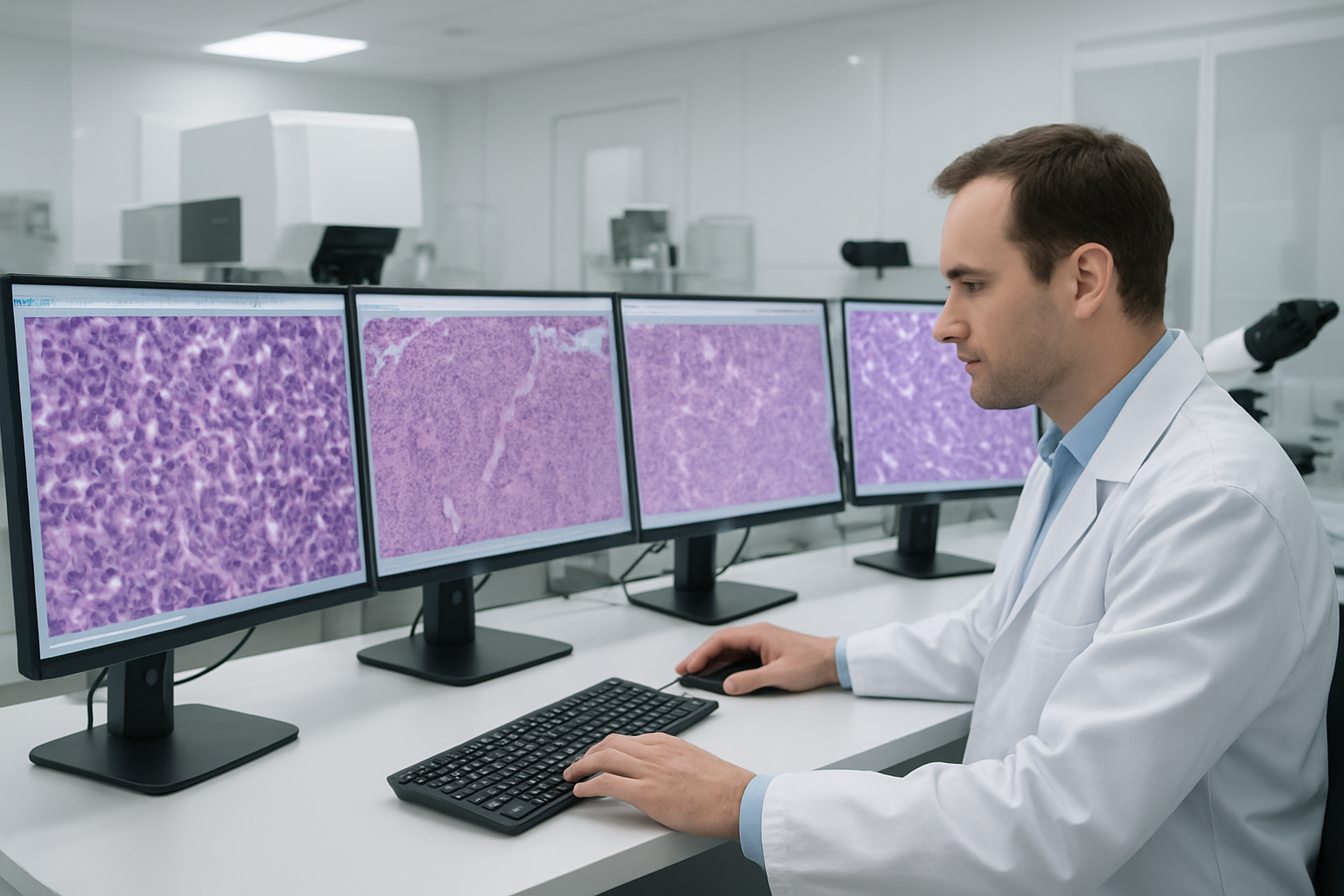
Whole-slide images present unique challenges that make standard medical image processing approaches inadequate. These digital pathology files often exceed 100,000 x 100,000 pixels and can reach several gigabytes in size, creating memory and processing bottlenecks that require specialized handling strategies.
Memory Management Strategies:
- Tile-based processing: Break images into smaller, manageable chunks (typically 512×512 or 1024×1024 pixels)
- Streaming algorithms: Process image data without loading the entire file into memory
- Lazy loading: Read only the image regions currently being processed
- Memory mapping: Use virtual memory to handle large files efficiently
AWS infrastructure optimization becomes critical when dealing with these massive files. EC2 instances with high memory configurations (r5.xlarge or larger) provide the necessary RAM for efficient processing. EBS gp3 volumes with provisioned IOPS ensure fast read/write operations, while S3 Transfer Acceleration speeds up file uploads and downloads for distributed processing workflows.
Docker containerization offers significant advantages for whole-slide image processing by providing consistent environments across different compute instances. Containers can be configured with specific memory limits and resource allocations, preventing out-of-memory errors that commonly occur with gigapixel images.
Pyramid Structure Preservation During De-identification
Whole-slide images use pyramid structures with multiple resolution levels to enable efficient viewing and navigation. Each pyramid level represents the same image at different magnifications, from thumbnail views to cellular-level detail. Maintaining this structure during medical image de-identification requires careful coordination across all pyramid layers.
Key preservation techniques include:
- Synchronized redaction: Apply identical redaction patterns across all pyramid levels
- Resolution-aware processing: Adjust redaction coordinates for each pyramid level’s scale factor
- Metadata consistency: Ensure image properties and calibration data remain accurate after processing
- Format compliance: Maintain adherence to formats like OpenSlide, TIFF pyramids, or proprietary vendor formats
The challenge lies in ensuring that redacted regions appear consistently across all zoom levels. A redacted area visible at 40x magnification must also be properly masked at 4x and 0.4x levels. This requires mathematical transformation of coordinates and careful testing to prevent information leakage through misaligned redaction boundaries.
Docker containers simplify this process by packaging pyramid processing tools and libraries into portable units. Popular tools like OpenSlide, VIPS, or Bio-Formats can be pre-configured within containers, ensuring consistent processing results regardless of the underlying infrastructure.
Annotation Layer Handling and Redaction Strategies
Whole-slide images often contain multiple annotation layers with pathologist markings, region of interest (ROI) definitions, and diagnostic annotations. These layers may contain patient identifiers, physician names, or other sensitive information that requires careful handling during the medical image redaction pipeline.
Annotation Processing Approaches:
| Strategy | Description | Use Case |
|---|---|---|
| Complete Removal | Strip all annotation layers | High-security environments |
| Selective Redaction | Remove only identifying annotations | Research with preserved diagnostic data |
| Anonymized Replacement | Replace identifiers with anonymous codes | Clinical workflow continuity |
| Encrypted Annotations | Maintain annotations with encryption | Authorized access scenarios |
Implementation considerations include parsing various annotation formats (XML, JSON, proprietary binary), handling coordinate system transformations, and maintaining spatial relationships between annotations and image regions. Some annotations may reference specific tissue regions that could indirectly identify patients, requiring sophisticated analysis to determine redaction necessity.
AWS medical image de-identification workflows benefit from Lambda functions for lightweight annotation processing and Step Functions for orchestrating complex multi-step redaction workflows. S3 event triggers can automatically initiate annotation processing when new whole-slide images are uploaded, creating seamless integration with existing pathology workflows.
Docker containers provide isolation for annotation processing tools, preventing conflicts between different parsing libraries and ensuring reproducible results. Custom container images can include specialized tools for handling vendor-specific formats while maintaining standardized interfaces for the broader processing pipeline.
Building the Docker-Based Redaction Pipeline
Core Container Architecture and Component Design
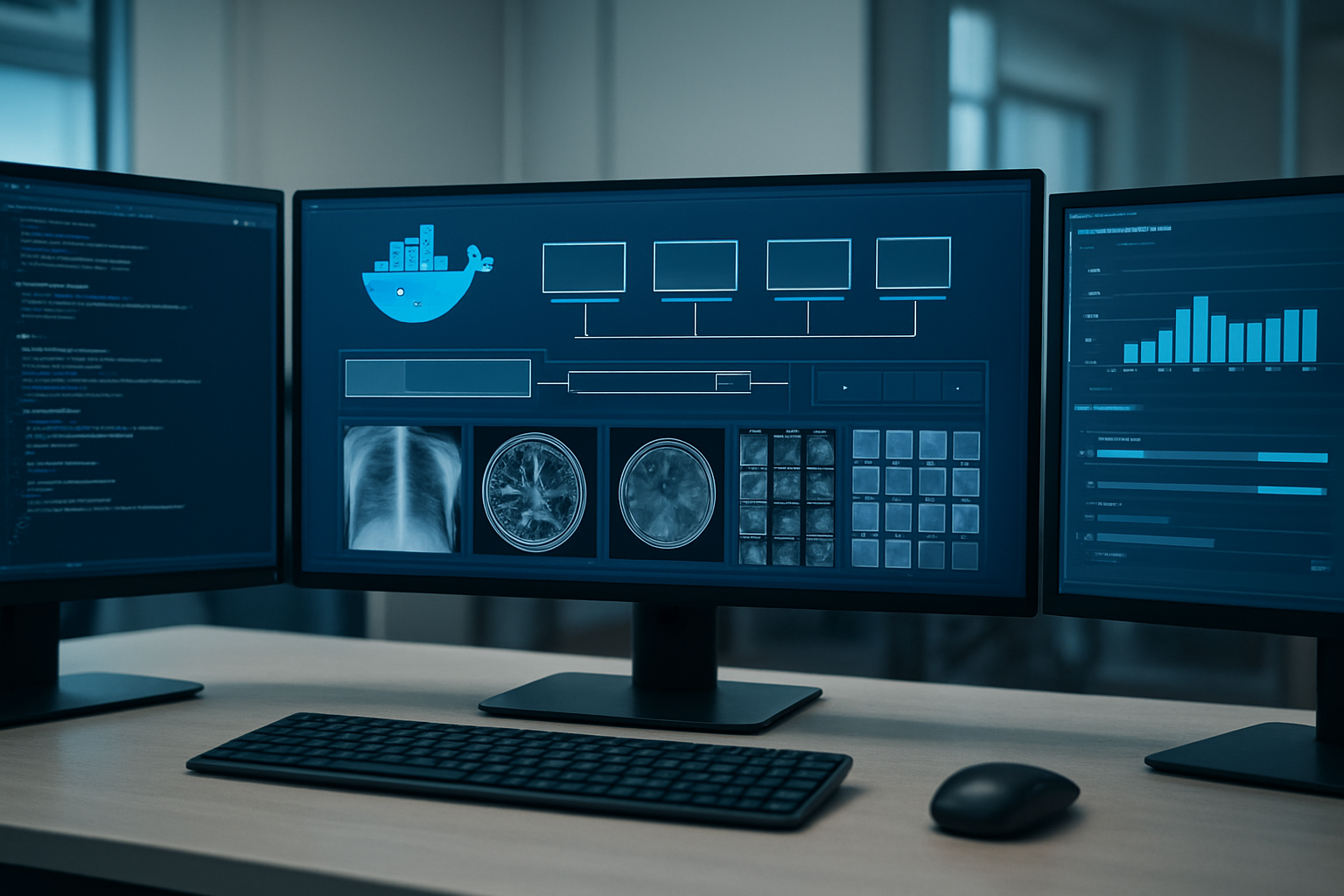
The foundation of a robust AWS medical image de-identification system lies in its modular container design. Each container serves a specific purpose within the processing pipeline, creating a clean separation of concerns that enhances maintainability and scalability. The primary containers include an orchestrator service, image processors for different formats, metadata handlers, and quality control validators.
The orchestrator container acts as the central command center, coordinating the entire workflow and managing communication between specialized processing containers. This Docker containerization medical workflows approach allows teams to deploy updates to individual components without affecting the entire system. Image processing containers are purpose-built for specific formats – one optimized for DICOM files and another for whole-slide images, each containing the necessary libraries and dependencies for their respective tasks.
Storage containers handle secure temporary file management and implement encryption at rest, while API gateway containers manage external communications and authentication. Network isolation between containers ensures that sensitive medical data remains protected during processing, with containers communicating through encrypted channels and predefined interfaces.
Input Validation and Image Format Detection
Proper validation forms the first line of defense in any medical image redaction pipeline. The validation module performs comprehensive checks on incoming files, verifying file integrity, format compliance, and metadata structure before processing begins. This step prevents corrupted or malicious files from entering the pipeline and causing downstream issues.
Format detection algorithms analyze file headers, magic numbers, and structural patterns to accurately identify DICOM files, whole-slide images in various formats (SVS, NDPI, CZI), and other medical imaging standards. The system maintains a registry of supported formats and their specifications, automatically updating detection rules as new formats emerge in medical imaging.
File size and resolution validation ensures that incoming images fall within acceptable processing parameters. The system checks for minimum quality thresholds while flagging unusually large files that might require special handling or additional resources. Metadata validation examines DICOM tags and other embedded information to identify potential privacy risks before the redaction process begins.
Automated Redaction Algorithms and Rule Engines
The heart of DICOM de-identification techniques lies in sophisticated algorithms that automatically identify and redact sensitive information. Machine learning models trained on medical imaging datasets can detect patient information embedded in image pixels, such as burned-in annotations, patient names, or dates that appear as overlays on scanned films.
Rule engines process metadata systematically, applying configurable redaction policies to DICOM tags and other structured data elements. These engines support both standard de-identification profiles (like DICOM PS3.15) and custom organizational policies. Regular expressions and pattern matching algorithms identify personal health information in text fields, while date shifting algorithms maintain temporal relationships while protecting actual dates.
Advanced optical character recognition (OCR) components scan image content for text that might contain patient identifiers. The system maintains whitelists of acceptable medical terminology while flagging potential PHI for manual review or automatic redaction. Smart algorithms can distinguish between medical annotations and patient identifiers, preserving clinically relevant information while removing privacy-sensitive data.
Quality Assurance and Verification Processes
Comprehensive quality assurance mechanisms validate that redaction processes complete successfully without introducing artifacts or losing critical medical information. Automated verification tools compare before-and-after images to ensure that only intended modifications occurred, using hash comparisons for metadata and pixel-level analysis for image content.
Statistical validation algorithms analyze processed images to detect anomalies that might indicate incomplete redaction or processing errors. These tools measure image quality metrics, verify that anatomical structures remain intact, and confirm that diagnostic information stays preserved throughout the de-identification process.
Audit logging captures every action taken during processing, creating immutable records for compliance and troubleshooting purposes. The system generates detailed reports showing which redaction rules were applied, what information was modified, and verification that all processing steps completed successfully.
Output Formatting and Delivery Mechanisms
The final stage focuses on preparing de-identified images for delivery while maintaining format compatibility and clinical utility. Output formatters ensure that processed DICOM files comply with industry standards and remain compatible with existing medical imaging systems and PACS environments.
Flexible delivery options support various use cases, from research datasets requiring batch processing to clinical workflows needing real-time processing. The system can package outputs as encrypted archives, stream results to designated endpoints, or integrate directly with existing healthcare information systems through HL7 FHIR APIs.
Metadata reconstruction ensures that de-identified images retain necessary clinical context while removing privacy-sensitive information. Custom tagging options allow organizations to add processing timestamps, workflow identifiers, and quality assurance flags to help downstream systems handle de-identified content appropriately.
Performance Optimization and Scaling Strategies

Parallel Processing Implementation for High-Volume Workflows
Medical imaging workloads demand robust parallel processing strategies to handle the massive data volumes typical in healthcare environments. The AWS medical image de-identification pipeline leverages Docker’s containerization to distribute processing tasks across multiple CPU cores and instances simultaneously.
Implementing parallel processing begins with partitioning large image datasets into smaller, manageable chunks. Each Docker DICOM processing container handles a specific subset of images, enabling concurrent operations that dramatically reduce overall processing time. AWS Batch provides an ideal orchestration layer, automatically managing container deployment and resource allocation based on queue depth and available compute capacity.
For optimal throughput, configure worker pools that scale dynamically based on incoming workload. A typical setup includes:
- Primary processing containers: Handle standard DICOM files with basic de-identification tasks
- Specialized containers: Process complex whole-slide images requiring advanced redaction techniques
- Coordination containers: Manage task distribution and result aggregation
Memory-intensive operations benefit from AWS Fargate’s ability to allocate varying CPU and memory combinations per container. This flexibility ensures that medical image redaction pipeline components receive appropriate resources without over-provisioning.
Container orchestration through Amazon ECS enables sophisticated load balancing across availability zones, providing both performance benefits and fault tolerance. When processing peaks occur, the system automatically spawns additional containers to maintain consistent throughput rates.
Memory Management for Large Image Files
Whole slide image processing presents unique memory challenges due to file sizes that often exceed several gigabytes. Effective memory management strategies prevent out-of-memory errors while maintaining processing speed and system stability.
Streaming processing techniques prove essential for handling oversized medical images. Rather than loading entire files into memory, the pipeline processes images in overlapping tiles or regions of interest. This approach keeps memory footprints predictable while enabling processing of arbitrarily large images.
Docker containers benefit from explicit memory limits and swap configuration:
| Container Type | Memory Limit | Swap Configuration | Use Case |
|---|---|---|---|
| DICOM Standard | 2-4 GB | Disabled | Regular medical images |
| Whole Slide | 8-16 GB | Limited (2GB) | Pathology slides |
| Metadata Only | 512 MB | Disabled | Header processing |
Implementing memory pooling reduces garbage collection overhead during intensive processing cycles. Pre-allocated buffer pools handle common image dimensions and data types, eliminating frequent allocation and deallocation operations that can cause performance degradation.
Monitoring memory usage patterns helps identify optimization opportunities. CloudWatch container insights provide detailed metrics on memory utilization, helping teams right-size container specifications and identify memory leaks before they impact production workflows.
Auto-scaling Configuration Based on Processing Demand
Dynamic scaling ensures the medical image privacy protection pipeline maintains performance during varying workload conditions while controlling operational costs. AWS Auto Scaling groups respond to multiple metrics to provide intelligent resource management.
Queue-based scaling metrics offer the most responsive approach for medical image processing workloads. SQS queue depth indicates pending work volume, while processing time metrics help predict future resource needs. Custom CloudWatch metrics tracking images per minute processed provide additional scaling signals.
Scaling policies should account for medical imaging workflow patterns:
- Predictive scaling: Handle known busy periods like end-of-day batch uploads
- Target tracking: Maintain specific queue depth or processing rate targets
- Step scaling: Rapidly respond to sudden workload spikes
Container warm-up time impacts scaling effectiveness. Pre-built Docker images with embedded dependencies reduce startup latency from several minutes to under 30 seconds. Amazon ECR’s image layer caching further accelerates container initialization across the fleet.
Configure scaling cooldown periods to prevent thrashing during variable workloads. Medical image processing often experiences bursty traffic patterns, and appropriate cooldowns prevent unnecessary scaling oscillations that waste resources and introduce instability.
Monitoring and Alerting for Pipeline Health
Comprehensive monitoring ensures the DICOM de-identification techniques pipeline operates reliably and meets healthcare compliance requirements. Multi-layer monitoring covers infrastructure health, processing accuracy, and data integrity verification.
Application-level metrics track de-identification success rates, processing latency, and error classifications. Custom metrics monitor specific healthcare requirements like PHI detection accuracy and anonymization completeness. These metrics feed into CloudWatch dashboards providing real-time visibility into pipeline performance.
Infrastructure monitoring covers container health, resource utilization, and network performance. Key metrics include:
- Container restart frequency and failure reasons
- CPU and memory utilization trends across the fleet
- Network throughput and error rates between services
- Storage I/O performance for image processing operations
Alerting strategies must balance sensitivity with actionable intelligence. Critical alerts trigger on processing failures, data corruption, or security violations. Warning alerts notify teams of performance degradation or resource constraints before they impact service levels.
Integration with AWS X-Ray provides distributed tracing capabilities essential for debugging complex processing chains. Trace data helps identify bottlenecks and optimize the healthcare data de-identification AWS pipeline for maximum efficiency.
Log aggregation through CloudWatch Logs enables centralized troubleshooting and audit trail maintenance. Structured logging with consistent formats across all pipeline components simplifies automated analysis and compliance reporting requirements.
Implementation Best Practices and Security Measures

Access Control and Authentication Protocols
Protecting sensitive medical data starts with rock-solid access control mechanisms that go far beyond basic username-password combinations. Your AWS medical image de-identification pipeline needs multi-layered authentication that includes IAM roles with least-privilege principles, multi-factor authentication (MFA), and time-based access tokens. Each Docker container should run with its own dedicated service account, preventing lateral movement if one component gets compromised.
Set up AWS Cognito for user authentication and integrate it with your existing hospital directory services through SAML or OIDC. This creates a single sign-on experience while maintaining granular control over who can access which parts of your Docker DICOM processing workflow. Role-based access control (RBAC) should map directly to job functions – radiologists get read access to de-identified images, while data engineers manage the pipeline infrastructure.
Consider implementing just-in-time (JIT) access for administrative functions. Tools like AWS Systems Manager Session Manager eliminate the need for permanent SSH keys or open ports, providing temporary access that gets automatically logged and revoked.
Audit Logging and Compliance Tracking
Every single action within your medical image redaction pipeline must create an immutable audit trail. AWS CloudTrail captures API calls, but you need application-level logging that tracks who accessed which images, when de-identification occurred, and what specific techniques were applied. Structure these logs in JSON format for easy parsing and automated compliance reporting.
Implement centralized logging using Amazon CloudWatch Logs or ship logs to AWS OpenSearch for advanced analytics. Your Docker containers should use structured logging libraries that automatically include correlation IDs, making it possible to trace a single DICOM file’s journey through the entire processing chain.
Set up automated compliance checks that scan logs for suspicious patterns – like unusual access times, bulk downloads, or failed authentication attempts. Amazon GuardDuty can detect anomalous behavior, while custom Lambda functions can enforce business rules specific to your healthcare data de-identification AWS requirements.
Create dashboards that provide real-time visibility into processing volumes, error rates, and compliance metrics. This transparency helps during regulatory audits and identifies potential issues before they become problems.
Data Encryption in Transit and at Rest
Medical images contain incredibly sensitive information that needs military-grade encryption throughout their lifecycle. Use TLS 1.3 for all network communications, including traffic between Docker containers within the same VPC. AWS Application Load Balancer handles TLS termination, but encrypt internal communications using service mesh technologies like AWS App Mesh or Istio.
Amazon S3 provides server-side encryption with AWS KMS keys, giving you fine-grained control over who can decrypt your stored images. Create separate KMS keys for different data types – raw DICOM files, de-identified images, and processing logs should each use distinct encryption keys with different rotation policies.
Your Docker containerization medical workflows should encrypt temporary storage using AWS EBS encryption or container-level encryption tools. Never store unencrypted PHI on local Docker volumes, even temporarily. Implement envelope encryption for large whole slide image processing files, where data encryption keys get encrypted by master keys stored in AWS CloudHSM for hardware-level security.
Consider client-side encryption for the most sensitive data, where images get encrypted before leaving the hospital network and only get decrypted within your secure processing environment.
Backup and Disaster Recovery Planning
Medical imaging data has unique backup requirements due to its size and regulatory retention periods. Implement a multi-tier backup strategy using Amazon S3 storage classes – frequently accessed de-identified images in S3 Standard, older datasets in S3 Intelligent-Tiering, and long-term archives in S3 Glacier Deep Archive.
Your Docker-based pipeline configuration and custom code need version control and automated backups. Store Docker images in Amazon ECR with image scanning enabled, and use AWS CodeCommit for infrastructure-as-code templates. Test disaster recovery scenarios monthly by spinning up your entire pipeline in a different AWS region from backups.
Cross-region replication ensures business continuity even during regional outages. Configure S3 Cross-Region Replication for critical datasets, and use AWS Database Migration Service to maintain synchronized metadata databases across regions.
Create runbooks that document exact recovery procedures, including how to restore specific patient datasets, rebuild Docker containers, and validate data integrity after recovery. Automate as much of the recovery process as possible using AWS Systems Manager documents and Lambda functions.
Plan for different disaster scenarios – from single container failures to complete regional outages. Your DICOM anonymization tools should gracefully handle partial recoveries and automatically resume processing from the last successful checkpoint.

De-identifying medical images on AWS doesn’t have to be overwhelming when you break it down into manageable components. We’ve walked through the essential requirements, explored how Docker containers can streamline your workflow, and covered the specific techniques needed for both DICOM and whole-slide images. The combination of AWS’s robust infrastructure with containerized processing creates a scalable, secure foundation that can handle the unique challenges of medical imaging data.
Start by focusing on your specific compliance requirements and building from there. The Docker-based pipeline approach gives you the flexibility to adapt as regulations change while keeping your processing consistent and reliable. Remember that performance optimization and security aren’t afterthoughts – they’re core parts of your architecture that should be planned from day one. With the right setup, you’ll have a solution that not only meets today’s de-identification needs but can grow with your organization’s future requirements.