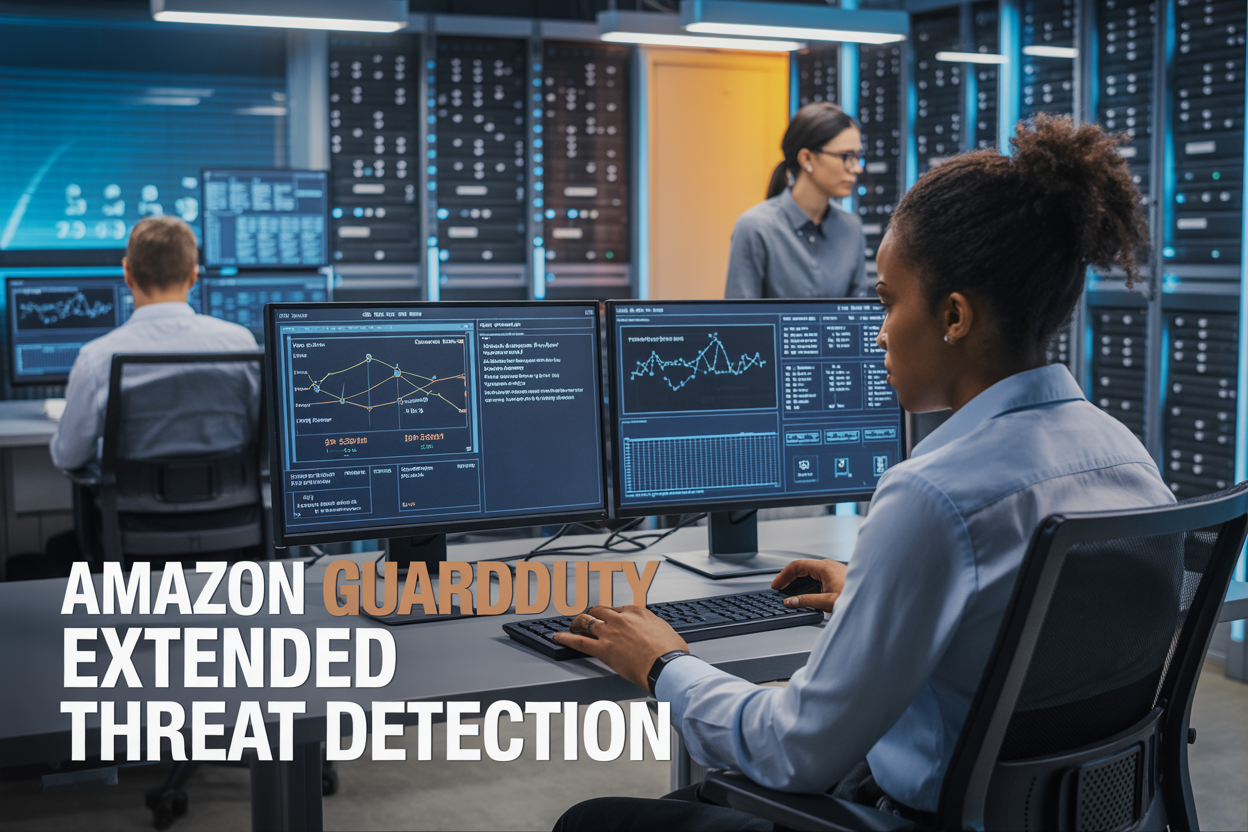
Amazon GuardDuty Extended Threat Detection takes AWS’s built-in security monitoring to the next level by analyzing deeper threat patterns across your cloud environment. This advanced service helps security teams and DevOps professionals identify sophisticated attacks that basic monitoring tools often miss.
If you’re responsible for securing AWS workloads or managing cloud infrastructure, this guide will show you exactly how Amazon GuardDuty Extended Threat Detection works and why it’s becoming essential for modern cloud security strategies. We’ll break down the key threat detection benefits your organization can expect, from catching advanced persistent threats to reducing false positives that waste your team’s time.
You’ll also get a practical walkthrough of the essential deployment requirements and prerequisites needed before implementation, plus step-by-step deployment instructions that make the setup process straightforward. Finally, we’ll cover proven optimization techniques to maximize your security value and ensure GuardDuty delivers the protection your environment needs.
Understanding Amazon GuardDuty Extended Threat Detection

Core functionality and intelligent threat analysis capabilities
Amazon GuardDuty Extended Threat Detection operates as a comprehensive security intelligence service that continuously monitors your AWS environment for malicious activity and unauthorized behavior. The service analyzes billions of events across multiple data sources, including DNS logs, VPC Flow Logs, CloudTrail event logs, and Kubernetes audit logs to identify potential security threats.
The intelligent threat analysis engine processes this massive volume of data using threat intelligence feeds from AWS Security, CrowdStrike, and Proofpoint. These feeds contain known malicious domains, IP addresses, and signatures that help identify sophisticated attack patterns. GuardDuty correlates findings across different data sources to provide contextual threat information, reducing false positives while maintaining high detection accuracy.
The service automatically prioritizes threats based on severity levels, enabling security teams to focus on the most critical issues first. Each finding includes detailed metadata about the threat, affected resources, and recommended remediation steps. This intelligent analysis extends beyond simple rule-based detection to understand behavioral patterns and identify previously unknown threats.
Advanced machine learning algorithms for anomaly detection
GuardDuty’s machine learning capabilities represent a significant advancement in cloud security threat detection. The service employs unsupervised learning models that establish baseline behavior patterns for your AWS environment, then identify deviations that could indicate malicious activity.
These algorithms analyze user behavior, API call patterns, network traffic flows, and resource access patterns to detect anomalies that traditional signature-based systems might miss. For example, the system can identify when a user account suddenly accesses resources from an unusual geographic location or when an EC2 instance begins communicating with known command and control servers.
The machine learning models continuously adapt and improve by learning from new threats and attack patterns. This adaptive approach ensures that GuardDuty remains effective against evolving threats, including zero-day attacks and advanced persistent threats that use novel techniques to evade detection.
The service also employs supervised learning algorithms trained on AWS’s extensive threat intelligence database, enabling it to recognize attack patterns observed across the global AWS infrastructure while maintaining customer data privacy.
Integration with AWS security ecosystem and services
Amazon GuardDuty Extended Threat Detection seamlessly integrates with the broader AWS security ecosystem, creating a unified defense strategy across your cloud infrastructure. The service works natively with AWS Security Hub, which serves as a central dashboard for viewing and managing security findings from multiple AWS security services.
Integration with Amazon Detective provides deep investigation capabilities, allowing security teams to analyze the root cause of GuardDuty findings through interactive visualizations and guided investigations. This connection helps teams understand the full scope of potential security incidents and develop appropriate response strategies.
GuardDuty findings can trigger automated responses through Amazon EventBridge, enabling integration with AWS Lambda functions, Amazon SNS notifications, and third-party security orchestration platforms. This automation capability allows organizations to implement immediate containment measures, such as isolating compromised instances or blocking malicious IP addresses.
The service also integrates with AWS Organizations for centralized management across multiple AWS accounts, providing security teams with a unified view of threats across their entire AWS infrastructure. This multi-account support includes delegated administration capabilities and findings aggregation.
Real-time monitoring and continuous threat assessment
GuardDuty provides real-time threat monitoring with findings typically generated within minutes of detecting suspicious activity. This rapid response capability is crucial for containing threats before they can cause significant damage to your AWS environment.
The continuous monitoring approach means GuardDuty never sleeps, analyzing your AWS environment 24/7 without requiring manual intervention or scheduled scans. This always-on protection ensures that threats are detected regardless of when they occur, providing consistent security coverage.
The service maintains updated threat intelligence feeds and detection rules, automatically incorporating new threat signatures and attack patterns without requiring manual updates. This continuous improvement ensures that your protection remains current against the latest threats.
Real-time alerting mechanisms can be customized based on threat severity and organizational requirements. Teams can configure immediate notifications for high-severity threats while setting up automated responses for lower-priority findings, ensuring that critical threats receive immediate attention while reducing alert fatigue for security teams.
Key Threat Detection Benefits for Your Organization

Enhanced Visibility Into Sophisticated Attack Patterns
Amazon GuardDuty Extended Threat Detection transforms how organizations detect complex cybersecurity threats by analyzing multiple data sources simultaneously. This advanced capability goes beyond traditional signature-based detection, using machine learning algorithms to identify subtle attack patterns that might otherwise slip through conventional security measures.
The service continuously monitors VPC Flow Logs, DNS queries, CloudTrail events, and Kubernetes audit logs to build a comprehensive picture of your AWS environment. When attackers attempt to use advanced techniques like living-off-the-land attacks, lateral movement, or credential stuffing, GuardDuty’s intelligent analysis can spot these behaviors even when they mimic legitimate user activities.
For example, the system can detect when an attacker gains initial access through a compromised EC2 instance and then attempts to escalate privileges or move laterally across your infrastructure. These multi-stage attacks often unfold over days or weeks, making them particularly challenging for traditional security tools to catch. GuardDuty threat detection benefits include the ability to correlate seemingly unrelated events across your entire AWS footprint, creating a timeline that reveals the full scope of an attack campaign.
The enhanced visibility also extends to detecting insider threats, where authorized users may be accessing resources outside their normal patterns or attempting to exfiltrate sensitive data through seemingly legitimate channels.
Reduced False Positives Through Intelligent Filtering
One of the biggest challenges security teams face is alert fatigue caused by an overwhelming number of false positives. Amazon GuardDuty Extended Threat Detection addresses this problem head-on by incorporating contextual intelligence and behavioral baselines that significantly reduce noise while maintaining high detection accuracy.
The system learns your organization’s normal operational patterns, including typical user behaviors, application communication flows, and resource access patterns. This baseline understanding allows GuardDuty to distinguish between legitimate business activities and genuine security threats. For instance, if your development team regularly accesses specific S3 buckets during business hours, the system won’t flag this as suspicious activity.
GuardDuty’s intelligent filtering also considers factors like:
- Geographic context and normal user locations
- Time-based patterns and business hours
- Application-specific communication requirements
- Historical user and entity behavior analytics
The threat intelligence feeds from AWS Security and third-party sources help validate findings against known bad actors, malicious IP addresses, and current attack campaigns. This multi-layered approach means that when GuardDuty generates an alert, security teams can have much higher confidence that it represents a genuine threat requiring investigation.
This reduction in false positives allows security analysts to focus their time and expertise on real threats rather than chasing down benign activities that triggered overly sensitive detection rules.
Faster Incident Response and Automated Threat Remediation
Speed matters when dealing with security incidents, and Amazon GuardDuty Extended Threat Detection provides the foundation for rapid response capabilities that can mean the difference between a contained incident and a major breach. The service generates detailed findings with actionable intelligence that security teams can immediately act upon.
Each GuardDuty finding includes rich metadata such as affected resources, attack vectors, severity levels, and recommended remediation steps. This information eliminates the guesswork that often slows down incident response, allowing teams to quickly understand the scope and nature of a threat. The findings also include network connection details, user activity timelines, and potential impact assessments.
Integration with AWS services enables automated response workflows through:
- Lambda functions that can immediately isolate compromised instances
- CloudWatch Events that trigger automated playbooks
- Systems Manager for executing remediation scripts across affected resources
- IAM policies that can automatically revoke suspicious user permissions
Security teams can create custom automation that responds to specific finding types. For example, when GuardDuty detects cryptocurrency mining activity on an EC2 instance, an automated workflow could immediately stop the instance, create a forensic snapshot, and launch a clean replacement from a known good AMI.
The service also supports integration with popular SIEM platforms and security orchestration tools, allowing organizations to incorporate GuardDuty findings into existing incident response processes. This AWS threat detection deployment flexibility means teams don’t need to completely overhaul their security operations to benefit from GuardDuty’s advanced capabilities.
Real-time notifications through SNS ensure that critical findings reach the right people immediately, whether through email, Slack channels, or mobile push notifications. This immediate alerting capability, combined with detailed finding information, dramatically reduces the time between threat detection and active response.
Essential Deployment Requirements and Prerequisites

AWS account setup and necessary IAM permissions
Setting up Amazon GuardDuty Extended Threat Detection starts with proper AWS account configuration and permissions management. Your AWS account needs specific IAM roles and policies to enable GuardDuty’s comprehensive monitoring capabilities across your cloud environment.
The primary requirement involves creating or modifying IAM roles that grant GuardDuty access to essential AWS services. The GuardDuty service role needs permissions to analyze VPC Flow Logs, DNS logs, and CloudTrail event logs. Without these foundational permissions, the threat detection system cannot function effectively.
Key IAM permissions include:
- AmazonGuardDutyFullAccess for administrative users
- GuardDutyServiceRole for the service itself
- CloudTrail access permissions for event monitoring
- VPC Flow Logs read permissions for network analysis
- DNS logs access for domain-based threat detection
Account administrators should also establish cross-account access if managing multiple AWS accounts. This setup allows centralized threat monitoring across your entire AWS infrastructure. The master account can invite member accounts, creating a unified security monitoring dashboard that provides comprehensive visibility.
Multi-account organizations benefit from AWS Organizations integration, which simplifies permission management and enables automatic GuardDuty deployment across all organizational units. This approach streamlines the initial setup process and ensures consistent security coverage.
Regional availability and service compatibility considerations
Amazon GuardDuty Extended Threat Detection operates in specific AWS regions, and understanding these geographical limitations affects your deployment strategy. The service availability varies by region, with some advanced features rolling out to established regions first before expanding globally.
Currently supported regions include major AWS availability zones across North America, Europe, Asia Pacific, and select other global locations. Before beginning deployment, verify that your primary operational regions support the extended threat detection features you plan to implement.
Service compatibility extends beyond regional availability to encompass integration with other AWS security services:
- AWS Security Hub for centralized security findings management
- Amazon EventBridge for automated response workflows
- AWS Lambda for custom threat response functions
- Amazon S3 for log storage and analysis
- AWS CloudFormation for infrastructure-as-code deployments
Network architecture considerations play a role in compatibility planning. GuardDuty Extended Threat Detection works optimally when VPC Flow Logs are enabled across all monitored subnets. Organizations using complex network setups, including Transit Gateways or VPC peering arrangements, need to ensure comprehensive log collection coverage.
Third-party security tools integration requires careful planning to avoid duplicate alerting or conflicting automated responses. Map existing security tool workflows before implementing GuardDuty to prevent operational disruptions.
Cost planning and resource allocation strategies
GuardDuty deployment requirements include thorough cost analysis and resource planning to avoid unexpected expenses. The pricing model combines data analysis volume, feature usage, and optional services like Malware Protection and S3 bucket monitoring.
Primary cost components include:
- VPC Flow Logs analysis (per GB processed)
- DNS logs processing (per million queries)
- CloudTrail event analysis (per million events)
- S3 data event monitoring (when enabled)
- Malware Protection scanning (per GB scanned)
Resource allocation planning starts with estimating your data volumes. Large organizations with high network traffic or extensive S3 usage face significantly higher costs than smaller deployments. Use AWS Cost Calculator tools to project monthly expenses based on your infrastructure size and activity levels.
Budget optimization strategies include:
- Enabling only necessary data sources initially
- Using S3 bucket-level monitoring selectively
- Implementing data retention policies for cost-effective log management
- Monitoring usage patterns to identify cost-saving opportunities
Consider staging your deployment across environments, starting with production systems and gradually expanding to development and testing environments. This phased approach helps manage costs while building operational expertise.
Integration planning with existing security tools
Successful GuardDuty deployment requires careful integration planning with your current security infrastructure. Most organizations operate multiple security solutions, and adding Amazon GuardDuty Extended Threat Detection should enhance rather than complicate existing workflows.
SIEM integration represents a primary consideration for enterprise environments. GuardDuty findings can feed into platforms like Splunk, IBM QRadar, or Elastic Security through API connections or AWS native integrations. Plan data formatting and parsing requirements to ensure seamless threat intelligence sharing.
Security orchestration tools benefit from GuardDuty’s programmatic access capabilities:
- API-based threat data extraction for custom integrations
- EventBridge rules for automated response triggering
- SNS notifications for real-time alerting systems
- Lambda function triggers for custom response workflows
Incident response procedures need updating to incorporate GuardDuty findings. Establish clear escalation paths for different threat severity levels and define responsibilities for investigating GuardDuty alerts. Training security team members on GuardDuty-specific threat indicators improves response effectiveness.
Consider existing compliance requirements when planning integration approaches. GuardDuty generates detailed audit trails and security findings that can support regulatory compliance efforts, but proper configuration ensures these benefits align with your compliance framework requirements.
Step-by-Step Deployment Implementation Guide

Initial configuration through AWS Management Console
Setting up Amazon GuardDuty Extended Threat Detection starts with accessing your AWS Management Console. Navigate to the GuardDuty service dashboard and click “Get Started” if this is your first time using the service. The setup wizard guides you through enabling GuardDuty in your current AWS region, and you’ll want to repeat this process for all regions where you have AWS resources.
Once you enable GuardDuty, the service automatically begins analyzing VPC Flow Logs, DNS logs, and CloudTrail event logs within minutes. The initial setup includes configuring your account as either a standalone account or as part of a multi-account setup. For organizations managing multiple AWS accounts, designating a master account streamlines centralized monitoring and management.
The console displays your current threat detection status immediately after activation. You’ll see the findings dashboard, which shows detected threats, severity levels, and affected resources. Take time to familiarize yourself with the interface layout, as this becomes your primary hub for monitoring security events.
Customizing threat detection rules and sensitivity levels
GuardDuty Extended Threat Detection offers customizable threat detection parameters to match your organization’s security requirements. Access the “Settings” section to adjust finding types and configure which threat categories receive priority attention. You can enable or disable specific finding types based on your environment’s unique characteristics.
The service provides three main sensitivity levels: low, medium, and high. Higher sensitivity levels detect more potential threats but may generate additional false positives. Start with medium sensitivity and adjust based on your team’s capacity to investigate findings. Organizations with dedicated security teams often prefer higher sensitivity settings to catch subtle attack patterns.
Custom threat intelligence feeds enhance detection capabilities beyond AWS’s default intelligence sources. Upload your organization’s specific indicators of compromise (IOCs) or integrate third-party threat feeds through the console. This customization helps GuardDuty recognize threats specific to your industry or geographic region.
Suppression rules help reduce noise from known benign activities. Create rules for trusted IP addresses, expected administrative activities, or legitimate business processes that might trigger false alarms. These rules prevent alert fatigue while maintaining comprehensive threat coverage for genuine security concerns.
Setting up automated alerts and notification channels
Effective threat detection requires immediate notification when security events occur. Configure Amazon SNS topics to receive GuardDuty findings and route them to your preferred communication channels. Start by creating an SNS topic specifically for security alerts, then configure email subscriptions for your security team members.
EventBridge integration provides advanced alert routing capabilities. Set up EventBridge rules that trigger based on finding severity levels, threat types, or affected resource tags. This approach allows different team members to receive relevant alerts based on their responsibilities. For example, database administrators might only receive alerts related to RDS instances.
Slack and Microsoft Teams integrations streamline team communication during security incidents. Use AWS Lambda functions to process GuardDuty findings and format them for chat platforms. Include relevant finding details, affected resources, and recommended remediation steps in your notifications.
Consider implementing escalation procedures for high-severity findings. Configure multiple notification channels with increasing urgency levels. Critical threats might trigger immediate phone notifications, while lower-priority findings use email or chat channels. This tiered approach ensures appropriate response times without overwhelming your team.
Testing and validating deployment effectiveness
Validate your GuardDuty deployment using controlled security simulations. AWS provides sample finding generation features that create test findings across different threat categories. Use these samples to verify your alert routing, team notification procedures, and incident response workflows work correctly.
Generate realistic threat scenarios using tools like Amazon Detective or third-party penetration testing frameworks. Test scenarios should include common attack patterns like cryptocurrency mining, data exfiltration attempts, and unauthorized API calls. Monitor how quickly GuardDuty detects these activities and whether your team receives appropriate notifications.
Review finding accuracy over the first few weeks of deployment. Track false positive rates and adjust sensitivity levels or suppression rules as needed. Document legitimate activities that trigger false alarms and create suppression rules to prevent future noise. Regular tuning improves the signal-to-noise ratio of your threat detection system.
Establish baseline metrics for your deployment’s effectiveness. Measure mean time to detection (MTTD), mean time to response (MTTR), and finding resolution rates. These metrics help demonstrate security improvements and identify areas needing additional attention or resources.
Schedule regular deployment reviews with your security team to assess GuardDuty’s performance against your organization’s threat landscape. Update configurations, threat intelligence sources, and notification procedures based on emerging threats and lessons learned from real security incidents.
Optimizing Performance and Maximizing Security Value

Fine-tuning detection parameters for your environment
Amazon GuardDuty Extended Threat Detection comes with default settings that work well for most organizations, but customizing these parameters can dramatically improve your security posture. Start by analyzing your baseline traffic patterns and typical user behaviors to reduce false positives while maintaining comprehensive threat coverage.
Adjust sensitivity levels based on your environment’s risk tolerance. High-security environments like financial services might benefit from maximum sensitivity settings, while development environments could use moderate settings to avoid alert fatigue. Configure custom threat lists by uploading IP addresses, domains, or file hashes specific to your organization’s threat landscape.
Set up suppression rules for known safe activities that consistently trigger alerts. For example, if your organization regularly performs penetration testing or uses specific security tools, create suppression rules to filter out these expected behaviors. This focused approach helps your security team concentrate on genuine threats rather than sorting through predictable false positives.
Geographic filtering provides another powerful optimization tool. If your organization operates exclusively in certain regions, configure GuardDuty to flag traffic from unexpected geographical locations as high-priority alerts. Similarly, adjust the malware detection thresholds for different workload types – production systems might warrant immediate alerts, while development environments could use longer observation periods.
Establishing effective incident response workflows
Building robust incident response workflows transforms GuardDuty threat detection benefits into actionable security improvements. Create automated response playbooks that trigger specific actions based on finding severity levels and threat types. Low-severity findings might generate tickets in your IT service management system, while critical threats could automatically isolate affected resources.
Design escalation procedures that match your organization’s structure and availability requirements. Define clear roles for security analysts, system administrators, and management teams. Set up notification channels using Amazon SNS to ensure the right people receive alerts through their preferred communication methods – whether that’s email, Slack, or SMS.
Integrate GuardDuty with your existing security tools through APIs and automation platforms like AWS Lambda. Create workflows that automatically gather additional context when threats are detected, such as pulling relevant logs from CloudTrail or capturing network traffic samples. This automated evidence collection speeds up investigation time and improves response accuracy.
Document standard operating procedures for common threat scenarios. Include step-by-step instructions for containment, evidence preservation, and system recovery. Regular tabletop exercises help team members practice these procedures and identify gaps before real incidents occur.
Regular monitoring and maintenance best practices
Consistent monitoring ensures your Amazon GuardDuty setup continues delivering optimal threat detection optimization over time. Schedule weekly reviews of finding trends to identify patterns that might indicate emerging threats or configuration issues. Look for unusual spikes in specific finding types or geographic regions that warrant deeper investigation.
Maintain your threat intelligence feeds by regularly updating custom IP lists, domain blocklists, and hash databases. Remove outdated entries and add newly discovered indicators of compromise from your threat intelligence sources. This ongoing maintenance keeps your detection capabilities current with evolving threat landscapes.
Review and update your suppression rules quarterly to ensure they remain relevant. Business processes change, and suppression rules that made sense six months ago might now be hiding legitimate threats. Similarly, examine your notification settings to verify the right stakeholders receive appropriate alerts as team structures evolve.
Monitor your GuardDuty costs and usage patterns to optimize your AWS security monitoring investment. Use AWS Cost Explorer to track expenses across different finding types and data sources. Consider adjusting data source configurations if certain features provide limited value for your specific environment while consuming significant resources.
Establish regular security metrics reporting to demonstrate the value of your GuardDuty implementation to leadership. Track metrics like mean time to detection, mean time to response, and the number of prevented security incidents. These measurements help justify continued investment in cloud security threat detection and identify areas for improvement.

Amazon GuardDuty Extended Threat Detection offers a powerful way to strengthen your organization’s security posture without the complexity of traditional monitoring solutions. By implementing this service, you gain automated threat detection that works around the clock, protecting your AWS environment from malicious activities and unauthorized access attempts. The deployment process is straightforward, and the ongoing benefits far outweigh the initial setup effort.
Getting started with GuardDuty Extended Threat Detection puts you ahead of potential security threats before they become costly incidents. Take the time to properly configure your deployment settings and regularly review the insights it provides. Your security team will appreciate having this intelligent monitoring system working alongside them, and your organization will benefit from the peace of mind that comes with comprehensive threat protection.