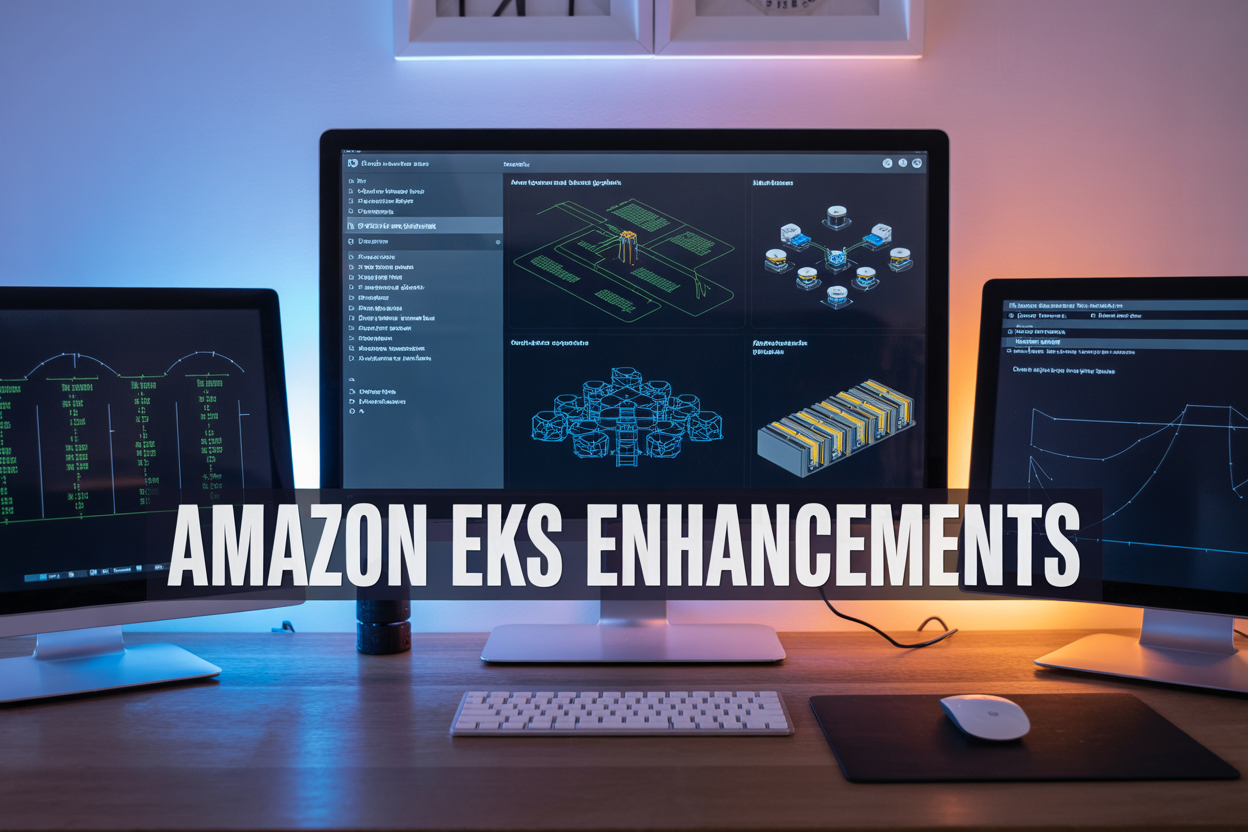
Amazon EKS continues to evolve with powerful new capabilities that make container orchestration on AWS more efficient and scalable. These Amazon EKS enhancements deliver significant improvements in cluster performance, security, and cost management that directly impact your development and operations workflows.
This guide is designed for DevOps engineers, cloud architects, and Kubernetes administrators who want to understand the latest EKS updates and implement them effectively in their organizations. Whether you’re managing existing clusters or planning new deployments, you’ll find practical insights to leverage these improvements.
We’ll explore the latest Amazon EKS new features and their real-world impact on your infrastructure. You’ll discover the operational benefits of Amazon EKS enhancements, including improved autoscaling, enhanced security controls, and streamlined cluster management. Finally, we’ll walk through the technical architecture changes and provide a comprehensive Amazon EKS deployment guide to help you implement these updates in your environment.
Latest Amazon EKS Feature Updates and Improvements

Enhanced Security Capabilities and Access Controls
Amazon EKS enhancements have brought significant improvements to cluster security through advanced access controls and authentication mechanisms. The introduction of EKS Pod Identity simplifies how applications access AWS services by automatically managing credentials without storing them in your pods. This approach eliminates the security risks associated with hardcoded credentials and reduces the complexity of IAM role management.
The enhanced RBAC (Role-Based Access Control) integration now provides granular permissions at the namespace level, allowing administrators to create fine-tuned access policies. Teams can now implement zero-trust security models more effectively with improved integration between AWS IAM and Kubernetes native authentication systems.
EKS now supports advanced security policies through the Amazon VPC CNI plugin, enabling network-level security controls that automatically isolate workloads. The enhanced security groups for pods feature allows you to apply EC2 security group rules directly to individual pods, providing network-level isolation that matches your application architecture.
Improved Cluster Performance and Scalability Options
Recent Amazon EKS new features have dramatically improved cluster performance through optimized node group management and enhanced auto-scaling capabilities. The Karpenter node provisioner now offers sub-minute node provisioning, reducing application startup times and improving resource utilization across your clusters.
Enhanced cluster auto-scaling now supports mixed instance types and spot instances more intelligently, automatically selecting the most cost-effective compute options based on your workload requirements. This smart selection reduces operational costs while maintaining performance standards.
The improved networking stack delivers up to 40% better pod networking performance through optimized CNI plugins and enhanced load balancing algorithms. These Amazon EKS enhancements enable clusters to handle higher pod densities and network throughput without compromising stability.
Vertical Pod Autoscaling (VPA) integration has been refined to provide more accurate resource recommendations, helping teams optimize resource allocation and reduce waste. The enhanced metrics collection provides deeper insights into cluster performance patterns.
Advanced Networking and Service Mesh Integration
EKS networking capabilities have expanded with native support for advanced service mesh architectures. The AWS Load Balancer Controller now provides intelligent traffic distribution with support for weighted routing, header-based routing, and advanced health checking mechanisms.
Integration with AWS App Mesh has been streamlined, allowing teams to implement service mesh patterns without complex configuration overhead. The enhanced networking features support cross-cluster communication and multi-region service discovery, enabling distributed application architectures.
The improved ingress capabilities now support multiple protocols simultaneously, including HTTP/2, gRPC, and WebSocket connections. This flexibility allows modern applications to leverage the most appropriate communication protocols for different components.
Network policy enforcement has been enhanced with better integration between Kubernetes NetworkPolicies and AWS security groups, providing consistent security controls across your infrastructure stack.
Streamlined Kubernetes Version Management
EKS cluster management has been simplified through automated version management capabilities that reduce the operational overhead of keeping clusters current. The enhanced update process now supports blue-green cluster updates, allowing teams to test new versions without affecting production workloads.
Extended version support windows provide more flexibility in upgrade planning, while automated compatibility checking ensures add-ons and applications remain functional across version updates. The improved upgrade process includes automatic backup creation and rollback capabilities.
Managed node group updates now handle complex dependency chains automatically, ensuring applications remain available during infrastructure updates. The enhanced update orchestration coordinates updates across multiple availability zones to maintain service availability.
Version drift detection alerts help teams identify clusters that require attention, while automated security patching ensures nodes receive critical updates without manual intervention. These Amazon EKS enhancements significantly reduce the operational burden of cluster maintenance while improving security posture.
Operational Benefits of Amazon EKS Enhancements

Reduced Infrastructure Management Overhead
Amazon EKS enhancements dramatically cut down the time and effort teams spend managing Kubernetes infrastructure. With managed node groups and automated cluster updates, administrators no longer need to manually patch nodes or worry about version compatibility issues. The service handles complex tasks like certificate rotation, API server upgrades, and etcd backups automatically.
The enhanced EKS control plane removes the burden of maintaining master nodes entirely. AWS manages the Kubernetes control plane across multiple availability zones, ensuring high availability without requiring your team to configure or monitor these critical components. This means your DevOps engineers can focus on application deployment and optimization instead of wrestling with cluster maintenance.
Automated scaling capabilities reduce manual intervention even further. The cluster autoscaler and horizontal pod autoscaler work together to adjust resources based on actual demand. Your infrastructure scales up during peak traffic and scales down during quiet periods without human oversight. This automation prevents over-provisioning while ensuring applications have the resources they need.
EKS Fargate integration eliminates node management completely for serverless workloads. You simply define your pod requirements, and AWS handles the underlying infrastructure. No more capacity planning, patching, or monitoring EC2 instances for these workloads.
Enhanced Cost Optimization and Resource Efficiency
The latest Amazon EKS enhancements deliver significant cost savings through intelligent resource management and pricing options. Spot instance integration allows clusters to use spare AWS capacity at up to 90% discount compared to on-demand pricing. The enhanced spot instance support includes better interruption handling and automatic replacement of terminated instances.
Mixed instance types within node groups optimize costs by combining different instance families based on workload requirements. CPU-intensive applications can run on compute-optimized instances while memory-heavy workloads use memory-optimized instances, all within the same cluster. This granular control prevents paying for unused resources.
Enhanced cluster autoscaling reduces waste by automatically removing underutilized nodes. The improved algorithms consider pod requirements, node utilization, and scaling policies to make smarter decisions about when to scale down. This prevents the common problem of idle nodes consuming unnecessary costs.
AWS Savings Plans and Reserved Instances integration with EKS provides predictable pricing for steady-state workloads. Teams can commit to specific usage levels and receive substantial discounts. The enhanced cost monitoring and reporting features help identify optimization opportunities and track spending patterns across different applications and teams.
Resource quotas and limits prevent runaway costs from misconfigured applications. Enhanced monitoring tools provide real-time cost visibility, allowing teams to set alerts when spending exceeds thresholds.
Improved Application Reliability and Uptime
Amazon EKS enhancements significantly boost application reliability through advanced health monitoring and automated recovery mechanisms. Enhanced liveness and readiness probes provide more sophisticated health checking capabilities, allowing applications to define custom health endpoints and complex validation logic.
Multi-zone pod distribution ensures applications remain available even during availability zone outages. The enhanced scheduler spreads replicas across different zones automatically, and pod disruption budgets prevent too many instances from being unavailable simultaneously during maintenance or scaling events.
Improved networking with the AWS Load Balancer Controller provides better traffic distribution and health checking. Application Load Balancers integrate seamlessly with EKS services, offering advanced routing based on headers, paths, and other criteria. This intelligence routing improves user experience and prevents overloading specific application instances.
Enhanced backup and disaster recovery capabilities protect against data loss and enable faster recovery times. EKS integrates with AWS Backup for automated snapshots of persistent volumes, while cross-region cluster replication ensures business continuity during regional outages.
The enhanced monitoring stack includes improved metrics collection and alerting. CloudWatch Container Insights provides deep visibility into cluster and application performance, while integration with third-party monitoring tools like Prometheus and Grafana offers customizable dashboards and alerting rules.
Automatic security patching for managed node groups reduces vulnerabilities without manual intervention. AWS applies security patches during maintenance windows, ensuring clusters stay secure without downtime. Enhanced security scanning identifies potential issues before they impact production workloads.
Technical Architecture and Implementation Details

Container Orchestration Engine Improvements
Amazon EKS enhancements have transformed the core orchestration capabilities, delivering significant improvements in pod scheduling, resource allocation, and workload management. The latest engine updates include advanced topology-aware scheduling that intelligently places workloads based on hardware characteristics and network proximity. This smart scheduling reduces latency and improves application performance by considering CPU architecture, storage types, and network bandwidth when making placement decisions.
The enhanced container runtime now supports improved image caching mechanisms, reducing pod startup times by up to 60% for frequently used images. Multi-architecture image support has been expanded, enabling seamless deployment across ARM and x86 instances without manual configuration changes. Container lifecycle management has also been refined with better garbage collection policies and optimized resource cleanup processes.
Node group management capabilities have been upgraded with more granular control over instance types and availability zones. The new mixed instance policies allow for cost optimization by automatically selecting the most cost-effective instance types while maintaining performance requirements. Enhanced drain and cordon operations provide smoother maintenance windows with minimal application disruption.
Integration with AWS Native Services and Tools
The latest EKS technical architecture delivers deeper integration with AWS native services, creating a more cohesive cloud-native experience. Amazon EKS now seamlessly connects with AWS App Mesh for advanced service mesh capabilities, providing traffic management, observability, and security features without complex manual configurations. The integration automatically configures Envoy proxies and handles certificate management through AWS Certificate Manager.
CloudWatch Container Insights integration has been enhanced with custom metrics collection and automated dashboard generation. This deeper observability allows teams to monitor application performance, resource utilization, and cluster health through familiar AWS tools. The integration includes pre-built alerts and anomaly detection that trigger based on container-specific metrics and patterns.
AWS Systems Manager integration enables centralized configuration management and patch automation for EKS clusters. Parameter Store integration allows secure configuration injection into containers without hardcoding sensitive values. The enhanced integration also supports AWS Secrets Manager for automatic secret rotation and encrypted secret distribution to pods.
Amazon ECR integration now includes vulnerability scanning results directly in the EKS console, enabling security-first deployment decisions. Image signing and verification through AWS Signer ensures only trusted container images run in production environments.
Multi-Zone High Availability Configuration
Amazon EKS improvements include sophisticated multi-zone high availability configurations that automatically distribute workloads across multiple availability zones for maximum resilience. The enhanced architecture uses intelligent pod anti-affinity rules and zone-aware scheduling to prevent single points of failure. Cross-zone load balancing has been optimized to reduce latency while maintaining fault tolerance.
The new topology spread constraints feature automatically distributes pods across zones, nodes, and regions based on configurable policies. This ensures workloads remain available even during zone-level outages or maintenance events. Enhanced persistent volume management supports cross-zone storage replication and automated failover for stateful applications.
Network redundancy improvements include multiple subnet configurations per availability zone and automatic route table management. The enhanced networking layer provides seamless failover between availability zones without application code changes. Load balancer integration automatically adjusts target groups during zone failures, maintaining service availability.
Cluster API integration enables multi-cluster deployments across regions for disaster recovery scenarios. The enhanced backup and restoration capabilities support cross-region cluster migration and automated recovery procedures.
Automated Scaling and Load Distribution Mechanisms
The latest Amazon EKS enhancements introduce sophisticated automated scaling mechanisms that respond to both application demand and infrastructure constraints. Vertical Pod Autoscaler (VPA) integration now provides more accurate resource recommendations based on historical usage patterns and predictive analytics. The enhanced VPA can automatically adjust CPU and memory requests without pod restarts in many scenarios.
Horizontal Pod Autoscaler (HPA) improvements include support for custom metrics from CloudWatch, Prometheus, and other monitoring systems. Multi-metric scaling policies allow complex scaling decisions based on multiple factors like CPU utilization, memory usage, and application-specific metrics simultaneously. The new predictive scaling capability anticipates traffic patterns and pre-scales resources before demand spikes occur.
Cluster Autoscaler enhancements provide faster node provisioning and more intelligent instance type selection. The improved algorithms consider spot instance availability, pricing fluctuations, and workload requirements when adding new nodes. Mixed instance type support optimizes costs while maintaining performance by selecting the best available instance types for specific workload requirements.
KEDA (Kubernetes Event-Driven Autoscaling) integration enables scaling based on external events like SQS queue depth, database connections, or custom application metrics. This event-driven approach provides more responsive scaling for batch processing and microservices architectures.
Security Layer and Compliance Framework Integration
Security enhancements in Amazon EKS implementation include comprehensive identity and access management integration with AWS IAM and RBAC (Role-Based Access Control). The new IAM Roles for Service Accounts (IRSA) improvements provide fine-grained permissions for individual pods without exposing cluster-wide credentials. Enhanced audit logging captures detailed API access patterns and resource modifications for compliance monitoring.
Pod Security Standards enforcement has been integrated natively, replacing the deprecated Pod Security Policies with more flexible and maintainable security controls. The enhanced framework includes pre-defined security profiles and custom policy creation capabilities. Network policies integration with AWS security groups provides both Kubernetes-native and AWS-native network security controls.
Secrets management improvements include automatic rotation through AWS Secrets Manager and encrypted storage using AWS KMS. The enhanced secrets handling supports external secrets operators that synchronize secrets from multiple sources while maintaining encryption at rest and in transit.
Compliance framework integration supports SOC, PCI DSS, and HIPAA requirements through automated policy enforcement and continuous monitoring. The enhanced security scanning includes runtime threat detection and automated response capabilities that can isolate compromised workloads and trigger security incident workflows.
Step-by-Step Deployment Guide for Enhanced EKS

Prerequisites and Environment Preparation
Before diving into your Amazon EKS deployment, you’ll need to set up the foundation for a successful implementation. Start by installing the AWS CLI and configuring it with proper credentials that have the necessary permissions for EKS cluster management, IAM role creation, and VPC operations.
Your local environment should include kubectl (version 1.21 or later) and eksctl, which streamlines many EKS operations. Install the AWS Load Balancer Controller and Container Insights for enhanced monitoring capabilities. These tools work together to provide comprehensive cluster management and observability.
Create an IAM service role for your EKS cluster with the following managed policies:
AmazonEKSClusterPolicyAmazonEKSVPCResourceController
Set up a VPC with both public and private subnets across multiple Availability Zones. Your subnets need proper tags for EKS discovery:
kubernetes.io/cluster/<cluster-name>= sharedkubernetes.io/role/elb= 1 (for public subnets)kubernetes.io/role/internal-elb= 1 (for private subnets)
Configure your security groups to allow necessary traffic between cluster components. The control plane security group should allow HTTPS traffic on port 443 from your worker nodes.
Cluster Configuration and Setup Process
Creating your enhanced EKS cluster starts with choosing the right Kubernetes version and enabling key features that improve operational efficiency. Use the latest stable version to access Amazon EKS new features like improved networking, enhanced security controls, and better integration with AWS services.
Configure your cluster with these essential settings:
apiVersion: eksctl.io/v1alpha5
kind: ClusterConfig

metadata:
  name: enhanced-eks-cluster
  region: us-west-2
  version: "1.28"

vpc:
  subnets:
    private:
      us-west-2a: { id: subnet-xxx }
      us-west-2b: { id: subnet-yyy }
    public:
      us-west-2a: { id: subnet-aaa }
      us-west-2b: { id: subnet-bbb }

cloudWatch:
  clusterLogging:
    enableTypes: ["*"]
Enable cluster logging for all log types to capture API server, audit, authenticator, controller manager, and scheduler logs. This provides comprehensive visibility into cluster operations and supports compliance requirements.
Configure OIDC identity provider to enable IAM roles for service accounts (IRSA), which allows fine-grained permissions for pods without storing AWS credentials in containers. This security enhancement is a cornerstone of EKS best practices.
Add-ons play a crucial role in cluster functionality. Install the Amazon VPC CNI, CoreDNS, and kube-proxy add-ons with managed versions to ensure automatic updates and security patches.
Node Group Optimization and Worker Node Deployment
Worker node deployment requires careful consideration of instance types, scaling policies, and security configurations to maximize the operational benefits of your EKS cluster. Choose instance types that match your workload requirements – compute-optimized instances for CPU-intensive applications or memory-optimized for data processing workloads.
Create managed node groups rather than self-managed nodes when possible. Managed node groups provide automatic AMI updates, node lifecycle management, and integration with Auto Scaling Groups. Here’s an optimal configuration:
managedNodeGroups:
  - name: worker-nodes
    instanceType: m5.large
    minSize: 2
    maxSize: 10
    desiredCapacity: 3
    volumeSize: 100
    volumeType: gp3
    amiFamily: AmazonLinux2
    iam:
      attachPolicyARNs:
        - arn:aws:iam::aws:policy/AmazonEKSWorkerNodePolicy
        - arn:aws:iam::aws:policy/AmazonEKS_CNI_Policy
        - arn:aws:iam::aws:policy/AmazonEC2ContainerRegistryReadOnly
Implement cluster autoscaler to automatically adjust node capacity based on pod scheduling needs. This reduces costs during low-demand periods and ensures availability during traffic spikes.
Configure node groups with multiple instance types using Spot instances for cost optimization. Mix on-demand and Spot instances with a 70/30 ratio for production workloads to balance cost and reliability.
Set up proper taints and tolerations for specialized workloads. Use node selectors and affinity rules to control pod placement across your infrastructure.
Enable Container Insights during node group creation to collect metrics and logs from your containers automatically. This provides deep visibility into resource utilization and application performance without additional configuration overhead.

The recent Amazon EKS updates bring game-changing improvements that make container management significantly easier for development teams. From enhanced security features to streamlined networking capabilities, these updates address real pain points that teams face daily. The operational benefits are clear: reduced maintenance overhead, improved scalability, and better cost optimization that directly impact your bottom line.
Getting started with these enhancements doesn’t have to be overwhelming. The step-by-step deployment approach we’ve covered gives you a practical roadmap to implement these features in your existing infrastructure. Start with one enhancement that addresses your team’s biggest challenge, test it thoroughly in a development environment, and gradually roll it out to production. Your containerized applications will run more efficiently, and your team will spend less time troubleshooting and more time building great products.