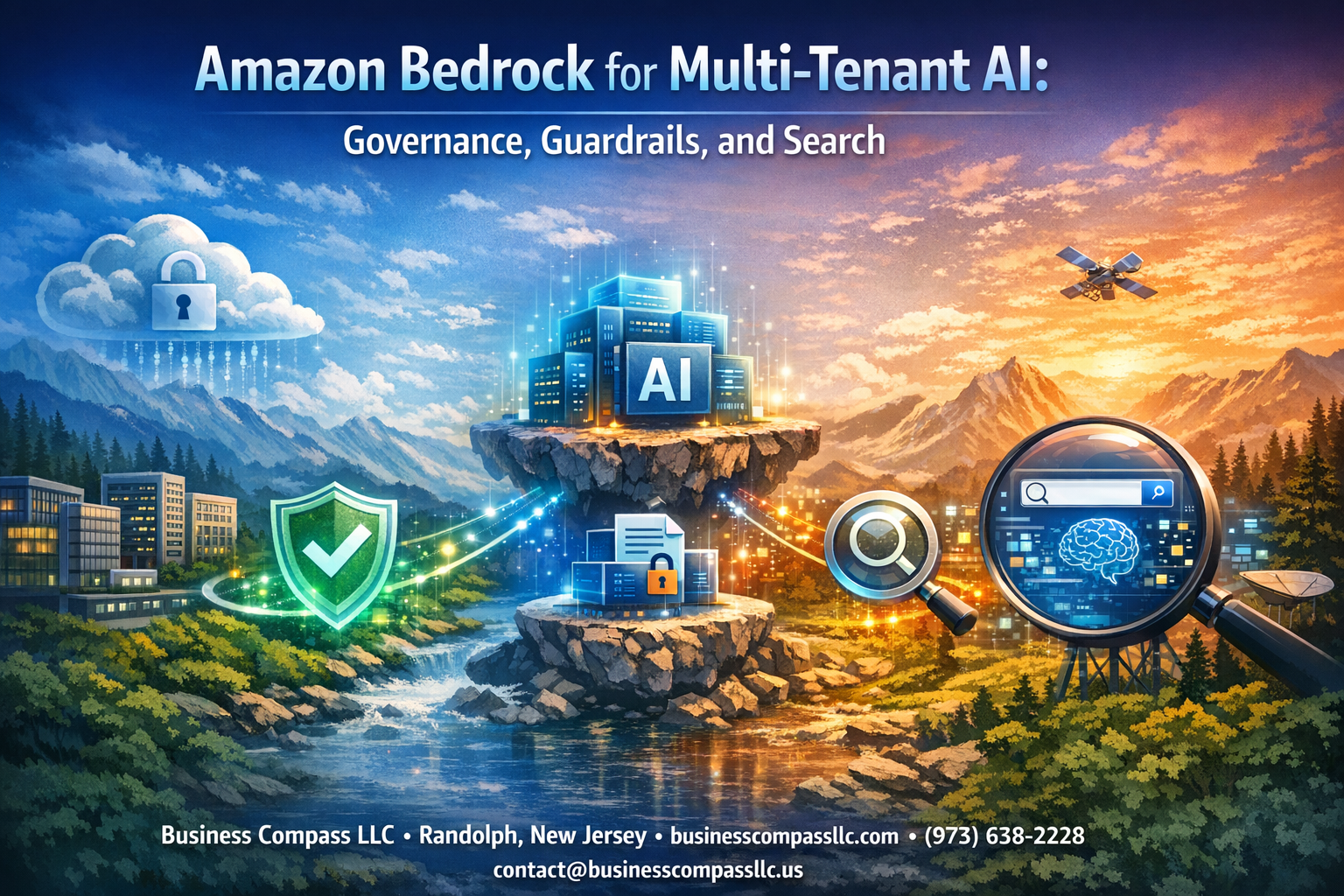
Building secure, scalable AI applications for multiple customers requires careful planning and the right tools. Amazon Bedrock multi-tenant architecture offers enterprise teams a powerful foundation for deploying AI services while maintaining strict boundaries between different customer environments.
This guide is designed for cloud architects, AI engineers, and DevOps teams who need to implement AI governance framework solutions that scale across multiple tenants without compromising security or performance.
We’ll walk through Amazon Bedrock’s multi-tenant capabilities and show you how to set up proper tenant isolation. You’ll learn how to implement Amazon Bedrock guardrails that protect your AI models from misuse while ensuring each customer’s data stays completely separate. We’ll also cover AI search optimization techniques that deliver fast, relevant results across different tenant environments without data bleeding between customers.
By the end, you’ll have a clear roadmap for building AI applications that serve multiple customers safely and efficiently using Amazon Bedrock’s enterprise-grade features.
Understanding Amazon Bedrock’s Multi-Tenant Architecture

Foundation Model Access Across Multiple Organizations
Amazon Bedrock’s multi-tenant architecture revolutionizes how organizations access foundation models by creating a shared infrastructure that serves multiple tenants while maintaining strict boundaries between them. This approach allows businesses to leverage cutting-edge AI capabilities without the massive overhead of building and maintaining their own model infrastructure.
The platform provides seamless access to various foundation models from leading AI providers like Anthropic, AI21 Labs, Cohere, and Amazon’s own Titan models. Each tenant organization can select and configure the models that best fit their specific use cases, whether they need text generation, code completion, or conversational AI capabilities. The beauty of this Amazon Bedrock multi-tenant setup lies in its ability to democratize access to advanced AI while ensuring each organization maintains control over their model selection and configuration.
Organizations can switch between different models or use multiple models simultaneously without worrying about infrastructure management. This flexibility enables teams to experiment with various AI approaches and find the optimal solutions for their unique business requirements. The shared infrastructure model also means faster deployment times and reduced time-to-market for AI-powered applications.
Tenant Isolation and Resource Segmentation
Effective tenant isolation forms the backbone of any successful multi-tenant AI architecture. Amazon Bedrock implements multiple layers of isolation to ensure that one tenant’s activities, data, and resources never interfere with another’s operations. This isolation extends beyond simple data separation to include compute resources, model inference capacity, and even API rate limits.
Each tenant receives its own logical workspace with dedicated resource pools, ensuring predictable performance regardless of other tenants’ usage patterns. The platform uses sophisticated resource allocation algorithms to distribute computational load efficiently while maintaining strict boundaries between tenant environments. This approach prevents the “noisy neighbor” problem common in shared infrastructure scenarios.
Resource segmentation goes deeper than surface-level separation. Amazon Bedrock allocates specific GPU clusters, memory pools, and network bandwidth to individual tenants based on their service level agreements. This granular control ensures that enterprise customers receive consistent performance while smaller organizations can still access powerful AI capabilities at a fraction of the cost of dedicated infrastructure.
The platform also provides detailed resource usage tracking and billing transparency, allowing organizations to monitor their consumption patterns and optimize their AI spending. This level of visibility helps IT teams make informed decisions about scaling their AI initiatives.
Scalable Infrastructure for Enterprise AI Deployments
Amazon Bedrock’s scalable infrastructure automatically adjusts to handle varying workloads across multiple tenants without manual intervention. The platform uses elastic scaling mechanisms that respond to demand spikes within seconds, ensuring that AI applications remain responsive even during peak usage periods.
The infrastructure leverages AWS’s global network to provide low-latency access to foundation models from multiple geographic regions. This distributed approach ensures that organizations can deploy AI solutions close to their users while maintaining compliance with data residency requirements. Regional failover capabilities provide additional reliability for mission-critical AI applications.
Auto-scaling capabilities extend to both horizontal and vertical scaling dimensions. The system can spin up additional compute instances when demand increases and automatically optimize resource allocation based on workload characteristics. Machine learning-powered capacity planning helps predict future resource needs, enabling proactive scaling that prevents performance degradation.
Enterprise customers benefit from dedicated capacity reservations that guarantee resource availability during critical business periods. This hybrid approach combines the cost efficiency of shared resources with the reliability guarantees that enterprise applications require. The platform also supports burst capacity allocation, allowing organizations to handle unexpected load spikes without pre-provisioning expensive infrastructure.
Performance monitoring tools provide real-time insights into system health and resource utilization across all tenants. These metrics help both AWS and customer teams optimize their multi-tenant AI deployments for maximum efficiency and cost-effectiveness.
Implementing Robust Governance Frameworks

Role-Based Access Control for AI Resources
Managing access to AI resources in multi-tenant Amazon Bedrock environments requires a sophisticated approach to role-based access control (RBAC). Organizations need to establish granular permissions that align with specific job functions and tenant requirements. Different roles demand varying levels of access to foundational models, inference endpoints, and fine-tuning capabilities.
Creating effective RBAC policies starts with identifying distinct user categories: data scientists who need model training access, developers requiring inference capabilities, and business users who only need read access to AI-generated insights. Each tenant should have isolated permissions that prevent cross-contamination of data or unauthorized access to other tenants’ resources.
Amazon Identity and Access Management (IAM) policies work seamlessly with Bedrock to control who can invoke specific models, access training data, or modify model configurations. Custom policies can restrict access based on resource tags, API endpoints, or specific model versions. This granular control ensures that each user has exactly the permissions needed for their role without excessive privileges.
Regular access reviews and automated permission audits help maintain security hygiene. Organizations should implement temporary access grants for contractors or temporary team members, with automatic expiration dates to prevent orphaned accounts from creating security vulnerabilities.
Compliance Management Across Industries
Different industries face unique regulatory requirements when implementing AI governance frameworks with Amazon Bedrock multi-tenant architectures. Healthcare organizations must comply with HIPAA regulations, financial institutions need SOX compliance, and government contractors require FedRAMP authorization.
Establishing industry-specific governance frameworks means mapping AI model usage to specific compliance requirements. For healthcare tenants, this includes ensuring patient data remains encrypted at rest and in transit, implementing proper data retention policies, and maintaining detailed logs of all AI model interactions with sensitive information.
Financial services organizations require additional controls around model bias detection and fairness testing. Amazon Bedrock guardrails can be configured to detect and prevent discriminatory outputs, while custom monitoring solutions track model performance across different demographic groups.
Data residency requirements vary significantly across regions and industries. Multi-tenant environments must account for these differences by implementing tenant-specific data storage policies. Some tenants may require data to remain within specific geographic boundaries, while others need cross-region replication for disaster recovery purposes.
Regular compliance assessments and third-party audits validate that governance frameworks meet evolving regulatory standards. Organizations should maintain documented evidence of compliance controls and be prepared to demonstrate how their Amazon Bedrock implementation adheres to industry-specific requirements.
Audit Trails and Activity Monitoring
Comprehensive audit trails form the backbone of effective AI governance strategies in multi-tenant environments. Every interaction with Amazon Bedrock services should be logged, timestamped, and attributed to specific users or tenants. This includes model invocations, training jobs, data access patterns, and configuration changes.
AWS CloudTrail integration provides detailed logging of all API calls made to Bedrock services. These logs capture who made requests, when they occurred, which models were accessed, and what parameters were used. For multi-tenant environments, proper log segregation ensures that each tenant’s activities remain isolated while providing administrators with comprehensive oversight.
Real-time monitoring dashboards surface unusual patterns or potential security incidents. Automated alerts can notify administrators when users exceed normal usage patterns, attempt unauthorized model access, or trigger guardrail violations. These early warning systems help prevent small issues from becoming major security incidents.
Log retention policies must balance regulatory requirements with storage costs. Different tenants may have varying retention needs based on their industry or contractual obligations. Automated log archival and deletion policies help manage costs while ensuring compliance requirements are met.
Regular log analysis reveals usage patterns, performance bottlenecks, and optimization opportunities. Machine learning models can analyze historical logs to predict resource needs, identify potential security threats, and recommend governance policy improvements.
Cost Allocation and Budget Controls
Accurate cost allocation across multiple tenants requires detailed tracking of resource consumption at the tenant level. Amazon Bedrock usage can vary dramatically based on model types, inference frequency, and training data volumes. Organizations need granular visibility into these costs to implement fair billing and prevent budget overruns.
Resource tagging strategies enable precise cost attribution by tenant, department, or project. Consistent tagging across all Bedrock resources allows for detailed cost reporting and helps identify which tenants or use cases generate the highest expenses. Automated tagging policies ensure new resources receive appropriate tags without manual intervention.
Budget alerts and spending limits prevent unexpected costs from spiraling out of control. Each tenant can have individualized budget thresholds with escalating notifications as spending approaches limits. Hard stops can prevent critical budget overruns, while soft limits provide early warnings for proactive cost management.
Chargeback models create accountability and encourage efficient resource usage. Detailed usage reports show tenants exactly how their activities translate to costs, promoting more thoughtful model selection and optimization efforts. This transparency helps justify AI investments and demonstrates clear ROI for different tenant use cases.
Reserved capacity planning optimizes costs for predictable workloads. Organizations can purchase reserved instances for baseline tenant needs while using on-demand pricing for variable workloads. This hybrid approach minimizes costs while maintaining flexibility for changing requirements.
Establishing Effective AI Guardrails

Content Filtering and Safety Mechanisms
Amazon Bedrock guardrails provide comprehensive content filtering that acts as the first line of defense against inappropriate outputs. The platform’s built-in safety mechanisms scan all model responses for harmful content across categories like violence, hate speech, sexual content, and self-harm. When implementing multi-tenant AI architecture, these filters can be customized to match different tenant requirements and industry standards.
The content filtering system works at multiple levels, examining both input prompts and generated responses. This dual-layer approach prevents problematic queries from reaching the models and catches potentially harmful outputs before they’re delivered to end users. The filtering algorithms use advanced natural language processing to understand context, reducing false positives while maintaining strict safety standards.
Organizations can configure different sensitivity levels for various content categories. Healthcare tenants might require stricter medical misinformation filters, while creative agencies might need more relaxed guidelines for artistic content. The system supports granular customization, allowing administrators to fine-tune filtering parameters based on specific use cases and regulatory requirements.
Model Output Validation and Quality Checks
Beyond safety filtering, Amazon Bedrock implements sophisticated validation mechanisms to ensure output quality and accuracy. These checks verify that generated content meets predefined standards for coherence, relevance, and factual consistency. The validation process includes automated scoring systems that evaluate response quality across multiple dimensions.
Quality checks encompass several key areas:
- Coherence Assessment: Evaluates whether responses make logical sense and maintain consistent narrative flow
- Relevance Scoring: Measures how well outputs address the original query or prompt
- Factual Verification: Cross-references claims against trusted knowledge bases when possible
- Language Quality: Checks grammar, syntax, and overall readability
The multi-tenant environment allows different quality thresholds for various tenant types. Enterprise customers might require higher accuracy standards for business-critical applications, while creative platforms might prioritize originality over strict factual adherence. These configurable parameters ensure each tenant receives outputs that align with their specific quality requirements.
Preventing Harmful or Biased AI Responses
AI bias mitigation stands as a critical component of Amazon Bedrock’s guardrail system. The platform employs multiple strategies to identify and prevent biased outputs that could unfairly favor or discriminate against specific groups. These mechanisms continuously monitor model responses for patterns that might indicate demographic, cultural, or ideological bias.
The bias detection system analyzes outputs across various dimensions including gender, race, religion, political affiliation, and socioeconomic status. When potentially biased content is identified, the system can either block the response entirely or prompt the model to generate alternative outputs that maintain neutrality and fairness.
Training data diversity plays a crucial role in bias prevention. Amazon Bedrock’s foundation models are trained on carefully curated datasets that represent diverse perspectives and experiences. Regular bias audits help identify potential blind spots, allowing for continuous improvement of the underlying models and guardrail mechanisms.
Customizable Risk Thresholds per Tenant
Multi-tenant AI platforms must accommodate varying risk tolerance levels across different organizations and use cases. Amazon Bedrock addresses this need through highly configurable risk thresholds that can be tailored to each tenant’s specific requirements and regulatory environment.
Risk threshold customization spans several dimensions:
- Content Severity Levels: Adjustable sensitivity for different types of potentially harmful content
- Confidence Scores: Minimum confidence requirements before allowing model outputs
- Topic Restrictions: Customizable lists of prohibited or sensitive subject areas
- Response Length Limits: Configurable maximum output lengths to prevent overly verbose responses
Financial services tenants might require extremely conservative settings to comply with strict regulatory requirements, while educational platforms might allow more flexibility for creative learning applications. The system maintains detailed logs of all threshold adjustments and their impacts, enabling administrators to fine-tune settings based on real-world performance data.
These customizable guardrails integrate seamlessly with existing tenant management systems, allowing organizations to implement role-based access controls and approval workflows for threshold modifications. This approach ensures that risk management strategies remain aligned with business objectives while maintaining appropriate safety standards across all tenant environments.
Optimizing Search Capabilities in Multi-Tenant Environments

Federated Search Across Tenant Data Sources
Building effective federated search in Amazon Bedrock multi-tenant environments requires smart orchestration across isolated data silos. Each tenant maintains separate knowledge bases, document repositories, and contextual information that need to remain secure while enabling powerful search capabilities.
The architecture starts with a centralized search service that coordinates queries across multiple tenant-specific data sources. This service acts as an intelligent router, determining which tenant data repositories are relevant to specific search requests while maintaining strict access controls. When a user initiates a search, the system first validates their tenant membership and permissions before routing the query to appropriate data sources.
Vector embeddings play a crucial role in this federated approach. Each tenant’s documents get processed through Amazon Bedrock’s foundation models to generate semantic embeddings that capture meaning beyond simple keyword matching. These embeddings get stored in tenant-specific vector databases, creating isolated but searchable knowledge graphs for each organization.
Cross-tenant search scenarios require careful handling. Some organizations might need to search across multiple business units or subsidiaries while maintaining data sovereignty. The federated search layer manages these complex scenarios by implementing fine-grained access policies that determine which data sources are accessible to specific user roles or organizational hierarchies.
Real-time indexing becomes critical as tenant data volumes grow. The system needs to continuously update embeddings as new documents are added, modified, or removed from tenant repositories. This requires efficient change detection mechanisms and incremental embedding updates to maintain search accuracy without overwhelming system resources.
Personalized Search Results Based on User Context
User context drives search personalization in multi-tenant AI environments. Amazon Bedrock’s capabilities extend beyond simple keyword matching to understand user intent, role, and historical interaction patterns within their specific tenant context.
Role-based personalization starts with understanding each user’s position within their organization. A marketing manager searching for “campaign performance” should receive different results than a financial analyst using the same query. The system analyzes user roles, department affiliations, and project assignments to tailor search results accordingly.
Historical interaction patterns provide valuable signals for personalizing search experiences. The system tracks which documents users frequently access, their typical search patterns, and content engagement metrics. This behavioral data helps predict relevant results for new queries, creating a more intuitive search experience that learns from user preferences over time.
Contextual filters automatically apply based on user permissions and project involvement. When users search for project-related information, the system prioritizes documents from their active projects while filtering out unrelated content. This contextual awareness reduces information overload and improves search precision.
Dynamic ranking algorithms adjust result ordering based on individual user context. Recent documents from the user’s department might receive higher ranking, while frequently accessed file types get prioritized. The ranking system balances relevance signals with personalization factors to deliver optimal results for each user’s specific needs.
Collaborative filtering enhances personalization by identifying similar users within the same tenant. When users with comparable roles or responsibilities find specific content valuable, the system can recommend similar documents to other users in analogous positions.
Vector Database Integration for Enhanced Retrieval
Vector databases transform how Amazon Bedrock multi-tenant environments handle complex search and retrieval tasks. These specialized databases store high-dimensional embeddings that capture semantic meaning, enabling sophisticated similarity searches that go far beyond traditional keyword matching.
Amazon Bedrock’s foundation models generate dense vector representations of documents, queries, and other content. These embeddings encode semantic relationships, allowing the system to find conceptually related information even when exact keywords don’t match. A search for “customer satisfaction” might surface documents about “client happiness” or “user experience” based on semantic similarity.
Multi-tenant vector database architecture requires careful partitioning strategies. Each tenant’s embeddings live in isolated vector spaces, preventing data leakage while maintaining search performance. The system can implement logical partitioning within a single vector database or deploy separate vector database instances for larger tenants with significant data volumes.
Hybrid search combines traditional keyword search with vector similarity matching. This approach leverages the precision of exact keyword matches while capturing the semantic richness that vector embeddings provide. Users get comprehensive results that include both precisely matching documents and contextually relevant content.
Real-time embedding updates keep vector databases current as tenant data evolves. New documents automatically generate embeddings that get indexed for immediate searchability. Modified documents trigger embedding recalculation to maintain search accuracy. This continuous updating process ensures users always search against the most current information.
Performance optimization becomes essential as vector databases scale. Approximate nearest neighbor algorithms enable fast similarity searches across millions of embeddings. Index optimization techniques like hierarchical navigable small world graphs balance search speed with accuracy, delivering sub-second response times even for complex semantic queries.
Multi-modal embeddings extend beyond text to include images, audio, and other content types. This capability enables comprehensive search across diverse content formats within tenant environments, creating unified search experiences that span all organizational knowledge assets.
Security and Data Protection Strategies

End-to-End Encryption for Sensitive Information
Amazon Bedrock multi-tenant environments demand comprehensive encryption strategies that protect data throughout its entire lifecycle. Data encryption must occur at multiple layers, starting with data at rest using AWS Key Management Service (KMS) with customer-managed keys specific to each tenant. This approach allows organizations to maintain granular control over encryption keys while ensuring that sensitive AI training data and model outputs remain protected.
In-transit encryption becomes equally critical when data moves between services, applications, and tenant boundaries. TLS 1.3 protocols secure all communications between clients and Bedrock endpoints, while VPC endpoints provide additional network isolation. For highly sensitive workloads, consider implementing client-side encryption before data even reaches AWS services, ensuring that plaintext data never exists outside your controlled environment.
Model artifacts and inference results require special attention in multi-tenant scenarios. Encrypt these outputs using tenant-specific keys to prevent cross-contamination and unauthorized access. Implement envelope encryption patterns where possible, using data encryption keys (DEKs) for high-volume operations while protecting these DEKs with master keys stored in AWS KMS.
Cross-Tenant Data Isolation Protocols
Effective data isolation forms the backbone of secure multi-tenant AI architectures. Bedrock security best practices emphasize implementing strict logical and physical separation mechanisms that prevent any possibility of data leakage between tenants. Start by designing your data architecture with tenant-specific S3 buckets, each configured with unique IAM policies that explicitly deny cross-tenant access.
Database-level isolation requires careful planning of partition strategies and access controls. Use tenant-aware query patterns that automatically filter results based on authenticated tenant context. Row-level security policies can provide an additional layer of protection, ensuring that database queries never accidentally expose data from other tenants.
Network segmentation plays a crucial role in maintaining isolation boundaries. Deploy separate VPCs or subnets for different tenant tiers, with carefully configured security groups and NACLs that restrict traffic flow. This network-level isolation complements application-level controls and provides defense-in-depth protection.
Consider implementing data residency controls that keep tenant data within specific geographic regions or availability zones. This approach not only supports compliance requirements but also reduces the attack surface by limiting data movement across network boundaries.
Identity Management Integration
Modern multi-tenant AI monitoring systems require sophisticated identity management that can handle complex authentication and authorization scenarios. Integration with enterprise identity providers through SAML 2.0 or OpenID Connect enables seamless single sign-on experiences while maintaining strict access controls. Configure attribute-based access control (ABAC) policies that consider tenant membership, role hierarchies, and resource sensitivity levels.
Service-to-service authentication becomes particularly important in AI governance frameworks where multiple components need to interact securely. Implement OAuth 2.0 client credentials flow for backend services, ensuring that each service authenticates using least-privilege principles. Use AWS IAM roles for cross-service communication, avoiding long-lived credentials wherever possible.
Multi-factor authentication should be mandatory for administrative access to Bedrock resources. Configure adaptive authentication policies that consider risk factors like location, device characteristics, and access patterns. This dynamic approach helps prevent unauthorized access while maintaining user experience for legitimate operations.
Regular access reviews and automated deprovisioning processes ensure that identity permissions remain aligned with current business needs. Implement just-in-time access for administrative operations, requiring explicit approval workflows for sensitive actions that could affect multiple tenants.
Backup and Disaster Recovery Planning
Comprehensive backup strategies must account for the unique challenges of multi-tenant AI environments. Design backup schedules that consider both tenant-specific recovery time objectives (RTOs) and recovery point objectives (RPOs). Critical AI models and training data may require more frequent backups than less sensitive configuration data.
Cross-region replication provides protection against regional disasters while maintaining data sovereignty requirements. Configure S3 cross-region replication rules that respect tenant-specific compliance needs, ensuring that sensitive data remains within approved geographic boundaries even during disaster scenarios.
Database backup strategies should include both automated snapshots and point-in-time recovery capabilities. Test restore procedures regularly using non-production environments to validate that recovery processes work correctly across different tenant configurations. Document recovery procedures with clear escalation paths and communication protocols.
Consider implementing immutable backup storage using S3 Object Lock or similar technologies. This approach protects against both accidental deletion and malicious attacks that might attempt to compromise backup integrity. Regular disaster recovery testing ensures that your multi-tenant AI architecture can recover quickly and completely from various failure scenarios.
Performance Optimization and Monitoring

Load Balancing Across Multiple Tenants
Building effective load balancing for Amazon Bedrock multi-tenant environments requires strategic distribution of AI workloads across multiple tenants without compromising performance or security. The key lies in implementing intelligent routing algorithms that consider both tenant priority levels and current system capacity.
Smart tenant prioritization works by categorizing tenants based on service level agreements, usage patterns, and business criticality. Premium tenants might receive dedicated compute resources, while standard tenants share pooled resources with fair allocation policies. This approach prevents resource starvation while maintaining cost efficiency across the entire multi-tenant AI architecture.
Resource pooling strategies become essential when managing diverse AI workloads. Different tenants may require varying model sizes, inference speeds, and memory allocations. Dynamic resource allocation algorithms can automatically adjust compute resources based on real-time demand, ensuring optimal utilization without cross-tenant interference.
Geographic distribution adds another layer of complexity and opportunity. By deploying Bedrock instances across multiple AWS regions, you can route tenant requests to the nearest available resources, reducing latency while providing built-in disaster recovery capabilities.
Real-Time Performance Metrics and Analytics
Real-time visibility into Amazon Bedrock performance metrics transforms how teams manage multi-tenant AI monitoring and optimization. CloudWatch integration provides comprehensive dashboards that track critical performance indicators across all tenant workloads simultaneously.
Key metrics to monitor include:
- Model inference latency per tenant and request type
- Token processing rates and throughput measurements
- Error rates and failure patterns across different tenant segments
- Resource utilization including CPU, memory, and GPU consumption
- Queue depths and processing backlogs for each tenant
Custom metric collection becomes valuable when standard CloudWatch metrics don’t capture specific business requirements. Building custom collectors that track tenant-specific KPIs like accuracy scores, response quality ratings, or user satisfaction metrics provides deeper insights into system performance.
Alerting strategies should distinguish between tenant-specific issues and system-wide problems. Automated escalation paths can notify the appropriate teams when performance degrades, ensuring rapid response times. Machine learning-powered anomaly detection helps identify unusual patterns before they impact tenant experiences.
Automated Scaling Based on Usage Patterns
Predictive scaling transforms Bedrock performance optimization by anticipating demand spikes before they occur. Historical usage data reveals patterns that help predict when specific tenants will experience increased AI workloads, allowing proactive resource allocation.
Auto-scaling policies should account for the unique characteristics of AI workloads. Unlike traditional web applications, AI model inference can have unpredictable resource requirements based on input complexity. Scaling decisions need to consider not just request volume but also the computational intensity of different AI tasks.
Tenant-aware scaling policies prevent noisy neighbor problems where one tenant’s sudden demand spike affects others. Individual tenant scaling thresholds ensure fair resource distribution while maintaining system stability. This approach supports both burst capacity for occasional high-demand periods and sustained scaling for growing tenant workloads.
Cost optimization through intelligent scaling reduces operational expenses without sacrificing performance. By analyzing usage patterns, you can identify opportunities to scale down during predictable low-usage periods, right-size instances based on actual demand, and leverage spot instances for non-critical workloads.
Integration with AWS Application Auto Scaling provides sophisticated scaling strategies that consider multiple metrics simultaneously. This multi-dimensional approach creates more responsive and cost-effective scaling decisions that adapt to the dynamic nature of multi-tenant AI environments.

Amazon Bedrock offers a solid foundation for building multi-tenant AI applications that can scale safely and efficiently. The platform’s built-in governance tools, customizable guardrails, and robust security features make it easier to manage multiple tenants while keeping their data separate and protected. Smart search optimization and continuous performance monitoring help ensure your AI applications deliver consistent results across all users.
Getting started with multi-tenant AI doesn’t have to be overwhelming. Focus on setting up your governance framework first, then layer in the appropriate guardrails for your specific use case. Take advantage of Bedrock’s monitoring capabilities to track performance and make adjustments as needed. Your users will appreciate the reliable, secure AI experience, and you’ll have the peace of mind that comes with proper tenant isolation and data protection.