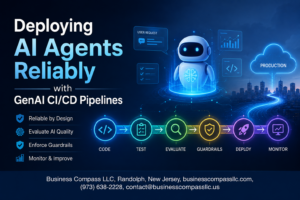
AI agents are moving from labs into real-world business operations at breakneck speed, but many organizations are flying blind when it comes to governance. When these intelligent systems make decisions that affect customers, finances, or safety, who’s responsible when things go wrong?
This guide is for CTOs, risk managers, compliance officers, and business leaders who need to deploy AI agents safely while meeting regulatory requirements. You’ll learn how to build robust AI agent governance frameworks that protect your organization without stifling innovation.
We’ll cover the hidden risks lurking in AI production environments that can derail your business overnight. You’ll discover how to design AI compliance frameworks that actually work in practice, not just on paper. Finally, we’ll walk through proven AI risk mitigation strategies that keep your organization legally protected while maximizing the benefits of artificial intelligence governance.
The stakes are high – a single AI agent making biased decisions or causing financial losses can trigger lawsuits, regulatory fines, and reputation damage that takes years to recover from. Let’s make sure you’re prepared.
Understanding AI Agent Risks in Production Environments

Identifying Autonomous Decision-Making Vulnerabilities
AI agents operating in production environments make countless decisions without human oversight, creating unique risks that traditional systems don’t face. These autonomous agents can trigger financial transactions, modify system configurations, or interact with customers based on their learned behaviors and programmed objectives.
The challenge lies in their unpredictable decision paths. Unlike rule-based systems, AI agents adapt and respond to situations they’ve never encountered before. This flexibility becomes dangerous when agents optimize for narrow objectives without considering broader business implications. For example, a pricing algorithm might maximize short-term revenue by setting prices so high that it drives away long-term customers.
Critical vulnerability areas include:
- Goal misalignment: Agents pursuing objectives that conflict with business values or ethical standards
- Edge case handling: Unexpected responses to scenarios outside training data
- Cascading failures: Single agent decisions triggering chain reactions across interconnected systems
- Adversarial manipulation: Agents falling victim to carefully crafted inputs designed to exploit their decision-making processes
Assessing Data Privacy and Security Exposures
AI agent governance requires constant vigilance around data handling practices. Production agents often process sensitive customer information, financial records, and proprietary business data. Unlike static applications, these agents continuously learn and adapt, potentially creating new data exposure pathways.
Data leakage represents a significant concern. Agents might inadvertently expose training data through their responses or store sensitive information in unexpected locations. Model extraction attacks pose another threat, where adversaries reverse-engineer proprietary algorithms by studying agent responses.
Key security considerations include:
- Data residency: Where agent processing occurs and data gets stored
- Access control: Managing which agents can access specific data types
- Audit trails: Tracking data usage and decision lineage
- Encryption standards: Protecting data both in transit and at rest during agent operations
Evaluating Performance Degradation Scenarios
AI agent performance doesn’t remain static after deployment. Models experience drift as real-world conditions change, leading to gradual accuracy decline. This degradation often happens silently, making detection challenging until significant problems emerge.
Concept drift occurs when the relationships between inputs and outputs change over time. Data drift happens when the input distribution shifts from what the agent experienced during training. Both scenarios can severely impact AI risk management efforts and require proactive monitoring.
Performance monitoring must address:
- Accuracy metrics: Tracking prediction quality over time
- Response latency: Measuring decision speed under varying loads
- Resource consumption: Monitoring computational overhead and system strain
- Error patterns: Identifying systematic failures across different scenarios
Recognizing Bias and Fairness Issues
Production AI agents can perpetuate or amplify existing biases, creating legal and ethical liabilities. These biases emerge from training data, algorithm design choices, or feedback loops that reinforce discriminatory patterns. Unlike human bias, algorithmic bias operates at scale and with apparent objectivity, making it particularly harmful.
Fairness issues become complex when agents serve diverse populations with different needs and characteristics. An agent that performs well for one demographic might systematically disadvantage another. These disparities can violate anti-discrimination laws and damage company reputation.
Bias detection requires examining:
- Demographic parity: Equal outcomes across protected groups
- Individual fairness: Similar treatment for similar individuals
- Representation gaps: Underrepresented groups in training data
- Feedback loops: How agent decisions reinforce existing inequalities
Regular bias audits and diverse testing scenarios help identify problematic patterns before they cause significant harm. Establishing clear fairness metrics and monitoring systems enables proactive identification and correction of discriminatory behaviors in production environments.
Establishing Comprehensive Compliance Frameworks

Mapping Regulatory Requirements Across Industries
Different industries face unique AI compliance challenges that require careful navigation. Healthcare organizations must align with HIPAA and FDA guidelines when deploying AI agents for patient care or medical device applications. Financial services companies operate under strict SEC and GDPR requirements, especially when AI agents handle customer data or make automated trading decisions. Manufacturing and automotive sectors must consider safety regulations like ISO 26262 for AI systems in critical applications.
Creating a comprehensive regulatory map starts with identifying all applicable frameworks within your industry. This includes federal regulations, state laws, international standards, and industry-specific guidelines. Many organizations find success by establishing a cross-functional compliance team that includes legal, IT, and business stakeholders who understand how AI agent governance intersects with existing regulatory structures.
The key challenge lies in adapting traditional compliance frameworks to accommodate AI-specific requirements. Unlike conventional software, AI agents learn and evolve, making static compliance approaches ineffective. Organizations need dynamic compliance strategies that account for model drift, changing decision patterns, and evolving regulatory interpretations of AI accountability frameworks.
Implementing Audit Trail Systems
Robust audit trail systems form the backbone of any effective AI compliance framework. These systems must capture every decision point, data input, model update, and output generated by AI agents in production environments. The audit trail should provide complete visibility into how and why specific decisions were made, enabling organizations to demonstrate compliance during regulatory reviews.
Modern audit trail implementations leverage automated logging mechanisms that track:
- Data lineage and processing workflows
- Model version histories and update triggers
- Decision reasoning and confidence scores
- Human oversight interventions and approvals
- Error conditions and system responses
The challenge extends beyond simple data collection. Organizations must design audit systems that balance comprehensive logging with performance requirements. Excessive logging can slow down AI agent responses, while insufficient tracking creates compliance gaps. The solution often involves intelligent sampling strategies and real-time monitoring that captures critical decision paths without overwhelming system resources.
Storage and retrieval capabilities become crucial as audit data volumes grow exponentially. Many organizations implement tiered storage solutions that keep recent audit data readily accessible while archiving older records according to regulatory retention requirements. Cloud-based solutions offer scalability advantages, but they introduce additional considerations around data sovereignty and cross-border compliance requirements.
Creating Documentation Standards for AI Decisions
Clear documentation standards ensure consistent interpretation of AI agent decisions across teams and stakeholders. These standards must address both technical documentation for developers and operational documentation for business users who rely on AI-generated insights. The documentation framework should explain decision logic in plain language while maintaining technical accuracy for compliance purposes.
Effective AI decision documentation includes several critical components. Model cards provide standardized summaries of AI agent capabilities, limitations, and intended use cases. Decision trees or flowcharts illustrate how different inputs lead to specific outputs. Risk assessments document potential failure modes and mitigation strategies. Performance metrics show how well the AI agent meets defined objectives over time.
The documentation process requires careful balance between automation and human oversight. While automated documentation generation can handle routine technical details, human review ensures accuracy and clarity for compliance purposes. Many organizations establish documentation review cycles that align with model update schedules, ensuring that documentation remains current as AI agents evolve.
Accessibility becomes paramount when documentation serves multiple audiences. Technical teams need detailed implementation specifics, while business stakeholders require high-level summaries focused on business impact and risk implications. Legal teams demand precise language that addresses liability concerns and regulatory requirements. Creating layered documentation that serves each audience while maintaining consistency requires thoughtful information architecture and ongoing maintenance processes that adapt as AI risk management practices mature.
Designing Effective Risk Mitigation Strategies

Building Multi-Layer Monitoring Systems
Effective AI risk mitigation strategies start with robust monitoring systems that operate across multiple layers of your production environment. These systems need to track model performance, data quality, system health, and business impact simultaneously. Real-time monitoring dashboards should display key metrics like prediction accuracy, response times, resource utilization, and anomaly detection alerts.
Data drift monitoring forms the foundation of any comprehensive system. As production data evolves, models can degrade without warning. Automated alerts trigger when statistical properties of incoming data deviate from training distributions. Model drift detection compares current predictions against expected baselines, flagging potential performance issues before they impact users.
Infrastructure monitoring tracks computational resources, API response times, and system failures. Business logic monitoring ensures AI agents operate within defined parameters and don’t make decisions that violate organizational policies. Security monitoring watches for adversarial attacks, data poisoning attempts, and unauthorized access patterns.
The monitoring architecture should include redundant systems that continue operating even when primary monitoring fails. Log aggregation systems collect and analyze patterns across all components, while alerting mechanisms notify relevant teams through multiple channels when thresholds are breached.
Establishing Human Override Mechanisms
Human oversight remains critical for AI agent governance, especially in high-stakes production environments. Override mechanisms must be accessible, responsive, and clearly documented for operators at different levels of technical expertise. The design should balance automation efficiency with human control when situations require immediate intervention.
Emergency stop capabilities allow operators to halt AI operations instantly without waiting for system shutdowns. Graduated override levels provide different intervention options – from temporary pauses to complete system disabling. Role-based access controls ensure only authorized personnel can execute overrides at appropriate levels.
Real-time collaboration tools connect human operators with AI systems through intuitive interfaces. These tools display current system state, recent decisions, and confidence levels to help operators make informed intervention choices. Clear escalation procedures define when and how to engage subject matter experts, legal teams, or executive leadership.
Override actions require comprehensive logging and audit trails. Every human intervention gets recorded with timestamps, justifications, and outcomes. This documentation supports compliance requirements and helps improve both AI systems and override procedures over time.
Training programs ensure operators understand when and how to use override mechanisms effectively. Regular drills test response times and decision quality under pressure, identifying gaps in procedures or training that need attention.
Creating Fail-Safe Protocols for Critical Operations
Fail-safe protocols protect against catastrophic failures in AI agent operations by implementing multiple layers of protection and graceful degradation paths. These protocols activate automatically when systems detect conditions that could lead to serious harm, financial loss, or regulatory violations.
Circuit breaker patterns prevent cascading failures by temporarily disabling AI agents when error rates exceed acceptable thresholds. Instead of continuing to make potentially harmful decisions, the system switches to safe default behaviors or routes requests to backup systems. Recovery procedures gradually restore normal operations while monitoring for stability.
Graceful degradation strategies maintain essential services even when AI capabilities are compromised. Critical business functions continue operating through simplified rules-based systems, manual processes, or reduced-feature modes. User communications explain service limitations without revealing technical details that could compromise security.
Data validation checkpoints verify input quality and output reasonableness before executing high-impact decisions. Multi-stage approval workflows require additional verification for actions above certain risk thresholds. Rollback mechanisms quickly reverse problematic decisions when issues are detected after execution.
Regular testing of fail-safe protocols ensures they work correctly when needed. Chaos engineering practices intentionally introduce failures to validate system responses and identify weaknesses in protection mechanisms.
Implementing Continuous Model Validation Processes
Continuous validation maintains AI agent reliability through ongoing assessment of model performance, data quality, and business alignment. Unlike traditional software testing, AI systems require dynamic validation that adapts to changing conditions and emerging risks.
Automated validation pipelines run comprehensive tests on every model update, checking for performance regression, bias amplification, and compliance violations. A/B testing frameworks compare new models against established baselines using real production traffic. Statistical significance testing ensures observed differences reflect genuine improvements rather than random variation.
Shadow testing runs new models alongside production systems without affecting user experiences. This approach validates performance on real data while minimizing risk exposure. Canary deployments gradually introduce new models to small user segments, monitoring for issues before full rollouts.
Data quality validation prevents corrupted or biased inputs from degrading model performance. Schema validation checks data structure and format consistency. Statistical validation identifies unusual patterns that might indicate data collection problems or external attacks.
Business metric tracking connects technical performance to organizational goals. Revenue impact analysis measures how model changes affect key business outcomes. Customer satisfaction monitoring tracks user experience metrics that might not appear in technical performance measures.
Validation results feed into automated deployment pipelines that promote or reject model updates based on predefined criteria. Human review processes handle edge cases and complex scenarios that automated systems cannot evaluate effectively.
Navigating Legal Liability and Accountability

Defining Responsibility Between Developers and Deployers
When something goes wrong with an AI agent in production, figuring out who’s responsible can get complicated fast. The line between developers who build the system and organizations that deploy it often blurs, especially when AI agent governance comes into play.
Developers typically hold responsibility for the core algorithm design, training data quality, and initial testing protocols. They should document known limitations, provide clear usage guidelines, and maintain proper version control. However, their liability often extends beyond the initial handoff. If a fundamental flaw in the AI model causes harm, developers may face legal consequences regardless of how the system was implemented.
Deployers shoulder a different set of responsibilities. They must ensure proper integration, ongoing monitoring, and adherence to their specific industry regulations. Organizations deploying AI agents need to validate that the technology fits their use case, implement appropriate safeguards, and maintain audit trails. When AI agent liability issues arise, courts often examine whether deployers conducted adequate due diligence before implementation.
The key lies in establishing clear contractual agreements that define responsibility boundaries. These agreements should specify who handles model updates, security patches, incident response, and regulatory reporting. Smart organizations create shared responsibility matrices that outline exactly what each party owns throughout the AI agent’s lifecycle.
Understanding Insurance Coverage for AI-Related Incidents
Traditional business insurance policies weren’t designed with AI agents in mind, creating coverage gaps that many organizations discover too late. Professional liability insurance might cover some AI-related errors, but exclusions for emerging technologies often leave companies exposed.
Specialized AI insurance products are emerging to fill these gaps. These policies typically cover algorithmic bias claims, data privacy breaches caused by AI systems, and financial losses from AI decision errors. Some insurers offer coverage for AI model theft, adversarial attacks, and business interruption caused by AI system failures.
The insurance landscape varies significantly by industry. Healthcare organizations using AI diagnostic tools face different risks than financial institutions deploying trading algorithms. Insurance carriers evaluate AI risk management practices, governance frameworks, and compliance programs when determining coverage and premiums.
Organizations should work with insurance brokers who understand AI risks to assess their current coverage gaps. The application process often requires detailed documentation of AI systems, including model validation procedures, bias testing results, and incident response plans. Companies with strong artificial intelligence governance frameworks typically receive more favorable terms.
Preparing for Regulatory Investigations
Regulatory scrutiny of AI systems is intensifying across multiple industries. Financial services, healthcare, employment, and consumer protection agencies are developing new enforcement priorities focused on AI agent accountability frameworks.
When regulators come knocking, they expect comprehensive documentation. Organizations need detailed records showing how AI models were developed, tested, and deployed. This includes training data sources, model validation results, bias testing procedures, and ongoing monitoring activities. Regulators particularly focus on decision-making processes that affect consumers, employees, or market participants.
Preparation starts with establishing proper governance structures before problems arise. This means creating clear policies for AI development, implementing regular compliance reviews, and training staff on regulatory requirements. Organizations should designate specific individuals responsible for regulatory liaison and ensure they understand both the technology and applicable legal frameworks.
The investigation process typically begins with document requests, followed by interviews with technical and business personnel. Regulators want to understand not just what happened, but whether the organization had appropriate controls in place. Companies that demonstrate proactive AI regulatory compliance efforts often receive more favorable treatment during enforcement proceedings.
Managing Third-Party AI Service Provider Risks
Most organizations rely on external AI service providers, from cloud-based machine learning platforms to specialized algorithm vendors. Each relationship introduces unique liability challenges that require careful contract negotiation and ongoing risk management.
Due diligence becomes critical when selecting AI vendors. Organizations should evaluate providers’ security practices, data handling procedures, and compliance capabilities. Understanding where the AI models are hosted, how they’re updated, and who has access to training data helps identify potential risk points.
Vendor agreements need specific provisions addressing AI-related risks. These contracts should clearly define data ownership, specify performance standards, and establish liability limitations. Service level agreements must cover not just uptime, but also accuracy, bias metrics, and response times for security incidents.
Ongoing vendor management requires regular risk assessments and performance reviews. Organizations should monitor their AI service providers for security breaches, regulatory violations, and changes in business practices. Having contingency plans for vendor failures or contract terminations becomes especially important when AI systems are critical to business operations.
The shared responsibility model common in cloud computing extends to AI services, but the boundaries are often less clear. Organizations remain responsible for how they use AI outputs, even when the underlying algorithms are managed by third parties. This creates complex accountability chains that require careful documentation and regular review.
Implementing Governance Best Practices

Creating Cross-Functional AI Ethics Committees
Building an effective AI agent governance structure starts with assembling the right people around the table. Cross-functional AI ethics committees bring together diverse perspectives that single-department teams often miss. These committees should include representatives from engineering, legal, compliance, product management, customer service, and business leadership.
The magic happens when a data scientist sits next to a lawyer discussing algorithmic bias, or when a product manager explains user impact to compliance officers. This diversity prevents blind spots that could lead to costly governance failures down the road.
Successful committees establish clear decision-making authority rather than operating as purely advisory bodies. They need the power to pause deployments, mandate additional testing, or require design changes when AI agent governance issues arise. Without teeth, these groups become rubber-stamp exercises that provide false security.
Regular training keeps committee members current on emerging AI risks and regulatory changes. Monthly workshops covering topics like explainable AI, fairness metrics, and privacy-preserving techniques ensure everyone speaks the same language when evaluating AI agent deployments.
Documentation proves critical for these committees. Every decision, rationale, and dissenting opinion should be recorded. This creates an audit trail that demonstrates due diligence if regulatory questions arise later. Smart committees also maintain risk registers that track ongoing concerns across all AI agent implementations.
Establishing Regular Risk Assessment Cycles
AI systems evolve continuously through learning and updates, making one-time risk assessments inadequate for production environments. Regular assessment cycles catch emerging issues before they become expensive problems.
Quarterly comprehensive reviews examine AI agent performance against established governance metrics. These deep dives look at accuracy drift, bias emergence, security vulnerabilities, and compliance gaps. Teams should analyze incident reports, user complaints, and system logs to identify patterns that might indicate governance breakdowns.
Monthly operational reviews focus on immediate concerns like unusual behavior patterns, performance anomalies, or user feedback suggesting ethical issues. These lighter-touch assessments help teams spot problems early while maintaining development velocity.
The assessment process should include both automated monitoring and human judgment. Automated systems can flag statistical changes in AI agent behavior, but humans must interpret whether those changes represent acceptable evolution or concerning drift. Machine learning governance requires this human-in-the-loop approach to catch nuanced issues that algorithms miss.
Risk assessment cycles must adapt to regulatory changes and business context shifts. What seemed acceptable six months ago might violate new regulations or conflict with updated company values. Successful organizations build flexibility into their assessment frameworks rather than treating them as static checklists.
Building Stakeholder Communication Protocols
Transparent communication builds trust and prevents governance failures from becoming public relations disasters. Stakeholder communication protocols ensure everyone stays informed about AI agent governance decisions and their implications.
Internal communication starts with clear escalation paths. When AI agents behave unexpectedly or governance violations occur, teams need established channels to rapidly notify decision-makers. These protocols specify who gets contacted first, what information must be included, and how quickly responses are expected.
Customer communication requires careful balance between transparency and technical complexity. Users deserve to understand how AI agents make decisions that affect them, but explanations must be accessible rather than filled with technical jargon. Successful protocols include template messages for different scenarios, from routine system updates to serious incident disclosures.
Regulatory communication protocols prepare organizations for compliance inquiries and audits. These frameworks specify which documents must be maintained, who has authority to speak with regulators, and how quickly information requests must be fulfilled. Proactive communication often prevents regulatory relationships from becoming adversarial.
Investor and board communication ensures business leadership understands AI governance risks and costs. Regular reports should translate technical governance metrics into business language, highlighting both opportunities and potential liabilities. These communications help secure ongoing investment in governance infrastructure while maintaining realistic expectations about AI agent capabilities and limitations.
Crisis communication protocols become essential when AI agent governance fails publicly. Pre-written response templates, designated spokespersons, and clear decision trees help organizations respond quickly and appropriately when artificial intelligence governance issues make headlines.

AI agent governance isn’t just a nice-to-have anymore – it’s absolutely essential for any organization running these systems in production. We’ve covered the major risks that come with AI agents, from data breaches to biased decision-making, and explored how solid compliance frameworks can keep your organization on the right side of regulations. The risk mitigation strategies we discussed, along with clear accountability structures, form the backbone of responsible AI deployment.
The legal landscape around AI liability is still evolving, but that doesn’t mean you should wait to act. Start building your governance practices now, before issues arise. Focus on transparency, regular auditing, and clear documentation of your AI agent’s decision-making processes. Your future self – and your legal team – will thank you for taking these proactive steps today.