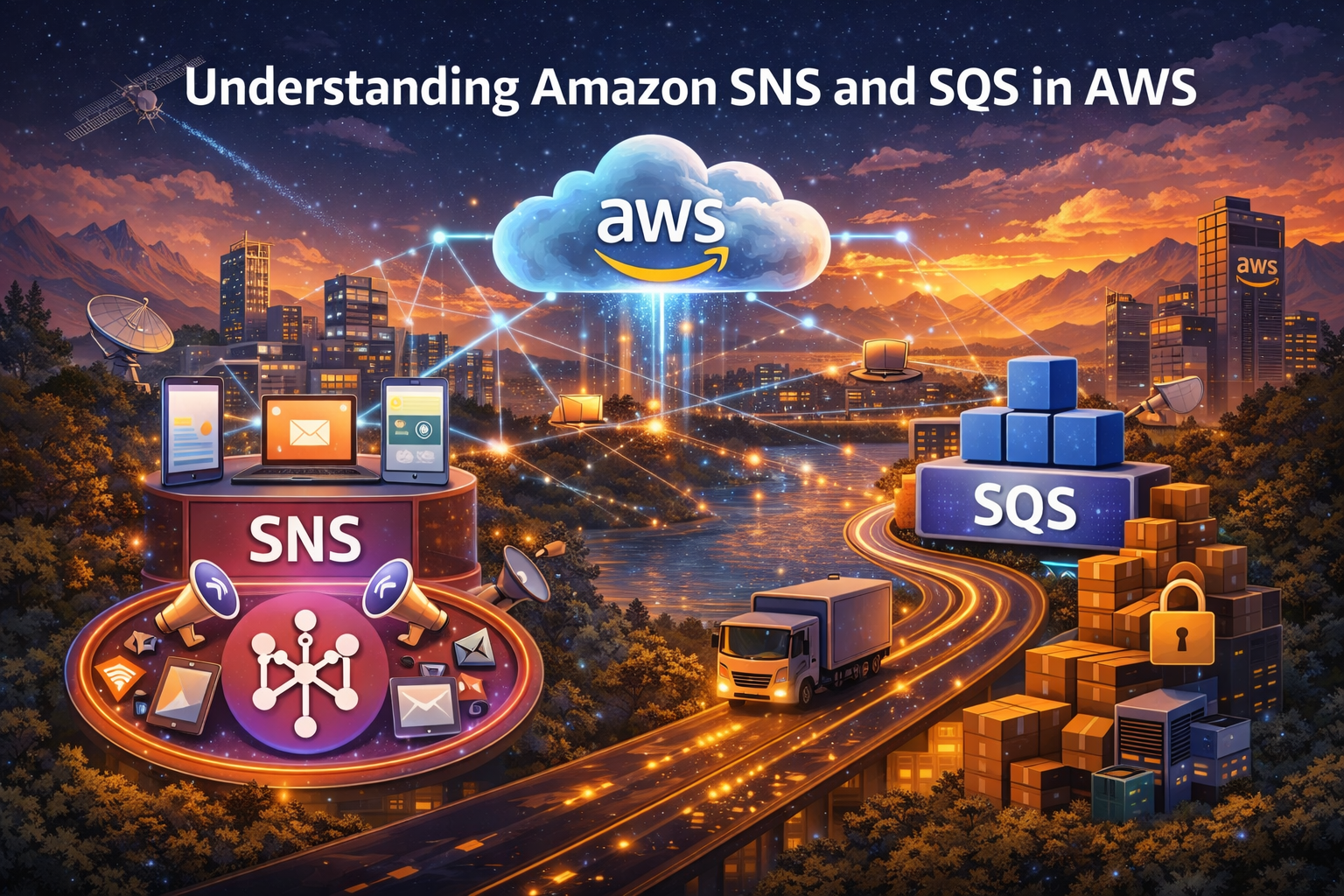
Amazon SNS and Amazon SQS are two core AWS messaging services that handle communication between different parts of your applications. If you’re a developer, cloud architect, or DevOps engineer working with distributed systems, these services can make or break your application’s reliability and scalability.
This guide walks you through everything you need to know about Amazon Simple Notification Service and Amazon Simple Queue Service. You’ll discover how SNS delivers messages instantly to multiple subscribers, while SQS manages reliable message queues that won’t lose your data. We’ll also cover the essential SNS vs SQS comparison to help you pick the right tool for each situation.
You’ll learn practical AWS messaging architecture patterns, see real examples of SNS SQS integration, and get actionable AWS messaging best practices you can use in production. By the end, you’ll know exactly when to use each service and how to combine them for bulletproof AWS queue management in your applications.
Master Amazon SNS Fundamentals for Seamless Messaging
Define Simple Notification Service and its core messaging capabilities
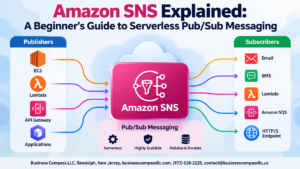
Amazon SNS operates as a fully managed messaging service that enables applications, services, and devices to send notifications instantly. This AWS messaging service follows a publish-subscribe model where publishers send messages to topics, and subscribers receive notifications through various delivery protocols including HTTP/HTTPS, email, SMS, and mobile push notifications.
Explore publisher-subscriber architecture benefits
The publisher-subscriber architecture decouples message producers from consumers, creating scalable and flexible messaging systems. Publishers don’t need to know about subscribers, allowing for dynamic scaling as your application grows. Multiple subscribers can receive the same message simultaneously, enabling broadcast scenarios while maintaining loose coupling between system components.
Identify key use cases for real-time notifications
Amazon SNS excels in real-time notification scenarios such as application alerts, system monitoring warnings, order confirmations, and breaking news updates. Mobile app developers leverage SNS for push notifications across iOS and Android platforms. DevOps teams use it for infrastructure monitoring alerts, while e-commerce platforms depend on SNS for order status updates and promotional campaigns.
Understand message filtering and delivery protocols
Message filtering allows subscribers to receive only relevant messages based on attributes like region, customer type, or priority level. SNS supports multiple delivery protocols including HTTP/HTTPS endpoints for webhooks, email for human notifications, SMS for mobile alerts, and direct integration with other AWS services like Lambda functions and SQS queues for automated processing workflows.
Unlock Amazon SQS Power for Reliable Queue Management
Grasp Simple Queue Service essentials and queue types
Amazon SQS serves as a fully managed message queuing service that decouples application components and scales automatically. Standard queues offer at-least-once delivery with high throughput, while FIFO queues guarantee exactly-once processing and maintain strict message ordering for applications requiring sequential processing.
Compare standard queues versus FIFO queues
Standard queues deliver maximum throughput with best-effort ordering, perfect for applications tolerating duplicate messages. FIFO queues provide exactly-once processing with guaranteed order but limited to 300 transactions per second. Choose standard queues for high-volume scenarios and FIFO queues when message sequence matters.
Leverage message retention and visibility timeout features
Message retention keeps messages in queues for up to 14 days, ensuring data persistence during system outages. Visibility timeout prevents other consumers from processing messages currently being handled, ranging from 0 seconds to 12 hours. These features enable reliable AWS queue management for distributed applications.
Implement dead letter queues for error handling
Dead letter queues capture messages that fail processing after specified retry attempts, preventing message loss and enabling debugging. Configure maximum receive counts to automatically route problematic messages to dead letter queues. This error handling mechanism maintains system stability while providing visibility into processing failures.
Compare SNS and SQS to Choose the Right Service
Analyze push versus pull messaging models
Amazon SNS operates on a push messaging model, instantly delivering messages to subscribers when events occur. Think of it like a news alert system – the moment something happens, all subscribers get notified immediately. Amazon SQS, however, uses a pull messaging model where applications actively retrieve messages from queues at their own pace. This difference shapes your entire messaging architecture.
Push messaging with SNS excels when you need real-time notifications across multiple systems. Email alerts, mobile push notifications, and webhook integrations benefit from this instant delivery approach. Pull messaging with SQS works better when you want to control message processing rates and ensure reliable handling even during traffic spikes.
The messaging models directly impact your application’s responsiveness and resource consumption. SNS requires subscribers to be available and responsive when messages arrive, while SQS allows consumers to process messages when ready, providing better fault tolerance and load management capabilities.
Evaluate scalability and performance characteristics
Both AWS messaging services scale automatically, but their performance patterns differ significantly. SNS can simultaneously deliver messages to millions of subscribers with minimal latency, making it ideal for broadcast scenarios. SQS handles massive message volumes while maintaining consistent performance, with standard queues supporting nearly unlimited throughput.
SNS vs SQS comparison reveals distinct performance trade-offs:
- SNS throughput: Up to 300,000 messages per second for standard topics
- SQS throughput: Nearly unlimited for standard queues, 3,000 messages per second for FIFO queues
- Latency: SNS provides sub-second delivery, SQS offers configurable polling intervals
- Message ordering: SQS FIFO guarantees order, SNS doesn’t guarantee delivery sequence
Regional availability and multi-AZ redundancy ensure high availability for both services. However, SQS provides better message durability with configurable retention periods up to 14 days, while SNS focuses on immediate delivery with limited retry mechanisms.
Assess cost implications for different workloads
AWS messaging architecture costs vary dramatically based on usage patterns and message volumes. SNS charges per message published and delivered, making it cost-effective for broadcast scenarios but expensive when sending identical messages to many subscribers. SQS pricing focuses on requests rather than message content size, offering predictable costs for queue-based workflows.
Cost comparison for typical workloads:
- High-frequency notifications: SNS becomes expensive with multiple subscribers per message
- Batch processing: SQS offers better value with request-based pricing
- Cross-region messaging: Both services charge for data transfer, but SNS multiplies costs per subscriber
- Long polling vs. short polling: SQS long polling reduces costs by minimizing empty requests
AWS queue management with SQS often proves more economical for decoupled architectures, especially when messages don’t require immediate processing. SNS works best cost-wise when subscriber counts remain low or when real-time delivery justifies the premium pricing model.
Integrate SNS and SQS for Robust Application Architecture
Design fan-out patterns with SNS to SQS integration
SNS to SQS integration creates powerful fan-out messaging patterns where a single message published to an SNS topic gets delivered to multiple SQS queues simultaneously. This AWS messaging architecture enables one producer to broadcast updates to multiple consumers without tight coupling. Each SQS queue can process messages independently, allowing different services to handle the same event at their own pace. Fan-out patterns work perfectly for scenarios like order processing, where inventory, billing, and shipping services all need notifications about new orders but operate with different processing speeds and requirements.
Implement decoupled microservices communication
Decoupling microservices through SNS SQS integration eliminates direct service-to-service dependencies and creates resilient communication channels. Services publish events to SNS topics without knowing which downstream services will consume them, while subscriber services pull messages from their dedicated SQS queues. This approach prevents cascading failures when individual services become unavailable and allows teams to deploy, scale, and modify services independently. The asynchronous nature of this messaging pattern improves overall system performance by removing blocking operations between services.
Build resilient message processing workflows
Resilient workflows combine SNS reliability with SQS durability features like dead letter queues, message retention, and retry mechanisms. Configure visibility timeouts to prevent message duplication during processing failures, and set up dead letter queues to capture messages that repeatedly fail processing. Use SQS delay queues for implementing backoff strategies and exponential retry patterns. Multi-AZ deployment of both services ensures high availability, while cross-region replication can provide disaster recovery capabilities for critical messaging workflows.
Handle message ordering and duplicate prevention
Message ordering requires careful consideration since SNS doesn’t guarantee delivery order to multiple SQS queues. Use SQS FIFO queues when strict ordering is essential, though this limits fan-out to a single queue per message group. Implement idempotency in message consumers using unique message IDs or business logic keys to handle potential duplicates. Consider adding timestamps or sequence numbers to message payloads for application-level ordering when using standard queues. Design consumers to be stateless and handle out-of-order processing gracefully.
Monitor and troubleshoot integrated messaging systems
CloudWatch metrics provide comprehensive visibility into SNS SQS integration performance, tracking message publication rates, queue depths, processing times, and error rates. Set up alarms for dead letter queue message accumulation and unusual processing delays. Use AWS X-Ray for distributed tracing across the entire message flow from SNS publication through SQS processing. Enable CloudTrail logging for audit trails and debugging integration issues. Monitor message age and implement alerting for messages stuck in queues longer than expected processing times.
Implement Best Practices for Production Deployments
Configure Security Policies and Access Controls
Set up IAM policies with least privilege principles for both Amazon SNS and SQS services. Create dedicated service roles for applications to access messaging resources without exposing root credentials. Enable server-side encryption using AWS KMS keys to protect message content at rest and in transit. Configure VPC endpoints to keep traffic within your private network when accessing AWS messaging services. Implement cross-account access controls carefully, ensuring only authorized services can publish to topics or consume from queues.
Optimize Message Throughput and Reduce Latency
Enable SQS long polling to reduce empty responses and lower costs while improving message retrieval efficiency. Use batch operations for both SNS and SQS to process multiple messages simultaneously, reducing API calls and improving throughput. Configure appropriate visibility timeout values based on your processing requirements to prevent message duplication. For high-volume applications, consider using SQS FIFO queues with message deduplication when strict ordering is required. Distribute load across multiple queues and implement parallel processing to handle peak traffic effectively.
Set Up Comprehensive Monitoring and Alerting
Create CloudWatch alarms for key metrics including message age, queue depth, and failed delivery attempts across your SNS and SQS infrastructure. Set up dead letter queues to capture failed messages and monitor them closely for processing issues. Use AWS X-Ray to trace message flows through your distributed architecture and identify bottlenecks. Configure SNS notifications for critical alerts to ensure your team responds quickly to production issues. Track message processing times and delivery success rates to maintain optimal AWS messaging best practices and system performance.
Amazon SNS and SQS are game-changers when it comes to building scalable applications on AWS. SNS excels at broadcasting messages to multiple subscribers instantly, while SQS ensures your messages get delivered reliably through its queue system. The real magic happens when you use them together – SNS can fan out messages to multiple SQS queues, giving you the best of both worlds for handling complex workflows and keeping your services loosely coupled.
Getting these services right from the start makes all the difference in your application’s performance and reliability. Set up proper monitoring, configure dead letter queues, and don’t forget about security settings like IAM policies and encryption. Start small with a simple setup, test everything thoroughly, and gradually add complexity as your needs grow. Your future self will thank you for taking the time to implement these AWS messaging services correctly.