Multi-Cloud Infrastructure Provisioning with AWS and GCP
Managing infrastructure across multiple cloud providers has become essential for businesses seeking better resilience, cost savings, and vendor flexibility. This guide walks DevOps engineers, cloud architects, and infrastructure teams through the practical steps of building a robust multi-cloud infrastructure that spans Amazon Web Services and Google Cloud Platform.
You’ll discover how to design effective multi-cloud networking solutions that connect your AWS and GCP resources seamlessly. We’ll explore proven infrastructure as code approaches using tools like Terraform to deploy and manage resources consistently across both platforms. Finally, you’ll learn cost optimization strategies and security best practices that keep your multi-cloud environment both efficient and secure.
Ready to build infrastructure that gives you the best of both cloud worlds? Let’s dive into the essential components that make multi-cloud deployment successful.
Understanding Multi-Cloud Strategy Benefits and Challenges
Cost Optimization Through Provider Competition
Multi-cloud strategies create competitive pricing dynamics between AWS and GCP, enabling organizations to negotiate better rates and leverage each provider’s cost advantages. By distributing workloads strategically, companies can take advantage of AWS’s mature pricing models for established services while capitalizing on GCP’s competitive rates for AI/ML workloads and data analytics. This approach allows teams to optimize costs by selecting the most cost-effective provider for specific use cases, avoiding the premium pricing that comes with single-vendor dependency.
Enhanced Reliability and Disaster Recovery
Running infrastructure across AWS and GCP provides unparalleled resilience through geographic and technological diversification. When one cloud provider experiences outages, your applications continue running on the other platform, ensuring business continuity. This multi-cloud infrastructure approach creates natural disaster recovery scenarios where data and services can failover seamlessly between providers. Organizations achieve higher uptime guarantees by distributing critical workloads across multiple availability zones and regions spanning different cloud platforms.
Avoiding Vendor Lock-in Risks
Multi-cloud deployment prevents organizations from becoming trapped in a single provider’s ecosystem, maintaining flexibility in technology choices and contract negotiations. By designing cloud provisioning tools and infrastructure as code templates that work across AWS and GCP, teams can migrate workloads between providers when business needs change. This independence allows companies to adopt new services from either provider without architectural constraints, ensuring they can always choose the best technology for their requirements rather than being limited by existing vendor relationships.
Compliance and Data Sovereignty Requirements
Different cloud providers excel in various regulatory environments, making multi-cloud strategy essential for global organizations facing complex compliance requirements. AWS offers extensive compliance certifications for financial services, while GCP provides strong data sovereignty controls for European markets through specific regional offerings. By leveraging both platforms, organizations can ensure sensitive data remains in required jurisdictions while meeting industry-specific compliance standards. This approach enables companies to serve global customers while respecting local data protection laws and regulatory frameworks across different regions.
Essential Prerequisites for Multi-Cloud Infrastructure Setup
Account Creation and Initial Configuration for AWS and GCP
Start by creating accounts on both AWS and GCP platforms through their respective management consoles. For AWS, sign up at aws.amazon.com and complete the billing information setup, while GCP requires registration through console.cloud.google.com with Google account credentials. Enable billing accounts on both platforms and activate necessary APIs – particularly Compute Engine API for GCP and EC2 service for AWS. Set up organizational units and projects to maintain clean resource segregation. Configure initial IAM roles with appropriate permissions for multi-cloud infrastructure deployment. Create dedicated service accounts for automation tools and establish basic networking configurations including default VPCs and security groups.
Installing and Configuring Command Line Tools
Install AWS CLI v2 and Google Cloud SDK on your local development environment or CI/CD systems. Download AWS CLI from the official AWS documentation and verify installation using aws --version command. For GCP, install gcloud SDK package and run gcloud init to complete initial setup. Configure both CLIs with appropriate regions – choose geographically distributed regions for optimal multi-cloud strategy implementation. Install additional tools like Terraform for infrastructure as code management, kubectl for Kubernetes orchestration, and cloud-specific SDKs for programming language integration. Verify all installations work correctly by running basic list commands against both cloud providers.
Setting Up Authentication and Access Management
Configure programmatic access using service account keys for GCP and access keys for AWS. Create dedicated service accounts with minimal required permissions following principle of least privilege. For AWS, generate access key pairs through IAM console and configure them using aws configure command. In GCP, create service account JSON keys and authenticate using gcloud auth activate-service-account command. Set up cross-account roles and federated identity where needed for secure multi-cloud networking. Store credentials securely using environment variables or credential management services. Test authentication by running simple API calls against both platforms to ensure proper access control and permissions are working correctly.
Infrastructure as Code Tools for Multi-Cloud Deployment
Terraform for Cross-Cloud Resource Management
Terraform stands as the gold standard for multi-cloud infrastructure deployment, offering a unified language to provision resources across AWS and GCP simultaneously. Its provider-agnostic approach lets you define infrastructure using HCL (HashiCorp Configuration Language) while maintaining state consistency across multiple cloud platforms. The tool excels at managing dependencies between resources, automatically determining the correct order for creation and destruction. When building multi-cloud strategy implementations, Terraform’s modular design allows you to create reusable components that work seamlessly across different providers.
Key advantages include:
- Single configuration syntax for all cloud providers
- Built-in state management and drift detection
- Extensive provider ecosystem with regular updates
- Plan and apply workflow for change validation
- Remote state storage for team collaboration
Cloud-Specific Tools: AWS CloudFormation vs Google Cloud Deployment Manager
AWS CloudFormation and Google Cloud Deployment Manager serve as native infrastructure as code solutions within their respective ecosystems. CloudFormation uses JSON or YAML templates to define AWS resources, offering deep integration with AWS services and automatic rollback capabilities on failure. The service provides comprehensive coverage of AWS features, often supporting new services before third-party tools catch up.
Google Cloud Deployment Manager takes a similar approach with YAML, Python, or Jinja2 templates. While less mature than CloudFormation, it integrates tightly with GCP services and supports custom resource types through APIs. Both tools excel in their native environments but create vendor lock-in, making them less suitable for true multi-cloud infrastructure scenarios.
CloudFormation strengths:
- Mature ecosystem with extensive documentation
- Advanced features like StackSets for multi-account deployment
- Native AWS service integration
- Comprehensive resource coverage
Deployment Manager advantages:
- Python template flexibility
- Schema validation for resource definitions
- Integration with GCP’s resource hierarchy
- Preview mode for change visualization
Ansible for Configuration Management Across Platforms
Ansible bridges the gap between infrastructure provisioning and configuration management in multi-cloud strategy environments. While primarily known for server configuration, Ansible’s cloud modules enable resource provisioning across AWS and GCP using familiar playbook syntax. Its agentless architecture simplifies deployment across hybrid environments without requiring software installation on target systems.
The tool shines when orchestrating complex workflows that span infrastructure provisioning and application deployment. Ansible playbooks can provision cloud resources, configure operating systems, deploy applications, and manage ongoing configuration drift. The declarative YAML syntax makes playbooks readable and maintainable, while the extensive module library covers most cloud services and configuration scenarios.
Ansible’s multi-cloud infrastructure capabilities include:
- Unified playbook syntax across cloud providers
- Dynamic inventory integration with cloud APIs
- Role-based organization for reusable configurations
- Vault integration for secrets management
- Rolling deployment strategies for zero-downtime updates
Comparing Tool Capabilities and Use Cases
Each cloud provisioning tools category serves distinct purposes in multi-cloud architectures. Terraform dominates infrastructure provisioning with its comprehensive provider ecosystem and state management capabilities. Native tools like CloudFormation and Deployment Manager excel within their specific cloud environments but limit portability. Ansible provides the most flexibility for configuration management and application deployment across diverse environments.
The optimal approach often involves combining tools based on specific requirements. Large enterprises frequently use Terraform for infrastructure provisioning, native tools for cloud-specific advanced features, and Ansible for configuration management. This hybrid approach maximizes each tool’s strengths while maintaining flexibility across cloud platforms.
Selection criteria should include:
- Team expertise and learning curve considerations
- Required cloud provider coverage
- Integration needs with existing toolchains
- Compliance and governance requirements
- Long-term strategic cloud direction
Terraform multi-cloud deployments typically handle foundational infrastructure, while Ansible manages the application layer and ongoing configuration needs. This separation of concerns creates maintainable, scalable multi-cloud solutions that leverage the best capabilities of each tool category.
Network Architecture Design for Multi-Cloud Environments
Virtual Private Cloud Setup in AWS and GCP
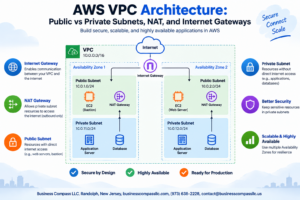
Creating isolated network environments starts with establishing VPCs in both AWS and GCP. AWS VPC provides complete control over IP addressing, subnets, route tables, and gateways, while GCP’s Virtual Private Cloud offers global networking with automatic subnet creation across regions. Configure CIDR blocks carefully to avoid overlapping IP ranges – AWS typically uses /16 networks while GCP supports /8 to /29 ranges. Set up public and private subnets strategically, placing web tiers in public subnets with internet gateways and database layers in private subnets with NAT gateways for outbound access. Both platforms support custom route tables, security groups, and network ACLs for granular traffic control. Enable VPC Flow Logs in both environments to monitor network traffic patterns and troubleshoot connectivity issues effectively.
Establishing Secure Inter-Cloud Connectivity
Multi-cloud networking requires robust connectivity solutions between AWS and GCP environments. VPN connections offer encrypted tunnels over the internet – configure AWS VPN Gateway with GCP Cloud VPN for basic connectivity. For higher bandwidth and lower latency, implement dedicated connections using AWS Direct Connect paired with GCP Cloud Interconnect through colocation facilities. VPC peering within each provider handles internal communication, while cross-cloud traffic flows through encrypted tunnels or dedicated links. Design redundant paths across multiple availability zones and regions to prevent single points of failure. Implement proper routing policies using BGP for dynamic path selection and automatic failover. Monitor connection health with CloudWatch and Google Cloud Monitoring to track latency, packet loss, and throughput metrics across your multi-cloud infrastructure.
Load Balancing Across Multiple Cloud Providers
Traffic distribution across AWS and GCP requires sophisticated load balancing strategies combining DNS-based routing with application-level balancing. Start with Route 53 weighted routing policies or Google Cloud DNS to direct traffic based on geography, health checks, or performance metrics. Implement AWS Application Load Balancer and GCP Global Load Balancer within each environment for regional traffic distribution. For true multi-cloud load balancing, deploy third-party solutions like F5, HAProxy, or cloud-native service meshes that can route traffic intelligently across providers. Health checks become critical – configure automated failover when services in one cloud become unavailable. Consider latency-based routing to direct users to the closest healthy endpoint regardless of cloud provider. Session affinity and SSL termination add complexity but improve user experience across your distributed multi-cloud architecture.
Compute Resource Provisioning Strategies
EC2 vs Compute Engine Instance Selection Criteria
When choosing between AWS EC2 and Google Compute Engine instances for your multi-cloud infrastructure, the decision comes down to specific workload requirements and performance characteristics. EC2 offers broader instance family diversity with specialized options like GPU-optimized P4 instances and ARM-based Graviton processors, making it ideal for machine learning and high-performance computing workloads. Compute Engine excels in sustained use discounts and provides better price-performance ratios for long-running applications, particularly with custom machine types that let you fine-tune CPU and memory combinations. Consider network proximity to your users, integration with existing cloud services, and specific compliance requirements when making your selection across both platforms.
Auto-Scaling Configuration Across Platforms
Setting up auto-scaling in a multi-cloud strategy requires coordinating between AWS Auto Scaling Groups and Google Cloud’s Managed Instance Groups while maintaining consistent performance thresholds. AWS offers more granular scaling policies with target tracking and step scaling options, while GCP provides predictive autoscaling that anticipates traffic spikes. Configure cross-platform monitoring using tools like Terraform multi-cloud modules to ensure scaling decisions consider resource availability across both environments. Implement consistent tagging strategies and use unified monitoring dashboards to track scaling events and optimize trigger thresholds. Remember to account for different pricing models when setting scaling policies, as AWS charges per instance-hour while GCP offers per-minute billing.
Container Orchestration with Kubernetes
Kubernetes provides the perfect abstraction layer for managing containerized applications across AWS EKS and Google GKE clusters in your multi-cloud deployment. Both managed services handle control plane operations, but differ in networking implementations and add-on ecosystems. EKS integrates deeply with AWS services like ALB for ingress and IAM for authentication, while GKE offers superior cluster autoscaling and built-in service mesh capabilities. Deploy workloads using consistent YAML manifests across clusters, leveraging tools like Helm charts for application packaging. Configure cluster federation or use GitOps approaches with tools like ArgoCD to maintain application state synchronization between your AWS and GCP Kubernetes environments.
Serverless Computing Integration
Serverless functions bridge the gap between your AWS Lambda and Google Cloud Functions within a unified multi-cloud architecture. Both platforms support similar triggers and event-driven patterns, but Lambda provides more runtime options and tighter integration with AWS services, while Cloud Functions offers faster cold starts and simpler deployment workflows. Design your serverless applications using cloud-agnostic frameworks like Serverless Framework or AWS SAM templates that can deploy across both platforms. Implement consistent logging and monitoring using tools that aggregate data from both CloudWatch and Cloud Logging. Consider using API Gateway on both platforms to create unified endpoints that can route requests based on region, cost, or availability requirements.
Storage Solutions and Data Management
Object Storage: S3 vs Cloud Storage Implementation
Amazon S3 and Google Cloud Storage serve as the backbone for multi-cloud infrastructure data storage. S3 offers mature features like lifecycle policies, cross-region replication, and intelligent tiering for automatic cost optimization. Google Cloud Storage provides strong consistency, regional and multi-regional buckets, and seamless integration with BigQuery for analytics workloads.
When implementing both services, consider bucket naming conventions that work across providers, standardize IAM policies for consistent access control, and leverage terraform multi-cloud configurations to manage resources uniformly. S3’s extensive ecosystem of third-party tools contrasts with Cloud Storage’s tighter integration with Google’s AI and analytics services.
Key differences include pricing models – S3 charges for requests while Cloud Storage offers more predictable egress pricing. For multi-cloud strategy success, implement cross-cloud data migration pipelines and establish clear data residency policies to meet compliance requirements across both AWS and GCP environments.
Database Services: RDS and Cloud SQL Configuration
RDS and Cloud SQL provide managed database solutions that reduce operational overhead in multi-cloud deployments. RDS supports multiple engines including MySQL, PostgreSQL, Oracle, and SQL Server with automated backups, patch management, and multi-AZ deployments for high availability. Cloud SQL focuses on MySQL, PostgreSQL, and SQL Server with automatic failover and point-in-time recovery.
Cross-cloud database strategies require careful planning of connection pooling, security groups, and VPC peering between AWS and GCP networks. Both services support read replicas for scaling read workloads, but replication across cloud providers needs custom solutions or third-party tools.
Configuration best practices include enabling automated backups with different retention periods, setting up monitoring alerts for performance metrics, and implementing encryption at rest and in transit. For multi-cloud infrastructure, maintain consistent database parameter groups and security configurations to simplify management and ensure uniform performance across environments.
Data Synchronization and Backup Strategies
Effective data synchronization across AWS and GCP requires robust strategies that handle network latencies, data consistency, and disaster recovery scenarios. Cloud provisioning tools like Terraform can automate backup job creation and cross-cloud data transfer pipelines, ensuring consistent configuration across both platforms.
Real-time synchronization options include database replication, CDC (Change Data Capture) tools, and message queue systems like AWS SQS paired with Google Pub/Sub. For batch synchronization, schedule regular data transfers using AWS DataSync, Google Transfer Service, or custom ETL pipelines that validate data integrity across clouds.
Backup strategies should implement the 3-2-1 rule: three copies of data, stored on two different media types, with one copy offsite. Multi-cloud architecture naturally supports this by storing primary data in one cloud and backups in another. Automated testing of backup restoration processes prevents surprises during actual disaster recovery scenarios, while cross-cloud monitoring ensures synchronization jobs complete successfully and data remains accessible across both AWS GCP deployment environments.
Security and Compliance Implementation
Identity and Access Management Across Clouds
Multi-cloud security starts with centralized identity management that works seamlessly across AWS and GCP. Implement federated authentication using AWS IAM Identity Center or Google Cloud Identity to create a single source of truth for user access. Configure cross-cloud service accounts with minimal necessary permissions, following the principle of least privilege. Set up role-based access control (RBAC) that maps consistently between AWS IAM roles and GCP service accounts. Use tools like HashiCorp Vault or cloud-native secret managers to handle credential rotation automatically. Deploy multi-factor authentication across all cloud environments and integrate with your existing directory services like Active Directory or LDAP for seamless user experience.
Encryption and Key Management Services
Data protection in multi-cloud infrastructure requires a unified encryption strategy that spans both AWS and GCP environments. Implement encryption at rest using AWS KMS and Google Cloud KMS, with centralized key management through tools like HashiCorp Vault Enterprise or cloud-agnostic solutions. Configure envelope encryption for sensitive data and establish key rotation policies that work across both platforms. Set up cross-cloud key sharing for disaster recovery scenarios while maintaining compliance with data sovereignty requirements. Enable encryption in transit using TLS 1.3 for all inter-cloud communications and internal service mesh traffic. Create backup encryption keys in both clouds to prevent vendor lock-in and ensure business continuity during outages.
Network Security and Firewall Rules
Network security in multi-cloud environments demands consistent firewall policies and traffic inspection across AWS and GCP. Configure Virtual Private Clouds (VPCs) with proper subnet segmentation and implement network access control lists (NACLs) alongside security groups for defense in depth. Deploy Web Application Firewalls (WAF) like AWS WAF and Google Cloud Armor to protect against common attack vectors. Set up VPC peering and VPN connections with proper encryption for secure inter-cloud communication. Implement zero-trust network architecture using service mesh technologies like Istio or consul Connect. Use network monitoring tools to detect anomalous traffic patterns and potential security breaches across both cloud environments.
Monitoring and Audit Trail Setup
Comprehensive monitoring and auditing across multi-cloud infrastructure ensures compliance and rapid incident response. Configure CloudTrail on AWS and Cloud Audit Logs on GCP to capture all API calls and administrative actions. Set up centralized log aggregation using tools like Elasticsearch, Splunk, or cloud-native solutions like AWS CloudWatch and Google Cloud Logging. Implement security information and event management (SIEM) systems that correlate events across both cloud platforms. Create automated alerting for suspicious activities, compliance violations, and security policy breaches. Deploy infrastructure monitoring with Prometheus, Grafana, or cloud-native monitoring services to track resource usage and performance metrics. Establish regular compliance reporting and automated remediation workflows to maintain security posture across your multi-cloud infrastructure.
Cost Management and Resource Optimization
Setting Up Budget Alerts and Cost Monitoring
Tracking expenses across AWS and GCP requires dedicated monitoring dashboards and automated alerts. Set up AWS Cost Explorer and Google Cloud Billing to establish spending thresholds that trigger notifications when costs exceed predetermined limits. Configure custom alerts for specific services like EC2 instances or Compute Engine VMs to catch unexpected spikes early. Use tools like CloudWatch and Cloud Monitoring to create detailed cost breakdowns by project, team, or environment, enabling precise accountability across your multi-cloud infrastructure.
Right-Sizing Resources for Maximum Efficiency
Regular resource auditing prevents over-provisioning waste in your multi-cloud strategy. Analyze CPU utilization metrics from both AWS CloudWatch and GCP Monitoring to identify underused instances that can be downsized. Implement automated scaling policies that adjust compute capacity based on actual demand patterns rather than peak estimates. Consider using AWS Compute Optimizer and Google Cloud Recommender to receive AI-driven suggestions for optimal instance types and configurations that balance performance with cost optimization.
Reserved Instances and Committed Use Discounts
Long-term commitments offer significant savings when managing predictable workloads across cloud providers. Purchase AWS Reserved Instances for stable compute needs, achieving up to 75% cost reduction compared to on-demand pricing. Similarly, Google Cloud’s Committed Use Discounts provide substantial savings for consistent resource consumption. Mix reservation types strategically – use Convertible Reserved Instances for flexibility while leveraging Standard reservations for maximum discount on unchanging workloads in your cloud provisioning tools setup.
Managing infrastructure across AWS and GCP opens up incredible opportunities for businesses to build resilient, scalable systems. The key is having the right foundation – solid Infrastructure as Code practices, well-planned network architecture, and smart resource provisioning strategies. When you combine these with proper security measures and cost optimization techniques, you create a powerful multi-cloud setup that can handle whatever your business throws at it.
The real magic happens when you stop thinking about clouds as separate entities and start treating them as one unified platform. Focus on automation, keep security at the center of everything you do, and always keep an eye on your spending. Start small with one workload, learn from the experience, and gradually expand your multi-cloud footprint. Your future self will thank you for building something that’s both robust and flexible enough to grow with your business needs.