When building secure AWS cloud infrastructure, choosing between a NAT Gateway vs Internet Gateway can make or break your network security strategy. These two critical components handle traffic differently, and picking the wrong one could expose your resources or inflate your costs.
This guide is designed for cloud architects, DevOps engineers, and AWS practitioners who need to understand how these VPC connectivity options work and when to use each one. You’ll learn the security trade-offs, cost differences, and performance impacts that shape your cloud network architecture decisions.
We’ll break down the core functions of AWS Internet Gateway and explore how it enables direct public internet access. Then we’ll dive into NAT Gateway security advantages and examine why it’s the go-to choice for protecting private resources that need outbound connectivity. Finally, you’ll discover practical deployment strategies and cost optimization techniques to help you implement the right secure traffic flow solution for your specific use case.
Define Internet Gateway and Its Core Functions
Enable direct bidirectional communication between VPC and internet
An AWS Internet Gateway serves as your VPC’s primary connection point to the internet, creating a bridge that allows resources in public subnets to communicate directly with external networks. Unlike NAT Gateway security restrictions, the Internet Gateway enables full two-way traffic flow, meaning external users can initiate connections to your EC2 instances when properly configured with security groups and network ACLs.
Provide public IP address mapping for EC2 instances
The Internet Gateway automatically handles network address translation between private IP addresses assigned to your EC2 instances and their corresponding public IP addresses. This seamless mapping process ensures that when an instance in a public subnet needs internet access, the gateway translates the private IP to a public IP for outbound traffic and reverses this process for incoming responses.
Support high availability with automatic scaling capabilities
Built into AWS’s infrastructure, Internet Gateways operate as highly available, redundant components that automatically scale to meet your traffic demands without any manual intervention. This managed service eliminates single points of failure and provides consistent performance across multiple Availability Zones, making it a reliable foundation for your VPC connectivity options and cloud network architecture.
Create cost-effective internet access for public subnets
Internet Gateways offer the most economical solution for direct internet connectivity since AWS doesn’t charge additional fees for data processing through the gateway itself. You only pay for standard data transfer costs, making this approach significantly more budget-friendly than NAT Gateway benefits when your architecture requires direct internet access for public-facing resources like web servers or application load balancers.
Understand NAT Gateway Architecture and Benefits
Enable secure outbound internet access for private subnets
NAT Gateway acts as a critical bridge between your private AWS resources and the internet, allowing instances in private subnets to initiate outbound connections while blocking inbound traffic. This one-way communication model ensures your database servers, application backends, and other sensitive workloads can download updates, patches, and communicate with external APIs without exposing them directly to internet threats. The managed service handles all the complex networking automatically, making it simple to maintain secure VPC connectivity options.
Prevent unsolicited inbound connections from external sources
The NAT Gateway security model creates an asymmetric barrier that protects your private infrastructure from external attacks. When your private instances make outbound requests, NAT Gateway translates the private IP addresses to its own public IP, maintaining connection state to route responses back correctly. However, external sources cannot initiate new connections through the gateway, effectively creating a firewall that blocks unsolicited traffic while preserving legitimate communication flows.
Maintain high availability within single availability zones
AWS designs NAT Gateway with built-in redundancy within each availability zone, using multiple underlying instances to prevent single points of failure. The service automatically handles failover scenarios without requiring manual intervention or complex configuration. For multi-AZ deployments, you’ll deploy separate NAT Gateways in each zone to ensure your private subnets maintain internet access even during AZ-level outages, creating a robust cloud network architecture that supports business continuity.
Deliver managed service advantages over self-hosted NAT instances
NAT Gateway benefits include automated patching, scaling, and maintenance that eliminates the operational overhead of managing EC2-based NAT instances. AWS handles all the underlying infrastructure, security updates, and performance optimization, while you pay only for the data you process. This managed approach reduces administrative burden, improves reliability, and often provides better cost efficiency compared to maintaining your own NAT instances, especially for high-traffic workloads requiring consistent performance.
Compare Security Models and Traffic Control Mechanisms
Analyze inbound traffic restrictions and access patterns
Internet Gateways expose your AWS infrastructure to direct internet access, creating potential security vulnerabilities through unrestricted inbound connections. NAT Gateway security architecture blocks all unsolicited inbound traffic by default, only allowing responses to outbound requests initiated from private subnets. This fundamental difference makes NAT Gateways ideal for protecting sensitive workloads while Internet Gateways require careful security group configuration and network ACL management to prevent unauthorized access attempts.
Evaluate outbound traffic filtering and monitoring capabilities
NAT Gateway benefits include centralized traffic monitoring and logging capabilities that simplify network security oversight across your VPC connectivity options. Unlike Internet Gateway configuration which distributes traffic across multiple instances, NAT Gateways funnel all outbound traffic through a single point, enabling comprehensive traffic analysis and bandwidth monitoring. This centralized approach allows security teams to implement consistent filtering policies, track data transfer patterns, and identify unusual network behavior more effectively than distributed gateway architectures.
Assess network isolation benefits for sensitive workloads
Cloud network architecture utilizing NAT Gateways provides superior network isolation by maintaining complete separation between public and private subnet resources. Private instances behind NAT Gateways cannot receive direct internet connections, eliminating attack vectors common with publicly accessible resources. This VPC gateway comparison reveals that NAT implementations create an additional security layer, making them essential for compliance-driven environments where sensitive data processing requires strict network boundaries and controlled internet access patterns without exposing internal infrastructure.
Examine Cost Structures and Performance Characteristics
Calculate Internet Gateway pricing and data transfer costs
Internet Gateway offers cost-effective connectivity with no hourly charges – you only pay for data transfer out of AWS at standard rates ranging from $0.09 per GB for the first 10TB monthly. This pricing model makes Internet Gateway ideal for public-facing applications with predictable traffic patterns and direct internet access requirements.
Understand NAT Gateway hourly charges and bandwidth fees
NAT Gateway pricing includes both hourly charges ($0.045 per hour) and data processing fees ($0.045 per GB processed). Monthly costs can reach $32.85 for the gateway alone, plus processing fees for all traffic. This dual pricing structure significantly impacts budgets for high-traffic private subnet applications requiring secure outbound internet access.
Compare throughput limitations and scaling behaviors
Internet Gateway provides virtually unlimited bandwidth scaling automatically with your EC2 instance capabilities, supporting up to 100 Gbps for enhanced networking instances. NAT Gateway caps at 45 Gbps bandwidth but offers automatic scaling within this limit. Performance differences become critical for bandwidth-intensive applications where NAT Gateway limitations may require multiple gateways across availability zones.
Optimize costs through strategic gateway selection
Choose Internet Gateway for public subnets requiring bidirectional internet access and cost optimization. Select NAT Gateway for private subnets needing secure outbound connectivity with managed scaling. Hybrid architectures work best – using Internet Gateway for web servers and NAT Gateway for database servers creates optimal cost-performance balance while maintaining proper VPC security boundaries and traffic flow control.
Implement Best Practices for Gateway Selection and Deployment
Choose appropriate gateways based on subnet requirements
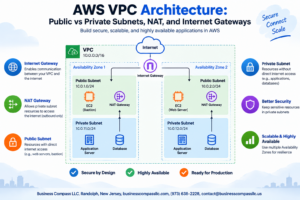
Public subnets hosting web servers, load balancers, and bastion hosts require Internet Gateway connectivity for direct bidirectional communication. Private subnets containing databases, application servers, and backend services need NAT Gateway access for outbound internet traffic while maintaining security isolation. Mixed environments benefit from strategic gateway placement based on specific workload requirements and AWS network architecture patterns.
Design hybrid architectures combining both gateway types
Smart VPC connectivity options combine Internet Gateway and NAT Gateway deployment across multiple availability zones for optimal performance and redundancy. Public-facing resources connect through Internet Gateway while backend systems route through NAT Gateway for secure traffic flow. This dual-gateway approach enables cost-effective scaling while maintaining strict security boundaries between application tiers and external networks.
Configure security groups and NACLs for enhanced protection
Layer security controls using both security groups and Network ACLs to create defense-in-depth protection for gateway traffic. Security groups act as virtual firewalls controlling instance-level access, while NACLs provide subnet-level filtering for additional protection. Implement least privilege access principles, restrict unnecessary ports, and regularly audit rules to maintain optimal cloud network architecture security posture across all gateway configurations.
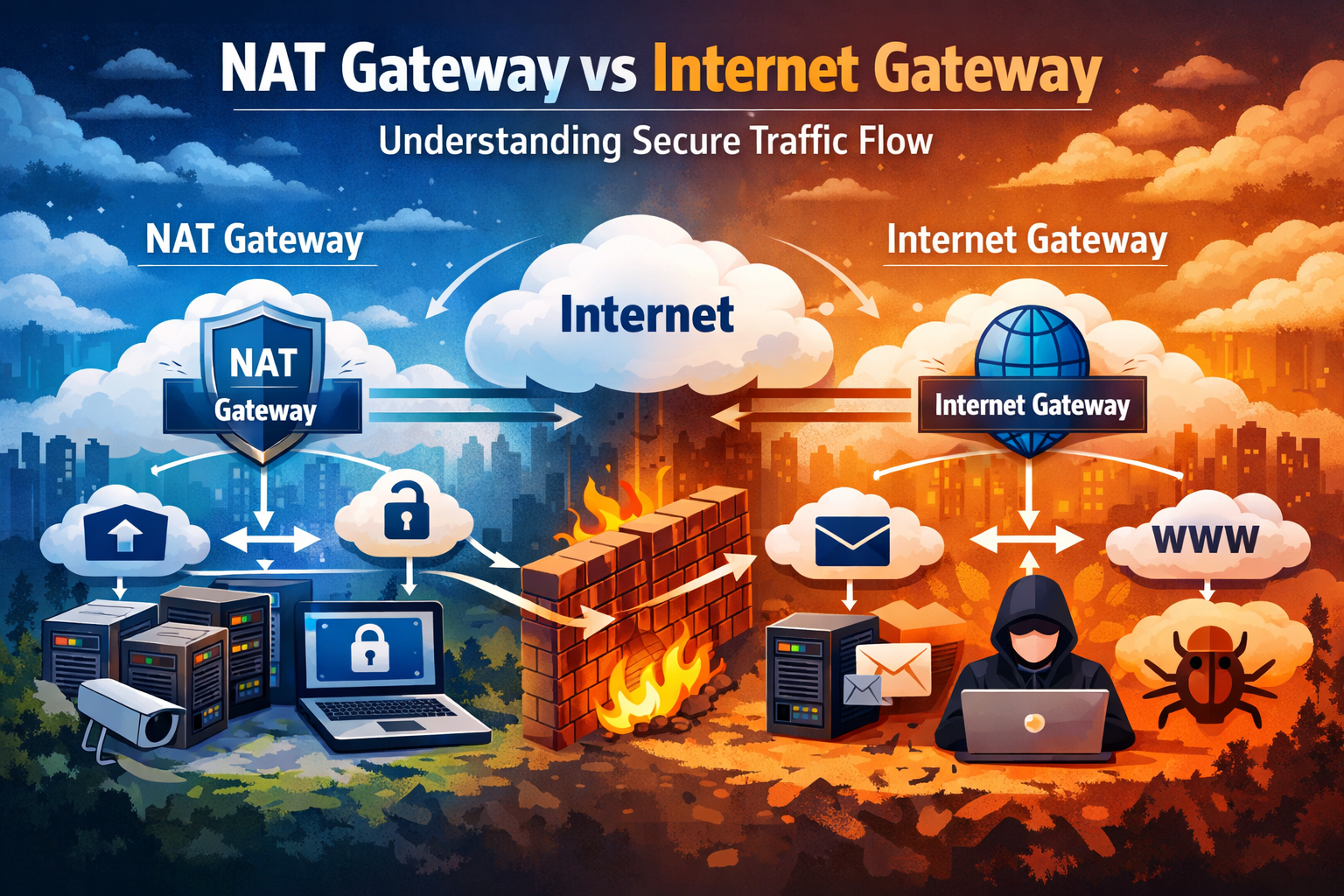
Both NAT Gateways and Internet Gateways serve critical roles in managing your cloud traffic, but they work in completely different ways. Internet Gateways give you direct, bidirectional connectivity that’s perfect for public-facing resources, while NAT Gateways act as protective middlemen that keep your private resources hidden while still allowing outbound access. The security differences are huge – NAT Gateways provide an extra layer of protection by masking internal IP addresses, while Internet Gateways expose resources directly to the internet.
When choosing between these options, think about your specific needs and budget. NAT Gateways cost more but offer better security for private resources that need internet access. Internet Gateways are free but require careful security planning since they expose your resources directly. The best approach often involves using both – Internet Gateways for your public subnets and NAT Gateways for private ones. Take time to map out your network architecture and security requirements before making the call, because getting this right from the start will save you headaches and money down the road.