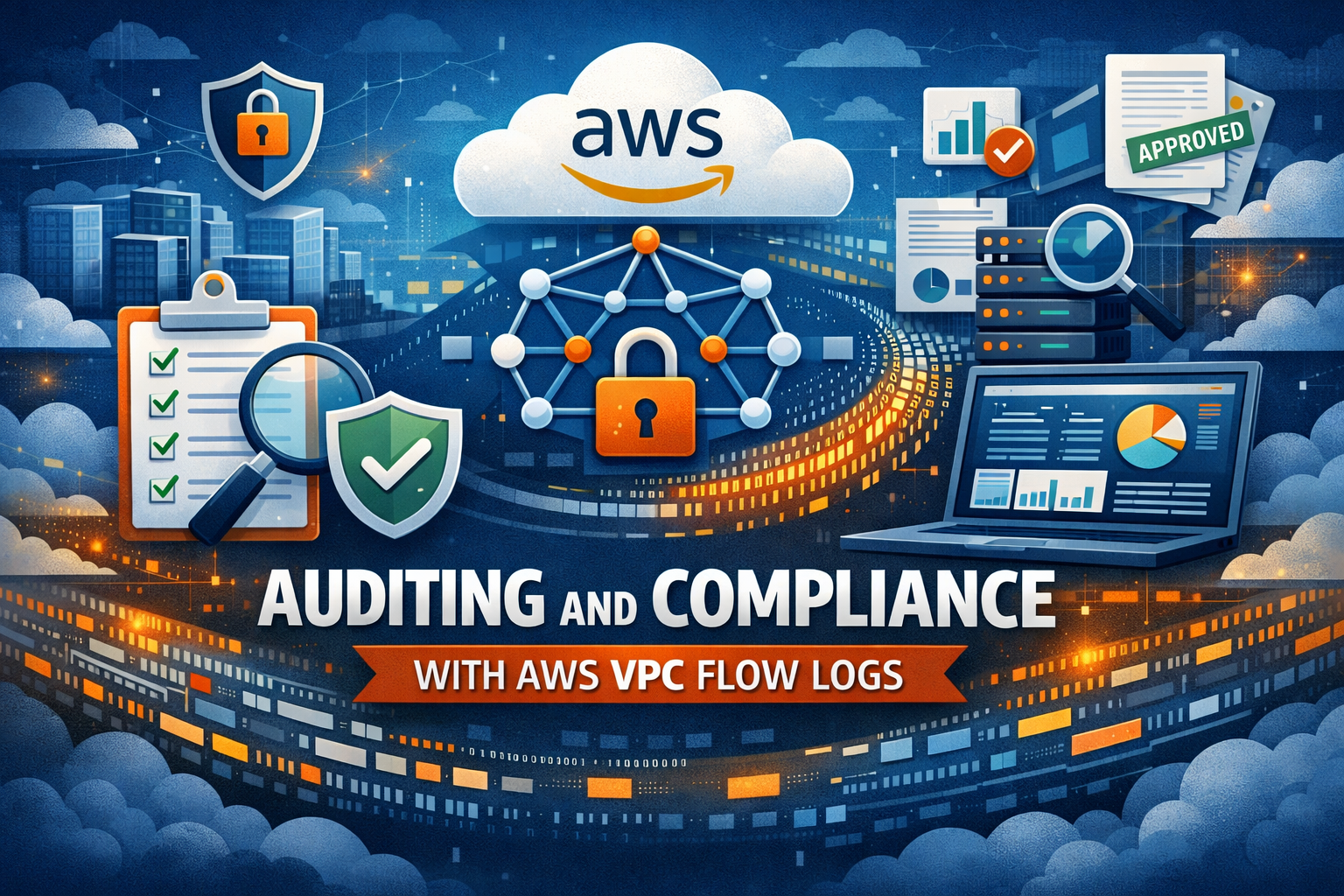
AWS VPC Flow Logs serve as your network’s security camera, capturing detailed traffic data that’s essential for auditing and compliance in cloud environments. This comprehensive guide targets cloud security engineers, DevOps teams, and compliance professionals who need to implement robust AWS network security monitoring and meet regulatory requirements.
VPC Flow Logs auditing goes beyond basic network monitoring—it provides the foundation for detecting security threats, proving compliance, and optimizing your cloud infrastructure. Whether you’re dealing with SOC 2 audits, PCI DSS requirements, or internal security policies, proper VPC Flow Logs setup and analysis can make or break your compliance strategy.
We’ll walk through the practical steps of VPC Flow Logs setup for comprehensive network auditing, showing you how to capture the right data without breaking your budget. You’ll learn advanced analysis techniques for security threat detection that help you spot suspicious patterns and potential breaches before they cause damage. Finally, we’ll cover VPC Flow Logs cost optimization strategies that keep your AWS compliance monitoring effective while controlling expenses.
By the end of this guide, you’ll have a solid framework for using network traffic analysis AWS tools to strengthen your security posture and streamline your cloud network security operations.
Understanding AWS VPC Flow Logs for Enhanced Security Monitoring
Core Components and Data Structure of VPC Flow Logs
AWS VPC Flow Logs capture network traffic metadata across your virtual private cloud infrastructure, providing detailed records of IP addresses, ports, protocols, and packet counts. Each flow log record contains essential fields including source and destination IPs, port numbers, protocol types, packet and byte counts, plus timestamps that enable comprehensive AWS network security monitoring. The structured format allows administrators to track connection attempts, bandwidth usage, and traffic patterns with granular precision. VPC Flow Logs auditing becomes streamlined through this standardized data structure, making it easier to identify suspicious activities and maintain security baselines across cloud environments.
Network Traffic Visibility and Monitoring Capabilities
VPC Flow Logs deliver complete visibility into network communications flowing through your AWS infrastructure, capturing both accepted and rejected traffic at network interface, subnet, or VPC levels. This comprehensive network traffic analysis AWS capability enables real-time monitoring of data flows between resources, external connections, and cross-region communications. Security teams gain insights into traffic patterns, connection frequencies, and data transfer volumes that help identify anomalies and potential threats. The logs reveal detailed communication pathways, allowing organizations to map network dependencies, validate security group configurations, and detect unauthorized access attempts across their cloud network security perimeter.
Integration with AWS Security Services and Tools
VPC Flow Logs seamlessly integrate with CloudWatch, CloudTrail, and AWS Security Hub to create a unified AWS security auditing ecosystem. Amazon Kinesis processes flow log streams in real-time, while Lambda functions can trigger automated responses to specific traffic patterns or security events. Integration with third-party SIEM solutions enhances threat detection capabilities through correlation with other security data sources. GuardDuty leverages flow log data to identify malicious IP addresses and suspicious network behaviors, while AWS Config ensures compliance with network security policies. This interconnected approach strengthens overall security posture through comprehensive monitoring and automated incident response workflows.
Setting Up VPC Flow Logs for Comprehensive Network Auditing
Configuring flow logs at VPC, subnet, and network interface levels
AWS VPC Flow Logs setup requires choosing the right scope for your network security monitoring needs. You can enable logging at three distinct levels: VPC-wide captures all traffic across your entire virtual network, subnet-level targets specific network segments, and network interface monitoring focuses on individual instances. VPC-level configuration provides comprehensive coverage for compliance auditing, while subnet-level offers granular control over critical network segments. Interface-level logging delivers precise visibility for high-security workloads requiring detailed traffic analysis.
Choosing optimal log destinations and storage options
Your AWS VPC Flow Logs destination significantly impacts both cost and analysis capabilities. CloudWatch Logs provides real-time monitoring with built-in search functionality, perfect for immediate security threat detection. S3 buckets offer cost-effective long-term storage ideal for compliance requirements and historical analysis. Kinesis Data Streams enables real-time processing for advanced security analytics. Consider data retention policies, query frequency, and integration with existing security tools when selecting destinations for your VPC Flow Logs auditing strategy.
Implementing cost-effective logging strategies
Smart AWS VPC Flow Logs cost optimization starts with selective monitoring based on your security requirements. Enable logging only on critical subnets and high-risk network interfaces rather than blanket VPC-wide coverage. Use custom log formats to capture essential fields while reducing storage costs. Implement lifecycle policies for S3 storage, transitioning older logs to cheaper storage classes. Schedule regular reviews of logging scope to eliminate unnecessary data collection while maintaining effective network traffic analysis for compliance monitoring.
Establishing proper IAM permissions and access controls
Securing your VPC Flow Logs requires carefully crafted IAM policies that balance accessibility with security. Create dedicated roles for log collection with minimal permissions to publish logs to your chosen destination. Implement least-privilege access for analysts reviewing flow logs, restricting access to specific log streams or S3 prefixes. Use resource-based policies to control cross-account access for centralized logging architectures. Regular auditing of IAM permissions ensures your AWS security auditing infrastructure remains protected against unauthorized access while supporting compliance monitoring workflows.
Leveraging Flow Logs for Regulatory Compliance Requirements
Meeting industry-specific compliance standards with network logging
AWS VPC Flow Logs provide the comprehensive network visibility required by major compliance frameworks like SOX, HIPAA, PCI DSS, and SOC 2. These logs capture detailed network traffic metadata including source and destination IP addresses, ports, protocols, and packet counts, creating an auditable trail of all network communications. Financial institutions leverage VPC Flow Logs compliance features to meet strict banking regulations, while healthcare organizations use them to protect patient data under HIPAA requirements. The logs automatically capture network access attempts, failed connections, and traffic patterns, providing auditors with concrete evidence of security controls and network monitoring capabilities.
Documenting network access patterns for audit trails
VPC Flow Logs create detailed records of network communication patterns that auditors can analyze to verify proper access controls and security measures. Each log entry documents the timestamp, source, destination, and traffic volume, establishing a complete chronological record of network activity. Security teams can demonstrate that only authorized traffic flows between specific subnets, proving compliance with network segmentation requirements. The logs also capture rejected traffic, showing that security groups and NACLs are properly configured to block unauthorized access attempts. This documentation becomes critical during compliance audits when organizations must prove their network security posture.
Establishing data retention policies for compliance frameworks
Different regulatory frameworks require specific data retention periods for network logs – HIPAA mandates six years, while PCI DSS requires one year minimum. AWS VPC Flow Logs auditing supports these requirements through configurable retention policies in CloudWatch Logs or S3 storage. Organizations can set up automated lifecycle policies to transition older logs to cheaper storage classes like S3 Glacier for long-term retention while maintaining immediate access to recent data. Proper retention policies ensure compliance teams can access historical network data during audits while managing AWS compliance monitoring costs effectively through intelligent storage tiering.
Advanced Analysis Techniques for Security Threat Detection
Identifying suspicious network traffic patterns and anomalies
AWS VPC Flow Logs provide the foundation for detecting unusual network behavior that could signal security threats. Look for traffic spikes during off-hours, connections to blacklisted IP addresses, or unexpected geographical locations. Data exfiltration attempts often show up as large outbound transfers to unfamiliar destinations. Port scanning activities create distinctive patterns of rapid connections across multiple ports from single sources. Failed connection attempts clustering around specific timeframes can reveal brute force attacks or reconnaissance activities.
Correlating flow log data with security incidents
When security alerts trigger, VPC Flow Logs become your detective’s notebook. Cross-reference timestamps from your security tools with flow log entries to trace attack paths and understand blast radius. Combine CloudTrail events with network traffic data to see both what happened and how attackers moved through your infrastructure. This correlation helps determine if suspicious API calls coincided with unusual network activity. Integration with AWS Security Hub streamlines this process by centralizing findings from multiple security services alongside network traffic insights.
Automating threat detection using machine learning algorithms
Amazon GuardDuty already uses machine learning on VPC Flow Logs to spot threats automatically, but you can build custom models for organization-specific risks. Use Amazon SageMaker to create algorithms that learn your normal traffic patterns and flag deviations. Behavioral analysis models can detect insider threats by identifying users accessing resources outside their typical patterns. Real-time streaming analytics with Amazon Kinesis enables immediate response to emerging threats rather than waiting for batch processing results.
Creating custom metrics and dashboards for security monitoring
Transform raw flow log data into actionable security intelligence through custom CloudWatch metrics and dashboards. Track metrics like rejected connection ratios, geographic distribution of traffic sources, and protocol usage patterns. Amazon QuickSight dashboards can visualize network security trends over time and highlight anomalies requiring investigation. Set up automated alerts when custom metrics exceed baseline thresholds, ensuring rapid response to potential security incidents. These visualizations help security teams quickly assess network health and identify areas needing deeper investigation.
Optimizing Flow Log Management and Cost Control
Implementing log filtering to reduce storage costs
Smart filtering dramatically cuts VPC Flow Logs storage expenses by capturing only relevant traffic patterns. Configure custom filters to exclude internal health checks, DNS queries, and routine administrative traffic that adds little security value. Target specific protocols, ports, or IP ranges based on your compliance requirements. Pre-filtering at the source prevents unnecessary data ingestion, reducing both storage and processing costs while maintaining audit trail integrity for critical network communications.
Architecting scalable log processing pipelines
Build robust data pipelines using Amazon Kinesis Data Firehose to stream VPC Flow Logs directly to cost-effective storage tiers. Implement parallel processing with AWS Lambda functions for real-time analysis and alerting. Design your pipeline architecture to handle traffic spikes automatically, using Amazon S3 partitioning strategies that optimize query performance. Separate hot data for immediate analysis from cold data for long-term compliance storage, creating a tiered approach that balances accessibility with cost efficiency across your entire log processing workflow.
Automating log lifecycle management and archival strategies
Automate VPC Flow Logs cost optimization through intelligent lifecycle policies that transition data between storage classes based on access patterns. Configure S3 Intelligent-Tiering to automatically move logs from Standard to Infrequent Access, then to Glacier for long-term compliance retention. Set up automated deletion policies for logs beyond regulatory requirements. Use AWS Systems Manager to orchestrate complex archival workflows, including data validation, compression, and metadata tagging that supports future compliance audits while minimizing ongoing storage expenses.
AWS VPC Flow Logs offer powerful capabilities that go far beyond basic network monitoring. They create a detailed audit trail of your network traffic, help you meet strict compliance requirements, and give you the tools to spot security threats before they become major problems. When you set them up properly and analyze the data effectively, you’re building a strong foundation for both security and regulatory compliance.
The real value comes from treating Flow Logs as part of your overall security strategy, not just a compliance checkbox. Start with the basics – get your logs flowing to the right destinations and make sure you’re capturing the traffic that matters most. Then dive deeper into analysis techniques that can reveal suspicious patterns and potential threats. Don’t forget to keep an eye on costs as your data grows, because smart log management will save you money while keeping your security posture strong.