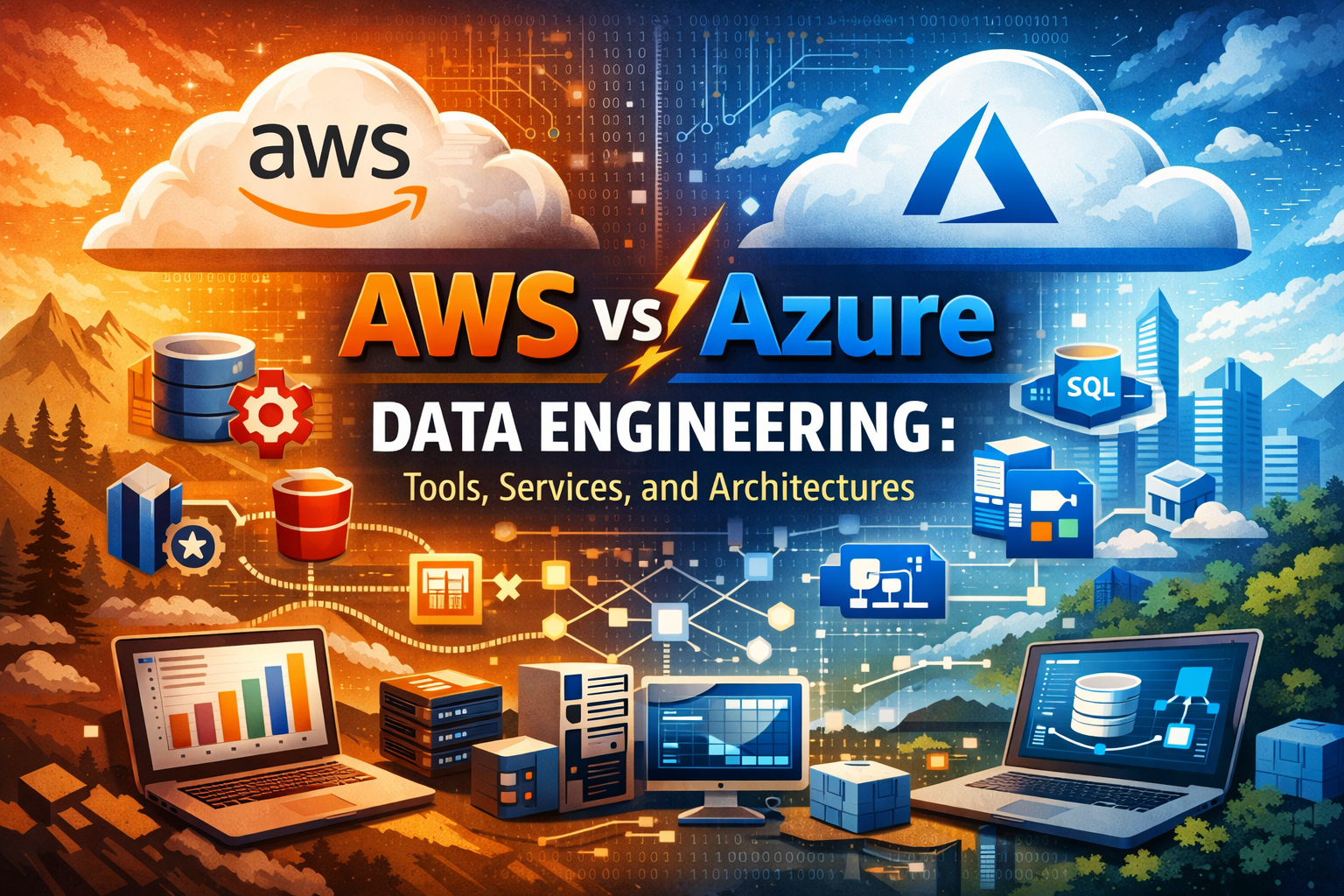
Choosing between AWS vs Azure data engineering platforms can make or break your data strategy. Both cloud giants offer powerful tools for building data pipelines, but their approaches differ significantly in pricing, performance, and ease of use.
This guide is for data engineers, cloud architects, and technical decision-makers evaluating which platform best fits their organization’s data needs. You’ll get practical insights to compare AWS data services vs Azure data services without the marketing fluff.
We’ll break down the core differences between AWS Glue vs Azure Data Factory for ETL workflows and compare Redshift vs Synapse Analytics for data warehousing. You’ll also discover how each platform handles serverless data processing and integrates with machine learning tools. Finally, we’ll explore proven cloud data architecture patterns and cost optimization strategies that can save your team thousands in monthly cloud bills.
Core Data Engineering Services Comparison

Storage Solutions for Big Data Workloads
Amazon Web Services offers a comprehensive storage ecosystem with Amazon S3 serving as the backbone for data lakes and big data architectures. S3 provides virtually unlimited scalability with different storage classes like Standard, Intelligent-Tiering, and Glacier for cost optimization based on access patterns. AWS Lake Formation builds on S3 to simplify data lake creation and management, while Amazon EFS and EBS handle file system and block storage needs respectively.
Azure counters with Azure Data Lake Storage Gen2, which combines the scalability of object storage with the performance of a hierarchical file system. This service integrates seamlessly with Azure Analytics services and provides better performance for analytics workloads compared to traditional blob storage. Azure Blob Storage remains the foundation for unstructured data, offering hot, cool, and archive access tiers.
Both platforms excel in different scenarios. AWS S3’s maturity shows in its extensive ecosystem integrations and global availability across regions. Azure Data Lake Storage Gen2 provides superior performance for analytics scenarios and offers better integration with Microsoft’s business intelligence tools.
The choice often depends on existing infrastructure and specific workload requirements. Organizations already invested in Microsoft ecosystems find Azure’s unified approach compelling, while those requiring maximum flexibility and third-party tool compatibility lean toward AWS.
Compute Engine Capabilities and Performance
AWS Lambda leads the serverless computing space for data processing with support for multiple programming languages and extensive trigger options from various data sources. For larger workloads, Amazon EMR provides managed Hadoop, Spark, and other big data frameworks with auto-scaling capabilities. AWS Batch handles batch processing workloads efficiently, while EC2 instances offer complete control over compute environments.
Azure Functions mirrors Lambda’s serverless capabilities but integrates more tightly with Microsoft development tools and Visual Studio. Azure HDInsight serves as the equivalent to EMR, supporting Hadoop, Spark, Kafka, and HBase clusters. Azure Batch provides similar batch processing capabilities, while virtual machines offer the infrastructure flexibility comparable to EC2.
Performance differences emerge in specific scenarios. AWS Lambda typically offers faster cold start times and broader language support. Azure Functions excels in enterprise environments with Active Directory integration and hybrid cloud scenarios. EMR provides more granular control over cluster configurations, while HDInsight offers better integration with Power BI and other Microsoft analytics tools.
Cost-effectiveness varies by usage pattern. AWS tends to be more competitive for variable workloads due to its pricing granularity, while Azure often provides better value for consistent, enterprise workloads through reserved capacity and hybrid benefits.
Database Management Systems and Analytics
Amazon’s database portfolio spans multiple engines and use cases. Amazon Redshift dominates the data warehousing space with columnar storage and massively parallel processing capabilities. For operational databases, RDS supports PostgreSQL, MySQL, MariaDB, Oracle, and SQL Server, while DynamoDB handles NoSQL requirements. Amazon Aurora combines MySQL and PostgreSQL compatibility with cloud-native performance enhancements.
Azure SQL Database and Azure SQL Managed Instance provide comprehensive relational database services with intelligent performance tuning. Azure Synapse Analytics (formerly SQL Data Warehouse) competes directly with Redshift, offering both serverless and dedicated compute pools. Cosmos DB serves as Azure’s globally distributed NoSQL solution with multiple consistency models and API compatibility.
Redshift vs Synapse Analytics represents a key battleground. Redshift offers more mature optimization features and a larger ecosystem of third-party tools. Synapse Analytics provides better integration with other Azure services and supports both data warehousing and big data analytics in a unified platform.
Database compatibility plays a crucial role in platform selection. Organizations with existing SQL Server investments benefit from Azure’s seamless migration paths and licensing flexibility. Those requiring specific database engines or maximum performance optimization often prefer AWS’s specialized offerings.
Real-time Streaming Data Processing
Amazon Kinesis provides a complete streaming platform with Kinesis Data Streams for real-time ingestion, Kinesis Data Firehose for delivery to data stores, and Kinesis Data Analytics for stream processing using SQL or Apache Flink. Amazon MSK (Managed Streaming for Apache Kafka) offers a fully managed Kafka service for organizations requiring Kafka-specific features.
Azure Event Hubs serves as the primary streaming ingestion service, handling millions of events per second with built-in partitioning and retention policies. Azure Stream Analytics processes streaming data using SQL-like queries and integrates seamlessly with Power BI for real-time dashboards. Azure Event Grid provides event-driven architectures with pub-sub messaging capabilities.
Performance characteristics differ between platforms. Kinesis excels in scenarios requiring fine-grained control over data partitioning and retention policies. Event Hubs provides better integration with enterprise identity systems and offers more predictable pricing models.
Stream processing capabilities show distinct approaches. Kinesis Data Analytics offers both SQL and Flink-based processing, providing flexibility for different skill sets. Stream Analytics focuses on SQL-based processing with excellent integration into the Microsoft ecosystem, making it accessible to business analysts familiar with SQL but lacking extensive programming experience.
Extract, Transform, Load Tool Ecosystem

Native ETL Service Offerings and Features
AWS Glue stands as Amazon’s flagship managed ETL service, offering serverless data integration with automatic scaling capabilities. The platform provides built-in connectors for popular data sources including S3, RDS, DynamoDB, and Redshift, while supporting both batch and streaming data processing through Apache Spark. Glue’s data catalog automatically discovers and catalogs metadata, making data assets easily searchable across your organization.
Azure Data Factory takes a different approach with its hybrid data integration service that connects on-premises and cloud data sources. The platform excels in handling complex data movement scenarios with over 90 built-in connectors spanning SaaS applications, databases, and file systems. Data Factory’s mapping data flows provide a visual interface for building transformation logic without writing code, while still offering flexibility for custom transformations.
Both platforms support schema evolution and data lineage tracking, but their implementation differs significantly. AWS Glue automatically tracks schema changes and maintains version history in its data catalog, while Azure Data Factory relies on integration with Azure Purview for comprehensive data lineage visualization.
Performance-wise, AWS Glue’s serverless architecture eliminates infrastructure management overhead but can experience cold start delays. Azure Data Factory offers more predictable performance through dedicated integration runtimes, particularly beneficial for consistent workload patterns.
Third-party Integration Capabilities
The cloud data engineering comparison reveals substantial differences in third-party ecosystem support between AWS and Azure. AWS maintains an extensive partner network with pre-built integrations for tools like Informatica PowerCenter, Talend, and Matillion. The AWS Marketplace simplifies deployment of these solutions, offering pay-as-you-go pricing models that align with cloud economics.
Azure’s integration strategy focuses heavily on Microsoft’s ecosystem while maintaining robust support for popular open-source tools. The platform provides native integration with tools like Apache Airflow through Azure Data Factory’s custom activities, and supports deployment of third-party ETL tools on Azure Virtual Machines or Azure Kubernetes Service.
Key integration capabilities include:
- API Connectivity: Both platforms offer REST API support for custom integrations, with AWS providing more granular IAM controls
- Real-time Streaming: AWS Kinesis integrates seamlessly with Apache Kafka and Spark Streaming, while Azure Event Hubs provides similar capabilities with stronger Microsoft ecosystem alignment
- Database Connectors: Azure excels in SQL Server and Oracle connectivity, while AWS provides superior PostgreSQL and MySQL integration
The choice between platforms often depends on existing technology investments. Organizations heavily invested in Microsoft technologies find Azure’s integration more straightforward, while those using diverse open-source tools may prefer AWS’s broader partner ecosystem.
Data Pipeline Orchestration and Scheduling
AWS offers multiple orchestration options, with AWS Step Functions providing state machine-based workflow management and Amazon Managed Workflows for Apache Airflow (MWAA) supporting complex DAG-based pipelines. Step Functions excel in serverless orchestration scenarios with built-in error handling and retry logic, while MWAA provides the full power of Airflow for complex dependency management.
Azure Data Factory includes built-in orchestration through pipelines and triggers, supporting time-based, event-based, and tumbling window scheduling. The platform’s control flow activities enable sophisticated branching logic and conditional execution without requiring separate orchestration tools.
Scheduling capabilities comparison:
- Time-based Triggers: Both platforms support cron-style scheduling with Azure offering more intuitive visual scheduling interfaces
- Event-driven Execution: AWS CloudWatch Events and Azure Logic Apps provide robust event-based triggering mechanisms
- Dependency Management: Airflow on AWS provides superior dependency handling, while Azure’s pipeline dependencies work well for simpler scenarios
- Resource Management: AWS Step Functions automatically scale based on demand, while Azure Data Factory allows manual scaling of integration runtimes
Code vs No-code Development Options
The ETL tools AWS Azure comparison shows significant differences in development approaches. AWS Glue Studio provides a visual interface for building ETL jobs while still generating editable PySpark or Scala code underneath. This hybrid approach appeals to both technical and business users, allowing seamless transitions between visual and code-based development.
Azure Data Factory emphasizes no-code development through its browser-based authoring experience. The platform’s mapping data flows enable complex transformations through drag-and-drop interfaces, with automatic code generation for Spark execution. However, advanced scenarios still require custom activities or Azure Functions for complex business logic.
Development flexibility features:
- Visual Development: Azure provides more polished no-code experiences, while AWS offers better code visibility and customization
- Custom Code Integration: AWS allows inline custom transformations within Glue jobs, Azure requires separate compute resources for custom code
- Version Control: Both platforms integrate with Git repositories, but AWS provides more granular version control at the job level
- Testing and Debugging: AWS Glue interactive sessions enable notebook-style development, while Azure relies on pipeline debug runs
Monitoring and Error Handling Mechanisms
AWS CloudWatch provides comprehensive monitoring for Glue jobs with custom metrics, logs, and alerting capabilities. The platform’s X-Ray service offers detailed tracing for data pipeline execution, helping identify bottlenecks and errors across distributed systems. AWS also provides automated error handling through Step Functions’ built-in retry mechanisms and dead letter queues.
Azure Monitor integrates deeply with Data Factory to provide pipeline execution monitoring, resource utilization tracking, and custom alerting rules. The platform’s Application Insights offers detailed performance analytics and dependency tracking for complex data workflows.
Monitoring capabilities include:
- Real-time Dashboards: Both platforms provide customizable dashboards, with Azure offering more pre-built templates
- Error Alerting: AWS SNS and Azure Action Groups enable flexible notification strategies
- Performance Metrics: AWS provides more granular Spark-level metrics, while Azure focuses on pipeline-level performance indicators
- Log Analysis: AWS CloudWatch Logs Insights offers powerful log querying, while Azure Log Analytics provides similar capabilities with KQL query language
The choice between AWS vs Azure data engineering platforms for monitoring often depends on existing observability investments and team expertise with specific monitoring tools.
Data Warehouse and Analytics Platform Analysis

Enterprise Data Warehouse Solutions
Amazon Redshift stands as AWS’s flagship data warehouse solution, built specifically for analytical workloads at petabyte scale. This fully managed service excels in handling structured data with its columnar storage architecture and massive parallel processing capabilities. Redshift Spectrum extends the warehouse by allowing direct queries against data stored in S3, creating a seamless bridge between your data lake and warehouse environments.
Azure Synapse Analytics takes a different approach by combining data warehousing, big data analytics, and data integration into a unified platform. Previously known as SQL Data Warehouse, Synapse offers both dedicated SQL pools for traditional warehousing and serverless SQL pools for on-demand queries. The platform’s unique selling point lies in its ability to handle both relational and non-relational data within the same environment.
Both platforms support auto-scaling capabilities, but their implementations differ significantly. Redshift offers manual resizing and automatic scaling of compute resources, while Synapse provides more granular control with pause-and-resume functionality for dedicated pools. Redshift’s Reserved Instances can deliver substantial cost savings for predictable workloads, whereas Synapse’s pay-per-query model in serverless mode works better for sporadic analytical tasks.
The choice between these platforms often depends on your existing cloud ecosystem and specific performance requirements. Organizations already invested in AWS services typically find Redshift’s tight integration with other AWS tools compelling, while Azure-centric companies appreciate Synapse’s seamless connection with Power BI and other Microsoft analytics tools.
Columnar Storage and Query Performance
Columnar storage represents a fundamental shift from traditional row-based databases, delivering exceptional performance for analytical queries that typically scan large datasets. Both AWS and Azure have optimized their warehousing solutions around this architecture, but each implements unique enhancements.
Redshift employs sophisticated compression algorithms that automatically select the best compression type for each column based on data characteristics. The platform’s Zone Maps act as automatic indexing, storing minimum and maximum values for data blocks to eliminate unnecessary I/O operations during query execution. Advanced Query Accelerator (AQUA) pushes compute closer to storage, reducing data movement and improving query performance by up to 10x for certain workloads.
Synapse Analytics leverages columnstore indexes with batch and delta stores, automatically organizing data for optimal query performance. The platform’s Adaptive Query Processing dynamically adjusts execution plans based on actual data characteristics, while intelligent workload management automatically classifies and routes queries to appropriate resource pools. Synapse’s integration with Apache Spark pools enables seamless processing of both structured and unstructured data using the same columnar optimizations.
Performance tuning strategies vary between platforms. Redshift focuses heavily on distribution keys and sort keys to optimize data placement across nodes, while Synapse emphasizes automatic statistics and intelligent caching. Both platforms support result set caching, but Synapse’s broader caching strategy extends to intermediate results and compiled query plans.
Query concurrency handling shows distinct differences. Redshift uses workload management queues with configurable memory allocation, while Synapse employs workload groups with more flexible resource governance. Both approaches aim to prevent resource contention, but Synapse’s approach provides more dynamic resource allocation based on actual query complexity.
Business Intelligence Integration Points
The integration between data warehouses and BI tools significantly impacts the end-user experience and overall analytics adoption. AWS and Azure data warehouse platforms offer different approaches to connecting with popular BI solutions, each with distinct advantages.
Redshift provides native connectivity with major BI platforms including Tableau, Power BI, Looker, and QlikSense through standard JDBC/ODBC drivers. The platform’s integration with Amazon QuickSight offers a fully managed, serverless BI solution that scales automatically with user demand. QuickSight’s SPICE engine creates an optimized in-memory layer that accelerates dashboard performance, while ML-powered insights automatically detect anomalies and trends in your data.
Azure Synapse Analytics shines in its tight integration with Microsoft’s Power BI ecosystem. DirectQuery mode enables real-time dashboard updates without data movement, while Import mode leverages Power BI’s compressed data model for faster interactions. The integration extends beyond connectivity to include shared security models, single sign-on, and unified monitoring across both platforms.
Both platforms support modern BI architectures through REST APIs and GraphQL endpoints, enabling custom application development and embedded analytics scenarios. Redshift Data API allows applications to run SQL commands without managing database connections, while Synapse’s REST APIs provide comprehensive access to warehouse metadata and query execution capabilities.
Real-time dashboard requirements often drive platform selection decisions. Synapse’s live connection capabilities with Power BI deliver sub-second response times for summary-level queries, while Redshift’s materialized views can pre-compute complex aggregations to support real-time use cases. Both platforms support incremental data refresh strategies that balance data freshness with resource consumption.
Security integration represents another critical consideration. Redshift integrates with AWS IAM for fine-grained access control and supports row-level security for multi-tenant scenarios. Synapse leverages Azure Active Directory for authentication and authorization, providing seamless integration with existing enterprise identity systems and supporting advanced features like conditional access policies.
Machine Learning and AI Integration Benefits

Built-in ML Model Development Tools
Both AWS and Azure offer comprehensive machine learning platforms that integrate seamlessly with their data engineering ecosystems. AWS SageMaker provides a complete environment for building, training, and deploying ML models, featuring automated model tuning, built-in algorithms, and Jupyter notebook instances. The platform supports popular frameworks like TensorFlow, PyTorch, and Scikit-learn, making it easy for data scientists to work with familiar tools.
Azure Machine Learning Studio offers a similar experience with drag-and-drop model building capabilities and automated machine learning (AutoML) features. The platform excels in experiment tracking and model versioning, allowing teams to manage complex ML workflows efficiently. Both platforms provide pre-built algorithms for common use cases like regression, classification, and clustering, reducing development time significantly.
When comparing AWS vs Azure machine learning integration, SageMaker’s strength lies in its tight coupling with other AWS data services like S3 and Glue, while Azure ML benefits from strong integration with Microsoft’s broader ecosystem, including Power BI and Excel for business users.
Automated Feature Engineering Capabilities
Feature engineering automation has become a game-changer in modern data science workflows. AWS SageMaker Data Wrangler simplifies the process of preparing data for machine learning by offering over 300 built-in transformations. Users can visually explore datasets, identify data quality issues, and apply transformations without writing code. The tool automatically generates suggestions for feature transformations based on data types and distributions.
Azure’s approach centers around Azure Machine Learning’s automated ML capabilities, which automatically perform feature scaling, encoding, and selection. The platform can handle missing values, detect and mitigate data drift, and create polynomial features when beneficial. Azure’s AutoML also provides feature importance rankings, helping data scientists understand which variables contribute most to model performance.
Both platforms offer time-series specific feature engineering, including lag features, rolling windows, and seasonality detection. AWS provides specialized tools through SageMaker Autopilot, while Azure includes time-series forecasting as part of its AutoML suite. These automated capabilities significantly reduce the time data engineers spend on manual feature preparation, allowing them to focus on higher-level architecture decisions.
Model Deployment and Serving Infrastructure
Model deployment represents a critical bridge between data science experimentation and production value delivery. AWS SageMaker offers multiple deployment options, including real-time endpoints for low-latency predictions, batch transform jobs for processing large datasets, and multi-model endpoints for cost-effective serving of multiple models on a single instance. The platform’s auto-scaling capabilities ensure models can handle varying traffic loads without manual intervention.
Azure Machine Learning provides similar deployment flexibility through Azure Container Instances, Azure Kubernetes Service, and Azure Functions for serverless inference. The platform’s managed online endpoints offer built-in monitoring, A/B testing capabilities, and automatic scaling. Azure’s integration with Azure DevOps creates smooth CI/CD pipelines for model deployment, enabling MLOps best practices.
Both platforms support edge deployment scenarios. AWS offers AWS IoT Greengrass for deploying models to edge devices, while Azure provides Azure IoT Edge with custom vision and speech services. Container-based deployments are standard across both platforms, ensuring consistency between development and production environments. The choice often depends on existing infrastructure preferences and specific performance requirements for your cloud data engineering architecture.
Architecture Patterns and Best Practices

Lambda Architecture Implementation Strategies
Both AWS and Azure offer robust toolsets for implementing Lambda architecture, where batch and stream processing work together to handle massive data volumes. AWS Lambda architecture typically combines Amazon Kinesis for real-time streaming, Apache Spark on EMR for batch processing, and DynamoDB or S3 for serving layers. The batch layer processes historical data using EMR clusters, while Kinesis Analytics handles the speed layer for real-time insights.
Azure’s Lambda implementation leverages Azure Stream Analytics for real-time processing, HDInsight for batch workloads, and Cosmos DB for the serving layer. Event Hubs captures streaming data, while Azure Data Lake Storage provides the foundation for both batch and speed layers. Azure’s approach often integrates more seamlessly with Microsoft’s ecosystem, making it attractive for organizations already using Office 365 or Power BI.
Key differences emerge in fault tolerance and scalability. AWS offers more granular control over individual components, allowing for custom configurations but requiring deeper technical expertise. Azure provides more managed services that reduce operational overhead but may limit customization options.
Kappa Architecture Design Considerations
Kappa architecture simplifies data processing by treating everything as a stream, eliminating the complexity of maintaining separate batch and streaming systems. This approach works exceptionally well when you need consistent processing logic across all data.
AWS implements Kappa architecture primarily through Amazon Kinesis ecosystem. Kinesis Data Streams captures all events, Kinesis Analytics processes them in real-time, and Kinesis Data Firehose delivers results to storage or analytics services. AWS Lambda functions can trigger additional processing, while Amazon MSK (Managed Streaming for Kafka) provides enterprise-grade streaming capabilities.
Azure’s Kappa implementation centers around Azure Event Hubs and Stream Analytics. Event Hubs ingests massive event streams, while Stream Analytics applies real-time transformations. Azure Functions handle event-driven processing, and Service Bus manages complex messaging scenarios.
The cloud data engineering comparison reveals that AWS offers more flexibility in stream processing configurations, while Azure provides better integration with business intelligence tools. Organizations must consider their existing technology stack and team expertise when choosing between platforms.
Data Lake vs Data Warehouse Architectures
Modern cloud data architecture patterns require careful consideration of whether to implement data lakes, data warehouses, or hybrid approaches. Each platform offers distinct advantages for different use cases.
AWS data lake architecture revolves around Amazon S3 as the central repository, with AWS Glue for cataloging and ETL operations. Amazon Athena enables serverless querying directly on S3 data, while Amazon Redshift serves as the primary data warehouse solution. This separation allows organizations to store raw data cheaply in S3 while maintaining high-performance analytics in Redshift.
Azure’s approach centers on Azure Data Lake Storage Gen2, which combines the scalability of data lakes with the performance characteristics of file systems. Azure Synapse Analytics bridges the gap between data lakes and warehouses, providing a unified experience for both batch and interactive analytics. This integration reduces data movement and simplifies architecture complexity.
Cost considerations vary significantly between approaches. Data lakes typically offer lower storage costs but may require more processing power for complex queries. Data warehouses provide faster query performance but at higher storage costs. AWS pricing favors organizations with predictable workloads, while Azure’s consumption-based pricing benefits variable usage patterns.
Multi-cloud and Hybrid Deployment Models
Organizations increasingly adopt multi-cloud strategies to avoid vendor lock-in and leverage best-of-breed services. Both AWS and Azure support hybrid deployments, but with different philosophies and toolsets.
AWS hybrid solutions focus on extending cloud services to on-premises environments. AWS Outposts brings native AWS services to customer data centers, while AWS Storage Gateway connects on-premises environments to cloud storage. AWS Direct Connect provides dedicated network connections for consistent performance and security.
Azure’s hybrid approach emphasizes seamless integration between cloud and on-premises resources. Azure Arc extends Azure management capabilities to any infrastructure, including other cloud providers. Azure Stack Hub brings Azure services to on-premises environments, maintaining API compatibility and consistent development experiences.
Multi-cloud data engineering presents unique challenges around data governance, security, and cost management. Organizations must implement robust data lineage tracking and ensure consistent security policies across platforms. Network latency and data transfer costs become critical factors when moving data between cloud providers.
Successful multi-cloud deployments require standardized APIs, containerized workloads, and cloud-agnostic tooling. Infrastructure as Code becomes essential for managing resources consistently across platforms. Monitoring and observability tools must provide unified views across all environments to maintain operational efficiency.
Cost Optimization and Pricing Models

Pay-per-use vs Reserved Instance Strategies
AWS and Azure offer fundamentally different approaches to pricing that can dramatically impact your data engineering budget. AWS operates on a true pay-per-use model for most services like S3, Lambda, and Glue, where you’re charged only for what you consume. Azure follows a similar pattern but often bundles services differently, sometimes requiring upfront commitments for certain tiers.
Reserved instances provide substantial savings when you have predictable workloads. AWS offers Reserved Instances for EC2, RDS, and Redshift with discounts up to 75% for three-year commitments. Azure’s equivalent Reserved VM Instances and SQL Database reserved capacity can save up to 72% compared to pay-as-you-go rates.
For data engineering workloads, the sweet spot often lies in hybrid strategies. Use reserved capacity for your baseline processing needs like persistent data warehouses or always-on ETL processes. Combine this with on-demand resources for burst processing during peak data ingestion periods.
AWS Savings Plans offer more flexibility than traditional reserved instances, covering compute usage across EC2, Fargate, and Lambda. Azure’s equivalent is the Azure Hybrid Benefit, which lets you use existing Windows Server and SQL Server licenses for additional cost reduction.
Storage Cost Efficiency Comparisons
Storage costs form a significant portion of any data engineering budget, and both platforms offer tiered storage solutions with different price points. AWS S3 provides multiple storage classes ranging from Standard ($0.023/GB/month) to Glacier Deep Archive ($0.00099/GB/month). Azure Blob Storage offers similar tiers with Hot, Cool, and Archive access levels.
The key difference lies in retrieval costs and minimum storage durations. AWS Glacier has retrieval fees and requires 90-day minimum storage, while Azure Archive storage charges for early deletion within 180 days. For frequently accessed data, Azure’s Hot tier often costs slightly less than S3 Standard, but the gap narrows when considering data transfer fees.
Data lifecycle policies can automate cost optimization by moving older data to cheaper storage tiers. AWS offers more granular controls with S3 Intelligent-Tiering that automatically moves objects between access tiers without retrieval fees. Azure’s equivalent automation requires more manual configuration but provides similar cost benefits.
Cross-region data replication costs vary significantly between platforms. Azure charges less for geo-redundant storage options, while AWS provides more flexibility in choosing specific regions for replication, allowing better cost control for compliance requirements.
Compute Resource Scaling Economics
The economics of compute scaling reveal important differences between AWS and Azure data engineering services. AWS Glue charges per Data Processing Unit (DPU) with a 10-minute minimum billing increment, making it expensive for short-running jobs. Azure Data Factory’s mapping data flows charge per vCore-hour with 1-minute billing, offering better cost efficiency for smaller transformations.
Serverless options provide compelling economics for variable workloads. AWS Lambda bills in 1ms increments with generous free tier allowances, making it ideal for lightweight data processing tasks. Azure Functions offers similar pricing but includes more free executions per month, benefiting organizations with many small data triggers.
Auto-scaling capabilities directly impact costs through resource optimization. Azure Synapse Analytics allows pausing compute resources entirely while maintaining storage, something AWS Redshift only achieved with the newer Serverless option. This pause capability can reduce costs by up to 90% during non-business hours.
Container-based data processing shows different cost patterns. AWS Fargate charges for vCPU and memory per second, while Azure Container Instances bills per second with fractional CPU allocation. For data engineering workloads requiring specific resource ratios, Azure often provides more cost-effective options.
Spot instances and low-priority VMs offer significant savings for batch processing workloads that can tolerate interruptions. AWS Spot Instances provide discounts up to 90% but with less predictability than Azure’s Spot VMs, which offer clearer eviction policies and pricing transparency.

Both AWS and Azure offer powerful data engineering ecosystems that can transform how organizations handle their data workflows. AWS brings mature services like Redshift and comprehensive ETL tools, while Azure delivers seamless integration with Microsoft products and competitive analytics platforms. The choice between these cloud giants often comes down to your existing tech stack, team expertise, and specific project requirements rather than raw capabilities.
Smart data engineering teams focus on understanding their unique needs before picking a platform. Consider your current infrastructure, budget constraints, and long-term scalability goals. Both platforms excel in different areas – AWS with its extensive service catalog and Azure with its enterprise-friendly approach. Start with a pilot project to test the waters, and remember that the best architecture is the one your team can effectively build, maintain, and scale.