Internet gateways serve as the front door to your cloud infrastructure, making proper security configuration absolutely critical for any organization running public-facing applications on AWS. This guide is designed for cloud architects, DevOps engineers, and security professionals who need to implement robust IGW security measures while maintaining reliable application access.
Getting your AWS IGW configuration right from the start prevents costly security incidents and ensures your applications can scale safely. We’ll walk through the essential security foundations you need before deploying any internet gateway, then dive into strategic configuration techniques that maximize protection without sacrificing performance.
You’ll learn how to implement advanced security measures specifically designed for public-facing applications, including multi-layered defense strategies and automated threat detection. We’ll also cover the ongoing monitoring practices that keep your cloud infrastructure security strong over time, helping you catch potential issues before they become real problems.
Understanding Internet Gateways and Their Critical Role

Define IGWs and their function in AWS architecture
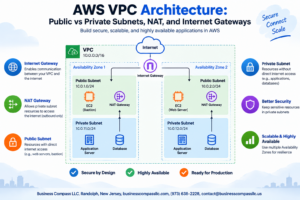
Internet Gateways serve as the critical bridge connecting your AWS Virtual Private Cloud to the internet, enabling bidirectional communication for public-facing applications. An IGW acts as a horizontally scaled, redundant, and highly available VPC component that allows instances in public subnets to communicate with the internet while providing a target in your VPC route tables for internet-routable traffic. This managed service automatically handles the translation between private IP addresses within your VPC and public IP addresses, making it essential for any secure cloud architecture requiring external connectivity.
Distinguish between public and private subnets for security
Public subnets contain instances that can directly communicate with the internet through an IGW configuration, while private subnets house resources that remain isolated from direct internet access. The key difference lies in routing table configuration – public subnets include a route directing traffic (0.0.0.0/0) to the Internet Gateway, whereas private subnets lack this route. This architectural separation creates a security boundary where sensitive database servers and internal applications reside in private subnets, protected from direct internet exposure, while web servers and load balancers operate in public subnets to handle incoming requests.
Identify common security vulnerabilities without proper IGW configuration
Misconfigured Internet Gateway security can expose applications to numerous attack vectors, including unrestricted inbound access, overly permissive security group rules, and inadequate network access control lists. Without proper IGW best practices, organizations risk data breaches through exposed databases, unauthorized access to internal systems, and DDoS attacks targeting public-facing infrastructure. Common vulnerabilities include failing to implement proper subnet segregation, neglecting to configure NACLs for additional security layers, and allowing unnecessary ports and protocols through security groups, creating potential entry points for malicious actors targeting cloud infrastructure security weaknesses.
Essential Security Foundations Before IGW Implementation

Establish robust VPC design principles for isolation
Creating a well-architected VPC forms the backbone of Internet Gateway security. Design your VPC with clear network segmentation using multiple availability zones and separate subnets for different application tiers. Public subnets should only contain resources that genuinely need direct internet access, like load balancers or NAT gateways. Keep your application servers, databases, and sensitive workloads in private subnets that route internet traffic through NAT instances. This layered approach creates natural boundaries that limit blast radius if one component gets compromised. Plan your CIDR blocks carefully to avoid conflicts and ensure you have room for future growth while maintaining clean network boundaries.
Configure security groups with least privilege access
Security groups act as virtual firewalls that control traffic at the instance level. Start with a deny-all approach and only open the specific ports your application needs. Create granular security groups for different application components rather than using broad, permissive rules. For web servers, limit HTTP/HTTPS access to specific source ranges instead of allowing 0.0.0.0/0 unless absolutely necessary. Reference other security groups in your rules instead of IP addresses when possible – this creates dynamic relationships that automatically adjust as your infrastructure scales. Regularly audit your security group rules and remove any that are no longer needed. Document the purpose of each rule to make future maintenance easier.
Implement Network Access Control Lists as additional protection layers
NACLs provide subnet-level security that complements your security groups. While security groups are stateful, NACLs are stateless, meaning you need to configure both inbound and outbound rules explicitly. Use NACLs to create broad traffic filtering policies that apply to entire subnets. For public subnets hosting web applications, create rules that allow standard web traffic while blocking uncommon protocols or suspicious traffic patterns. Consider implementing geo-blocking at the NACL level to prevent access from high-risk regions. Unlike security groups, NACLs process rules in numerical order, so organize your rules strategically with more specific rules having lower numbers than general rules.
Set up proper subnet routing for traffic control
Routing tables determine where network traffic goes, making them critical for AWS network security. Create separate routing tables for public and private subnets with different route configurations. Public subnet routing tables should have routes to the Internet Gateway for direct internet access, while private subnets should route internet traffic through NAT gateways or instances. Use multiple NAT gateways across different availability zones for high availability and better traffic distribution. Implement route table associations carefully and avoid using the main route table for production workloads. Consider creating custom routing for specific use cases, such as directing certain traffic through virtual private gateways or transit gateways when connecting to on-premises networks.
Strategic IGW Configuration for Maximum Security

Deploy IGWs with proper route table associations
Your Internet Gateway security starts with precise route table configuration. Create dedicated route tables for public subnets containing only essential routes—typically 0.0.0.0/0 pointing to your IGW. Separate private subnet route tables should never reference the IGW directly. This isolation prevents accidental exposure of internal resources while maintaining controlled public access paths. Configure explicit route priorities to avoid traffic misrouting during network changes.
Configure elastic IP addresses for predictable access points
Elastic IP addresses provide static entry points that simplify security group rules and DNS management. Attach EIPs to NAT gateways in public subnets rather than directly to application instances when possible. This approach creates predictable outbound IP addresses for whitelist scenarios while maintaining instance flexibility. Reserve sufficient EIP quota before deployment and document IP allocations for compliance requirements and security audits.
Implement load balancer integration for traffic distribution
Application Load Balancers positioned in public subnets behind your IGW create secure traffic distribution patterns. Configure ALB security groups to accept only necessary ports (80/443) from internet sources while backend instance security groups allow traffic solely from the load balancer. Enable deletion protection and access logging to maintain service availability and traffic visibility. This architecture shields application instances from direct internet exposure while ensuring scalable public access.
Establish monitoring and logging for all gateway traffic
VPC Flow Logs capture all traffic traversing your IGW, providing essential security visibility. Enable flow logs at the VPC level with CloudWatch Logs destination for real-time analysis. Configure CloudTrail to monitor IGW configuration changes and route table modifications. Set up CloudWatch alarms for unusual traffic patterns, connection spikes, or unexpected source IP ranges. Regular log analysis reveals attack patterns and helps optimize security group rules for your public-facing applications.
Advanced Security Measures for Public-Facing Applications

Enable AWS Web Application Firewall for application-layer protection
AWS WAF acts as your first line of defense against common web exploits targeting your public-facing applications behind Internet Gateways. Configure custom rules to block SQL injection attempts, cross-site scripting attacks, and malicious bot traffic before they reach your application servers. Set up rate limiting to prevent DDoS attacks and create IP whitelists for trusted sources. WAF integrates seamlessly with CloudFront and Application Load Balancers, providing real-time protection without impacting legitimate user traffic.
Integrate CloudFront for DDoS mitigation and performance
CloudFront distribution shields your IGW-connected applications from volumetric DDoS attacks by absorbing malicious traffic at edge locations worldwide. Configure origin shield to add an extra caching layer between CloudFront and your origin servers. Enable AWS Shield Standard for automatic DDoS protection, or upgrade to Shield Advanced for dedicated response teams and cost protection. CloudFront’s global network reduces latency while filtering suspicious requests before they reach your infrastructure.
Configure SSL/TLS certificates for encrypted communications
Deploy AWS Certificate Manager to provision and manage SSL/TLS certificates for your public-facing applications automatically. Enable HTTPS-only traffic by configuring security groups and load balancer listeners to reject HTTP connections. Set up certificate auto-renewal to prevent service disruptions from expired certificates. Configure perfect forward secrecy and strong cipher suites to protect data in transit between users and your IGW-enabled applications, meeting compliance requirements for secure cloud architecture.
Monitoring and Maintaining IGW Security Over Time

Set up automated alerts for suspicious traffic patterns
Configure CloudWatch alarms to track unusual spikes in traffic volume, failed connection attempts, and geographic anomalies. Set up SNS notifications for real-time incident response when suspicious patterns emerge across your IGW infrastructure.
Conduct regular security audits and penetration testing
Schedule quarterly penetration tests targeting your public-facing applications through the Internet Gateway. Review security group rules, NACLs, and routing tables monthly to identify potential vulnerabilities and ensure compliance with your cloud security monitoring standards.
Update security policies based on threat intelligence
Subscribe to AWS security bulletins and threat intelligence feeds to stay current with emerging attack vectors. Regularly update your security policies and AWS IGW configuration based on new threat data and industry best practices for secure cloud architecture.
Implement disaster recovery procedures for compromised gateways
Create documented procedures for isolating compromised IGWs, including automated scripts for emergency traffic rerouting. Maintain backup routing configurations and practice incident response scenarios to minimize downtime during security breaches affecting your cloud infrastructure security.

Internet Gateways serve as the backbone of secure public-facing applications, but their effectiveness depends entirely on how well you implement the supporting security measures. From establishing strong foundational practices to configuring IGWs strategically, every step plays a crucial role in protecting your applications from potential threats. The advanced security measures we’ve covered, combined with proper monitoring and maintenance, create multiple layers of protection that work together to keep your infrastructure safe.
Don’t treat IGW security as a one-time setup. Regular monitoring, consistent updates, and proactive maintenance are what separate truly secure applications from those that just appear secure on the surface. Start by auditing your current IGW configuration against the security foundations we’ve discussed, then gradually implement the advanced measures that make sense for your specific use case. Your applications and your users will benefit from this investment in robust security practices.