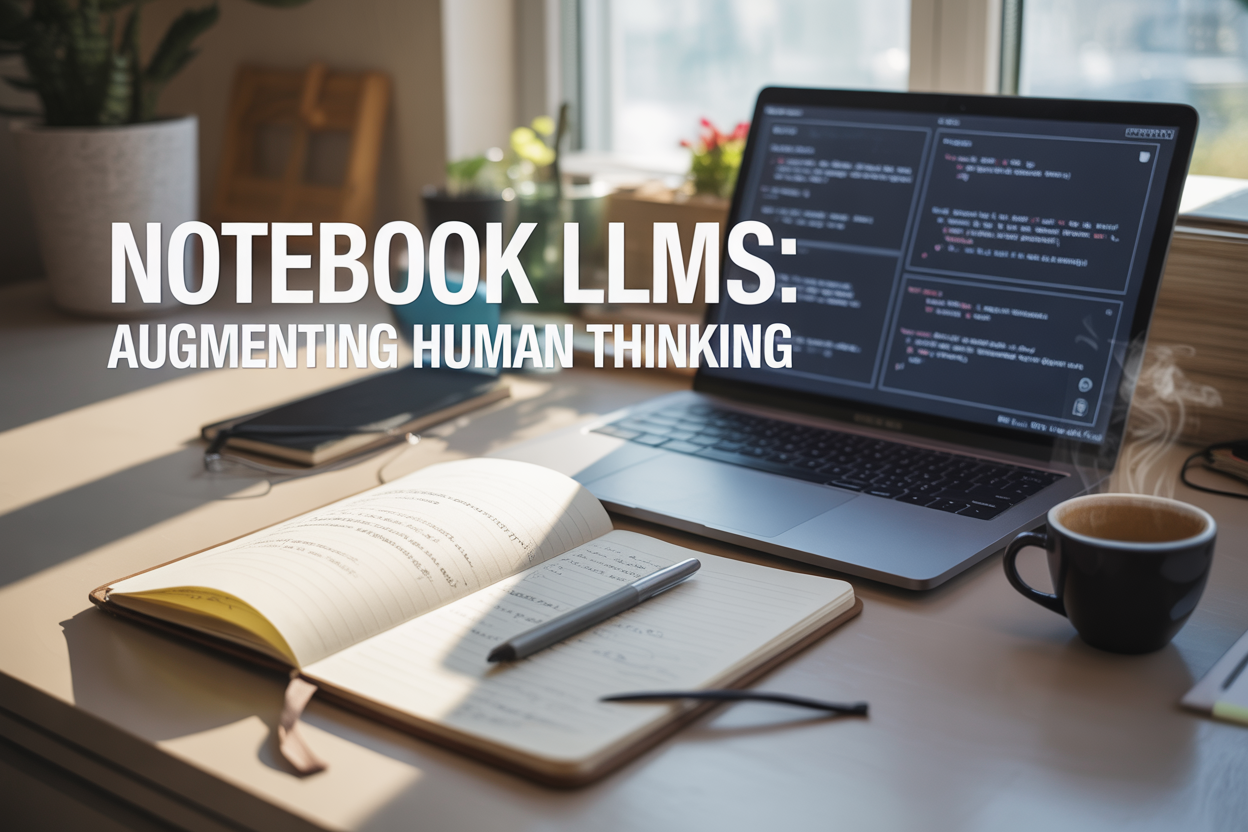
Notebook LLMs are changing how we think, solve problems, and process information by turning traditional note-taking into dynamic conversations with AI. These AI-powered notebooks let you bounce ideas off intelligent systems that can analyze, question, and expand your thoughts in real-time.
This guide is perfect for researchers, students, professionals, and anyone who wants to supercharge their thinking process with human-AI collaboration. You’ll discover how these cognitive augmentation tools can transform scattered thoughts into structured insights and help you tackle complex problems more effectively.
We’ll explore how notebook LLMs actually work and what makes them different from regular AI chat tools. You’ll learn practical ways to use interactive AI notebooks for research, brainstorming, and decision-making that boost your enhanced cognitive performance. We’ll also cover the real challenges you might face when implementing these systems and honest strategies for getting the most out of AI thinking assistants without losing your own critical thinking skills.
Understanding Notebook LLMs and Their Core Functionality

Defining notebook-style interfaces for language model interaction
Notebook LLMs represent a revolutionary shift from traditional AI chat interfaces to structured, document-based environments where humans and AI can collaborate more naturally. Think of them as digital workspaces that combine the familiar feel of a notebook with the power of large language models for thinking and reasoning.
These interfaces organize conversations into cells or blocks, similar to Jupyter notebooks used by data scientists. Each cell can contain different types of content – text, code, analysis, or AI responses – creating a living document that evolves as your thinking progresses. Unlike simple chat windows, notebook-style interfaces maintain persistent context across multiple sessions and allow you to revisit, edit, and build upon previous thoughts.
The core design philosophy centers around treating AI interactions as collaborative documents rather than fleeting conversations. Users can structure their work into logical sections, create templates for recurring thought processes, and maintain comprehensive records of their reasoning journey. This approach transforms AI-powered notebooks from simple query-response tools into genuine cognitive augmentation tools that mirror how we naturally organize complex thinking.
Key features that differentiate notebook LLMs from traditional chatbots
Traditional chatbots operate on a linear, conversational model where each exchange stands relatively isolated. Interactive AI notebooks break this paradigm by offering several distinctive capabilities that enhance the human-AI collaboration experience.
Persistent Memory and Context: Unlike chatbots that often lose track of earlier conversations, notebook LLMs maintain comprehensive context across your entire project. This enables deeper, more nuanced discussions that build organically over time.
Multi-modal Integration: These systems seamlessly blend text, images, data visualizations, and even executable code within a single workspace. You can upload documents, analyze datasets, create diagrams, and have the AI reference all these materials cohesively.
Version Control and Iteration: Notebook LLMs allow you to experiment with different approaches without losing previous work. You can branch conversations, compare alternative solutions, and track the evolution of your ideas.
| Feature | Traditional Chatbots | Notebook LLMs |
|---|---|---|
| Context Retention | Session-based | Project-wide persistence |
| Content Organization | Linear chat thread | Structured cells/blocks |
| Collaboration Style | Q&A format | Co-creation workspace |
| Output Format | Text responses | Rich multimedia documents |
| Revision Capability | Limited | Full edit/iterate control |
Template and Workflow Support: Many intelligent notebook systems offer pre-built templates for common thinking patterns – from research analysis to creative brainstorming to problem-solving frameworks.
How notebook LLMs process and organize information sequentially
The sequential processing capabilities of notebook LLMs mirror human cognitive patterns while adding computational advantages. These systems excel at breaking down complex problems into manageable chunks and maintaining logical flow throughout extended thinking sessions.
Hierarchical Information Architecture: Notebook LLMs naturally create information hierarchies, organizing thoughts into main topics, subtopics, and supporting details. This structure helps both humans and AI maintain clarity as discussions become more complex.
Contextual Awareness Across Cells: Each cell in the notebook understands its relationship to previous and subsequent content. When you reference earlier ideas or ask the AI to build upon previous analysis, the system can trace these connections and provide coherent responses that acknowledge the full context.
Progressive Refinement: The sequential nature allows for iterative thinking where initial rough ideas get gradually refined into polished insights. You might start with a broad question, narrow it down through several exchanges, explore different angles, and finally synthesize findings – all while maintaining a clear record of your thought process.
Cross-Reference and Linking: Advanced LLM productivity applications can automatically identify connections between different sections of your notebook, suggesting relevant earlier discussions or highlighting patterns across your work. This capability transforms scattered thoughts into coherent knowledge networks.
The sequential processing also enables sophisticated AI-human workflow optimization where the system learns your thinking patterns and proactively suggests next steps, relevant resources, or alternative approaches based on the trajectory of your current work session.
Transforming Your Thinking Process with Interactive AI Notebooks

Breaking down complex problems into manageable components
Interactive AI notebooks excel at helping you dissect overwhelming problems into bite-sized pieces. Think of them as your personal thinking partner that never gets tired of your questions. When you’re staring at a massive project or trying to solve a multi-layered challenge, notebook LLMs can guide you through a structured decomposition process.
Start by describing your problem in plain language to the AI. The system will suggest logical breakdowns, identify key dependencies, and help you prioritize which components to tackle first. For instance, if you’re planning a product launch, the AI might help you separate market research, competitive analysis, timeline creation, and resource allocation into distinct workstreams.
The real power comes from the AI’s ability to spot connections you might miss. It can flag when one component depends on another, suggest parallel workstreams, and even predict potential bottlenecks before they happen. This systematic approach transforms chaotic thinking into organized action plans.
Iterative refinement of ideas through conversational AI assistance
The conversational nature of notebook LLMs creates a dynamic feedback loop that sharpens your thinking with each exchange. Rather than working in isolation, you’re engaging in an ongoing dialogue where ideas evolve naturally through back-and-forth discussion.
Your initial thoughts serve as raw material that the AI helps polish. Share a rough concept, and the system will ask clarifying questions, point out assumptions, and suggest alternative angles. This process mimics the best aspects of brainstorming with a knowledgeable colleague who brings fresh perspectives to every conversation.
The beauty lies in the AI’s patience and persistence. It won’t get frustrated with your half-formed ideas or judge your creative experiments. You can explore wild tangents, test unconventional approaches, and refine concepts through multiple iterations until they crystallize into actionable insights. Each conversation builds on the last, creating a natural evolution of your thinking.
Building upon previous thoughts and conclusions systematically
One of the most powerful features of AI-powered notebooks is their ability to create coherent knowledge threads that span multiple sessions. Your previous insights don’t disappear into forgotten files – they become building blocks for future thinking.
The system maintains a living record of your reasoning process, connecting new ideas to established conclusions. When you return to a project weeks later, the AI can quickly summarize where you left off and suggest natural next steps based on your previous work. This creates intellectual momentum that traditional note-taking systems simply can’t match.
Think of it as constructing a knowledge pyramid where each new insight rests on the foundation of previous discoveries. The AI helps you see patterns across time, identify recurring themes in your thinking, and build increasingly sophisticated mental models. Your notebook becomes a growing repository of connected insights rather than scattered observations.
Maintaining context across extended reasoning sessions
Extended problem-solving often suffers from context loss – you forget crucial details, lose track of your original assumptions, or repeat previous analysis. Interactive AI notebooks solve this by maintaining perfect memory of your entire thinking journey.
The system tracks not just your conclusions but the reasoning behind them. When you revisit a topic, it can remind you why you rejected certain approaches or what evidence led to specific decisions. This contextual awareness prevents backtracking and keeps your thinking focused on unexplored territory.
Large language models for thinking excel at synthesizing information across long conversations, identifying when current discussions relate to previous work, and maintaining thematic coherence throughout extended sessions. You can jump between related topics without losing the thread, explore tangential ideas while preserving your main line of reasoning, and build complex arguments that span multiple sessions with confidence that nothing important will be forgotten.
Practical Applications for Enhanced Cognitive Performance

Research and Analysis Workflows with AI-Powered Note-Taking
Modern researchers are discovering how notebook LLMs can transform their data collection and analysis processes. These AI-powered notebooks serve as intelligent research partners that can help organize findings, identify patterns across multiple sources, and generate new hypotheses based on accumulated evidence.
When working with complex datasets or literature reviews, researchers can feed raw information into these systems and receive structured summaries that highlight key themes, contradictions, and gaps in the existing knowledge. The AI doesn’t just store information—it actively connects disparate pieces of data, suggesting relationships that might not be immediately obvious to human researchers.
Academic researchers report significant time savings when using these tools for citation management and source synthesis. The AI can cross-reference multiple papers, identify common methodologies, and even suggest additional sources that align with specific research objectives. This cognitive augmentation allows researchers to focus on higher-level analysis rather than getting bogged down in organizational tasks.
Creative Writing and Brainstorming with Intelligent Feedback Loops
Writers are finding that interactive AI notebooks excel at breaking through creative blocks and expanding initial ideas. These systems can generate alternative plot directions, suggest character development arcs, or provide historical context that enriches storytelling.
The real magic happens in the iterative feedback process. Writers can bounce ideas off the AI, receive immediate suggestions, and then build upon those responses to create something entirely new. This back-and-forth creates a dynamic creative environment where human imagination combines with machine-generated possibilities.
Content creators use these tools for everything from social media campaigns to novel writing. The AI can help maintain consistency in tone and style across long projects, suggest improvements to dialogue, or even generate multiple versions of the same scene for comparison. Many writers describe the experience as having a knowledgeable writing partner who’s available 24/7 and never runs out of creative energy.
Problem-Solving Methodologies Enhanced by Machine Reasoning
Large language models for thinking excel at systematic problem decomposition and solution exploration. When faced with complex challenges, users can work with AI to break down problems into manageable components, explore multiple solution pathways, and evaluate potential outcomes before implementation.
The AI’s strength lies in its ability to consider numerous variables simultaneously and suggest approaches that humans might overlook. For technical problems, it can walk through different methodologies, highlight potential pitfalls, and even simulate how different solutions might play out under various conditions.
Business analysts and consultants find these tools particularly valuable for strategic planning. The AI can help model different scenarios, identify risk factors, and suggest mitigation strategies. This collaborative approach to problem-solving combines human intuition and experience with machine-powered analytical capabilities.
Learning and Knowledge Synthesis Through Interactive Exploration
Students and lifelong learners are using AI thinking assistants to create personalized learning experiences that adapt to their pace and learning style. These systems can explain complex concepts in multiple ways, create custom examples, and generate practice problems tailored to specific knowledge gaps.
The interactive nature of these tools allows learners to ask follow-up questions, request clarification, and explore tangential topics without losing the thread of their main learning objective. The AI can connect new information to previously learned concepts, creating a web of understanding that’s more robust than traditional linear learning approaches.
Professional development becomes more efficient when learners can engage in dialogue with AI tutors who understand their specific goals and constraints. Whether someone’s learning a new programming language or studying market trends, the AI can customize explanations and provide real-world applications that make abstract concepts more concrete.
Decision-Making Frameworks Supported by AI Analysis
Human-AI collaboration shines brightest when dealing with complex decisions that involve multiple stakeholders, competing priorities, and uncertain outcomes. These intelligent notebook systems can help structure decision-making processes by organizing relevant factors, weighing pros and cons, and modeling potential consequences.
The AI excels at maintaining objectivity and considering factors that emotional decision-makers might overlook. It can help identify biases, suggest additional data sources, and present alternative perspectives that challenge initial assumptions.
| Decision Type | AI Contribution | Human Contribution |
|---|---|---|
| Strategic Planning | Data analysis, scenario modeling | Vision, stakeholder management |
| Resource Allocation | Cost-benefit analysis, optimization | Value judgment, priority setting |
| Risk Assessment | Pattern recognition, probability calculation | Experience-based intuition, context |
| Innovation Projects | Research synthesis, idea generation | Creative vision, implementation |
Business leaders report that having AI support in decision-making processes leads to more thorough analysis and better-documented reasoning. This documentation proves valuable later when reviewing decisions or explaining choices to stakeholders who weren’t part of the original process.
The key to successful AI-augmented reasoning lies in understanding that these tools enhance rather than replace human judgment. They provide comprehensive analysis and multiple perspectives, but humans still make the final calls based on values, experience, and contextual knowledge that AI cannot fully capture.
Maximizing Productivity Through Human-AI Collaboration

Designing Effective Prompting Strategies for Notebook Environments
The key to successful human-AI collaboration lies in crafting prompts that unlock the full potential of notebook LLMs. Start with context-rich prompts that provide background information, specific constraints, and clear expectations. Instead of asking “Analyze this data,” try “Acting as a data scientist, analyze this quarterly sales data for trends and anomalies, focusing on seasonal patterns and regional variations. Provide three actionable insights with supporting evidence.”
Chain your prompts progressively, building on previous responses to create deeper analysis. Begin with broad exploration, then narrow down to specific aspects that emerge as interesting or problematic. This iterative approach mirrors natural human thinking while leveraging the AI’s ability to maintain context across extended conversations.
Create prompt templates for recurring tasks in your workflow. Develop standardized formats for research summaries, problem-solving frameworks, and decision matrices. These templates ensure consistency while saving time on routine cognitive tasks.
Organizing and Structuring Your AI-Assisted Workflow
Structure your notebook sessions around clear objectives and logical progression. Start each session by defining your goal, current knowledge state, and desired outcomes. This foundation helps the AI provide more targeted assistance throughout your work.
Implement a modular approach where each notebook section serves a specific purpose:
- Exploration Phase: Brainstorming, question generation, and initial research
- Analysis Phase: Deep dives, comparisons, and structured evaluation
- Synthesis Phase: Integration of insights, decision-making, and action planning
Use headings, tags, and consistent formatting to create navigable documents that both you and the AI can reference effectively. This organization becomes crucial when revisiting projects or sharing work with collaborators.
Establish checkpoints throughout your workflow where you pause to evaluate the AI’s contributions, fact-check important claims, and redirect the conversation if needed. These moments of reflection prevent you from following potentially misleading paths too far.
Leveraging AI Strengths While Maintaining Human Oversight
Recognize that AI-powered notebooks excel at pattern recognition, information synthesis, and generating multiple perspectives quickly. Use these strengths for tasks like comparing complex options, identifying blind spots in your reasoning, or exploring alternative approaches you might not have considered.
However, maintain control over critical decisions, ethical considerations, and domain-specific knowledge that requires real-world experience. The AI serves as a powerful thinking partner, not a replacement for human judgment and expertise.
Create validation checkpoints where you verify AI-generated insights against trusted sources, your own expertise, or external feedback. This practice helps you catch errors while building confidence in the collaborative process.
Develop a personal quality control system that flags when AI responses seem off-target, overly confident about uncertain topics, or inconsistent with previous interactions. Trust your instincts when something doesn’t feel right, and don’t hesitate to push back or seek clarification.
Remember that the most productive human-AI collaboration happens when you bring your creativity, intuition, and domain expertise while allowing the AI to handle information processing, pattern matching, and systematic analysis. This division of cognitive labor amplifies both your strengths and the AI’s capabilities.
Overcoming Limitations and Implementation Challenges

Addressing Accuracy Concerns and Fact-Checking Protocols
Notebook LLMs can sometimes generate plausible-sounding but incorrect information, making robust verification essential for reliable cognitive augmentation tools. Smart users develop systematic fact-checking workflows that treat AI outputs as starting points rather than final answers.
Create verification checkpoints in your AI-powered notebooks by implementing multiple validation layers. Cross-reference AI suggestions with authoritative sources, especially for technical claims or statistical information. Set up automated alerts for high-stakes decisions and establish review protocols where critical information gets verified through independent sources.
LLM implementation challenges around accuracy require building trust gradually. Start with low-risk tasks where errors have minimal consequences, then expand usage as you develop confidence in the system’s reliability patterns. Document recurring error types to identify blind spots in your chosen interactive AI notebooks platform.
Managing Information Overload and Maintaining Focus
The productivity paradox of AI thinking assistants lies in their ability to generate vast amounts of information that can overwhelm rather than enhance your thinking process. Without proper filtering mechanisms, these tools can create decision paralysis instead of cognitive clarity.
Design information hierarchies within your notebook AI integration system. Use structured prompts that request prioritized responses, limiting initial outputs to three key points before diving deeper. Configure your intelligent notebook systems to present information in digestible chunks with clear action items.
Time-boxing proves crucial for maintaining cognitive control. Allocate specific periods for AI brainstorming sessions, followed by dedicated reflection time without AI input. This rhythm prevents the constant temptation to generate more content when you should be processing existing insights.
Balancing AI Assistance with Independent Critical Thinking
Human-AI collaboration requires maintaining your analytical edge while leveraging AI capabilities. Over-reliance on AI suggestions can atrophy critical thinking muscles, creating dependency rather than augmentation.
Establish “AI-free zones” in your thinking process where you work through problems independently before consulting your large language models for thinking. This approach ensures you maintain problem-solving intuition while benefiting from AI perspectives during review phases.
Practice deliberate disagreement with AI outputs. Challenge suggestions, ask for alternative viewpoints, and force yourself to articulate why certain AI recommendations might be flawed. This adversarial approach strengthens your analytical capabilities while improving AI prompt quality.
Rotate between different AI models to avoid developing blind spots tied to single-system biases. Each LLM productivity application has unique strengths and weaknesses, so exposing your thinking to varied AI perspectives maintains intellectual flexibility.
Privacy and Data Security Considerations for Sensitive Work
Enhanced cognitive performance through AI comes with significant privacy trade-offs that require careful evaluation, especially when handling confidential information or proprietary research. Most cloud-based notebook LLMs process data on external servers, creating potential exposure points for sensitive material.
Implement data classification protocols before integrating AI into your workflow. Separate public-safe brainstorming from confidential analysis, using local AI models for sensitive work when possible. Some AI-augmented reasoning platforms offer on-premises deployment options that keep data within your security perimeter.
Audit your AI tool’s data retention policies regularly. Many platforms update terms of service frequently, and yesterday’s acceptable privacy policy might become tomorrow’s security risk. Document which types of information you’ve shared with which AI systems to enable rapid response if security issues emerge.
Consider anonymization techniques for sensitive datasets. Remove identifying information before feeding data into AI-human workflow optimization systems, allowing you to benefit from AI analysis while protecting confidential details. Create synthetic datasets that preserve analytical value without exposing real information.

Notebook LLMs represent a game-changing approach to how we think, work, and solve problems. By seamlessly blending human creativity with AI’s computational power, these interactive tools transform ordinary note-taking into dynamic thinking sessions where ideas evolve and expand in real-time. From brainstorming complex projects to analyzing data patterns, notebook LLMs help you push past mental blocks and explore possibilities you might never have considered on your own.
The real magic happens when you stop thinking of AI as a replacement for human thought and start seeing it as your thinking partner. Yes, there are hurdles to overcome – technical setup, learning new workflows, and finding the right balance between human intuition and AI assistance. But the payoff is worth it: faster problem-solving, deeper insights, and the ability to tackle challenges that would typically drain your mental energy. Start small, experiment with different approaches, and watch how this technology reshapes the way you approach complex thinking tasks.