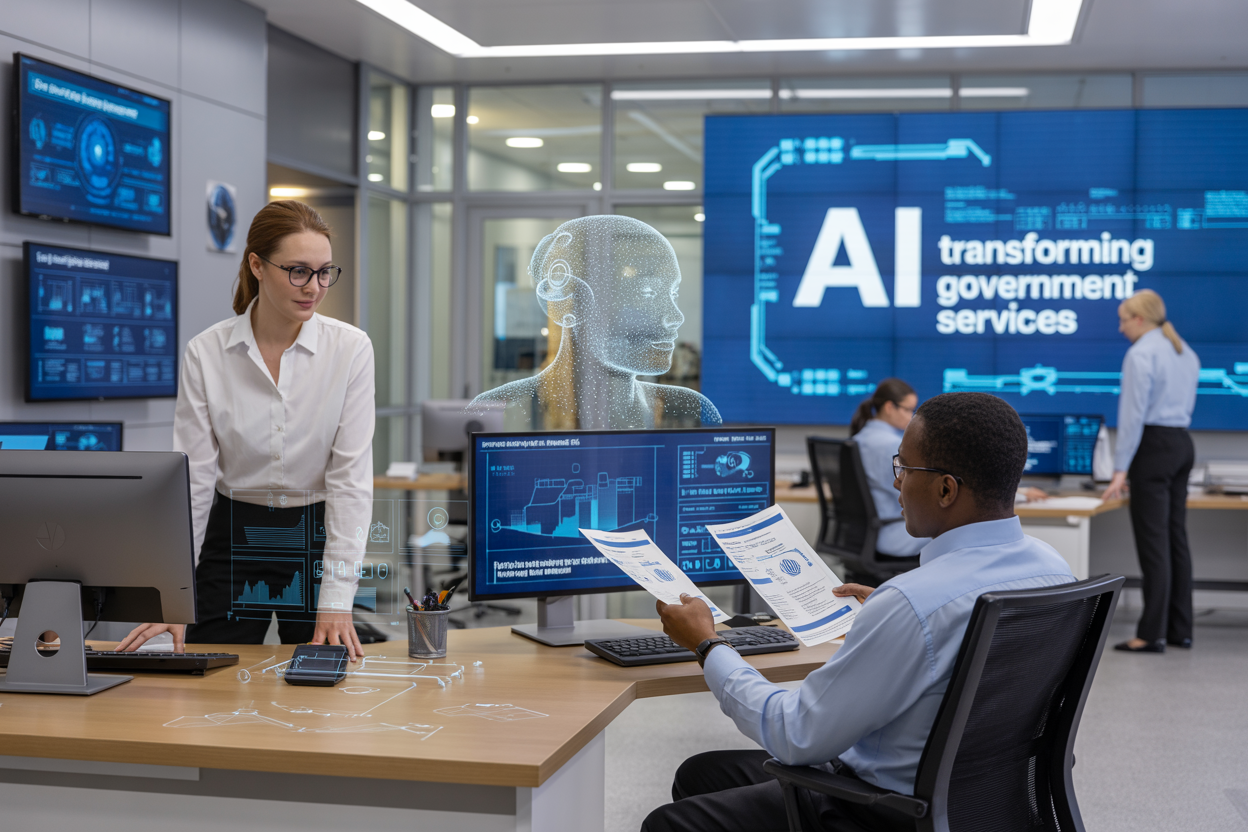
Government agencies across the globe are discovering how AI and generative AI government services can completely change the way they connect with citizens. This transformation touches everyone – from taxpayers seeking faster responses to their inquiries, to government employees looking for smarter ways to handle their daily tasks.
Who This Guide Helps
This comprehensive overview serves government leaders, IT directors, policy makers, and public sector employees who want to understand how digital transformation public sector initiatives can improve their operations. Whether you manage citizen services or oversee administrative processes, you’ll find practical insights for your situation.
What We’ll Explore
We’ll walk through how intelligent government systems are streamlining everything from permit applications to emergency response times. You’ll discover specific examples of AI automation citizen services that reduce wait times and improve accuracy. We’ll also examine the real challenges agencies face during government AI implementation, including budget constraints and staff training needs, plus proven strategies for measuring success and calculating return on investment.
The shift toward AI-powered government operations isn’t just about adopting new technology – it’s about creating more responsive, efficient public services that actually work better for everyone involved.
Understanding AI and Generative AI Technologies in Public Sector Context

Defining Traditional AI Applications for Government Operations
Traditional AI in government focuses on rule-based systems and machine learning algorithms that automate routine processes and analyze structured data. These systems excel at pattern recognition, data classification, and predictive analytics across various government operations.
Common applications include fraud detection in social services, where AI algorithms flag suspicious benefit claims by analyzing spending patterns and eligibility criteria. Tax agencies deploy AI systems to identify potential audit candidates by examining filing anomalies and cross-referencing multiple data sources. Immigration services use AI-powered document verification systems to authenticate passports and visas, significantly reducing processing times.
Key Traditional AI Applications:
- Automated form processing and data extraction
- Predictive maintenance for government infrastructure
- Traffic management and optimization systems
- Budget forecasting and resource allocation models
- Citizen service chatbots with pre-programmed responses
These AI systems typically require extensive training on historical government data and operate within clearly defined parameters. They excel at handling high-volume, repetitive tasks while maintaining consistency and accuracy levels that surpass human capabilities in specific domains.
Exploring Generative AI Capabilities and Unique Value Propositions
Generative AI brings transformative capabilities to government operations through its ability to create new content, generate insights, and adapt to diverse scenarios without extensive pre-programming. Unlike traditional AI systems, generative AI can produce human-like text, synthesize complex reports, and provide contextual responses to unique citizen inquiries.
Government agencies are discovering generative AI’s potential in policy drafting, where the technology assists in creating initial policy frameworks based on existing regulations and best practices. Public communication teams leverage generative AI to craft personalized citizen notifications, translating complex legal language into accessible formats across multiple languages.
Unique Value Propositions:
- Dynamic content creation for public communications
- Real-time language translation for multilingual services
- Automated report generation from complex datasets
- Interactive policy simulation and scenario planning
- Personalized citizen service recommendations
Generative AI’s ability to understand context and generate relevant responses makes it particularly valuable for citizen-facing services. Rather than following rigid scripts, these systems can engage in natural conversations, ask clarifying questions, and provide tailored solutions based on individual circumstances.
Key Differences Between AI and Generative AI in Government Use Cases
The fundamental distinction lies in how these technologies approach problem-solving and interaction patterns. Traditional AI operates through pattern matching and classification, making it ideal for standardized processes with predictable outcomes. Generative AI creates original responses and adapts to novel situations, making it suitable for complex, variable interactions.
| Traditional AI | Generative AI |
|---|---|
| Processes structured data efficiently | Creates new content and insights |
| Follows predetermined decision trees | Adapts responses based on context |
| Best for repetitive, rule-based tasks | Excels at creative and analytical tasks |
| Limited to training data patterns | Generates novel solutions and approaches |
| Requires extensive domain-specific training | Leverages broad knowledge across domains |
In citizen services, traditional AI might route inquiries to appropriate departments based on keywords, while generative AI can understand the citizen’s actual problem and provide comprehensive guidance. For policy analysis, traditional AI identifies trends in existing data, whereas generative AI can simulate policy outcomes and generate alternative approaches.
Government agencies benefit most when deploying both technologies strategically – using traditional AI for high-volume processing tasks and generative AI for complex problem-solving and citizen engagement scenarios.
Essential Infrastructure Requirements for Successful Implementation
Successful AI implementation in government requires robust technological foundations, comprehensive data governance frameworks, and skilled personnel capable of managing complex AI systems. Government agencies must establish secure, scalable computing infrastructure that meets stringent security and compliance requirements.
Core Infrastructure Components:
- High-performance computing resources with government-grade security
- Comprehensive data management platforms with encryption and access controls
- API integration capabilities for connecting legacy systems
- Real-time monitoring and audit systems for AI decision tracking
- Backup and disaster recovery systems for continuous operations
Data quality and accessibility pose significant challenges for government AI initiatives. Agencies often manage information across disparate systems, requiring substantial data integration and standardization efforts before AI deployment. Establishing clear data ownership, privacy protection protocols, and inter-agency sharing agreements becomes critical for successful implementation.
Staff training and change management represent equally important infrastructure elements. Government employees need training on AI capabilities, limitations, and oversight responsibilities. Creating cross-functional teams that include IT specialists, domain experts, and ethics advisors helps ensure AI systems align with public service objectives while maintaining accountability and transparency standards that citizens expect from their government services.
Streamlining Citizen Services Through Intelligent Automation

Accelerating Application Processing and Permit Approvals
Government agencies handle millions of applications annually, from business licenses to building permits, creating bottlenecks that frustrate citizens and drain resources. AI automation citizen services are changing this landscape by processing routine applications in minutes rather than weeks.
Machine learning algorithms now review permit applications by automatically checking compliance against zoning laws, building codes, and environmental regulations. Cities like Miami and Austin have reduced permit processing times by 60% using AI systems that flag potential issues early and route complex cases to human reviewers. These intelligent government systems can cross-reference multiple databases simultaneously, catching inconsistencies that might take human staff hours to identify.
The real game-changer comes with generative AI’s ability to prepare draft responses and recommendations. When an application requires clarification, AI can generate personalized requests for additional information, explaining exactly what’s needed in plain language. This eliminates the back-and-forth confusion that typically extends processing times.
| Traditional Process | AI-Enhanced Process |
|---|---|
| 15-30 business days | 3-7 business days |
| Manual document review | Automated compliance checking |
| Sequential processing | Parallel workflow management |
| High error rates | 95%+ accuracy |
Smart routing systems ensure applications reach the right department immediately, while predictive analytics help agencies anticipate volume surges and allocate staff accordingly. The result? Citizens get faster approvals, government workers focus on complex cases requiring human judgment, and agencies can handle increased application volumes without expanding staff.
Enhancing 24/7 Customer Support with AI-Powered Chatbots
Citizens don’t keep business hours, and neither should government services. AI-powered government operations now provide round-the-clock support through sophisticated chatbots that handle everything from tax questions to service requests.
Modern government chatbots go far beyond simple FAQ responses. They access real-time databases to provide personalized information about application status, payment due dates, and service appointments. When a resident asks about their property tax assessment, the chatbot pulls current records and explains how the assessment was calculated, what appeals options exist, and when payments are due.
Generative AI government services enable these systems to understand complex, multi-part questions and provide comprehensive answers. A citizen might ask, “I’m starting a food truck business downtown. What permits do I need, how much will they cost, and where can I park legally?” The AI breaks down this query, identifies all relevant permits, calculates total fees, and provides zone-specific parking regulations in a single, coherent response.
The multilingual capabilities of these systems break down language barriers that historically prevented many citizens from accessing services. Real-time translation ensures that language never becomes an obstacle to government interaction.
Analytics from chatbot interactions reveal common pain points and frequently misunderstood policies, helping agencies improve their services proactively. When the AI notices repeated confusion about a particular process, it alerts staff to review and clarify that information across all channels.
Personalizing Citizen Interactions Based on Individual Needs
Every citizen has unique circumstances, yet traditional government services often apply one-size-fits-all approaches. Digital transformation public sector initiatives now leverage AI to create personalized experiences that adapt to individual situations and preferences.
AI systems analyze interaction history, demographic data, and stated preferences to customize service delivery. A senior citizen might receive information in larger fonts with simplified language and phone callback options, while a tech-savvy young professional gets detailed online guides and mobile-friendly interfaces.
Smart government solutions predict what services citizens might need based on life events and circumstances. When someone registers a new business, the system proactively suggests relevant licenses, tax registrations, and compliance requirements. New parents automatically receive information about birth certificate processing, childcare licensing requirements, and family support services.
Behavioral analytics help agencies understand how different groups prefer to interact with government services. Some demographics prefer video explanations, others want step-by-step written instructions, and many need phone support. AI ensures each citizen receives information in their preferred format.
Predictive modeling identifies citizens who might benefit from specific programs or services they’re unaware of. Veterans might receive targeted information about benefits they haven’t claimed, while small business owners get alerts about relevant grant opportunities. This proactive approach transforms government from a reactive service provider into a helpful partner that anticipates citizen needs.
The personalization extends to communication timing and channels. AI learns when individual citizens are most likely to engage with messages and through which platforms, dramatically improving response rates and service uptake.
Revolutionizing Administrative Operations and Workflow Management

Automating Document Processing and Data Entry Tasks
Government agencies handle massive volumes of paperwork daily, from permit applications to tax forms and benefits claims. AI in government operations has transformed this traditionally labor-intensive process through intelligent automation systems that can read, interpret, and process documents with remarkable accuracy.
Modern AI systems equipped with optical character recognition (OCR) and natural language processing capabilities can extract relevant information from various document formats, including handwritten forms, scanned PDFs, and digital submissions. These systems automatically populate databases, flag incomplete applications, and route documents to appropriate departments without human intervention.
For example, tax processing agencies now use AI-powered systems that can analyze thousands of returns per hour, identifying patterns that might indicate errors or fraud while ensuring compliance with regulations. Similarly, immigration services leverage document automation to process visa applications, reducing processing times from weeks to days.
The accuracy rates of these AI systems often exceed human performance, particularly for routine data entry tasks. Machine learning algorithms continuously improve by learning from corrections and updates, creating a self-optimizing system that becomes more efficient over time.
Optimizing Resource Allocation Through Predictive Analytics
Predictive analytics powered by AI helps government agencies make smarter decisions about resource deployment and budget allocation. By analyzing historical data, current trends, and external factors, these systems provide insights that enable proactive planning rather than reactive responses.
Emergency services departments use predictive models to determine optimal staffing levels based on factors like weather patterns, local events, and historical incident data. This approach ensures adequate coverage during peak demand periods while avoiding unnecessary overtime costs during slower periods.
Budget planning benefits significantly from AI-driven forecasting models that analyze spending patterns, economic indicators, and demographic changes. These tools help agencies:
- Predict future service demand with greater accuracy
- Identify potential budget shortfalls before they occur
- Optimize procurement timing to take advantage of market conditions
- Allocate staff resources to high-priority areas
Public works departments utilize predictive maintenance algorithms to schedule infrastructure repairs before failures occur, extending asset lifespans and reducing emergency repair costs. These systems analyze sensor data, maintenance histories, and environmental factors to create comprehensive maintenance schedules.
Reducing Administrative Costs and Processing Times
Digital transformation through AI automation delivers substantial cost savings and efficiency gains across government operations. Routine administrative tasks that previously required hours of manual work can now be completed in minutes through intelligent automation.
Processing times for common services have decreased dramatically. Permit applications that once took weeks for review can now be processed within days through automated compliance checking and risk assessment. Business license renewals happen almost instantaneously when AI systems verify that all requirements are met.
The financial impact is significant. Agencies report cost reductions of 30-50% in administrative operations after implementing AI-powered workflow systems. These savings come from:
| Cost Reduction Area | Typical Savings |
|---|---|
| Manual data entry elimination | 40-60% |
| Reduced processing errors | 25-35% |
| Faster application approvals | 45-70% |
| Decreased staff overtime | 20-40% |
Staff members previously tied up with routine tasks can now focus on complex cases requiring human judgment and citizen interaction, improving overall service quality while maintaining or reducing operational costs.
Improving Interdepartmental Communication and Coordination
AI-powered government operations break down traditional silos between departments through integrated communication platforms and shared data systems. These systems create seamless information flow that enables better coordination and collaboration across agencies.
Smart routing systems automatically direct inquiries and requests to the most appropriate department based on content analysis and historical patterns. Citizens no longer need to navigate complex bureaucratic structures to find the right office for their needs.
Real-time data sharing between departments eliminates duplicate data collection and reduces citizen frustration with repetitive form filling. When someone applies for multiple services, AI systems can pre-populate forms with information already on file, creating a more streamlined experience.
Cross-departmental projects benefit from AI-driven project management tools that track progress, identify potential conflicts, and suggest resource reallocation. These systems provide visibility into interdependencies that might otherwise go unnoticed until problems arise.
Enhancing Decision-Making Through Real-Time Data Analysis
Government leaders now have access to real-time dashboards and analytics that provide comprehensive views of operations across all departments. AI systems continuously monitor key performance indicators, alert managers to developing issues, and suggest corrective actions based on historical success patterns.
Policy implementation becomes more effective when supported by data-driven insights. AI systems can model the potential impact of proposed changes, helping decision-makers understand likely outcomes before implementation. This capability reduces the risk of unintended consequences and improves policy effectiveness.
Performance monitoring happens automatically through AI systems that track service delivery metrics, citizen satisfaction scores, and operational efficiency indicators. Managers receive alerts when metrics fall outside acceptable ranges, enabling quick responses to emerging problems.
Strategic planning benefits from AI’s ability to identify trends and patterns that might not be apparent to human analysts. These insights help government agencies anticipate future challenges and opportunities, enabling proactive rather than reactive governance approaches.
Transforming Public Safety and Security Services

Strengthening Emergency Response Systems with Predictive Modeling
AI in government transforms how emergency services predict and respond to crises. Predictive modeling analyzes historical data, weather patterns, population density, and real-time sensor information to forecast potential emergencies before they escalate. Fire departments now use machine learning algorithms that predict high-risk areas for wildfires by analyzing humidity levels, wind speeds, and vegetation dryness. These systems help deploy resources strategically rather than reactively.
Emergency management agencies leverage predictive analytics to anticipate natural disasters. Hurricane tracking models powered by AI provide more accurate landfall predictions, giving communities extra time to evacuate. Flood prediction systems analyze rainfall patterns, soil saturation, and river levels to alert residents hours or even days before flooding occurs.
During active emergencies, AI-powered dispatch systems optimize resource allocation. Machine learning algorithms analyze call patterns, traffic conditions, and available units to route ambulances and fire trucks along the fastest paths. Some cities report 15-20% faster response times after implementing these intelligent dispatch systems.
Generative AI government services extend to creating emergency communication materials. AI systems generate multilingual evacuation notices, safety instructions, and real-time updates tailored to specific communities. This ensures critical information reaches diverse populations quickly and accurately during high-stress situations.
Improving Crime Prevention Through Advanced Pattern Recognition
Law enforcement agencies harness AI automation citizen services to identify crime patterns invisible to human analysts. Advanced pattern recognition systems process vast amounts of data from police reports, surveillance cameras, social media, and public records to predict where crimes might occur. These predictive policing tools don’t replace human judgment but provide valuable insights for strategic deployment of patrol units.
Computer vision technology analyzes surveillance footage to detect suspicious activities in real-time. Airport security systems identify unattended baggage, recognize faces on watchlists, and flag unusual behavior patterns. Public transportation networks use similar technology to monitor platforms and trains for safety threats.
Social media monitoring tools help law enforcement identify potential threats before they materialize. AI systems scan public posts for keywords, images, and patterns associated with planned violence or criminal activity. This capability proved crucial in preventing several planned attacks on public events and government facilities.
Criminal investigation departments benefit from AI tools that analyze digital evidence. Machine learning algorithms process cell phone data, financial records, and communication patterns to uncover criminal networks. DNA analysis powered by AI helps solve cold cases by matching samples with expanded databases more efficiently than traditional methods.
Digital forensics teams use AI to process enormous volumes of electronic evidence quickly. These tools extract relevant information from seized computers, smartphones, and cloud storage accounts, dramatically reducing investigation timelines from months to weeks.
Enhancing Cybersecurity Measures for Government Systems
Government agencies face sophisticated cyber threats requiring equally advanced defenses. AI-powered government operations include cybersecurity systems that monitor network traffic 24/7, detecting anomalies that might indicate attacks. These systems learn normal behavior patterns and immediately flag deviations that could signal intrusions.
Threat detection algorithms analyze millions of data points per second, identifying malware signatures, unusual login patterns, and suspicious file transfers. Machine learning models continuously evolve as they encounter new attack vectors, staying ahead of cybercriminals who constantly adapt their methods.
Automated incident response systems contain threats without human intervention when every second counts. AI systems can isolate compromised devices, block malicious IP addresses, and prevent data exfiltration while security teams mobilize. This rapid response capability prevents minor breaches from becoming major security incidents.
Government digital innovation includes AI systems that test cybersecurity defenses through simulated attacks. These tools continuously probe networks for vulnerabilities, identifying weak points before malicious actors discover them. Automated penetration testing ensures security measures remain effective as systems evolve.
Identity and access management systems use behavioral analytics to verify user authenticity. AI monitors typing patterns, mouse movements, and access habits to detect account compromises. When someone’s behavior deviates from established patterns, the system triggers additional authentication steps or temporarily restricts access.
Public sector AI adoption in cybersecurity extends to protecting citizen data. AI systems monitor databases containing personal information, ensuring unauthorized access attempts are blocked immediately. These protective measures build public trust in digital government services by demonstrating robust security practices.
Modernizing Healthcare and Social Services Delivery

Streamlining Benefit Distribution and Eligibility Verification
Government agencies have discovered that AI in government systems can dramatically cut down the time it takes to process benefit applications from weeks to just hours. Traditional eligibility verification often involves multiple caseworkers manually reviewing stacks of paperwork, but intelligent automation now handles these tasks with remarkable accuracy.
Machine learning algorithms analyze income statements, employment records, and family circumstances to determine eligibility for programs like SNAP, Medicaid, and housing assistance. The system cross-references data from multiple government databases, catching inconsistencies that human reviewers might miss while speeding up the approval process.
Citizens can upload documents through mobile apps, and AI immediately extracts relevant information, flags missing paperwork, and guides applicants through next steps. This eliminates the frustrating back-and-forth that used to characterize benefit applications. Real-time eligibility checks also prevent fraud by identifying duplicate applications or inconsistent information across different programs.
Some states report reducing benefit processing times by up to 75% while maintaining higher accuracy rates than manual reviews. The technology also helps caseworkers focus on complex cases that need human judgment rather than getting bogged down in routine paperwork.
Improving Healthcare Access Through Telemedicine Integration
Generative AI government services are transforming how public health systems deliver care to underserved populations. AI-powered chatbots now provide initial health screenings, helping citizens determine whether they need immediate medical attention or can manage symptoms at home.
These systems integrate seamlessly with telemedicine platforms, automatically scheduling appointments based on symptom severity and doctor availability. The AI can even prepare preliminary assessments for healthcare providers, summarizing patient symptoms and medical history before virtual consultations begin.
Rural communities benefit tremendously from this technology. Citizens living hours away from the nearest hospital can receive quality healthcare guidance without traveling long distances. AI translation services also break down language barriers, ensuring non-English speakers receive the same level of care.
Public health departments use predictive analytics to identify potential disease outbreaks by analyzing patterns in symptom reports across different geographic areas. This early warning system helped several municipalities respond faster to COVID-19 variants and seasonal flu spikes.
The cost savings are substantial too. Virtual consultations cost roughly 40% less than in-person visits, and AI triage reduces unnecessary emergency room visits by directing patients to appropriate care levels.
Personalizing Social Services Based on Citizen Demographics
Digital transformation in the public sector now enables government agencies to tailor social services to individual needs rather than applying one-size-fits-all solutions. AI systems analyze demographic data, family composition, employment history, and geographic location to recommend specific programs and services.
For example, a single mother with young children might receive information about childcare assistance, job training programs, and nutrition support all in one coordinated package. Meanwhile, an elderly citizen could get connected with transportation services, Medicare guidance, and local senior centers.
The technology goes beyond simple demographic matching. It considers factors like previous service usage, cultural preferences, and accessibility needs. Citizens with disabilities automatically receive information about services in accessible formats, while Spanish-speaking residents get communications in their preferred language.
Government agencies report that personalized service delivery increases program participation rates by up to 60%. Citizens are more likely to engage with services when they understand how programs specifically benefit their situation.
Smart government solutions also help case managers prioritize their caseloads. The system flags high-risk situations that need immediate attention while routing routine requests to automated processes.
Reducing Healthcare Costs Through Preventive Care Predictions
Public sector AI adoption in healthcare focuses heavily on preventing expensive medical emergencies before they happen. Predictive algorithms analyze patient data to identify individuals at high risk for chronic conditions like diabetes, heart disease, and hypertension.
These AI-powered government operations can spot warning signs in routine health screenings that human reviewers might overlook. For instance, the system might notice that a patient’s blood pressure readings, combined with family history and lifestyle factors, indicate a high probability of developing cardiovascular problems within the next two years.
Healthcare providers then reach out proactively with prevention programs. Patients receive personalized nutrition plans, exercise recommendations, and medication management support designed to prevent serious health issues from developing.
The financial impact is significant. Preventing one heart attack saves the healthcare system approximately $50,000 in emergency treatment costs. Diabetes prevention programs cost around $1,500 per person but avoid roughly $10,000 in annual treatment expenses for each case prevented.
Government health systems also use AI to optimize resource allocation. The technology predicts seasonal demand for different services, helping hospitals staff appropriately and maintain adequate medication supplies. This reduces both costs and wait times while improving patient outcomes across the board.
Public sector technology modernization through preventive care AI has already shown measurable results in pilot programs, with some regions reporting 25% reductions in preventable hospitalizations within the first year of implementation.
Overcoming Implementation Challenges and Barriers

Addressing Privacy Concerns and Data Security Requirements
Privacy protection stands as the biggest hurdle when implementing AI in government services. Citizens rightfully worry about how their personal data gets collected, stored, and processed by intelligent systems. Government agencies must establish robust data governance frameworks that clearly define what information gets accessed and why.
Building trust requires transparent communication about data usage policies. Citizens need to understand exactly how AI systems process their information and what safeguards protect their privacy. Many successful government AI implementations include privacy-by-design principles, meaning data protection measures are built into the system from the ground up rather than added afterward.
Encryption, access controls, and regular security audits become non-negotiable requirements. Government agencies should implement multi-layered security approaches that include both technical measures and human oversight. Regular vulnerability assessments help identify potential weak points before they become problems.
Data minimization practices ensure AI systems only collect information absolutely necessary for their function. This approach reduces privacy risks while maintaining system effectiveness. Government organizations also benefit from establishing clear data retention policies that automatically delete information after specified periods.
Managing Budget Constraints and Resource Limitations
Government AI implementation faces significant financial challenges that require creative solutions and strategic planning. Budget limitations often force agencies to prioritize which AI projects deliver the highest impact for citizens while staying within allocated resources.
Smart procurement strategies help maximize value from available funds. Many agencies find success with phased rollouts that spread costs over multiple budget cycles. Starting with pilot programs allows organizations to demonstrate value and secure additional funding for larger implementations.
Cloud-based AI solutions often provide more cost-effective alternatives to building in-house systems. These platforms reduce upfront infrastructure investments while providing access to cutting-edge technology. Government agencies can leverage shared services and collaborative purchasing agreements to reduce individual costs.
Resource sharing between departments creates economies of scale. When multiple agencies coordinate their AI initiatives, they can share development costs, technical expertise, and best practices. This collaborative approach often produces better results than isolated departmental efforts.
Training Government Personnel for AI Technology Adoption
Successful government AI implementation depends heavily on having skilled personnel who understand both the technology and its applications in public service. Many government workers feel intimidated by AI systems, creating resistance that can derail even well-planned initiatives.
Comprehensive training programs need to address different skill levels within the organization. Technical staff require deep knowledge of AI system configuration and maintenance, while front-line employees need practical knowledge about how AI tools enhance their daily work. Managers need strategic understanding of AI capabilities and limitations.
Hands-on learning approaches work better than theoretical presentations. Government agencies benefit from creating sandbox environments where employees can experiment with AI tools without affecting live systems. This practice-based learning builds confidence and competency simultaneously.
Change management strategies help address cultural resistance to new technology. Some employees worry that AI will replace their jobs, while others feel overwhelmed by learning new systems. Effective training programs address these concerns directly while highlighting how AI enhances rather than replaces human capabilities.
Ongoing education ensures staff stay current with rapidly evolving AI technologies. Regular workshops, certification programs, and knowledge-sharing sessions help maintain expertise levels across the organization.
Ensuring Compliance with Regulatory Standards and Ethics
Government AI systems must navigate complex regulatory landscapes that vary by jurisdiction and application area. Compliance requirements often conflict with AI system capabilities, creating implementation challenges that require careful legal and technical consideration.
Algorithmic transparency becomes essential for maintaining public trust and meeting regulatory requirements. Government agencies must document how their AI systems make decisions, especially in high-impact areas like benefits determination or law enforcement. This documentation helps ensure accountability and enables external audits.
Bias detection and mitigation represent critical compliance challenges. AI systems can inadvertently discriminate against certain groups if not properly designed and monitored. Regular testing for bias across different demographic groups helps identify problems before they affect citizens.
Ethics committees provide valuable oversight for government AI projects. These groups review proposed implementations for potential ethical concerns and ongoing monitoring of deployed systems. Including diverse perspectives on ethics committees helps identify issues that technical teams might miss.
Legal frameworks for AI in government continue evolving, requiring agencies to stay informed about changing requirements. Proactive compliance strategies include working with legal counsel throughout the development process rather than waiting until deployment. This approach helps identify potential issues early when they’re easier and less expensive to address.
Human oversight mechanisms ensure AI systems remain accountable to human judgment. Even the most sophisticated AI systems require human review for critical decisions affecting citizens’ lives. Clear escalation procedures help ensure complex cases receive appropriate human attention.
Measuring Success and Return on Investment

Tracking Efficiency Gains and Cost Savings Metrics
Government agencies implementing AI in government operations need concrete ways to measure their success. The most straightforward approach involves tracking operational efficiency improvements and direct cost reductions. Agencies should establish baseline measurements before deployment, capturing current processing times, staff hours required for specific tasks, and associated costs.
Key metrics include processing time reductions for citizen requests, automated case resolutions, and reduced manual intervention requirements. For example, AI-powered chatbots handling routine inquiries can reduce call center volumes by 60-80%, directly translating to staffing cost savings. Document processing automation through generative AI government services typically shows 70-90% reduction in processing times for permits, applications, and compliance reviews.
Financial tracking should encompass both direct savings (reduced labor costs, paper reduction, facility consolidation) and indirect benefits (faster service delivery leading to improved compliance rates, reduced error correction costs). Many agencies create dashboards showing real-time efficiency metrics, comparing pre-implementation baseline performance against current AI-enhanced operations.
Resource allocation optimization represents another critical measurement area. AI automation citizen services free up human workers for higher-value tasks, creating measurable productivity gains across departments. Smart scheduling and resource management systems can reduce overtime costs by 20-30% while improving service availability.
Monitoring Citizen Satisfaction and Service Quality Improvements
Citizen experience metrics provide essential feedback on whether digital transformation public sector initiatives actually improve public service delivery. Traditional satisfaction surveys remain valuable, but modern measurement approaches include real-time feedback collection, sentiment analysis of citizen interactions, and behavioral analytics from digital service platforms.
Response time improvements often show the most dramatic citizen satisfaction gains. When permit processing drops from weeks to days, or benefit applications process in hours rather than months, satisfaction scores typically increase significantly. Many agencies track Net Promoter Scores (NPS) specifically for different service categories, monitoring how AI implementation affects citizen willingness to recommend government services.
Quality metrics include accuracy improvements in decision-making processes, consistency across different service channels, and reduced error rates in document processing. AI-powered government operations typically demonstrate 95%+ accuracy rates compared to 85-90% for manual processing, directly impacting citizen trust and satisfaction.
Accessibility improvements represent another crucial measurement area. AI systems can provide 24/7 service availability, multi-language support, and enhanced accessibility features for citizens with disabilities. Usage analytics show increased service adoption rates, particularly among previously underserved populations.
Complaint resolution tracking reveals how AI systems handle service recovery. Automated escalation processes and intelligent routing can reduce complaint resolution times while improving first-contact resolution rates.
Evaluating Long-Term Impact on Government Modernization Goals
Government AI implementation success extends beyond immediate operational improvements to support broader modernization objectives. Long-term evaluation requires assessing how AI adoption advances strategic goals like improved transparency, enhanced data-driven decision making, and increased government agility.
Digital maturity assessments track progress across multiple dimensions: technological infrastructure, workforce capabilities, process modernization, and cultural adaptation to intelligent government systems. Many agencies use standardized frameworks to benchmark their AI adoption against peer organizations and industry standards.
Workforce transformation metrics capture how employees adapt to AI-augmented roles. Success indicators include increased job satisfaction among workers whose roles evolved from routine processing to complex problem-solving, skill development program completion rates, and retention improvements in modernized departments.
Data governance and analytics capabilities often improve significantly through AI implementation. Agencies can measure their enhanced ability to generate actionable insights, improve predictive capabilities for service demand, and create evidence-based policy recommendations. These improvements support better resource planning and more responsive service delivery.
Public sector technology modernization goals frequently include increased inter-agency collaboration and data sharing. AI platforms that enable seamless information exchange between departments create measurable improvements in coordinated service delivery and reduced citizen burden for multi-agency processes.
Innovation culture development represents a softer but crucial long-term metric. Agencies track their ability to pilot new technologies, adapt quickly to changing citizen needs, and maintain competitive service standards compared to private sector alternatives.

Government agencies worldwide are discovering that AI and generative AI technologies offer unprecedented opportunities to enhance public services and create more efficient operations. From automating routine administrative tasks to providing personalized citizen support, these tools are helping governments deliver faster, more accurate services while reducing costs and improving accessibility. The transformation spans across all sectors – from healthcare and social services to public safety and security – showing that no area of government remains untouched by this technological revolution.
The key to successful AI implementation lies in addressing challenges head-on while maintaining a clear focus on measurable outcomes and citizen satisfaction. Government leaders who invest time in proper planning, staff training, and robust measurement systems are seeing significant returns on their investments through reduced processing times, improved service quality, and higher citizen engagement rates. The future of government services is already here, and agencies that embrace AI technologies today will be better positioned to serve their communities tomorrow.