Shift-Left Testing: Embedding Automation into DevOps Workflows
Traditional software testing at the end of development cycles creates bottlenecks, delays releases, and increases fix costs. Shift-left testing changes this by moving automated testing earlier in the development process, catching bugs before they become expensive problems.
This guide is for DevOps engineers, QA professionals, and development teams who want to implement continuous testing practices that speed up delivery without sacrificing quality. You’ll learn how test automation tools integrate with your existing CI/CD testing pipelines and discover why early testing methodology has become essential for competitive software teams.
We’ll explore the core principles behind shift-left strategy and show you how to build a compelling business case for DevOps automation. You’ll also get practical guidance on selecting the right automated testing in DevOps tools and designing seamless DevOps integration strategies that actually work in real-world environments.
By the end, you’ll understand how agile testing practices fit into modern development workflows and have a clear roadmap for overcoming common implementation challenges that trip up most teams.
Understanding Shift-Left Testing Fundamentals

Define Shift-Left Testing Methodology and Core Principles
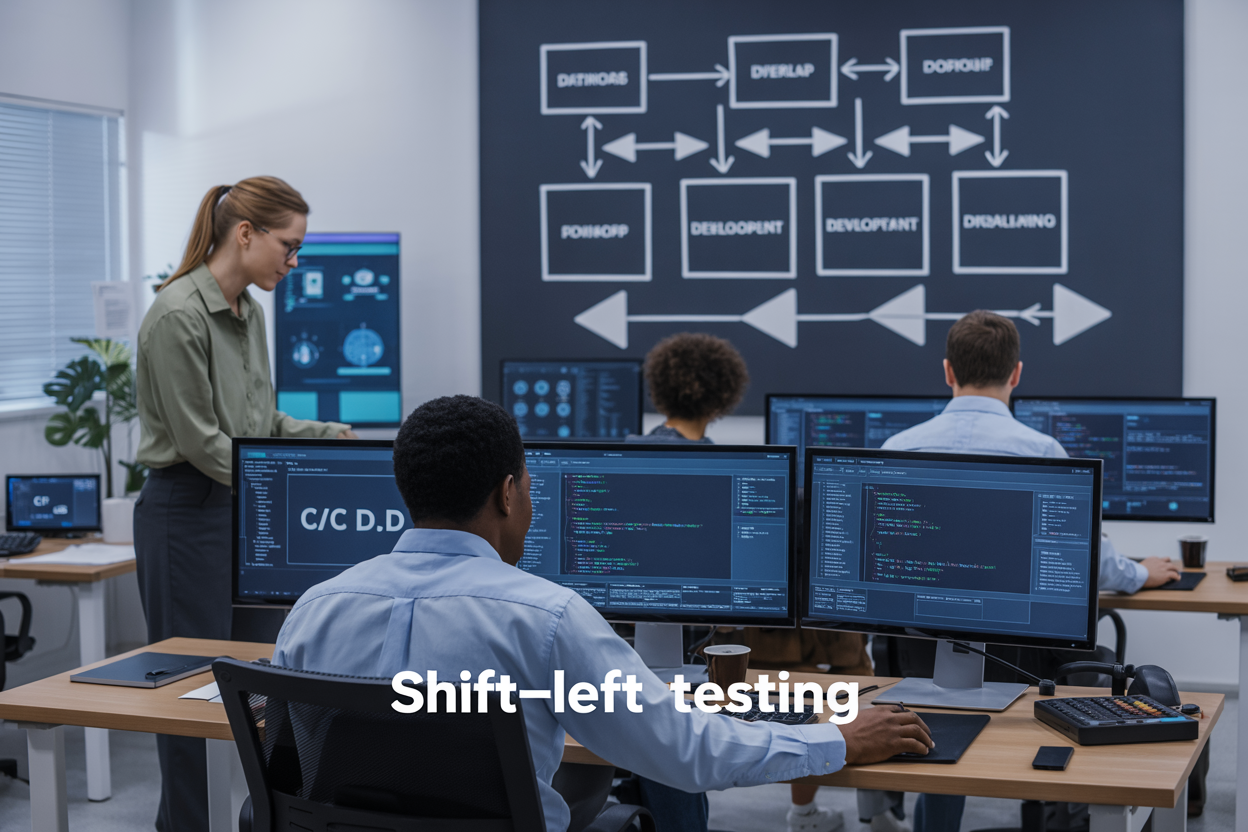
Shift-left testing represents a fundamental change in how teams approach quality assurance by moving testing activities earlier in the software development lifecycle. Instead of waiting until the end of development cycles, this early testing methodology integrates quality checks right from the planning and coding phases.
The core principles revolve around three key concepts: early detection, continuous feedback, and collaborative responsibility. Early detection means identifying bugs when they’re cheapest to fix – during development rather than after deployment. Continuous feedback creates rapid loops between developers and quality processes, while collaborative responsibility breaks down silos between development and testing teams.
This shift-left strategy operates on the premise that prevention costs less than correction. By embedding automated testing in DevOps pipelines from day one, teams catch issues before they compound into expensive problems. The methodology emphasizes writing tests alongside code, not after it, making quality a shared concern across all team members.
DevOps automation becomes the backbone of successful shift-left implementation, enabling teams to run comprehensive test suites automatically whenever code changes occur. This creates a safety net that allows developers to move fast while maintaining confidence in their changes.
Compare Traditional Testing vs. Shift-Left Approaches
Traditional testing follows a waterfall-like sequence where development happens first, followed by dedicated testing phases. This approach often creates bottlenecks, with testing teams scrambling to validate entire applications under tight deadlines. Bugs discovered late in the cycle require expensive rollbacks and emergency fixes.
| Aspect | Traditional Testing | Shift-Left Testing |
|---|---|---|
| Timing | End of development cycle | Throughout development |
| Responsibility | Dedicated QA team | Shared across all roles |
| Bug Detection | Post-development | During development |
| Cost of Fixes | High (late discovery) | Low (early discovery) |
| Feedback Speed | Days to weeks | Minutes to hours |
| Automation Level | Limited, manual-heavy | Extensive CI/CD testing |
Shift-left approaches flip this model entirely. Continuous testing runs automatically with every code commit, providing immediate feedback to developers. This creates shorter feedback loops and prevents problematic code from progressing through the pipeline.
The shift-left model integrates seamlessly with agile testing practices, supporting rapid iterations without sacrificing quality. Teams can deploy multiple times per day because automated checks validate changes continuously, building confidence in the deployment process.
Identify Key Benefits of Early Testing Integration
Early testing integration delivers measurable improvements across multiple dimensions of software development. Cost reduction stands as the most significant benefit – fixing bugs during development costs roughly 10 times less than fixing them in production. This dramatic cost difference stems from reduced debugging complexity and eliminated rework cycles.
Development velocity increases substantially when teams adopt DevOps integration for testing. Developers receive instant feedback about code quality, allowing them to correct issues immediately while the context remains fresh in their minds. This eliminates the traditional delay between writing code and discovering problems.
Test automation tools enable teams to run comprehensive validation suites that would be impossible to execute manually within rapid deployment cycles. These tools can execute thousands of tests in minutes, providing coverage that manual testing simply cannot match at the speed modern applications demand.
Risk mitigation becomes proactive rather than reactive. Instead of hoping testing catches issues before release, shift-left practices prevent problematic code from entering the main codebase. This creates more stable releases and reduces the frequency of emergency hotfixes.
Team collaboration improves dramatically when quality becomes everyone’s responsibility. Developers gain deeper understanding of user requirements through early testing involvement, while testing professionals contribute to better application architecture decisions.
Recognize Common Misconceptions About Shift-Left Implementation
Many organizations believe shift-left testing means eliminating dedicated testing roles entirely. This misconception leads to inadequate quality strategies where developers attempt to cover all testing aspects without proper expertise. Successful shift-left implementations actually enhance testing roles by freeing QA professionals from repetitive manual tasks, allowing them to focus on complex scenarios and user experience validation.
Another prevalent myth suggests that shift-left strategy requires complete automation from day one. Teams often delay implementation thinking they need perfect automated test coverage before starting. Reality shows that gradual automation works better – starting with critical path testing and expanding coverage over time creates sustainable progress.
Some teams assume shift-left testing works only for new projects, dismissing it for legacy applications. While greenfield projects benefit from shift-left approaches more easily, legacy systems can adopt these practices incrementally. Starting with automated testing in DevOps pipelines for new features and gradually expanding coverage proves effective for established codebases.
The misconception that shift-left testing slows down initial development creates resistance to adoption. While teams may initially spend more time writing tests alongside code, this investment pays dividends quickly through reduced debugging time and fewer production incidents. The apparent slowdown in feature development speed gets offset by dramatic reductions in bug-fixing cycles.
Organizations sometimes believe that successful shift-left implementation requires expensive test automation tools and infrastructure investments. While good tooling helps, many effective implementations start with simple, open-source solutions and grow their toolchain as needs expand.
Building the Business Case for Shift-Left Automation

Calculate cost savings from early defect detection
The financial impact of shifting testing left becomes crystal clear when you crunch the numbers. Studies consistently show that fixing a bug during development costs 10 times less than fixing it during system testing, and up to 100 times less than fixing it after production deployment. For a typical software project with a $1 million budget, this translates to saving anywhere from $50,000 to $200,000 by catching defects early through shift-left testing practices.
Consider a real-world scenario: A critical security vulnerability discovered during development might cost $5,000 to fix, including developer time and code review. The same vulnerability found in production could cost $500,000 when you factor in emergency patches, security audits, customer notifications, potential data breach penalties, and reputation damage.
Your automated testing in DevOps pipeline creates multiple checkpoints where defects get caught before they escalate. Static code analysis tools catch syntax errors and security vulnerabilities during the coding phase. Unit tests identify logic flaws immediately after code commits. Integration tests reveal interface problems before components reach staging environments.
Track these metrics to build your business case:
- Defect detection rate by phase – Measure how many bugs you catch in development vs. later stages
- Average cost per defect by discovery phase – Document the escalating costs
- Rework effort reduction – Calculate time saved by avoiding late-stage fixes
- Production incident reduction – Track the decrease in emergency fixes and hotfixes
Demonstrate improved time-to-market advantages
Shift-left strategy dramatically accelerates your release cycles by eliminating the traditional bottlenecks that plague software delivery. Teams practicing early testing methodology report 30-50% faster deployment cycles compared to traditional testing approaches.
The acceleration happens through parallel processing rather than sequential handoffs. While developers write code, automated tests run continuously in the background. CI/CD testing provides instant feedback, allowing teams to address issues immediately instead of waiting weeks for dedicated testing phases.
Consider these time-to-market improvements:
| Traditional Approach | Shift-Left Approach | Time Saved |
|---|---|---|
| 8-week development + 4-week testing | 8-week integrated dev/test | 4 weeks |
| 3-day bug fix cycles | Same-day automated feedback | 2.5 days per issue |
| 2-week regression testing | Continuous automated regression | 1.5 weeks |
Your DevOps automation eliminates waiting periods that traditionally slow down releases. Developers don’t wait for testing teams to become available. Testing teams don’t wait for “complete” builds to start their work. Product managers don’t wait for lengthy bug-fix cycles to close out releases.
The competitive advantage becomes obvious when you can ship features monthly instead of quarterly, or weekly instead of monthly. Companies using shift-left testing often report being first-to-market with new features, directly translating to increased market share and revenue opportunities.
Quantify quality improvements and customer satisfaction gains
Quality metrics tell a compelling story when you implement continuous testing practices. Customer-facing defects typically drop by 40-60% within the first year of adopting shift-left testing, while customer satisfaction scores show measurable improvement.
Your test automation tools create comprehensive coverage that human testing simply can’t match at scale. Automated regression suites run thousands of test cases with every code change, catching edge cases and integration problems that manual testing might miss.
Track these quality indicators to demonstrate value:
- Customer-reported defects per release – Watch this number decline steadily
- Mean time to resolution (MTTR) – Faster problem identification leads to quicker fixes
- Feature adoption rates – Higher quality features see better user adoption
- Customer churn related to quality issues – Document the reduction in quality-driven cancellations
User experience improvements become measurable through application performance monitoring integrated into your DevOps integration. Page load times improve when performance tests catch bottlenecks early. User interface bugs decrease when automated UI testing validates every user journey before release.
Customer satisfaction surveys reveal the human impact of technical improvements. Users report higher confidence in your software when they encounter fewer bugs. Support ticket volume decreases as quality issues get resolved before reaching production. Net Promoter Scores often increase as customers experience more reliable, polished software products.
The compound effect of these improvements builds long-term business value beyond immediate cost savings, creating a sustainable competitive advantage through superior software quality.
Essential Tools and Technologies for Shift-Left Success

Select appropriate test automation frameworks
Choosing the right test automation framework sets the foundation for successful shift-left testing implementation. Your framework selection impacts everything from development speed to maintenance overhead, making this decision crucial for long-term DevOps automation success.
Popular Framework Options:
| Framework | Best For | Key Strengths |
|---|---|---|
| Jest | JavaScript/Node.js | Fast execution, built-in mocking |
| Selenium WebDriver | Cross-browser testing | Wide browser support, mature ecosystem |
| Cypress | Modern web apps | Real-time debugging, excellent DX |
| TestNG/JUnit | Java applications | Parallel execution, flexible configuration |
| Playwright | Multi-browser automation | Modern API, reliable element handling |
Consider these factors when making your choice:
- Technology stack alignment: Pick frameworks that integrate naturally with your development languages and tools
- Team expertise: Leverage existing knowledge while planning for skill development
- Execution speed: Faster feedback loops support continuous testing goals
- Maintenance burden: Simple, readable tests reduce long-term costs
- CI/CD compatibility: Seamless integration with your automated testing in DevOps pipelines
Start with unit test frameworks since they provide the fastest feedback. Pyramid-shaped test strategies work best – many unit tests, fewer integration tests, and minimal UI tests. This approach supports agile testing practices while keeping execution times manageable.
Integrate static code analysis tools effectively
Static code analysis catches issues before they reach runtime, making it a cornerstone of early testing methodology. These tools scan your codebase for potential bugs, security vulnerabilities, and code quality issues without executing the program.
Essential Tool Categories:
- Security scanners: SonarQube, Checkmarx, Veracode identify vulnerabilities early
- Code quality analyzers: ESLint, PMD, RuboCop enforce coding standards
- Dependency checkers: Snyk, WhiteSource, OWASP Dependency Check flag risky libraries
- Language-specific tools: mypy for Python, ktlint for Kotlin, golangci-lint for Go
Integration strategies that actually work:
Pre-commit hooks catch problems before they enter version control. Configure lightweight checks that run in seconds, not minutes. Developers won’t bypass tools that don’t slow them down.
IDE integration provides real-time feedback during coding. Most modern editors support plugins for popular analyzers, showing issues as red squiggles while you type.
Pull request automation runs comprehensive analysis on proposed changes. Set up quality gates that block merges when critical issues are found, but allow warnings to pass with team review.
Configure rules thoughtfully. Start with critical security and bug-detection rules, then gradually add style and maintainability checks. Too many rules upfront creates resistance and tool abandonment.
Implement continuous integration and deployment pipelines
CI/CD pipelines transform shift-left strategy from concept into practice by automating test execution at every code change. Well-designed pipelines provide rapid feedback while maintaining deployment confidence.
Pipeline Architecture Essentials:
Code Commit → Build → Unit Tests → Integration Tests → Security Scans → Deployment
Build stage optimization:
- Use parallel execution for faster completion
- Cache dependencies between runs
- Fail fast on compilation errors
- Generate artifacts once, promote through environments
Test execution strategy:
- Run fastest tests first (unit tests in under 5 minutes)
- Parallel test execution across multiple agents
- Smart test selection based on changed code areas
- Automatic retry for flaky tests with investigation triggers
Quality gates implementation:
- Code coverage thresholds (aim for 80%+ on new code)
- Security scan results (block on high/critical vulnerabilities)
- Performance regression checks
- Manual approval steps for production deployments
Popular platform choices include Jenkins, GitLab CI, GitHub Actions, and Azure DevOps. Each offers different strengths – GitLab provides integrated security scanning, GitHub Actions excels in open source workflows, while Jenkins offers maximum customization flexibility.
Pipeline-as-code practices keep your CI/CD configuration versioned alongside application code. This approach makes pipeline changes reviewable and enables consistent environments across teams.
Choose monitoring and observability solutions
Monitoring and observability close the feedback loop in shift-left testing by providing production insights that inform development practices. Modern observability goes beyond basic metrics to include distributed tracing, structured logging, and real user monitoring.
Core Observability Components:
- Metrics: Quantitative measurements (response times, error rates, throughput)
- Logs: Detailed event records for debugging and analysis
- Traces: Request flow visualization across distributed systems
- Real User Monitoring (RUM): Actual user experience data
Tool Selection Matrix:
| Category | Tools | Use Case |
|---|---|---|
| APM | New Relic, Datadog, AppDynamics | End-to-end performance monitoring |
| Logging | ELK Stack, Splunk, Fluentd | Centralized log aggregation |
| Metrics | Prometheus, Grafana, CloudWatch | System and business metrics |
| Tracing | Jaeger, Zipkin, AWS X-Ray | Distributed request tracking |
Implementation Strategy:
Start with application performance monitoring (APM) for immediate visibility into production behavior. APM tools provide out-of-the-box dashboards and alerting that help teams understand system health quickly.
Add structured logging early in the development process. Consistent log formats enable automated analysis and faster issue resolution. Include correlation IDs to trace requests across service boundaries.
Implement synthetic monitoring to catch issues before users do. Automated tests running against production endpoints detect problems during low-traffic periods.
Connect observability data back to development workflows. Set up alerts that create tickets automatically, and include monitoring links in deployment notifications. This connection helps developers understand the production impact of their changes and improves future development decisions.
Designing Effective DevOps Integration Strategies

Establish cross-functional team collaboration models
Breaking down traditional silos starts with creating dedicated cross-functional teams that bring together developers, testers, operations engineers, and product owners. These teams should work together from day one, sharing ownership of the entire application lifecycle rather than passing work between departments.
The most effective model involves embedded quality assurance engineers who sit directly with development teams, participating in sprint planning, daily standups, and retrospectives. This embedded approach ensures that shift-left testing becomes a natural part of the development process rather than an afterthought.
Consider implementing “Three Amigos” sessions where developers, testers, and business analysts collaborate on user story refinement before any code gets written. These sessions help identify potential testing scenarios early and ensure everyone understands both the technical requirements and business expectations.
Pod-based structures work exceptionally well for larger organizations. Each pod contains 6-10 people with all necessary skills to deliver features independently. This autonomy reduces dependencies and speeds up feedback cycles, making DevOps automation more effective.
Regular cross-team knowledge sharing sessions help spread testing expertise across the organization. Developers learn about testing methodologies while operations teams understand development challenges, creating a more cohesive approach to continuous testing.
Create seamless handoffs between development and operations
Eliminating handoff friction requires standardizing how teams communicate about deployments, configurations, and dependencies. Documentation should live in shared repositories where both developers and operations teams can access and update information in real-time.
Infrastructure as Code (IaC) becomes crucial here. When operations teams define infrastructure requirements as code, developers can replicate production environments locally, reducing the “it works on my machine” problem that plagues traditional workflows.
Automated deployment pipelines should include checkpoints where operations teams can review changes without blocking the entire process. Pre-deployment validation scripts can catch configuration issues before they reach production, reducing the back-and-forth between teams.
Shared monitoring and alerting systems give both teams visibility into application performance and system health. When developers can see how their code performs in production, they make better decisions about optimization and error handling.
Container technologies and microservices architectures naturally support smoother handoffs by packaging applications with their dependencies and configuration requirements, making deployments more predictable and repeatable.
Implement feedback loops for continuous improvement
Fast feedback loops drive successful shift-left strategy implementation. Automated testing results should reach developers within minutes of committing code, not hours or days later. This immediate feedback helps teams course-correct quickly and maintain development momentum.
Metrics collection becomes essential for measuring improvement over time. Track deployment frequency, lead time, mean time to recovery, and change failure rates to understand how well your DevOps integration performs.
Regular retrospectives should include both technical and process improvements. Teams need space to discuss what’s working, what isn’t, and how to adjust their approach based on real experience rather than theoretical best practices.
Production monitoring data should feed back into the development process. When operations teams identify performance bottlenecks or error patterns, this information should directly influence the next sprint’s priorities and testing focus.
Customer feedback integration helps teams understand the real-world impact of their changes. User behavior data, support ticket trends, and performance metrics should all inform future development and testing strategies.
Define clear roles and responsibilities across teams
Role clarity prevents confusion and ensures accountability without creating rigid boundaries that slow down collaboration. Each team member should understand their primary responsibilities while maintaining flexibility to support others when needed.
Developers own code quality, unit tests, and initial integration testing. They’re responsible for ensuring their changes don’t break existing functionality and that new features meet performance requirements from the start.
Quality engineers focus on test strategy, automation framework design, and complex integration scenarios. They guide testing decisions and help developers implement effective testing practices rather than simply finding bugs after the fact.
Operations teams manage deployment processes, infrastructure scaling, and production monitoring. They provide the platform and tools that enable automated testing and continuous deployment while maintaining system stability.
Product owners bridge business requirements and technical implementation. They help prioritize testing efforts based on business risk and user impact, ensuring the team focuses on the most critical scenarios first.
DevOps engineers facilitate the entire process by building and maintaining the automation tools, CI/CD pipelines, and monitoring systems that make shift-left testing possible at scale.
Overcoming Implementation Challenges and Roadblocks

Address skill gaps and training requirements
Moving to a shift-left strategy demands new competencies from team members who might not have extensive automation experience. Developers need to understand testing frameworks, testers must learn programming languages, and operations staff require knowledge of CI/CD testing pipelines.
Start by conducting a skills assessment across your DevOps teams. Identify who already has automation experience and who needs training in test automation tools like Selenium, Cypress, or Playwright. Create personalized learning paths that match each team member’s current abilities and role requirements.
Pair programming sessions work incredibly well for knowledge transfer. Match experienced automation engineers with developers who are new to writing automated tests. This hands-on approach accelerates learning while building real test suites for your applications.
Consider investing in formal training programs for critical technologies. Online platforms offer structured courses on continuous testing frameworks, API testing tools, and DevOps automation practices. Budget for certification programs that validate skills in popular test automation tools.
Create internal documentation and best practices guides specific to your technology stack. Generic training materials don’t always translate well to your specific environment, so having custom examples using your actual applications makes learning more relevant and practical.
Manage cultural resistance to process changes
Shifting testing left challenges traditional workflows where testing happened at the end of development cycles. Some team members might resist taking on testing responsibilities they view as outside their expertise.
Communicate the benefits clearly to all stakeholders. Developers often worry that writing tests will slow them down, but show them how automated testing actually speeds up debugging and reduces time spent fixing bugs found in production. Use metrics from pilot projects to demonstrate reduced deployment failures and faster resolution times.
Start small with voluntary participation rather than mandating immediate adoption across all projects. Find early adopters who are enthusiastic about agile testing practices and let their success stories influence others naturally. Success breeds adoption faster than top-down mandates.
Address concerns about job security head-on. Some QA professionals worry that shift-left testing will eliminate their roles. Emphasize how their testing expertise becomes more valuable when applied earlier in the development process, and how they can evolve into automation specialists and quality advocates.
Celebrate wins publicly when teams successfully implement early testing methodology. Share specific examples of bugs caught during development rather than in production, and quantify the time and cost savings achieved through shift-left strategy implementation.
Handle legacy system integration complexities
Legacy applications often lack the architecture needed for effective test automation. These systems might have tightly coupled components, limited API access, or dependencies on outdated technologies that don’t integrate well with modern DevOps automation tools.
Create a prioritized modernization roadmap that balances business value with technical feasibility. You don’t need to refactor everything at once. Focus on high-risk, frequently changed components first, and gradually expand your automated testing coverage as you modernize different system parts.
Use wrapper APIs and testing facades to create testable interfaces around legacy components. This approach lets you implement CI/CD testing without major architectural changes to existing systems. Build these adapters incrementally as you identify testing needs for specific legacy modules.
Consider hybrid approaches that combine manual and automated testing for legacy systems. While waiting for modernization efforts, maintain manual test coverage for complex legacy workflows while automating simpler, more stable components.
Database testing presents particular challenges in legacy environments. Implement database virtualization or containerization strategies that let you create consistent test environments without impacting production data. Tools like Docker can help isolate legacy database dependencies during automated test runs.
Document integration patterns that work well with your legacy stack. Each legacy system has unique quirks, so building a knowledge base of successful integration approaches saves time when expanding your shift-left testing coverage to additional legacy components.

Shift-left testing transforms how development teams approach quality assurance by moving testing earlier in the development cycle. When you embed automation into your DevOps workflows from the start, you catch bugs faster, reduce costs, and deliver better software to your users. The right combination of tools, clear integration strategies, and a solid business case makes this transition smoother and more successful.
Getting started with shift-left testing doesn’t have to be overwhelming. Focus on building your automation framework gradually, invest in the tools that match your team’s needs, and prepare for the common challenges that come with any major process change. Your development team will work more efficiently, your releases will be more reliable, and your customers will notice the difference in quality. The time you spend setting up shift-left practices today will pay off with faster delivery and fewer headaches down the road.