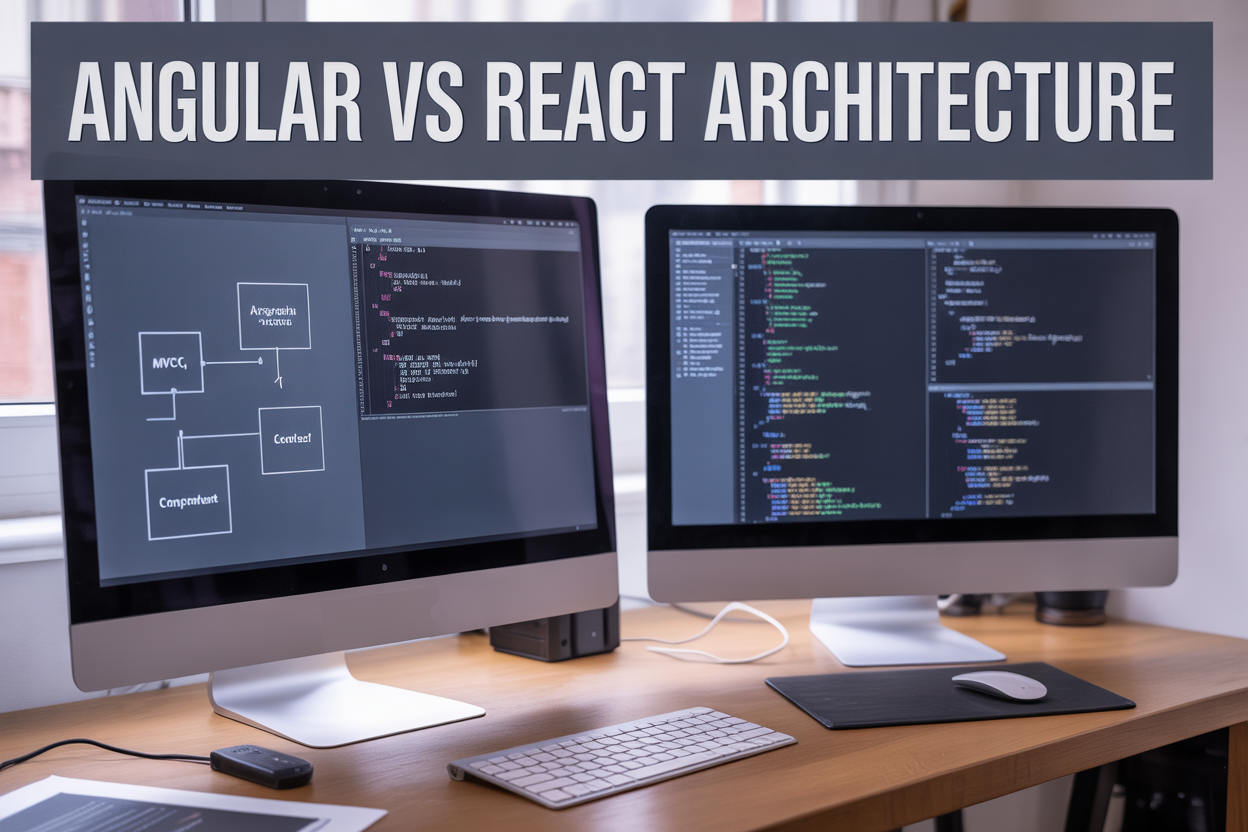
MVC in Front-End Development: Angular Architecture vs React’s Component Model
Choosing between Angular and React for your next project? The architectural differences between these popular frameworks can make or break your development experience. This guide breaks down how Angular’s MVC architecture frontend approach compares to React’s component-based architecture, helping frontend developers, tech leads, and project managers make informed decisions.
Who this is for: Frontend developers evaluating framework options, team leads planning new projects, and anyone curious about Angular vs React architecture differences.
We’ll explore Angular’s complete MVC implementation strategy and how it structures your entire application, dive into React’s flexible component model that puts components at the center of everything, and examine the real-world trade-offs between these architectural patterns. By the end, you’ll understand which frontend development frameworks approach aligns best with your project’s specific needs and team preferences.
Understanding MVC Architecture in Modern Frontend Development

Core MVC Principles and Data Flow Patterns
Model-View-Controller architecture fundamentally organizes code by separating data management, user interface presentation, and business logic into distinct layers. The Model handles data storage, retrieval, and validation, acting as the single source of truth for application state. The View manages what users see and interact with, focusing purely on presentation without containing business rules. The Controller coordinates between Model and View, processing user input and updating the appropriate components.
In MVC architecture frontend applications, data flows in a predictable pattern. User interactions trigger Controller methods, which manipulate Model data and update Views accordingly. This unidirectional flow prevents the chaotic state management that plagued early JavaScript applications, where data could be modified from anywhere, making debugging nearly impossible.
Modern frontend development frameworks have adapted these principles for client-side applications. Unlike traditional server-side MVC where each request creates a new View, frontend MVC maintains persistent Views that update dynamically. The Controller becomes more sophisticated, handling real-time user interactions, API calls, and state synchronization across multiple components.
Data binding plays a crucial role in frontend MVC implementations. Two-way binding allows automatic synchronization between Model and View, while one-way binding provides more predictable data flow patterns. Event-driven architectures complement MVC by enabling loose coupling between components, making applications more maintainable and testable.
Benefits of Separation of Concerns in User Interface Design
Separation of concerns in frontend architecture comparison scenarios demonstrates clear advantages for development teams. When presentation logic stays separate from business logic, designers can modify user interfaces without affecting core functionality. Developers can update data processing algorithms without breaking visual components.
This architectural approach dramatically improves code maintainability. Bug fixes become isolated to specific layers rather than requiring changes across multiple files. A data validation issue gets resolved in the Model layer without touching View components. Interface updates happen in Views without modifying Controller logic.
Testing becomes significantly easier with proper separation. Unit tests can target individual layers without complex setup requirements. Mock objects replace dependencies cleanly, enabling faster test execution and more reliable results. Integration tests verify layer interactions while maintaining clear boundaries between components.
Team collaboration benefits enormously from this structure. Frontend specialists focus on View implementation while backend developers handle Model logic. DevOps engineers can optimize Controller performance without understanding every user interface detail. Project managers can track progress more effectively when features align with architectural boundaries.
Code reusability increases substantially when concerns remain separate. View components can work with different data sources by swapping Models. Controllers can manage various interfaces by connecting to different Views. This modularity reduces development time for new features and simplifies maintenance tasks.
How MVC Adapts to Single Page Application Requirements
Single Page Applications challenge traditional MVC patterns by maintaining state across multiple views without server round-trips. Angular MVC implementation addresses this by creating a client-side MVC framework where Controllers manage component lifecycle, Models handle application state, and Views render dynamic content through templates.
Client-side routing becomes essential for SPA architecture, replacing server-side navigation with JavaScript-based URL management. Controllers coordinate route changes, load appropriate Views, and maintain application context. This approach provides smooth user experiences while preserving browser functionality like bookmarking and back button navigation.
State management grows more complex in SPAs since data persists throughout the user session. Models must handle local storage, session storage, and memory-based state while synchronizing with backend services. Caching strategies become crucial for performance, requiring sophisticated invalidation mechanisms to ensure data consistency.
Angular vs React architecture patterns reveal different approaches to SPA challenges. Angular provides a complete MVC framework with dependency injection, routing, and state management built-in. React focuses on the View layer, leaving developers to choose separate libraries for Controller and Model functionality.
Real-time features like live updates and push notifications require additional architectural considerations. WebSocket connections, Server-Sent Events, and polling mechanisms must integrate seamlessly with MVC patterns. Controllers handle connection management, Models process incoming data, and Views update automatically to reflect changes.
Progressive loading and code splitting optimize SPA performance by downloading only necessary components. MVC layers can be loaded independently, reducing initial bundle sizes and improving perceived performance. This modular approach aligns perfectly with separation of concerns principles while addressing modern web application requirements.
Angular’s Complete MVC Implementation Strategy

Controllers and Services Managing Application Logic
Angular’s MVC implementation relies heavily on a clear separation between controllers and services to manage application logic effectively. Controllers act as intermediaries between the user interface and the business logic, handling user interactions and coordinating data flow. Services, on the other hand, contain the core business logic and data management functionality that can be shared across multiple components.
The framework’s service architecture promotes code reusability by allowing developers to inject the same service into different components. This approach prevents code duplication and creates a centralized location for business logic. Angular services typically handle:
- HTTP requests and API communication
- Data transformation and validation
- State management across components
- Complex calculations and processing
- Authentication and authorization logic
Controllers in Angular manage the presentation layer by responding to user events, updating the view with new data, and coordinating between different services. This separation creates cleaner, more maintainable code that follows established architectural patterns.
Two-Way Data Binding Between Models and Views
Angular’s two-way data binding represents one of the framework’s most powerful features for implementing MVC architecture frontend patterns. This mechanism automatically synchronizes data between the model and view layers, eliminating the need for manual DOM manipulation in most scenarios.
When a user interacts with form elements or other input controls, changes are immediately reflected in the underlying data model. Conversely, when the model data changes programmatically, the view updates automatically without requiring explicit refresh commands. This bi-directional flow creates a seamless user experience and reduces boilerplate code significantly.
The implementation uses Angular’s change detection system to monitor model properties and update the DOM accordingly. Developers can leverage this feature through:
- Template-driven forms with ngModel directives
- Reactive forms with FormControl bindings
- Custom components with property and event bindings
- Dynamic content updates based on user interactions
This approach contrasts sharply with React’s unidirectional data flow, making Angular particularly suitable for applications requiring frequent form interactions and real-time data updates.
Dependency Injection for Scalable Code Architecture
Angular’s dependency injection system forms the backbone of its MVC implementation, enabling developers to create loosely coupled, testable, and scalable applications. The framework’s hierarchical injector system manages service instances and their dependencies automatically, reducing configuration overhead while maintaining flexibility.
The dependency injection mechanism works by analyzing constructor parameters and providing appropriate service instances at runtime. This approach offers several advantages for Angular architecture patterns:
- Testability: Services can be easily mocked or stubbed during unit testing
- Modularity: Components remain independent of specific service implementations
- Scalability: New services can be added without modifying existing components
- Performance: Singleton services prevent unnecessary instance creation
Developers can configure injection at multiple levels, from application-wide providers to component-specific services. The framework also supports provider factories, multi-providers, and injection tokens for advanced scenarios requiring custom instantiation logic.
TypeScript Integration for Enhanced Development Experience
Angular’s deep integration with TypeScript elevates the MVC implementation by providing static type checking, enhanced IDE support, and improved code documentation. This combination creates a more robust development environment compared to plain JavaScript implementations.
TypeScript enables developers to define clear interfaces for models, ensuring data consistency across the application. The type system catches potential errors at compile time rather than runtime, reducing bugs in production environments. Angular leverages TypeScript’s decorators extensively for:
- Component metadata definition
- Service registration and configuration
- Routing parameter specification
- HTTP interceptor implementation
The framework’s CLI generates TypeScript files by default, encouraging best practices from project initialization. IntelliSense support provides auto-completion for Angular-specific APIs, making development faster and more accurate. This integration particularly benefits large teams working on complex applications where type safety becomes critical for maintainability.
TypeScript’s class-based syntax aligns naturally with Angular’s component architecture, making the transition from other object-oriented languages more intuitive for developers. The combination creates a powerful foundation for implementing sophisticated MVC patterns in modern web applications.
React’s Component-Based Architecture Approach

Component State Management as Model Layer
React takes a fundamentally different approach to data management compared to traditional MVC patterns. Instead of having a centralized model layer, React distributes data management across individual components through state and props. Each component can maintain its own local state using hooks like useState and useReducer, creating a decentralized data architecture that closely aligns with the component-based architecture React philosophy.
The component state serves as a micro-model for each piece of the user interface. When a component needs to track form inputs, toggle visibility, or manage loading states, it creates its own isolated data layer. This approach eliminates the need for complex model hierarchies and makes data flow more predictable since each component controls its own destiny.
For larger applications, React developers often implement state management solutions like Redux, Zustand, or Context API to create shared data layers. These tools provide centralized state management while still respecting React’s component boundaries. The beauty lies in the flexibility – simple components can manage their own state, while complex applications can layer in sophisticated state management as needed.
JSX Rendering and Virtual DOM for View Logic
JSX serves as React’s innovative approach to handling view logic, blending JavaScript and HTML syntax into a powerful templating system. Unlike traditional template engines that separate logic from markup, JSX embeds JavaScript expressions directly within the component structure. This creates a tight coupling between data and presentation that feels natural and reduces context switching for developers.
The Virtual DOM acts as React’s secret weapon for efficient rendering. When component state changes, React creates a virtual representation of the DOM tree in memory, compares it with the previous version, and calculates the minimal set of changes needed to update the actual DOM. This diffing algorithm ensures that only the necessary DOM manipulations occur, resulting in significant performance improvements.
React components encapsulate both their data and rendering logic within the same file, making the view layer highly cohesive. A single component file contains everything needed to understand how that piece of UI behaves, from state management to event handling to visual presentation. This co-location reduces cognitive overhead and makes components easier to reason about and maintain.
Props and Event Handling for Data Communication
Props form the backbone of React’s communication system, enabling parent components to pass data down to their children in a unidirectional flow. This one-way data binding creates predictable data patterns where information flows from top to bottom, making it easier to trace data sources and debug applications. Props are immutable from the child component’s perspective, ensuring that data modifications happen in controlled locations.
Event handling in React follows a callback pattern where child components communicate with parents through function props. When a child component needs to notify its parent about user interactions or state changes, it calls a function that was passed down as a prop. This creates a clean separation of concerns where child components focus on their specific functionality while parents orchestrate higher-level application logic.
The combination of props for downward data flow and callbacks for upward communication creates a robust architecture for component interaction. Complex applications often implement patterns like compound components or use context providers to avoid prop drilling, where data needs to pass through multiple component layers. These patterns maintain the predictable data flow while reducing the verbosity of passing props through intermediate components that don’t actually use the data.
React’s component model promotes composition over inheritance, encouraging developers to build complex UIs by combining simpler, focused components rather than creating deep inheritance hierarchies.
Architectural Trade-offs Between Angular and React

Learning Curve and Developer Productivity Comparison
Angular’s complete MVC implementation strategy demands a steeper initial investment from developers. The framework introduces concepts like dependency injection, decorators, TypeScript integration, and a specific file structure that can overwhelm newcomers. However, once teams master these fundamentals, productivity often accelerates due to Angular’s opinionated nature and comprehensive tooling.
React’s component-based architecture offers a gentler entry point. Developers can start building functional components with basic JavaScript knowledge and gradually adopt advanced patterns. The ecosystem flexibility means teams can choose their preferred state management, routing, and styling solutions, though this freedom sometimes leads to decision paralysis.
Developer Onboarding Speed:
- Angular: 2-4 weeks for basic proficiency, 2-3 months for advanced patterns
- React: 1-2 weeks for basic components, ongoing learning for ecosystem tools
Long-term Productivity Factors:
- Angular teams benefit from standardized patterns and built-in solutions
- React teams gain flexibility but need stronger architectural decision-making skills
- Angular’s CLI generates boilerplate faster than most React alternatives
- React’s hot reloading and smaller bundle updates provide faster development feedback
Performance Implications of Different Rendering Strategies
Angular’s MVC implementation relies on a sophisticated change detection system that checks component trees for data changes. This approach works well for most applications but can create performance bottlenecks in complex interfaces with frequent updates. Angular’s zone.js automatically triggers change detection, which simplifies development but reduces fine-grained control over rendering optimization.
React’s component model leverages a virtual DOM diffing algorithm that efficiently updates only changed elements. The framework’s reconciliation process compares virtual DOM trees and applies minimal real DOM manipulations. React’s one-way data flow and immutable state patterns naturally support performance optimization through techniques like memoization and component splitting.
Key Performance Characteristics:
- Angular: Consistent performance for typical applications, requires optimization for high-frequency updates
- React: Better baseline performance for dynamic interfaces, more predictable optimization paths
- Angular’s OnPush strategy can match React’s performance when properly implemented
- React’s concurrent features enable better user experience during heavy computations
- Bundle sizes favor React for smaller applications, Angular for enterprise-scale projects
Code Organization and Maintainability Benefits
Angular architecture patterns promote consistent project structure through its opinionated approach. The framework enforces separation between components, services, and modules, making large codebases easier to navigate. Angular’s dependency injection system creates clear relationships between different parts of the application, while TypeScript integration catches errors during development.
React’s flexibility allows teams to organize code according to their specific needs and preferences. This adaptability works well for smaller teams with strong architectural vision but can lead to inconsistent patterns across different projects or team members. The component-based architecture naturally encourages reusable code, though maintaining consistency requires deliberate effort.
Maintainability Advantages:
- Angular: Standardized folder structure, enforced coding patterns, built-in testing utilities
- React: Customizable organization, easier refactoring of individual components, simpler debugging of component hierarchies
- Angular’s services and modules provide clear boundaries for business logic
- React’s functional approach reduces complexity in component interactions
- Both frameworks support code splitting, though Angular’s lazy loading is more integrated
Testing and Debugging Capabilities in Each Framework
Angular’s MVC implementation includes comprehensive testing tools out of the box. The framework provides TestBed for component testing, dependency injection mocking, and integration with Jasmine and Karma. Angular’s structured approach makes it easier to test different layers of the application independently, from services to components to end-to-end workflows.
React’s component model simplifies unit testing since components are typically pure functions or classes with predictable inputs and outputs. The ecosystem offers excellent testing libraries like React Testing Library and Enzyme, though teams must choose and configure these tools themselves. React’s debugging experience benefits from excellent browser extensions and clear component hierarchies.
Testing Ecosystem Comparison:
- Angular: Integrated testing setup, service mocking, dependency injection testing
- React: Flexible testing library choices, simpler component isolation, snapshot testing
- Angular’s end-to-end testing with Protractor (now deprecated) vs Cypress integration
- React’s debugging tools provide clearer component state inspection
- Both frameworks support hot reloading during development, improving debugging speed
Error Handling and Diagnostics:
- Angular’s error messages often point to specific architectural violations
- React’s error boundaries provide better error isolation in component trees
- Angular’s strict mode catches more potential issues during compilation
- React’s development warnings help identify performance and accessibility problems
Choosing the Right Architecture for Your Project Needs

Project Scale and Complexity Considerations
When dealing with small to medium-sized projects, React’s component-based architecture often provides the flexibility you need without overwhelming your development process. The component model shines in scenarios where you’re building interactive user interfaces with focused functionality. Startups and small teams frequently choose React because they can quickly prototype and iterate without being locked into a rigid structure.
Large enterprise applications tell a different story. Angular’s complete MVC implementation strategy becomes incredibly valuable when managing complex business logic, multiple data sources, and extensive user workflows. The framework’s opinionated structure helps prevent architectural chaos that can plague larger codebases. Companies building comprehensive web applications with dozens of features often find Angular’s built-in solutions for routing, state management, and dependency injection save significant development time.
The complexity of your data flow also plays a crucial role. Applications with simple, unidirectional data patterns work beautifully with React’s component model. However, when you’re dealing with complex inter-component communication and sophisticated business rules, Angular’s MVC architecture frontend approach provides clearer separation of concerns.
Consider your project’s growth trajectory too. If you’re starting small but expect rapid feature expansion, React’s flexibility might serve you better initially. Conversely, if you know your application will be feature-rich from the start, Angular’s comprehensive tooling can handle that complexity more gracefully.
Team Experience and Development Timeline Factors
Your team’s existing skills significantly impact which frontend architecture comparison makes sense for your project. Developers with strong JavaScript fundamentals often adapt quickly to React’s component-based architecture React approach. The learning curve feels more natural because React builds on familiar JavaScript concepts rather than introducing entirely new paradigms.
Angular demands a steeper initial investment in learning TypeScript, dependency injection, and the framework’s specific patterns. Teams with object-oriented programming backgrounds, particularly those coming from languages like Java or C#, often find Angular’s structure more intuitive. The Angular MVC implementation mirrors patterns they already understand.
Timeline pressures also influence architectural decisions. React projects can often move faster in the initial phases because developers can start building components immediately without understanding the entire framework ecosystem. You can add complexity gradually as your application grows.
Angular projects typically require more upfront planning and architecture decisions, but this investment pays off in the long run. Once your team masters Angular’s patterns, development velocity often increases because the framework provides solutions for common problems out of the box.
Training considerations matter too. If you’re hiring junior developers, React’s more gradual learning curve might be advantageous. Experienced teams might prefer Angular’s comprehensive approach because it eliminates many architectural decisions they’d otherwise need to make.
Long-term Maintenance and Feature Expansion Requirements
The maintenance story differs significantly between these frontend development frameworks. React’s flexibility means you have more choices about how to structure your code, but this freedom can lead to inconsistencies across a large codebase. Different developers might solve similar problems in completely different ways, making maintenance challenging over time.
Angular architecture patterns enforce consistency through conventions and built-in tools. Code reviews become easier because there’s usually one “Angular way” to implement features. This standardization becomes invaluable when team members change or when you need to onboard new developers quickly.
Feature expansion scenarios reveal another key difference. React’s component model excels when you’re adding new, independent features that don’t heavily integrate with existing functionality. The component-based nature makes it easy to add new pieces without affecting the rest of your application.
Angular’s MVC vs component architecture debate often comes down to integration complexity. When new features need to share services, communicate across multiple layers, or integrate with complex business logic, Angular’s dependency injection and service architecture provide cleaner solutions.
Technical debt accumulation patterns also vary. React applications can accumulate debt through inconsistent state management approaches and ad-hoc component communication patterns. Angular applications more commonly face debt through over-engineering and unnecessary abstraction layers.
Performance optimization strategies differ too. React gives you fine-grained control over rendering optimization, but you need to implement these optimizations yourself. Angular provides more automated optimizations but with less granular control over the specifics.

Angular’s strict MVC structure gives you a clear roadmap for organizing large applications, with its dependency injection and service layers making code predictable and maintainable. React’s component-based approach offers more flexibility, letting you build reusable pieces that can adapt to different architectural patterns as your project grows. Both frameworks solve real problems, just in different ways.
The choice between Angular’s MVC and React’s component model really comes down to your team’s experience and project requirements. If you’re working on enterprise applications that need consistent structure across multiple developers, Angular’s opinionated approach might save you headaches down the road. For projects that value flexibility and faster initial development, React’s simpler learning curve and vast ecosystem could be the better bet. Start by building a small prototype in both frameworks to see which one feels right for your specific use case.