Amazon S3 powers millions of production applications, but many engineers struggle with optimization pitfalls that can sink performance and blow budgets. Getting your Amazon S3 production deployment right from the start saves you from costly mistakes and late-night outages.
This guide is for backend engineers, DevOps professionals, and system architects who need to deploy and manage S3 at scale. You’ll learn the practical skills that separate hobby projects from bulletproof production systems.
We’ll cover the S3 storage classes optimization strategies that can cut your costs by 60% while maintaining performance. You’ll also discover AWS S3 security best practices that protect your data without creating bottlenecks for your applications. Finally, we’ll dive into S3 performance tuning high traffic techniques that keep your services running smoothly even during peak loads.
Skip the trial-and-error phase. These proven strategies will help you build S3 infrastructure that scales with confidence.
Essential S3 Storage Classes for Production Performance
Standard Storage Class for High-Frequency Access
When your production applications need instant data access, S3 Standard delivers millisecond retrieval times with 99.999999999% durability. This storage class works best for frequently accessed files, user-generated content, and real-time analytics where latency matters most for business operations.
Intelligent Tiering for Cost Optimization
S3 Intelligent Tiering automatically moves objects between access tiers based on usage patterns, reducing storage costs by up to 68% without performance impact. Perfect for unpredictable workloads, this S3 storage classes optimization eliminates manual monitoring while maintaining instant access to hot data and cost savings for cold data.
Glacier Storage Classes for Long-Term Archival
Glacier Instant Retrieval offers millisecond access for rarely accessed data at 68% lower cost than Standard, while Glacier Flexible Retrieval provides retrieval options from minutes to hours. Glacier Deep Archive delivers the lowest storage costs for compliance data and long-term backups with 12-hour retrieval times.
One Zone-IA for Cost-Effective Infrequent Access
One Zone-IA stores data in a single availability zone, offering 20% cost savings compared to Standard-IA for reproducible or secondary backup data. While it lacks multi-zone redundancy, this class works well for disaster recovery copies, media transcoding, and data that can be easily recreated if needed.
Security Best Practices That Protect Production Data
IAM Policies and Role-Based Access Control
Proper IAM configuration forms the backbone of AWS S3 security best practices for production environments. Create granular policies that follow the principle of least privilege, granting users only the specific S3 actions they need. Use IAM roles instead of hardcoded credentials in applications, and implement role-based access control to manage permissions at scale. Cross-account access requires careful policy configuration to prevent unauthorized data exposure while maintaining operational flexibility.
Bucket Policies and Access Control Lists
Bucket policies provide resource-based permissions that work alongside IAM policies to create defense-in-depth security. Configure bucket policies to restrict access by IP address, time of day, or require MFA for sensitive operations. Access Control Lists (ACLs) offer object-level permissions but should be disabled in favor of bucket policies for most production scenarios. Always deny public read/write access unless explicitly required, and regularly audit bucket policies for overly permissive configurations.
Server-Side Encryption Configuration
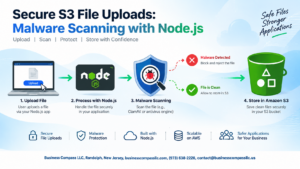
Enable server-side encryption by default for all production S3 buckets to protect data at rest. Choose between S3-managed keys (SSE-S3), AWS KMS keys (SSE-KMS), or customer-provided keys (SSE-C) based on your compliance requirements. KMS encryption provides additional audit trails and granular key management capabilities essential for enterprise workloads. Configure bucket policies to deny uploads without proper encryption headers, ensuring all objects remain encrypted regardless of client configuration.
VPC Endpoints for Secure Network Access
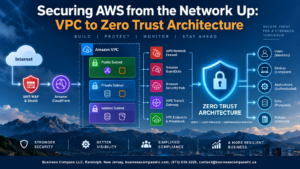
VPC endpoints create private connections between your VPC and S3, eliminating internet gateway traffic and reducing security exposure. Gateway endpoints provide cost-effective access for most use cases, while interface endpoints offer more granular network controls. Configure endpoint policies to restrict access to specific buckets and actions, creating network-level security boundaries. This approach significantly reduces attack surfaces and ensures S3 traffic remains within the AWS backbone infrastructure.
CloudTrail Integration for Audit Logging
CloudTrail integration captures comprehensive API-level logging for all S3 operations, creating essential audit trails for production S3 configuration guide compliance. Enable data events logging to track object-level operations including GetObject, PutObject, and DeleteObject actions. Configure CloudTrail to deliver logs to a separate, secured S3 bucket with restricted access and long-term retention policies. Set up CloudWatch alarms on suspicious access patterns or policy violations to enable real-time security monitoring and incident response.
Performance Optimization Strategies for High-Traffic Applications
Multipart Upload for Large Files
Break down files larger than 100MB into smaller chunks for parallel uploads. This dramatically reduces upload times and provides better error recovery. Configure parts between 5MB and 5GB, with 100MB being the sweet spot for most production workloads. Failed parts can retry individually without restarting the entire upload, making large file transfers more reliable.
Transfer Acceleration for Global Performance
Enable S3 Transfer Acceleration to route uploads through CloudFront edge locations closest to your users. This feature can reduce upload times by 50-500% depending on distance from the nearest AWS region. Particularly valuable for applications serving global audiences or uploading from remote locations with poor connectivity to your primary S3 region.
Request Rate Distribution and Hot-Spotting Prevention
Distribute requests across multiple prefixes to avoid hot-spotting on individual S3 partitions. Use randomized prefixes or reverse timestamp patterns instead of sequential naming schemes. S3 can handle 3,500 PUT/COPY/POST/DELETE requests and 5,500 GET/HEAD requests per second per prefix. Monitor request patterns and implement exponential backoff for 503 errors during traffic spikes.
Monitoring and Alerting Systems for Production Reliability
CloudWatch Metrics for Storage and Request Monitoring
Track critical S3 performance indicators through CloudWatch’s comprehensive metrics dashboard. Monitor bucket-level statistics including request rates, error percentages, and data transfer volumes. Set up custom dashboards displaying 4XXError and 5XXError rates alongside AllRequests metrics to spot performance bottlenecks. Track BucketSizeBytes and NumberOfObjects for capacity planning. Enable detailed request metrics for granular analysis of GET, PUT, and DELETE operations across different time periods.
S3 Access Logs for Traffic Analysis
Access logs provide detailed records of every request made to your S3 buckets, capturing source IP addresses, request types, response codes, and processing times. Configure server access logging to analyze traffic patterns, identify suspicious activity, and optimize content delivery. Parse logs using CloudWatch Logs Insights or Amazon Athena to generate reports on user behavior, geographic distribution, and bandwidth consumption patterns.
Cost and Usage Reports for Budget Control
AWS Cost and Usage Reports deliver granular billing data for S3 monitoring alerting production environments. Track storage costs by bucket, storage class, and data transfer charges. Set up cost allocation tags to categorize expenses by project or department. Monitor trends in storage growth and request volumes to forecast budget requirements. Create custom reports filtering S3-specific charges to identify cost optimization opportunities.
Automated Alerting for Service Disruptions
Configure CloudWatch alarms for proactive monitoring of S3 reliability monitoring systems. Set thresholds for error rates, latency spikes, and availability metrics to trigger immediate notifications. Create SNS topics connected to email, SMS, or Slack for rapid response to production issues. Implement multi-threshold alarms for graduated response levels – warnings for minor degradation and critical alerts for service outages affecting user experience.
Backup and Disaster Recovery Implementation
Cross-Region Replication Setup
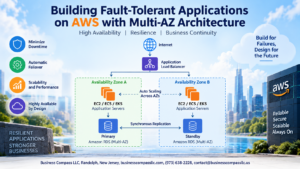
Setting up cross-region replication protects your AWS S3 disaster recovery strategy by automatically copying objects to different geographical locations. Configure replication rules to specify source and destination buckets, ensuring your production data stays available even during regional outages. Enable replication for existing objects using S3 Batch Replication to maintain comprehensive coverage. Monitor replication metrics through CloudWatch to verify data synchronization across regions. This redundancy approach significantly reduces recovery time objectives and provides geographic distribution for compliance requirements.
Versioning and Lifecycle Management
Object versioning creates multiple copies of files whenever changes occur, allowing you to restore previous versions if corruption or accidental deletion happens. Configure lifecycle policies to automatically transition older versions to cheaper storage classes like Glacier or Intelligent-Tiering. Set up deletion policies to remove unnecessary versions after specific time periods, balancing data protection with storage costs. Combine versioning with MFA delete protection for critical production buckets to prevent unauthorized data removal. This layered approach ensures comprehensive AWS S3 disaster recovery backup capabilities.
Point-in-Time Recovery Strategies
Design point-in-time recovery by combining S3 versioning with detailed logging and metadata tracking. Create automated snapshots of critical data states using Lambda functions triggered by CloudWatch events. Implement recovery procedures that can restore your entire application state to any specific moment, not just individual files. Test recovery scenarios regularly to validate your procedures work under pressure. Document recovery time objectives and recovery point objectives to meet business continuity requirements. This systematic approach transforms your S3 infrastructure into a reliable recovery foundation.
Cost Management Techniques for Enterprise Budgets
Storage Class Analysis and Optimization
Analyzing your data access patterns reveals which S3 cost optimization enterprise strategies work best for your workloads. Frequently accessed data belongs in Standard storage, while infrequently accessed files should move to Standard-IA or Glacier for immediate savings. Archive data older than 90 days typically sees 80% cost reduction when moved to Glacier Deep Archive. Monitor access metrics monthly to identify misclassified objects and optimize placement decisions.
Lifecycle Policies for Automated Cost Reduction
Automated lifecycle transitions eliminate manual oversight while reducing storage costs by up to 70%. Configure policies that move objects from Standard to Standard-IA after 30 days, then to Glacier after 90 days. Set deletion rules for temporary files, logs, and backups based on compliance requirements. Version management policies automatically clean up old object versions, preventing storage bloat from accumulating over time.
Request Pattern Analysis for Pricing Efficiency
Request costs often surprise engineering teams managing high-traffic applications. GET requests cost $0.0004 per 1,000 requests, while PUT requests run $0.005 per 1,000. CloudFront caching reduces S3 requests by 90% for static content, dramatically cutting monthly bills. Batch operations save money when processing thousands of objects simultaneously. Monitor request patterns through CloudWatch to identify optimization opportunities and reduce unnecessary API calls.
Reserved Capacity Planning
Reserved capacity purchasing delivers 30-50% savings on predictable workloads with one-year commitments. Calculate baseline storage needs using historical growth data to determine optimal reservation levels. Purchase reserved capacity for stable production data while keeping growth headroom in on-demand pricing. Review utilization quarterly to adjust reservations and maximize cost efficiency. Combine reserved capacity with lifecycle policies for maximum S3 cost optimization enterprise benefits.
Understanding the right storage classes can make or break your production S3 setup. Smart choices between Standard, IA, and Glacier tiers directly impact both performance and costs. Pair this with solid security practices like proper IAM policies, encryption, and access logging, and you’re building a foundation that can handle real-world traffic without breaking the bank.
The difference between a smooth-running production system and one that keeps you up at night comes down to the details. Set up proper monitoring with CloudWatch metrics, implement automated alerting for critical thresholds, and don’t forget your disaster recovery plan. When you combine performance optimization techniques with cost management strategies, you’re not just running S3 – you’re running it like a pro. Start with these fundamentals, test everything thoroughly, and your production workloads will thank you for it.