Machine learning teams waste countless hours wrestling with deployment complexities instead of building better models. This comprehensive guide walks you through building a robust MLOps pipeline using Terraform EKS deployment, GitHub Actions CI/CD, and Argo CD GitOps to automate your entire machine learning operations workflow.
Who this guide serves: ML engineers, DevOps professionals, and data science teams ready to move beyond manual deployments and embrace MLOps infrastructure automation.
You’ll learn how to set up Kubernetes ML deployment on Amazon EKS using infrastructure as code, then build an EKS MLOps workflow that automatically handles everything from code commits to production rollouts. We’ll also cover implementing GitOps machine learning practices with Argo CD to keep your deployments consistent and your CI/CD pipeline MLOps running smoothly across environments.
MLOps Pipeline Architecture Overview
Core components and their interconnections
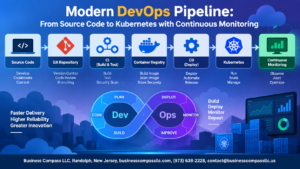
The MLOps pipeline architecture creates a powerful ecosystem where four key tools work together seamlessly. Terraform provisions the cloud infrastructure and Amazon EKS clusters, establishing the foundation. GitHub Actions handles continuous integration and builds container images, while Argo CD manages GitOps-based deployments directly to Kubernetes. These components communicate through APIs and webhook triggers – when developers push code, GitHub Actions automatically builds and tests ML models, then updates deployment manifests that Argo CD continuously monitors and syncs to the EKS cluster.
Benefits of combining Terraform, EKS, GitHub Actions, and Argo CD
This MLOps infrastructure automation combination delivers exceptional scalability and reliability for machine learning operations. Terraform EKS deployment ensures consistent, reproducible infrastructure across environments, while GitHub Actions CI/CD provides fast, automated testing and building of ML models. Argo CD GitOps enables declarative deployments with automatic rollbacks and drift detection. Together, they reduce deployment time from hours to minutes, eliminate configuration drift, and provide complete audit trails for compliance. The Kubernetes ML deployment capability allows teams to handle varying workloads efficiently while maintaining high availability.
How each tool addresses specific deployment challenges
GitHub Actions CI/CD solves the challenge of inconsistent model building by automating testing, validation, and containerization of ML models with standardized workflows. Terraform eliminates infrastructure drift and manual provisioning errors by treating infrastructure as code with version control. Amazon EKS addresses scalability and resource management issues by providing managed Kubernetes that automatically scales ML workloads based on demand. Argo CD tackles deployment inconsistencies and manual errors through GitOps machine learning practices, ensuring the actual cluster state matches the desired state defined in Git repositories while providing visual deployment tracking.
Infrastructure as Code with Terraform
Setting up AWS EKS clusters automatically
Terraform transforms EKS cluster provisioning from a manual nightmare into automated infrastructure magic. Define your cluster configuration once in declarative HCL syntax, then watch as Terraform spins up worker nodes, control planes, and essential add-ons with a single command. The beauty lies in consistency – every environment gets identical infrastructure, eliminating those “works on my machine” headaches that plague MLOps teams.
resource "aws_eks_cluster" "mlops_cluster" {
  name     = "mlops-production"
  role_arn = aws_iam_role.cluster_role.arn
  version  = "1.27"

  vpc_config {
    subnet_ids = var.subnet_ids
  }
}
Managing networking and security configurations
Security configurations become repeatable and auditable through Terraform’s infrastructure as code approach. Define VPCs, security groups, and IAM policies that automatically enforce least-privilege access across your MLOps pipeline infrastructure. Network policies protect your machine learning workloads while service meshes handle inter-pod communication securely.
Key networking components include:
- Private subnets for worker nodes
- Public subnets for load balancers
- NAT gateways for outbound internet access
- Security groups restricting pod-to-pod communication
- Network ACLs for subnet-level protection
Version controlling your infrastructure changes
Git becomes your infrastructure’s source of truth, tracking every cluster modification, security update, and configuration change. Terraform state files capture your current infrastructure reality while .tf files define your desired state. Pull requests enable peer review of infrastructure changes before they hit production, preventing costly misconfigurations in your MLOps workflow.
Branching strategies mirror application development:
- Feature branches for experimental infrastructure
- Staging environments for testing changes
- Production deployments through merge commits
- Rollback capabilities using Git history
- Collaborative infrastructure development
Cost optimization through automated resource management
Terraform’s resource lifecycle management automatically right-sizes your EKS infrastructure based on actual MLOps workload demands. Spot instances reduce compute costs by up to 90% for training jobs, while auto-scaling groups dynamically adjust cluster capacity. Schedule-based scaling shuts down development environments during off-hours, dramatically cutting your AWS bill without sacrificing functionality.
Smart cost optimization techniques:
- Mixed instance types for diverse workload requirements
- Cluster autoscaler for demand-responsive scaling
- Scheduled scaling for predictable usage patterns
- Resource tagging for granular cost tracking
- Reserved instances for stable production workloads
Kubernetes Orchestration with Amazon EKS
Scalable container deployment strategies
Amazon EKS provides automatic scaling capabilities that adapt to your ML workloads through horizontal pod autoscaling and cluster autoscaling. When training jobs spike or inference requests increase, EKS automatically provisions additional compute resources and scales pods based on CPU, memory, or custom metrics. Node groups can be configured with mixed instance types and spot instances to optimize costs while maintaining performance. This elastic infrastructure ensures your MLOps pipeline handles varying workloads efficiently without manual intervention.
Multi-environment cluster management
EKS simplifies managing development, staging, and production environments through namespace isolation and dedicated clusters. Each environment can have distinct resource quotas, security policies, and networking configurations while sharing the same underlying infrastructure patterns. GitOps workflows with Argo CD enable consistent deployments across environments, ensuring code promoted from development reaches production with identical configurations. This approach reduces environment drift and accelerates the ML model promotion process.
Enhanced security and compliance features
EKS integrates with AWS IAM for fine-grained access control, allowing teams to implement least-privilege principles for ML workloads. Pod security standards and network policies isolate training jobs and model serving containers, preventing unauthorized access to sensitive data. Encryption at rest and in transit protects model artifacts and training datasets. AWS Config and CloudTrail provide comprehensive auditing capabilities essential for compliance in regulated industries deploying machine learning models.
Integration with AWS services for seamless operations
EKS connects natively with essential AWS services that power robust MLOps pipelines. Amazon ECR stores container images securely, while S3 provides scalable storage for datasets and model artifacts. CloudWatch collects metrics and logs from ML workloads, enabling proactive monitoring and alerting. Integration with AWS Load Balancer Controller automatically provisions Application Load Balancers for model inference endpoints. This seamless connectivity eliminates complex configurations and accelerates MLOps infrastructure automation across your machine learning operations.
Automated CI/CD with GitHub Actions
Triggering deployments on code commits
Setting up automated deployment triggers in your GitHub Actions MLOps pipeline creates a seamless development experience. Configure workflow triggers using on: push for main branches and on: pull_request for feature branches. Use path filters to trigger deployments only when ML model code, training scripts, or deployment configurations change. This selective triggering prevents unnecessary builds and keeps your CI/CD pipeline MLOps workflow efficient while maintaining rapid iteration cycles.
Running automated tests and quality checks
Your GitHub Actions CI/CD pipeline should include comprehensive testing stages that validate both code quality and model performance. Implement unit tests for data preprocessing functions, integration tests for model inference APIs, and data validation checks using tools like Great Expectations. Add linting with Black and Flake8, security scanning with Bandit, and dependency vulnerability checks. Run model accuracy tests against validation datasets to catch performance regressions before they reach production environments.
Building and pushing container images efficiently
Optimize your container build process using Docker layer caching and multi-stage builds within GitHub Actions workflows. Configure the workflow to build ML model containers with specific tags based on git commits or semantic versioning. Use GitHub’s built-in container registry or integrate with Amazon ECR for your EKS MLOps workflow. Implement parallel builds for different model variants and leverage BuildKit for faster image creation, reducing overall pipeline execution time significantly.
Managing secrets and environment variables securely
Store sensitive credentials like AWS access keys, database passwords, and API tokens in GitHub Secrets rather than hardcoding them in workflows. Create environment-specific secret groups for development, staging, and production deployments. Use the secrets context in workflow files and implement least-privilege access principles. For Kubernetes deployments, integrate with AWS Secrets Manager or Kubernetes secrets to maintain security boundaries throughout your MLOps infrastructure automation.
Creating reusable workflow templates
Develop modular workflow templates that can be shared across multiple ML projects in your organization. Create composite actions for common MLOps tasks like model training, testing, and deployment validation. Use workflow templates with input parameters for different model types, environments, and deployment strategies. Store these templates in a centralized repository and reference them using the uses keyword, promoting consistency and reducing maintenance overhead across your machine learning operations.
GitOps Implementation with Argo CD
Declarative Application Deployment from Git Repositories
Argo CD transforms your Git repositories into the single source of truth for ML model deployments. When you commit Kubernetes manifests or Helm charts to your GitOps machine learning repository, Argo CD automatically detects changes and applies them to your EKS cluster. This declarative approach means you define what your ML application should look like rather than scripting how to deploy it. Your models, inference services, and supporting infrastructure are all versioned in Git, creating an audit trail that tracks every deployment change. The GitOps workflow eliminates manual kubectl commands and reduces configuration drift across environments.
Automated Synchronization and Drift Detection
Argo CD continuously monitors your Git repository and compares the desired state with your actual EKS cluster configuration. When someone makes unauthorized changes directly to the cluster, Argo CD immediately flags this drift and can automatically sync back to the Git-defined state. This automated synchronization ensures your MLOps pipeline maintains consistency across development, staging, and production environments. The drift detection feature provides real-time visibility into configuration changes, preventing the “it worked on my machine” scenarios that plague ML deployments. You can configure sync policies to be automatic or require manual approval based on your team’s preferences.
Rollback Capabilities for Failed Deployments
Failed ML model deployments become manageable with Argo CD’s built-in rollback functionality. Every deployment creates a revision history that lets you instantly revert to any previous working state. When a new model version causes issues in production, you can rollback to the last stable deployment with a single click through the Argo CD UI or CLI. The rollback process updates both the cluster state and the Git repository, maintaining consistency across your entire MLOps infrastructure automation stack. Health checks and automated rollback policies can trigger automatic reverts when deployment failures are detected.
Multi-Cluster Application Management
Argo CD excels at managing ML applications across multiple EKS clusters from a centralized control plane. You can deploy the same model to development, staging, and production clusters while maintaining environment-specific configurations through Kustomize or Helm values. The ApplicationSet controller enables template-based deployments across multiple clusters, perfect for deploying models to edge locations or different AWS regions. Cross-cluster deployment visibility helps ML teams track model versions and performance across all environments. This multi-cluster approach supports complex MLOps workflows where models need testing in isolated environments before production release.
End-to-End Deployment Workflow
Developer Code Commit to Production Pipeline
The MLOps pipeline transforms code commits into production deployments through automated stages. Developers push ML model changes to GitHub, triggering GitHub Actions CI/CD workflows that validate code quality and run tests. The pipeline packages models into container images, pushes them to registries, and updates Kubernetes manifests. Argo CD monitors Git repositories for configuration changes, automatically syncing updates to the EKS cluster. This GitOps approach ensures every production deployment originates from version-controlled source code, creating a reliable audit trail from development to production.
Automated Testing and Validation Gates
Robust validation gates prevent faulty models from reaching production environments. The pipeline implements multi-stage testing including unit tests for model logic, integration tests for API endpoints, and data validation checks for input schemas. Model performance benchmarks run against test datasets, comparing accuracy metrics to established baselines. Container security scans identify vulnerabilities before deployment. Each validation stage acts as a quality gate – failures halt the pipeline until issues resolve. These automated checks maintain model reliability while reducing manual oversight requirements in the MLOps workflow.
Progressive Deployment Strategies and Canary Releases
Canary deployments minimize risk by gradually rolling out model updates to production traffic. The EKS cluster runs multiple model versions simultaneously, with load balancers directing small traffic percentages to new versions initially. Monitoring systems track key metrics like prediction accuracy, response times, and error rates during canary phases. Successful canaries automatically scale up traffic allocation, while performance degradation triggers automatic rollbacks to stable versions. Blue-green deployments provide instant switchover capabilities for critical updates, ensuring zero-downtime model deployments across the Kubernetes ML deployment infrastructure.
Monitoring and Observability Integration
Real-time deployment status tracking
Your MLOps pipeline needs visibility into every deployment stage. Argo CD provides a comprehensive dashboard showing application sync status, health checks, and resource states across your EKS cluster. Set up custom metrics using Prometheus to track deployment success rates, rollback frequencies, and time-to-deployment. GitHub Actions integrates seamlessly with status APIs, sending real-time notifications to Slack or Microsoft Teams when builds fail or succeed. Configure webhooks to trigger alerts based on specific deployment events, ensuring your team stays informed about critical pipeline changes without constantly monitoring dashboards.
Performance metrics and alerting setup
Monitor your machine learning models and infrastructure performance using a combination of Prometheus, Grafana, and CloudWatch. Track key metrics like model inference latency, throughput, memory usage, and CPU utilization across your EKS nodes. Set up intelligent alerting rules that trigger when model accuracy drops below thresholds or when resource consumption spikes unexpectedly. Create custom dashboards displaying business-critical metrics alongside technical performance indicators. Implement automated scaling policies based on these metrics to handle traffic fluctuations while maintaining cost efficiency and service reliability.
Log aggregation and troubleshooting workflows
Centralize logs from your MLOps pipeline using the ELK stack or AWS CloudWatch Logs. Configure Fluent Bit as a DaemonSet on your EKS cluster to collect logs from all pods and services automatically. Structure your logging strategy to capture model predictions, training metrics, and system events in a searchable format. Create log-based alerts for common failure patterns like out-of-memory errors or model serving timeouts. Establish clear troubleshooting runbooks that guide your team through common issues using log correlation and distributed tracing to quickly identify root causes.
Cost monitoring and resource optimization insights
Track spending across your MLOps infrastructure using AWS Cost Explorer and custom Kubernetes resource monitoring tools. Implement resource quotas and limits on your EKS namespaces to prevent runaway costs from experimental workloads. Monitor GPU utilization rates for training jobs and right-size instances based on actual usage patterns. Set up automated cost alerts when spending exceeds predefined budgets for specific projects or environments. Use tools like KubeCost to get granular visibility into per-application resource consumption and identify optimization opportunities for your machine learning workloads.
Best Practices and Common Pitfalls
Security considerations for production deployments
Securing your MLOps pipeline requires implementing multi-layered protection across Terraform infrastructure automation, EKS clusters, and CI/CD pipeline MLOps workflows. Start with role-based access control (RBAC) for Kubernetes ML deployment environments, enabling least-privilege principles for service accounts. Store sensitive data like model artifacts and API keys in AWS Secrets Manager or Kubernetes secrets, never in Git repositories. Configure network policies to restrict pod-to-pod communication and use private EKS endpoints to limit cluster exposure. Enable audit logging across GitHub Actions CI/CD pipelines and Argo CD GitOps operations to track all deployment activities. Implement image scanning in your container registry to catch vulnerabilities before deployment. Regular security assessments of your MLOps infrastructure automation help identify potential attack vectors early.
Disaster recovery and backup strategies
Building resilient MLOps workflows means preparing for infrastructure failures and data corruption scenarios that can disrupt your machine learning operations. Create automated backup schedules for critical components including model registries, training data, and configuration files stored in your GitOps machine learning repositories. Use Terraform state file backups stored in versioned S3 buckets with cross-region replication to recover your EKS MLOps workflow infrastructure quickly. Implement database snapshots for metadata stores and establish recovery time objectives (RTO) for different system components. Test your disaster recovery procedures regularly by simulating failures in non-production environments. Document runbooks for common failure scenarios and ensure your team knows how to restore services when Argo CD GitOps or GitHub Actions pipelines fail unexpectedly.
Performance tuning recommendations
Optimizing MLOps pipeline performance involves fine-tuning resource allocation across your Terraform EKS deployment and streamlining CI/CD workflows. Right-size your EKS worker nodes based on model training and inference requirements, using node groups with appropriate instance types for CPU and GPU workloads. Configure horizontal pod autoscaling (HPA) and vertical pod autoscaling (VPA) to handle varying traffic patterns in your Kubernetes ML deployment environment. Optimize Docker images by using multi-stage builds and minimal base images to reduce container startup times. Cache dependencies and artifacts in GitHub Actions workflows to speed up build processes. Monitor resource utilization metrics and adjust CPU/memory requests and limits for your ML containers. Use spot instances for non-critical workloads to reduce infrastructure costs while maintaining performance standards.
Troubleshooting deployment failures effectively
Diagnosing MLOps pipeline failures requires systematic approaches to identify root causes across complex distributed systems. Start with centralized logging using tools like Fluentd or AWS CloudWatch to aggregate logs from GitHub Actions CI/CD, Argo CD applications, and Kubernetes pods. Check Argo CD application health status and sync errors first, then examine pod logs and events using kubectl commands. Monitor resource constraints like memory limits and CPU throttling that commonly cause container failures. Validate Terraform configurations and state files when infrastructure provisioning fails. Use debugging tools like kubectl port-forward to access applications directly and test connectivity. Keep detailed troubleshooting documentation with common error patterns and their solutions. Set up alerting for critical failure scenarios to catch issues before they impact production machine learning operations.
Building a robust MLOps pipeline doesn’t have to be overwhelming when you break it down into manageable pieces. By combining Terraform for infrastructure management, Amazon EKS for container orchestration, GitHub Actions for continuous integration, and Argo CD for GitOps deployment, you create a powerful automated system that handles everything from code commits to production deployments. This setup gives you the reliability and scalability needed for machine learning workloads while keeping your infrastructure consistent and version-controlled.
The real magic happens when these tools work together seamlessly – your data scientists can focus on model development while the pipeline handles the heavy lifting of deployment, monitoring, and scaling. Remember to start small, implement proper monitoring from day one, and always test your pipeline thoroughly before pushing to production. With this foundation in place, you’ll have a deployment process that’s not only efficient but also maintainable and secure for the long haul.