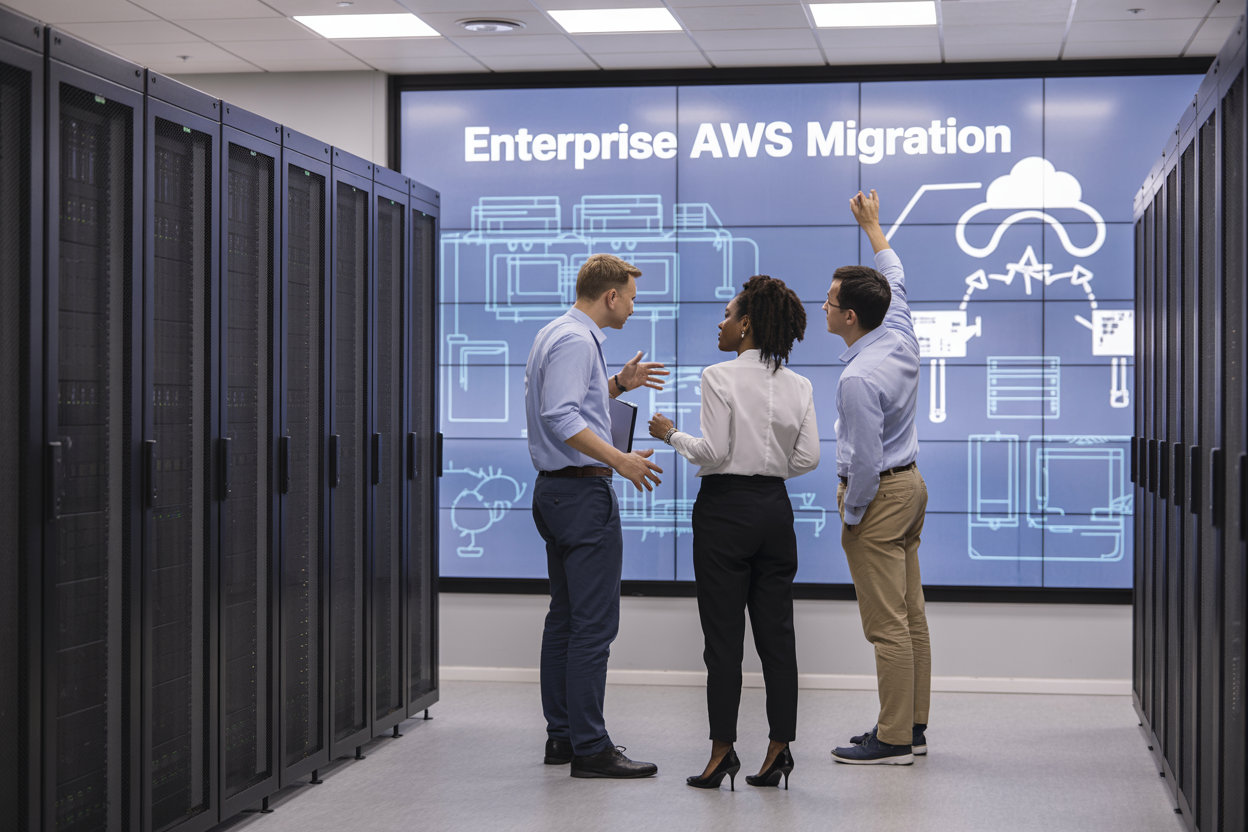
Enterprise IT teams face mounting pressure to modernize legacy systems and reduce operational costs. On-premise to AWS migration offers a proven path to scalable, cost-effective infrastructure that can transform how businesses operate and compete.
This comprehensive guide is designed for enterprise architects, IT directors, and cloud migration teams planning or executing large-scale cloud transformations. You’ll discover practical strategies to move critical workloads safely while maintaining security and compliance standards.
We’ll walk through proven AWS migration strategies that match your specific business requirements, from lift-and-shift approaches to complete application modernization. You’ll also learn how to build a robust AWS cloud architecture using core enterprise services like EC2, RDS, and VPC to create resilient, high-performance environments.
Finally, we’ll cover enterprise cloud security best practices and compliance frameworks that protect your data throughout the migration journey. Plus, you’ll get actionable insights on monitoring tools and optimization techniques to maximize your cloud investment from day one.
Understanding Enterprise Migration Drivers and Business Benefits

Cost optimization through reduced infrastructure maintenance
Switching to AWS migration brings immediate relief from the financial burden of maintaining physical servers and data centers. Traditional on-premise infrastructure requires constant investment in hardware upgrades, cooling systems, power management, and dedicated IT staff for round-the-clock maintenance. These costs often spiral beyond initial estimates, especially when accounting for unexpected hardware failures and emergency repairs.
Cloud migration planning eliminates these overhead expenses by transferring infrastructure responsibility to AWS. Organizations typically see 20-30% cost reductions in their first year alone, with savings increasing over time as they optimize their cloud resource usage. The pay-as-you-go model means businesses only pay for resources they actually use, rather than maintaining excess capacity for peak demand periods that might occur just a few times per year.
Enhanced scalability for growing business demands
AWS cloud architecture provides elastic scaling capabilities that traditional infrastructure simply cannot match. When your business experiences sudden traffic spikes or seasonal demands, AWS automatically adjusts resources to handle the load without manual intervention or pre-planning.
Enterprise cloud migration opens doors to several scaling advantages:
- Horizontal scaling: Add or remove server instances based on real-time demand
- Vertical scaling: Increase or decrease computing power for existing resources
- Global expansion: Deploy applications across multiple regions instantly
- Storage flexibility: Scale storage capacity up or down without hardware limitations
This flexibility proves invaluable for growing businesses that face unpredictable demand patterns. E-commerce companies, for example, can handle Black Friday traffic surges without investing in expensive infrastructure that sits idle for most of the year.
Improved disaster recovery and business continuity
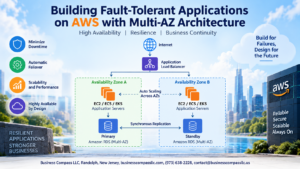
On-premise disaster recovery traditionally requires maintaining duplicate infrastructure at secondary locations, doubling costs while providing limited protection. AWS migration services transform this approach by offering built-in redundancy across multiple availability zones and regions.
Enterprise migration strategy should include these disaster recovery benefits:
| Feature | On-Premise | AWS Cloud |
|---|---|---|
| Recovery Time | Hours to days | Minutes to hours |
| Geographic Distribution | Limited locations | Global coverage |
| Cost Structure | High upfront investment | Pay-per-use model |
| Testing Frequency | Quarterly/annually | Continuous |
AWS automatically backs up data across geographically distributed data centers, ensuring business operations can continue even if entire regions experience outages. This level of protection would cost millions to replicate with traditional infrastructure.
Access to advanced cloud-native services and innovation
Enterprise cloud transformation unlocks access to cutting-edge technologies that would be impossible to implement in traditional data centers. AWS constantly rolls out new services for artificial intelligence, machine learning, data analytics, and Internet of Things applications.
These services integrate seamlessly with existing applications, allowing businesses to add sophisticated capabilities without building complex infrastructure from scratch. Companies can experiment with machine learning models, implement real-time data processing, or deploy serverless applications that automatically scale based on usage patterns.
The innovation cycle accelerates dramatically when development teams can provision new environments in minutes rather than weeks, test new technologies without capital expenditure, and iterate quickly based on market feedback. This agility often becomes a competitive advantage that separates cloud-native companies from their traditional counterparts.
Pre-Migration Assessment and Strategic Planning

Current Infrastructure Audit and Dependency Mapping
Before making any move to AWS, you need a crystal-clear picture of what you’re working with. Start by documenting every piece of hardware, software, and network component in your current environment. This means servers, databases, applications, storage systems, networking equipment, and even that forgotten legacy system running in the corner.
The real challenge comes with dependency mapping. Applications rarely exist in isolation – they talk to databases, rely on shared services, and connect to external systems. Create visual maps showing how data flows between components. Tools like AWS Application Discovery Service can automate much of this discovery process, scanning your network to identify servers and their connections.
Pay special attention to:
- Database relationships and data flow patterns
- Network latency requirements between services
- Shared storage dependencies
- Load balancing configurations
- Security groups and firewall rules
- Integration points with third-party systems
Document performance baselines for each component. Record CPU usage, memory consumption, storage IOPS, and network bandwidth patterns. These metrics become crucial when sizing AWS resources and planning your migration strategy.
Application Portfolio Analysis and Migration Prioritization
Not every application should migrate at the same time or using the same approach. Start by categorizing your applications based on business criticality, technical complexity, and cloud readiness. Create a simple matrix ranking applications from high to low impact and high to low effort.
Quick wins typically include:
- Stateless web applications with minimal dependencies
- Development and testing environments
- Applications with standard database backends
- Non-critical business applications
Hold off on complex systems until later:
- Legacy applications with hard-coded IP addresses
- Systems requiring specialized hardware
- Applications with strict compliance requirements
- Mission-critical systems running on outdated platforms
Consider the six Rs of cloud migration planning for each application:
- Rehost (lift-and-shift) for applications that work well as-is
- Replatform for systems needing minor cloud optimizations
- Refactor applications to take full advantage of cloud-native features
- Retire applications that are no longer needed
- Retain systems that must stay on-premise for now
- Repurchase by moving to SaaS alternatives
Total Cost of Ownership Calculations and Budget Planning
Building an accurate cost model requires looking beyond just server costs. Your current on-premise expenses include hardware, software licenses, data center space, power, cooling, network connectivity, and IT staff time. Don’t forget about hidden costs like backup storage, disaster recovery sites, and regular hardware refresh cycles.
For AWS migration assessment, use the AWS Pricing Calculator to estimate cloud costs based on your infrastructure audit. Factor in different instance types, storage options, and data transfer costs. Remember that cloud pricing works differently – you pay for what you use rather than maintaining peak capacity all the time.
| Cost Category | On-Premise | AWS Cloud |
|---|---|---|
| Hardware | Upfront capital expense | Pay-as-you-go instances |
| Software Licenses | Often over-provisioned | Right-sized licensing |
| Data Center | Fixed monthly costs | Variable based on usage |
| IT Staff | Full-time maintenance | Reduced operational overhead |
| Disaster Recovery | Separate infrastructure | Built-in redundancy options |
Create three budget scenarios: conservative (lift-and-shift approach), moderate (some optimization), and aggressive (full cloud-native redesign). Include migration costs like data transfer, professional services, staff training, and temporary dual-environment operations.
Plan for cost optimization opportunities that come with cloud adoption. Reserved Instances can reduce compute costs by up to 75% for predictable workloads. Auto-scaling eliminates paying for idle resources. Managed services reduce operational overhead. These savings often offset migration costs within the first year.
Set up proper cost allocation tags from day one. This lets you track spending by department, project, or environment, making it easier to optimize and justify your cloud migration investment to stakeholders.
Choosing the Right AWS Migration Strategy

Rehost Approach for Quick Lift-and-Shift Migrations
Rehosting, commonly known as “lift-and-shift,” represents the most straightforward AWS migration strategy for enterprises seeking rapid cloud adoption. This approach involves moving existing applications and workloads to AWS infrastructure with minimal changes to the underlying architecture. Virtual machines running on-premise can be directly migrated to Amazon EC2 instances, maintaining the same operating systems, applications, and configurations.
AWS Migration Services like AWS Application Migration Service (MGN) streamline this process by providing automated replication and orchestration capabilities. The service continuously replicates source servers to AWS, enabling businesses to perform migrations with minimal downtime. For enterprises with tight deadlines or limited cloud expertise, rehosting offers the fastest path to cloud migration while maintaining operational continuity.
The primary advantage lies in speed and simplicity. Organizations can achieve their enterprise cloud migration goals within weeks rather than months, reducing the burden on IT teams and minimizing business disruption. This strategy proves particularly effective for legacy applications where code modifications would be complex or costly.
However, rehosting doesn’t unlock the full potential of cloud-native benefits. While applications gain basic cloud advantages like scalability and availability, they miss out on cost optimizations and advanced AWS services that could enhance performance and reduce operational overhead.
Replatform Strategy for Performance Optimization
Replatforming strikes a balance between speed and cloud optimization, making targeted improvements during the migration to AWS cloud process. This strategy involves making selective modifications to applications while preserving their core architecture, allowing enterprises to capture additional cloud benefits without extensive redevelopment.
Common replatforming scenarios include migrating databases to Amazon RDS for improved management and performance, or containerizing applications using Amazon ECS or EKS. These changes require moderate effort but deliver significant operational improvements and cost savings compared to pure rehosting.
Enterprise migration strategy often favors replatforming for business-critical applications where performance gains justify the additional migration complexity. Organizations can upgrade database engines, implement auto-scaling capabilities, or integrate with AWS services like CloudFront for content delivery optimization.
The approach typically reduces operational costs by 10-20% compared to rehosting while improving application performance and reliability. Development teams gain valuable cloud experience during the migration process, building skills for future cloud-native initiatives.
Refactor Methodology for Cloud-Native Transformation
Refactoring represents the most comprehensive approach to enterprise cloud transformation, involving significant application redesign to leverage cloud-native services and architectures. This methodology transforms monolithic applications into microservices, implements serverless computing patterns, and integrates advanced AWS services for maximum cloud benefits.
AWS enterprise solutions like Lambda for serverless computing, API Gateway for service orchestration, and DynamoDB for NoSQL data storage become integral components of refactored applications. This transformation typically delivers the highest return on investment through improved scalability, reduced operational costs, and enhanced agility.
The refactoring process requires substantial development effort and cloud expertise but enables organizations to achieve cost reductions of 30-50% while dramatically improving application performance and user experience. Modern development practices like DevOps, continuous integration, and infrastructure as code become natural components of the refactored environment.
Cloud migration best practices recommend refactoring for applications with high technical debt, scalability requirements, or strategic business importance. While the timeline extends to months or quarters, the long-term benefits justify the investment for forward-thinking enterprises.
Replace Options with SaaS Alternatives
The replace strategy involves retiring existing on-premise applications in favor of Software-as-a-Service alternatives available through AWS Marketplace or third-party vendors. This approach eliminates technical debt and operational overhead while providing immediate access to modern, cloud-native functionality.
Common replacement scenarios include migrating from on-premise email servers to Amazon WorkMail, replacing legacy CRM systems with Salesforce, or adopting cloud-based productivity suites. AWS cloud adoption becomes simpler when applications are replaced rather than migrated, reducing complexity and accelerating digital transformation.
| Migration Strategy | Timeline | Cost Impact | Cloud Benefits | Technical Complexity |
|---|---|---|---|---|
| Rehost | Weeks | Baseline | Basic | Low |
| Replatform | Months | 10-20% reduction | Moderate | Medium |
| Refactor | Quarters | 30-50% reduction | Maximum | High |
| Replace | Immediate | Variable | SaaS-dependent | Minimal |
Organizations often combine multiple strategies across their application portfolio, using replace for non-differentiating applications while investing refactoring efforts in core business systems. This hybrid approach optimizes resource allocation and maximizes the value of cloud infrastructure migration initiatives.
Essential AWS Services for Enterprise Architecture

Compute Services Selection for Workload Requirements
Amazon EC2 remains the cornerstone of AWS compute services, offering virtual machines with varying performance profiles to match specific workload needs. When migrating enterprise applications, choosing between general-purpose, compute-optimized, memory-optimized, or storage-optimized instances directly impacts both performance and cost efficiency.
AWS Lambda transforms how businesses handle event-driven workloads and microservices architectures. Rather than maintaining always-on servers, Lambda executes code only when triggered, eliminating idle resource costs while providing automatic scaling. This serverless approach works exceptionally well for API backends, data processing pipelines, and real-time file processing tasks.
For containerized applications, Amazon EKS (Elastic Kubernetes Service) provides managed Kubernetes clusters that simplify container orchestration. EKS integrates seamlessly with existing CI/CD pipelines and offers enterprise-grade security features. Amazon ECS (Elastic Container Service) serves as an alternative for teams preferring AWS-native container management without Kubernetes complexity.
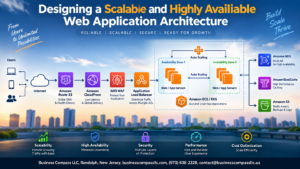
Auto Scaling Groups automatically adjust EC2 capacity based on demand patterns, ensuring applications maintain performance during traffic spikes while minimizing costs during low-usage periods. This capability proves invaluable for enterprise workloads with unpredictable or seasonal traffic patterns.
AWS Batch handles compute-intensive workloads like data analytics, machine learning training, and scientific computing. It automatically provisions optimal compute resources and manages job queues, allowing teams to focus on core business logic rather than infrastructure management.
Storage Solutions for Data Migration and Management
Amazon S3 serves as the foundation for enterprise data storage strategies, offering multiple storage classes optimized for different access patterns and cost requirements. S3 Standard provides immediate access for frequently used data, while S3 Intelligent-Tiering automatically moves objects between access tiers based on usage patterns, optimizing costs without performance impact.
For long-term archival needs, S3 Glacier and S3 Glacier Deep Archive deliver cost-effective solutions for data that requires infrequent access. These services integrate with lifecycle policies that automatically transition aging data to more economical storage tiers.
Amazon EBS (Elastic Block Store) provides persistent block storage for EC2 instances with multiple volume types tailored to specific performance needs. GP3 volumes offer balanced price and performance for most workloads, while IO1 and IO2 volumes deliver high IOPS for database and mission-critical applications. EBS snapshots enable point-in-time backups and cross-region data replication for disaster recovery.
Amazon EFS (Elastic File System) creates shared file storage accessible across multiple EC2 instances simultaneously. This fully managed NFS service scales automatically and supports concurrent access patterns common in enterprise applications.
AWS Storage Gateway bridges on-premise environments with cloud storage through file, volume, and tape gateway configurations. This hybrid approach allows gradual migration strategies where sensitive data remains on-premise while leveraging cloud storage benefits for backup and archival purposes.
Networking Configurations for Secure Connectivity
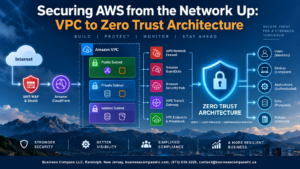
Amazon VPC (Virtual Private Cloud) creates isolated network environments within AWS, providing complete control over IP address ranges, subnets, route tables, and network gateways. Custom VPC configurations enable network segmentation strategies that align with enterprise security policies and compliance requirements.
AWS Direct Connect establishes dedicated network connections between on-premise data centers and AWS, bypassing public internet routing for consistent network performance and enhanced security. Direct Connect proves essential for applications requiring predictable bandwidth or handling sensitive data that cannot traverse public networks.
VPC Peering connects multiple VPCs within the same or different AWS accounts, enabling secure communication between isolated network environments. This capability supports multi-tier applications distributed across separate VPCs or facilitates secure data sharing between different business units.
AWS Transit Gateway simplifies complex network topologies by acting as a central hub for VPC and on-premise network connections. Rather than managing numerous point-to-point connections, Transit Gateway provides a star topology that scales efficiently as network requirements grow.
Network Access Control Lists (NACLs) and Security Groups create layered security controls at subnet and instance levels respectively. NACLs function as stateless firewalls controlling traffic at subnet boundaries, while Security Groups provide stateful filtering for individual instances or groups of instances.
AWS PrivateLink enables secure access to AWS services and third-party applications without exposing traffic to the public internet. This service creates private endpoints within VPCs, ensuring sensitive communications remain within AWS backbone infrastructure.
Database Migration Options and Managed Services
AWS Database Migration Service (DMS) facilitates seamless database migrations with minimal downtime, supporting homogeneous migrations (Oracle to Oracle) and heterogeneous migrations (Oracle to PostgreSQL). DMS handles ongoing replication during migration phases, allowing applications to continue operating while data transfers complete.
Amazon RDS provides managed relational database services for MySQL, PostgreSQL, MariaDB, Oracle, and SQL Server. RDS eliminates database administration overhead through automated backups, software patching, monitoring, and scaling capabilities. Multi-AZ deployments ensure high availability through automatic failover to standby instances.
Amazon Aurora delivers MySQL and PostgreSQL-compatible databases designed for cloud-native performance. Aurora’s distributed architecture provides up to five times better performance than standard MySQL and three times better than PostgreSQL, while maintaining full compatibility with existing applications.
For NoSQL workloads, Amazon DynamoDB offers single-digit millisecond performance at any scale with automatic scaling and built-in security features. DynamoDB Global Tables provide multi-region replication for applications requiring global data distribution.
Amazon ElastiCache accelerates application performance through managed Redis and Memcached services. ElastiCache reduces database load by caching frequently accessed data in memory, significantly improving response times for read-heavy workloads.
AWS Database Migration Service Schema Conversion Tool automatically converts database schemas and stored procedures between different database engines, reducing manual effort during heterogeneous migrations. The tool identifies potential compatibility issues and provides recommendations for optimal migration strategies.
Implementing Robust Security and Compliance Frameworks

Identity and Access Management Best Practices
Building a solid identity and access management foundation starts with implementing AWS Identity and Access Manager (IAM) policies that follow the principle of least privilege. Create granular policies that grant users only the permissions they absolutely need for their specific roles. Multi-factor authentication becomes non-negotiable for all administrative accounts and privileged users accessing critical AWS resources.
Role-based access control streamlines permission management across your enterprise cloud migration. Define clear job functions and create corresponding IAM roles rather than assigning permissions directly to individual users. This approach simplifies user lifecycle management when employees change roles or leave the organization.
Single sign-on integration connects your existing enterprise directory services with AWS through services like AWS SSO or third-party solutions. This maintains familiar user experiences while centralizing authentication controls. Regular access reviews help identify and remove orphaned accounts or excessive permissions that accumulate over time.
Consider implementing AWS Organizations to manage multiple AWS accounts across your enterprise. Service control policies provide guardrails that prevent accidental or unauthorized resource deployments across all organizational units.
Data Encryption in Transit and at Rest
AWS provides multiple encryption options that protect your enterprise data throughout its lifecycle. Enable encryption at rest for all storage services including Amazon S3, EBS volumes, and RDS databases. AWS Key Management Service (KMS) centralizes encryption key management with hardware security modules protecting your keys.
Transport layer security protects data moving between services and external connections. Configure SSL/TLS certificates through AWS Certificate Manager for web applications and API endpoints. VPC endpoints allow private communication between AWS services without traversing the public internet.
Client-side encryption adds another layer of protection by encrypting data before it reaches AWS services. This approach ensures that even AWS personnel cannot access your sensitive information. Implement field-level encryption for highly sensitive data elements within your applications.
Database encryption requires careful planning during your AWS migration strategy. Most AWS database services support transparent data encryption that encrypts entire databases without application changes. Column-level encryption protects specific sensitive fields like personally identifiable information.
Network Security Controls and Monitoring
Virtual Private Cloud (VPC) configuration forms the foundation of your AWS cloud architecture security. Design network segments that isolate different application tiers and environments. Private subnets keep sensitive resources away from internet access while public subnets handle web-facing components.
Security groups act as virtual firewalls controlling traffic at the instance level. Create restrictive inbound rules that only allow necessary ports and protocols from specific sources. Network Access Control Lists provide subnet-level filtering for additional defense layers.
AWS WAF protects web applications from common attacks like SQL injection and cross-site scripting. Configure custom rules that match your application’s specific security requirements. CloudFront integration extends protection to globally distributed content delivery.
VPC Flow Logs capture network traffic metadata for security analysis and compliance auditing. Amazon GuardDuty analyzes these logs using machine learning to detect suspicious activities and potential threats. Set up automated responses to common security events through Lambda functions and SNS notifications.
Network monitoring extends beyond basic connectivity checks. Implement distributed tracing with AWS X-Ray to understand application performance and identify potential security bottlenecks. CloudWatch custom metrics track security-relevant events specific to your enterprise applications.
Compliance Automation for Regulatory Requirements
AWS Config continuously monitors your cloud infrastructure configuration against compliance benchmarks. Enable rules that automatically detect deviations from security baselines and industry standards like SOC 2, HIPAA, or PCI DSS. Automated remediation scripts fix common compliance violations without manual intervention.
AWS CloudTrail creates comprehensive audit logs of all API calls across your AWS environment. Configure log file validation and tamper detection to meet regulatory requirements for data integrity. Cross-region log replication ensures audit trail availability during disaster recovery scenarios.
Compliance reporting automation saves significant time during audit preparations. AWS Security Hub aggregates security findings from multiple sources into standardized formats that auditors expect. Custom compliance dashboards show real-time status across all regulatory requirements relevant to your enterprise cloud transformation.
AWS Systems Manager automates patch management and configuration compliance across EC2 instances. Maintenance windows ensure patches deploy during approved timeframes while automated rollback capabilities handle failed updates. Document everything through runbooks that demonstrate consistent operational procedures to auditors.
Artifact provides self-service access to AWS compliance documentation and certifications. Download reports that demonstrate AWS infrastructure compliance with various regulatory frameworks. This documentation supports your enterprise migration strategy by showing inherited controls from the AWS shared responsibility model.
Monitoring Performance and Optimizing Cloud Operations
CloudWatch implementation for comprehensive visibility
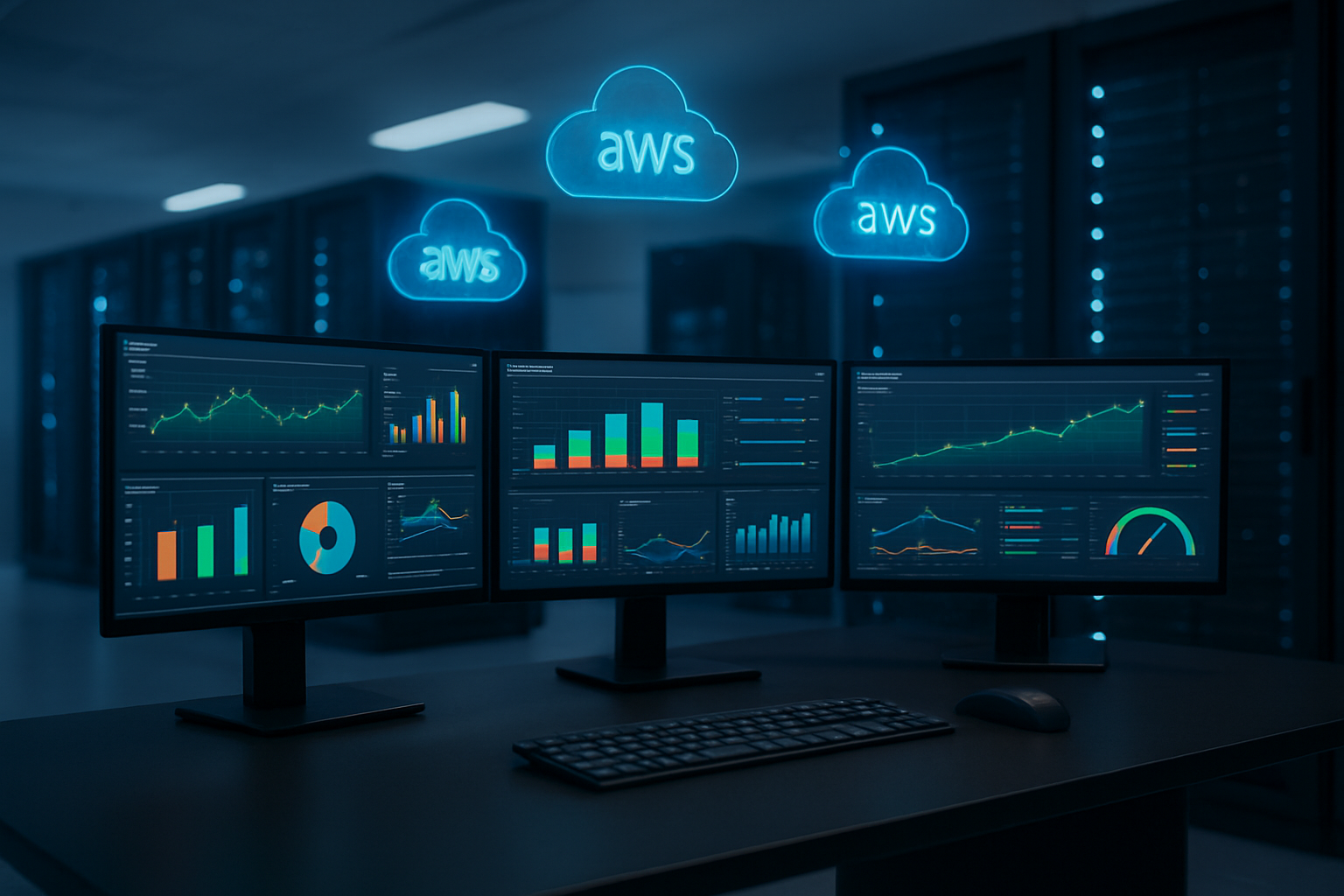
CloudWatch serves as the central nervous system for monitoring your AWS migration success. After moving from on-premise to cloud infrastructure, you need real-time insights into how your applications and systems are performing. CloudWatch collects metrics, logs, and events from virtually every AWS service, giving you a unified view of your entire cloud environment.
Setting up CloudWatch dashboards becomes your first line of defense against performance issues. Create custom dashboards that display key performance indicators specific to your enterprise needs – CPU utilization, memory consumption, network throughput, and application response times. These visual representations help your team quickly spot trends and identify potential problems before they impact your business operations.
CloudWatch alarms act as your early warning system. Configure thresholds for critical metrics like database connection counts, queue lengths, or error rates. When these thresholds are breached, CloudWatch can automatically trigger notifications via SNS, send emails to your operations team, or even initiate automated remediation actions through Lambda functions.
The CloudWatch Logs feature centralizes log management across your AWS migration. Instead of logging into individual servers to check log files, all your application logs, system logs, and AWS service logs flow into CloudWatch Logs. You can search, filter, and analyze logs in real-time, making troubleshooting faster and more efficient.
CloudWatch Insights takes log analysis to the next level with its query language that lets you dig deep into your log data. Run complex queries to identify patterns, track user behavior, or investigate security incidents across your entire AWS cloud architecture.
Cost management tools and optimization strategies
Cost optimization becomes critical once your enterprise migration to AWS is complete. The pay-as-you-go model offers flexibility, but without proper monitoring, costs can spiral quickly. AWS provides several tools to help you track, analyze, and optimize your cloud spending.
AWS Cost Explorer gives you detailed visibility into your spending patterns. Break down costs by service, region, or custom tags to understand where your money is going. The tool’s forecasting capabilities help you predict future costs based on historical usage patterns, making budget planning more accurate for your cloud migration planning.
AWS Budgets lets you set custom spending limits and receive alerts when you’re approaching those thresholds. Create budgets for different departments, projects, or environments within your enterprise cloud transformation. When costs exceed predefined limits, the system can automatically trigger cost-saving actions like shutting down non-production environments or scaling down resources.
Right-sizing your resources saves significant money without impacting performance. Use AWS Compute Optimizer to analyze your EC2 instances, EBS volumes, and Lambda functions. The service provides recommendations based on actual usage patterns, helping you identify oversized instances that can be downsized or underutilized resources that can be consolidated.
Reserved Instances and Savings Plans offer substantial discounts for predictable workloads. Analyze your usage patterns to identify stable workloads that run consistently throughout the year. Committing to Reserved Instances for these workloads can reduce costs by up to 75% compared to on-demand pricing.
Spot Instances provide another cost-saving opportunity for fault-tolerant workloads. These instances can be up to 90% cheaper than on-demand instances, making them perfect for batch processing, data analysis, or development environments where interruptions are acceptable.
Automated scaling policies for resource efficiency
Auto Scaling transforms how your AWS enterprise solutions handle varying workloads. Instead of manually adding or removing resources, automated scaling policies adjust your infrastructure based on real-time demand. This approach ensures optimal performance while minimizing costs.
EC2 Auto Scaling groups maintain the right number of instances for your applications. Define minimum, maximum, and desired capacity settings based on your performance requirements. When demand increases, new instances launch automatically. When demand decreases, excess instances terminate, reducing costs immediately.
Target tracking scaling policies simplify the configuration process. Set a target value for a specific metric like average CPU utilization or request count per target. Auto Scaling automatically adjusts the number of instances to maintain that target value, handling the complex calculations behind the scenes.
Step scaling policies provide more granular control over scaling actions. Define multiple scaling steps based on how far the current metric value deviates from the threshold. For example, add one instance if CPU utilization exceeds 70%, but add three instances if it exceeds 90%. This approach prevents overreaction to temporary spikes while ensuring adequate response to sustained high demand.
Predictive scaling analyzes historical patterns to forecast future demand and pre-scale resources accordingly. This feature works particularly well for applications with predictable daily or weekly traffic patterns, ensuring resources are available before demand peaks occur.
Application Load Balancer integration with Auto Scaling creates a powerful combination for handling traffic distribution. The load balancer automatically registers new instances as they launch and removes unhealthy instances from the rotation, maintaining high availability throughout scaling events.
Cross-zone scaling policies ensure even distribution of instances across multiple Availability Zones, improving fault tolerance while maintaining optimal performance. This approach protects your applications from single zone failures while supporting your overall AWS migration strategy for enterprise resilience.

Moving your enterprise from on-premise infrastructure to AWS isn’t just about keeping up with technology trends—it’s about unlocking real business value. Companies that take the time to properly assess their current systems, choose the right migration approach, and leverage AWS’s powerful services see significant improvements in scalability, cost efficiency, and operational flexibility. The key lies in treating this as a strategic transformation rather than a simple lift-and-shift operation.
Success in AWS migration comes down to preparation and execution. Start with a thorough assessment of your current environment, pick a migration strategy that fits your business goals, and don’t overlook the importance of security and monitoring from day one. The cloud offers incredible opportunities for innovation and growth, but only when you build on a solid foundation. Take the first step by evaluating where your organization stands today and mapping out a clear path to your cloud future.