Moving your business from on-premise infrastructure to AWS can transform your operations, but the journey requires careful planning and execution. This comprehensive guide walks IT leaders, cloud architects, and enterprise decision-makers through a proven on-premise to AWS migration strategy that minimizes downtime and maximizes success.
Amazon EC2 migration and Amazon RDS database migration form the backbone of most enterprise moves to the cloud. Getting these core components right sets the foundation for everything else. The right AWS cloud migration strategy can reduce costs, improve scalability, and boost your team’s productivity.
We’ll dive deep into the pre-migration assessment process that identifies what you’re working with and maps out potential roadblocks before they become expensive problems. You’ll learn how to design a database migration strategy with Amazon RDS that keeps your data safe while moving it efficiently to the cloud. Finally, we’ll cover the network configuration and connectivity setup that ensures your applications can communicate properly in their new AWS environment.
By the end of this guide, you’ll have a clear roadmap for your enterprise cloud migration that your team can execute with confidence.
Pre-Migration Assessment and Planning
Inventory Your Current On-Premises Infrastructure
Start by cataloging every component of your existing infrastructure. Document servers, storage systems, network equipment, operating systems, and software versions. Create a detailed spreadsheet listing hardware specifications, performance metrics, and current utilization rates. This comprehensive AWS migration planning foundation helps identify which workloads are ready for Amazon EC2 migration and which systems need updates before moving to the cloud.
Assess Application Dependencies and Database Relationships
Map out how your applications connect and communicate with each other. Identify database relationships, API calls, file sharing protocols, and authentication systems. Understanding these interdependencies prevents breaking critical connections during your on-premise to AWS migration. Pay special attention to legacy applications that might require specific database versions or custom configurations when planning your Amazon RDS database migration strategy.
Evaluate Network Architecture and Security Requirements
Review your current network setup, including firewalls, VPNs, load balancers, and security policies. Document compliance requirements, data classification levels, and access controls that must be maintained in AWS. Consider bandwidth needs, latency requirements, and disaster recovery expectations. This analysis shapes your AWS infrastructure migration approach and helps design the right network architecture using AWS security services and connectivity options.
Calculate Total Cost of Ownership for AWS Migration
Compare your current on-premises costs against projected AWS expenses. Include hardware depreciation, maintenance contracts, power consumption, cooling, facility costs, and IT staff time in your calculations. Factor in AWS instance types, storage costs, data transfer fees, and potential Reserved Instance savings. This cloud migration best practices approach ensures your enterprise cloud migration delivers expected financial benefits and helps secure stakeholder buy-in for the project.
Choosing the Right AWS Services for Your Migration
Select Appropriate EC2 Instance Types for Your Workloads
Picking the right EC2 instance types can make or break your AWS cloud migration strategy. Start by analyzing your current CPU, memory, and storage requirements from your on-premise infrastructure. CPU-intensive applications work best with compute-optimized instances like C5 or C6i, while memory-heavy databases benefit from R5 or R6i instances. For general workloads, M5 or M6i instances offer balanced performance. Don’t forget about storage – applications requiring high IOPS need EBS-optimized instances. Consider burstable instances like T3 or T4g for variable workloads to optimize costs. Review your network bandwidth needs since some instances offer enhanced networking capabilities. Always match instance families to your specific workload patterns rather than simply replicating your existing hardware specs.
Determine Optimal RDS Engine and Configuration Options
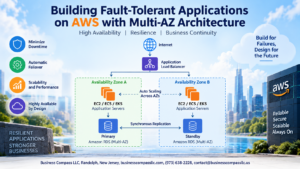
Your Amazon RDS database migration success depends on selecting the right engine and configuration. If you’re running SQL Server on-premises, RDS SQL Server maintains compatibility while offering managed benefits. PostgreSQL and MySQL workloads can migrate directly to their RDS counterparts. Oracle databases should evaluate RDS Oracle licensing costs versus migrating to PostgreSQL. Multi-AZ deployments provide high availability for production workloads, while read replicas help with read-heavy applications. Choose between General Purpose SSD for balanced workloads or Provisioned IOPS for consistent performance requirements. Backup retention settings should align with your compliance needs. Consider RDS Proxy for connection pooling if you have applications with many database connections. Size your instances based on current peak usage, not average usage patterns.
Plan VPC Architecture and Security Groups
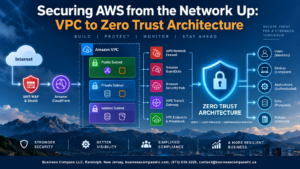
Designing your VPC architecture correctly from the start prevents major headaches during your AWS infrastructure migration. Create separate subnets for different tiers – public subnets for load balancers, private subnets for application servers, and isolated subnets for databases. Plan your CIDR blocks carefully to avoid IP conflicts with your existing on-premise networks. Security groups act as virtual firewalls, so create specific rules for each application tier instead of using broad permissions. Database security groups should only allow access from application server security groups, never from the internet. Set up Network ACLs as an additional security layer for subnet-level filtering. Plan for hybrid connectivity using VPN or Direct Connect to maintain communication with your remaining on-premise systems during the migration process.
Database Migration Strategy with Amazon RDS
Backup and Export On-Premises Database Systems
Creating comprehensive backups represents the foundation of successful Amazon RDS database migration. Export your production databases using native tools like mysqldump for MySQL, pg_dump for PostgreSQL, or SQL Server Management Studio for SQL Server. Schedule backups during low-traffic periods to minimize performance impact on running applications. Store backup files in secure, accessible locations with proper encryption and verify backup integrity before proceeding with the AWS migration process.
Create and Configure Target RDS Instances
Launch RDS instances that match or exceed your on-premises database specifications for optimal performance. Select appropriate instance types based on CPU, memory, and storage requirements identified during pre-migration assessment. Configure Multi-AZ deployments for high availability, automated backups, and maintenance windows that align with your business operations. Set up security groups, parameter groups, and subnet groups to ensure proper network isolation and database performance tuning for your AWS infrastructure migration.
Implement Database Migration Service for Seamless Transfer
AWS Database Migration Service streamlines the migration process by providing real-time data replication with minimal downtime. Create migration tasks that support both homogeneous and heterogeneous database transfers while maintaining data consistency. Configure source and target endpoints with proper SSL connections and network settings. Monitor migration progress through CloudWatch metrics and DMS console logs to address any replication issues promptly during your on-premise to AWS migration journey.
Validate Data Integrity and Performance Post-Migration
Execute comprehensive data validation tests comparing row counts, checksums, and data types between source and target databases. Run performance benchmarks using representative workloads to ensure RDS instances meet application requirements. Test application connectivity, query response times, and transaction throughput under various load conditions. Validate backup and recovery procedures, failover mechanisms, and monitoring alerts to confirm your Amazon RDS database migration maintains business continuity standards and cloud migration best practices.
Application Server Migration to Amazon EC2
Create Custom AMIs from On-Premises Servers
Building custom Amazon Machine Images (AMIs) from your existing on-premises servers creates the foundation for a successful Amazon EC2 migration. Start by installing the AWS CLI and VM Import/Export tools on your current servers to capture complete system configurations, including operating systems, applications, and dependencies. Use the aws ec2 import-image command to convert your VMware, Hyper-V, or KVM virtual machines into AMIs that preserve your exact server setup. Document all custom configurations, installed software packages, and security settings during this process to ensure nothing gets lost in translation. Test your custom AMIs thoroughly in a non-production AWS environment before proceeding with the full migration.
Deploy and Configure EC2 Instances with Proper Sizing
Right-sizing your EC2 instances prevents both performance bottlenecks and unnecessary costs during your AWS cloud migration strategy. Analyze your on-premises server utilization patterns using AWS Application Discovery Service or third-party monitoring tools to understand CPU, memory, storage, and network requirements. Match these requirements to appropriate EC2 instance families – choose compute-optimized instances for CPU-intensive workloads, memory-optimized for in-memory databases, or general-purpose instances for balanced workloads. Configure your instances with appropriate storage types, selecting gp3 for general purposes, io2 for high IOPS requirements, or st1 for throughput-optimized workloads. Set up proper security groups, key pairs, and IAM roles before launching instances to maintain security standards from day one.
Establish Load Balancing and Auto Scaling Groups
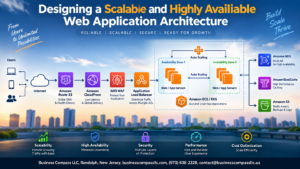
Application Load Balancers and Auto Scaling Groups provide the resilience and scalability that make Amazon EC2 migration worthwhile compared to static on-premises infrastructure. Configure Application Load Balancers to distribute incoming traffic across multiple EC2 instances, improving both performance and availability for your migrated applications. Set up health checks that monitor application-level metrics, not just instance status, to ensure traffic only reaches healthy servers. Create Auto Scaling Groups that automatically adjust instance capacity based on CloudWatch metrics like CPU utilization, request count, or custom application metrics. Define scaling policies that gradually add or remove instances to handle traffic spikes without overwhelming your application or incurring sudden cost increases. Configure your Auto Scaling Groups across multiple Availability Zones to protect against single-zone failures and meet enterprise cloud migration requirements for high availability.
Network Configuration and Connectivity Setup
Configure VPC Peering and Direct Connect Options
Setting up secure network connectivity between your on-premise infrastructure and AWS requires careful planning of your Virtual Private Cloud architecture. VPC peering creates direct connections between multiple VPCs, allowing resources to communicate privately across different regions or accounts during your AWS cloud migration strategy. Direct Connect provides dedicated network connections that bypass the public internet, offering consistent bandwidth and lower latency for enterprise cloud migration scenarios. Consider bandwidth requirements, security policies, and cost implications when choosing between these connectivity options for your AWS infrastructure migration.
Implement Security Groups and Network ACLs
Network security forms the backbone of any successful on-premise to AWS migration. Security groups act as virtual firewalls controlling inbound and outbound traffic at the instance level, while Network ACLs provide subnet-level protection with stateless filtering rules. Configure security groups to allow only necessary ports and protocols, following the principle of least privilege. Network ACLs serve as an additional layer of defense, offering numbered rules that process traffic in order. Document all security configurations thoroughly and establish clear naming conventions to maintain consistency across your migrated infrastructure.
Set Up DNS Resolution and Route 53 Integration
DNS configuration plays a critical role in ensuring seamless connectivity during your AWS migration services implementation. Route 53 provides scalable DNS management with features like health checks, traffic routing policies, and integration with other AWS services. Configure private hosted zones for internal resource resolution and public zones for external-facing applications. Implement DNS forwarding rules to handle hybrid scenarios where some resources remain on-premise during the migration phase. Consider using weighted routing policies to gradually shift traffic between old and new environments during your cloud migration best practices implementation.
Establish VPN Connections for Hybrid Operations
VPN connections enable secure communication between your on-premise environment and AWS during the migration process and ongoing hybrid operations. Site-to-site VPN connections create encrypted tunnels over the internet, providing cost-effective connectivity for smaller workloads. Configure redundant VPN tunnels across multiple availability zones to ensure high availability. Client VPN services support remote user access to AWS resources, essential for distributed teams managing the migration process. Monitor VPN performance metrics and adjust configurations based on throughput requirements and security compliance needs throughout your on-prem to cloud migration guide implementation.
Testing and Validation of Migrated Infrastructure
Conduct Performance Benchmarking Against On-Premises Baseline
Performance benchmarking establishes critical metrics for comparing your AWS cloud migration success against existing on-premises infrastructure. Document baseline performance data including CPU utilization, memory consumption, disk I/O rates, and network throughput before migration begins. Run identical workloads on both Amazon EC2 instances and your original servers using tools like AWS CloudWatch and third-party monitoring solutions. This comparison reveals whether your AWS migration strategy delivers expected performance improvements or identifies areas requiring optimization. Focus on peak usage periods and stress testing scenarios to ensure your migrated infrastructure handles production workloads effectively.
Execute End-to-End Application Testing Scenarios
Comprehensive application testing validates that your entire software stack functions correctly after AWS infrastructure migration. Create test scenarios covering user authentication, data processing workflows, API integrations, and business-critical transactions. Test applications under various load conditions to identify potential bottlenecks or configuration issues specific to Amazon EC2 environments. Include disaster recovery testing, failover mechanisms, and auto-scaling behavior verification. Document any performance discrepancies or functional issues discovered during testing phases. This systematic approach ensures your on-premise to AWS migration maintains application reliability and user experience standards.
Verify Database Connectivity and Transaction Processing
Database connectivity verification confirms that applications communicate seamlessly with Amazon RDS instances after migration. Test connection pooling, query performance, and transaction rollback capabilities across different application scenarios. Validate that database replication, backup procedures, and security configurations work as expected in the AWS environment. Run database-intensive operations to ensure Amazon RDS handles concurrent connections and complex queries without degradation. Check that database migration preserved data integrity and maintained referential relationships between tables. This validation step prevents data corruption issues and ensures business continuity during your enterprise cloud migration process.
Cutover Execution and Go-Live Strategy
Schedule Maintenance Windows for Minimal Business Impact
Plan cutover activities during low-traffic periods, typically weekends or after business hours. Coordinate with stakeholders across departments to secure approval for downtime windows. Create detailed timelines with specific start and end times for each migration phase. Communicate scheduled maintenance windows to all users at least 72 hours in advance through multiple channels including email, internal portals, and team meetings.
Execute Final Data Synchronization and DNS Updates
Perform the last database synchronization between on-premises systems and Amazon RDS to capture any remaining transactions. Stop write operations on source systems to prevent data inconsistencies. Update DNS records to redirect traffic from on-premise servers to new Amazon EC2 instances. Verify database integrity through checksum validation and row counts. Configure load balancers and update application connection strings to point to the new AWS infrastructure components.
Monitor System Performance During Initial Production Phase
Deploy comprehensive monitoring tools including Amazon CloudWatch and application performance monitoring solutions. Track key metrics such as CPU utilization, memory consumption, database response times, and network latency. Set up automated alerts for critical thresholds to enable rapid response to performance issues. Monitor user experience metrics and transaction success rates during the first 24-48 hours. Establish escalation procedures for performance degradation and maintain dedicated support teams for immediate issue resolution.
Implement Rollback Procedures for Critical Issues
Design clear rollback procedures before starting the migration cutover process. Keep on-premise systems in standby mode for quick restoration if critical issues emerge. Document step-by-step rollback instructions including database restoration, DNS reversion, and application server startup sequences. Define specific criteria that trigger rollback decisions such as system unavailability exceeding defined thresholds or data corruption detection. Test rollback procedures during pre-production phases and ensure backup teams understand execution protocols for emergency scenarios.
Post-Migration Optimization and Cost Management
Right-Size EC2 Instances Based on Actual Usage Patterns
After your AWS migration completes, analyzing real-world performance data becomes essential for cost optimization. CloudWatch metrics reveal CPU utilization, memory consumption, and network patterns that guide instance rightsizing decisions. Many organizations discover they’ve over-provisioned resources during initial migration, leading to 30-40% cost savings through strategic downsizing. Monitor workloads for at least two weeks to capture peak and baseline usage patterns. Consider Reserved Instances or Savings Plans for consistent workloads, while using Spot Instances for fault-tolerant applications. AWS Compute Optimizer provides automated recommendations based on your actual usage data, identifying opportunities to switch instance families or sizes for better price-performance ratios.
Optimize RDS Storage and Backup Configurations
Amazon RDS storage optimization directly impacts your monthly AWS bills and database performance. Start by reviewing storage metrics to identify over-allocated space and switch from General Purpose (gp2) to gp3 volumes for better cost-per-IOPS ratios. Enable storage autoscaling to prevent manual intervention while controlling maximum limits. Backup retention policies often default to seven days, but business requirements may allow shorter periods for development environments. Cross-region backup replication adds significant costs, so evaluate whether local snapshots meet your disaster recovery needs. Consider Amazon RDS Proxy for connection pooling to reduce database load and enable smaller instance sizes. Regular maintenance windows help apply patches and optimize query performance automatically.
Implement CloudWatch Monitoring and Automated Alerts
Proactive monitoring prevents performance issues and identifies cost optimization opportunities across your migrated infrastructure. Set up CloudWatch dashboards to track key metrics like EC2 CPU utilization, RDS connection counts, and storage consumption trends. Create custom alarms for unusual spending patterns, idle resources, and performance thresholds that trigger automated responses. SNS notifications keep your team informed about critical events without constant manual monitoring. CloudWatch Logs centralize application and system logs for troubleshooting and compliance requirements. Use CloudWatch Events to trigger Lambda functions that automatically stop development instances outside business hours. AWS Cost and Usage Reports integrated with CloudWatch provide granular spending analysis and budget alerts to prevent unexpected charges from impacting your cloud migration strategy.
Moving from on-premises infrastructure to AWS doesn’t have to be overwhelming when you break it down into clear, manageable steps. By taking time to properly assess your current setup, choosing the right AWS services like EC2 and RDS, and following a structured migration approach, you can make the transition smooth and successful. The key is thorough planning, careful testing, and having a solid rollback plan ready just in case things don’t go as expected.
Once you’ve made the move, don’t forget that migration is just the beginning. Keep an eye on your costs, fine-tune your resources, and take advantage of AWS’s built-in tools to optimize performance. The cloud offers incredible flexibility and scalability that your old on-premises setup simply couldn’t match. Start planning your migration strategy today, and remember that AWS provides plenty of resources and support to help you every step of the way.