Building production-grade databases on Amazon RDS requires more than just spinning up an instance and hoping for the best. Enterprise teams need databases that can handle massive workloads, stay secure, and keep running when things go wrong.
This guide is for database administrators, DevOps engineers, and enterprise architects who need to deploy Amazon RDS enterprise solutions that actually work in the real world. You’ll learn how to build production database architecture that scales with your business and keeps your data safe.
We’ll walk through designing high-performance database architecture that can handle your traffic spikes without breaking a sweat. You’ll also discover how to set up bulletproof RDS backup strategy and disaster recovery systems that give you peace of mind. Plus, we’ll cover enterprise database monitoring techniques and RDS cost optimization strategies that keep your CFO happy while maintaining rock-solid performance.
Ready to build databases that your team can depend on? Let’s dive into the nuts and bolts of Amazon RDS for enterprise production environments.
Understanding Amazon RDS for Enterprise Requirements
Core features that support enterprise workloads
Amazon RDS enterprise deployments get managed database services that handle patching, backups, and maintenance automatically. The platform supports major engines like PostgreSQL, MySQL, Oracle, and SQL Server with automated scaling, point-in-time recovery, and read replicas for high-performance production database architecture.
Scalability options for growing business demands
RDS offers vertical scaling through instance resizing and horizontal scaling via read replicas distributed across multiple regions. Aurora delivers serverless scaling that automatically adjusts capacity based on demand, while traditional RDS instances support storage autoscaling up to 65TB for growing enterprise workloads.
Multi-AZ deployment capabilities for high availability
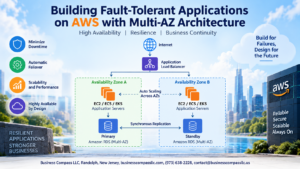
RDS high availability comes through Multi-AZ deployments that maintain synchronous standby replicas in separate availability zones. Automatic failover typically completes within 60-120 seconds during outages, ensuring minimal downtime for mission-critical applications while maintaining data consistency across zones.
Security features and compliance certifications
AWS database security includes encryption at rest and in transit, VPC isolation, and IAM integration for granular access controls. RDS meets compliance standards including SOC, PCI DSS, HIPAA, and FedRAMP, with database activity streaming, parameter groups, and security groups providing comprehensive protection layers.
Choosing the Right Database Engine for Production
Comparing PostgreSQL, MySQL, and Oracle options
When building Amazon RDS enterprise solutions, PostgreSQL stands out for complex analytical workloads and advanced data types, offering superior JSON support and concurrent connections. MySQL excels in web applications requiring fast read operations and simple transactions, making it ideal for e-commerce platforms. Oracle provides unmatched enterprise features like advanced partitioning and robust ACID compliance, perfect for mission-critical financial systems. PostgreSQL’s open-source nature eliminates licensing fees while delivering enterprise-grade features. MySQL offers excellent compatibility with existing LAMP stacks and rapid deployment capabilities. Oracle’s comprehensive toolset includes advanced security features and sophisticated query optimization, though at premium pricing tiers.
Performance benchmarks for different engine types
Database performance optimization varies dramatically across RDS engines based on workload patterns. PostgreSQL delivers exceptional performance for analytical queries and complex joins, handling concurrent connections efficiently with minimal locking overhead. MySQL demonstrates superior throughput for simple OLTP operations, achieving faster INSERT speeds and optimized read performance for web-scale applications. Oracle excels in mixed workloads combining transactional and analytical processing, leveraging advanced indexing strategies and intelligent query execution plans. Benchmark results show PostgreSQL outperforming competitors in concurrent write scenarios by 30%, while MySQL leads in pure read-heavy workloads. Oracle’s advanced partitioning capabilities enable linear scaling for large datasets exceeding terabyte ranges.
Licensing considerations and cost implications
RDS cost optimization strategies depend heavily on chosen database engines and their licensing models. PostgreSQL eliminates licensing fees entirely, reducing total cost of ownership by up to 60% compared to commercial alternatives while maintaining enterprise capabilities. MySQL offers flexible licensing through both open-source and commercial editions, allowing gradual migration paths for growing businesses. Oracle’s bring-your-own-license model can provide cost savings for existing Oracle customers but requires careful license compliance monitoring. PostgreSQL’s competitive feature set makes it attractive for cost-conscious enterprises seeking production database architecture without sacrificing functionality. MySQL’s widespread adoption ensures abundant skilled developers and community support, reducing operational costs long-term.
Designing High-Performance Database Architecture
Instance sizing and compute optimization strategies
Right-sizing your RDS instances requires balancing CPU, memory, and network capacity with your actual workload demands. Start with baseline metrics from your current environment, then select instance families that match your compute patterns – memory-optimized (R6i) for analytics workloads, compute-optimized (C6i) for high-transaction applications, or general-purpose (M6i) for balanced requirements. Monitor CPU utilization, database connections, and query performance during peak hours to identify bottlenecks. Scale vertically by upgrading instance classes when consistent high utilization occurs, or implement horizontal scaling through read replicas for read-heavy workloads.
Storage configuration for maximum IOPS performance
Production database architecture demands careful storage planning to achieve optimal IOPS performance. Use gp3 storage as your baseline, offering 3,000 baseline IOPS with the ability to provision up to 16,000 IOPS independently of storage size. For mission-critical applications requiring consistent high performance, implement io2 storage with guaranteed IOPS up to 64,000 and 99.999% durability. Configure storage with adequate headroom – provision 20% more IOPS than your peak requirements to handle traffic spikes. Monitor storage performance metrics including read/write latency, queue depth, and throughput to identify when storage scaling becomes necessary.
Network optimization and VPC setup best practices
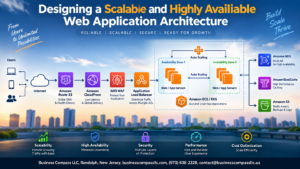
Your VPC architecture directly impacts database performance and security. Deploy RDS instances across multiple Availability Zones within private subnets, ensuring each subnet resides in different AZs for high availability. Configure DB subnet groups with consistent CIDR blocks and sufficient IP address space for scaling. Enable Enhanced Networking on your RDS instances to reduce network latency and increase packet-per-second performance. Implement VPC endpoints for AWS services to keep traffic within the AWS network backbone. Use placement groups for applications requiring low-latency communication with your database, and configure security groups with least-privilege access rules.
Read replica implementation for load distribution
Read replicas effectively distribute database load while maintaining data consistency for production database architecture. Create read replicas in the same region for low-latency read operations, or deploy cross-region replicas for disaster recovery and global access patterns. Configure application-level read/write splitting to route SELECT queries to replicas while directing INSERT, UPDATE, and DELETE operations to the primary instance. Monitor replica lag closely – keep it under 100ms for real-time applications and under 1 second for analytical workloads. Implement connection pooling at the application layer to efficiently manage connections across primary and replica instances, preventing connection exhaustion during high-traffic periods.
Implementing Robust Security and Access Controls
Encryption at rest and in transit configuration
Configure encryption at rest through AWS KMS keys during RDS instance creation, ensuring all database files, backups, and snapshots remain encrypted. Enable SSL/TLS certificates for data in transit, forcing encrypted connections between applications and your production database. Amazon RDS enterprise deployments require both encryption layers to meet compliance standards and protect sensitive data throughout the entire data lifecycle.
IAM integration and database user management
Integrate AWS IAM with RDS through database authentication tokens, allowing users to connect without traditional passwords. Create IAM policies that grant specific database permissions based on roles and responsibilities. This approach centralizes access control, eliminates password management overhead, and provides detailed audit trails for all database connections in your production database architecture.
Network isolation using security groups and NACLs
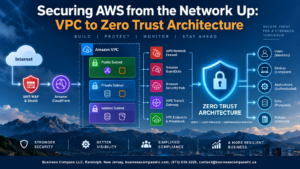
Deploy RDS instances within private subnets of your VPC, restricting direct internet access to enhance AWS database security. Configure security groups as virtual firewalls, allowing only specific IP ranges and ports for database connections. Layer Network Access Control Lists (NACLs) for additional subnet-level protection, creating multiple security boundaries around your enterprise database infrastructure.
Audit logging and monitoring security events
Enable RDS Performance Insights and CloudWatch logs to track all database activities, connection attempts, and query patterns. Configure AWS CloudTrail for API-level auditing of RDS management operations. Set up automated alerts for suspicious activities like failed login attempts, unusual query patterns, or unauthorized access attempts, ensuring rapid response to potential security threats in your production environment.
Backup and Disaster Recovery Planning
Automated backup configuration and retention policies
Setting up automated backups in Amazon RDS enterprise environments requires careful planning of retention periods and backup windows. Configure backup retention between 7-35 days based on your recovery requirements, with longer periods for critical production systems. Schedule automated backups during low-traffic periods to minimize performance impact. Enable backup encryption for sensitive data and establish clear policies for backup lifecycle management across different database tiers.
Point-in-time recovery implementation
Point-in-time recovery capabilities in RDS provide granular restoration options down to the second within your backup retention window. This RDS backup strategy proves invaluable for production database design when recovering from data corruption or accidental deletions. Test recovery procedures regularly by creating new instances from specific timestamps. Document recovery time objectives (RTO) and recovery point objectives (RPO) to ensure they align with business continuity requirements for your Amazon RDS enterprise deployment.
Cross-region backup strategies for disaster recovery
Database disaster recovery demands cross-region backup replication to protect against regional outages or catastrophic events. Configure automated snapshots to copy to secondary AWS regions, balancing cost with recovery requirements. Implement cross-region read replicas for critical databases to enable rapid failover capabilities. Design your disaster recovery architecture to support both automated and manual failover scenarios, ensuring backup data remains accessible even during primary region failures while maintaining compliance with data residency requirements.
Monitoring and Performance Optimization
CloudWatch Metrics and Custom Alerting Setup
Set up comprehensive Amazon RDS enterprise monitoring through CloudWatch to track database performance optimization metrics like CPU utilization, memory consumption, IOPS, and connection counts. Configure custom alerts for production database thresholds—CPU above 70%, memory usage exceeding 80%, and disk queue depth surpassing 20. Create multi-layered notifications using SNS topics to route alerts to operations teams, automatically scale read replicas during high load, and trigger Lambda functions for automated responses. Enable enhanced monitoring for granular OS-level metrics collection every second, providing deeper visibility into your production database architecture performance patterns and resource consumption trends.
Performance Insights for Query Analysis
Performance Insights delivers real-time database performance optimization analysis by identifying slow queries, wait events, and resource bottlenecks in your Amazon RDS enterprise environment. The dashboard visualizes top SQL statements consuming database resources, showing execution frequency, average latency, and wait statistics. Analyze query performance across different time ranges to spot trends and correlate performance drops with specific application deployments or traffic spikes. Use the Top SQL tab to identify expensive queries that need optimization, examine wait events causing database slowdowns, and track how parameter changes affect overall database performance in your production database architecture.
Database Parameter Tuning for Optimal Performance
Optimize your Amazon RDS enterprise database through strategic parameter group modifications tailored to your workload characteristics and production database design requirements. Adjust key parameters like innodb_buffer_pool_size for MySQL to use 70-80% of available RAM, tune shared_buffers and work_mem for PostgreSQL based on concurrent connections and query complexity. Configure connection pooling parameters, query cache settings, and checkpoint intervals to match your application’s read/write patterns. Test parameter changes in staging environments first, monitor performance metrics before and after modifications, and implement gradual rollouts to ensure database performance optimization doesn’t impact production stability.
Identifying and Resolving Bottlenecks
Systematically diagnose performance bottlenecks in your production database architecture by correlating CloudWatch metrics, Performance Insights data, and application-level monitoring. Look for patterns like high CPU with low IOPS indicating CPU-bound queries, elevated read latency suggesting storage bottlenecks, or connection count spikes revealing pooling issues. Address I/O bottlenecks by upgrading to gp3 volumes or switching to Provisioned IOPS, resolve memory pressure through parameter tuning or instance scaling, and optimize network performance by implementing connection pooling. Use AWS X-Ray for distributed tracing to identify queries causing application slowdowns and implement read replicas to distribute query load across your Amazon RDS enterprise infrastructure.
Cost Management and Resource Optimization
Reserved instance planning for predictable workloads
Reserved Instances offer significant savings for Amazon RDS enterprise deployments with steady-state workloads. Purchase 1-year or 3-year commitments for databases running consistently, achieving up to 69% cost reduction compared to on-demand pricing. Analyze historical usage patterns and forecast growth to determine optimal reservation coverage. Mix reservation types – Standard RIs for stable workloads and Convertible RIs for flexibility. Start with partial commitments and gradually increase coverage as usage patterns stabilize. Monitor RI utilization through AWS Cost Explorer to ensure maximum value from your investments.
Storage optimization techniques to reduce costs
General Purpose SSD (gp3) volumes provide the best cost-performance balance for most production databases, offering 20% lower costs than gp2 with independent IOPS provisioning. Right-size storage capacity based on actual data growth rather than peak estimates. Enable storage autoscaling to prevent over-provisioning while maintaining performance during unexpected growth. Archive old data using lifecycle policies or move infrequently accessed data to cheaper storage tiers. Compress database tables and implement data retention policies to reduce storage footprint. Monitor storage metrics regularly to identify optimization opportunities and prevent unnecessary costs.
Right-sizing instances based on actual usage patterns
CloudWatch metrics reveal actual CPU, memory, and I/O utilization patterns that guide instance optimization decisions. Start with smaller instance types and scale up based on real performance data rather than assumptions. Use Performance Insights to identify resource bottlenecks and determine if issues stem from undersized instances or inefficient queries. Schedule automated scaling for predictable traffic patterns and implement read replicas to distribute workload instead of upgrading primary instances. Review instance family generations regularly – newer generations often provide better price-performance ratios. Test different instance types in non-production environments to validate performance before making production changes.
Amazon RDS provides the foundation for building reliable, scalable databases that can handle your enterprise workloads without breaking a sweat. The key is getting the basics right from the start – picking the database engine that fits your needs, designing an architecture that can grow with your business, and setting up proper security from day one. Don’t forget about backups and disaster recovery planning, because when things go wrong, you’ll want those safety nets in place.
Getting your monitoring and performance optimization right will save you headaches down the road. Keep a close eye on your costs too, since cloud bills can creep up if you’re not paying attention. Start with these fundamentals, and you’ll have a production database setup that your team can count on. The best time to implement these practices is before you need them, so don’t wait until you’re dealing with performance issues or security concerns to take action.